There is something special about Fridays in Israel. While Shabbat happens everywhere in the world, Friday in Israel, especially in Jerusalem, just seems different. There is a different energy, a different vibe. There is a buzz in the air, an excitment about it almost being Shabbat. It is something I don’t think I can adequately explain – it’s something you have to feel, you have to experience. This Friday was no exception, especially because it is Jerusalem. There was an energy in the air, a vibe that you can’t describe, you can only feel.
Being in Jerusalem always creates a desire for me to learn. One of my favorite teachers, Ari Ben-David joined us to explore some facinating questions. Today’s topic was “What am I?” A great and deep question. Being in Israel and in Jerusalem, we went to the Torah to explore it.
If you are like me, the image of torah study that I grew up with was boring. Reading these stories with no context and taking them literally. Over the years, I have learned that is not torah study. It’s simply reading stories. Torah study involves discussion, analysis, questioning, and debating. That’s what we did, led my friend and amazing educator, Aryeh Ben-David. Aryeh took us through Genesis chapter 1, verse 1 and half of verse 2. That’s it. All we needed to spend an hour or more discussing the deep topic, “What am I?”
He asked us to pick one line in chapter 1 and one line in chapter 2 that most answered the question. In chapter 1, we agreed on verse 26, “And God said, ‘Let us make man in our image, after our likeness.” In chapter 2, we agreed on verses 7 and 8, “the Lord God formed man from the dust of the earth. He blew into his nostrils the breath of life, and man became a human being.” So we are the image of God, have God inside us, and are dust. Simple points.
It doesn’t end there. Dust is our physical being but the image of God and having God inside us is our soul. That’s the competition we face every single day. Every single decision. Dust (physical wants and needs) vs. soul (the greater good). Dust is about the self and immediate pleasure. The soul is about all and comprises the past, present, and future. What will we choose when faced with the decision? That’s the key question that each of us answer every day with every decision. It’s not about always choosing one over the other – there are times when we need to choose dust and there are times when we need to choose the soul. It’s about being conscious of the decision. What a mind blowing realization on a Friday morning in Jerusalem? With Shabbat approaching quickly, it’s a deep thought to take to the Kotel.
I love the energy of Machane Yehuda, the shuk, especially on a Friday. I went to help bring the catered food for Shabbat dinner to our room and get everything set up before heading to the shuk. A little bit of soul work. When I got to the shuk, as usual it was packed. I wanted to get to my favorite gluten free bakery there to get a bunch of challah, challah rolls, babkah, dates and walnuts. Most I will bring home and freeze, but I wanted a challah I could eat for shabbat and dates with walnuts to snack on. It was 100% for dust, for my own wants and needs. While there, I got to buy some desserts for Shabbat dinner (parve rugalach from Marzipan) and wine for those at dinner. A little bit of soul, doing things for others, since I wasn’t eating the rugalach or drinking the wine. Torah into action.
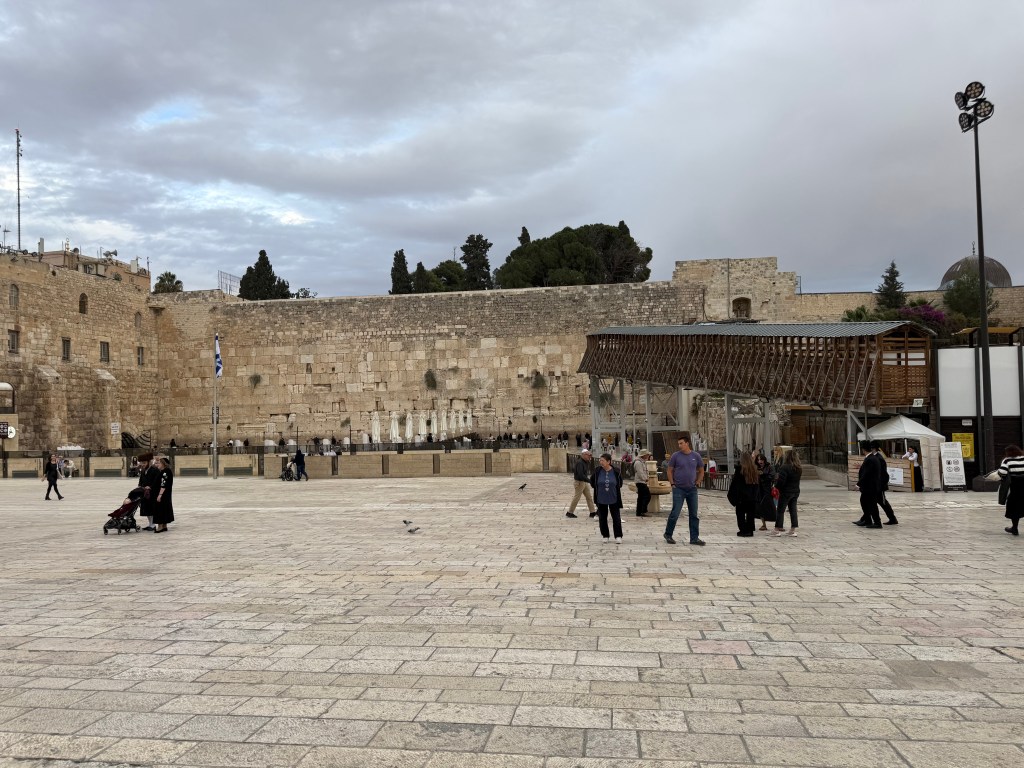
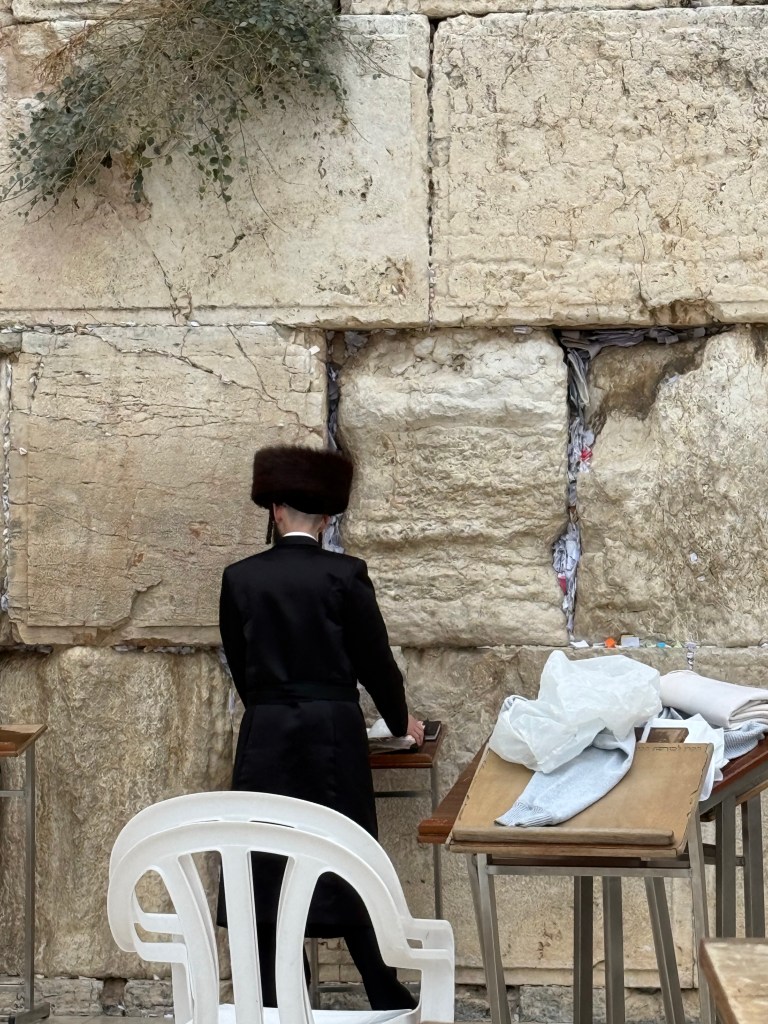
We got to the Kotel for shabbat very early. It was fairly empty when we arrived which gave us time to spend at the wall in deep thought and prayer. For the first time in a very long time, I had the time and space to sit in a chair at the kotel and just be. To let the air and the spirituality overwhelm me as I did nothing but sit and be. It was incredibly peaceful and powerful. I looked at the notes in the Kotel that others had left – their prayers, hopefully answered. I saw Jews of all shapes and colors arrive and pray. As the sun began to set, I felt the quiet and peace around and inside me.
If you’ve never been to the Kotel for Shabbat, it’s quite an experience. It never gets old for me. The singing, dancing, ruach (spirit) and connection is incredible. This was no exception. We gathered together in the plaza and prayed, sang, danced, and connected. We listed as others, in bigger groups, did the same but even louder. It was more than personal prayer – it was the feeling of a people coming together as one. As somebody who doesn’t love services, I always love Friday night at the Kotel. When we finished our prayer, I wanted to go join one of the others.
Instead we began our walk from the old city to where we were having Shabbat dinner. It was about a 40 minute walk, on a beautiful night, exiting through the Armenian Quarter and continuing up Jaffa Street until we arrived. The table was set for 15, the food was plentiful, and the company divine. I love the Shabbat table where you have a little bit of prayer, a little bit of ritual, and a lot of food and conversation. We prayed, ate, sang, and talked for a few hours, getting to know each other better, sharing pieces of ourselves, and enjoying the beauty of peoplehood, Shabbat, Jerusalem, and Israel.
During our learning with Aryeh he asked us what Jerusalem really was. We threw out a bunch of answers before he gave us his. He said, “Jerusalem is the hospital for broken souls.”. Powerful, beautiful, and true. Each of us has our own cracks in our soul. It’s part of being human. In Jerusalem we can get the treatment to begin the healing process for our soul. I’ve always loved Jerusalem but never really had a deep understanding why. Aryeh’s explanation fits. When I’m hear, my soul gets the treatment it needs to heal. To improve. To be better. I can get out of focusing on the dust, on my wants and needs, and instead focus on my soul. On the bigger picture. On being of service instead of what’s in it for me.
If you’ve never been to Jerusalem, I encourage to visit. To explore. To open your heart and heal your soul. If you’ve been – come back. It’s time for another treatment.
This was a wonderful Shabbat filled with happiness, joy, friendship and peace. I want to do my part to make sure they are all like this, no matter where I am.
Shabbat (the Sabbath) is an interesting concept. A day of rest. A day where you don’t do work. A day of reflection. What is it really and what do words like rest, work, and reflection actually mean?
I have never found an interest in ‘keeping shabbat’ (following all the rules) in a strict sense. Not turning on light switches or the using the remote control never made sense to me. Driving isn’t really work, is it? You turn a key or push a button and it starts. After that, what’s the difference? Not turn on the oven or stove. Why can’t I push buttons on the microwave or the air fryer? And not carry? Why do pants have pockets anyway?
When I am in Israel, Shabbat becomes a little bit clearer. I typically find that I look forward to it for a number of reasons. First, by the time Friday afternoon arrives, I am usually wiped out. The thought of having a day with little to do and a chance to really unplug from the prior week is attractive. Going to the Kotel (Western Wall) for Shabbat services is always fun and meaningful. You’ll hear more about that later. A nice dinner with friends that is leisurely and relaxing? Sign me up.
On this trip I had the privilege of learning from three amazing people. As we were walking back to the hotel on Friday after an amazing morning at the Begin Center, I started asking Lori Palatnik, the founder of Momentum, about Shabbat. I understand the prohibition about not working and a day of rest, but my definition of work isn’t starting and driving a car, turning on the stove or oven and cooking, turning on the TV, changing channels and watching shows. So how does that reconcile? Lori taught me something interesting that I am still chewing on. She told me that there is no prohibition against work. That is a wrong interpretation. The prohibition is for creating. And the reason there is a prohibition against creating is that Shabbat is a chance to honor and recognize THE creator, God. The reason she doesn’t do these things is because they involve creating. On Shabbat, it’s all about our creator, God.
It is an interesting concept to take a day each week and use it to honor and thank God. I meditate and pray every day. I have for more than 35 years. I don’t use a prayerbook when I pray, it’s a quiet conversation with God. Over the years it has gone from asking him for things that I wanted to thanking him for the things that I have. When I meditate, it’s often in silence, just focusing on my breathing and paying attention to all the sounds around me. I get in touch with God and with the world. Sometimes I will do a guided meditation to mix it up and they are enjoyable as well. But most of the time, my meditation is about getting closer to God.
So what if I was to expand my practice of prayer and meditation to take a full day each week and focused entirely on that connection with God? I don’t know that I’d go to synagogue or follow a formal process, but what if I were to unplug, honor our creator, and not worry about making anything for a day? It’s an interesting question and one that I will ponder for a while.
I also had the opportunity to learn with Rabbi Yakov Palatnik, Lori’s husband. I have seen him on other trips, but this was the first time I really got to spend time with him, and WOW! I have been missing out. This quiet and humble man is filled with incredible wisdom. One of the things we discussed that really intrigued me was about prayer. As a scholar of Maimonides (the Rambam), he told me that the Rambam said you need three things in a prayer.
The first is to praise God and acknowledge his greatness. While I am not an overly religious person, that is something I always do. One of my favorite things to say is that God often does for me, what I can’t do for myself. I have seen that happen over and over again in my life. Things happen that I hate and that I think are awful and I would get upset about. A few days or weeks or months later, I would look back and realize it was the best thing that could have happened. I know and understand the greatness of God and it centers me and gives me great comfort.
The second is to ask for what you want or need. As I said, I used to do this but stopped. In part this was because of my understanding of the greatness of God. Who am I to ask? I don’t know what’s best for me. Isn’t it better to ask God just to take care of me and that’s enough? Rabbi Palatnik said no. He said we have to ask because we have to know ourselves. If we don’t ask it means we don’t know. Of course God knows, and we aren’t asking for him to know. We are asking to show that we know. We are asking because we have done our part and done the work. That makes sense to me but it is still going to be uncomfortable to ask for things for myself. That is because of the third thing that Rabbi Palatnik told me Maimonides required in prayer.
You have to say Thank You to God. That I do every day. I thank God for giving me another day of life. Sometimes it’s saying the Modeh Ani, but most of the time it is just saying thank you for another day. I say it at night when I go to sleep. I say it throughout the day. Part of the reason I struggle with asking God for things is because I know he will take care of me and I’d rather say thank you than ask for things that I may think I want but in hindsight I wish I didn’t get. Saying thank you to God is comforting to me.
It is an interesting process for sure. Over the next few days, weeks, and month, I am going to follow Rabbi Palatnik’s suggestion to listen to the Rambam. I’m going to work to make sure I include all three components in my prayers. We will see what happens as a result.
Lori and Rabbi Palatnik and me. Two great teachers. One average student.
The third person I got to learn from was our trip leader, Saul Blinkoff. Saul is an amazing man, and you can google him to learn more about him. During Shabbat, he said two things that really resonated with me.
The first is that what you will die for determines what you live for. It’s a fascinating concept. He shared the story of a woman in a concentration camp during the Holocaust. The woman looked like she was ready to end her life when she walked up to the Rabbi in the camp and asked for a knife. The Rabbi was shocked and worried about her. She demanded a knife again. The Rabbi didn’t have one and tried to talk to her. She looked behind him and saw a member of the SS who had a knife. She walked up to him, grabbed the knife, reached down to her leg and pulled a baby out from under her uniform. She had recently given birth and was keeping the baby a secret. She took the knife, performed a circumcision, a Brit Milah in Hebrew, entering her son into the covenant with God. She then gave the knife and the crying, newly circumcised baby to the SS officer, turned around and walked away. A minute later there was a shot and the baby stopped crying. A few seconds later and the SS officer shot the woman in the back of the head. She knew what she was willing to die for – to be Jewish and part of the Jewish people. So she knew what she was living for.
It is a powerful lesson and question. What am I willing to die for? What is so important to me that I would sacrifice my life for it? I have started my list and will be thinking about this for a long time. Once I know what I would die for, I will know what I live for and can make sure that’s what I am doing in my daily life.
The other lesson Saul taught me on Shabbat was about the mezuzah. I have had a mezuzah on my door for many, many years. I know what it is, why it is there, what is inside it, what it says, where the commandment comes from. One of my clients has a focus on the mezuzah so I’ve learned even more over the past few months. And yet, Saul taught me something new and important. He said that one reason the mezuzah is on the door is because it signals a transition. When we walk into the home from outside, we need to leave our outside problems at the door. It is a visible signal to change our focus to what is inside the house, our family, and go all in. What a really cool concept. A visible reminder of what is important. This is one that I have already started using. When I walk through a new door with a mezuzah on it, I think about where I am going to and what mindset do I need in this new space.
Saul Blinkoff teaching us. What an amazing man and teacher. Lucky and proud to call him my friend.
Learning stuff like this to challenge my behaviors and beliefs is really cool (at least to me) but that isn’t the only special part of Shabbat. As I have said, I am not the most religious person and don’t really go to shul. Ok, I don’t go to shul unless it is a family simcha (celebration). In Israel, I don’t want to miss Shabbat at the Kotel (Western Wall). It is joyous, fun, exciting, and meaningful. There are so many different types of Jews there and so many different services going on. And you never know who you are going to see. This Shabbat was no exception. As we got to the Kotel and began our service, I looked ahead and saw Rabbi Lipskier from Chabad at UCF. I quickly made my way over to him to give him a big hug and to wish him Shabbat Shalom. Only in Israel! I returned to our group and the singing and dancing began. We were a group of about 25-30 men. This is small on Friday night at the Kotel but as we sang louder and danced, we started seeing others come over and join us. IDF soldiers in uniform. Hassidic men. Men in Black hats. Men pulling out their kippah from their pocket before they joined us. Men with the big fur hat. Men who looked like they belonged at a Grateful Dead show. Even a little boy. It was amazing to see all these different types of Jews join us to sing and dance.
When it was over and it was just our group again, I started thinking about how this was an allegory for the world. If Jews of all different types can come together at the Kotel on Shabbat and not only pray together and separately but also join together in unification, why can’t we do it elsewhere. Forget about the entire world, why can’t we do this in our local communities? Why can’t we find different types of people who will be happy with their differences and yet also celebrate their similarities? What can we do to make our local communities look more like the Kotel on Shabbat? Different types of people enjoying both their differences and similarities. That’s the type of world I want to live in.
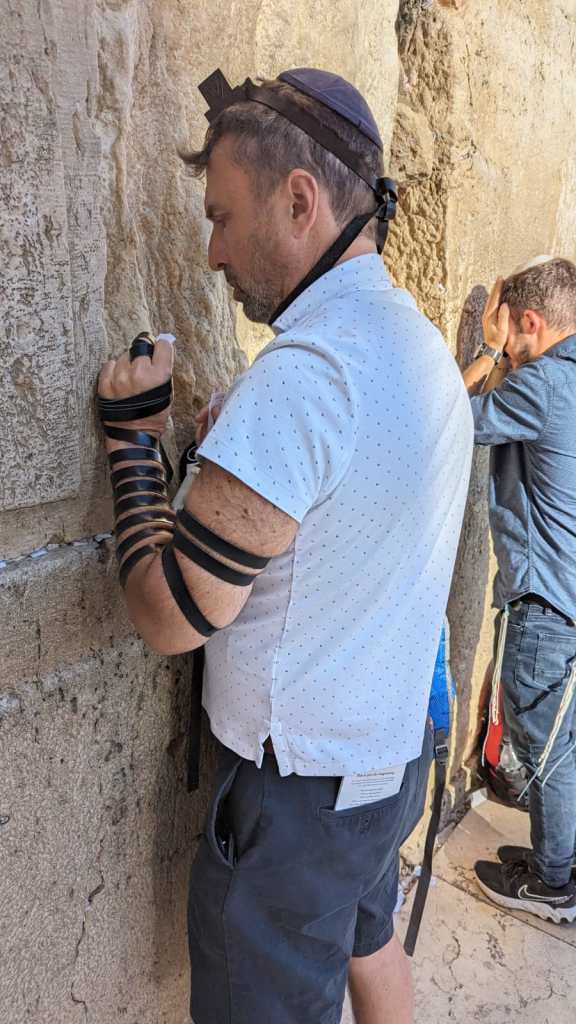
My takeaway is really something else that Rabbi Palatnik taught me during this trip. We have to be able to learn from everybody. It is a fascinating concept that everybody has something to teach us. It doesn’t matter who they are, where they come from, how much or how little they have, how well educated they are or are not, or anything else. Everybody in the world has something to teach us. I haven’t only learned from these three amazing people on this trip. I learned from the other men on the trip. I learned from some of the women on the women’s trip who spoke. I learned from the French Machal soldiers and the families from Kibbutz Alumim who have been relocated. I learned from the farmer, visiting Kfar Aza and Nova. I learned from the Chabad Rabbi who put my tefillin on at the Kotel on Wednesday. When I am open to thing, I can learn from everybody.
I know how to put on Tefillin but I can still learn from the Chabad Rabbi who did it for me at the Kotel.
What a powerful thought – to learn from everybody and every interaction. That sure makes us all better people and makes for a better world.
It’s Sunday so time to let music be my inspiration. This week it’s a song by Luke Bryan from 2017 titled, “Most People are Good”. It’s an interesting choice since not long ago, inspired by Anne Frank, I was talking about how there aren’t enough good people in the world. I’m honestly not sure if there aren’t enough good people or if they are just quiet and do good, or if the media just chooses to only focus on the bad. Perhaps it’s a combination of all three.
The lyrics are insightful and thoughtful.
I believe kids oughta stay kids as long as they can. Turn off the screen, go climb a tree, get dirt on their hands.
We live in a world where kids grow up way to fast. I think back to my childhood where we played outside every day. People had part time jobs for pocket money not as a primary goal nor to further our future careers. We played multiple sports and had diverse groups of friends. There was no such thing as “travel ball.” My mom would make us take off not just our shoes but our dirty clothes in the garage before entering the house. Times were simpler. The only screens were TVs and VCRs were fairly new so you could try to tape a show if you missed it but our lives were not dominated by TV, the internet (didn’t exist), streaming services, etc. We stayed kids as long as we could and that wasn’t a bad thing. When I look at how my kids and their friends grew up compared how I grew up, it’s truly a different world. We walked or road our bikes everywhere. Our parents didn’t know where we were every moment of every day through tracking software on cellphones or texting. Life was simpler. I have done what I can to provide that for my children. We have never tracked their location on their cellphones. We encourage them to stay kids as long as they can because adulting is both hard and long. Childhood is meant to be cherished and in today’s world, it’s now rushed through. I worry about our future when kids aren’t allowed and encouraged to be kids.
I believe we gotta forgive and make amends. ‘Cause nobody gets chance to make new old friends.
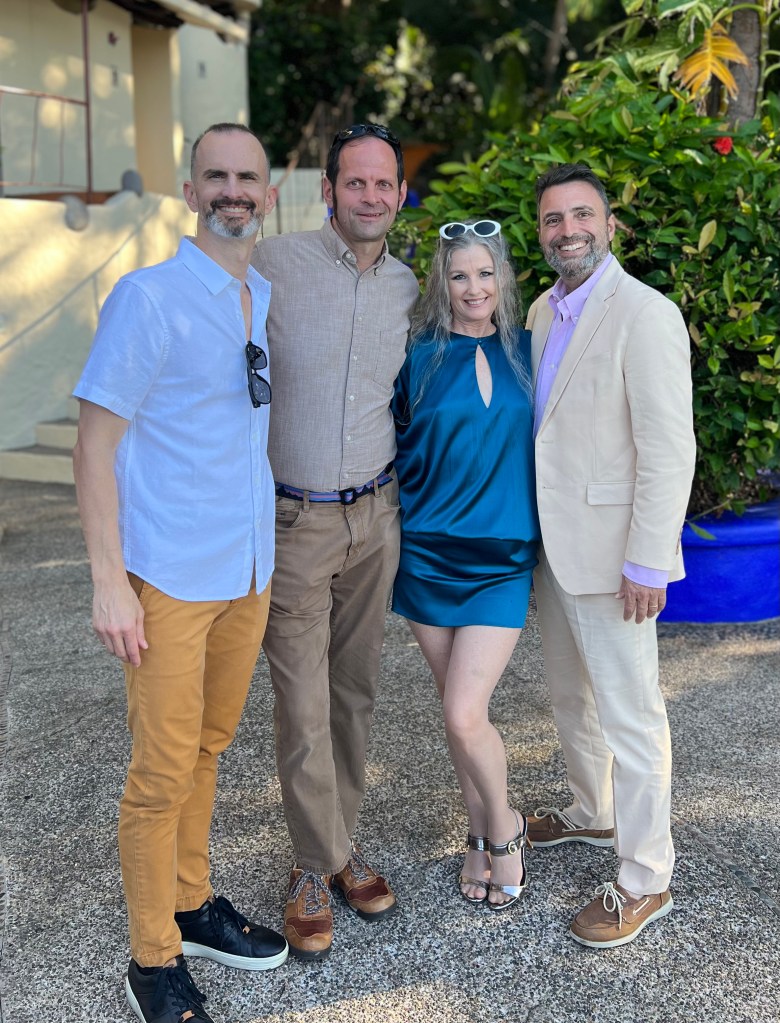
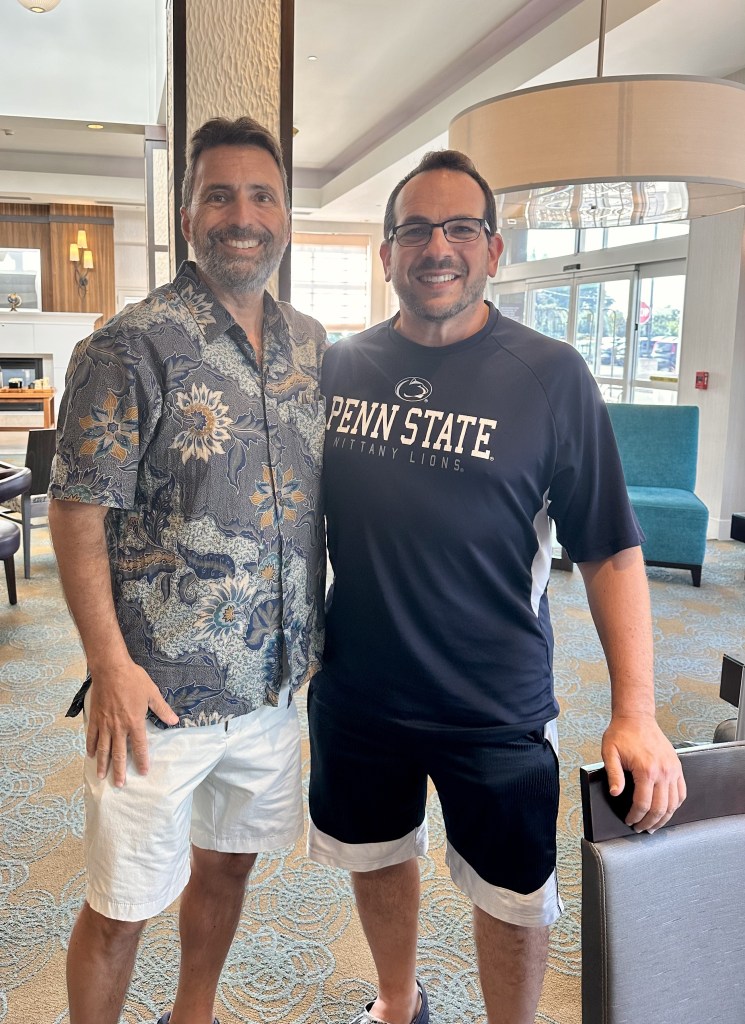
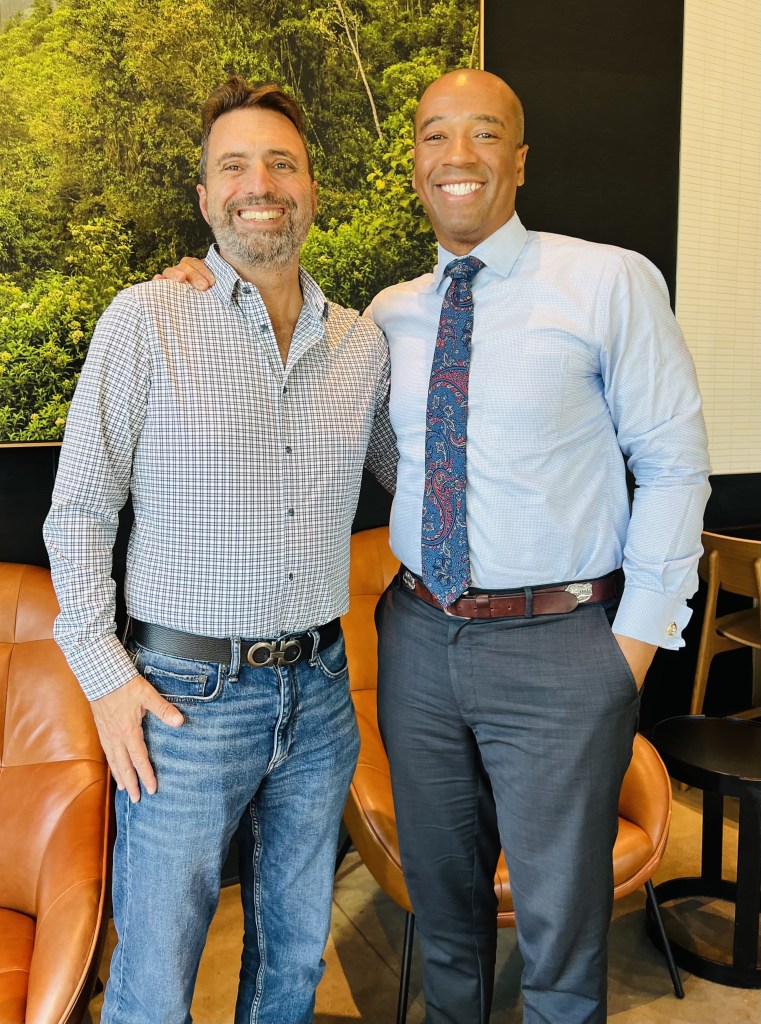
I consider myself lucky, in part because I have so many friends for more than 30 years. Some are more than 40 years and others more than 50. People who I grew up with. People who I have known most of my life. Like the song says, you can’t make new, old friends. Many years ago, I learned to ask a very important question. Would I rather be happy, or right? Most of the time, I’d rather be happy and choose actions that provide happiness. By choosing to be happy, I forgive and make amends. My friends stay my friends and we get through the challenges that all friendships and relationships have. Just this week I was talking to a friend from middle school and a friend from high school. I am getting together with a high school friend today because she is in town. These relationships are precious. They span decades and go back to a simpler time with cherished memories. In today’s world, we often let disagreements end friendships. Life is too short. Time is too precious. What do I gain from ending friendships that have lasted decades over unimportant things? I like that my children know my old friends. I like that they tell my children stories from ‘the old days’, even when they are embarrassing and especially when they are funny. Here are just a few pictures of a few of them.
I just got to spend time with Jim, Ananda, and Anna Marie at our friend Jeremy’s wedding. It has been years for some of us yet it felt like no time had passed.
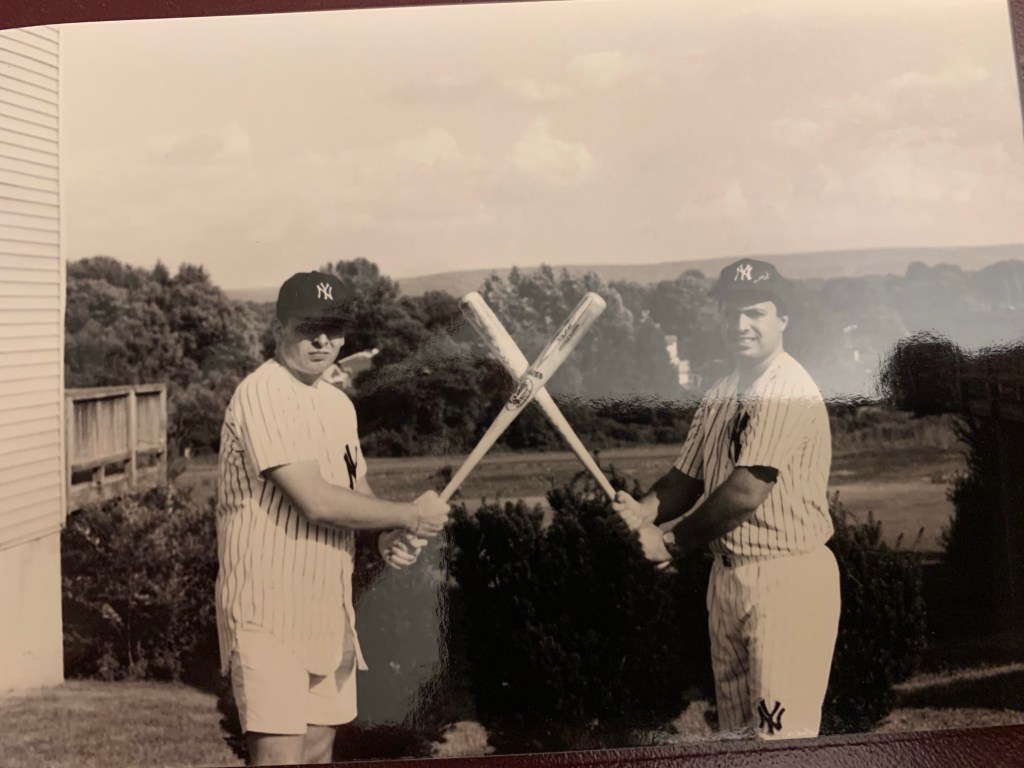
My friend Aric who tells my kids classic stories they often don’t believe. We became friends in 1988 and are like brothers.
My friend Todd who has great stories to tell my kids, also ones they don’t believe. We became friends in 1987 and talk at least once a week.
My dear friend Ron – we have experienced the ups and downs of life together for the past 30+ years.
Larry and I met in either 1984 or 1985. We still talk every week.
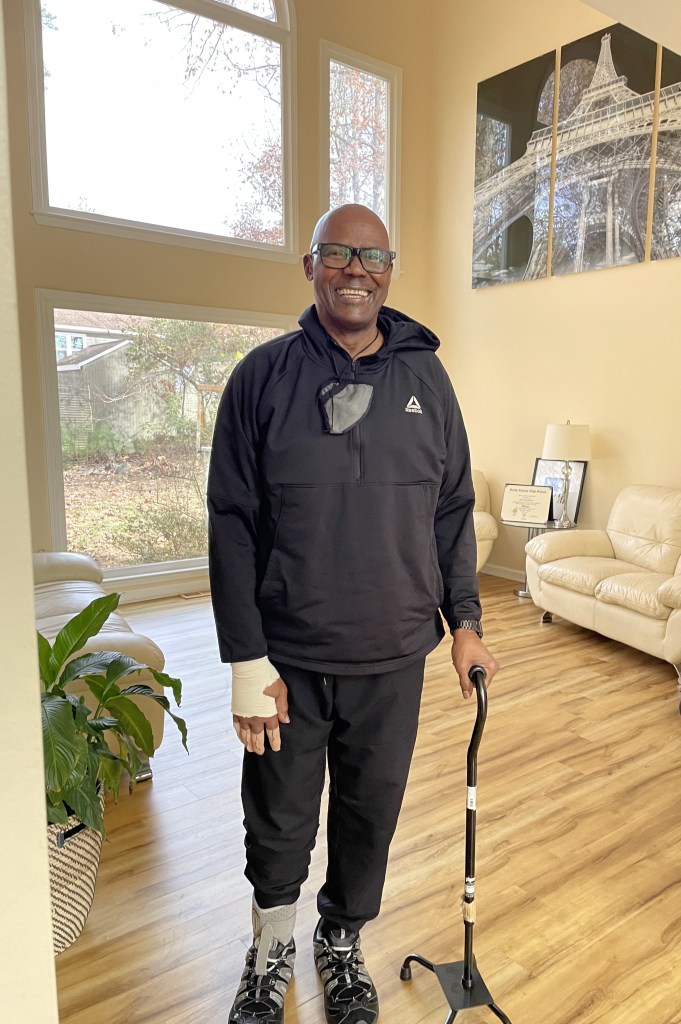
Jamal and I have been friends for 20 years. He always inspires me and I am humbled when he says the same about me.
Darryl and I have been friends since 6th grade. He is now a mentor to my son Evan. Who wants to try to make new, old friends when you have old friends like this?
I read a very interesting article about two friends in Israel who allowed their political differences to impact their friendship. The impact of October 7th made them realize how important their friendship is and their disagreements politically aren’t a reason to not be friends. That’s a real life example of this lyric.
I believe in workin’ hard for what you’ve got. Even if it doesn’t add up to a hell of a lot.
My grandparents and parents taught me early in life the importance of hard work. They would often say that hard work is its own reward. As a kid, this was hard to understand. Hard work was to get a result. It was to obtain things. How could hard work be its own reward?
As I got older, I began to understand what they were talking about. It is about having a work ethic. It is about having values and living up to them. It is having integrity and working hard because it is the right thing to do, not because you will get a specific outcome.
The older I have gotten, the more I appreciate the things I have. Growing up and into my 30s it was all about more, more, more. The bigger house. The nicer car. More toys. The newest technology. Today I am grateful for what I have and often time realize that I would be just as happy, if not happier, if I had less. There is value in appreciating what you have and not wanting more all the time.
There is also another hidden message in these lyrics. Often times we judge people based on appearance. Based on the car they drive, the clothes they wear. This line urges us to look at the person, not what or how much they have. It reminds me of quote by the Reverend Dr. Martin Luther King, Jr. in which he said, “I have a dream that my four little children will one day live in a nation where they will not be judged by the color of their skin but by the content of their character.” The color of their skin, the amount of money in their bank account, the type of car they drive, the clothes they wear – all have nothing to do with the content of their character. All have nothing to do with the type of person and human being they are. We need to pay attention to who people are based on their actions, not their bank account.
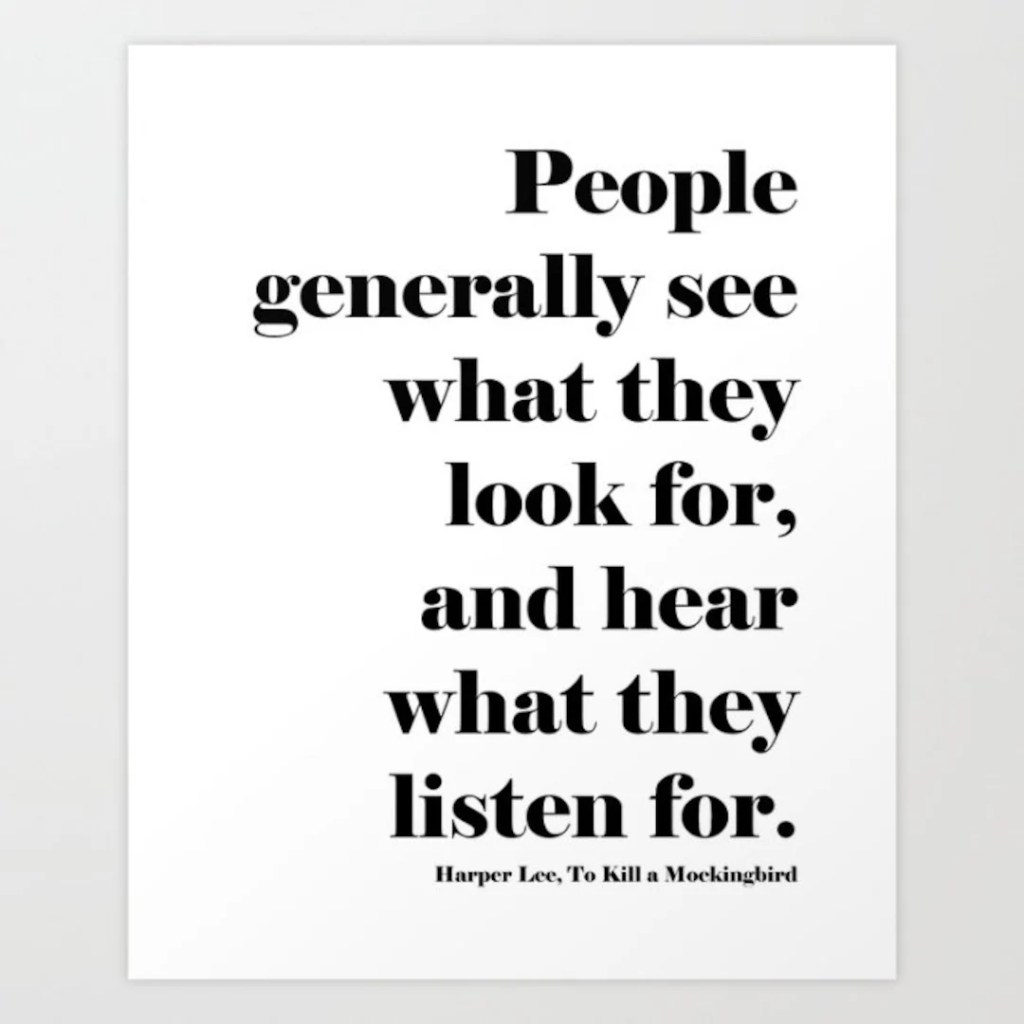
A brilliant quote from To Kill a Mockingbird by Harper Lee. We see what we look for.
I believe most people are good and most mamas oughta qualify for sainthood.
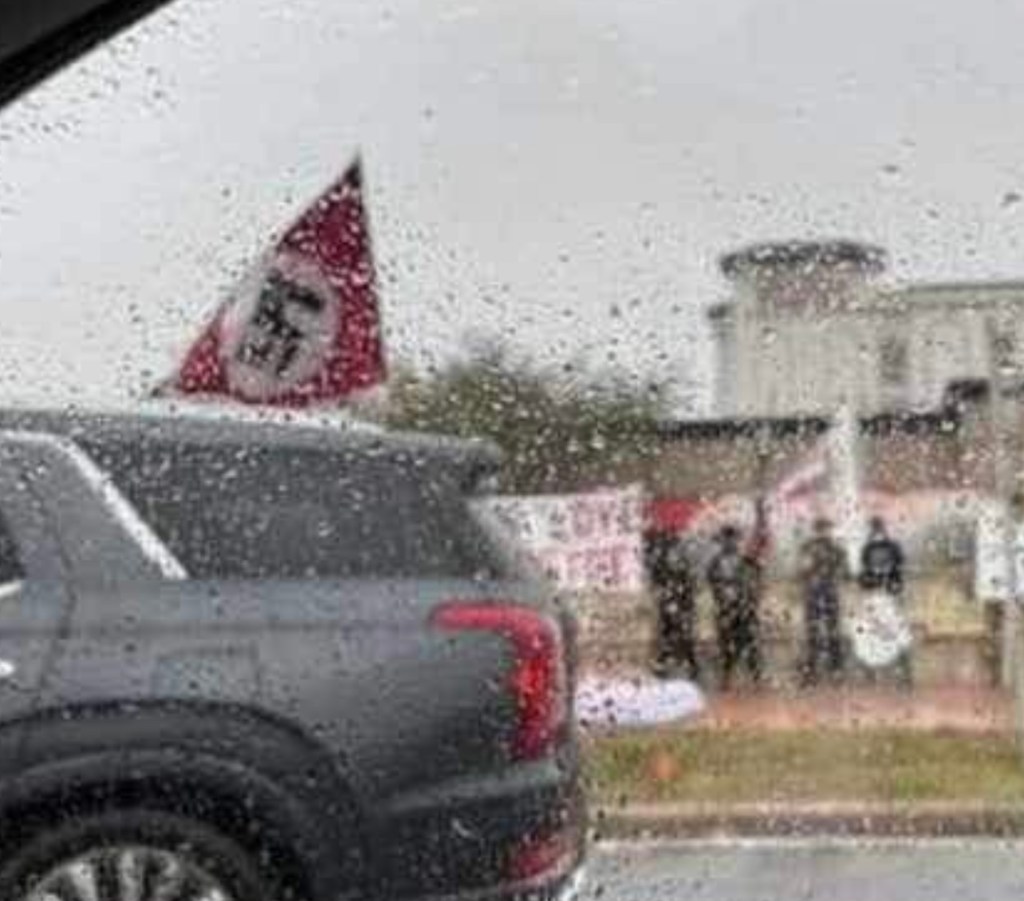
This is the line that I struggle with. Not the second part but the first part. In today’s world, are most people good? Half the country hates the other half. The rise in antisemitism is frightening. We literally see Nazis in Central Florida every few weeks. Sometimes in uniform, usually waving a big Nazi flag and chanting horrible things with awful signs. In Nashville there was a Nazi march where people were chanting ‘Heil Hitler’. This is not the 1930s in Germany. This is 2024 in the United States. Crime is up. Instead of random acts of kindness, we see random acts of violence. The rape, murder, and kidnapping of Jews on October 7th is acceptable only because they are Jews. Calls for a ceasefire happen daily but these people don’t demand the release of the hostages, now in their 133rd day of captivity. Too many good people are silent. It seems that over the past few years the famous quote, “The only thing necessary for the triumph of evil is for good men to do nothing.” was everywhere being said by everybody. Yet after October 7th, these people went silent. It seems there are daily demonstrations of the evil of humanity. I look every day for signs that most people are good and yet most people fail the test every day.
This was yesterday, 2 miles from my house. The hatred is real.I never thought I’d see Nazi flags flying like this in my lifetime. This was February 17, 2024.The growth of antisemitism is real. February 17, 2024 in Winter Park, FL.
It is a reminder to me that I can’t control anybody else. I am only responsible for myself. I can choose to be good. I can do my part to make the world a better place. I can choose to engage in random acts of kindness. I can choose to fight against all hatred and stand up and speak out. I can be an example and live true to my values. Perhaps if we each take responsibility for ourselves, we will end up with most people being good. At the end of the day, I’m not responsible for most people. I am responsible for myself.
I love the line about most mamas qualifying for sainthood. Being a parent is difficult and as I have watched my mom, my mother-in-law, and my wife, I see how much more difficult it is to be a mom. I don’t know if it is societal expectations and training or something innate, but the differences between being a mom and a dad are significant. I am ok with my children struggling – it’s part of life and learning important life lessons. My wife wants to protect them from any struggles, it’s in her DNA as a mom. We both love our children and want only the best for them. We talked about this last night, and I was fascinated by the difference in our points of view. So I agree with Luke Bryan – most mamas should be Saint Mama.
I believe most Friday nights look better under neon or stadium lights.
As the parent of a high school football player, there was not much better than Friday Night Lights and watching my son play each week. It was an incredible four years and six years after it ended, I still miss it.
I can dig deeper into this lyric and go beyond high school football. Growing up, Friday night meant Shabbat dinner. It didn’t matter what I wanted to do before or after, we sat down as a family, often with guests, for Shabbat dinner. My mom would light Shabbat candles, my dad would typically make kiddush, and one of the kids would say the Motzi. No matter what, we were together as a family for Shabbat dinner. When my son played high school football, that became our Shabbat dinner – together as a family, under the stadium lights, usually eating a hot dog or hamburger for dinner, and loving every minute of being together.
Friday night, Shabbat, gives me the opportunity to set aside the business of the week and focus on the things that are really important. Family. Friends. Spirituality. Health. Just like Friday Night Lights creates a special environment, Shabbat itself creates that opportunity, if we are willing to take it. I fully admit that I am not a traditionally shomer shabbat person. I do use Shabbat as a break from the week. It’s the day that I get to refocus and recenter. It’s the day I focus more intensely on family. As a family of college football fanatics, Shabbat has been a traditional day where all four of us sit together all day watching college football. When the kids were little, we all climbed into our bed. Now that they are bigger than me, we watch in the living room. It’s become a family tradition that is a break from the rest of the week.
Friday night looks better under the neon or stadium lights because of the uniqueness they offer. Friday night also looks better because of the uniqueness of Shabbat and the opportunity to, for one day, set aside the stress of the real world and focus instead on the smaller, more intimate world of family and friends.
I believe you love who you love. Ain’t nothing you should ever be ashamed of.
It makes me so happy that a country singer wrote these words and sings it proudly. Country music and fans of country music are often categorized as racist and homophobic. To have a major country music star make this type of statement helps improve the world. It says loud and clear that people are people. Who you love is your business and nobody else’s. And there is nothing wrong with loving whoever it is that you love.
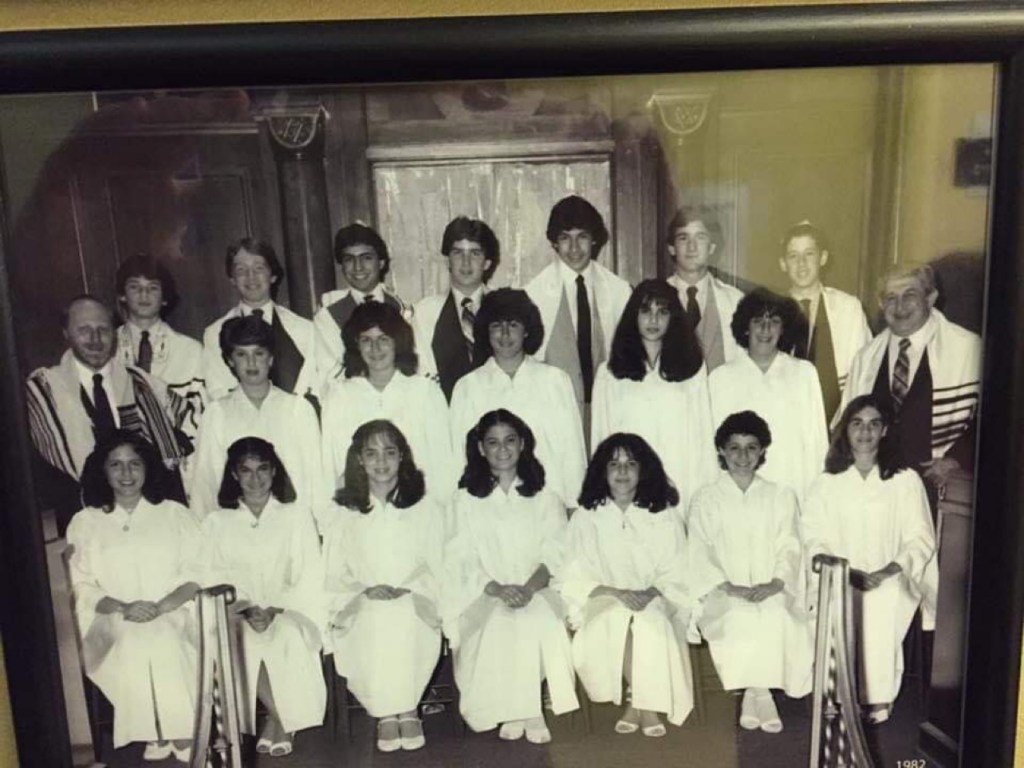
Growing up, we had a tight group of friends that all went to Hebrew School together. Most of us also went to the same public schools. We remain close today and have a Facebook messenger chat group to keep in touch. I remember when two members of our tightknit group came out. It wasn’t a surprise to any of us. We had known for years and years. It didn’t matter because we love everybody in the group for who they are. We celebrate all the diversity of our friends because of who they are.
My confirmation class – we stay in touch 40 years later.
In a song about most people being good, this line is so important. Hate is simply unacceptable yet continues to grow in our world. It doesn’t matter who the hate is targeting. It can be the African American community, the LGBTQ+ community, the Asian community, the Muslim community, the Jewish community – hate is hate is hate. We must stand together against all hate because those who live in hate will simply move their hatred from group to group. Our power comes from standing together and strongly condemning all hate. Not allowing it to fester and grow. Hate is taught which means we can teach love instead of hate. Just like Luke Bryan, I believe you love who you love and there is nothing to be ashamed of. You are who you are and there is nothing to be ashamed of. If we want to live in a world driven by love instead of hate, we accept people for who they are and appreciate all the differences each of us bring to our community and to the world.
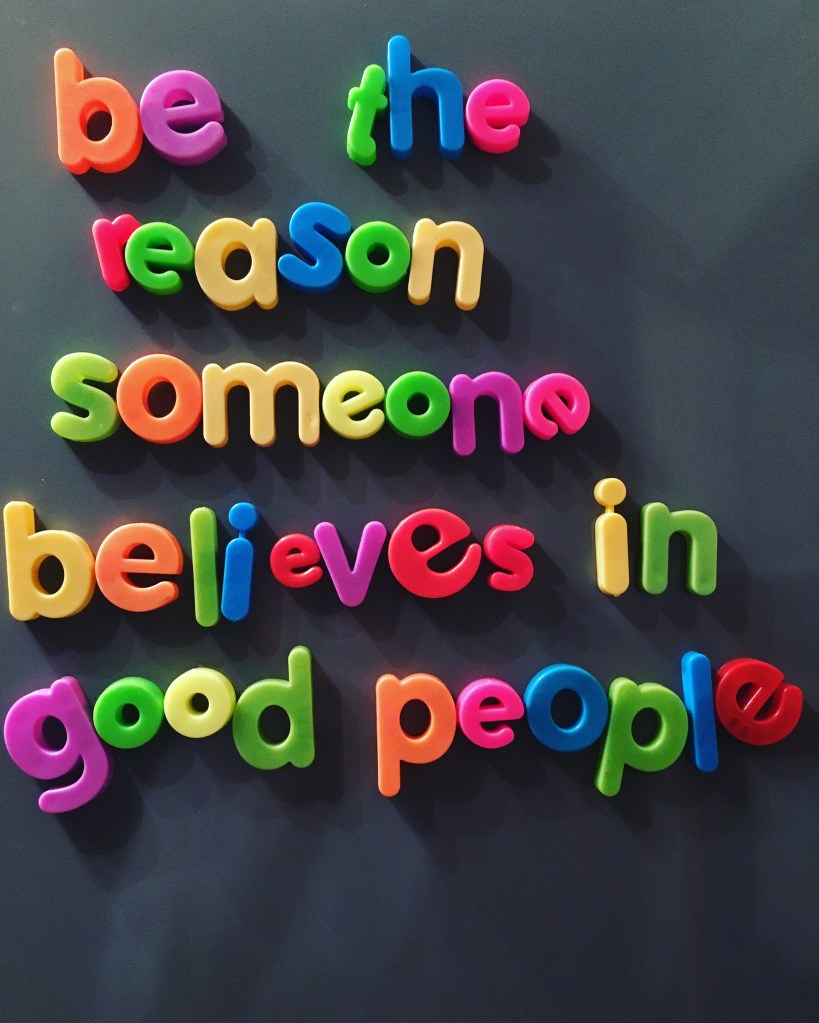
I believe this world ain’t half as bad as it looks. I believe most people are good.
Despite some of my struggles with most people being good, I find this line inspirational. Perhaps it is because he says it ‘ain’t half as bad as it looks’, recognizing that the world looks pretty bad today. So much of why the world looks bad is because of what the media shows us. The saying, “If it bleeds, it leads” has become more than the truth, it seems it is now the mantra for the media. We get shown the worst of humanity most of the time. We live in our own bubbles where we don’t interact enough with people who are different from us. We don’t celebrate our diversity and we don’t bother to try to understand others, instead we try to get them to agree with us.
In 2019 I had the gift of participating on the Encounter Immersive Program. This is a program that takes Jewish leaders to meet with leaders of Palestinian civil society for four days. I remember thinking that four days seemed awful short. After day 3, I was grateful it was only four days. The tagline for Encounter is “Listen, Learn, Lead.” And the program is really all about listening. It’s about understanding a different point of view and perspective. It’s not about trying to convince anybody of my beliefs but rather a chance for me to learn about their beliefs, their narrative, their story. It was a truly fascinating experience that I wrote about earlier in this blog – you can find the many posts I wrote near the beginning of this site. By listening, learning, and asking clarifying questions, I got a better understanding of the challenges in the region. It wasn’t just the simple good vs. evil or mine vs. yours. It gave me a chance to dig into challenges that have reframed by understanding. It only strengthened my Zionism while also increasing my humanity and building bridges.
If we can get beyond the surface answers and really spend time communicating – listening and learning – there is hope for the future. Not just in Israel but in the United States and around the world. There is so much clickbait and so many people only read the headlines without really understanding the details that it is easy to lose hope and only see the negative. I truly believe that most of us want the same things, it is more about how we get there and how we find was to talk about it that are the key. I think often of the stories of President Ronald Reagan and Speaker of the House, Tip O’Neill. They would spend all day arguing policy and at the end of the day, they would go out together and get a beer. How do we get back to the days when we focused on our similarities, not our differences?
So maybe the world really isn’t half as bad as it looks. We can certainly hope and do our part, since it looks pretty awful right now.
I believe them streets of gold are worth the work. But I’d still wanna go even if they were paved in dirt.
My parents taught us all that results aren’t promised. We can only do our part and put in the work. That’s what they asked of us – put in the work. I remember being happy in school getting an A- without any work and my parents being very upset. I didn’t understand. I remember working hard and only getting a B and they were happy and supportive. That confused me as well – wasn’t the A- better than the B? It took me a long time to understand that the value was in the work, not the result.
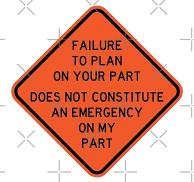
As I got older and began to understand the importance of the work itself, I began to learn things like not having control of the results. I can only do the work and put things in place for a likelihood of success. There are too many other factors to make it my responsibility for the outcome. The wisdom of Benjamin Franklin spoke to me when said, “If you fail to plan, you are planning to fail”. One of my mentors, Rabbi Mark Kram, was famous for saying “Failure to plan on your part does not constitute an emergency on my part.”
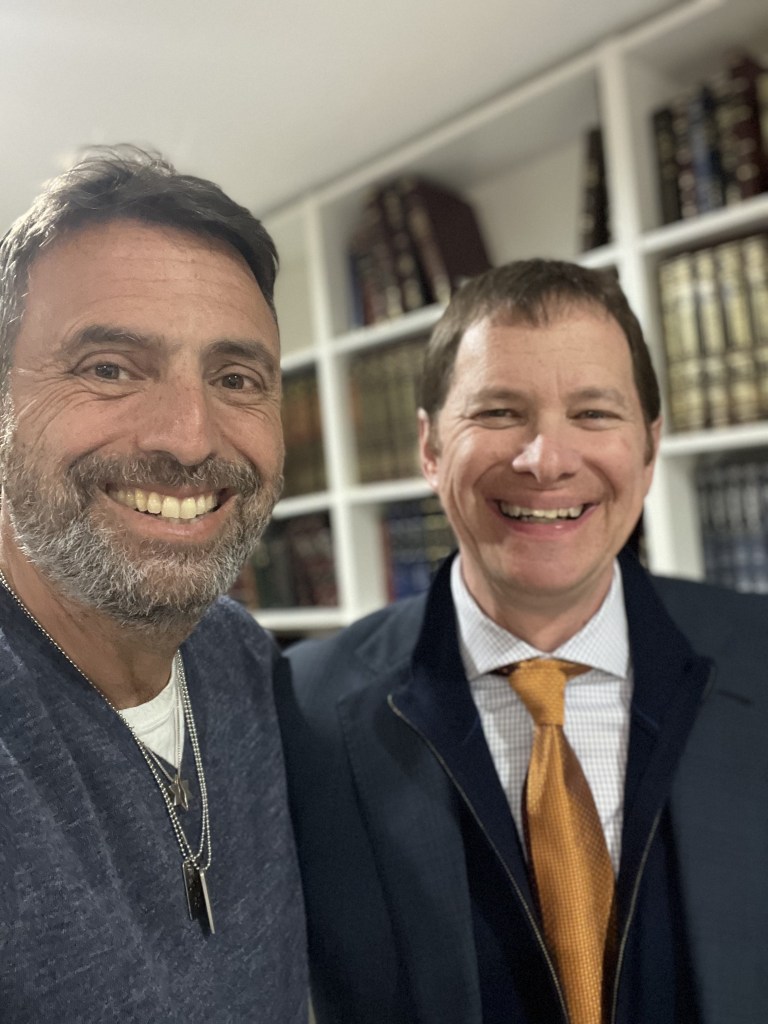
Over the past years as I began to learn with a Rabbi, these thinking was reinforced again. I have learned with many Rabbis and educators. One common theme has been and continues to be that everything comes from God. Our job is to the work, not determine the results. Recently I was having dinner with my friend Harry Rothenberg, an attorney who is perhaps the best Jewish educator I have ever experienced. I watch his video blog every week and learn something meaningful each time. We were talking about how he had been stuck in terrible traffic and was going to be late to an event. He didn’t have a chance to eat lunch and there was a great cocktail reception before the event with delicious food. He was incredibly hungry and was going to miss the chance to eat. He was getting frustrated. He managed to make it to the event just as they were finishing clearing up the last of the food. Disappointed and hungry, he sat down for the event. At that time, he realized that the entire plan was one from God. He made the event on time. He arrived safely. Sure he missed the food but he wasn’t going to starve. He just missed the food. In the meantime, he had missed the bigger picture of everything being God’s plan. He realized he needed to do better.
Harry and me after dinner and a great learning session. I love having him as a friend and teacher.
I was inspired by the story for two reasons. First, if you are like me, you tend to get caught up in what is happening that minute and can lose sight of the big picture. I can get upset because traffic means I will be late. The person in front of me is driving slowly. I didn’t get to eat lunch and am hungry. All sorts of details that are happening right at that time but don’t really matter. I lose the big picture that I I will arrive where I need to get safely. That patience is a virtue. That I won’t starve and have plenty of food, just not at that minute. When I focus on the big picture, I get filled with gratitude. Even if the roads are paved in dirt, they feel like they are paved in gold.
The second part of inspiration is the desire to do better. There is always an opportunity to improve, to do a little more, to be a little better. My spiritual advisor, Mickey Singer, would often guide me that life is a journey to be experienced. We are here as a spiritual being, having a human experience, so experience it. Realizing that we can improve, that we can be better, and doing the work required to do better really does make those dirt roads into gold.
I believe that youth is spent well on the young. ‘Cause wisdom in your teens would be a lot less fun.
How many times have any of us said, “If I only knew then what I know now…”? Would we really want to know then what we know now? As a 16-year-old, would I really know and be able to follow through on things that took me 40 years to learn? Would that knowledge ruin the childhood that I talked about above? Would I be any better off knowing it then but not having the capacity or ability to really take advantage of it?
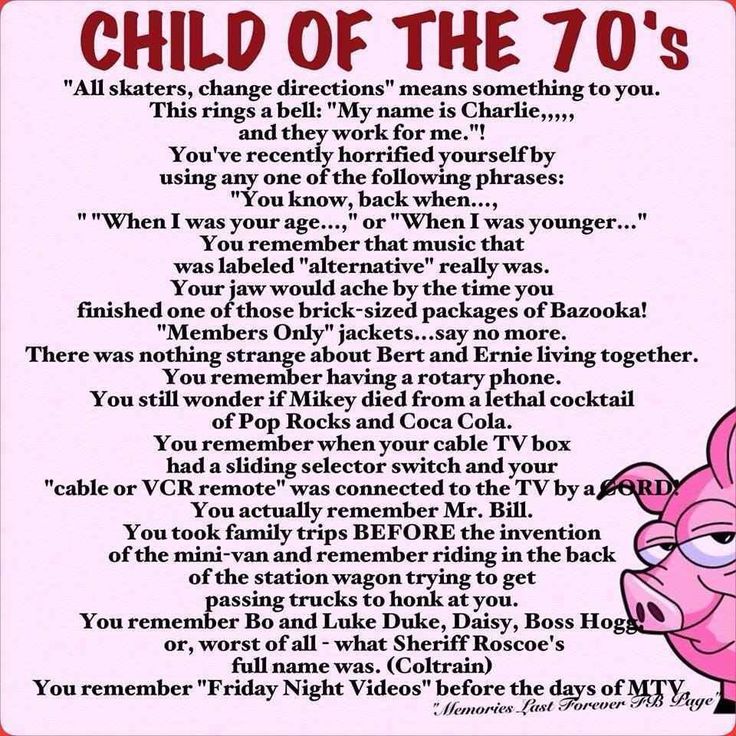
Youth is for the young. Our bodies are able to do more. We have more energy and the lessons of the world have not been learned yet. As somebody who grew up in the 70s and 80s, I look back with fond memories. Not because I want to be who I was back then but because of who I was back then. It was the only time in my life that I could be that person. That I could have the freedom offered to the young. No physical restriction. No limitations because of the responsibilities of a wife and children. No career to be concerned about.
I think about friends who didn’t have the luxury of youth when they were young. Financial insecurity. Issues with permanent housing. Unstable home life situations. They were forced to grow up quickly and had far more wisdom at 16 or 20 than I did. It comes at a cost. I think of the children impacted by the war with Israel and Hamas. They have far too much life wisdom now. How many of them would trade all of this wisdom to go back to an October 6th world?
We live in such a fast-paced world now that kids don’t get a chance to be kids. There is academic pressure that begins at an insanely early age. I remember a few years ago talking to parents about their 2-year-old child in our preschool. The child’s grandfather had already called Harvard about getting him on a wait list. Let me repeat, the child was 2 YEARS OLD! I think about the IB and AP courses my children took in high school and the academic pressure they faced. In hindsight was it really worth it? When I talk with them the answer is no – both would have been much happier doing a dual enrollment program or even taking regular coursework.
Youth is for the young. Let’s not steal it from them by trying to get them somewhere before they need to be there.
I believe if you just go by the nightly news, your faith in all mankind would be first thing you lose.
I stopped watching the nightly news a number of years ago. Everything was negative and the national news was focused entirely on their own spin. There is a reason there is no longer a news department and these programs are in the entertainment division. It is far too easy to find a news channel that will reinforce your own beliefs or will make you hate those with different views.
For a while I watched the CBS Sunday morning show because they only told happy and inspiring stories. It made me realize that there are plenty of these stories available if you look for them. We don’t have to be consumed with the negativity and lose our faith in mankind. We can find the stories that inspire us. That give us hope. One news site I follow does a story every Sunday where they allow a reader to tell a story of gratitude where they get to highlight the kindness somebody else did for them. It’s one of my favorite things to read because it reinforces faith in mankind.
The nightly news can be toxic. On October 7th, my friend the Consul General of Israel to Florida, told me to stop watching the news. It wasn’t healthy to be so focused and so obsessed on the murder, rape, and kidnapping of Jews by Hamas. I understood but also couldn’t stop. When I watched the Hamas video of October 7th, many people asked why I would want to see that inhumanity and put myself through it. I told them I needed to bear witness. We have to be careful with what we consume as it shapes our reality. I spend time talking with friends of mine in Israel, with friends who have had family members taken hostage – some have been released and some are still hostages. I talk with people who are actively looking to change the world through their actions. Medical research. Summer camp for children. People working with victims of terror to attempt to restore humanity. Mentoring and coaching youth who need the guidance and support to have a better future. Those working with pediatric hospitalized patients and seniors struggling with loneliness. People focused on finding the light in the world amidst the darkness.
We can find our faith in mankind restored when we choose to see the beauty happening all around us and make an active choice to join in that beauty.
I believe that days go slow, and years go fast. And every breath’s a gift, the first one to the last.
As a kid, the days went slow, and the years seemed to go slower. There was always something to look forward to. Turning 10 and being double digits. 13 was Bar Mitzvah. 16 was my driver’s license. Graduating high school and going off to college. 18 was voting. 21 the legal drinking age. Graduating college. Focusing on the milestones, time seemed to drag on as the next one was always so significant and exciting. I remember when my oldest son was born and being told that now the days will go slow, but the years will go fast. How true that statement became. It seems like yesterday my sons were in preschool, taking naps, and I was reading them bedtime stories as we cuddled, never certain who fell asleep first, them or me. Precious days and precious times. My wife commented to me the other day how much she misses my older son who is now in Tennessee starting his career. My youngest is still at home and we treasure the time because it goes too fast. In a few months he will be a senior in college, and we will prepare for the next big change in our lives.
I turned 56 in December. I still feel like I am in my 30s most days and there are times I feel like I’m back in high school. Yet 60 is around the corner. I remember when my Uncle Joe died at 50 years old thinking, “at least he lived a good long life.” I was 21 – what did I know? As a kid, filled with youth and being young, time was plentiful and abundant. Now it is the most precious commodity in the world. We only get so much of it and then it is gone forever.
I first experienced this when my cousin Eric died in 1995 at the age of 27. We grew up together and were like brothers. My childhood is filled with stories of Eric and me. One day he was here, vibrant, alive, with an incredible future. Then he was gone. I was blessed to know two of my great grandparents, all four of my grandparents, all four of my wife’s grandparents, and have great relationships with my parents and my in-laws. My great-grandparents and all eight of the grandparents are now gone. I treasure the time with them and appreciate all that I got. My dad died in September 2022, and I miss him every day. My cousin Todd, Eric’s younger brother, died tragically in 2015. After Eric’s death, he became another little brother to me, and we had many long and deep conversations. I had spoken with him a few days before he died. Every breath truly is a gift, the first to the last. And we are never promised the next one.
Its still hard to believe it has been almost 30 years since Eric died
I can’t beieve it’s 8 1/2 years since Todd died.
Over the last two years I had a number of health issues. I was still in the youth mindset of living forever and being indestructible, despite the clear signals that wasn’t true. My dad dying was the point where I knew I had to make changes. I lost weight, got in better shape, and tried to put better boundaries in my life. Work life balance became much more important as I realized that I had taken more breaths in my past than I would in my future. As these changes took hold and required significant life alterations, it really hit home when my mom said to me, “I was waiting for the call telling me you had a heart attack.” That statement shook me to the core and still does today. I’ve chosen to live my life differently as a result. Each breath we get is truly precious, from the first to the last. Why would want to waste a single one?
Who would have thought that a simple country music song would inspire a 5,000-word essay? I guess the need for believing that most people are good is really that important. The world we live in is so fraught with challenges that a simple believe in the goodness of people is essential and a given. Let’s join together to change that.
Some people get inspired by poetry. Others by art such paintings or sculptures. For some it is the beauty of dance. Still another group it’s the theater. That’s the great thing about the arts. Different people can find inspiration in different things at different times. For me, it has always been through music and the lyrics, or poetry, that make up the song. For years I would quote my favorite poet, Bruce Springsteen.
Recently, I have been listening to a lot of country music. I think it’s because my oldest son likes it and listens to it (along with hip-hop) in his car or when he would take over the music in my car. Since I tend to do most of the long-distance driving, I began listening. After our 10+ hour drive to Tennessee to move him to graduate school I was fully hooked and even had some favorite ‘new’ songs.
The lyrics to country music truly speak to life. I have found many artists that I like and even more songs that speak to me. As my children are now in their 20s, I found it a little odd that the song ‘Watching You’ by Rodney Atkins became a favorite as it’s about a father and his 4-year-old son. As I listened to it over many days, I finally realized that it’s not just about our children watching and learning from us. Children are sponges and soak up whatever we put out. What speaks to me now is the impact of this. As we see worldwide hatred continue to grow, as we have seen the incredible expression of Jew hatred since October 7th, it really does come down to the lyrics of this song and people watching us.
“So I said ‘son, where did you learn to talk like that?’ He said, ‘I’ve been watching you dad, ain’t that cool? I’m your buckaroo, I wanna be like you. And eat all my food and grow as tall as you are. We got cowboy boots and camo pants. Yeah, we’re just alike, hey, ain’t we dad? I wanna do everything you do. So I’ve been watching you.’”
People watch what we do. Our children are exposed the most and we have the most impact on them. I think of the messages I got from my parents and my grandparents about what really matters and what to invest in. About the messages I have sent and continue to send to my children.
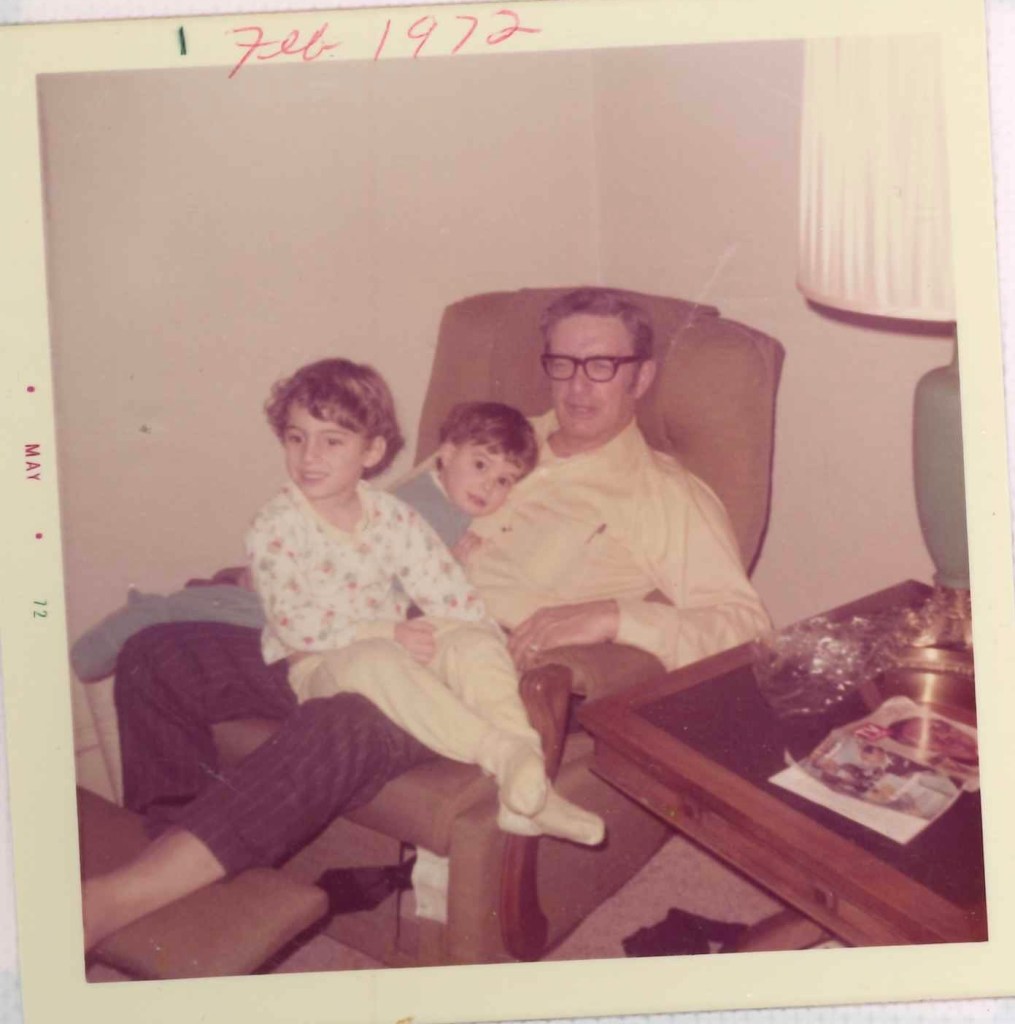
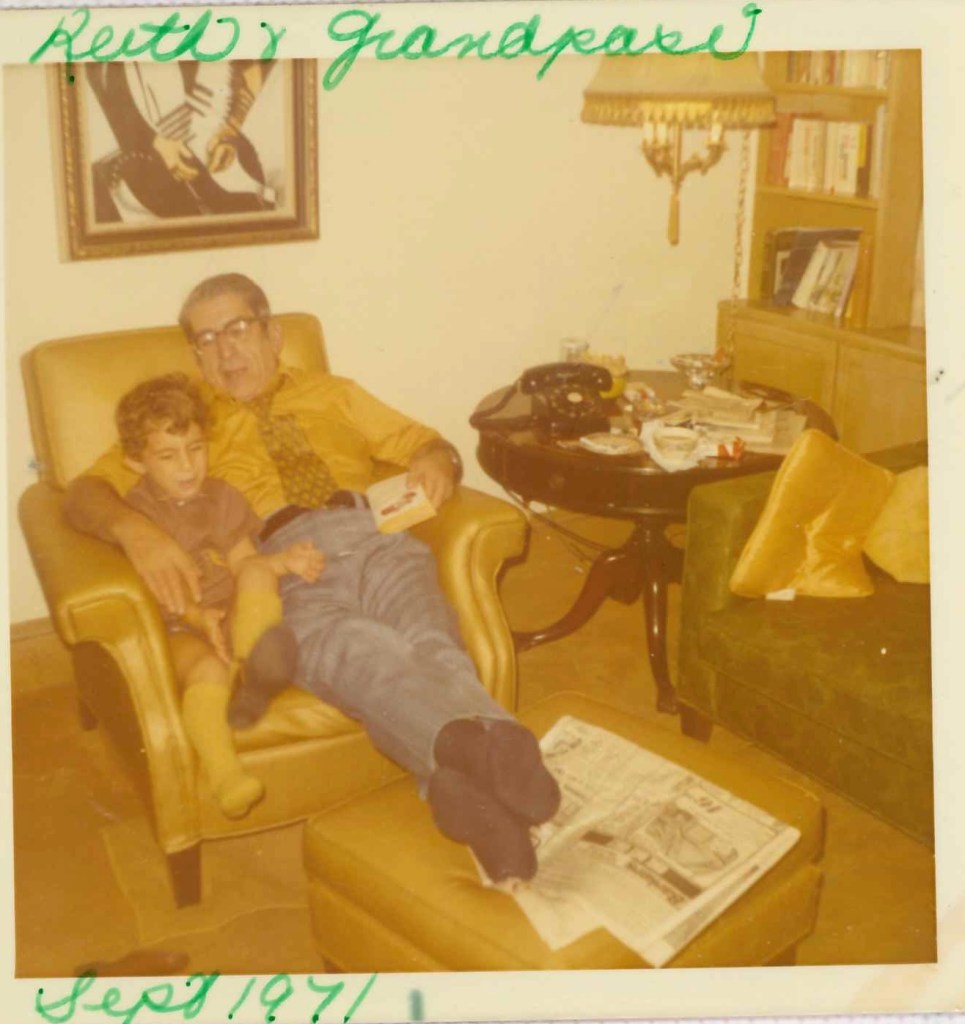
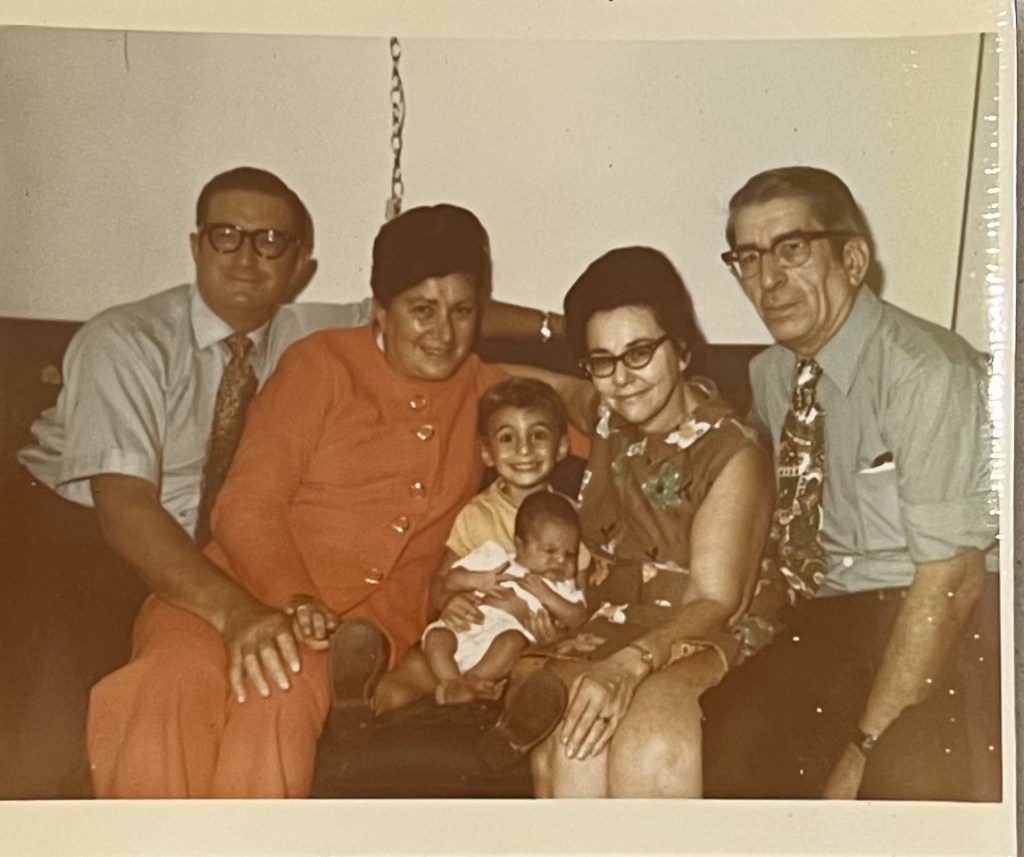
Sitting in Grandpa Len’s lap. He never stopped teachingGrandpa Si was always teaching us as we watched himI was lucky to have all 4 grandparents alive and teaching me until I was 26
I want to focus on 5.
1. Family is everything. It’s something my parents and grandparents always believed in. Whether that meant ensuring we spent time together as a nuclear family, extended family, or with those who are just considered family, there was never a question about this in our house. Growing up, we attended every family celebration. We spent vacations at my grandparent’s beach house in Connecticut which meant we spent that time with most of our cousins. Holidays were family events and I have fond memories of Thanksgiving and Passover with my cousins. This is something I have continued with my children. It’s essential they understand that when it comes to family, that always comes first.
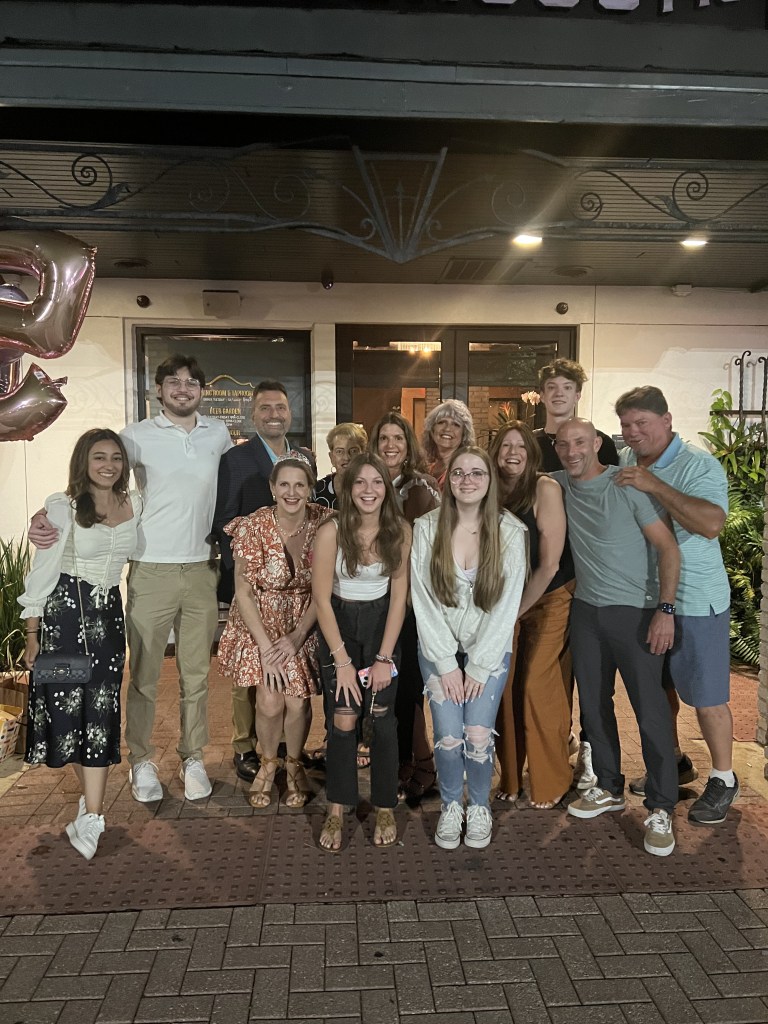
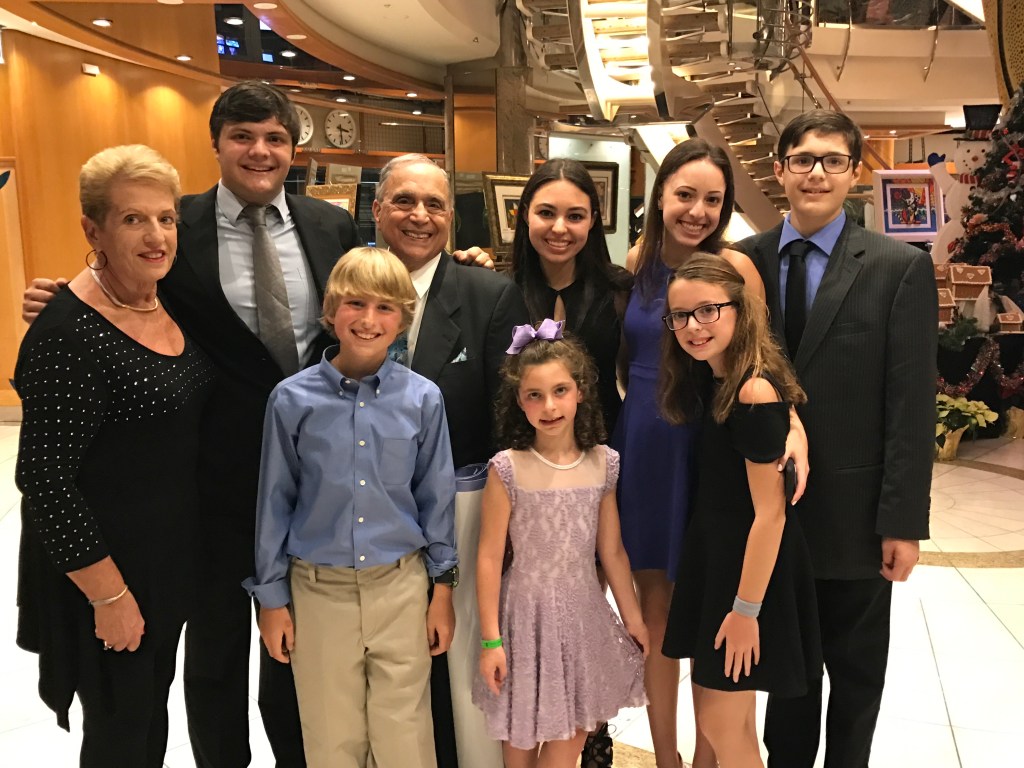
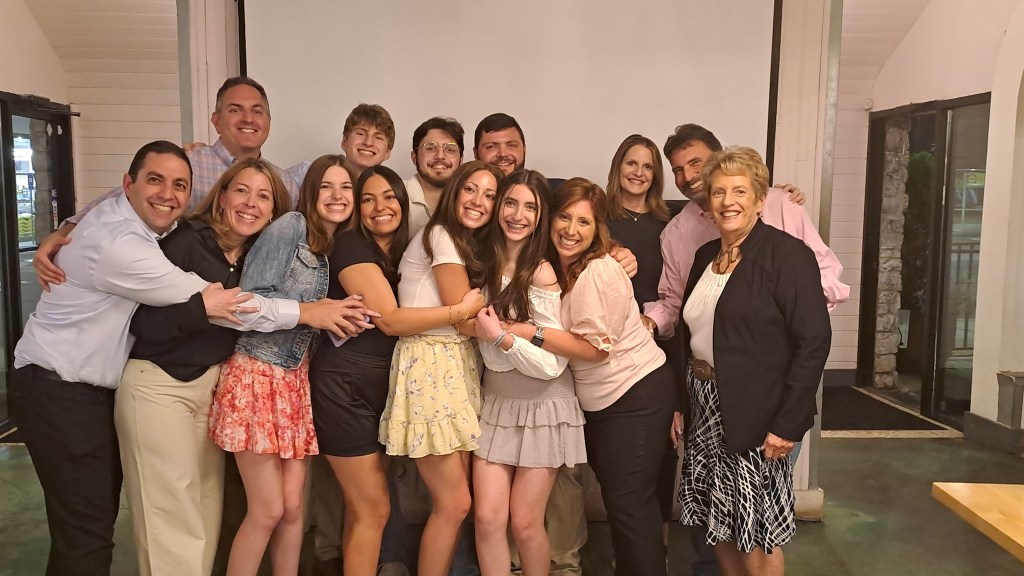
The family celebrating Ali’s 50th birthdayOne of our memorable family vacationsMy parents with their 7 grandchildren on their 50th anniversary cruiseThe Dvorchik family all togetherEven without my dad, when there is a family event we show up
2. Judaism matters. I spent most of my childhood at the synagogue or JCC. Hebrew school was 3 days a week. We went on Shabbat morning for services. My parents were involved so there was usually an event at least one other day a week. 4-5 days a week, 10 months a year, I was there for something. The JCC was a couple of blocks away and easy to walk between the two. I learned to swim at the JCC. I played basketball, floor hockey, did community theater and was on the swim team at the JCC. As I got older, the public school had a bus that stopped there so it was common for my friends and I to go there after school and then, at 5 pm, figure out which of our mom’s would be able to pick us up. Using the phone at the reception desk, eventually we would find one of them at home or before they left work to get us. At least most of the time. Being Jewish and a part of the Jewish community was ingrained in me from the beginning by what my parents did and invested in. I went to Jewish summer camp. I was involved with a Jewish youth group.
My synagogue confirmation class. We still keep in touch and many of us are in Facebook chat.There is even a big time future Rabbi in our group!
Every Friday night we had Shabbat dinner. We all sat down at the table after lighting candles. My dad said the kiddush. One of the kids said Hamotzi. Every week. We could invite friends if we wanted. As we got older, we were allowed to go out with friends on Friday night only AFTER Shabbat dinner. It was tradition. It was special. As my kids got older and my oldest started playing high school football, during football season, our Shabbat dinner changed. Instead of being at the table, it was in the stands, usually a hot dog and soda as we watched him play. It wasn’t the same quality of meal, but it was the same quality of time together. Even today, we are talking about Shabbat dinner and while I don’t bake Challah like I used to before becoming gluten free, I’m trying to find a good recipe so it will be part of the weekly ritual. Family time is special and a value to my grandparents, parents, myself, and our children. The investment my parents and grandparents put into infusing being Jewish into my core remains today.
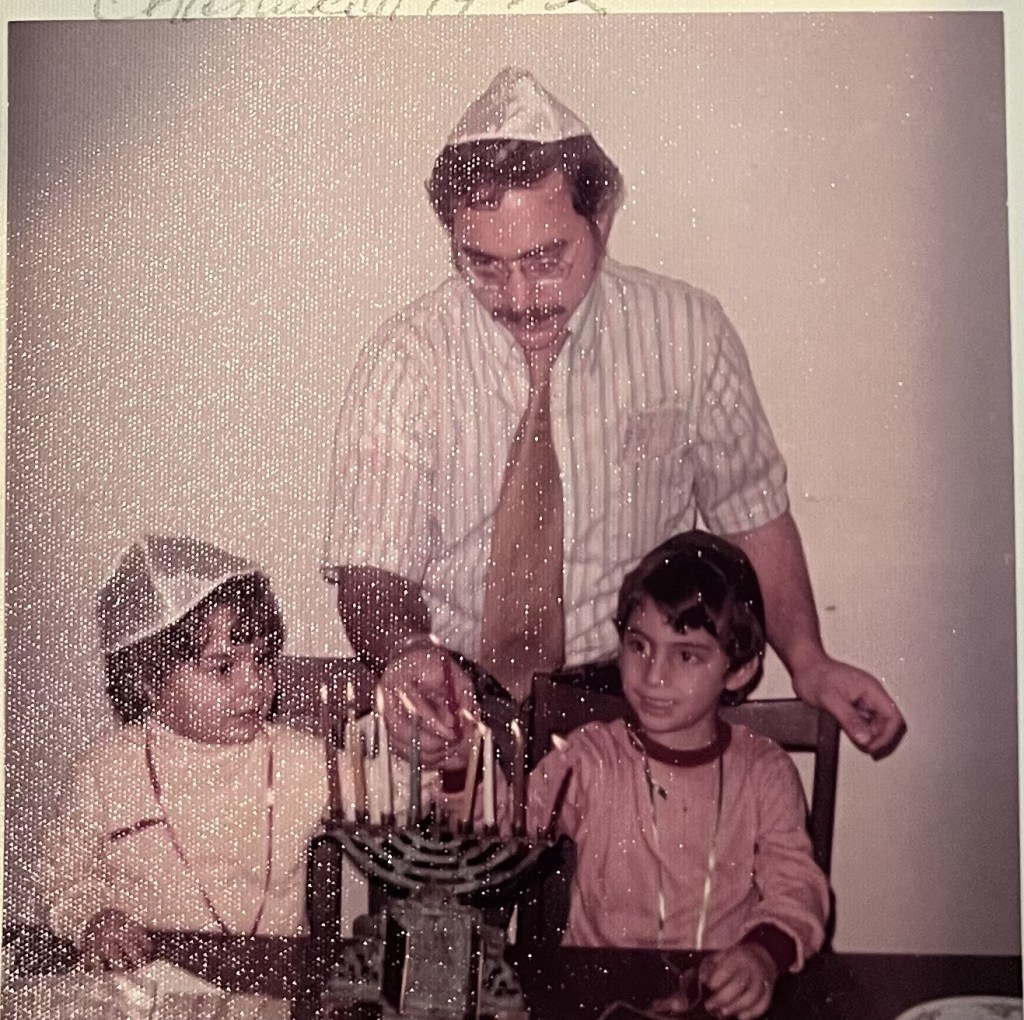
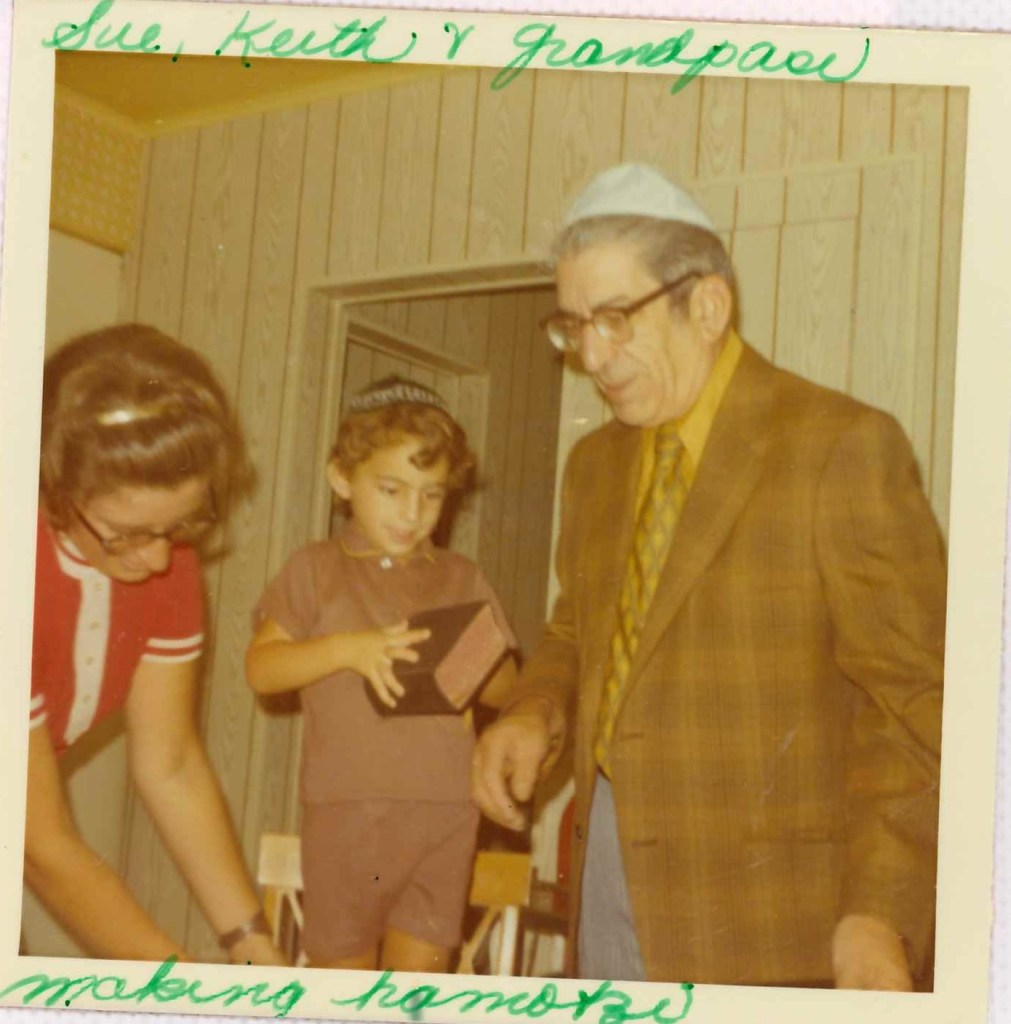
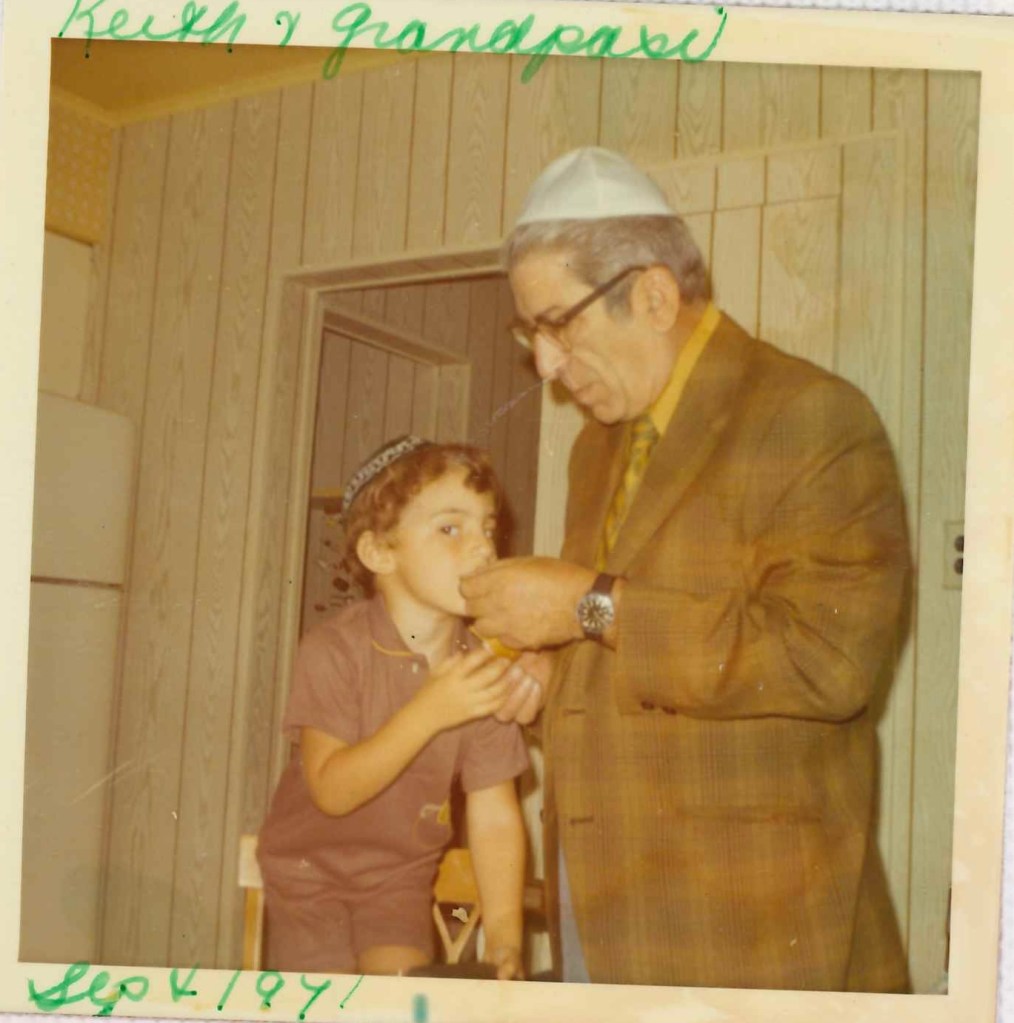
As little kids, lighting the menorah with my dadAs a little kid, saying Hamotzi with my Grandpa Si on ShabbatKiddush with Grandpa Si. I got a sip of wine.
3. Talk is cheap. This was one of my dad’s favorite statements to me (or maybe most often used). Anybody can say anything. It’s not what you say but what you do that matters. As a child, I would always have an excuse. My dad taught me that it didn’t matter what you said, it mattered what you did. “Show me, don’t tell me.” was a common theme. My parents showed love. They showed responsibility. They showed what a marriage looked like. They showed what raising a family is like. They showed sacrifice. They showed commitment. They gave the example of what to do, not what to say. At work. With each other. With us. Basically, they showed how to do this in life.
4. The best gift you can give your children is to love their mother. This came from my dad and his father. I heard this growing up. I saw it in action with my grandparents and my parents. Both sets of grandparents were married for over 55 years. My parents were married for over 55 years. They set the example for their children about love, commitment, and respect.
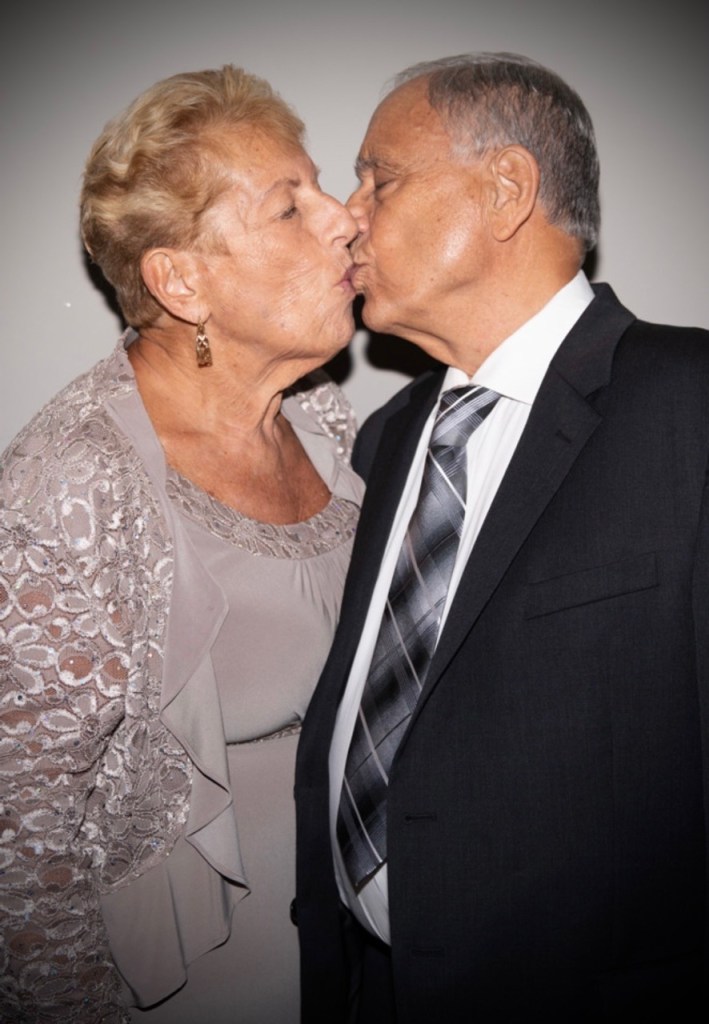
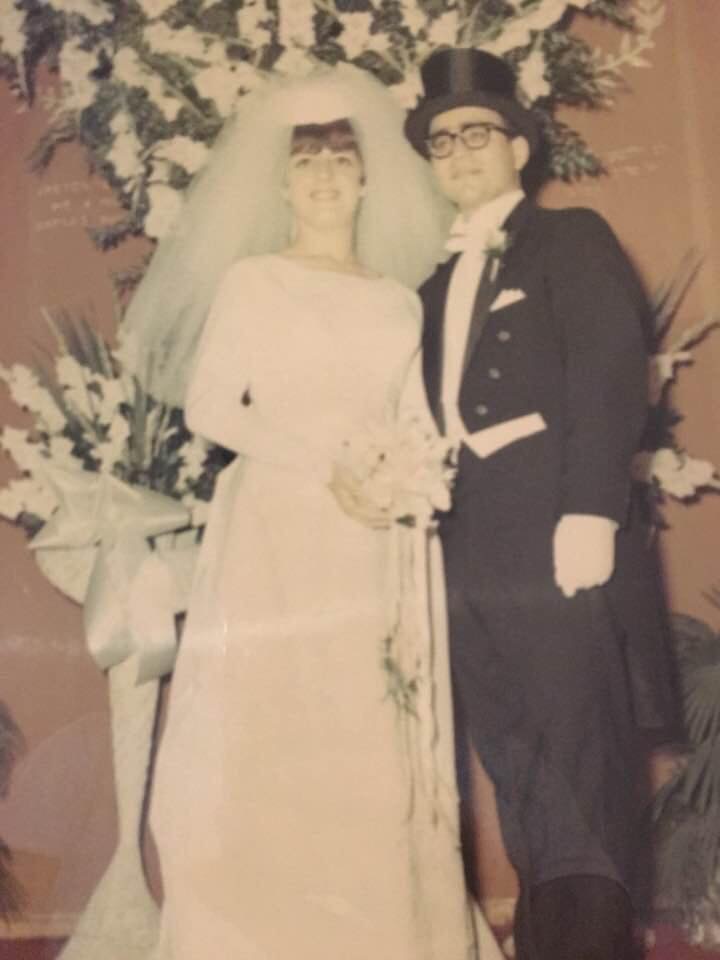
One of my favorite pictures of my parents showing their loveTheir faces show their loveTheir wedding picture has always been a favoriteMy dad’s favorite picture of my mom – he always had it in his officeAli and me enjoying a night out
5. Get involved and make a difference. My parents and grandparents were always involved in the community, particularly the Jewish community. Presidents of their synagogue. Involved with the men’s clubs, sisterhoods. Volunteering at the Jewish Home for the Aged as I grew up. The Masons, Kiwanis, Hadassah, National Council of Jewish Women, and B’nai Brith are just some of the organizations they were involved with. My grandmother knitted slippers and hats for people in the hospital. Growing up, I saw what commitment was like and as I got involved with my youth group, I took on leadership roles. In college, I was a leader in my fraternity. Throughout my adult life, getting involved has been important to me whether it was in the workplace or the things I do for fun. It’s something I have infused into my children as well. Just showing up isn’t enough. We have an obligation to get involved and make a difference.
My dad’s last big volunteer effort was a Nefesh Mountain concert to raise money for Jewish summer camps scholarships. Everybody said he was crazy. They made about 10k to help send kids to camp. He was so excited and so proud.
When I listen to Rodney Atkins sing those lyrics, I see myself as a little boy looking up at my dad. I see my boys looking up to me as their dad. And I think about the final chorus when he sings:
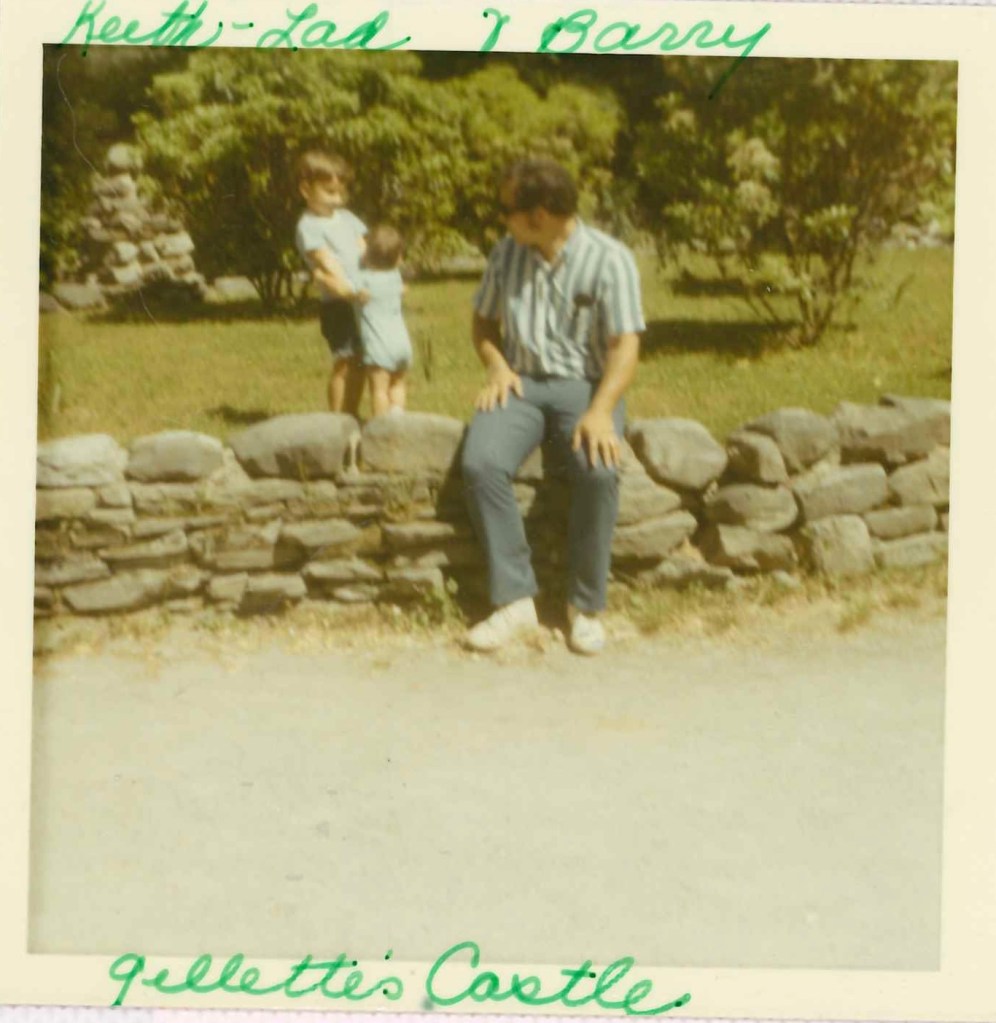
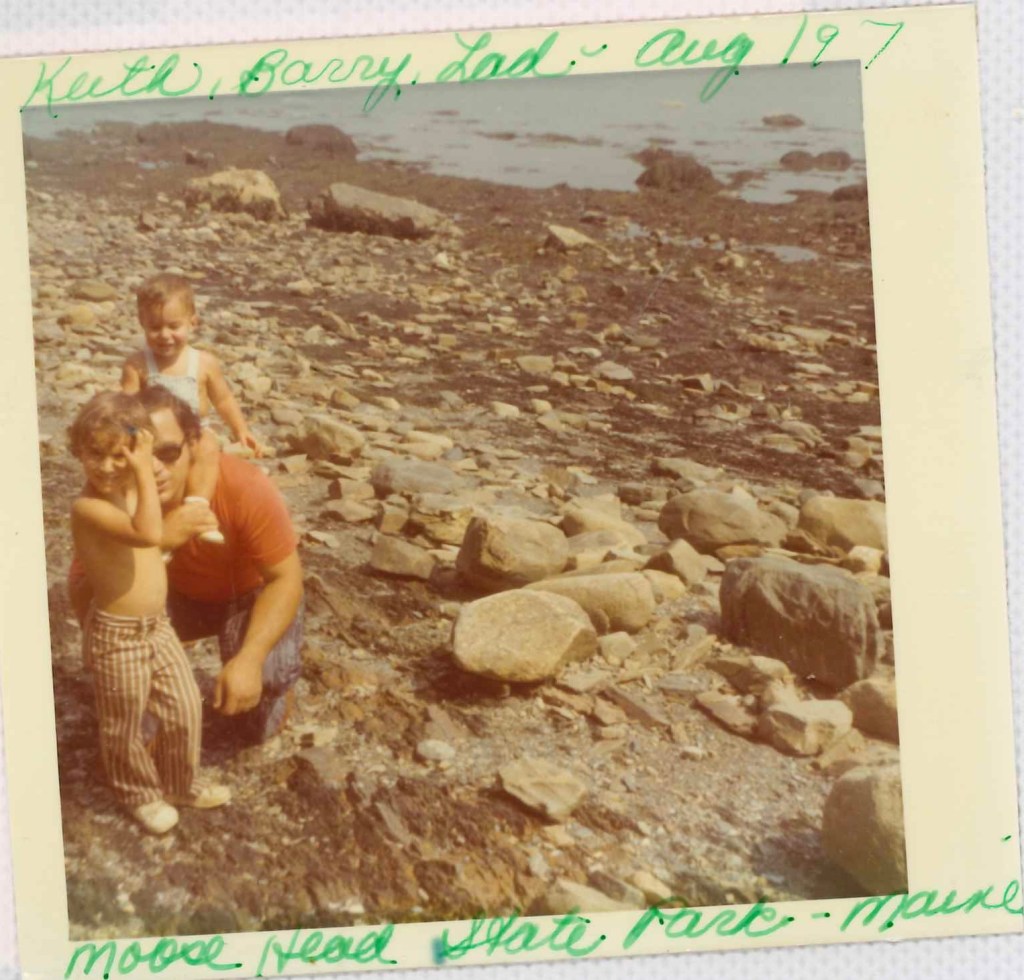
My dad with me and my brother when we were littleI’m sure I was doing something I wasn’t supposed toThe time I took my kids to dinner with Eli Weisel
“But when I’m big I’ll still know what to do. Cause I’ve been watching you dad, ain’t that cool? I’m your buckaroo, I wanna be like you. And eat all my food and grow as tall as you are. By then I’ll be strong as superman. We’ll be just alike, hey, won’t we dad? When I can do everything you do. ‘Cause I’ve been watching you.“
Our kids are watching us and learning. Their friends are watching us and learning. The world is looking at us and watching and learning. What are we committed to showing and teaching them? For me, I know. Do you?
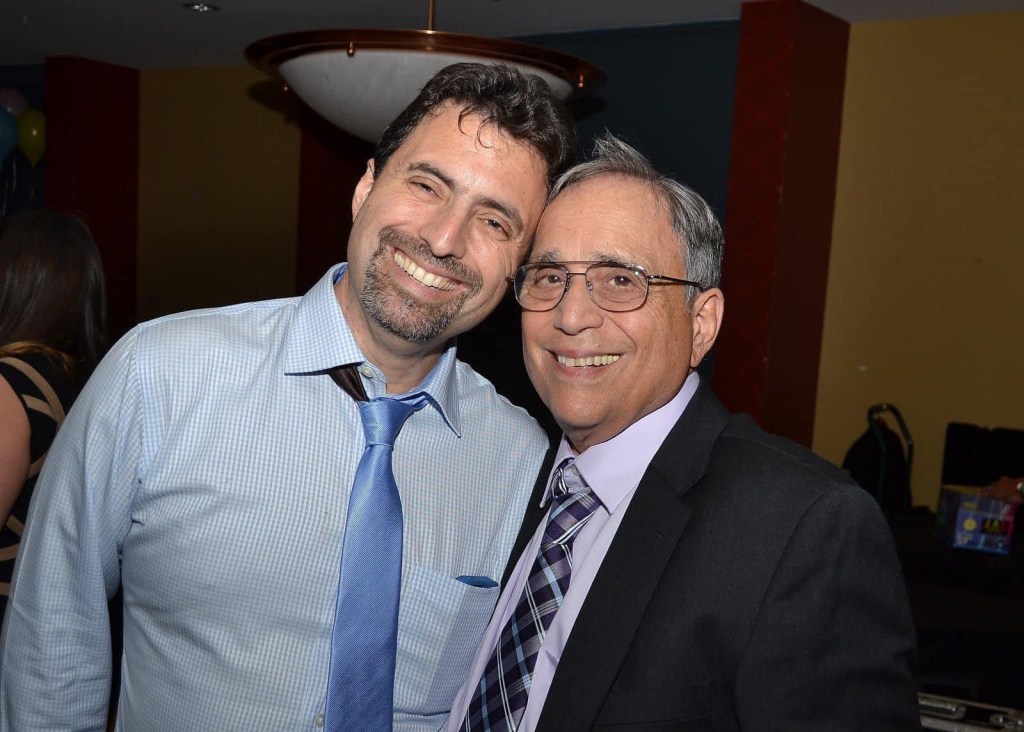
My favorite picture of me and my dad. This is from Evan’s Bar Mitzvah party. We were both filled with so much joy.















 keithdblog