The Children of Israel

Over the past two years the media has focused repeatedly on the children in Gaza. The suffering they faced. Some real, some made up. Stories they were real and that were made up.

They denied much of what happened to the children of Israel on October 7th. They completely ignored what happened to the children of Israel from October 8th until today. Spending this past week in Israel, I have had the opportunity to interact with many children here. Children in pre-school, elementary school and high school. Parents of young children who have struggled the past two years about what to say to their children, how to protect them from the horrors, and parents who are IDF reservists, struggling with the fact that they have been gone from their children’s lives for more than half of the past two years. It’s not something that can be ignored.

I visited a preschool in Carmiel, in the Northern District of Israel, often included in the area of Israel called the Misgav. It’s a town of 55,000 that is beautiful and as we drove through, you could see how wonderful a place it is. The preschool (Gan) I visited had 35 students, agest 3 and 4, and as we walked in, they were running around, happy, laughing, and inquisitive. They were excited to see new people and happily smiled at us, walked around us, and when we sat to talk, pulled up their own chairs to sit with us or sat on playground equipment to be a part of the group. They were wonderful, happy, normal children. It was amazing to see.

At one point, we moved inside to a smaller room to sit and talk without the children around us. We learned that the room we sat in was the safe room for the Gan. When the rocket alerts went off, this was where all 35 children and the staff of 3-5 teachers would all have to get into within 30 seconds. I ran a JCC with an early childhood center that had hundreds of children. Monthly, we practiced our fire drill in which we had to get all the children out of the building. We timed it an regularly had them all out of the building in under 5 minutes. Each class had no more than 16 children with 2 teachers. The alarm was loud and many of the children would hold their ears, cry, or be upset. In Israel, at this Gan, they had to get 35 children into a small room within 30 seconds. Who knew how long they would have to keep the children in this small room. Packing 38-40 people in this small room for any amount of time would be a challenge. Yet the teachers did it. The children did it. They managed. I think of how difficult that must have been on the children and on the teachers and am astounded that the children aren’t afraid of the room and don’t want to avoid it. That the room doesn’t hold terrible images for the teachers. The trauma is real and yet they are dealing with it.

We visited an afterschool program in Kiryat Shmona that has a special program for the children who live there. It’s hard to imagine, but with the 2 years of Covid and the 2 years of the war, these children have had 4 years of learning interrupted. A child in 1st grade at the start of Covid is now in 5th grade and has barely been in school. How do you overcome the deficits that occurred both developmentally and educationally? What has to happen so that these children have a chance at a normal life and learning the basic tools that they missed, both educationally and socially? My youngest son spent his entire senior year doing online learning due to Covid (before you freak out, the schools were open and there were many reasons why we began and then stayed with online learning for him). It wasn’t easy for him to overcome the social deficits as a result of the last semester of him junior year and his full senior year being done online. We created a plan and it worked. That was just over 1 year for a 17/18 year old. Not 4 years for a 6-9 year old child. These children in Kiryat Shmona and other evacuated communities may need years of remedial work to deal with the academic deficits, let alone the social and developmental ones. Who’s talking about the damage done to them?

I spoke with a 37 year old father who has spent more than a full year since October 7, 2023, in the IDF reserves. He talked about his struggles when he returns home. He has two children – two children who have not only missed having their dad in the life for more than half of the past two years but who also know that he has put his life on the line every day he wasn’t at home. A father who has trauma to deal with so isn’t the same father that left them on October 7th to defend the people of Israel and the Jewish people. A father who struggles to be there for them all the time. Who talks about these children? Who is taking care of their needs? Where is the attention on the children of those brave soldiers who have kept going back to serve to defend not just their country but the Jewish people? Why is there no outrage at the damage to them?

We talked about a school that one of my friend’s children attend. In one classroom there is a teacher who has spent a great deal of time in reserves. There are two children dealing with the loss of family members on October 7th. Why is there no outrage about these children, living in the center of the country, who know the cost of war and the cost of freedom better than most people in the United States? Why is there no outrage at the impact on these children of losing their teacher for so long?

We have a generation of children of Israel that face enormous challenges. Who have faced enormous stress. Who have lost loved ones, parents, and friends due to the Hamas attack on October 7th and the ensuring war to keep Israel safe. Where is the outrage about what they have to deal with? Where are the world’s children’s organizations who are so critical of Israel, forgiving of Hamas and their responsibility?

This past week in Israel has shown me a new price that is being paid by Israel and the Jewish people. The price is being paid by our children. I don’t think we’ll know the exact cost we have to pay for quite some time. It’s a high price for sure, one that the world doesn’t care about. Jewish children — Jewish people — are expendable to the world. They don’t count nor do they matter. It’s unforgivable.

We can never forget the price of this war and defending Israel. It is a very high cost. The only thing worse would have been doing nothing. It’s not easy, especially when you see this price. It’s worth the high cost and we hope to never pay it again. It’s worth the many people who were impacted because of the many people who will be kept safe as a result.

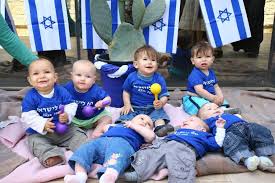
When you look at the faces of these beautiful children and these beautiful babies, how can you not stand up and speak out on their behalf? How can you not do everything possible to protect them? We know Hamas does everything they can do damage and harm the children in Gaza as well as the children in Israel. We have to fight back even harder to protect ours.
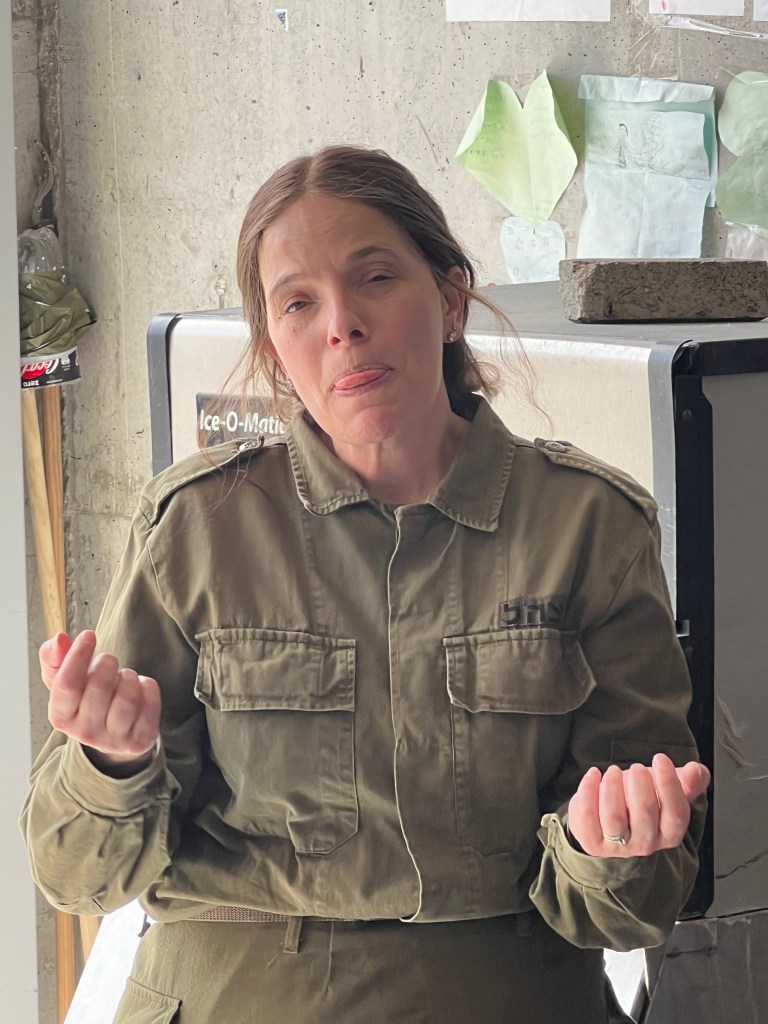
The living dead

I use a lot of sources to keep up to date on the news. Unlike the days of Walter Cronkite on CBS news, there is no single trusted source in today’s media. One of the people that I read is Danny Gordis. His “Israel from the Inside” substack posts are filled with a great deal of facts, stories, opinions, and thoughtful pieces. Today’s post was extremely powerful and hit me deeply, bringing tears to my eyes. Having been to Israel 3 times last year (May, July, and September), and working with many different organizations in Israel with daily contact with Israeli’s, it hit home. It’s what I have seen, heard and felt. While on a zoom with one of my partners last week, she let us know that she may have to leave in a few minutes because she got the “10 minute alert” that the Houthi’s had fired a ballistic missile at Israel. Sure enough, a few minutes later she said, “I have to go” and off she went to her safe room. The rest of us stayed and talked until she returned a few minutes later.

I urge you to read this story from Danny Gordis’s “Israel from the Inside”. It is an English translation of a Facebook Post (in Hebrew)from yesterday. And if you subscribe (paid or free), you won’t regret it.

I died on the 120th day of the war, but I didn’t tell anyone

I was killed on the 120th day of the war, but I didn’t tell anyone. The battles were raging and I didn’t want to hurt the guys’ morale. At the end of the month, I got leave.

My wife Talia picked me up from the train and hugged me tight, as if she were drowning in a frozen sea and I was a wooden door. So of course I didn’t tell her I was dead; everything had already fallen on her shoulders these past months. The moment I entered the apartment, Romi, my four-year-old daughter, came running from the neighbors, jumped on me and refused to let go—so I didn’t tell her either that Daddy was dead. Why break her heart?

After Romi fell asleep, Talia waited for me in bed with white wine. “I missed you,” she wrapped her warm thighs around my cold body. We made love. Not because I wanted to (the dead don’t need sex), but just to make her happy. It didn’t work; she stayed distant (or was it me?), and when she asked what I’d been through—I stayed silent (no reason to bring horrors into bed).

A few days later I went back to the battlefield, and two weeks after that I saved five soldiers from death.
“You’ve got balls of steel!” the battalion commander slapped my back. I wanted to say I was dead, so I hadn’t really risked anything, but since my actions had revived the unit’s spirit, which still hadn’t recovered from the death of Gilad the platoon commander, I replied, “Thank you, sir.”

At some point I was sent home, back to “normal life,” but between me and it stood a transparent, impassable border, behind which I watched them like a fish in an aquarium. And the world that once excited me—turned faded; work at the computer store no longer interested me, nor did poker games with friends, and at home, with Talia and Romi, I felt like an invading germ.

Until… One Saturday, Romi fell in the living room. “Daddyyyy!” she cried and I froze, hypnotized by the sight of blood trickling down her forehead, the clear tears dripping from her eyes, the yellowish urine that escaped her, and I thought about how many shades of fluid are in the human body, and remembered Sergei and the bullet he took to the head. That night, after we got back from the ER, Talia said I had to get help, that she couldn’t reach me, that she was out of strength. But all I heard was blah-blah from someone who doesn’t understand how the world works and how bloody and stinking and monstrous it is.
Better she doesn’t know. Let her put on an avocado mask and go to sleep.

But she kept nagging, so I went to the living room and stared at the sidewalk, seven floors down, and wanted to jump, because I felt like a foreign body that life had rejected. The window wouldn’t open. Turns out the frame was bent by a rocket that fell nearby. So I gave up and went to bed.

The next day, Assi, who’d been with me in high school and in the unit, came into the store. Since it was already noon, we went to the hummus place, gossiping about Victor who learned to jump with his new leg, about Barry who got a better hand than the one he lost, and about Udi who finally proposed.
At some point, there was silence and I asked if Talia had asked him to come talk to me. Assi nodded, because there’s no bullshit between us.

“So why is she worried?” he asked.
“It’s hard for her to accept that I’m dead,” I answered honestly, because I no longer had the strength to hide it.
Assi wasn’t fazed and speared a pickle from the plate. “Remember when you died?”
“The day Sergei was shot.”
“Mmm… half a year.” He bit into the pickle. “And what’s the hardest part about being dead?”
“That I don’t feel anything.”
“Really?” He looked at me, picked up a fork and stabbed my hand.
“Ow!” I jumped, “Are you nuts?!”
“Turns out there are some things you do feel,” he grinned, like a kid who just egged the principal.
I glared at him. Really? Seriously?! That’s your reaction to my death?! Seven years of psychology studies for this?! I got so angry I threw an olive at his eye.
“You son of a—” he flung pita at me.
So I threw a shish kebab at him.
A wave of stupid laughter took over and we kept pelting each other with fries and falafel until the owner lost it and kicked us out.

“What if…” Assi wondered as we walked back to the store, “it’s not that you don’t feel, but that… you’re afraid to feel?”
“Afraid to feel what?” I asked, and immediately thought of Ortal, Sergei’s wife, who after years of fertility treatments finally got pregnant, and how he came back from leave beaming and showed us the ultrasound of the boy. “Check out this mega-penis! Just like his dad!!!”

48 hours later, he took a sniper’s bullet. A bullet that wasn’t even meant for him. I was supposed to go to the window, but I was breaking a record on a dusty Game Boy I’d found, so I asked him to go instead and… I started to cry, because he didn’t deserve it. He didn’t.

“Now I know you’re alive,” Assi said, “Know why?”
“Why?”
“Because dead men don’t cry.”

He put a comforting hand on me and suddenly there was wild gunfire, fighter jets tearing through the sky, which stank of smoke, of decay, someone cried “Yama! Yama!!” Or maybe it was “Mama! Mama!!” And my hands searched for a weapon, but I was in civilian clothes, in the middle of Bialik Boulevard—

“I’m losing my mind,” I told Assi.
“You’re not, bro! You’re feeling, don’t run from it, don’t run!” And he hugged me tight and didn’t let me fall.


That evening I went to Talia, who was folding clothes, and said I wanted, like before, to read Romi a bedtime story. “Not sure that’s a good idea,” she refused to look at me. So I pinched her butt, like we used to do to annoy each other when we were dating. It surprised her, even confused her.

“Assi came to visit me at the store,” I said.
“And…” she glanced at me.
“He stabbed me with a fork.”
“Too bad it wasn’t a pitchfork,” she looked at me for a few seconds and must have seen something that changed her mind, because she picked up a book from the couch and handed it to me.

I read Romi a story about a turtle who wanted to be a butterfly, and the night lamp painted colorful animals on the walls. She fell asleep before the end, where the turtle, drawn in black and white the whole book, suddenly glowed with colors. And even though it was a predictable and silly ending, I teared up, and stroked her tiny, sweet fingers, moving with the rhythm of her dreams, and I couldn’t understand how in the same world horror and love could live side by side.

And I thought of Sergei, of his wife, of the baby in her belly, of corpses and kisses, screams and butterflies, and everything inside me stormed and raged and cried… and I didn’t run from it… I didn’t run. I didn’t run.

I know far too many people like this brave man. Far too many Israeli friends that have been through hell and back since October 7th. Rami Davidian, the farmer who saved 750 people from the Nova Festival on October 7th – the look in his eyes as he told us how he untied dead women from the trees he was looking at, their bodies abused, to give them dignity, is something I will never forget.

I have heard stories from my friend Yaron about October 7th, the first four months of the war in Gaza, and the most recent hostage release during the last ceasefire, that I will never forget. There are more that he cannot share. My friend Tal goes back into reserves in what seems like every other week. I’ve been to army bases, had barbecues with IDF soldiers and families from Kibbutz Alumim. Hearing the members of Kibbutz Alumim who fought the terrorists on October 7th is something I will never forget. As one member pointed out the 3 places he was shot that day, the places where bullets still remain in his body, I often wonder how, or if, they will ever recover.

Then I think about the work Dror Israel is doing with children and families in Israel. I think about Hapoel Jerusalem Football Club and the work they are doing with Trauma Soccer and their neighborhood leagues which get Jewish and Arab children in Jerusalem to play and learn together. I think about Hersh Goldberg-Polin (z’l), one of the leaders of their fan club and how much a future of peace and healing mattered to him. I think about Israel Volunteer Corp-Sword of Iron, mobilizing a community of over 44,000 people who want to volunteer in Israel to help rebuild both the physical and emotional state of the country. I think about what I do and what else I could do, to make a difference.

The Jewish people and the citizens of Israel have a long road ahead of us – first to win this war against evil and get the hostages back, and secondly to recover from what we have seen and what we face on a daily basis. It won’t be easy but we can do it together.

My question to you is what will you do? Will you be like Talia and Assi and do the difficult thing to help? Will you stand by while the author of that piece and so many others suffer in silence? Will you shake your head in sadness at the murder of ​Yaron Lischinsky and Sarah Milgrim as they left a Jewish communal event or at the firebombing in Boulder during a peaceful march to have the hostages in Gaza returned or will you take action and do your part.

History is waiting to be written – the question is what will your role be. I hope that the writer of the piece in Danny Gordis’ “Israel from the Inside” inspires you to take action. I know it inspired me to do more.

Mourning, Air Force Base, and celebration

The last day of our trip was a powerful one on many levels. The amazing thing is that we only went three places and one of them was the restaurant for lunch!

We left about 30 minutes late which frustrated our staff. It ended up being perfect. Our first stop was at Shura Army base, a forensic center near Ramle where most of the victims from October 7th were brought to be identified. As we got there, they were loading the body of one of the IDF soldiers who was killed on Saturday in Gaza into the van to take him home to be buried. We go to watch them put him into the van, one of our group who was saying Kaddish for his mother said Kaddish, and we then escorted him out of the parking lot on his final journey. It was incredibly powerful and moving. To be able to do that type of honor for a soldier killed defending Israel and the Jewish people was overwhelming. These kids, and they are kids, put their lives at risk every day to protect Israel and the Jewish people. In America when I see a soldier, I always thank them for their service. In Israel, I want to begin doing that as well. It’s the very least I can do.

We met Noa, the woman who works to prepare the bodies for burial and for identification. Noa told us that she has 8 children and on October 7th, 7 of them, plus her husband and herself were drafted into the army. Think about what that must be like. It was yet another reminder that the Israeli people do not want this war. They do not want this war to go on indefinitely. They want the hostages returned. They want Hamas out of power and not able to kill Israelis any longer. They want peace and quiet on the border. They want to go back to living thir lives. They don’t want to worry about their children or their spouses in firefights. They want normalcy and that only comes with the return of the hostages and Hamas removed. They will deal with the emotions and fear to accomplish those goals. But it’s not what they want to do, despite what the media may tell you.

Noa speaking to us

We entered the base and came to the meeting room where we learned what they do here. After October 7th, this is where most of the bodies came for identification. They have a lab on the second floor to do DNA testing. They have DNA, dental records as well as fingerprint records for every IDF soldier . It made some of the identification easier but many of the bodies were burned or were just ashes. As we entered the actual area where they did this work, we were silent as the gravity of the work settled in each of us.

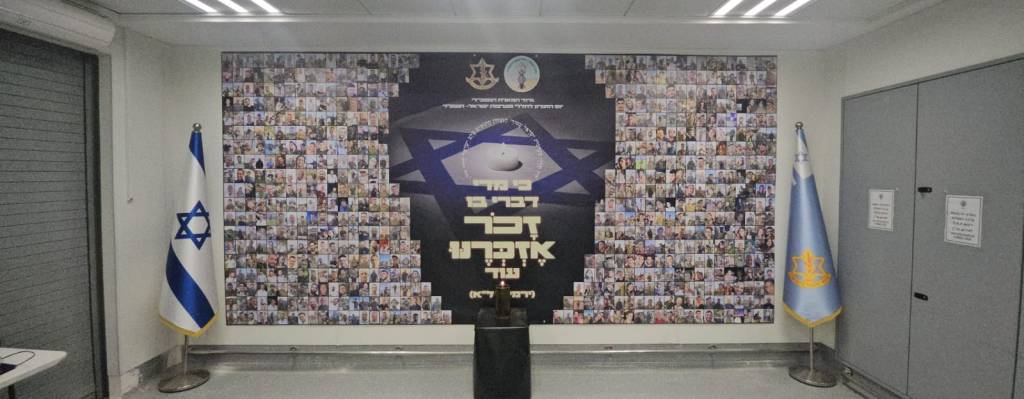
The meeting room in the base before you enter. Notice the pictures on the wall are all faces of those murdered on October 7.

In the room where they do the ritual preparation of the bodies, we heard what it was like after October 7th. I’m not sure that i can even try to describe what she was telling us. The condition of the bodies that came in. Some of the challenges identifying them. Some that were just ashes or parts of bodies. And the blood. That is the one thing that I will never forget. Her description of how much blood there was and they had to deal with. She told us about a Hassidic man who came in with bodies. He had been pulling dead bodies out of bomb shelters that Hamas attacked at Nova. He had blood halfway up his calf because to pull them out he had to step in pools of blood. The more stories she told us, the more horrified we were. Then she said something that has me thinking. She said that she can’t focus on how awful it was and what happened. Instead, she chooses to focus on the good in her life and what she can do to make the world better. She wants to cook a better dinner for her family. Be a better mother for her children. Be a better wife for her husband. Be a better friend, neighbor, and boss. It’s an incredible way to look at the world and an incredible attitude. It made me thing about what I am willing to do to deal with the anger and rage from Kfar Aza, Nova, and being at this base. Am I going to let the anger and rage consume me or am I going to turn it into something to make the world a better place. If Noa can do it after what she has seen, I know that I can as well.

We left the room and moved to the room where families have their chance to say their last goodbyes to their loved ones. It was hard sitting in that room, looking at the table where the body would be, knowing what families must be feeling and experiencing when their loved one is on that table. We were all quiet as we sat in the room and Noa talked to us. I think we were all grateful to have been in the room but even more grateful to leave it.

Listening to Noa talk about what she and her team have gone through since October 7th makes me think about all the people we normally don’t think about. They aren’t family members of those murdered or kidnapped. They haven’t lost family members who are serving in the IDF. Yet they are traumatized by what happened on October 7th and what has happened since October 7th. What is it like to have 7 of your 8 children drafted into the army to fight a war? What is it like to have both you and your spouse drafted into the army during a war, potentially leaving your chidren as orphans? What is it like to deal with that many dead bodies? With that many mutilated people? With remains that are just ashes? The entire country is dealing with PTSD and I’m not sure what it will mean long term.

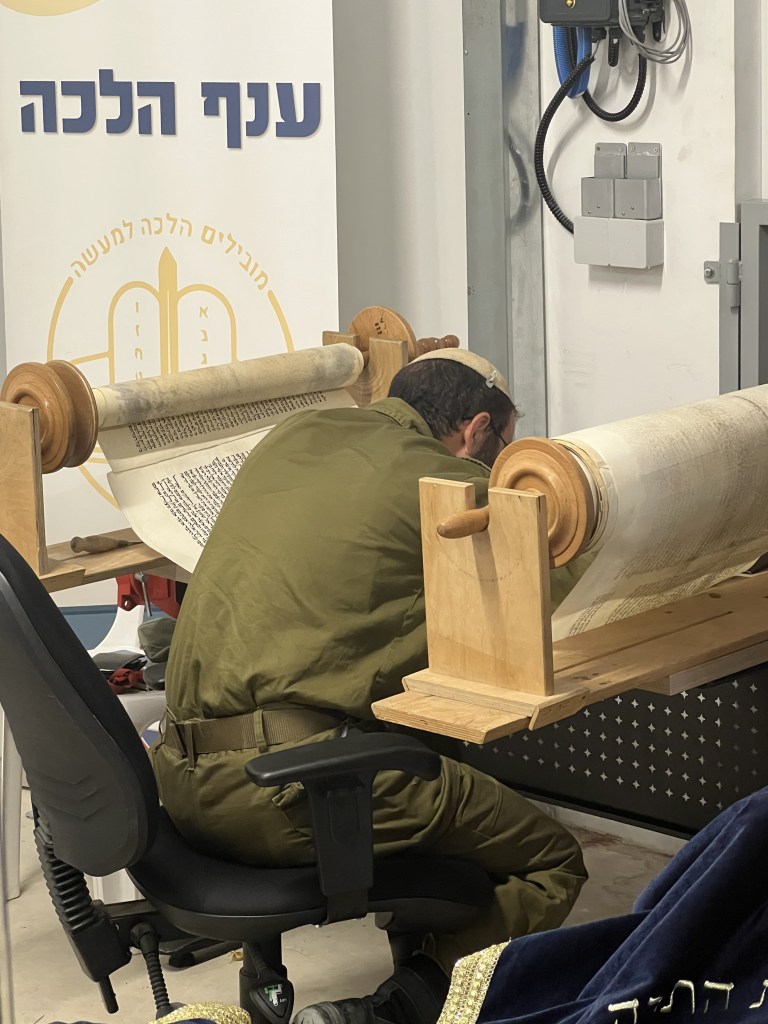
Our last stop on the base was to visit the place where all the IDF Torahs that need repair or can’t be repaired are kept. It was incredible seeing how many Torahs they have there. As the Rabbi who is in charge told us, it’s the largest Aaron Kodesh (ark) in the world. He also told me that the IDF needs thousands of mezuzahs for their soldiers. They need them for the rooms where soldiers sleep in bases, outposts and bunkers both within Israel, along the borders (south and north) and in Judea and Samaria. They also need a few dozen at this point for buildings inside Gaza seized and used for headquartersWhen you watch this video I took, you will be amazed at what you see.

The IDF torahs in need of repair or that can’t be repaired
The sofer (scribe) repairing a Torah

As we left the base, we were all shaken by the experience. Like at Kfar Aza and Nova, we felt the death. We felt the overwhelming loss related to the murder of 1200 people on October 7th. As I think about how Israel has changed since October 7th, these feelings are a part of it. If I am feeling it after only 8 days, how powerful must it be for Israelis who have been feeling it for over 7 months?

We headed to our last stop of the trip, the Palmachim air force base. This is where they fly drones from. The base is highly secure, no pictures were allowed, and things were off the record. What I can tell you is that I was blown away by what we learned. I can tell you that the process Israel uses to actually have a drone drop a bomb is multi-leveled and requires multiple approvals. And I can tell you that the drone operator ALWAYS has the authority to abort the mission no matter what the supervisor says if they determine that there are civilians, women or children in the area and that it would not be appropriate to execute the mission. I can also tell you that this happens more often than you would expect. The drone operators are kids. Their support staff are 18-19 year olds. It’s always amazing to look at who comprises the Israeli military. It’s largely the 18-22 year old population. This is very different from the US military and not what most people think of when they think of an army. These are kids who are willing to do whatever is needed to defend their country and the Jewish people but really want to finish their service, travel, and then go to college and live their lives.

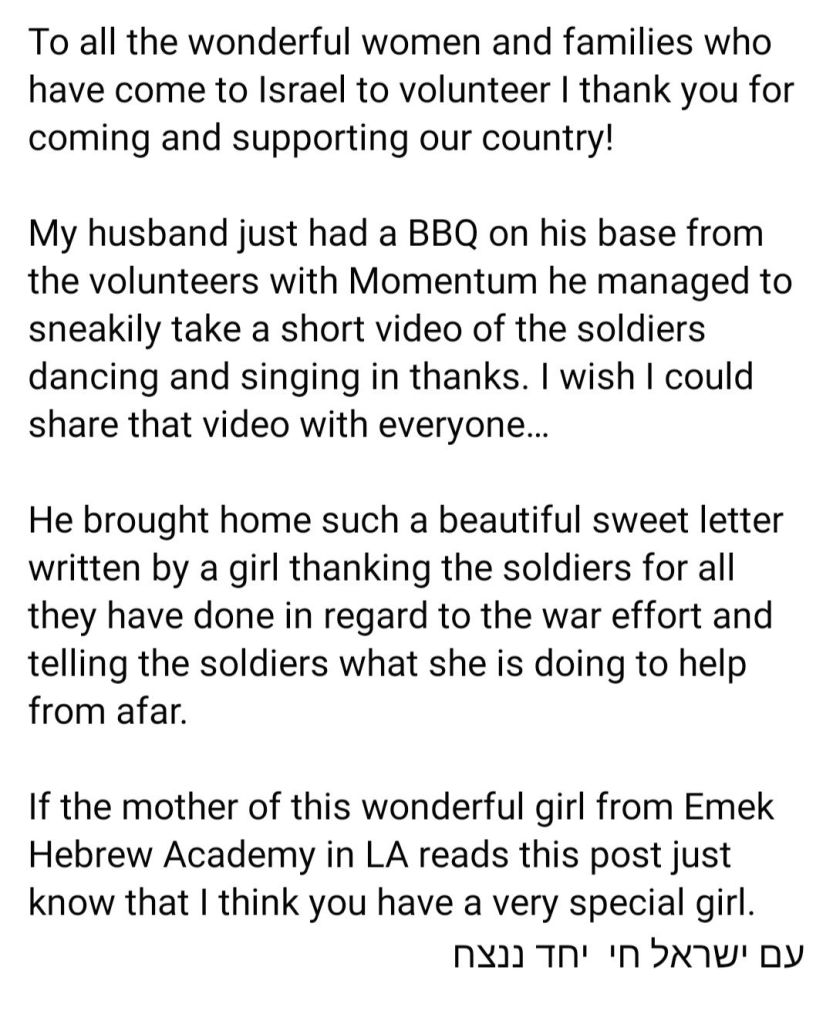
After the briefing, we had our final barbecue with the soliders on the base. These 18-25 year old men and women were so happy to have us there. We sat with them, talked, and got to know them. The DJ played great music, the food was good, and we had fun. After we ate, the DJ really got things moving and we got up and started dancing. The soldiers joined us as we danced and laughed and had a great time. As it got to be time for us to leave to take people to the airport, they had difficulty getting us to stop. We finally did, celebrating with the soldiers. Some of the guys on our trip were from Emek, a Jewish Day School in Los Angeles. They had some of their students write letters to the soldiers. The day after our visit, we got this note from the wife of one of the soldiers on the base. If you ever wonder if the letters you write, the visits you take to Israel, the support you provide really matter, I think this note proves how much they really do.

It was sad as some of the guys headed for Tel Aviv and then we dropped a bunch at Ben Gurion airport. The rest of us returned to Jerusalem and a few of us made plans for the next day. The trip was over but the experience will last a lifetime. There is so much for me to unpack from this trip. So much to understand about what it means to me to be a man, a husband, a father, and a Jew. What does it really mean to be a Zionist? what am I willing to die for that shows what I actually live for? Much much more. As I unpack it, I will share them.

I still have 2 days in Israel, two precious days in Israel. Two days to wake up in Jerusalem, smell the air, walk the streets. What a blessing that is. A day in Tel Aviv with meetings. Time to see friends. Israel is truly in my heart and in my soul. As my 21st trip approaches the end, I am already looking at possible trips 22, 23, 24, and 25 in the next year. I appreciate how lucky I am to get to go to Israel. How lucky I am to have the contacts and connections in Israel that I have. The Israeli friends that I have. An understand of the land, the history, the challenges, the struggles, and just how much it means to me as a Jew. If you haven’t been to Israel, I urge you to come, especially now. If you have been to Israel, I urge you to come back. I promise you will experience a different country and a have a different experience.