Being Jewish and Inspired

Those who know me, know that I am not the most religiously observant person. While I am very Jewish and have a strong Jewish identity, when it comes to religious observant, I’m on the low end. When my friend asked me to come to services this Shabbat as he was sponsoring the kiddush in memory of his son, I said yes without hesitation. Not because I love services but because friends show up. Instead of my relaxing Saturday morning on the couch, watching College Gameday, rooting for the student to make the field goal and take Pat McAfee’s money, I found myself in synagogue.

I care much more about what goes on inside a synagogue that what the inside looks like in a synagogue. I have been to many that are beautiful inside but I don’t find warm, welcoming, or the service interesting or meaningful. I understand why many people want to invest in making the environment beautiful but I’d much rather see the money go to ensure great clergy, staff, culture. It’s a personal preference.

I note this because I have found that those that are more modest aesthetically tend to be more welcoming and I tend to enjoy what happens in them. As soon as I walked into this synagogue, I felt at home. It was warm, welcoming, and it was clear to me that the investment was being made in what happens inside the rooms rather than the rooms themselves. A number of people welcomed me immediately and the Rabbi, in the middle of the service, walked up to me to welcome me and give me a hug. In a crowded room, they made sure to find me a seat. People came up to say hello and welcome me.

I often find that in Jewish spaces, this type of welcoming doesn’t happen. We want people to come to our events, to be a part of our organizations, and yet we don’t make sure they feel included or special when they do. It was the first time I was at this synagogue and they made me feel right at home. As sombody who doesn’t love services, I found myself enjoying it because of how I was made to feel while there. I enjoyed the loud singing and comraderie that was happening as part of the service. Amazingly, I found myself thinking I would like to go back.

I found myself wondering why we don’t do this more often. We see our synagogues and Jewish organizations struggling with membership and attendance. We also see so many people who want to have a Jewish connection and yet they can’t find one that resonates with them. The old ways, the “Jewish tax”, the mandatory synagogue membership, etc. are no longer applicable. People want to spend their time in a meaningful way and many of them aren’t finding it in Jewish spaces. How do we change this?

There was recently a study about the shortage of people enrolling in Rabbinic School. In the study, they found an incredible diversity of those who enrolled. 58% identify as women, 30% as men, and 12% as nonbinary with an estimated 51% identify as LGBTQ. It’s amazing to see how the field has changed in the past decade or so. There was a big outrage by some about the high percentage being LGTBQ and women Rabbinic students, as if that was a problem. Perhaps to some it is. The bigger concern to me is about the overall number of people enrolling in Rabbinic school and the Rabbis that are graduating. I am a firm believer that the Rabbi is the key to the success of a synagogue. When the Rabbi is inspiring, the synagogue tends to flourish. People want to learn from somebody who inspires them. People want to spend time around those who inspire them. Rather than focus on the sexuality or gender of those in Rabbinic school, perhaps we should be asking ourselves why we aren’t recruiting the best, inspirational people to be our clergy?

At the synagogue I attended this Shabbat, the Rabbi was engaging. He was teaching us torah in between each aliyah. He was funny. He was engaging. I learned something new and applicable to my life each time he taught during the service. It made me want to learn more with him. It made me want to go back. He was inspiring. Our leaders, particularly our clergy, need to be inspiring. What are we doing to ensure we have inspiring clergy? Where are we failing? How will we address it?

One of my favorite clergy members is Cantor Azi Schwartz from Park Avenue Synagogue. He does amazing work putting classic Jewish prayers and songs to contemporary music. His version of Hallelujah set to Bruce Springsteen’s Born to Run at Rosh Hashanah this year is outstanding. I’ve listened to it more than a dozen times.

His version of Adon Olam set to the music of the Broadway show Hamilton has over 1.2 million views on Youtube. I don’t get tired of listening to it and signing along. He inspires and I look forward to seeing and hearing what he will do next. When the streaming services from Park Ave Synagogue come on, I watch because I know it’s going to be special and meaningful.

When the Broadway show Wicked (one of my personal favorites) came out as a movie last year, Cantor Azi and Cantor Mira Davis were ready with a new version of Adon Olam set to the music from Wicked. It’s fun to listen to, to sing along with. There is very little Jewish music that I want to sing along with yet Cantor Azi has multiple versions of Jewish prayer that he has inspired me to listen to for fun and to sing along with.

As I was writing this and looking at the things Cantor Azi has done, I even found new ones. Adon Olam set to Born in the USA. I quickly began to sing along, tapping my feet, clapping my hands, and thoroughly enjoying myself. I found a version of Mi Chamocha set to Taylor Swift. That’s inspiration. Oseh Shalom to the tune of Shallow.

Not everybody has to be Cantor Azi. There are many ways to inspire. There are many ways to be welcoming and engaging. It takes effort. The payoff is worth it, both for the Jewish people as a whole and for each of us individually.

I’ve been lucky to work with and learn with many inspiring Rabbis. My childhood Rabbi, Jeffrey Wohlberg (always my image of a Rabbi) set a great example for me. Rabbis David Kaiman, Andy Koren, Yoni Kaiser-Blueth, Aaron Alexander, Dave Baum, Jonathan Siger, Yonah Schiller, Gail Swedrow, Chaim Albert, Jill Borodin, Randy Brown, Gabi Gittleson, Herb Tobin, Dovid Yachnes, Ari Federgrun, Ben Hassan, Danny Weiner, Josh Broide, Mark Kram, Efrem Goldberg, Irving “Yitz” Greenberg, Ed Rosenthal, Joseph Telushkin, Daniel Wolnerman, Darren Kleinberg, Mayer Abramowitz (z’l), Steve Engel, Neil Zuckerman, Jeremy Barras, Jonah Zinn, and Amram Hoffer are just a microcosm of the Rabbis who have impacted me. While the number of Cantors who have impacted me are smaller, I can’t leave out Cantors Lisa Segal, Rachelle Nelson, Mitch Martin (my Bar Mitzvah Cantor who I still keep in touch with today) who are incredibly inspiring. Perhaps I am spoiled by these amazing Rabbis and Cantors so I have set the bar too high. I don’t think so. Their excellence has showed me what is possible.

As a people, we need to invest whatever it takes to ensure we have excellent clergy. We need to do invest in ensuring we are a welcoming community. We need to invite those who show up into our community. When I was in Hebron a few years ago, our guide pointed to the parking lot and said to us, “This is where Abraham, recently self-circumsized, greeted the strangers and washed their feet.” (the the three angels). I think that if Abraham, at that point in time, would get up to welcome the stranger, who am I not to do the same?

As I finish writing and prepare to return to Israel in 2 days, I want to leave you with Cantor Azi and his Taylor Swift cover. As he sings, “We are never going back to Egypt again” think about what you are willing to do to ensure you are never enslaved again – mentally, physically, or spiritually. Think about what youwill do to find a way to make being Jewish interesting and fun. Ask yourself what it would take for you to want to be involved? To get your family involved? To make sure Judaism has an important part in your life, no matter how religious you may or may not be. No matter how much you may like or not particularly like religious services. No matter how you define being Jewish. Because at the end of the day, we are all Jewish so lets figure it out together.

Coexistence vs. Shared Society

One thing has become crystal clear over the past few years. Our world is really messed up. Those who used to advocate for standing up against hate are now leading the charge with their Jew hatred. Places that were once safe for Jews no longer are. The Arab world has begun to stand up against Hamas — sort of. The far left advocates for the Palestinians until Hamas begins to murder them – then they go silent. There is a famine in Gaza until a ceasefire is agreed upon at which point there is suddenly 3 months worth of food, overnight. The cries for the ceasefire are endless until there is one agreed upon and then those crying for the ceasefire urge Hamas to reject it so more people will die. New York, home to one of the largest Jewish populations outside of Israel, is ready to elect a Mayor who openly hates the Jews. A huge number of those NY Jews are ready to vote to elect him as Mayor as he openly talks about excluding anybody who supports the existence of Israel from his administration. The mainstream media publishes lie after lie and when caught, just pretends it didn’t happen.

It’s a crazy world we are living in. A crazy world we are told we are living in that often isn’t accurate or the truth. The words we use are often the wrong ones and we call things by the wrong name to incite people (famine instead of hunger, genocide instead of war, militant instead of terrorist).

Coexistence is one of these words. I never thought about it until yesterday when I spent time with people from the Arab villages of Ein Mahel and Jisr Al Zarqa. I had the opportunity to visit Ein Mahel last September and meet the leaders and some of th children in their branch of HaNoar HaOved (NOAL), an Israeli, Zionistic youth movement that is now 101 years old. That’s right, in Arab villages in Israel (55 to be exact) there are Zionist youth movement branchs. There are more than 20,000 arab children in these branches. More than 20,000 arab children who are actively involved with an Israeli, Zionistic, youth movement. Where do you see this on the news? Where do you read about this? It changes the paradigm in a way that those who hate Jews don’t like.

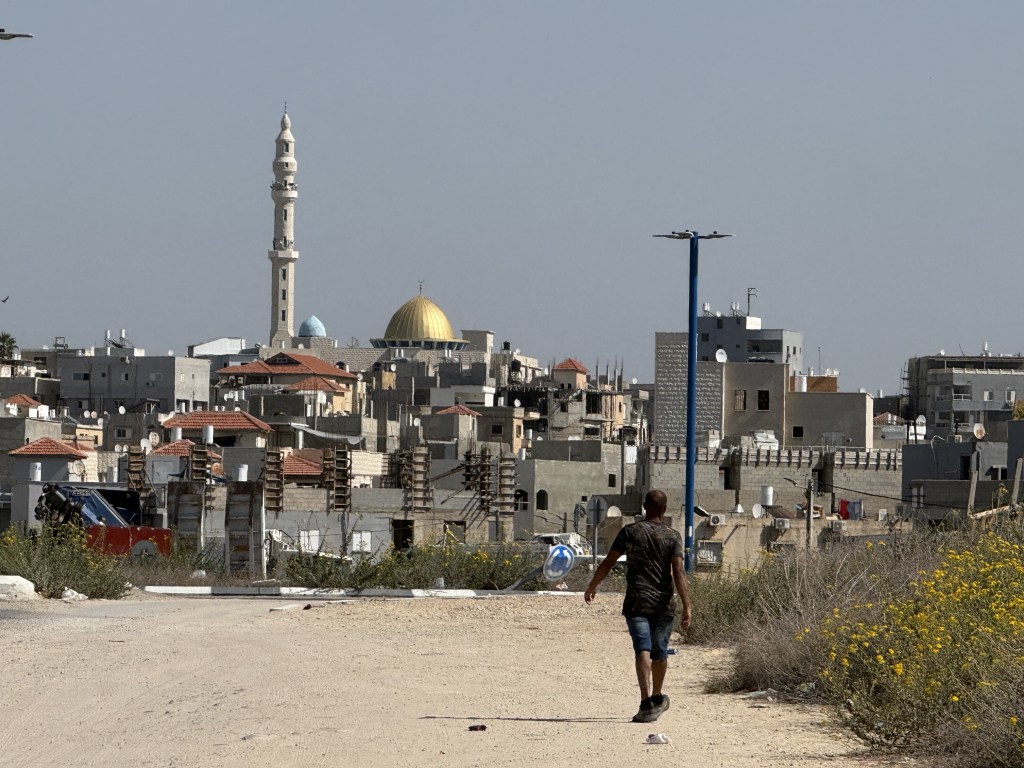
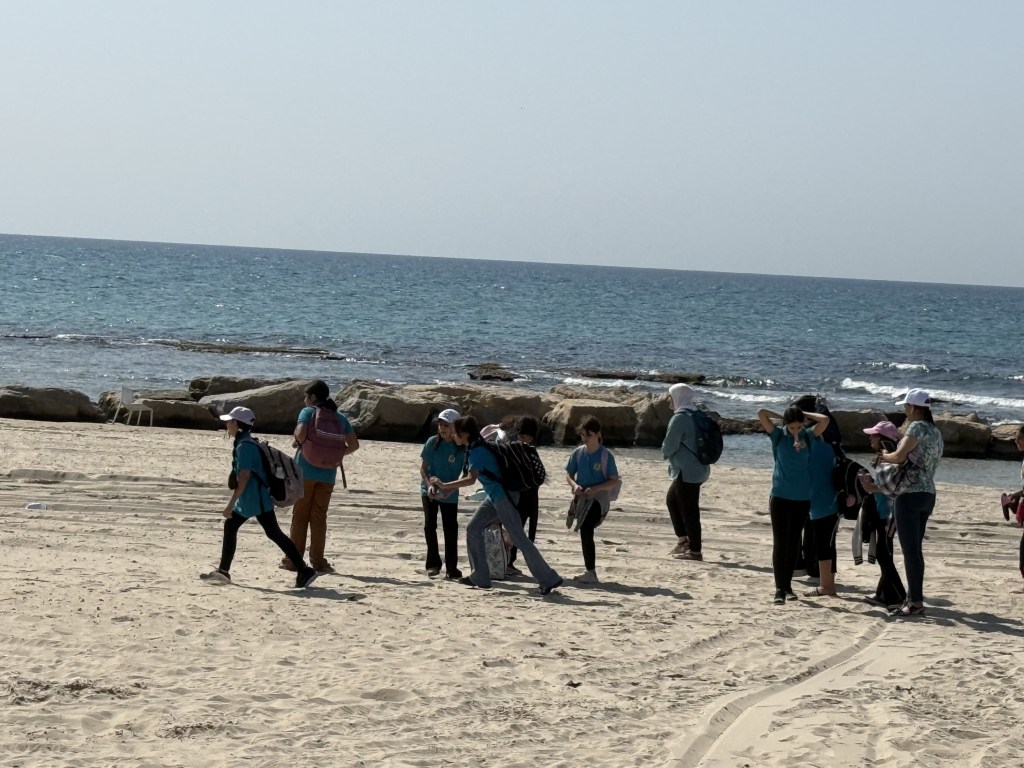
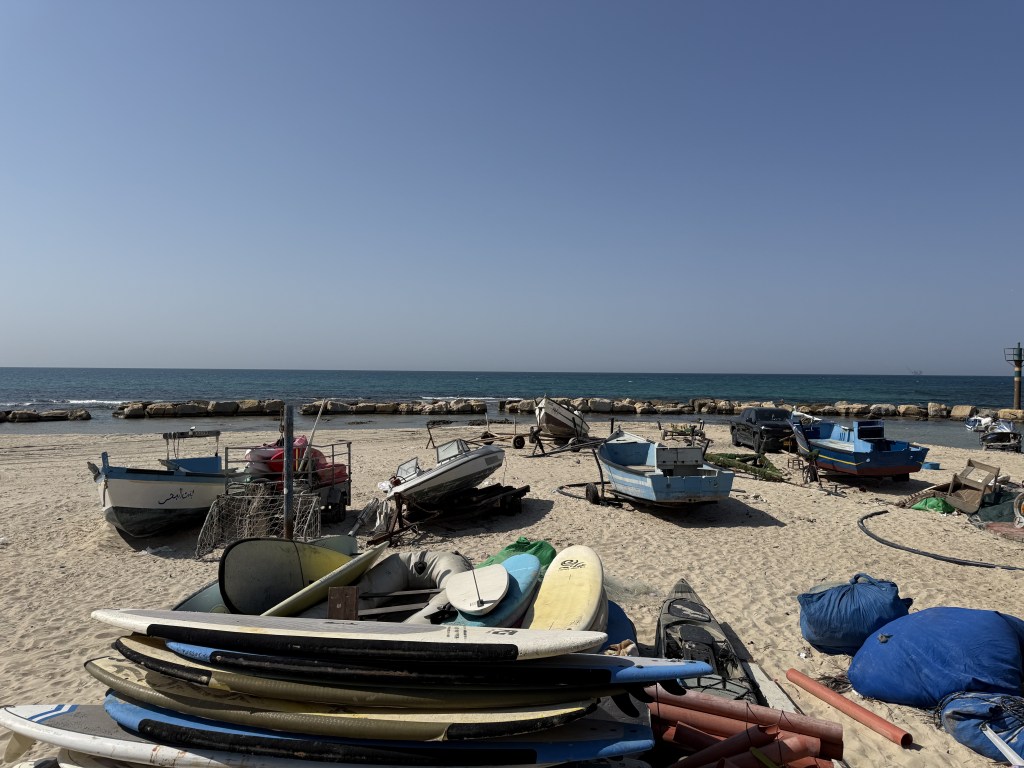
On Thursday, I had the chance to visit the Arab village of Jisr Al Zarqa. It is one of the poorest Arab villages that struggles with violence inside the village. As we entered the village, it was pointed out to us the locations where people were murdered by gangs inside the village last week. Jisr Al Zarqa has a remarkable asset that sets it apart from every other Arab village in Israel. It sits on the beach of the Mediterannean Sea. This poor town is right on the water with a beautiful beach. As we walked to the beach, we saw the trash strewn all around. It was a harbinger of the story we were about to be told – a story of hope and of a potential different future.

At the beach, we met Shadi, who lives in Ein Mahel and who I got to know last year during the visit. We also met Hamami, an amazing women from the village of Jisr Al Zarqa, and Hassan, an amazing young man from the village of Jisr Al Zarqa. Why did we meet with them? Because of their involvement with HaNoar HoOved (NOAL). Both Shadi and Hassan grew up in the movement. Shadi is in his early 30s, Hassan is 20. Both are leaders in the movement. You read that right – Arab (Muslim) leaders in an Israeli, Zionistic, youth movement. Shatters what the media tells you. Shatters the paradigm the world is taught and believes. We also met Hamami, a spectacular woman who is changing the reality on the ground. Hamami is a fisherman, the only woman in the fisherman’s guild in Jisr Al Zarqa. She was a professional soccer player when it was unheard of to have an Arab woman play professional sports on an Israeli team. She is a force of nature.

What is she doing? In a village where children often skip school and get in lots of trouble, she began going out in the streets and pulling them off the streets to participate in a sports program she created herself. She took them fishing, surfing, swimming, and all sorts of water sports. Every day she goes out in the streets and corrals them to come with her and do something productive instead of getting in trouble in the streets. At one point, she went to the schools and began working with them. She took the children off the streets in her program and then ordered them to return at 8 am the next day. All but 2 returned on time. The two who were late were sent home. The next day all of them showed up on time. She spent 3 months working with them on the water, with the sea, before returning them to school where they restarted their education. What an incredible woman.

Uri, a member of NOAL who works with the Arab villages, learned about the work of Hamami, and went to meet her. She told us that he was the first person who didn’t try to make money off her program and instead just wanted to know how he could help her and help the children. They are now partners in the effort, as Dror Israel, the overaching organization of NOAL, works to fund and support her organization Instead of trying to MAKE money off the work of Hamami and the children, they are INVESTING money in the work of Hamami and the children! Once again, you read that right. Jews and Arabs working together, in partnership, in Israel, to help the Arab children who are at risk. You don’t hear that from the UN or in the media. But it is happening.

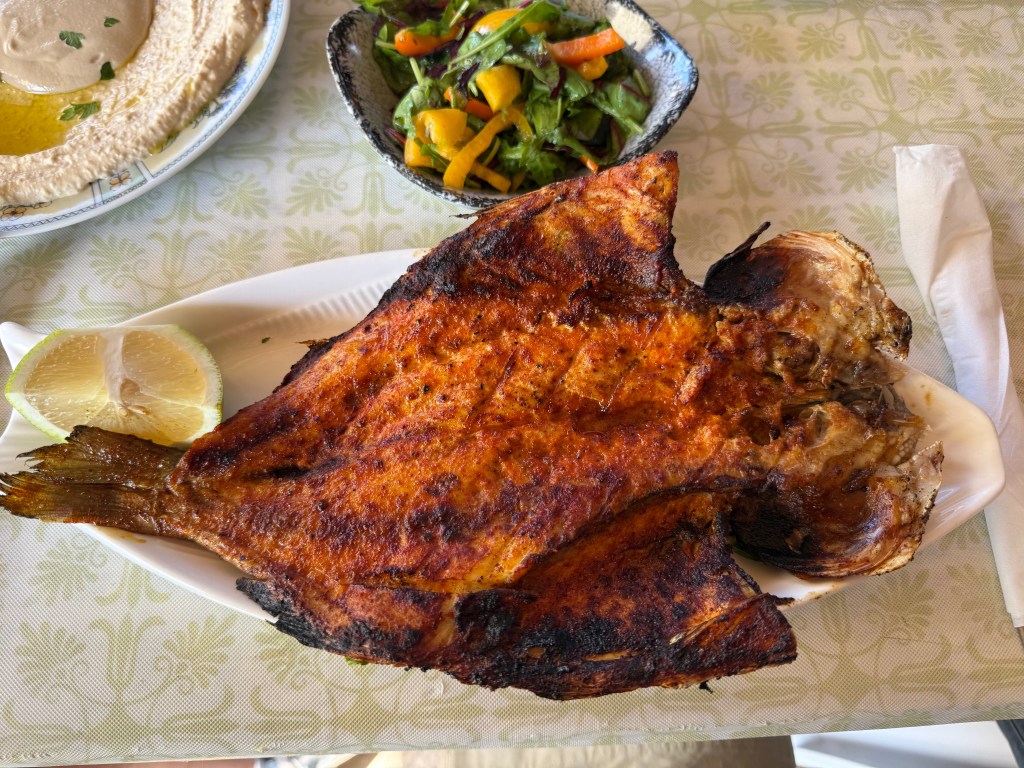
As we sat together to eat lunch and continue our conversation, one of our group used the phrase “coexistence’. Shadi quickly spoke up telling us not to use that word. He told us that coexistence means we live alongside each other. We don’t interact. There are Arab schools and Jewish schools. Arab youth movements and Jewish youth movements. Arab leadership programs and Jewish leadership programs. Saying coexistence means living separately, side-by-side. The right phrase, he educated us, was ‘shared society’ because we share things together. That’s what they are doing with NOAL. That’s what we need to strive for. Not coexistance where we live separately but a shared society where we truly live together. I was inspired and am changing my vocabulary.
Having met Shadi last year and connecting, we spent more time together this year. We built our friendship and talked about many things. The challenge of being Zionistic (loving Israel) with the challenges of the government and the country, especially post October 7th was the start of a fascinating conversation that I look forward to continuing with my friend.

As we talked, he shared his upcoming visit to the United States, mostly New York, to share the work of NOAL, Dror Israel, and help change people’s minds about what is happening and what is possible. When I shared that I may be back in December, he was quick to ask when and tell me about an amazing three (3) day leadership conference they are having in early January and urge me to come and experience it. I’m not sure what my schedule will look like but I know it’s something that if I can attend, I will attend. I can’t wait to see Shadi and the others lead and educate these Arab and Jewish youth together about leadership and shared society. As Shadi said to me and I replied back to him, “Inshalla” which means “if it’s God’s will”. A beautiful Arabic word. Part of a shared vocabulary now.

While the title uses the phrase Shadi taught me not to use, this is a great event and when they cme near you, make sure to go meet him, listen and learn.

There is so much happening in Israel that does not fit the narrative the media tells us. There is hope and there is possibility. There are Arabs and Jews working together, not just with NOAL and Dror Israel but across the entire country. It is something you can see with your own eyes and they are people you can meet in person and speak with. It is part of why I urge people of all faiths to go to Israel and see it themselves. Experience it yourself. Don’t believe the narrative. Don’t believe the lies. We can have a shared society if and when we work hard for it. Hamami, Shadi, Hassan and Uri are only 4 people working towards it. I’ve met many, many more. Too many to list by name. Come join them. See it, feel it, believe it, and help make it happen. Bring them to your community. Share the story and share them with your friends and family. Shared society is about togetherness and that’s what we need to make it happen.

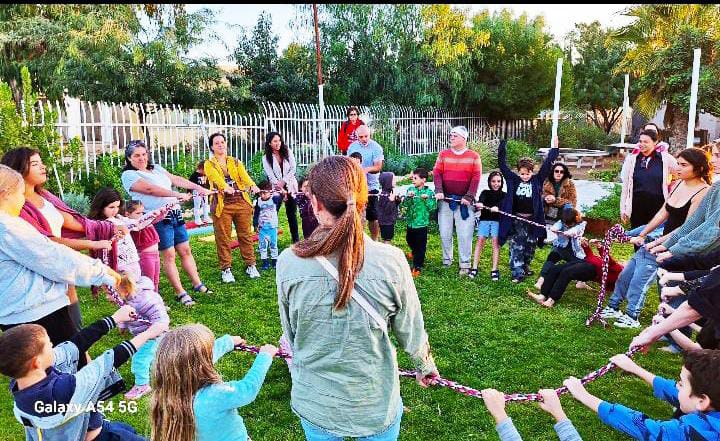
On the beach – Marc, Irit, Gary, Shadi, Sasha, Hamami, Jill, me, and Hassan – a new group of friends.

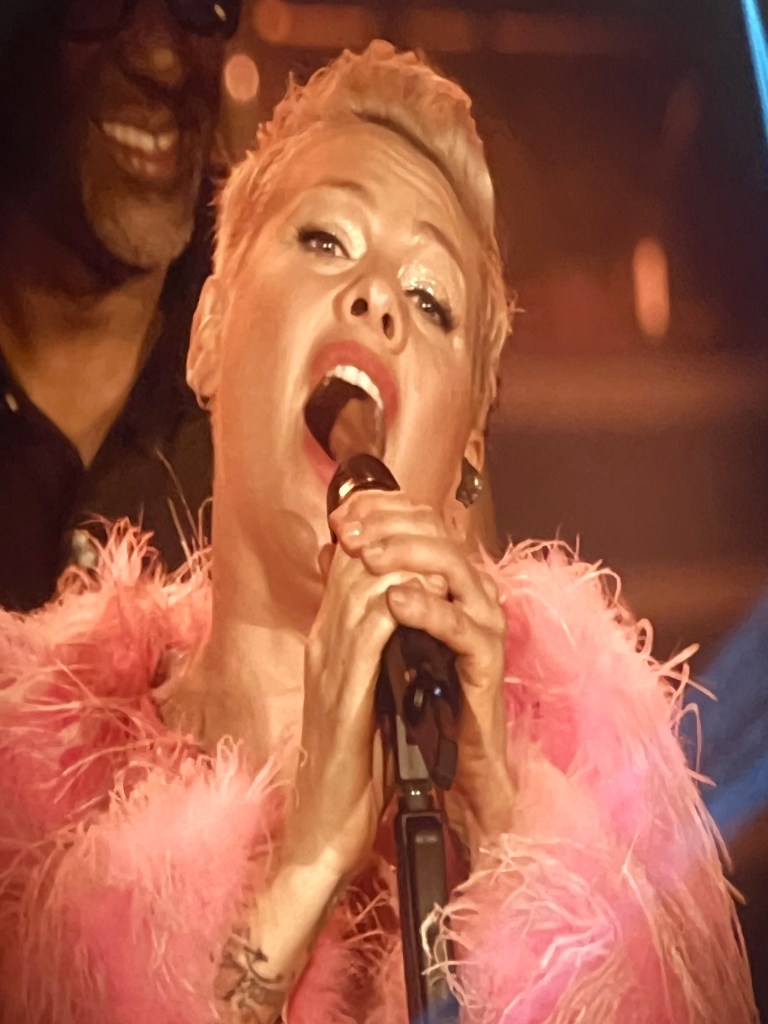
Pink inspires – a true Jewish message in her show

Last night I went to see the Jewish musical star Pink in concert. I bought tickets a long time ago and heard that she was a tremendous performer. I like her music, although I’m far from a rabid fan. With Sheryl Crow opening, I was excited for the show.

Sheryl Crow was awesome. She brought me back in time with her classic songs and while the show was in a stadium, I wish she was in a smokey crowded bar where you could really feel and appreciate her music. I enjoyed her performance as it brought me back to simpler times.

Then it was time for the main event. Pink was electric from the very beginning. Her energy and joy filled the stadium with positivity. Since October 7th, over a year ago, I’ve had a hard time truly letting go and embracing joy. Last night, Pink unlocked that for me. What a performer. She exuded happiness. Love flew from every song and every time she talked to us. Her very first song set the tone – watch and listen as she bounces with joy and flies effortlessly.

Her flying early in the show was beautiful. The music was great and she added elegance and beauty. The past 12 plus months have been filled with so much ugliness. October 7th and those images never leave me. I’m glad that I saw the Hamas 47 minute video but it altered who I am. I am glad that I have been to the Nova site twice, heard from survivors, and those involved with rescuing people that day, but the horror is now a part of me. I’m glad that I went to Kfar Aza twice, heard the stories from the IDF and from somebody who was there that day and recently returned to their home. I’m glad that I saw what the Hamas terrorists did but those images are burned into my soul. Last night, as she performed, it was the first time since October 7th that the only thing in my mind, heart, and soul was beauty and love.

Her cover of Pat Benatar’s “Heartbreaker” got us up, singing and dancing. I was transformed to the early 80s and my high school days. To simpler times. A time when hate didn’t dominate the world. When we didn’t see daily antisemitism and Jew hatred. Violence against Jews wasn’t happening on the streets of Amsterdam, Paris, New York, Chicago, and so many other places. I thought of my diverse group of friends from that time – we didn’t think about identity politics or our differences – we focused on the people we liked. So many of them are still friends today. Jewish, Christian, Mormon, Black, White, Gay, and Straight. We played sports together, went to parties together, hung out on the streets together, went to concerts together, and got in trouble together. I miss the simpleness of those times. The moral clarity that existed for us in high school and then college. Enjoy the song and performance, I sure did.

I wish that I recorded Pink as she talked to, and about, her mother and their relationship. Her mom was in the front row and it was a classic Jewish mother moment. We all laughed but I think those of us who have Jewish mothers laughed a little deeper as she talked about her mom telling her what to do and then watching her mom actually do it from the audience and Pink listening to her and then begging her to stop. When she talked about her late father, it hit home deeply for me. It brought me right back to my dad and the relationship we had. It made me sad and joyous at the same time. While I don’t know her, never met her, and have no personal relationship, I know we bonded over the loss of our fathers. Then she brought her daughter on stage to sing part of a song with her. What a highlight. I enjoyed watching Pink’s face more than anything else as she listened and watched her daughter Willow sing. As a father, there is nothing better than seeing my children succeed. Their joy and success is so much better and more powerful than my own. I could see that on Pink’s face and it reinforced my committment to do whatever I can to make this world a better place for my children and eventual grandchildren. There is no excuse for us to sit back and not do the work. Not put in the effort. We are not responsible for the outcome but we are each responsible for doing the work. That’s a summary from Pirkei Avot, the Ethics of our Fathers. It shows that anybody can learn and even teach a little Torah.

The show ended with an incredible encore where Pink literally flies across the stadium. The freedom in the song and as she flies is so clear. It’s a reminder that we control how we feel. We control whether we want to be tied down, locked up, bitter and angry, or if we want to be free, flying through the air, looking for the beauty and enjoying what the world offers. It takes effort to do it, but the power to live meaningful and beautiful lives is entirely in our own hands. The question is are you willing to do the work? Watch Pink fly and sing – see and feel the freedom. As the movie version of Wicked is about to be released, watch Pink defy gravity. Sorry I lose her for a bit but you get to see the audience during that time and feel the energy.

Pink inspired me last night It shows that you don’t have to truly be a torah scholar to inspire people with Torah values. It also shows how learning some Torah can help you see Jewish wisdom in every day life.

My friend Yocheved Ruttenberg is another real example of this. Founder of the Sword of Iron Facebook group with 40,000 members all interested in volunteering in Israel, her story as a 23 year old changing the world is inspiring. She recently won the Z3 Bridge Builder award. Her speech highlights her story and what she has done and what she is doing. It is inspiring.

The joy Yocheved brings to the 40,000 members of Sword of Iron is incredible. I read the posts of people volunteering in Israel and sharing their pictures doing it. I read about all the amazing volunteer opportunities and am astounded and inspired. It makes me wish I was independently wealthy and could just go and volunteer full time in Israel. From picking fruits and vegetables to helping rebuild in the south. Preparing BBQs for IDF soldiers to making tzizit for them. Helping those in need in every aspect of society. All done with gratitude. All done with grace. All done from the heart. All for our Jewish brothers and sisters who are fighting for the survival of the Jewish people. If you really want to experience the joy of Yocheved and her work, watch this Shabbat Shalom video. I can’t get enough of it. I dare you to only watch it once. It’s infectious.

There are so many ways to change the world and the world needs changing. You can do it through music. You can do it with volunteering. You can do it by helping others. A friend of mine who made aliyah years ago reached out today. He and his family will be in the United States to get away for a much needed respite in December. They will be in Florida for part of their trip and like my family, love sports and wanted to go to the Orlando Magic game for Jewish Heritage Night. They were having trouble getting tickets and asked for my help. Quickly, I was able to secure tickets for him in the block at an affordable price. I then reached out to a friend to see if they can help with some VIP experiences for their children. After the year that they have experienced, the least I can do is try to help them have some peace and joy. Just like Pink gave me last night, I can help them have a few moments of joy where they aren’t worried about sirens, they aren’t worried about rockets, they aren’t worried about friends in the IDF and if they are alive or not. They can be kids, enjoying a basketball game and maybe getting some special access. It didn’t take much for me to help. A little research. A few text messages. It did take effort but not much. Often times we don’t realize how easy it can be to make a difference in the lives of others. How we can give a little bit of life and levity to those in need.

I work with Dror Israel, and amazing organization that helps children with schools, youth groups, and summer camps. Their ZIONIST youth movement is in all the Druze villages and in 55 Arab villages with more than 20,000 Arabs involved. They do amazing work. In this same context, they are creating restorative trips for children and families to get away from areas with sirens, to go to Mitzpe Ramon (Israel’s version of the Grand Canyon). This short video highlights what they do and what the effect and impact is. They are changing the lives of these children and families and changing the world.

We have the ability to change the world with our own actions. Pink gave me a few hours of pure joy like I haven’t had since October 7th. Here is the question I pose to you. What are you going to do to find your joy. To find your stress relief? And what are you going to do to help others who are in need and can’t do it themselves? We all have that responsibility. It is Kol Yisrael Arevim zeh Bazeh (All of Israel is responsible for each other). Jewish or not, we can be inspired by this lesson. Each of us can change the world, one person at a time, one action at a time.

Let’s all choose to be like Pink, who electrified and inspired 75,000 people last night. Who sent a message of love, inclusion, support, family, and values. The movie The Waterboy puts it best. You can do it!

Thoughts and observations

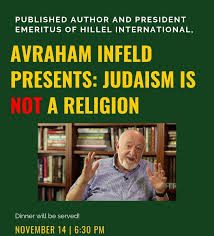
There is often a debate about whether being Jewish is a religion or a people. My friend, Avraham Infeld, has publicly spoken about this. He says, “We are a family, a people, with a common religion.” It’s the best description I have heard.

Rabbi Harold Kushner (z’l) has written about this as well. In his book, To Life, he asks, “What do you have to believe to be Jewish?”. The answer, is nothing. You don’t have to believe in God. You don’t have to believe in the Torah. In fact, you don’t have to do anything to be Jewish. You are Jewish if your mother is Jewish. That’s it. Many people in today’s world will say you are Jewish if either parent is Jewish. That is the proof that we are a people, a family, a mishpacha, that share a common religion.

This gets proven all the time with Jewish geography. In the Jewish world, it isn’t the 6 degrees of Kevin Bacon. Usually it is 2-3 degrees of connection. Hersh Goldberg-Polin (z’l) is a great example of this. I didn’t know him or his family. Yet I have friends who knew him at Camp Ramah Darom. 2 degrees of separation. The picture below is from a fraternity brother of mine who’s son was friends with Hersh. Another 2 degrees of separation.

Hersh as a kid with friends including my fraternity brother’s son

You may have seen the memes and comments about family in Israel.

I told someone I was traveling to Israel.

He asked, “do you have family there?”

“Yes I do. 8 million brothers and sisters.”

That’s who we are. Brothers and sisters. Family. Mishpacha.

As I think about family, I think about the hostages. There remain 101 of them in captivity and we don’t know how many of them are still alive. At Passover Seder, I set up chairs and put pictures of the Bibas family on the chairs so they could be at our Seder in spirit. After Seder, I couldn’t take them off the chairs so they remained there for a few months.

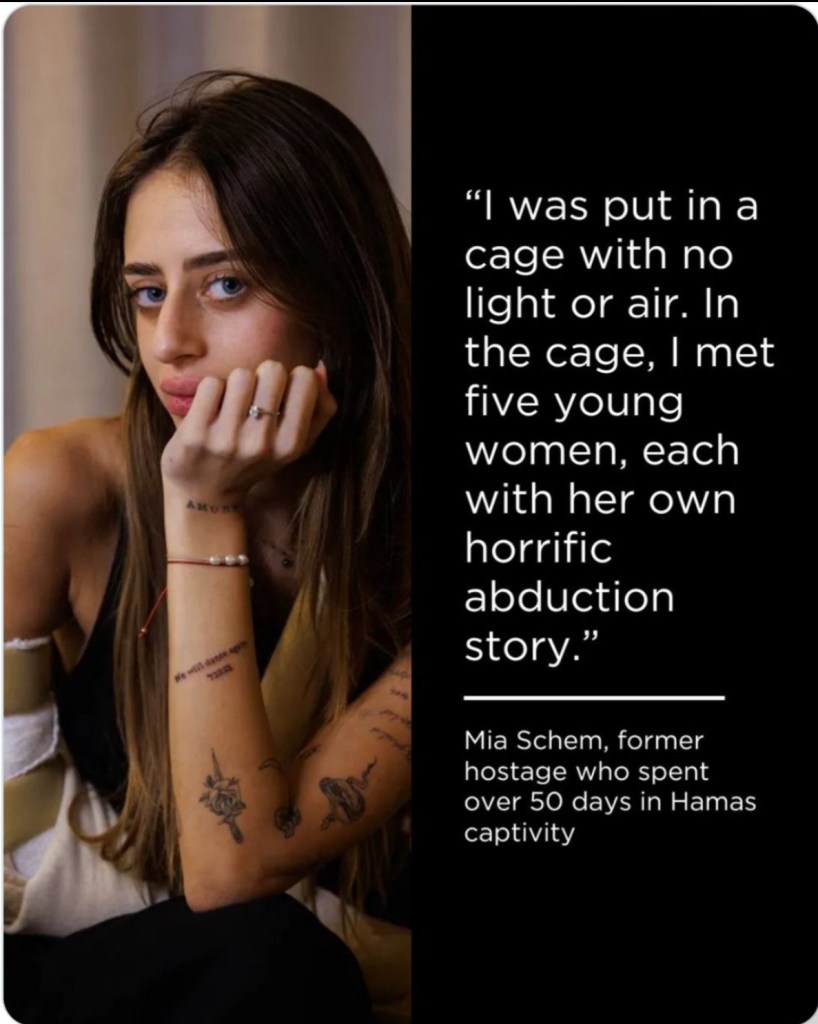
Mia Schem inspired me with her words, “We will dance again” and I got the same tattoo she did on my forearm. It inspires me to work hard every day to build a better future. To never forget the hostages that remain or the horrific violence that occurred on October 7th, I’ll never forget the look on Rami Davidian’s face as he talked about the morning of October 8th, when he went back to the Nova site to help clean up and provide dignity to those murdered. He looked at the trees right near us as he told us of the women tied to them that he had to cut down, cover them, give them some final dignity, and say the Shema for them. Unsaid was the condition of their bodies and the obvious rapes that had occurred. The tears in his eyes said more than his words ever could.

When Rachel Goldberg-Polin described the condition of her son Hersh’s (z’l) body, I cringed. Not just at the weight loss, the loss of part of his arm, and the obvious torture he had endured, but also how he was murdered. These aren’t the acts of freedom fighters or resistance. These are the acts of barbarians. As I listened to John Spencer, the pre-eminent expert on Urban warfare, talk about what he saw and how it doesn’t compare to any other barbarism he has seen throughout his career in studying warfare, it really hit home. People don’t want to believe other people can be this inhuman. People don’t want to believe this type of evil exists So they make excuses. They create lies to protect themselves from seeing that the evil exists.

The quote from Mia Schem below is powerful. “Each with her own horrific abduction story.” Yet the women’s rights groups couldn’t speak out. The ‘believe all women’ organizations denied that sexual violence occurred. The celebrities who spoke out in defense of every other group that faced sexual violence stayed silent. There was no ‘bring back our girls’ from Michelle Obama, Angelina Jolie, Pope Francis, Kim Kardashian, Ellen DeGeneres, Hillary Clinton, Anne Hathaway, Alicia Keys, Cara Delevingne, Jessica Alba, Khloé Kardashian, Sophia Bush, or Amy Poehler, who all spoke out when 276 girls from a school in Chibok, Nigeria were kidnapped by the Islamist militia group Boko Haram in 2014. Jewish women didn’t count.

Talking about Jewish women, my friend Yocheved Ruttenberg recently was announced as the Z3 Bridge Builder award winner. What did she do that won her the award? On October 8th, with her older brother serving in the IDF as a lone soldier, she realized that she could not stay in the United States in her Dallas construction sales position. This then 23 year old spent a week raising $17,000 to buy things for her brothers unit, booked a ticket to Israel, and began her journey. A month into her 2 week trip to Israel, she met another young woman and together they created the Sword of Iron Facebook group, creating a place for those wanting to come to Israel and volunteer to meet each other, learn where they could volunteer, and build a community. Today, almost a year later, the group has nearly 40,000 members. Yocheved is a star. The number of people excited to see her in Israel, who want to take a selfie, who thank her for creating this community which enables them to make a difference, is immense. People come back time after time to volunteer, using the Sword of Iron group to figure out where to stay that is affordable, where to volunteer, who else is going to be there, and how to connect to their community. Thanks to Yocheved, there is no ‘lone volunteer’. Everybody, Jewish or not, is part of a community.

Yocheved was 23 when she started Swords of Iron. She turned her passion into something that has changed the lives of more than the 40,000 members of the Facebook group. Every time somebody comes to Israel and volunteers, she is changing not only their lives but the lives of those who benefit from the volunteer work. She is changing the lives of the volunteers’ friends wherever they live, who hear that their friends are coming to Israel to volunteer, see the pictures, and hear from them upon their return.

If Yocheved can do it, what is your excuse for not following your heart and your dream to change the world? Yocheved isn’t done. There is far more she is planning. Let her be your inspiration to do something.

Doing something is what Dror Israel (Dror) is all about. After October 7th, they were first responders when it comes to the needs of children and families. They created pop-up schools at the Dead Sea for families that had been displaced. They created schools all over the country as people were displaced from the south and the north. They had afterschool programs, youth groups, and brought in counselors to help those dealing with stress and PTSD.

In September I had the opportunity to visit Dror while in Israel. Seeing their work in person was powerful. Hearing the impact directly from the children in school was incredible. Seeing the inpact of the youth movement in an Arab village was inspiring. Watching both the excitement learning and the gratitude the students had for Dror and their educators was impactful. In the middle of an ongoing war that is over a year long, with rockets being launched at them daily and sirens going off multiple times a day, the resilience of the children and the Dror educators was inspiring.

As the war continues into its second year, Dror educators continue to innovate. In order to help children deal with the stress and challenges just being children, they began restorative 3 day trips for them to Mitzpe Ramon where they can act like children without the rockets and sirens. They can play outside, sleep without worrying about having to go to the safe room in the middle of the night, and experience joy. As Dror began these trips, they quickly learned that the entire family had a need to participate. So as Dror does, they pivoted and innovated even more. Last week, 100 children and parents from the Nitzanim elementary school in Carmiel embarked on a three-day retreat in Mitzpe Ramon. “It was such great fun, far from the noise of the war. We had a chance to connect with other families from the school and our neighborhood—just what we all needed,” said Irena, mother of Michael and Vasily, both students at the school.

Israel is known as the start up nation but it is more than just technology. Israel innovates in so many different ways including education and how they value human life. This is seen through the work of Dror Israel, who is dedicated to supporting these children until they can safely return to their homes and to helping them rebuild their communities and restore a sense of trust, resilience, and hope. Imagine if we had that in the United States.

Families from Carmiel during the 3 day restorative trip to Mitzpe Ramon

Earlier I wrote about how we are a family with a common religion. The great thing about being a family is that we have traditions. Many of them are based on our common religion such as the Passover Seder, shaking the lulov and etrog on Sukkot, and putting on tefillin. One of my favorites is something that I just learned and began this summer.

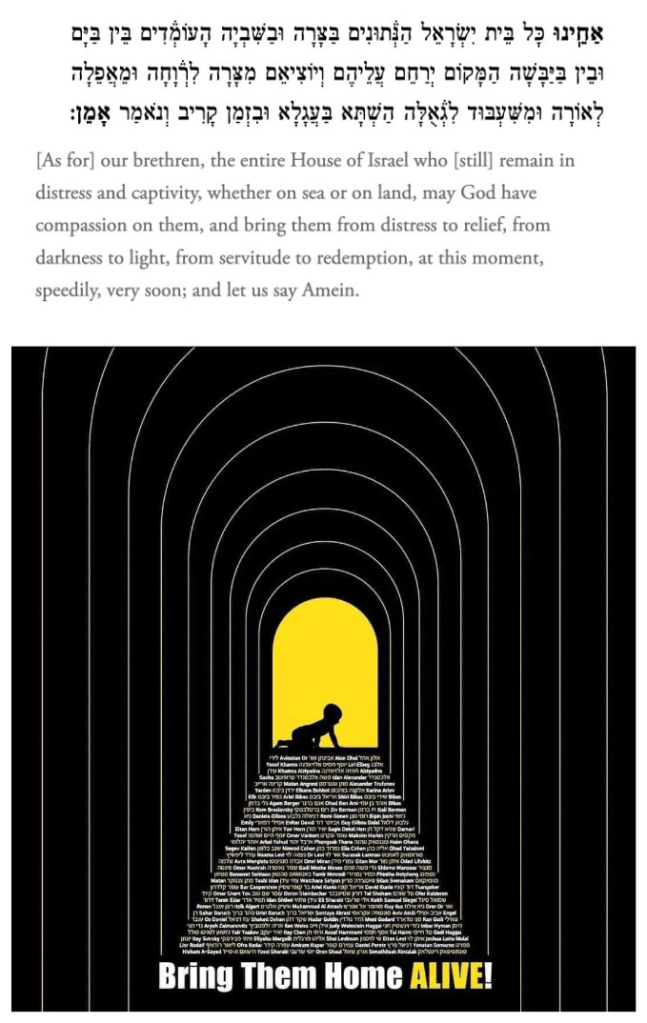
The prayer Acheinu is not an ancient one. It tracks back to the 9th century, 800 years after the destruction of the second Temple. The song “Acheinu” however, was only written in 1990. I sing it every day for the hostages. It’s short, simple, and easy to learn. It’s something tangible that I can do while I lie in bed, am in the shower, or sitting at my desk. I have the words on my phone and I get them in an email every day as well. As Jews, we have these type of regular things to remind us. As I said before, Tefillin is one (and I must admit that while I occassionaly put them on, I don’t do it regularly). Tefillin takes a few minutes and is a physical reminder. Singing Acheinu is a spiritual reminder that takes a minute or two with practice.

As Jews, we can find what are the things that resonate for us. What keeps us grounded? What connects us to God? What do we do to stay grounded, connected to God, connected to the world and to humanity. I pray and meditate every morning and have for more than three decades. For the past 5 months, I also sing Acheinu. It’s the one thing that I do daily that I look forward to NOT doing any longer. When the hostages are released, the need for me to sing Acheinu will be removed. Every day when I sing it, it has meaning. And every day that I sing it, I hope it is the last day that I will have to do so.

It’s 395 days today. 395 days of captivity. 395 days of terror and abuse. 395 days that American hostages have been ignored by our government. 395 days that the world has tried to excuse their being kidnapped and abused. We will not forget. We will not rest until they are returned. We will not stop until Hamas and Hezbollah are removed from power, until the threat that is Iran is no longer a threat.

Sinwar is gone – what have we learned?

This week the news broke that Yahyah Sinwar, the Hamas terrorist who planned the October 7th massacre and attempted genocide in Israel, was eliminated by the IDF. The amazing thing about it was that despite all the amazing Israeli intelligence and targeted attacks to eliminate Hezbollah and Hamas leadership, Sinwar was eliminated by a training unit in the tanks unit. This video shows the proof of his death.

Yahyah Sinwar is dead – the proof

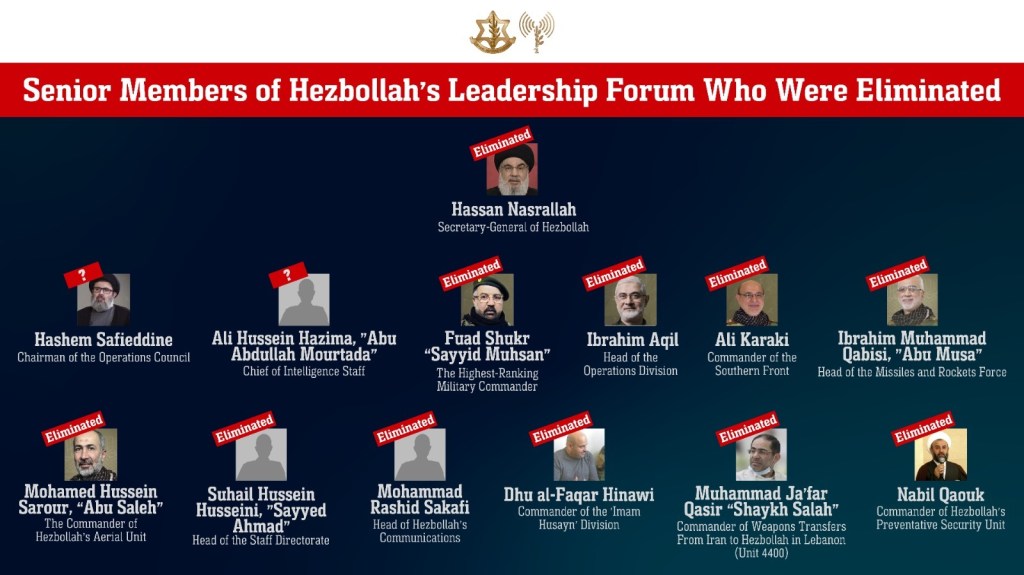
Israel has been targeting the leadership of Hezbollah and Hamas for a while now and eliminating them to destroy the infrastructure. While the world said this wasn’t possible, Israel has once again shown that what the world says is not possible, they will make happen. The Hezbollah leadership has been decimated. Not only have they eliminated Nasrallah, they eliminated the next two successors to him. As the chart below shows, the top 3 levels of Hezbollah’s leadership has now been eliminated. This is how you defeat terrorism.

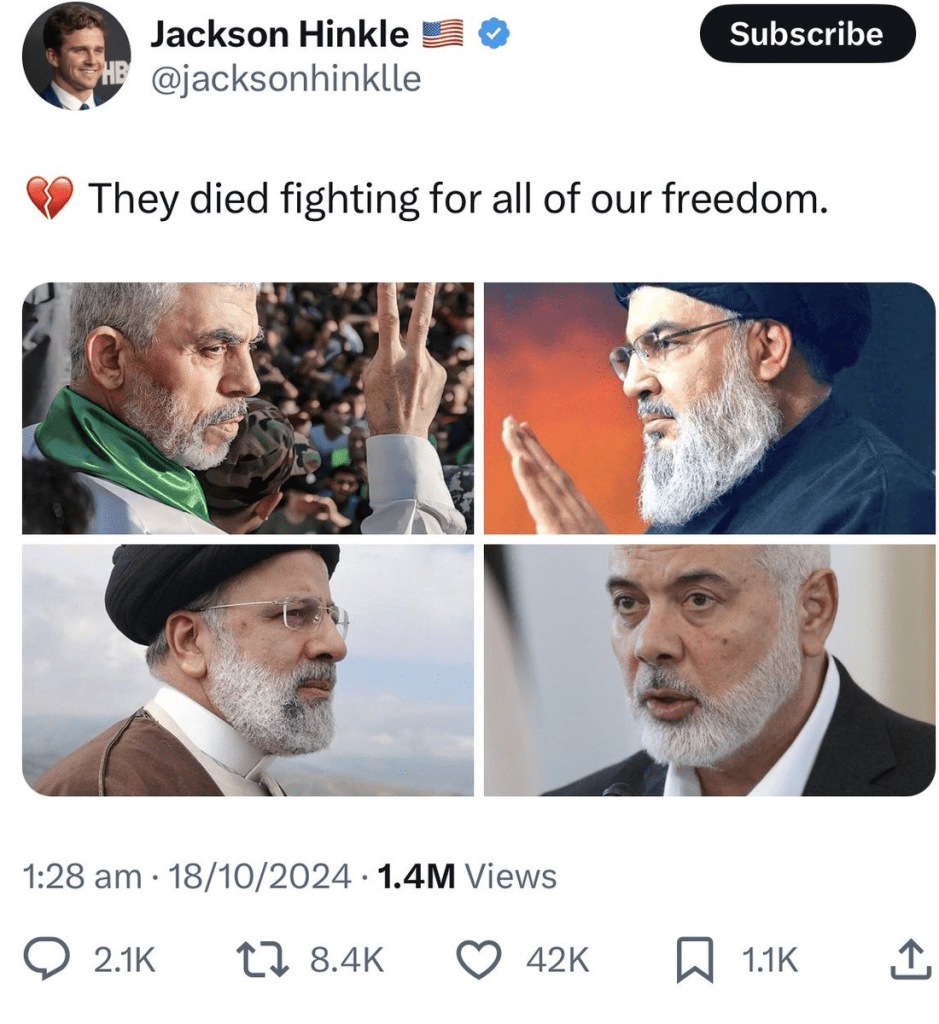
Yet there remain those who actively support the terrorists. Noted antisemite Jackson Hinkle continues to think the terrorists are fighting for freedom despite their clear statements to the opposite. While the terrorists call the United States “The Big Satan” and are clear that while they want to eliminate Israel and all Jews, their real goal is eliminate the West and make the world part of the caliphate under Sharia Law, people like Hinkle empower and embolden them in their efforts to do so. His hatred of Jews blinds him to their desire to kill him. Note the number of views, the number of likes, and those who have saved the post. It’s frightening.

There are those memorializing Sinwar as some sort of Palestinian hero. How easy it is for them to forget his nickname, “The Butcher of Khan Younis” came for slaughtering Palestinians. They quickly forget, or never bothered to learn, that he went to prison for murdering Palestinians or while in prison, he was accused of raping Palestinians and ordered the honor killing of his own sister for having an extramarital affair. It doesn’t matter to them that in his interviews, he stated that he did not care if 100,000 Palestinians died in the conflict he started with Israel. Their hatred of Jews is more important that the facts.

Then there are the lies being told about Israel not allowing food and aid into Gaza. Despite the documentation, despite the pictures and videos, the world chooses to repeat the lies. The documentation of UNRWA providing the aid to Hamas doesn’t change the world’s condemnation of Israel. When the people of Gaza complain that the food given as aid to be given out freely is too expensive, the world turns a blind eye. Israel is the only country that is expected to provide food, water, fuel, medicine, and power to the enemy they are fighting against. They are required to give it to an organization, UNRWA, that is tied closely to Hamas, the enemy they are fighting. The hypocrisy is real.

Over the past month, as Israel has systemically eliminated the leaders of Hamas and Hezbollah, they have shown their strength. As a result, other Arab countries are now taking a strong position against Hamas and Hezbollah. Unlike the current United State administration and European countries, Israel understands that strength is the currency of the Middle East. When you show strength, others join with you. When you show weakness, you are not respected and you have no ability to impact what is happening. We are now seeing Saudi Arabia come out publicly against Hamas and Hezbollah. This is because Israel has shown strength.

Our media and the world’s media doesn’t like to cover those speaking out against the terrorists or the hatred. Yet more and more of them are speaking out. More and more we are seeing those with knowledge choosing to take action and speak out against the terrorists and in support of Israel. The lie that you can’t defeat an ideology is being proven wrong. Here is an amazing piece by a Muslim Yemeni asking real questions and providing real answers. My favorite part is when he tells the muslim woman that what she just said makes her a Zionist.

Here is an Australian journalist speaking the truth. Where is this in our U.S. media? Where is this on the BBC? It’s powerful to watch and hopefully we will now be getting more of this time of accurate coverage.

There are a number of things we have learned since October 7, 2023. Here is a list of things we have learned that we either take action on or suffer because we chose to ignore them.

The world really does hate us. We can’t forget that, ever. We see it constantly. Authors who cancel speaking engagements because they won’t share the stage with a Jew (they say Zionist but they mean Jew). Actors who take uneducated positions. Even Porn stars like Mia Khalifa are now being hailed by the NY Times as an activist because of her Jew hatred. She isn’t educated but she hates Jews and speaks out so that is enough. President Macron of France speaks out against us. President Erdagan of Turkey spews his Jew hatred and wants to partner with the regime of Iran. All we have to do is open our eyes and we can see the world hates us. We can’t keep our eyes closed or our heads buried in the sand about this any longer.

We are always Jews first. That’s who we are and how the world will see us. We are not American Jews, we are Jewish Americans. It’s no different than Germany in the 20s and 30s. Jews thought they were German first. They weren’t. We aren’t. Not Canadian-Jews but Jewish Canadians. We are not French Jews, English Jews, Spanish Jews, or Italian Jews. The Jewish part always comes first. We forget this at our own peril.

Education not Hasbarah for our children. We have lost and are losing our youth when it comes to Israel because we don’t teach them the facts. We don’t teach them the truth. Even when the truth may be ugly. No country is perfect. Every country has done things they regret and are embarrassing in retrospect. Israel is no exception. We need to teach the facts of Israel. Israel didn’t begin in 1948. It began with Abraham. When we teach our children the facts of Israel and the modern State of Israel, they are empowered to support Israel. They are much less likely to believe the lies they are told on college campuses and even in Middle and High School.

We can’t rely on anybody else. For years we have depended on the relationship with the United States for much of Israel’s support. Since October 7th we have seen that while we are still getting American support, some weapons are being delayed and withheld. As important as the relationship with the United States is, we cannot depend on America for as much as we do. Israel must create its own weapons industry to ensure that there are enough weapons, ammunition, and other needed weapons to defend herself when needed. At the end of the day, we are the only ones who will take care of ourselves. On a campaign stop Thursday at the University of Wisconsin-Milwaukee, VP and Presidential Candidate Kamala Harris was Vice President Kamala Harris was interrupted by anti-Israel protesters asking about ‘the Genocide’. Her response included the words, “What he’s talking about is real.” This is scary to hear from our current VP and possible next President. You can watch and listen to it yourself.

VP and Presidential Candidate Kamala Harris at the University of Wisconsin-Milwaukee last week.

Relationships do matter. If you had told me five years ago that Jordan, Saudi Arabia, and Egypt would help defend Israel from an attack by Iran, I would have laughed at you. Yet that’s what has happened TWICE in the past year. The Abraham Accords have changed the narrative and are creating a new opportunity for real peace in the region. The rebuilding of Gaza will happen with our Arab partners. The freeing of Lebanon will be with the Lebanese people. We see the Iranian people supporting Israel while the regime tries to eliminate us. Saudi Arabia is waiting to join in the economic boom that the United Arab Emirates (UAE) is experiencing because of their normalization with Israel.

Peace through strength is real. We have seen that the only way to have peace is to show your strength. It doesn’t mean war. It means showing your economic and military strength. It means having strong intelligence and being able to act on it. It means being daring and innovative to gain respect. World leaders respect strength. They do not respect weakness. From the time Israel took the offensive and blew up the pagers and walkie talkies of Hezbollah leaders, the world took notice. As the leaders of these two terrorist organizations have been systematically eliminated, the world took notice. Peace comes through strength. Diplomacy happens because they respect your strength.

The media lies. This may seem like an obvious statement however far too many people simply believe what they see, hear, or read. TikTok has become the preferred news media for many. The bots telling lies make sure to spread them far and wide. The news media is really in the entertainment department and more interested in ad sales and clicks than facts. The old saying, “If it bleeds, it leads” has never been more true. Facts don’t matter, only what will sell more ads. We must be careful with believing what we see, hear, or read as far too often it is simply not factual. The world believes what they are told which only enhances Jew hatred. We do have some reputable journalists and we need to listen to them. One, Douglas Murray, who isn’t Jewish, has been outspoken. Watch this interview with Bari Weiss of The Free Press on her Honestly show.

    This is an hour long and worth every single minute.

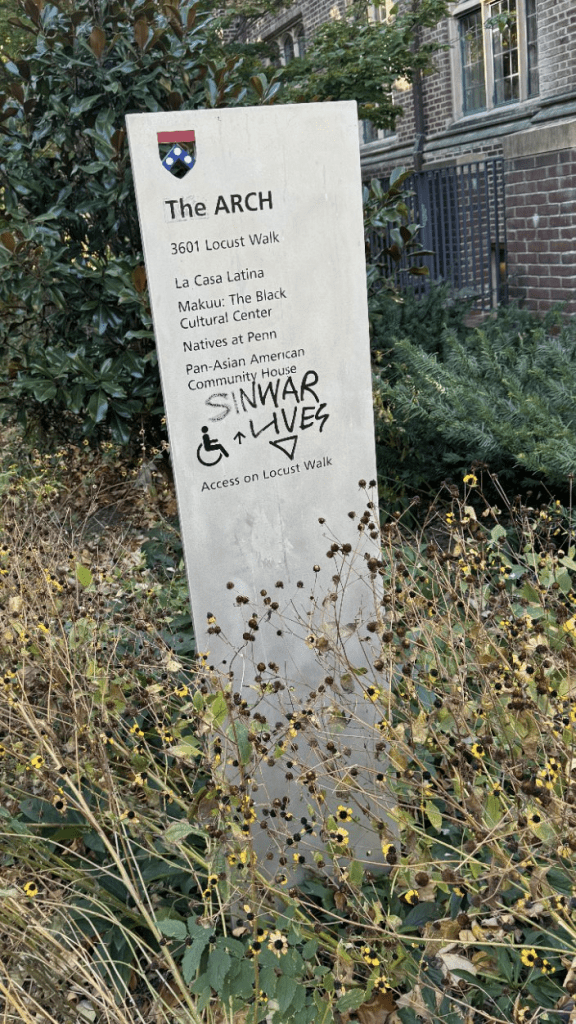
    Antisemitism, really Jew hatred, never went away. As Jews in America, we had an incredible period of time when expressing Jew hatred was not acceptable. As a result, we fooled ourselves into thinking that America was and always would be a safe place for us. October 7th and what has come afterwards has shown us the folly of our ways. Jew hatred on college campuses has gone from verbal to intimidation to physical attacks. There is a movement to defund and remove Hillels from college campuses. We see violent demonstrations targeting Jews and Jewish communal facilities under the guise of targeting Israel. Physical attacks just for being Jewish are happening all over the world, including America. The day after it was confirmed that Sinwar was eliminated, multiple signs on UPenn’s campus were vandalized with “Sinwar Lives.” This comes after students and faculty posted repeatedly about Sinwar as a “hero.” This is what we face on the college campuses.

      We cannot be silent. Far too many people are choosing to stay silent rather than stand up for what they know is right. They’d rather be silent and ignored than speak out and take a risk. Their silence makes them complicit in the Jew hatred and the violence. The choice is to remain silent and wait until they come for us or speak up loudly and not allow the hate to grow uncontested. We saw what happens when stay silent in Germany and with the pogroms in Russia. We can no longer afford to be silent. Our silence will ensure our death.

      We have to go to Israel. I don’t mean we have to make Aliyah. We have to visit. Our brothers and sisters need our support. We need to see, feel, and experience what’s going on there. We have an eternal bond with the land and after October 7th, that bond is stronger than we realize until we are there. So go. Volunteer. I’ve worked the land in May and July for a few hours. It’s incredibly rewarding. It is meaningful. I’ve volunteered making packages for IDF soldiers, making Tzizit for IDF soldiers, and making sandwiches for children who aren’t able to afford to purchase them. Each one is more meaningful than the next. I’m too old to join the IDF but I’m not too old to help Israel and the Israeli people.

      These are important lessons that we cannot forget. Our history shows we do forget. We think we are part of the Babylonian people, the Romans, Spain, Russia, Germany, England, France, and the United States. We aren’t. We are always the Jews. We have always been the Jews. We will always be the Jews. As long as we remember that, we will not just survive but thrive. When we forget, we risk elimination.

      Below are two pieces about being Jewish. Both are powerful pieces describing being Jewish. I encourage you to spend the time watching and listening to both.

      I met Andrew years ago at the JFNA General Assembly. His poetry is powerful and worth listening to.

      And of course, the famous piece by Rabbi Lord Jonathan Sacks (z’l)

      Fighting antisemitism by being Jewish

      I have been talking and writing about the increase in antisemitism and Jew hatred for a decade now.  I saw it when I was living in Seattle when a swastika would be drawn/painted on a Jewish building almost monthly.  I called it out then and many people thought I was being reactionary and fear mongering.  I was pointing out what was happening.

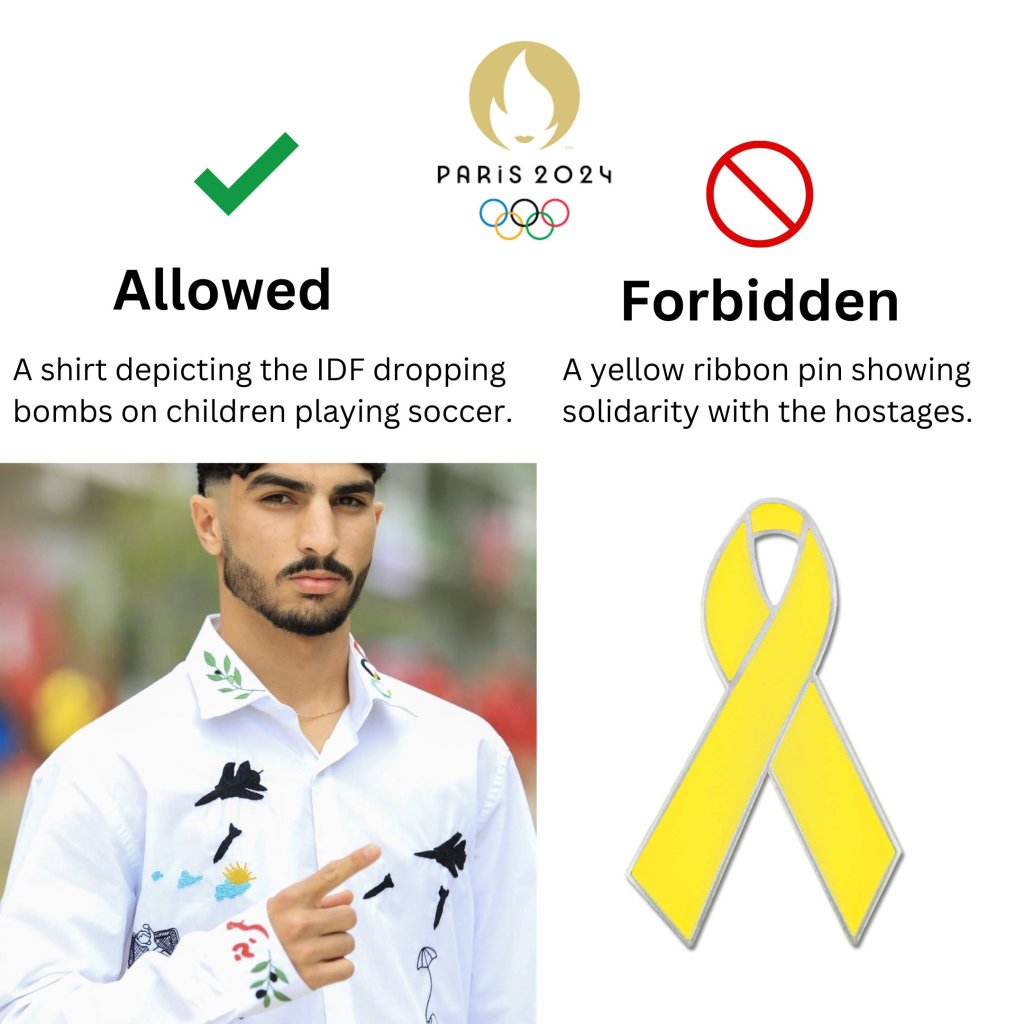
      Over the past decade, it has only gotten worse.  Since October 7th, the rise in Jew hatred has become frightening.  Violence against Jews is now common.  Shooting at Jewish schools happens too often.  Ugly, racist protests occur on college campuses and in the streets in the US, Canada, and throughout Europe.  Israeli Olympic athletes are threatened with death.  The Palestinian athletes are allowed to wear shirts with bombs dropping on Israel, but the Israeli athletes are not permitted to wear the yellow ribbons for the hostages.  The list goes on and on. 

      I have mentioned many times how I’m not super religious but very Jewish.  Over the past few years, I have been digging deeper into what being Jewish means to me outside of services.  Like many people, services don’t connect or inspire me.  I knew there was much more to being Jewish than just religious services so my exploration into Jewish spirituality, text and how it applies to my life, and finding more meaning have been a big part of my recent journey.

      As I learn with Rabbi Ehrenkranz, we include a bit of prayers to understand the why instead of the what.  My recent trip to Israel with the Jewish Leadership Institute (JLI) also focused deeply on the why instead of the what.  My recent trips to Israel have also been an exploration into the why instead of the what.  Why does Jerusalem matter?  What is the point behind some of what we do?  What is the intention?  The goal?  The objective?  I have found that when I understand the why, I can adapt the what to fit my life and what is meaningful to me.  Judaism has adapted since the time of Abraham, Moses, King David, and even the 2nd Temple.  We don’t pray the way they did but we can connect to God and each other the way they did.  I find that very meaningful.

      Rabbi Ehrenkranz started a monthly Sunday morning Minyan (prayer service) that I began attending because he asked me to.  Often times, just asking somebody you have a relationship with gets them to do what you ask.  It turns out most of the people who attend are friends of mine, so it becomes a social gathering as well as an opportunity to grow.  I appreciate how Rabbi Ehrenkranz explains the goal of each part of the service.  It has enabled me to move away from reading the Hebrew words that I don’t know what they mean and instead think about the goal and objective and connect that way.  It has turned an experience that was rote into one that is meaningful.

      This Sunday, with all that is going on in Israel and the recent attack by Hezbollah on the Druze village, I chose to wear my IDF tzitzit (ritual fringed garments).  I got them from Rabbi Atlas in the IDF as I am helping him with a project to fund the 5,000 mezuzahs the IDF needs.  I don’t wear them regularly and in fact, this was the first time that I wore them under my shirt like you are ‘supposed’ to.  It was a way to connect to Israel, the IDF, and Judaism.  I feel that way about mezuzahs too – something that is easy to put on your door and have a meaningful symbol without being required to be super religious.  It’s an easy thing to put on your doorpost and show Jewish pride both internally and externally.  If you don’t have one and want one, MyZuzah will give you one for FREE!  And if you want to support the IDF in their effort to get their needed mezuzahs for IDF soldiers, there is a dollar for dollar match and you can buy them for the IDF here for $30 each.

      At the minyan, I spent the time during the silent Amidah (the major prayer of the service) in my own mediation and conversation with God, thanking God for all the gifts in my life today.  In my learning with Rabbi Ehrenkranz, part of what I have learned is that most of our prayers are really a reminder to ourselves about how we should live and how much we need to be thankful to God for our lives.  As such, I took this time to focus in this area.  It is easy to take so many things for granted in our lives and this gave me a few minutes to really focus on things and express my gratitude.  Instead of reading Hebrew words without meaning, this time was special because it was focused on gratitude.  It reshaped my entire day as I realized not only how lucky I am to live the life that I do but also that it is only by the grace of God that I have so many gifts.  I am grateful to Rabbi Ehrenkranz for helping me find meaning in something that didn’t have meaning before.

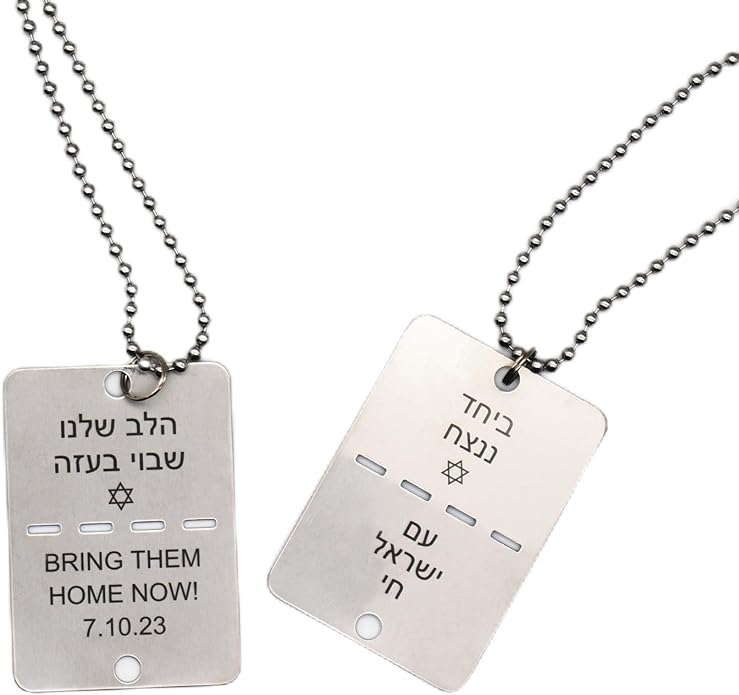
      We sang Acheinu, the prayer for those in capitivity, for the hostages. I began singing this in Israel in July and it has become incredibly meaningful to me. It’s an easy song to sing, a powerful prayer to say, and reminds me to keep the hostages front and center in my mind. That, along with my ‘Bring them home now’ dogtag that I wear every day keeps my priorities front of mind. It has been almost 10 full months of captivity and the reports now coming out from released hostages are horrific. I’m glad that I learned the how to sing it and do so daily. It takes me a couple of minutes, fills me with gratitude for my life, and doesn’t let me ever forget the hostages.

      Over the past few years, I have been very lucky to have some amazing Jewish mentors and teachers.  People who expose me to things that are meaningful and show Judaism in a different way in which I can connect.  Harry Rothenberg, Ari Shabat,  Saul Blinkoff, Lori Palatnik, Mickey Singer, David Abramowitz, and Rabbi Ehrenkranz are just some of them.  Each exposes me to different things to think about.  Each one expands my knowledge and enriches my life in different ways.  Pirkei Avot says, “Find yourself a teacher, acquire for yourself a friend”, and I have found this to be true.  Each of these teachers are also friends and only one is a Rabbi!

      As somebody who raised somewhat religious and is not any longer, I have found deep meaning in Judaism through understanding the why of what we do.  The what doesn’t really mean much to me but the why is something entirely different.  As antisemitism grows and Jew hatred explodes across the globe, I have found investing in my Jewish identity and Jewish meaningful practices to be important.  I have begun to bake challah again.  I make sure to say thank you to God every morning for waking me up (the basis of the Modeh Ani prayer), and since I learned about thanking God for making the rooster understand the difference between day and night, I thank him for the beauty of nature and this world. (It is a funny prayer that we start with – almost like the Rabbi’s are pranking us!)

      Many people think it is all or nothing.  You either go to synagogue or you don’t pray.  You either can pray in Hebrew or you don’t pray Jewishly.  You keep kosher or you aren’t really Jewish.  You keep Shabbat one specific way, or it doesn’t have any meaning to you.  I have found just the opposite.  There is incredible gray in Judaism once you understand why we do things.  Then you have the opportunity to do what is meaningful to you to accomplish the goals. 

      I encourage you to explore the why.  To learn about why Israel matters to Judaism.  To understand the intent behind the services and the prayers we do.  It will open doors for you to grow in ways you can’t imagine.

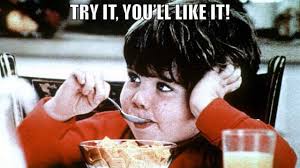
      Try it, you’ll like it!

      I went to minyan this morning.  For those that know me or follow me, you know that I am not religious and rarely go to synagogue.  The Rabbi that I learn with has begun a monthly Sunday morning minyan and I have committed to going to support him.  I bring my tallis and tefillin (the prayer shawl and the black boxes that go on your arm and your head) and one of my many prayerbooks that I rarely use to join the group.  Somehow, the group is always a group of friends so it’s a bonus to see them too.

      I have found that I really enjoy going.  It’s not because I have become religious, it is because the service is done in an intentional and meaningful way.  As we go through the prayers, what we are actually praying for and about is explained very briefly.  “This section is where we ask God to help the world in difficult times.”   Simple.  Clear.  It provides context to what we are saying and why we are saying it.  It’s a tour through the prayerbook.

      It reminds me of the playbill at the theater where they tell you what each scene is going to be.  When I learn with my Rabbi friend, we start by exploring the Siddur.  When we started doing this, I wasn’t very excited.  Services haven’t been meaningful to me in a very long time and exploring the Siddur wasn’t on my list of things to do.  I decided to be open to it and as we discuss a prayer and I understand what it is and why we say it, it has become interesting.  It reminds me of what my friend Roie, an IDF soldier at the time, said after Shabbat services.  The conversation went as follows:

      Roie:  So you know how to read the Hebrew words?  

      Us:  Yes.

      Roie:  And you know the tune to sing it?

      Us:  Yes.

      Roie:  But you have no idea what you are saying?

      Us:  That’s correct

      Roie:  I don’t understand!

      This was repeated over and over again.  He couldn’t understand how we could know the words and the tune but not what we were saying or why we were saying it.  He understood that just knowing the words and the tune wasn’t enough.  It wasn’t meaningful.  We were missing out on the entire purpose of what we were doing.  How could Judaism be meaningful if we didn’t know what we were actually doing or why we were doing it.

      I turn 57 this year and these minyanim are the first time that the parts of the service were actually explained.  As the different sections were explained, it began to make sense.  There was actual intention in each part.  There was a purpose to what we were saying.

      One of the things that really struck me today was his explanation of the Modim Anachnu Lach prayer.  It was so simple and so basic.  He said, “Nobody can say thank you to God for you except you.  You have to thank God yourself.  That’s what this prayer is for.”

      Wow.  Three short sentences and the prayer that I have said at services most of my life suddenly had real meaning.  What I have found is that Judaism has great meaning.  We simply don’t provide that type of content to our children and as a result, when they are adults, they aren’t interested.  When we show the meaning, people get engaged and excited. 

      There was recently a great poem written by Lizzy Savetsky titled, “The Six Pointed Star”.  It talks about who we are and points out that the hatred of today provides us with a reminder of who we are and that perhaps, we need to get back to basics and remember we are Jews and what being a Jew means.  I hope you enjoy her reciting it as much as I did.

      The Six Pointed Star

      There is something special about being Jewish.  I am not saying that Jews are better than anybody else.  It’s a more than 3,500-year-old peoplehood.  My friend Avraham Infeld had many sayings that I love.  One was when he would say, “Judaism in NOT a religion.  We are a mishpacha (family) that shares a common religion.” 

      Those words struck me not only the first time I heard them but every time after.  They resonated with me.  Being Jewish is about being part of a family.  It’s about being part of something bigger than yourself.  It’s why going to minyan this morning felt good.  I was with family.  We were spending our morning together.  We greeted each other with hugs.  We spent time after the minyan talking about our lives. 
      It is why Jewish holidays are a big deal.  We get together for a Passover Seder, to light the Hanukkah menorah, to eat in the sukkah or to dress up and eat hamantaschen.  Every holiday is about being together.  This year, I spent Yom HaZikaron (Israel’s Memorial Day) and Yom Ha’atzmaut (Israel’s Independence Day) in Israel.  After October 7th and in the middle of a war, it was more important to be together.  It meant more to Israelis that we were there than ever before.  Their brothers and sisters from across the Atlantic came to support them.  Their brothers and sisters came to show support and love. 
      Part of the reason Judaism and Jews are still here, more than 3,500 years later, is because we are more than a religion. Rabbi Harold Kushner z”l, in his book, To Life, asks the question, “What do you have to believe in order to be Jewish?” It is a great question. The answer is very simple. NOTHING! You don’t have to believe anything. You are born Jewish. If you convert, the minute you convert, you are now Jewish forever. Don’t believe in God? You are still Jewish. Don’t believe in keeping Kosher? Still Jewish. Don’t want to pray 3 times a day? Still Jewish. Don’t wear a kippah or follow the laws of Jewish purity? Still Jewish. Another of my favorite Avraham Infeld quotes is when he talks about people who convert to Judaism. He says there is no such thing a convert. The minute you convert, you are a Jew. Period. But, he says, there is a term ‘converted Jew’. This is somebody who is Jewish who converts to another religion. He says, “They only think they are the other religion. They are still a Jew.” We are more than a religion. We are more than a people. We are a mishpacha (family). So why not get to know your family a little better? Why not learn about your family? The more you learn, the more you will love your familiy and the more you will be happy and feel lucky to be a part of this family. As the famous Life Cereal commercial said, “Try it, you’ll like it”.

      More thoughts and inspiration from Israel

      As I continue to process my 10 days in Israel this month, I can only do so in bite size pieces.  Here is my second bite at the experience and what it has meant to me and what I have learned.

      On my trip in 2021, we had a number of Israeli men on our bus.  I wrote about Alex, whose son died on October 7th, in my last blog post.  Another person I met on that trip has become a close friend. I can’t use his name or pictures for security reasons.

      There were a few things that he spoke about that really resonated with me then and as I unpack the time in Israel, reinforce common themes that have come out of the trip and that I want to apply in my life.  One of the most significant was when he talked about holding his son’s bar mitzvah at Kibbutz Be’eri.  After being decimated on October 7th by the Hamas terrorists, he wanted to bring light and life to Kibbutz Be’eri, so that is where he held his son’s bar mitzvah.  It’s like saying that I want to get married on the still smoldering ruins of the Twin Towers in 2001.  Let’s celebrate a significant event at the devastated site of the apartment building in Sunny Isles, Florida.  Let’s celebrate our 50th wedding anniversary at any of the sites of school shootings a few months after children were murdered there.  In many ways, it doesn’t make sense.

      Yet through a Jewish lens, it makes total sense.  We value human life more than anything.  The Talmud teaches that Whoever Saves a Life Saves the World.  The idea of bringing light and life to a place where light and life was destroyed is incredibly Jewish.  It’s similar to what Noa was saying at Shura Army base when she spoke about making a better dinner for her family, being better for her children and husband.  We can take the sad, the dark, the bitter, and find a way to make the light shine again.  That’s what he and his family did at Kibbutz Be’eri.  They door a place stained with death, kidnapping, torture and pain and brought light to it.  They brought joy to it, if even for just a few hours or a day. 

      Noa, a true inspiration about how to live life. Our teachers show up when we are ready to learn.

      The lesson I take from this is that we all have an opportunity to bring light and joy to the world every single day.  It doesn’t matter what is happening in our own lives, in our country, or in the world.  We have the ability to make a conscious decision to do things that bring light to the world.  Sometimes it can be something as simple as holding the door for somebody.  Helping somebody cross the street.  Say a kind word to somebody that you see even if you don’t know them.  It doesn’t take much to bring light to our lives and the world.  It does take a conscious effort.  After this trip, one of the things I am going to do is find ways to bring light to the world around me.  Pay attention to the opportunities that present themselves every day and act.  The small random acts of kindness brighten somebody’s day and improve the world.  Thank you Yaron and Noa for inspiring and teaching me.

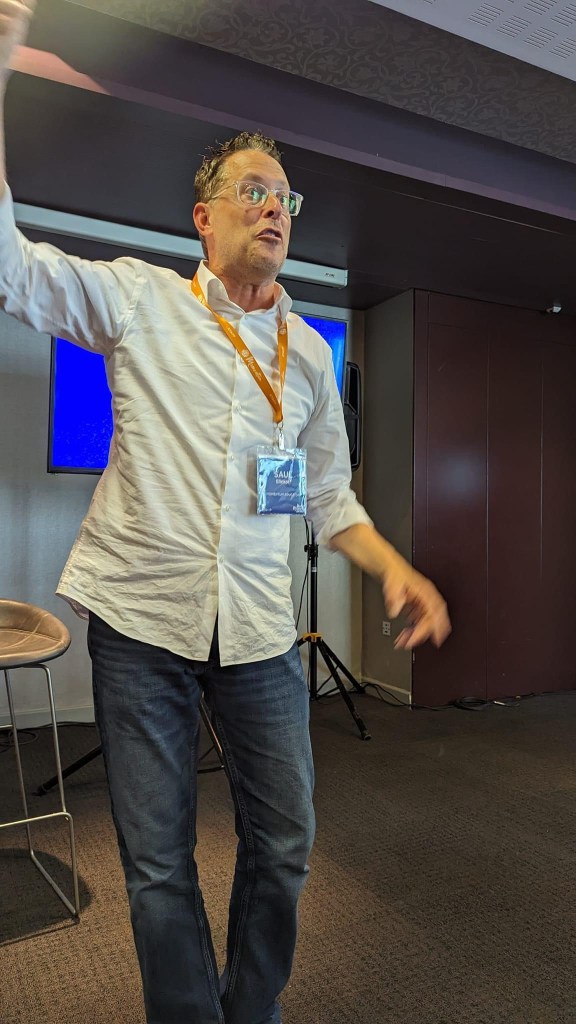
      Our trip leader, Saul Blinken, was incredibly inspiring.  We spent most of our time based out of Jerusalem and he said something that had an immediate impact on me.  Saul said that every day we wake up in Jerusalem, it’s a miracle.  Every day we breath the air in Jerusalem is a miracle.  Every day we walk the streets of Jerusalem, it’s a miracle.  And every night we go to sleep in Jerusalem, it’s a miracle.  He asked us to imagine if somebody told the Jews who were being exiled by the Romans not to worry, that 2000 years later the Jews would be back in Jerusalem and there would be a Jewish state.  They wouldn’t believe it.  Yet it happened.

      Saul passionately speaking to us. What an incredible teacher and friend.

      From the time Saul said that I took it to heart.  Every day when I woke up, it was an incredible feeling to know that I was waking up in Jerusalem.  As I walked the streets, I had a deeper appreciation of what it meant to be able to do that.  Going into the old city, visiting the Kotel, walking freely throughout the city – everything became a WOW moment.  It reminded me of what my friend Roni Akele, the Director General of the Ethiopian National Project said about being a Jew in Ethiopia.  He said that they always dreamed of returning to Jerusalem.  Everything was about Jerusalem.  The psalm we sing is “If I forget you, oh Jerusalem….”

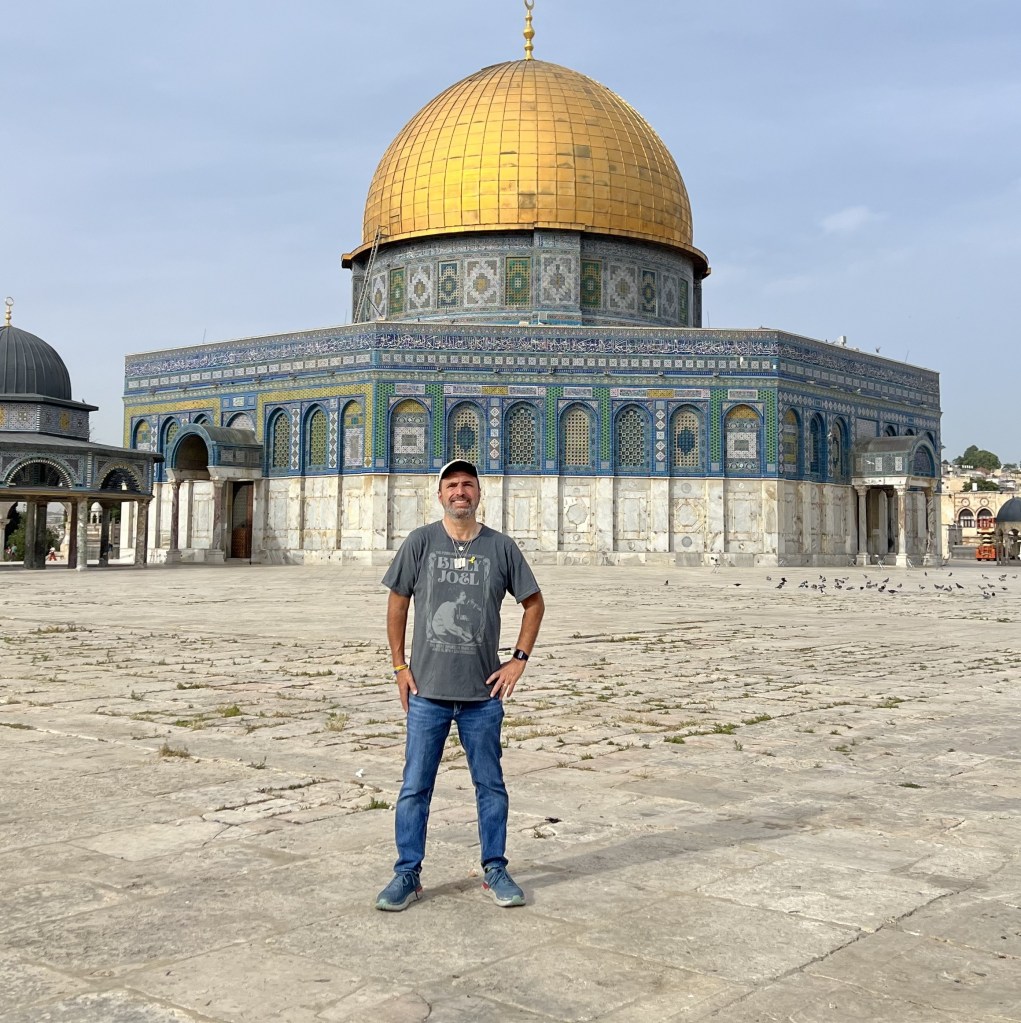
      I fell in love with Jerusalem on my first trip to Israel in 1989 and it has never changed.  I am not an overly religious person, yet going to the Kotel is powerful.  This trip I got to visit Temple Mount for the first time.  Incredibly powerful.  As we stood there and said the Shema, I felt a connection that is indescribable.  Saul’s words hit home and deeply.  I’ll never take Jerusalem for granted again.  I’ll never take for granted all the time I have spent there, all the sites I have seen, all the friends I have who live there. 

      It’s an opportunity to think deeply about gratitude.  This was my 21st trip to Israel and I hope to be back in Israel a few more times this year.  I don’t think much about it yet now I am filled with gratitude that I have these opportunities.  Each time I go to Israel, I get a deeper connection to Judaism and to understanding myself.  As I have said, I’m not very religious but I am very Jewish.  Israel brings that home to me.

      I also think about how many things I have to be grateful for in my life.  Jerusalem can easily be representative of so many important things.  My family.  My health.  Doing work that is personally meaningful.  The success of my children as people and in life.  The life I have is truly beyond my wildest dreams.  It is easy to lose track of that and focus on the things that aren’t going well or that I don’t like.  Temple Mount was a good example.  I wish we could go there whenever we want.  I wish we could openly pray there and celebrate that holy space.  I could focus on the things we don’t have.  Or I can focus on the fact that we can go there.  That I did find a private place to pray quietly.  That I did feel the connection with God in this special place.  Our choices determine everything.  Do I want to focus on what I don’t have or what I have?  Do I want to be bitter about the things I think I deserve or be grateful for the wonderful things I actually have?  Just like I’ll never take Jerusalem for granted again, I won’t take the wonders and gifts of my life for granted either.  Nothing is perfect but it sure can be great.
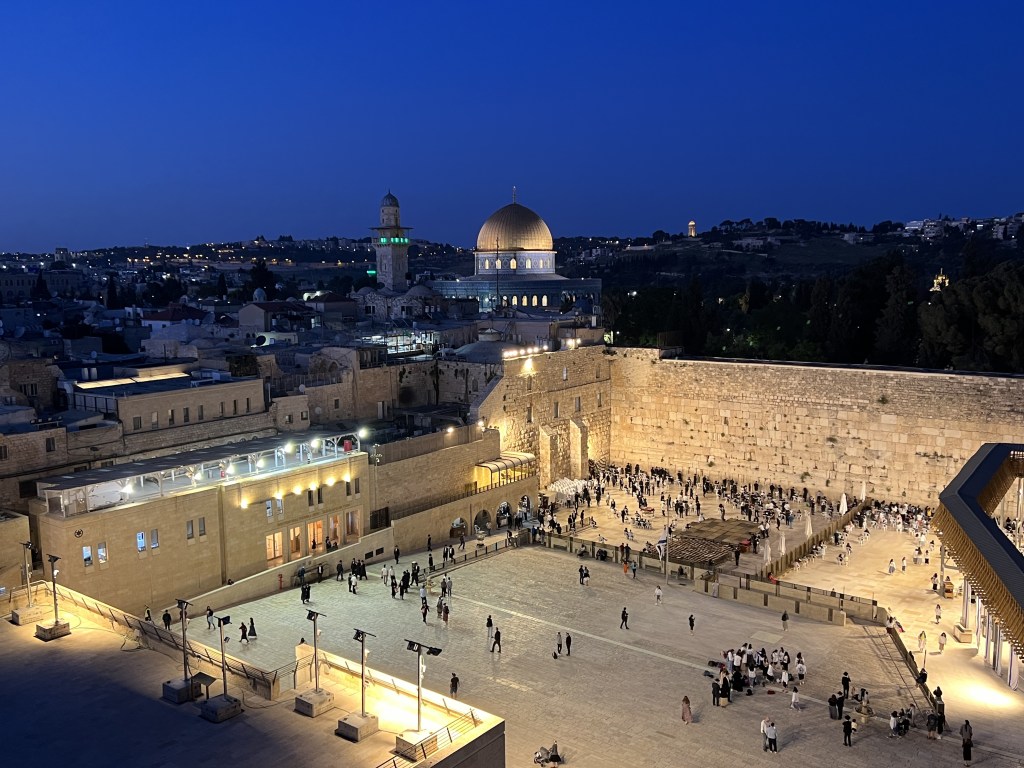
      A picture I took overlooking the Western Wall plaza. The beauty never disappoints.

      The last thing I want to unpack in this post relates to Israelis.  Not since the second intifada have I been in Israel where I was thanked so much by Israelis for being there.  During the second intifada they were happy to see Jews coming because most were not.  It was the Christians who were coming to visit.  This time they were grateful for Jewish solidarity.  For knowing the Jews of the diaspora love Israel and support them as brothers and sisters.  That we are willing to come in the middle of a war because of our love for Israel and the people of Israel.   That the Jewish community truly is global.  There was a unity we felt and that they needed.  I never expected to get the thanks we did or for it to mean as much as it did to me. 

      During the second intifada, part of the thanks was due to the economic benefit the country needed by our visiting.  While that is very true right now, that wasn’t what I was being thanked for.  The Israelis need to see us in person.  They need get our hugs and love.  They need to know they aren’t alone.  When the guys on our bus from an LA Jewish Day School gave the soldiers letters from kids at the school, they were deeply moved.  October 7th, the hostages, and the ensuing war is taking an incredible toll on the entire country.  Seeing their Jewish brothers and sisters from America and the rest of the world makes an incredible difference.

      It’s a reminder to me that not only do I need to show up both through WhatsApp and in person for my Israeli brothers and sisters, I need to do the same for my friends and family.  That random phone call, text, or email may often mean far more than I ever thought.  Checking in on friends and family doesn’t take much effort and the payoff is always significant and meaningful.  This trip reminded me that the 30 seconds it takes to send a text or email, or the 15 minutes I allocate for a phone call, may change a person’s entire day and outlook.  It doesn’t matter if they reply or if they answer the phone.  The effort is what is meaningful.

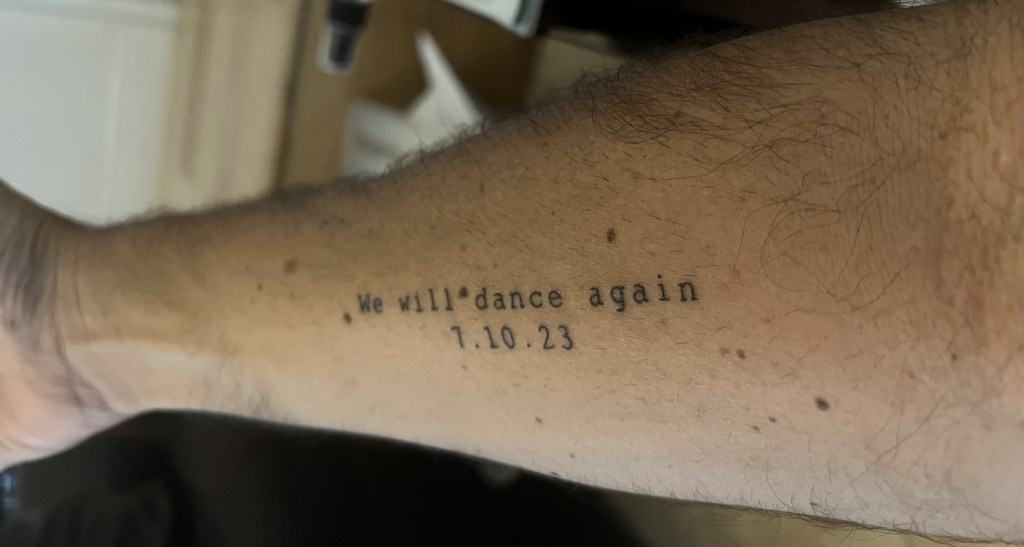
      The other thing that was surprising to me was the Israelis response to my tattoos related to October 7th.  I got them because of their meaning to me.  My children could have been at Nova.  I could have been there with them.  It hit home and hard.  The Mia Schem quote, “We will dance again” and the tattoo she got inspired me as well.  It is a reminder that we never give up hope.  We will overcome the challenges and not just survive but thrive.  Whatever is taken from us, we will get back.  They will never take our spirit or our soul.  Here in America, I get very few comments on them.  People are very used to tattoos and I have been surprised at the lack of comments or questions because of the uniqueness of them.  In Israel it was just the opposite.  Not only did they notice them, but people were stunned that October 7th meant that much to me.  ‘Wow’ was the most common thing said to me, followed by questions and a conversation.  At a t-shirt store where I got a few meaningful ones for myself, the owner was so taken by my tattoos that he asked if he could take pictures of them and use them on t-shirts he would sell.  Of course I said yes.  On my next trip, I’ll swing by and see if he has them on a t-shirt.  How cool would that be??

      Nova music festival – it could have my kids and me.
      The Mia Schem saying and tattoo

      Standing up for what you believe in matters.  The old saying, “If you don’t stand for something, you will fall for anything” really holds true.  I’m not advocating that everybody should get a tattoo.  I am advocating that whatever matters to you, whatever you stand for, make sure that you actually do it publicly.  It matters.  People notice what you say and do and what you don’t say and don’t do.  If they are your values, make it public.

      Trips to Israel, especially the Momentum Men’s Trips, always have me returning with my head spinning.  There is always much to unpack.  More is coming as I continue to process the time I spent there, the people I met, the things I saw, and how I felt.   If you have never been, I urge you to go.  If you have been, I urge you to return.  It truly does change your life.

      As I process my time in Israel, a few early thoughts

      Processing my recent trip to Israel has been a challenge.  This is my 21st trip yet the first since October 7th.  In many ways, this makes it my first trip to Israel.  Rather than being able to sum up the trip in one blog post, I am going to take bits and pieces and talk about them.  Take bites out of this experience and share them.  As I was talking to somebody this morning about the trip, we discussed how it really was an overwhelming experience filled with emotion. I’m going to begin by writing about three things.

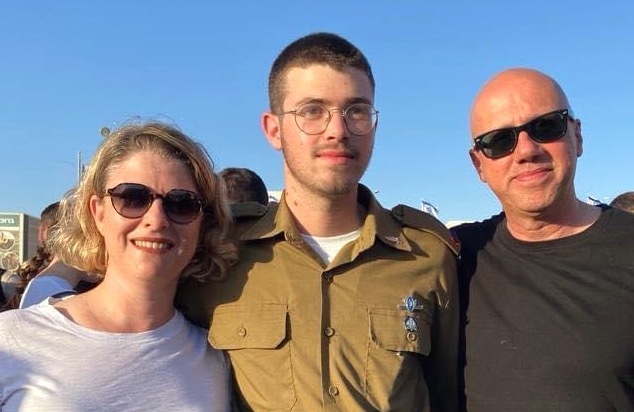
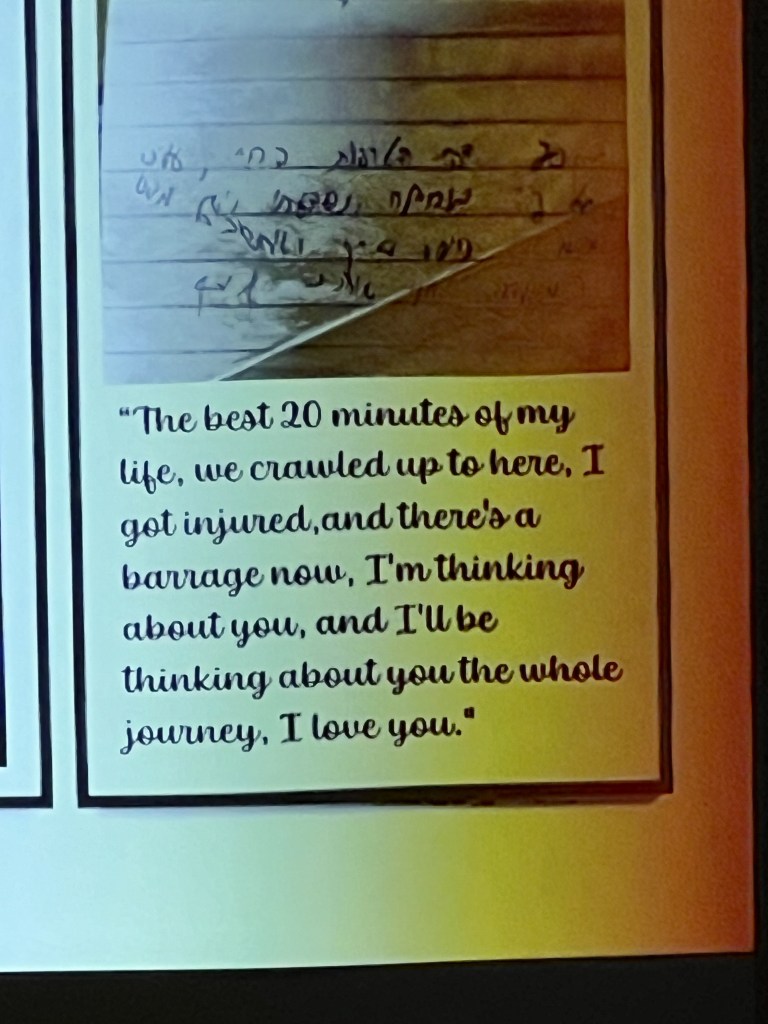
      In 2021 I participated in my first Momentum trip.  One of the people on our trip was an Israeli man named Alex Malayev.  While we didn’t become close friends on the trip, we did get to know each other.  Throughout the years after the trip, we kept in touch through our WhatsApp group.  He shared with us in the group that his son Yoav was in the IDF and killed fighting Hamas on October 7th.  It was devastating to hear this news and my heart broke for him.  On the trip, he talked about his son and shared what Yoav wrote, after he was mortally injured and was dying.
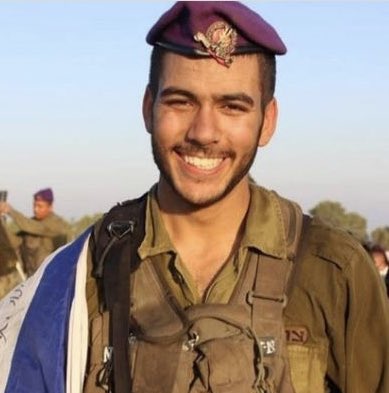
      Yoav Malayev z”l with his father Alex and mother Maya

      “The best 20 minutes of my life, we crawled up to here.  I got injured, and there’s a barrage now.  I’m thinking about you, and I’ll be thinking about you the whole journey.  I love you.”

      It brought tears to my eyes then and brings tears to my eyes now. As this 19 year old boy was injured and dying, his thoughts were on defending Israel, defending the Jewish people, and how much he loved his family. He was proud of his effort to defend the Jewish people and the Jewish homeland. The best 20 minutes of his life. What bravery. What inspiration. When I first heard it from Alex and read it on the page, I felt like I was being slapped in the face. He was willing to sacrifice his life for the Jewish people and the Jewish homeland. What am I willing to do? What am I willing to risk? How important is it to me? As I sit on my comfortable couch back in America, I continue to ask myself that question. I thought I did enough before this trip. After hearing Yoav’s story, I know I am not. I have to do more. I have to advocate for Israel. I have to advocate for the Jewish people. I can’t be silent because I am worried about my safety. He didn’t worry about his safety.

      Alex’s son Yoav may have died but he didn’t die in vain. Not only did he help protect Israel and the Jewish people, his life and death is an inspiration to us all to do more. To give more. To take bigger risks. To represent being Jewish in a public way. We have a collective responsibility. When Israel called, 350,000 reservists answered right away. More than were expected. The Jewish people are calling. Israel is calling. We need to respond. I know that I will. The next few weeks will be figuring out exactly how. I urge you, if inspired by Yoav, to do the same.

      The second thing I want to talk about is when we went to the Shura army base. When we arrived, we got there just as the body of Nachman Vaknin z”l was being loaded into the van to be taken to Eilat for burial. Nachman had been killed in battle a few days earlier. It was incredibly powerful watching his coffin being loaded into the van. Then, the doors were kept open so one of our group, who was saying mourners kaddish for his mother, could say kaddish there for both him other and for Nachman. When he finished, we were given the honor of escorting Nachman out of the parking lot and on his final journey home, where he would be buried later that day.

      Nachman Vaknin z”l

      None of us had known Nachman yet all of us felt we lost somebody close to us. This 20 year old boy was defending us. He was defending Israel. He was defending the Jewish people. On Thursday, we had been in Kfar Aza, less than a mile from Jabaliya. Before that, we had been working on a farm in the Gaza envelope where we could see Khan Yunis. After Kfar Aza we went to the site of the Nova music festival. Both Kibbutzim and the Nova festival were attacked on October 7th and suffered losses. Two of the three also had hostages taken. In the middle of the war, we knew that we could have been attacked at any time at those sites. Nachman was killed on Saturday, just two days after we were in the area. I think all of this combined to make him feel like an additional son to all of us.

      We were incredibly moved by being there for Nachman as he was put into the van and driven away. It made us think about life. Earlier on the trip, Saul, our trip leader, had talked to us about what we would die for determining what we would live for. I know that as I stood there with Nachman’s body, I knew what he would die for and so I knew what he lived for. It continued the spin in my head. What would I die for? Because I know that determines what I live for. Now that I am home, that spin in my head hasn’t stopped. Yoav and Nachman both knew. My head still spins. They were 19 and 20 yet they knew. I am 56 about to be 57 and I am not sure. My family is one thing that I would die for. I know that and have known that for a long time. What ideals? What values? It goes to my core which is what makes it so difficult. A core value of mine is honesty but would I die rather than tell a lie? I don’t think so. Where that line is a challenge for all of us to ask of ourselves. This trip has truly highlighted it for me and I want to be like Yoav and Nachman and know to my core what I would die for. Then I know what I truly live for.

      The final thing I want to write about also is from the Shura army base. After we said l’hitraot to Nachman on his final trip, we were introduced to Noa, who talked to us about the forensic center located at the base. Noa has 8 children and on October 7th, 7 of their family were called up from reserves. This includes both her and her husband. This means 7 of 10 people in her family have been active duty in the war since October 7th. It makes the story in Saving Private Ryan seem tame as he was one of 4 brothers and these are 5 siblings and 2 parents. Her job at the forensic center was to prepare the bodies of those who were murdered on October 7th for burial. One of the beautiful things she said that she always believes that the neshama, the soul, of the person who died is in the room with her. You can listen to her talk in this first video.

      Noa speaking to us and introducing herself and the base.

      Noa was truly amazing and inspiring. She talked about how they got not just the bodies of soldiers but of civilians as well. Men, women, and children. They also got the bodies of terrorists. This made it challenging as many of their bodies were booby trapped with bombs and grenades. Imagine working to humanely treat the bodies of the dead and having to rush out because there is concern one of the bodies has a grenade or bomb that could go off. As she talks about how many bodies were there on October 7th in such matter of fact voice was chilling. She finishes talking about an injured soldier with a twin brother and how she can’t make a mistake in the identification.

      Noa talking more about the base and what she does.

      When we went inside the thing Noa talked about that stuck with me the most was how after all the horror she saw, after all the blood she described dealing with, after seeing the mutiliated and abused bodies, she finds that she must still look for the positive. She still has to think about how to make the family a more delicious dinner. How to be a better wife and mother and friend. After all the horrors, instead of being stuck in them, she looks for the beauty in life. She looks for ways to make life better not just for herself but for those she cares about and loves. What a beautiful concept.

      After she talked about that, I found myself thinking about the things that I struggle with that keep me from focusing on the beauty of life. What things am I allowing to keep me from asking how I can be a better husband, father, and friend. What more delicious dinner should I make? What keeps me focused on the negative instead of the positive? And if Noa can do this after what she has seen, what stops me from doing it? It should be so much easier for me as I haven’t seen the gore she has. I haven’t dealt with the inhumanity that she has.

      Now that I am back in the United States, far away from the active war, I want to do better. I want whatever comes to my life to only make me want to do more. To do better. I have seen religious people talk about this often in the past, regardless of their religion, and always questioned it. After October 7th, after meeting Noa, after seeing the sacrifice made by Yoav and Nachman, after being at Kfar Aza and the Nova music festival site, I feel like it is my obligation to find ways to bring more light to world. Not to allow the darkness we all face to win. Noa actively shoves the darkness away and doesn’t merely make room for the light, she is the light. She fills the room with light. We were all amazing by Noa. Who she is as a person. What she does for Israel, for those who die in service to Israel, and for their families. The type of mother, sister, and wife she is. Who she is as a human being.

      Three amazing people to inspire me and hopefully inspire you. Yoav, who while giving his life for the state and people he loves not only celebrates the opportunity but shares his love for his family. Nachman, who paid the ultimate price to keep us all safe and while we didn’t know him, felt like a family member to us all, and Noa, who took care of those from October 7th and every female soldier since so they get treated with dignity and respect before burial. Who makes sure the families going through intense pain and loss know somebody was caring for their child until they are buried. All three knew what they’d die for. All 3 knew what they live for. While only one remains alive today, all three have full lives. All three have changed my life. I hope that over the rest of my life, I can live up to the standard they have set. I know I have work to do.

      Yotam Berger wrote this

      For the first time in the existance of this blog, I am not writing it. This was written by Yotam Berger, and Israeli PhD student at Stanford. I couldn’t have said it better or clearer so I’m letting his words say what I think and feel. Please read Yotam’s words and think hard about them. You can read the original post (in Hebrew) here. This translation came from Daniel Gordis’s substack Israel from the Inside.

      Man in a Hamas costume on the campus of Stanford this week.

      Five lessons from Stanford, California 

      The academic year in the United States is coming to an end. In a few weeks, the university students graduating will stand on the grass, in caps and gowns. They will excitedly take pictures, shake hands with the deans, and then fly away, making way for a new generation of their ilk.

      Ahead of the graduation ceremonies, the anti-Israel student protests at American universities are also increasing. Let’s start with the “all clear” siren. Here at Stanford, at least, the students who sleep on the campus lawns and call for a “global intifada” are—as a rule—not dangerous in the physical sense of the word. But they are very dangerous in the medium and long term, as far as the image of the leader of the free world is concerned.

      This is my second year at Stanford. When we returned here in September after the summer break, I intended to finish the year with an approved research proposal and a third of my PhD written. It’s hard to describe how far I am from meeting that goal. In my opinion, I’m not really unusual. Since October, many Israelis abroad have found themselves forced to choose between two options—to put their heads down or become ambassadors without a choice. Who can even write an article when his two brothers are fighting in Gaza? Instead, I found myself spending much of my time on “outreach” activities that I had no intention of taking part in.

      Despite this, I learned some very important lessons this year that I will never forget. As the school year comes to a close, and in light of the wave of anxious questions from around the country in light of the current round of campus madness, I thought I’d share the five most important lessons I learned this past year at Stanford, California.

      1. Whether we want it or not, we are always—first and foremost—the Jews.

      The first year here was a fabulous academic experience like no other. I felt surrounded by international friends. I was given full access to the world’s brightest legal minds. The feeling was that endless opportunities lay ahead. Friends from Israel, who asked already last year if we suffered from anti-Israelism, sounded funny to me. No way!! I am a liberal Israeli. I wrote for the most leftist newspaper in Israel. I did my clerkship in one of the more liberal courts in the Western world. Why would anyone have a problem with me? I walked among those who I thought were friends as equals among equals. I could talk about Israel freely, criticize it and love it, have discussions that I thought were good and complex about the most sensitive issues even with those who clearly disagreed with me. I felt like a citizen of the world.

      That was an illusion. There really is no such thing, it turns out, as a “Jew who is a citizen of the world,” as long as the Jew insists on his right to a national existence. For many of those whom I saw as friends, it turned out, I was first and foremost the Jew. At the moment of truth, few of them stood by me on a personal level. Almost none of them stood by me at the national level. Their double standards allowed Israel-hating students to say horrible things about me and my friends, but silenced our every attempt to oppose it. In some places, I had to choose between apologizing for my Israeliness and rejection. There was no choice to be made.

      This eye-opening experience also has advantages. It is a litmus test for the human quality of those around us. Some of the people around me went out of their way to support me, or to show gestures of humanity. I found myself surrounded by strong and durable ties. I will not forget these friends easily.

      2. America deserves Donald Trump.

      An Israeli friend joked to me that if Trump is re-elected president in November, he will walk the halls of Stanford and hand out baklava. It’s a very funny joke only because it’s not entirely imaginary.

      November 9, 2016 was a day that struck me with amazement. Like many all over the world, the fact that the United States of America elected Donald Trump as president was unimaginable. In a very deep sense, no matter how many commentaries I read, how many films and documentary series I watched—the appointment of this man seemed inexplicable to me. Unimaginable. Impossible. Even years later, when the words “President Trump” stopped feeling strange on the tongue, the choice of him seemed inexplicable to me. A glitch in the matrix. I couldn’t understand how his campaign could be successful.

      This year I finally got it. No, if I were an American I still wouldn’t vote for Trump. But I now understand those who vote for him. Donald Trump is some Americans’ answer to the madness on the other side, a madness I didn’t notice until it turned its face in my direction. A madness no less terrible than Trumps’s madness. No, if I had the right to vote, I would not vote for Donald Trump. But America deserves him.

      3. The progressive movement is not a political ally of liberal Zionists.

      Last year, the progressive movement seemed like an amusing youth rebellion to me. Yes, the ceremony where everyone announces their gender at the beginning of class seemed strange to me, not always necessary, but not harmful. The fact that I had to declare my race on every form I filled out (and make sure to state that I was “Middle Eastern”) made me laugh, but didn’t upset me. I saw the American progressive movement as the infantile sister of liberal movements that I respected. I saw it as an ally. That was a mistake.

      I saw the American progressive movement as the infantile sister of liberal movements that I respected. I saw it as an ally. That was a mistake.

      The “progressive” movement is not an amusing anecdote. This week I was exposed to a particularly graphic expression of this. In the “Pro-Palestinian” encampment (in double quotation marks, since a significant number of its residents are unable to point to the country on a map, and it is doubtful that they are able to name a single Palestinian leader) that was re-established in the heart of the campus, a man was photographed in a full terrorist costume—including a black sock hat with a slit for his eyes, and a green Hamas ribbon on his head, next to students who are active for transsexual rights. This strange alliance [DG – since Hamas executes those it considers sexual deviants, which obviously includes transsexuals] is not funny to me.

      The progressives are challenging much more than the state of Israel, or the right of the Jews to a nation state. I’m not sure how many of the people who identify as progressives actually hold these ideals, and how many of them are just repeating them over and over loudly, with the intention of gaining some kind of social sympathy. But those of them who hold this position really no longer believe in the existence of “truth,” or in the existence of facts.

      I’m not referring here to those who express the opinion that it is difficult to get to the truth, or who think that the courts do not always succeed in finding out what the facts are, or who hold that different ideas are perceived differently through different eyes. I’m speaking about those who say unequivocally that there is no such thing as truth. They are not interested in presenting facts to support their arguments because they do not believe there is such a thing as facts, and they say so explicitly. They think that it is forbidden to use the term “jihadist” in front of jihadists, or to call supporters of terrorism by their names, because feelings are more important than facts (although, of course, first and foremost theirfeelings). They don’t believe there should be consequences for actions, because they don’t believe there should be consequences for anything. Everything can be disputed, because nothing is real. Life is a debate club. It’s not a treat, or at least not just a treat: it’s an ideology. This ideology challenges the existence of objective truth—attainable or unattainable—as an intellectual concept.

      4. Always go straight. It is not so important what is said or written about you.

      The denial and turning of the backs of those whom I saw as friends, or at least fellow travelers, came with a temptation: to lower one’s head. I do not belittle and I completely understand Israelis who chose this. At this stage, for now, being ashamed of being Israeli, suppressing Jewish symbols, trying to adopt the American accent—can ensure a reasonable quality of life even in places where hatred of Israel is very present. But when the temptation was placed in front of me—to some extent at least— I tried to remember what I had learned from two teachers in recent years.

      Attorney Momi Lemberger usually tells his interns to “always walk straight.” When a decision is made in a case—should an indictment be filed? Should the charges be dropped?—The only thing that matters are the facts and the law. It is easy to be tempted to consider what was written in the newspapers. What the minister says. The chance to advance in the system. But considering such considerations inevitably leads to bragging, to losing one’s way. Judge George Kara used to tell his interns that “it doesn’t really matter what they say or write about you.” The facts are more important. Making the right decisions is more important. There is no reason to align with vanities, even if it has some social or public cost.

      These lessons are true in relation to greater and much more important decisions than the personal decision of whether to keep one’s head down or insist on externalizing and being proud of one’s Israeliness, even in unpleasant forums. But they are infinitely true when the heaviest price to pay for going straight is that some American PhD students will turn up their noses at you. Since October, I’ve learned that there’s no point in keeping your head down, while there is intrinsic value in the decision to always going straight, to calling a spade a spade.

      5. The solution to the university crisis cannot come from below, but it can be parachuted from above.

      The kids protesting in these university yards worked very hard to get accepted to Harvard, Stanford, Yale, and Columbia. Most of them are not the “Vietnam generation,” even if that is what they tell themselves. They are the equivalent of the 8200 children and IDF Radio in Israel. [DG – both very prestigious jobs in the army, the former in one of the most respected intelligence units, the latter on the radio, a position very hard to snag.] They worked very hard and paid a lot of money to get here, and they care a lot about how they graduate. More than that, they care what the characters they value think of them. True, they care what their classmates think. Most of them care just as much what the President of the University, the Dean of the Faculty, and even the lecturer in the course think of them.

      For many of them, the current wave of protests can be an educational opportunity. American universities repeatedly emphasize the importance of freedom of speech in American culture, the centrality of the First Amendment to the Constitution which guarantees absolute freedom of speech in the American political atmosphere. They can’t shut them up. That is true. But the universities can, and are even obliged, to educate their students. They should not and cannot prevent these children from screaming their demands to spread the intifada or boycott Israel. But they can tell them that they hold very stupid positions.

      If university presidents would stop trembling in their own shadows, they could tell their students that they have a right to express stupid views, but that shouting them out won’t make them any more correct. Lecturers cannot silence their students, but they can emphasize that anyone who expresses uninformed or unfounded positions with great confidence is an educational failure. An Israeli—as I discovered—cannot really convince his American counterpart that Israel is not committing genocide, even if there is not even a shred of evidence to support the argument that what is happening in Gaza is genocide. But if the president of the university were to look at his students and express sincere disappointment when they express such a preposterous position, something in a significant portion of those students might shift.

      The effectiveness of the “direct information”—in front of the young students—exists, but is very limited and in any case organized bodies can hardly promote it in an inorganic way. The solution, in my opinion, lies in putting pressure on the presidents. And there is urgency in this—today’s generation of presidents and senior lecturers are still old and established people, who were educated in the 1970s and 1980s. They remember the Six Day War and Yom Kippur War. They are liberals, but they are liberals like Bill Clinton. They have respect for Israel. They have no intention of responding to the BDS demands that many of their students voice. In private conversations with Israelis, they also express their feelings of affection for Israel generously. But their feelings of fear of their American students are immeasurably stronger than their affection for their Israeli students. The pressure needs to be put on them. If they are freed from the terror that grips them of expressing their opinion, they can set boundary lines, and these may seep down—to those who want to participate in the “pro-Palestinian” festivals, to make an impression, but want more to be loved by important people in their professional lives.

      If we do not take advantage of the present opportunity, we will find ourselves in a short time standing in front of a new generation of presidents and deans. It is not known if they will still have positive feelings—however repressed—towards Israel.