Temptation and the real lesson from Adam and Eve

It’s always interesting learning Jewish things in Israel, especially in Jerusalem.  Aryeh Ben David explored Chapter 3 of the beginning of the Torah with us.   We talked about Adam and Eve being expelled from the Garden of Eden.  The midrash (story from Rabbi’s) is that after being forbidden by God to eat from the tree of knowledge, it took them about 20 minutes to eat the apple.  It is about temptation. 

So why would God tempt Adam and Eve, knowing that they would fail the test and be expelled from the Garden of Eden?  How do we do when told we can’t do something, especially something that sounds interesting, fun or would be totally awesome?  A friend parks their Lamborghini in your driveway, gives you the keys, tells you they will be back in a month and that you CANNOT drive it.  How long would it take before the temptation to just take it for a little spin would win out?  He won’t know – it’s just a couple of miles.   Temptation is all around us and our goal is to do the best we can to not fall into it.

It is easy to fall into temptation.  We do it every day.  Too much food.  Delicious desserts.  Some people it’s with sexual activity.  Alcohol.  Drugs.  Buying expensive things that we can’t really afford.  Temptation feels good.  It’s immediate gratification.  The consequences happen down the road and we don’t think about them when we are in the middle of enjoying the fruits of temptation.  Adam and Eve didn’t think about what God would do if they ate the fruit they were told not to.  The consequences came after. 

How do we avoid temptation?  What can we do to be more aware?  That’s where structure comes in.  That’s where gratitude comes in.  Adam and Eve had everything, yet they still couldn’t appreciate what they had and risked everything because of temptation.  The desire for more.  They lost.  Often times we do the same.  We risk everything.  Our health by eating too much, the wrong type of foods, or too many sweets.  Our lives with drugs or alcohol.  Our marriage and families with sexual desires and behavior.  Sometimes we see the consequences and they are devastating, like Adam and Eve.  Sometimes we get away with them, which only reinforces the behavior.  It is like Las Vegas, and we are gambling with our lives.  Just like in Vegas, we forget that the house ALWAYS WINS

The second lesson we learned from Adam and Eve was to dream.  It sounds strange to think of that since the story doesn’t seem to focus on dreams at all.  Nobody ever told me that having dreams was part of Adam and Eve’s story.  It was about obeying God and the consequences when you don’t.  It was about being created in the image of God.  But dreaming?

After being kicked out of the Garden of Eden, Adam and Eve dreamed of finding a way back.  When they realized they could never get back, they began to dream about how to make the world they now lived in as perfect as they could to resemble the Garden of Eden.  That is the beginning of the Jewish value of Tikkun Olam, repairing the world.  Adam and Eve tasted the perfect world and lost it.  They, and their ancestors for thousands of years, would spend their time trying to recreate it. 

Each of us has the ability to make the world a little more perfect.  It’s not our job to make the whole world perfect.  That’s too much for any of us.  However, we do have the ability to do little things to make the world better.  That’s the essence of the story of Adam and Eve.  It’s not about how the snake convinced Eve or how Eve tempted Adam.  It’s not about how God took Adam’s rib to make Eve.  It’s about each of us doing our part to make the world a little bit more like the Garden of Eden.

It can sound overwhelming but it’s not.  It is the little things.  At our hotel in Jerusalem, I say hi and good morning to all of the people who work here.  The man who cleans my room is a nice guy, we talk throughout the day when I see him.  Instead of thinking of him as less than or pretending not to see him, I recognize him and treat him nicely.  He does the same to me.  Treating everybody as an equal human being makes the world a better place.  That’s an easy thing for us all to do if we simply pay attention and make the effort.

Adam and Eve had a big dream to make the world resemble the Garden of Eden.  Bigger dreams have bigger impacts.  We know one thing for sure, we cannot achieve a dream that we don’t have.  Dreamers in today’s world often get shut down.  There are too many challenges, too many risks to dream.  Yet it is dreamers who change the world.  Steve Jobs used to dream about making devices that you didn’t even know you needed.  The iPhone.  The iPad.  I remember the Thanksgiving discussion with my grandfather and my father about desktop computers.  My grandfather was 100% certain that there was no way that every house would want, need, afford, or have a computer.  In the end, he was right.  In my house we don’t have one computer. We have 6 or 7 computers (including laptops) and that doesn’t include iPads, iPhones, Apple Watches, etc.  Steve Jobs’ dream changed the world.

It isn’t just Steve Jobs though.  I remember a few years ago reading about a man named Rodney Smith Jr.  I’m sure you have all heard of him.  What?  You haven’t?  Rodney Smith Jr. came up with an amazing idea.  He wanted to raise boys into men, girls into women AND help those in need.  How does he do this?  He created a nonprofit called Raising Men and Women Lawn Care Service that encourages them to take the 50-yard challenge.  They are challenged to cut 50 lawns FREE for the elderly, disabled, single parents, veterans, & anyone in need of help in your town.  At each level of 10 they receive a new t-shirt of a different color and when they reach 50 lawns, the come to visit the boy or girl and present them both their black shirt to mark 50 lawns and give them a brand-new lawn mower, weed eater & blower!  How cool is that?  They are now in all 50 states, 8 countries, and have thousands of kids mowing lawns for people who need help.  In the winter, they shovel snow, and, in the fall, they rake leaves.  They are truly making a difference in the world.  Rodney Smith Jr. has made the world better for the thousands of children who are giving back, for their parents, and for the tens of thousands of people who get their services. 

Steve Jobs had another important quote for this context.  He said, “We’re here to put a dent in the universe. Otherwise, why else even be here?”  Each of us has the ability to put a dent in the universe.  As it says in Pirkei Avot (Ethics of our Fathers), Chapter 2:16; “(Rabbi Tarfon) used to say… It is not up to you to finish the task, but you are not free to avoid it.”  Our job is to participate in the job that Adam and Eve started.  Making the world as close to the Garden of Eden as possible.  What are you going to do today to make the world a better place?  What are your random acts of kindness going to be?  What impact will you make today.  We all have the opportunity to change the world a little bit every day.  The questions is are you going to do your part?

The trading of time

I’m here in Israel for two weeks with a group of young adults on a leadership program.  The Jewish Leadership Institute (JLI) was created by Rabbi Mayer Abramowitz more than 30 years ago.  He was a visionary.  He understood in the early 1990s that the future was on the college campus and that providing answers to the WHY of Judaism was critical to developing Jewish leaders.  I was introduced to the program in 1998 and have been a fan ever since.  Now I get to work with my friend David, Rabbi Abramowitz’s son, on JLI and the future of JLI.

While the focus of the trip is on the young adults, it is impossible not to be inspired by both them and the content.  I find myself thinking deeply throughout the different experiences and while I am not the intended target of the program (nor are you) the impact is felt.

Yesterday we had an amazing tour guide, Eytan Rund, take us on a tour of the Old City of Jerusalem.  I’ve been on many tours of the Old City.  Too many to count.  I love the Old City.  Last month, our guide gave a totally different view of the Old City that I wrote about.  Eytan spent two hours with us giving one of the most amazing tours I have ever experienced of the Old City. 

Eytan’s focus was on the difference between seeing old stuff and seeing stories, history, and memory.  The Old City was his muse to talk about peoplehood.  To talk about the Jewish collective.  To talk about what being Jewish means – being part of a mishpacha, a family, that is thousands of years old.  As we looked down into the ruins of Jerusalem from the time of the first Temple, he explained this was this built 3,000 years ago by Jews.  Well before Christianity.  Well before Islam. This is our homeland that we built.  He talked about how after the destruction of the first Temple, Jerusalem was filled in with sand to make an entirely new ground, well above the prior city.  It is always amazing to look at the areas from the time of the first Temple however this was different.  He tied it to us.  We built the first Jerusalem.  We built the second Jerusalem.  And we built the current Jerusalem.  It was powerful.

As we walked through the Old City, he focused on 1948 and the battle for the Old City as well as the battles with the Assyrians, Persians, and Romans.  The stories were vivid.  They were personal.  On my trip last month, Saul Blinken, our trip leader, talked about what a miracle it is that we get to wake up in Jerusalem.  We walk the streets of Jerusalem.  We breathe the air of Jerusalem.  That was incredibly impactful for me.  I am fulfilling the dreams of my ancestors from 2,000 years ago and I can never forget that.  Eytan reiterated that in his own way.  The modern state of Israel is truly a miracle that our ancestors who were conquered by the Romans could never imagine. 

It made me think of a story that my friend Harry Rothenberg told me a few years ago as we were climbing Masada.  I challenged him to do some on the spot Torah teaching about climbing a mountain.  He said that when God told Moses he would not be permitted to enter the land of Israel, Moses begged God thousands of times to be allowed to enter.  God refused every time.  God finally told Moses that if he climbed this mountain, he would be able to look into Israel and see the entire land.  Moses climbed the mountain, saw the land, and his love for the land he saw but could not entered is a part of all of us.  That is why we love Israel.  It’s a great teaching about how our love for this land goes back thousands of years.  It’s not since 1948.  It’s not since the late 1800s and Theodore Herzl and the creation of modern Zionism.  It goes back to Abraham.  To Moses.  To King David and King Solomon.  It is a part of who we are. 

One of the things I love about JLI is our morning services.  As somebody who does not like services, that is an interesting statement to make.  The reason I enjoy these services so much is because they focus on the WHY not the WHAT.  As we continued to discuss the prayers about thanking God for restoring our soul and for the rooster knowing the difference between day and night, we talked about time.  Previously I wrote about how Judaism marks the passage of time, so we don’t lose our focus.  Today we talked about how we are always trading time.

It is a fascinating concept that most people don’t really think about until they are older.  That is when we begin to realize that time is our most precious commodity.  We can always make more money, get a new car, a new house, new clothes, TVs, computers, etc.  What we can never get back is time.  Life is about the value of time and what we are willing to trade time for.

For many years, I was willing to trade time for money.  For career.  For ego and for title.  For status.  For the nicer house and the better car.  I wouldn’t trade time with my children – I took them to doctors appointments, went to their sporting events and music performances. I specifically remember having a small counseing practice and when I did the analysis of what insurance was paying me, realized that I would rather have dinner with my family than make money. Until I got a bigger job.

The bigger job, for some reason, changed the equation. I began to trade time more freely. I didn’t realize that’s what I was doing. I knew I didn’t like it but I continued to do it. After a few years, I realized that among many things, I wasn’t willing to trade that time for the money, title, and prestige of that job. So I left. My new job was still demanding but not in the same way. The trading of time was different. Perhaps it was because my children were a little older.

The question to ask ourselves is what is each experience worth? What would I trade it for? As one of our teachers here in Israel asked, ‘Would you trade your elbow for a million dollars? How about both elbows for ten million dollars?’ Over the past almost year, my equation for trading time has changed. I am eternally grateful for the last three weeks of my father’s life when I was able to be there for him and my mom. It is time I can never get back and I’m glad I didn’t trade that time for money, prestige, power, or anything else. I am not willing to trade time with my children the way I used to be. I won’t trade the time with my wife the way I used to be. My job today requires travel and it is not always balanced (July is a month of almost entire travel) but I built in time for a trip with my wife.

As we evaluate our lives, time is the ultimate measuring stick. Not money. Not titles. Not power nor prestige. At the end of the day, it is the time I spent with my family, with my wife, my children, my parents, that matter the most. It’s a lesson I continue to learn and I’m far from where I want to be with my willingness to trade time but I am much better than I was just a year ago.

Maybe this comes with age. Maybe it comes with losing a parent. I’m excited to take trips this fall to watch my older son coach college football. Sure it’s a 10 hour drive each way but who cares. It is likely either my wife or younger son or both will be in the car with me. Plus I get to watch him do what he loves. I’m excited to take trips with my younger son to sporting events, concerts, and other things. I look forward to planning the things my wife and I will do together and when not traveling for work, the time we just spend together as I get to work from my home office those days.

Life is far too short to give away our most valuable possession. Time.

How do you value your time? What are you willing to trade for time with your spouse, your children, your parents, your friends? Once you trade that time away, you can never get it back.

Who am I? Find for yourself a teacher.

As I have said many times, I am not a religious person.  I don’t go to synagogue often.  In fact, a monthly Sunday morning service is all I do right now.  And I only go because of the way it is done.  It is done in a meaningful and intentional way.  It is done not only for the ‘how’ of praying but more importantly for me, the ‘why’.  I began learning Torah with a Rabbi a few years ago because I valued the discussion and questions that came out of the process.  Studying Torah became about how I choose to live my life today rather than learning some stories verbatim and being able to repeat them back.

I often think that the challenge people have with religion and services, both in the Jewish and non-Jewish communities, is that we are taught only the HOW.  We are never taught the WHY.  One of my favorite parts of being Jewish has been that I have begun to ask the WHY question and don’t really care that much about the HOW.  The WHY is what matters. 

Simon Sinek’s amazing Ted Talk about Start with Why. The Why matters.

It’s interesting that for a guy who isn’t religious, doesn’t really like going to synagogue, doesn’t keep kosher, has his own definition of keeping Shabbat (I don’t do work but I drive, cook, drive a car, turn on the TV, etc.  I just don’t do professional work (most of the time)) that I find wisdom in the Torah.  As a few friends and teachers have told me, “The Torah is the instruction manual for life.”  I think it’s because of the teachers that I have found and the way they teach, how they explain the WHY of things rather than the literal story, that I find meaning and inspiration to be a better person.

I was excited that on this trip, the young adults and I were going to have the opportunity to learn some of the WHY from my longtime colleague and friend, Aryeh Ben-David.  From my experiences with him over the past 15 or so years, I knew that he would get to the WHY and boy did he.  He did in a brilliant and simple way, using only the first verse of the Torah. 

Genesis verse 1 talks about the creation of the earth.  Most of know the story of the six days of creation and the 7th day God rested.  None of this was what Aryeh discussed.  Instead, we focused on THE major life question.  WHO AM I?

Three words.  None more than 3 letters.  Yet it is perhaps the most asked and the most challenging question for all of us.  We start the Torah with the big question.  Judaism doesn’t mess around.  Let’s get right to it. 

As we discussed the question first in chevruta (pairs of two) and then as a big group, we were able to bring it together with Aryeh’s guidance to two things.  First, we are made in God’s image so that we are all perfectly as God intended.  This also means we have to strive to be more Godlike in life.  Secondly, we are both dust and soul.  The two don’t get along.  They fight constantly over us.  Are we focused on the here and now and pleasures of the body?  Or are we going to be focused on delayed gratification, making things have meaning, going deeper into what we are doing and why we are doing it?  Every choice we make is between the immediate pleasure or the delayed gratification.  The shallow or the deep.  One thing became very clear.  While there are people only for the dust (immediate pleasure), they are few and far between and typically easy to identify because they look like a caricature.  There are very few who are all about the soul (delayed gratification) and they are also easy to identify.  They are monks.  They deny the physical entirely, never marrying, living in isolation, depriving themselves of everything but the basics.  The challenge is the balance between the two.

There is a place for the dust.  We want nice things and there is nothing wrong with having nice things.  Good food.  Good wine.  A nice house.  A nice car.  Good clothes.  An enjoyable sex life.   Money in the bank.  The ability to travel.  The question is always, “at what cost?”  Where is the balance?  At what point are we only serving ourselves and not serving the larger community or God (and if you don’t believe in God, replace the word with nature or civilization or whatever you want).  Do we want to be like the wealthy attorney who owns the huge fields in Israel that we picked apples at and who donates all the food to those who are in need, or do we want to be the person who owns large parcels of land and lets them sit empty because they merely want to make a profit on the resale of the property?  Do we want to keep all our money, time, and talent for our benefit or do we want to give our money, time and talent to help others and improve the world.  These are the questions we need to ask.

In these crazy times that we currently live, this first verse of the Torah is more important than ever.  Do we want to fight hate or make money off it?  Do we want to hide and stay quiet, hoping it will pass us by or do we want to do the right thing and stand up against it?  Do we want to spend the time to get educated and understand the nuance or believe the soundbites and move on?  What are our morals?  What are our ethics?  What do we stand for?  The old saying, “If you don’t stand for something you will fall for anything” has never been truer.

We can even take this into the United State political arena.  Do you want to be part of the country that hates the other part of the country?  Do you want to live in hating the other political party and their candidates?  Would you rather work to solve our society problems?  These are choices we get to make every day.  Do we want to be spending more of our time on the dust, the physical plane or the soul, the spiritual plane.  Note that none of this has to do with religion or even being Jewish although the thought and questions come from the Torah. 

Each day we get to ask ourselves these questions.  Each day, when we wake up, we have the opportunity to make new choices.  In a different session, as we discussed a few of the prayers, there were two that jumped out at me.  The first, Modeh Ani, is what we are supposed to say every morning.  It is a simple thank you to God for letting us wake up.  It also ties into the dust and soul issue.  Our soul leaves us at night and returns in the morning.  Sleep is for the physical, the dust.  While I don’t usually say the Modeh Ani when I wake up, I do thank God every morning when I wake up.  It’s the first think that I do (maybe the second after using the bathroom).  I thank God for giving me the day ahead and everything that comes with it.  It takes me a minute or two and it’s really very simple.  “Thank you, God, for the day ahead and everything that comes with it.  I am excited to be alive today and grateful that you gave me the gift of life today.”  That’s the entire prayer.  Each morning when I say it, it inspires me to take action in the day, no matter what the day entails.  Sometimes I say it out loud, sometimes in my head.  I say it every day.

The second prayer that jumped out at me was the first prayer of the morning service.  It is a strange one.  We thank God for giving “the rooster understanding to differentiate between day and night.”  What a weird thing to say as the very first prayer of the service. We all sat there thinking about why we would say that.  What makes that so important to have it be the first prayer of the morning service.  Our teacher talked to us about how the most precious thing we have in life is time.  On a trip with a group of young adults, all under 26, that’s an interesting concept to discuss.  Time is endless for them.  They are in the beginning of living as adults.  We talked about how Judaism ensures we mark time to remember how important it is.  A bris or baby naming.  Bar/Bat Mitzvah.  Wedding/chuppah.  Yahrzeit (anniversary of somebody’s death).  We constantly mark the passage of time to not forget how important it is.  We say this prayer so that we notice not just the passage of time but also that we pay attention to all the little things that happen every single day that we take for granted.  The sun rising.  Food to eat.  Clothes to wear.  Shelter.  Loved ones in our life.  The rooster knowing the difference between day and night is to symbolize nature and all the things we take for granted.  We start each day with gratitude by saying Modeh Ani or our own thank you to God for the day ahead.  Then we thank God again for all the things we take for granted. 

What a way to start every day.  As most of you know, I’m not very religious so saying the Hebrew prayers isn’t something that I do regularly.  Every day, I do thank God for the gift of the day and now I have the opportunity to thank God for all the things I take for granted.  Maybe that will help me notice them during the day and not take them for granted. 

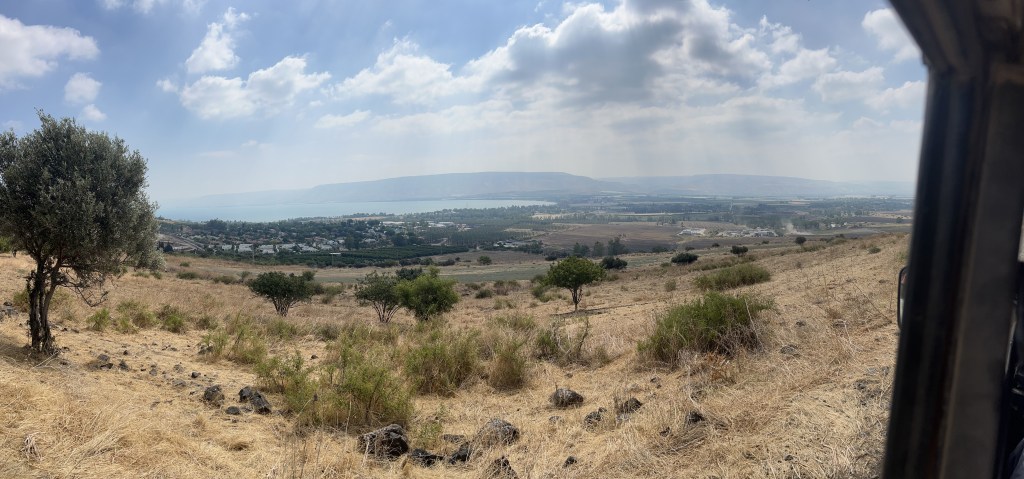
On my trip to Israel last month, we learned about what a miracle it is to wake up in Jerusalem.  To breathe the air in Jerusalem.  To walk the streets.  This morning, I woke up in the Southern Galilee to beautiful views.  God as an artist.  We rode jeeps around the area, looking at the fields growing fruit and vegetables.  At the mountains and the sky.  At the Kinneret (Sea of Galilee).  When we are in a different place and see the beauty around us, it is very easy to notice it.  What about in our own daily life?  What about in our own homes, looking at our own backyards? 

View of the lower Galilee. The Kinneret n the distance. Israel, Syria, and Jordan in the background.

As I spend two weeks of July in a country at war after spending 10 days here in May and planning another 10 days in August, I am so grateful for many things.  Grateful for the existence of the State of Israel.  Grateful to the IDF who protect this country.  Grateful that I have the ability to come to Israel as often as I have in my life.  Grateful for the pioneers who made the desert bloom.  Grateful to the leaders like David Ben Gurion, Moshe Dayan, Golda Meir, Shimon Peres, Menachem Begin, Yitzhak Rabin, Ariel Sharon, and many more who created this country.  I have the opportunity to live in the dust, enjoy being able to come here and enjoy the food, the people, the beach, and everything it has to offer.  More importantly, I have the opportunity to live in the soul as well, fighting on Israel’s behalf to educated and inform people about what it is really like and what is really happening.  I have the opportunity to let my soul open up while here and make sure it stays open when I return home. 

A short video from the lower Galilee with Israel, Syria, and Jordan in the background. It highlights how close everything is and is a way for me to educate and speak out on Israel’s behalf.

In Pirkei Avot 1:6, there is a famous line that I have chosen to live by.  To paraphrase it, we are charged to find ourselves a teacher, make them our friend, and judge others with grace and giving them the benefit of the doubt.  While all three are important, I sometimes struggle with the third and it is the first two that I am living by.  I have found myself not just a teacher but a few teachers.  They have become my friends.  They provide me guidance to be a better person.  They explain things and I ask lots of questions.  They make it relatable to my life today, in 2024.  One of my teachers, who I have been learning with and from for more than 20 years, told me a few weeks ago that I was now a yogi.  That was high praise from him and I’m not sure that I really believe that, but I have come a long way.  They all continue to inspire me.  I learn from all of them. 

So, who are you?  Where do you stand in the balance of dust and soul?  If you don’t know, that is totally ok.  Most people do not know.  Find yourself a teacher.  Make them your friend.  Learn.  It is not about being more religious.  It is about learning life lessons and how to apply them.  It is about finding meaning for you in what you choose to do.  It is a deeply personal journey and a powerful one.  I encourage you to begin the journey.  From my experience, it is one you will really enjoy.

My favorite band. One of their great songs. Who are you? That’s the key question.
In case you want to listen. Watching Keith Moon on drums is always a joy.

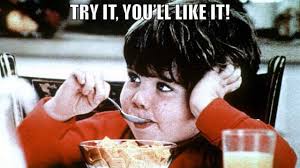
Try it, you’ll like it!

I went to minyan this morning.  For those that know me or follow me, you know that I am not religious and rarely go to synagogue.  The Rabbi that I learn with has begun a monthly Sunday morning minyan and I have committed to going to support him.  I bring my tallis and tefillin (the prayer shawl and the black boxes that go on your arm and your head) and one of my many prayerbooks that I rarely use to join the group.  Somehow, the group is always a group of friends so it’s a bonus to see them too.

I have found that I really enjoy going.  It’s not because I have become religious, it is because the service is done in an intentional and meaningful way.  As we go through the prayers, what we are actually praying for and about is explained very briefly.  “This section is where we ask God to help the world in difficult times.”   Simple.  Clear.  It provides context to what we are saying and why we are saying it.  It’s a tour through the prayerbook.

It reminds me of the playbill at the theater where they tell you what each scene is going to be.  When I learn with my Rabbi friend, we start by exploring the Siddur.  When we started doing this, I wasn’t very excited.  Services haven’t been meaningful to me in a very long time and exploring the Siddur wasn’t on my list of things to do.  I decided to be open to it and as we discuss a prayer and I understand what it is and why we say it, it has become interesting.  It reminds me of what my friend Roie, an IDF soldier at the time, said after Shabbat services.  The conversation went as follows:

Roie:  So you know how to read the Hebrew words?  

Us:  Yes.

Roie:  And you know the tune to sing it?

Us:  Yes.

Roie:  But you have no idea what you are saying?

Us:  That’s correct

Roie:  I don’t understand!

This was repeated over and over again.  He couldn’t understand how we could know the words and the tune but not what we were saying or why we were saying it.  He understood that just knowing the words and the tune wasn’t enough.  It wasn’t meaningful.  We were missing out on the entire purpose of what we were doing.  How could Judaism be meaningful if we didn’t know what we were actually doing or why we were doing it.

I turn 57 this year and these minyanim are the first time that the parts of the service were actually explained.  As the different sections were explained, it began to make sense.  There was actual intention in each part.  There was a purpose to what we were saying.

One of the things that really struck me today was his explanation of the Modim Anachnu Lach prayer.  It was so simple and so basic.  He said, “Nobody can say thank you to God for you except you.  You have to thank God yourself.  That’s what this prayer is for.”

Wow.  Three short sentences and the prayer that I have said at services most of my life suddenly had real meaning.  What I have found is that Judaism has great meaning.  We simply don’t provide that type of content to our children and as a result, when they are adults, they aren’t interested.  When we show the meaning, people get engaged and excited. 

There was recently a great poem written by Lizzy Savetsky titled, “The Six Pointed Star”.  It talks about who we are and points out that the hatred of today provides us with a reminder of who we are and that perhaps, we need to get back to basics and remember we are Jews and what being a Jew means.  I hope you enjoy her reciting it as much as I did.

The Six Pointed Star

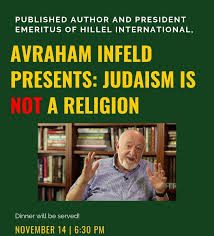
There is something special about being Jewish.  I am not saying that Jews are better than anybody else.  It’s a more than 3,500-year-old peoplehood.  My friend Avraham Infeld had many sayings that I love.  One was when he would say, “Judaism in NOT a religion.  We are a mishpacha (family) that shares a common religion.” 

Those words struck me not only the first time I heard them but every time after.  They resonated with me.  Being Jewish is about being part of a family.  It’s about being part of something bigger than yourself.  It’s why going to minyan this morning felt good.  I was with family.  We were spending our morning together.  We greeted each other with hugs.  We spent time after the minyan talking about our lives. 

It is why Jewish holidays are a big deal.  We get together for a Passover Seder, to light the Hanukkah menorah, to eat in the sukkah or to dress up and eat hamantaschen.  Every holiday is about being together.  This year, I spent Yom HaZikaron (Israel’s Memorial Day) and Yom Ha’atzmaut (Israel’s Independence Day) in Israel.  After October 7th and in the middle of a war, it was more important to be together.  It meant more to Israelis that we were there than ever before.  Their brothers and sisters from across the Atlantic came to support them.  Their brothers and sisters came to show support and love. 

Part of the reason Judaism and Jews are still here, more than 3,500 years later, is because we are more than a religion. Rabbi Harold Kushner z”l, in his book, To Life, asks the question, “What do you have to believe in order to be Jewish?” It is a great question. The answer is very simple. NOTHING! You don’t have to believe anything. You are born Jewish. If you convert, the minute you convert, you are now Jewish forever. Don’t believe in God? You are still Jewish. Don’t believe in keeping Kosher? Still Jewish. Don’t want to pray 3 times a day? Still Jewish. Don’t wear a kippah or follow the laws of Jewish purity? Still Jewish. Another of my favorite Avraham Infeld quotes is when he talks about people who convert to Judaism. He says there is no such thing a convert. The minute you convert, you are a Jew. Period. But, he says, there is a term ‘converted Jew’. This is somebody who is Jewish who converts to another religion. He says, “They only think they are the other religion. They are still a Jew.” We are more than a religion. We are more than a people. We are a mishpacha (family). So why not get to know your family a little better? Why not learn about your family? The more you learn, the more you will love your familiy and the more you will be happy and feel lucky to be a part of this family. As the famous Life Cereal commercial said, “Try it, you’ll like it”.

Lessons to make me a better person

Shabbat (the Sabbath) is an interesting concept.  A day of rest.  A day where you don’t do work.  A day of reflection.  What is it really and what do words like rest, work, and reflection actually mean? 

I have never found an interest in ‘keeping shabbat’ (following all the rules) in a strict sense.  Not turning on light switches or the using the remote control never made sense to me.  Driving isn’t really work, is it?  You turn a key or push a button and it starts.  After that, what’s the difference?  Not turn on the oven or stove.  Why can’t I push buttons on the microwave or the air fryer?  And not carry?  Why do pants have pockets anyway? 

When I am in Israel, Shabbat becomes a little bit clearer.  I typically find that I look forward to it for a number of reasons.  First, by the time Friday afternoon arrives, I am usually wiped out.  The thought of having a day with little to do and a chance to really unplug from the prior week is attractive.  Going to the Kotel (Western Wall) for Shabbat services is always fun and meaningful.  You’ll hear more about that later.  A nice dinner with friends that is leisurely and relaxing?  Sign me up. 

On this trip I had the privilege of learning from three amazing people.  As we were walking back to the hotel on Friday after an amazing morning at the Begin Center, I started asking Lori Palatnik, the founder of Momentum, about Shabbat.  I understand the prohibition about not working and a day of rest, but my definition of work isn’t starting and driving a car, turning on the stove or oven and cooking, turning on the TV, changing channels and watching shows.  So how does that reconcile?  Lori taught me something interesting that I am still chewing on.  She told me that there is no prohibition against work.  That is a wrong interpretation.  The prohibition is for creating.  And the reason there is a prohibition against creating is that Shabbat is a chance to honor and recognize THE creator, God.  The reason she doesn’t do these things is because they involve creating.  On Shabbat, it’s all about our creator, God. 

It is an interesting concept to take a day each week and use it to honor and thank God.  I meditate and pray every day.  I have for more than 35 years.  I don’t use a prayerbook when I pray, it’s a quiet conversation with God.  Over the years it has gone from asking him for things that I wanted to thanking him for the things that I have.  When I meditate, it’s often in silence, just focusing on my breathing and paying attention to all the sounds around me.  I get in touch with God and with the world.  Sometimes I will do a guided meditation to mix it up and they are enjoyable as well.  But most of the time, my meditation is about getting closer to God. 

So what if I was to expand my practice of prayer and meditation to take a full day each week and focused entirely on that connection with God?  I don’t know that I’d go to synagogue or follow a formal process, but what if I were to unplug, honor our creator, and not worry about making anything for a day?  It’s an interesting question and one that I will ponder for a while.

I also had the opportunity to learn with Rabbi Yakov Palatnik, Lori’s husband.  I have seen him on other trips, but this was the first time I really got to spend time with him, and WOW!  I have been missing out.  This quiet and humble man is filled with incredible wisdom.  One of the things we discussed that really intrigued me was about prayer.  As a scholar of Maimonides (the Rambam), he told me that the Rambam said you need three things in a prayer.

The first is to praise God and acknowledge his greatness.  While I am not an overly religious person, that is something I always do.  One of my favorite things to say is that God often does for me, what I can’t do for myself.  I have seen that happen over and over again in my life.  Things happen that I hate and that I think are awful and I would get upset about.  A few days or weeks or months later, I would look back and realize it was the best thing that could have happened.  I know and understand the greatness of God and it centers me and gives me great comfort.

The second is to ask for what you want or need.  As I said, I used to do this but stopped.  In part this was because of my understanding of the greatness of God.  Who am I to ask?  I don’t know what’s best for me.  Isn’t it better to ask God just to take care of me and that’s enough?  Rabbi Palatnik said no.  He said we have to ask because we have to know ourselves.  If we don’t ask it means we don’t know.  Of course God knows, and we aren’t asking for him to know.  We are asking to show that we know.  We are asking because we have done our part and done the work.  That makes sense to me but it is still going to be uncomfortable to ask for things for myself.  That is because of the third thing that Rabbi Palatnik told me Maimonides required in prayer.

You have to say Thank You to God.  That I do every day.  I thank God for giving me another day of life.  Sometimes it’s saying the Modeh Ani, but most of the time it is just saying thank you for another day.  I say it at night when I go to sleep.  I say it throughout the day.  Part of the reason I struggle with asking God for things is because I know he will take care of me and I’d rather say thank you than ask for things that I may think I want but in hindsight I wish I didn’t get.  Saying thank you to God is comforting to me. 

It is an interesting process for sure.  Over the next few days, weeks, and month, I am going to follow Rabbi Palatnik’s suggestion to listen to the Rambam.  I’m going to work to make sure I include all three components in my prayers.  We will see what happens as a result.

Lori and Rabbi Palatnik and me. Two great teachers. One average student.

The third person I got to learn from was our trip leader, Saul Blinkoff.  Saul is an amazing man, and you can google him to learn more about him.  During Shabbat, he said two things that really resonated with me. 

The first is that what you will die for determines what you live for.  It’s a fascinating concept.  He shared the story of a woman in a concentration camp during the Holocaust.  The woman looked like she was ready to end her life when she walked up to the Rabbi in the camp and asked for a knife.  The Rabbi was shocked and worried about her.  She demanded a knife again.  The Rabbi didn’t have one and tried to talk to her.  She looked behind him and saw a member of the SS who had a knife.  She walked up to him, grabbed the knife, reached down to her leg and pulled a baby out from under her uniform.  She had recently given birth and was keeping the baby a secret.  She took the knife, performed a circumcision, a Brit Milah in Hebrew, entering her son into the covenant with God.  She then gave the knife and the crying, newly circumcised baby to the SS officer, turned around and walked away.  A minute later there was a shot and the baby stopped crying.  A few seconds later and the SS officer shot the woman in the back of the head.  She knew what she was willing to die for – to be Jewish and part of the Jewish people.  So she knew what she was living for. 

It is a powerful lesson and question.  What am I willing to die for?  What is so important to me that I would sacrifice my life for it?  I have started my list and will be thinking about this for a long time.  Once I know what I would die for, I will know what I live for and can make sure that’s what I am doing in my daily life. 

The other lesson Saul taught me on Shabbat was about the mezuzah.  I have had a mezuzah on my door for many, many years.  I know what it is, why it is there, what is inside it, what it says, where the commandment comes from.  One of my clients has a focus on the mezuzah so I’ve learned even more over the past few months.  And yet, Saul taught me something new and important.  He said that one reason the mezuzah is on the door is because it signals a transition.  When we walk into the home from outside, we need to leave our outside problems at the door.  It is a visible signal to change our focus to what is inside the house, our family, and go all in.  What a really cool concept.  A visible reminder of what is important.  This is one that I have already started using.  When I walk through a new door with a mezuzah on it, I think about where I am going to and what mindset do I need in this new space. 

Saul Blinkoff teaching us. What an amazing man and teacher. Lucky and proud to call him my friend.

Learning stuff like this to challenge my behaviors and beliefs is really cool (at least to me) but that isn’t the only special part of Shabbat.  As I have said, I am not the most religious person and don’t really go to shul.  Ok, I don’t go to shul unless it is a family simcha (celebration).  In Israel, I don’t want to miss Shabbat at the Kotel (Western Wall).  It is joyous, fun, exciting, and meaningful.  There are so many different types of Jews there and so many different services going on.  And you never know who you are going to see.  This Shabbat was no exception.  As we got to the Kotel and began our service, I looked ahead and saw Rabbi Lipskier from Chabad at UCF.  I quickly made my way over to him to give him a big hug and to wish him Shabbat Shalom.  Only in Israel!  I returned to our group and the singing and dancing began.  We were a group of about 25-30 men.  This is small on Friday night at the Kotel but as we sang louder and danced, we started seeing others come over and join us.  IDF soldiers in uniform.  Hassidic men.  Men in Black hats.  Men pulling out their kippah from their pocket before they joined us.  Men with the big fur hat.  Men who looked like they belonged at a Grateful Dead show.  Even a little boy.  It was amazing to see all these different types of Jews join us to sing and dance.

When it was over and it was just our group again, I started thinking about how this was an allegory for the world.  If Jews of all different types can come together at the Kotel on Shabbat and not only pray together and separately but also join together in unification, why can’t we do it elsewhere.  Forget about the entire world, why can’t we do this in our local communities?  Why can’t we find different types of people who will be happy with their differences and yet also celebrate their similarities?  What can we do to make our local communities look more like the Kotel on Shabbat?  Different types of people enjoying both their differences and similarities.  That’s the type of world I want to live in.

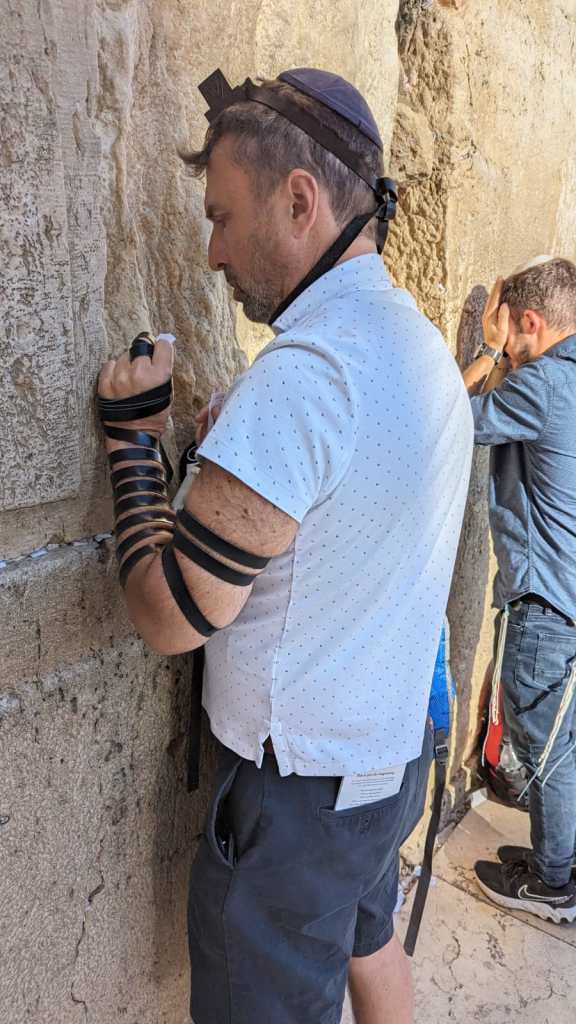
My takeaway is really something else that Rabbi Palatnik taught me during this trip.  We have to be able to learn from everybody.  It is a fascinating concept that everybody has something to teach us.  It doesn’t matter who they are, where they come from, how much or how little they have, how well educated they are or are not, or anything else.  Everybody in the world has something to teach us.  I haven’t only learned from these three amazing people on this trip.  I learned from the other men on the trip.  I learned from some of the women on the women’s trip who spoke.  I learned from the French Machal soldiers and the families from Kibbutz Alumim who have been relocated.  I learned from the farmer, visiting Kfar Aza and Nova.  I learned from the Chabad Rabbi who put my tefillin on at the Kotel on Wednesday.  When I am open to thing, I can learn from everybody.

I know how to put on Tefillin but I can still learn from the Chabad Rabbi who did it for me at the Kotel.

What a powerful thought – to learn from everybody and every interaction.  That sure makes us all better people and makes for a better world.

Can learning the Torah actually be fun and exciting???

A number of years ago, I was exposed to Jewish learning in a different way.  Instead of the boring lecture style of a classroom, I was in a group of 3 where one of us was the leader and would guide us into a discussion of Jewish text.  We spent months over a weekly lunch discussing the book of Daniel.  It was fun and interesting and something that I looked forward to each and every week.  It was very unlike my Hebrew School experience which I found boring.  I never thought that learning Jewish texts could be both fun and interesting.  I learned that I was wrong.

Since then, I have had the opportunity to learn with a few different people.  It’s something that I enjoy as I have found it to be intellectually challenging.  With a good learning partner, it’s not about the dry words, it’s about how the words come to life.  What can we learn from the words and the teachings that apply to our lives TODAY?  How does it impact the choices we make now?

I want to share a few examples of this from my own life and experiences. 

Many years ago, at UF Hillel, I gave a D’var Torah (sermon) on one of the High Holidays.  I talked about how for many years, I found the Torah to be a dusty old scroll.  It wasn’t relevant.  It wasn’t that interesting, especially since I didn’t speak Hebrew.  And, quite honestly, I preferred the movie (The 10 Commandments, still a favorite.)   I shared how I was exposed to this different type of Torah learning.  How it was a discussion and debate.  How I could ask questions and disagree and argue my points of view with another person.  They would argue back, and it would be a passionate conversation.  We would understand each other and sometimes agree at the end, and sometimes still disagree.  How it was intellectually challenging even if I wasn’t a Torah scholar and couldn’t speak Hebrew. 

One of my most memorable experiences with this type of learning happened in Israel when we visited Hebron, where the tombs of the Matriarchs and Patriarchs are (other than Rachel).  We sat between the tombs of the Patriarch Abraham and the Matriarch Sarah, which was surreal by itself, and discussed the story when God told Sarah she was going to have a baby when she was 90 years old, and she laughed.  My friend Harry Rothenberg led the learning session.  What did that mean?  What could it mean?  We dissected the story and the different possibilities.  It was fascinating hearing all the different possible interpretations of this story.  At the end, Harry shared his interpretation.  How it was really a love story between Abraham and Sarah.  How it was about communication and honesty between partners.  How it described not just their relationship but included relationship lessons for us today.  It wasn’t anything that I had contemplated before we sat down or during the conversation.  And then I thought how amazing it was to be talking about the love story of Abraham and Sarah while sitting between their burial tombs.  It is an experience I will never forget.

A year later, back in Israel with Harry, we were climbing Masada.  I’ve climbed Masada with both the snake path and Roman path many times.  The Roman path is pretty easy and quick.  The snake path is longer, harder, and more meaningful.  This morning we took the snake path.  I had been having some health issues and probably should have take the cable care to the top instead, but I was stubborn and chose poorly.  As I was making the long climb, I found myself needing to stop very frequently to catch my breath and let my heart rate slow down.  Everybody else passed me and a couple of friends slowed down to stay with me as we made the climb together.  Harry started late and came upon us.  He joked about me resting until I told him what was going on.  He then said he’d walk with us slowly as well.  I then challenged him – use this moment to teach me a little Torah.  I figured I had stumped him!!  Instead, he thought for a minute and told me the following story.

When Moses led the Jewish people to the edge of entering Israel, he was not permitted to enter the land.  He begged God thousands of times to please change his mind and let him enter the land.  God would not relent and change his mind.  However, after all of Moses’s pleading, God told Moses to climb to the top of the mountain where he would be able to see all of Israel.  Moses climbed the mountain and looked out at all of Israel.  His heart broke into pieces at the beauty and that he wouldn’t be able to enter the land.  It is those pieces of Moses’s heart in all of us that creates our longing and love for Israel. 

Harry took a Torah lesson, applied it to the mountain we were climbing, and our love and passion for Israel.  It was a beautiful moment.  He has a weekly video blog that I encourage you to check out. It’s 3-4 minutes and I find it interesting each week.

This week’s video blog by Harry Rothenberg, an attorney who is the best Jewish educator I have ever experienced.

When I lived in Seattle, I spent some time with Rabbi Levitin, the head of Chabad for the Pacific Northwest.  One day at lunch, he was talking about a big talk he was about to give.  The topic was about surrogacy and donor sperm/eggs.  He then went to the Torah to cite passages that apply to various circumstance for surrogacy.  Something we couldn’t contemplate at the time of the Torah, yet it applies today.  We discussed how it might affect a couple if it was the man’s sperm and a donor’s egg.  What if it was donor sperm and the woman’s egg?  And what if it was donor sperm and a donor egg?  Did it matter if the egg was implanted in a surrogate or in the woman who wanted the baby?  Is there a difference in how parents would treat a child they ended up having biologically instead of one of the other ways?  Fascinating topics and discussion points, all tied back to Torah lessons and commentators from centuries ago.

Now I learn with Rabbi Ehrenkranz from JOIN Orlando.  Each week we meet to study and learn Torah.  We meet in a public place, usually a Starbucks or Krispy Kreme.  While I don’t wear a kippah all the time, I put one on when I learn Torah out of respect and in honor of what I am doing.  So we sit in public, both wearing kippot, our siddurs open, reading out loud and discussing what we are reading.  We also use the Sefaria app (a free download and really a great resource that is now adding Lord Rabbi Jonathan Sachs teachings to it) to study what the commentators said over thousands of years.  We discuss, often debate, and I push him to better explain to me the things I either don’t understand or don’t agree with.  Most of the time he is able to do it but there are still things that I struggle with and that’s ok.  It’s part of the process.  I just hope that I don’t frustrate him too much with my questions and challenges!

Usually nobody bothers us, but I remember one time when a man came over and asked if we were doing bible study.  When we told him yes, his response was, “Cool!” and he walked away.  As I think about what happened in the UK yesterday when a man was threatened with arrest because he was wearing a kippah while a pro-Palestinian march was going on because him being Jewish was threatening to them, I am grateful we can learn publicly in Orlando.  I also wonder when/if that will change here. 

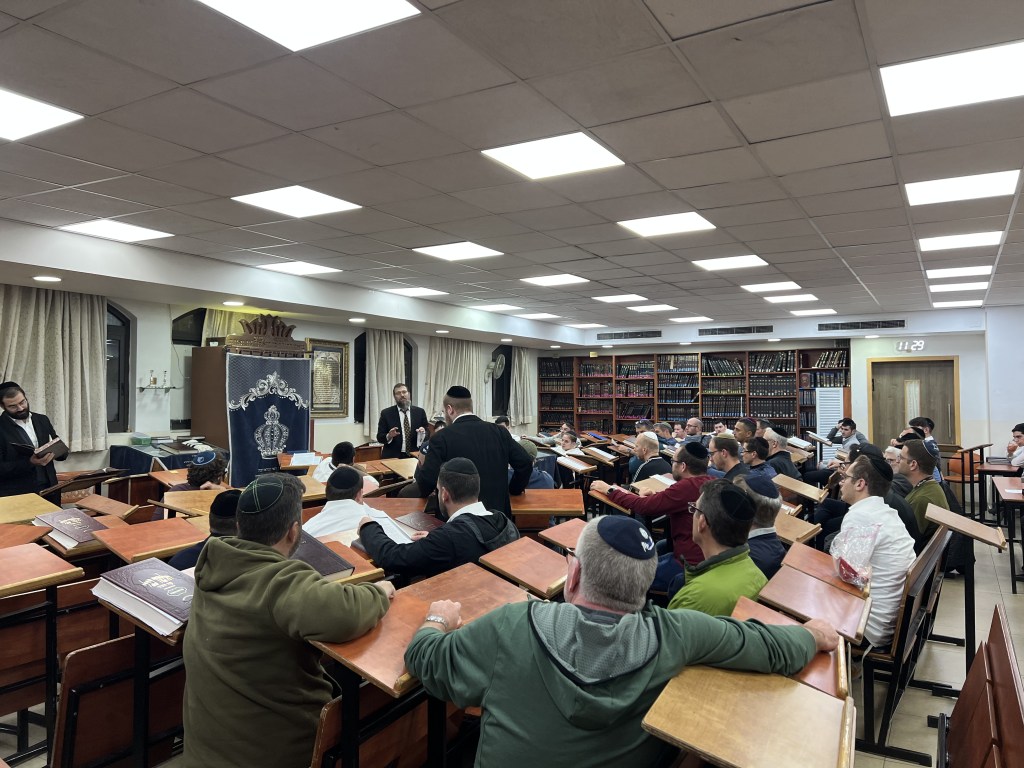
On two of my last three trips to Israel, I had the chance to go to a Yeshiva in Jerusalem on Thursday night for an hour-long learning session from 11 pm until midnight.  Usually I’m asleep well before 11 pm (I have gotten old).  I was worried I would fall asleep in the middle of it and embarrass myself.  Yet when it started, it was interesting and exciting.  It was a legal discussion.  It was back and forth.  Voices raised a bit.  Excitement when somebody thought they had the answer.  Disappointment when the explanation showed they were wrong but vindication when their thought process was affirmed.  The hour went fast.  The Rabbi teaching us shared his explanation.  It was great.  And then we had chicken poppers and cholent while hanging out.  What a fun night.  So much fun that it now happens in Orlando as well.  I don’t go often but enjoy it when I do.  There is a good crowd of regular people like me, not Torah scholars, who enjoy the back and forth.  We have to think thoroughly.  We build off prior lessons.  We do it together. 

Learning at the Yeshiva in Israel – it was captivating

Being Jewish is often seen as being a burden.  In fact, Rabbi Ehrenkranz and I talked this week about how being Jewish means you are taking on more responsibilities.  How we are the chosen people because we have chosen to take on these responsibilities.  If you are like me, then as a child you weren’t given meaningful Jewish content.  You never had the chance to argue with a teacher about Jewish topics.  It was bible stories and boring things.  Judaism was the thing for my parents and not something that was meaningful to me.  And yet that changed dramatically for me as I got past what and how I was taught as a child and understood the meaning that was possible.  I’m far from Orthodox.  I don’t go to synagogue.  I don’t keep kosher.  Yet I find the teachings of the Torah fascinating.  I find the exploration of Jewish texts to be relevant and impactful.  Hanging mezuzahs, putting on tefillin (occasionally), lighting shabbat candles, the Hanukkiah, baking challah, and other Jewish rituals are meaningful to me.  I’m excited to build a sukkah in my backyard this year.  I don’t think I’ll sleep in it, but I will enjoy building it and eating in it and hanging out in it.  It’s fun.  Judaism can be fun.  Learning Torah can be fun. 

So much fun singing Hotel California with this Hassid at Mamilla Mall in Jerusalem – proof that being Jewish can be fun.

So if you decide you want to start a journey like I did with Jewish learning in this way, let me know.  I’ll find somebody for you to learn with so you can find the joy that I have.  I encourage you to try – I’m willing to bet you won’t be disappointed.

Dancing at the Kotel on Friday night – so much fun being Jewish

184 days. 6 months. Hope and Gratitude?

6 months ago, I woke to a very different world.  I didn’t know it when I awoke that morning.  I made coffee, sat down to catch up on the news, and was horrified to hear about the attacks in Israel.  I turned on the TV and the only channel covering it well was CNN.  I don’t like watching most television news because of the bias, but on October 7, 2023, I didn’t have a choice.  It appeared nobody else was covering it well.  I was shocked at what I saw and how CNN covered it that day.  They acted like a real news network rather than being in the entertainment business. 

The horrors I saw on October 7th only got worse as I watched the 47-minute Hamas video, the documentary on the Nova music festival massacre, and heard from survivors on the attacks on Kibbutzim on October 7th and the Nova Music festival.  Images and stories I will never forget.

Many of you don’t know this about me, but in the early to mid 1990s I worked with the Department of Corrections.  My population for 18 months was solitary confinement, and I did coverage of Florida’s Death Row when the person who had that as their primary job was on vacation.  I also worked with rapists and child molesters who were getting treatment to stop offending if/when they ever got out of prison. I spent time with some of the ‘worst of the worst’.  I read files of people who had done horrible things.  I met with people who did horrible things.  While each of these people did horrific things, none of that was as horrifying to me as what happened on October 7th.  Working there definitely changed me and it took me 6 months after I left to feel like a normal person again.  I’m not sure I will ever be the person I was before October 7th again.

Sundays are when I get my inspiration from songs and music.  I debated whether to continue this week with that model or because of the 6-month mark of October 7th, to do something different.  I spend time with a couple of Rabbis each week learning and one thing that has come across clearly and that resonates with me is that Judaism believes in hope and gratitude.  So I decided to stick with music this week and pick a song that, for me, is entirely about gratitude and reinforces hope. 

On day 184 of the hostages’ captivity, on the 6 month mark since October 7th, hope and gratitude are what I need.  Hope that the hostages will be released soon.  Hope that they are alive.  Gratitude for the IDF and all those who risk everything to protect Israel and the Jewish people.  Gratitude for our leaders who are speaking out publicly against Hamas and defending Israel’s right to defend herself.  Hope that those who aren’t or who aren’t clear will get clarity and fight for good to defeat evil.

The song is Alright by Darius Rucker

Alright (alright), alright, Yeah, it’s alright (alright), alright.

Don’t need no five-star reservations, I got spaghetti and a cheap bottle of wine.
Don’t need no concert in the city, I got a stereo and the best of Patsy Cline

Ain’t got no caviar, no Dom Perignon, but as far as I can see, I got everything I want.

It’s a simple beginning focusing on all the things he doesn’t need.  All the things that are materialistic but not important.  As I sit here on day 184 of the hostages being in captivity and the 6-month mark of the terrorist attack on October 7th, I realize that none of the things that I thought were important on October 6th really are.  I would trade the delicious food, the concerts and shows I attend, the nice cars I own for the safe return of the hostages.  For the end of Hamas and the end of the war.  For the safety of my friends and my friends’ children who are serving in the IDF.  For those in Gaza who are innocent and suffering to have food, shelter, medicine, and a government that actually cares for them. 

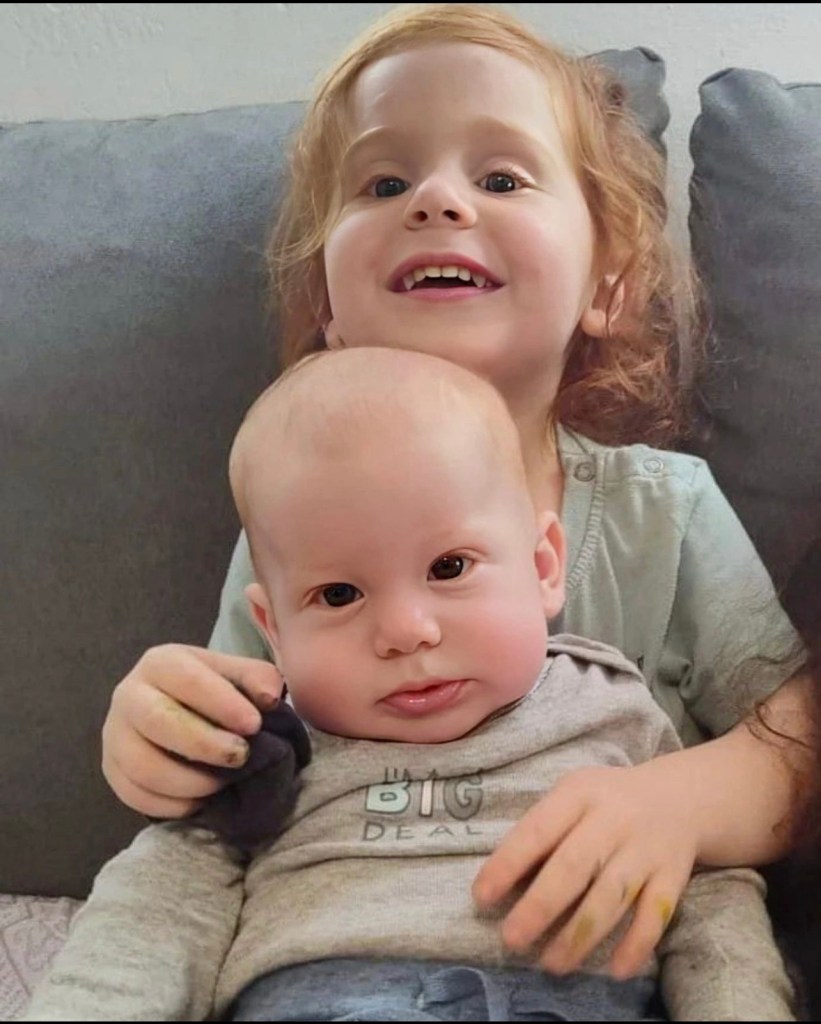
The Bibas kids – Kfir has spend nearly half his life as a hostage of Hamas

I am grateful for the health of my family.  For my mom, my in-laws, my siblings and sisters/brothers in law, nieces and nephews, and family that isn’t by blood.  I’m lucky that I want what I have rather than focusing on having what I want.  The last 20 months, since my dad got sick and then died through the many changes in life, I have paid attention to what is really important to me.  Family.  Friends.  Relationships.  Health.  As he sings, ‘as far as I can see, I have everything I want.’

‘Cause I got a roof over my head
The woman I love laying in my bed
And it’s alright (alright), alright
I got shoes under my feet
Forever in her eyes staring back at me
And it’s alright (alright), alright, yeah
I got all I need
And it’s alright by me

The chorus reiterates this.  The basics are what I need.  A roof over my head, somebody I love in my life, clothes, and that powerful relationship.  It’s what I need and when I focus on what I need, it’s certainly, “alright by me.”

I have heard the parents of hostages speak in person, on tv, and through interviews.  One thing is very clear to me.  They would trade EVERYTHING to get their loved one back.  I have heard from people who lost loved ones on October 7th – either on the kibbutzim, at the Nova music festival, or trying to save the lives of people being attacked by the Hamas terrorists.  They would give up everything to get their loved ones back.  Many of them have said they would return to the kibbutz where they lived prior to October 7th but would never live in that house again.  They need the roof over their head and the community that they love and love them, but they don’t need that specific home. 

I have friends who had loved ones taken hostage that have since been released.  When I talk to them, the appreciation they have for their loved one’s release and the empathy from those who have loved ones that have not been released.  I have friends who still have loved ones that are hostages and the daily pain they endure is unthinkable.  We often have these grandiose things that we want.  The nice, new car.  The bigger house.  The vacation home.  The exotic trip.  The designer clothes, bag, shoes.  I find myself, like the song says, caring about the things that money can’t buy.  Health.  Happiness.  Family.  I find myself grateful for the people who care about me and who I have the privilege of caring about.  And while I am saddened by the people who I have learned don’t really care, it also frees me up to invest more of my time and my energy with the people who do.

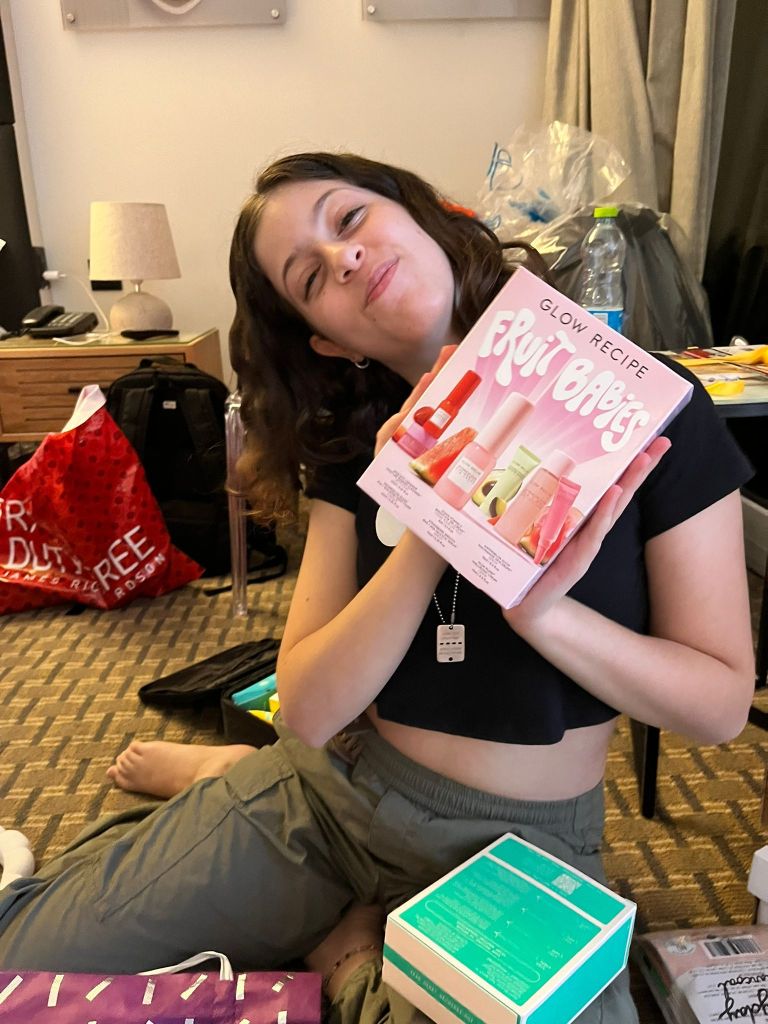
Hila was released after being kept as a hostage the day before she turned 13. The look on her face is priceless as she gets her birthday and Hanukkah gifts from her worldwide Jewish family.

Maybe later on, we’ll walk down to the river
Lay on a blanket and stare up at the moon
It may not be no French Riviera
But it’s all the same to me as long as I’m with you.

May be a simple life, but that’s okay
If you ask me baby, I think I’ve got it made.

I have had the privilege in my life to do some amazing travel.  Having been to Israel 20 times and my 21st coming up next month isn’t the extent of it.  I’ve been to many of the islands in the Caribbean, as a another famous song says, “Aruba, Jamaica” and many, many more.   I’ve been on cruises.  I’ve been to Mexico and Canada, Italy (more than once), Turkey, Spain, Greece, England, Switzerland, Egypt, Thailand, Bali, and more.  Every one of these trips was amazing.  I got to see incredible sights and experience incredible cultures and food and meet wonderful people.  And yet, I would much rather be with my loved ones and walk down to the lake.  I’d rather lay on a blanket together and look up at the moon, spending time with them.  I don’t need to go to the exotic places to get those special feelings. 

I’m not saying I don’t love traveling (I do).  And I’m not saying I’m going to stop traveling (I’m not).  What I am saying is that I don’t want to miss the time with family and friends because of some exotic place.  I get much more value from meeting my mom for lunch in Lakeland than eating at a café in Venice, Italy.  I have more fun eating lunch with a bunch of friends at Portillo’s in Springfield, Illinois than I do at a gourmet restaurant in Istanbul.  I love when we cook out at the beach or go as a large family out to dinner during our Greenberg family beach week much more than dinner at Big Itzik in Tel Aviv (and the food there is amazing). 

Dinner at Big Itzik (Itzik HaGadol). The food is amazing and the salads are incredible

On day 184 of captivity, on the 6-month mark of the October 7th massacre, I know that the families of those taken hostage or murdered would much rather eat cheese sandwiches with their loved ones than a fancy meal.  They’d rather sit in the living room with those in captivity or murdered than take an exotic trip.  We live in a world where our priorities are messed up.  We now value things so much we forget about the value of our friends and family until it’s too late. 

On Friday I learned of the death of a friend and colleague.  It wasn’t expected.  It was a shock.  He was a wonderful man, a friend, a colleague, and just a good human being.  Salt of the earth.  It was sudden.  He was only 5 years older than me.  We’ve known each other for around 20 years.  It was devastating.  It was shocking.  I think what bothers me the most is that I don’t remember the last time we spoke.  I think it was nearly a year ago in Atlanta.  Not for any good reason.  Life got busy.  We knew we’d talk again.  We knew the opportunity would occur.  Until it didn’t.  I don’t want to live my life that way any longer.  I don’t want to regret the call I didn’t make once it is too late.  I don’t want to regret the simple text or email to stay connected and make sure those who matter to me know they matter to me.  That’s more important than anything else.

When I lay down at night, I thank the Lord above
For giving me everything I ever could dream of

‘Cause I’ve got a roof over my head
The woman I love laying in my bed
And it’s alright, alright, alright, alright
I got shoes under my feet
Forever in her eyes staring back at me
And it’s alright, alright, alright, yeah

I got all I need, yeah
I got all I need
And it’s alright by me, oh, yeah
It’s alright by me, yeah, yeah, yeah

The last few lines and the chorus once again are powerful.  God (or the Lord) is a challenging thing to talk about today.  It tends to mean you are either an evangelical Christian, far right wing, a terrorist, a racist, you hate people who are different than you, or somebody who is trying to convert others to your beliefs.  Yet it really means none of that. 

I pray and meditate every day and have for decades.  I have a relationship with God that is personal and meaningful.  It’s my own and if you ask me about it, I’m happy to share mine and encourage you to have your own.  And if you don’t want your own, that’s ok too.  I no longer believe in the punishing God that I was raised with.  I believe in a God that is loving, caring, and only wants the best for me.  And that when the best doesn’t happen, it is never because of God, it’s always because of me.  My favorite book, Illusions by Richard Bach, is a thought-provoking book which challenged my conventional thinking about God and the universe.  It explores the nature of reality and perceived reality which led me to question my beliefs and consider new possibilities.  In it, there are many sayings pulled from the handbook for life.  My favorite is:

“Argue for your limitations and they are yours.”

Since reading the book the first time and reading that quote, I have challenged myself to not fight for my limitations and the limitations of God.  It doesn’t mean I can do everything or even anything.  It does mean that if I believe I can do it, I can do my best and it may just happen.  And it may not happen.  But if I argue before I do the work, it never happens.  There are many of these gems in the book and at one point I wrote them on index cards and carried them with me to remind me of the lessons. 

I thank God every day for the blessings in my life.  The relationship I had with my dad.  The relationship I have with my mom.  My family, my wife, my children, my siblings and sister/brother in laws.  My nieces and nephews.  My cousins.  My family that isn’t blood but is just as close.  My friends.  A roof over my head.  Shoes under my feet.  Food to eat. 

Many years ago, when I was not yet 21, a friend told me to write down what I wanted in the next year and seal it in an envelope.  A year later, we opened it together and I was amazing.  My list was incredibly short sited.  I had asked and hoped for far less than I actually got.  I had argued for my limitations when I wrote the list but didn’t in my life.  As a result, I got far more. 

On day 184, the 6-month mark since October 7th, we can’t argue for the IDF or Israel’s limitations.  They can do what they need to do to protect Israel and the Jewish people.  They can do what they need to free the hostages.  They will do what is needed to eliminate the evil that is Hamas. 

At the end of the day, I do have all that I need and it is alright with me.  I’m filled with gratitude and hope, despite the horrors of October 7th, the horrors of war, and the captivity of innocent civilians.  We, as a people, will continue to survive and thrive and will do what is needed. 

The butterfly effect – every choice knowingly or unknowingly made me who I am

In the early to mid 1990s, Hootie and the Blowfish hit the scene with some great music.  The lead singer was of course Hootie.  Except he wasn’t.  His name is Darius Rucker but even today, people still refer to him as Hootie.  Until he transitioned from rock/pop to country music.  It seemed to be a strange transition and as a fan of Hootie and the Blowfish’s music, I wondered if I would enjoy the new Country Music of Darius Rucker.  I didn’t expect that I would.  And I was wrong – I love it!  He takes the best of his music style and adds the country music twist to it to create a new sound that also has the deep lyrics and messages of country music.  This week, I decided to analyze the lyrics from his 2010 hit, This

The song begins:

Got a baby girl sleepin’ in my bedroom
And her momma laughing in my arms
There’s a sound of rain on the rooftop
And the game’s about to start
I don’t really know how I got here
But I’m so glad that I did
And it’s crazy to think that one little thing
Could have changed all of this.

I love that the song begins with such a normal setup.  A child asleep in the bedroom.  Her mother laughing in his arms.  It’s raining outside and he can hear the patter of rain hitting the roof.  So many of us have been in that exact situation in our lives many times.  I can’t think of the number of times I was sitting on the couch, the kids asleep in their rooms, my wife in arm on the couch, as it was raining outside, and we listened to the rain hitting the roof.  The only thing missing in the song, ironically for a country music song, is the dog laying on the floor by my feet!  The normalcy of the situation is comforting.  The game is about to start.  Such a beautiful image in the first 4 lines. 

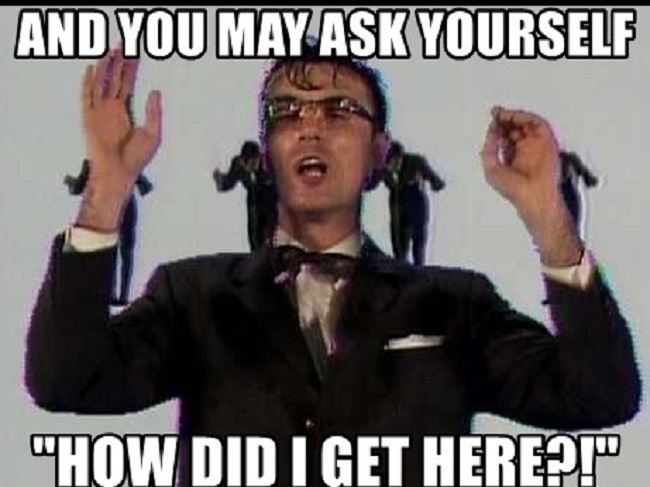
I am sure most of us can related to the next line.  I don’t really know how I got here.  When I look back at my life, it’s hard to believe how much time has passed, where I am in my life, and how I got here.  It doesn’t seem that long ago that I was in middle and high school.  The big party I had at my house in Harrisburg that we still talk about seems recent, not 40 years ago.  How can anything in my life be 40 years ago?  Married for nearly 26 years?  Two kids in their 20s, one a college grad finishing his master’s degree while the other is about to start his senior year of college.  Friends from 30 and 40 and even 50 years ago that are grandparents now.  I remember being in high school and listening to the Talking Heads song Once in a Lifetime and singing out loud the famous line, “And you may ask yourself, “Well, how did I get here?” Now I find myself truly asking, “How did I get here?”

I love the last 3 lines.  First, I am so glad that I am where I am.  Truly grateful.  When I look back upon my life, there were many decision points that led me to this place at this time.  And in a vacuum, I might go back and change a number of them because in hindsight, by themselves, they may not seem like the best choice.  I look back and wish that I had spent a semester studying in Israel during college.  I wish that I had done a gap year after college in Israel and perhaps served in the IDF as a 21 year.  I made career decisions throughout my life that when I look back, I wonder what it may have been like had I chosen differently.  But in the end, I am grateful I am here and had I not made every one of the choices that I did, I wouldn’t be right where I am today.  Had I spent a semester abroad in college, maybe I would have done the gap year and served in the IDF.  Maybe I would have made Aliyah after that.  I’d have missed time with my grandparents and parents.  I’d never have met my wife or had the children that I have.  So yes, it would be meaningful to have had that experience, but I wouldn’t trade having that experience for the life I have today.  And that’s the reality of the end of the verse. It is crazy to think that one little thing could have changed everything.  Studying abroad for a semester in 1987 or 1988 may have led to me making Aliyah, having a completely different life, wife, and children.  Choosing to stay in accounting rather than go back to get my Master’s Degree in counseling would have led to a different career, not moving to Florida when I did, and another totally different life.  We make so many decisions every single day and never realize just how important and impactful each one is to the life we end up living.  And I love the life I have today and am grateful for every decision that has led me here, even when the results ended up not being what I wanted at that time, because the results ended up getting me here, where I am grateful to be. That is the butterfly effect – the idea that small things can have non-linear impacts on a complex system. The concept is imagined with a butterfly flapping its wings and causing a typhoon.

Maybe it didn’t turn out like I planned
Maybe that’s why I’m such, such a lucky man

For every stoplight I didn’t make
Every chance I did or I didn’t take
All the nights I went too far
All the girls that broke my heart
All the doors that I had to close
All the things I knew but I didn’t know
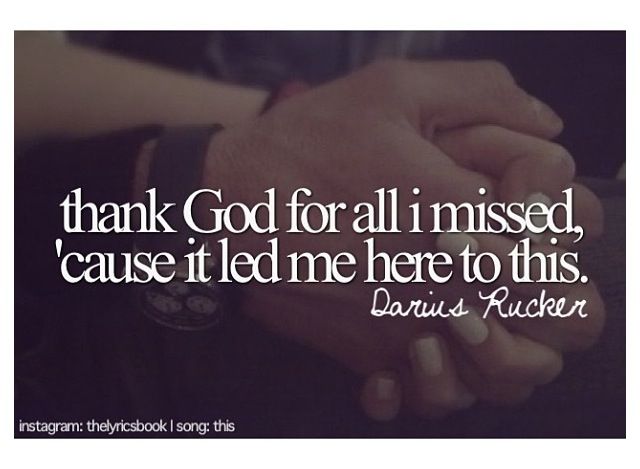
Thank God for all I missed
‘Cause it led me here to this

There is no question that it didn’t turn out like I planned. And no question that it is why I am such a lucky man.  I have learned over the years that my view of things tends to be very short term.  I can never really see the long-term impact of regular decisions until much later when life plays out.  Seemingly insignificant choices end up with huge, often life altering, results.

When I was in Seattle, we came back to Florida to visit my parents in Tampa.  As it happens, one of my dear friends, Sandy, was in the hospital in Tampa because she was having problems they couldn’t figure out.  Her husband Ron, one of my best friends in the world, let me know where they were, so I went to see them.  During my visit to their room, the doctor came in with a devastating diagnosis.  Glioblastoma.  6 months to live was the normal expectation.  As we all stood there in shock as this vibrant, healthy woman received terrible information, I was able to be the one there for both Ron and Sandy to help them process this shocking information.  I had moved across the country to Seattle.  I just happened to be visiting Tampa when she went to the hospital, in Tampa (they lived in Winter Haven).  And I happened to be visiting at the exact time when they got the diagnosis.  What are the odds?  Nearly 5 years later, as Sandy way outlived expectations, I called to say my goodbyes.  She couldn’t speak to me but could hear me as I talked to her.  About 30 minutes later, she died.  Again, what are the odds?  If I had done an errand before calling, I would have been too late.  As the song states in this verse, “For every stoplight I didn’t make, every chance I did or I didn’t take, all the nights I went too far, all the girls that broke my heart, all the doors that I had to close, all the things I knew but I didn’t know.”  Every single choice we make in life takes us on the path we are supposed to be on and makes us who we are today. 

Ron and Sandy – love them both and the role I got to play in their lives

My senior year of college, my girlfriend and I were very serious.  We went looking at engagement rings together, found one she loved, and I almost bought it.  She wanted me to buy it.  The jewelry store owner wanted me to buy.  I even wanted to buy it.  And the owner of the store made it financially possible for me to buy it.  But for some reason I didn’t.  About two months later we ended up breaking up and my life went on a different path.  How different would my life be today if I had bought that ring?  Would we have gotten married?  Had kids?  I believe we would have ended up being divorced.  Would I ever have moved to Florida?  Certainly not in 1992 like I did.  My career path would have been different.  Everything about my life would have been different with that one different choice. 

So, like the song says, Thank God for all I missed, ‘cause it led me here to this.

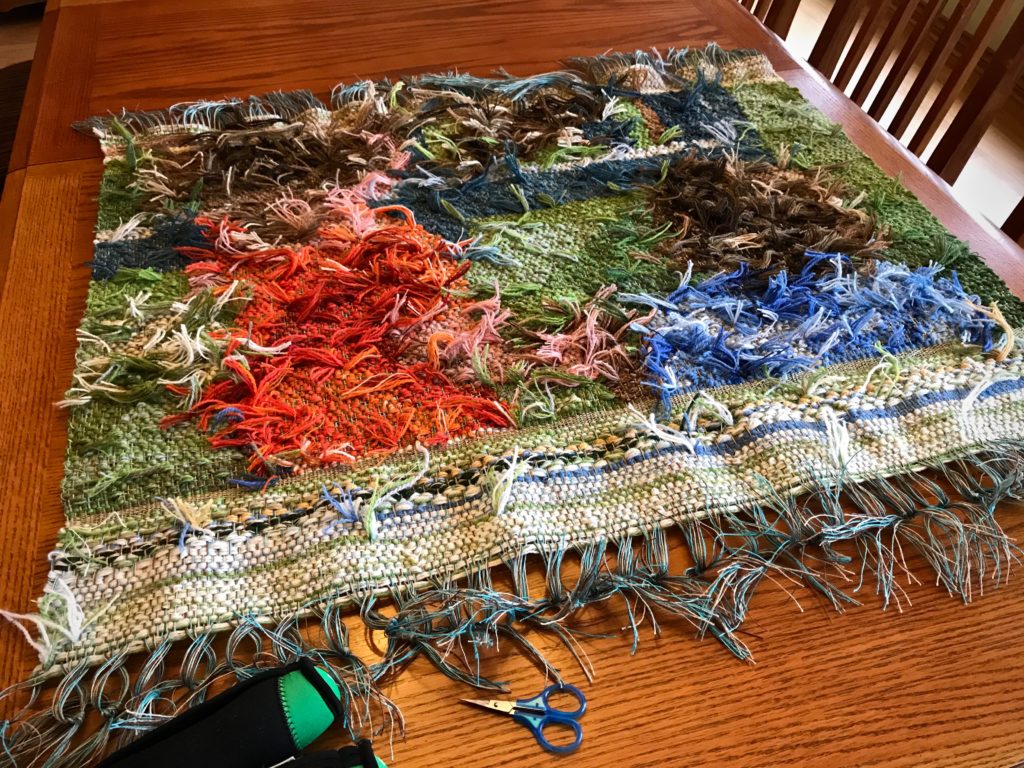
For many, many years I have believed the life is a tapestry and we only see the back end as we move along.  We see the flaws.  We see the strings and the extra yard or wool or silk.  It isn’t until we reach the right point that it is turned over and we see the beauty that we have created by living through what we saw as the mess.  Darius Rucker hits it right on the head with this song – everything we have today is because of every single small decision point along the path of life.  There is no need to regret any of these decisions because we wouldn’t be who we are, we wouldn’t be where we are, without every single one of them.

This is the back of the tapestry and what we see most of the time. It isn’t until it’s flipped over that we see the real design and beauty. God knows what it really looks like all the time while we see the mess. Trust in God because he knows the real beauty all the time.

Like the girl that I loved in high school
Who said she could do better
Or the college I wanted to go to
Till I got that letter
All the fights and the tears and the heartache
I thought I’d never get through
And the moment I almost gave up
All led me here to you
I didn’t understand it way back when
But sittin’ here right now
It all makes perfect sense

This verse gives us more examples.  It’s as if he knows that we will struggle with accepting that every single choice along the way is what got us here.  And that by changing any single one of them, we won’t be who we are, where we are, today.  In high school, I fell in love with Duke University.  I had my heart set on going there.  I applied early decision and wore my sweatshirt that my mom and I bought on our campus visit every week at a minimum.  I was 100 percent sure that I was going to Duke for college.  I applied a few other places, but I knew I was going to Duke.  When I studied abroad in November 1984, I got my acceptance letter to Penn State.  My friends who were in England took me out to celebrate, but honestly, I didn’t care.  I wasn’t going to Penn State.  I was going to Duke.  What did it matter that I got in there?   Of course, as you have realized, I didn’t get in to Duke.  I ended up going to Penn State, where I met my best friends who are like brothers to me.  My life was completely altered for the better because I didn’t get what I wanted and got what I needed.  If I could go back and change things so that magically I would get into Duke and go there, I would not do it.  I would be a completely different person living a completely different life if I had a gone to Duke for college.  And I like who I am today and the life I have today.  I wouldn’t trade it for anything.

Life has its ups and downs and plenty of challenges.  As the song says, there were plenty of times that I wasn’t sure that I would be able to get through whatever it was I was facing at that time.  I remember a number of them, as I sat alone, crying, and wondering what was going to happen now.  I almost gave up many times in many situations.  But I didn’t give up.  I did manage to make it through.  The same as many of you reading this were able to get through the things that, at the time, you thought were insurmountable.  In fact, as we look back, we may even find it silly that we thought we couldn’t get through these things, but that was who we were at that time.  As we sit here right now, it makes perfect sense.  Yet tomorrow, when we face the struggles and challenges that arise in our life, will we be able to remember that it really does all make sense, just not today?  Will we remember to thank God for all we miss, for the windows that open when the door we preferred gets shut?  Or will we be stuck looking at the back side of the tapestry, thinking that the mess we are looking at is really the art that will be final? 

Oh I cried when my momma passed away
And now I got an angel
Looking out for me today
So nothing’s a mistake

I have reached a point in my life where I know that I am closer to the end of it than the beginning.  It’s not as depressing a thought as I expected it to be.  As I look back, I am so lucky to have had so many amazing people in my life for the time that I had them.  Grandma Esther and Grandpa Si.  Grandma Ev and Grandpa Len.  Grandma Rose.  Grandma Florence and Grandpa Morris.  Grandma Cora and Grandpa Ralph.  They are my grandparents, my wife’s grandparents, and my great-grandmother.  My cousin Eric, who was my age and tragically died at the age of 27 in 1995.  My cousin Todd who died of an overdose in 2015 at the age of 42.  My niece Madeline, who died a few weeks after her birth.  My big brother in the fraternity, Jeff, who died young.  My Uncle Joe, who died at the ‘old’ age of 50 (I was 21 at the time and thought 50 was a good long life – how foolish we are when we are young.)  I wish this was the entire list but life doesn’t work that way.  We have the chance to build special relationships in our life and they end when they end. 

My cousin Eric – he looks so young and innocent
My cousin Todd. We spoke a few days before he died and I always wonder what if I had gotten on the plane to Florida that Monday. Would it have made a difference?

Of course, my father died in September 2022.  This has been the hardest of all for me, both because of the relationship we had and how much I was able to depend on him for guidance and advice.  I have cried a lot about my dad, both when it happened and ongoing since then.  I do believe he, and others, are my angels looking out for me.  I do believe that my dad and others continue to teach me as they were so influential in my life and development that it is as if I can ask them the question and they will answer. 

My dad just before my mom and I said goodnight and left his room. He died a few hours later. The sweet look on his face is one I will never forget.

I agree that nothing is a mistake.  It may not be what I wanted at the time.  It may not be what I would prefer.  It may not be enjoyable either at the moment it happens or ever.  Yet everything that happens in life shapes us into the person we are.  We have the things we have in our life today because of every one of these choices.  The ones we made and the ones we didn’t make.  The ones we knew we were making and the ones we never even noticed. 

The song ends with a repeat of the chorus and while I typically omit the chorus when it repeats, in this instance, I think it’s important to cite it one more time. 

Every stoplight I didn’t make
Every chance I did or I didn’t take
All the nights I went too far
All the girls that broke my heart
All the doors that I had to close
Everything I knew but I didn’t know
Thank God for all I missed
‘Cause it led me here to this

It led me here to this

It’s a reminder that we face so many decisions every day in our life.  It seems as if some matter and some don’t’.  They all matter.  They all help us become the person that we are today.  They give us the life that we have today.  Since my father died, I have faced a number of challenging life situations.  It has shown me who in my life really cares and who was really transactional.  It has also taught me that if I value people, it is MY obligation to reach out and tell them.  It is MY responsibility to call or text them, even if just to say hi and I was thinking of you.  I know first-hand how much those calls and texts mean.  I know that sometimes they are the difference in somebody else’s life.  I have the ability to take the chances, to act, and to not allow excuses of things that don’t really matter get in the way.  Or I can choose not to take that action and let people fade away from my life. 

This song makes me ask myself the following:

Who do I want to be?

What are my values?

What do I stand for?

How do I show my gratitude for being who I am today and for the life that I get to live today?

Am I happy with the person I am and the life that I have today?  When I answer this last question with a resounding YES, it means I am accepting of every little decision or choice I have made, knowingly or unknowingly, because without them, I would not be the person I am today nor would I have the life that I have.