It amazes me how the world chooses to forget and ignore the 101 hostages remaining in Gaza. When Iran held 52 American hostages for over a year, the world paid attention every single day. The TV show Nightline was created specifically for nightly updates on the hostage crisis. As a child, I remember the daily concern and stayed home from school as Ronald Reagan was inaugurated and the hostages were released, just to watch it happen and get the updates.
The 101 hostages, including 7 Americans, have been held for 422 days, close to them being held as long as Iran held the hostages from 1979 to 1981 (444 days). Yet the world remains largely silent. In August 2024, six of the hostages were brutally murdered by Hamas. None of the American hostages Iran took in 1979 were murdered. The world was outraged then and is quiet now.
Yesterday, Hamas released a video of Edan Alexander, one of the 7 Americans still being held hostage. It’s hard to watch. What is harder for me is the realization that for the 420 days that he has been held, America has largely forgotten him and the other 6 Americans. Other countries demanded Hamas release their hostages over a year ago and Hamas complied. America has not. It’s an embarassment. It’s horrifying. They have been allowed by our leaders to remain hostages simply because they are Jews.
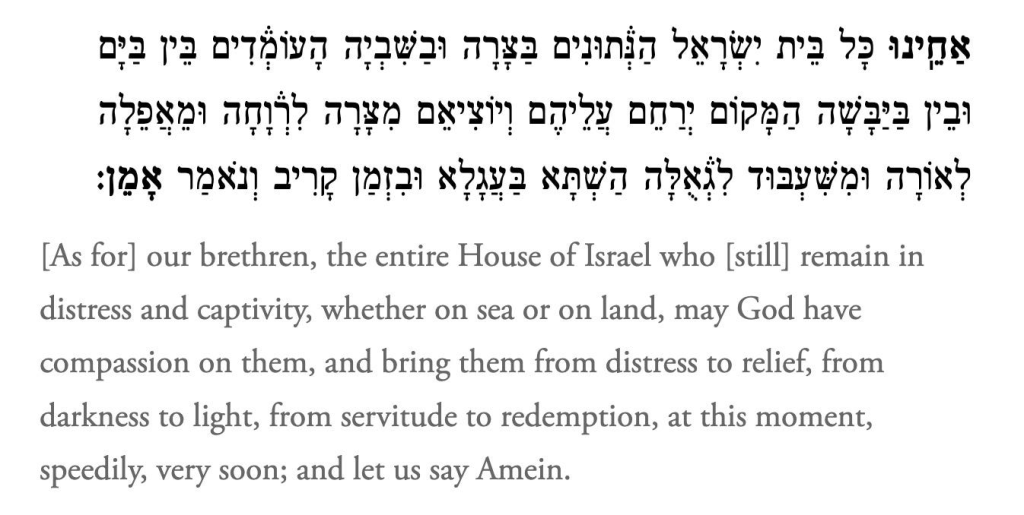
Recently I wrote and posted the video of released hostage Mia Schem talking at the UN. She urged people to look at her and realize it isn’t too late to save the current hostages. The sign below in a neighborhood in Jerusalem uses the memory of Hersch Goldberg-Polin (z’l) to remind us of the same thing. We cannot forget the hostages. We cannot allow them to remain brutalized and in captivity by Hamas. We must ensure they are released and returned to Israel – all of them, alive or dead. I urge you to do something and say something about the hostages every day. Remind yourself and others of their plight. I say the Achenu prayer daily to remind myself. I wear my yellow ribbon pin. I wear my dogtags. We owe it to them.
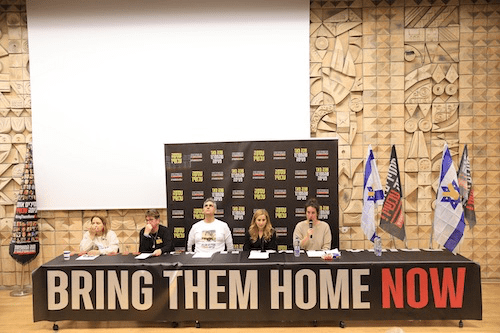
In Israel, the reminder of the hostages is daily. It’s everywhere. It is overwhelming, as it should be. Released hostages Raz Ben Ami and Gabriela Leimberg (left); Michel Illouz, father of the late Guy Illouz whose body is held in Gaza; released hostage Danielle Aloni; and Yifat Zailer, cousin of hostage Shiri Bibas, spoke yesterday at an event marking one year since the first and only hostage deal took place. It’s hard to believe it’s been a year since that deal happened. I remember watching it closely as the cousins of my friends were scheduled to be released. I remember sitting on pins and needs as I waited for confirmation that they had been released and then for reports on their health and safety. This should be the headline on the news. This should be above the fold in our newspapers. Because the hostages are mostly Jewish (note they are not all Jewish), the world doesn’t care. If you really wonder about the rise of antisemitism and if the past could happen again, simply watch the hostage situation as it is happening again.
The Hostages and Missing Families Forum headquartered in Tel Aviv is dedicated entirely to the hostages and their families. I’ve been there twice. It is referred to as ‘the saddest place on earth’ and I have to agree that is certainly is one of them. The Kibbutzim that were attacked on October 7th and the site of the Nova festival are two others that could claim that title. Yet visiting there and hostage square, just around the corner, is something that I feel compelled to do on each visit since October 7th. As long as thre are hostages remaining, I must remember them. I must speak out for them. It’s an obligation I think we all have. Every day, I still sing Achenu, praying for their safe return. It’s an easy thing to do so I’ll post it again here in case anybody wants to join me in this daily ritual. Hebrew or English it doesn’t matter.
My friend Lou’s daughter wrote this powerful piece about what studying at Stanford has been like as a Jewish student. She dropped out of her Ph.D. program there as a result. The stories are heartbreaking. We aren’t physical hostages but we are hostages to hate. I was talking to a friend of mine who lives in the northern United States last week. He was telling me about how scary it is to walk around publicly Jewish. I was telling him that I don’t care. I won’t surrender my identity. I won’t pretend to be something that I am not. Then again, I don’t wear a kippah and most people think I am Italian, not Jewish. My tattoos on my forearms are visible but most people don’t think of them as something Jewish unless they are Jewish.
Unlike the hostages in Gaza, we have a choice. We can choose to act like hostages, to hide our Jewish identities. Or we can choose to be proud of our intentities and fight back. I choose to fight back. I choose to stand up against the hate. I choose to not let them win. They can try to physically assault me. They can yell and scream at me. They do their damnest to make me intimidated to be Jewish. It won’t work. I am part of a 3,000 year old tribe and won’t disappear. Listen to the powerful words of my friend Andrew Lustig who writes powerful poetry. I am Jewish.
For the first time in the existance of this blog, I am not writing it. This was written by Yotam Berger, and Israeli PhD student at Stanford. I couldn’t have said it better or clearer so I’m letting his words say what I think and feel. Please read Yotam’s words and think hard about them. You can read the original post (in Hebrew) here. This translation came from Daniel Gordis’s substack Israel from the Inside.
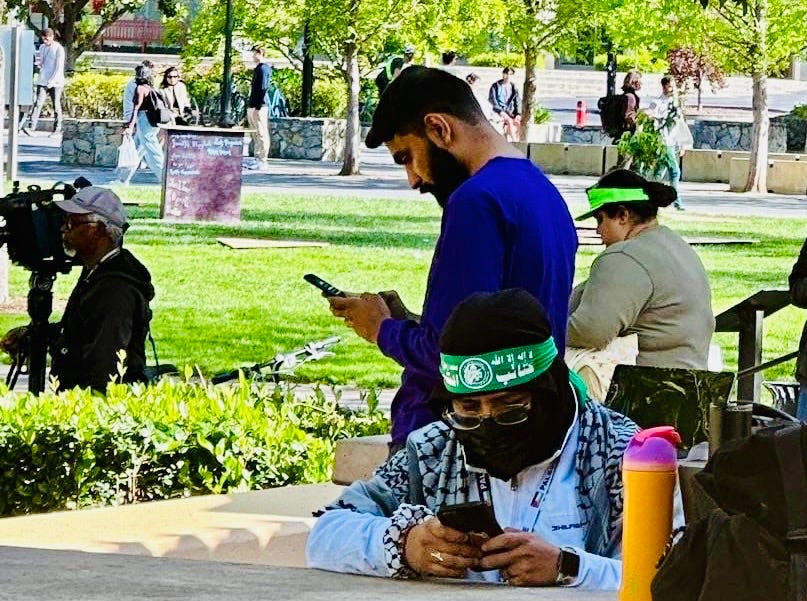
Man in a Hamas costume on the campus of Stanford this week.
Five lessons from Stanford, California
The academic year in the United States is coming to an end. In a few weeks, the university students graduating will stand on the grass, in caps and gowns. They will excitedly take pictures, shake hands with the deans, and then fly away, making way for a new generation of their ilk.
Ahead of the graduation ceremonies, the anti-Israel student protests at American universities are also increasing. Let’s start with the “all clear” siren. Here at Stanford, at least, the students who sleep on the campus lawns and call for a “global intifada” are—as a rule—not dangerous in the physical sense of the word. But they are very dangerous in the medium and long term, as far as the image of the leader of the free world is concerned.
This is my second year at Stanford. When we returned here in September after the summer break, I intended to finish the year with an approved research proposal and a third of my PhD written. It’s hard to describe how far I am from meeting that goal. In my opinion, I’m not really unusual. Since October, many Israelis abroad have found themselves forced to choose between two options—to put their heads down or become ambassadors without a choice. Who can even write an article when his two brothers are fighting in Gaza? Instead, I found myself spending much of my time on “outreach” activities that I had no intention of taking part in.
Despite this, I learned some very important lessons this year that I will never forget. As the school year comes to a close, and in light of the wave of anxious questions from around the country in light of the current round of campus madness, I thought I’d share the five most important lessons I learned this past year at Stanford, California.
1. Whether we want it or not, we are always—first and foremost—the Jews.
The first year here was a fabulous academic experience like no other. I felt surrounded by international friends. I was given full access to the world’s brightest legal minds. The feeling was that endless opportunities lay ahead. Friends from Israel, who asked already last year if we suffered from anti-Israelism, sounded funny to me. No way!! I am a liberal Israeli. I wrote for the most leftist newspaper in Israel. I did my clerkship in one of the more liberal courts in the Western world. Why would anyone have a problem with me? I walked among those who I thought were friends as equals among equals. I could talk about Israel freely, criticize it and love it, have discussions that I thought were good and complex about the most sensitive issues even with those who clearly disagreed with me. I felt like a citizen of the world.
That was an illusion. There really is no such thing, it turns out, as a “Jew who is a citizen of the world,” as long as the Jew insists on his right to a national existence. For many of those whom I saw as friends, it turned out, I was first and foremost the Jew. At the moment of truth, few of them stood by me on a personal level. Almost none of them stood by me at the national level. Their double standards allowed Israel-hating students to say horrible things about me and my friends, but silenced our every attempt to oppose it. In some places, I had to choose between apologizing for my Israeliness and rejection. There was no choice to be made.
This eye-opening experience also has advantages. It is a litmus test for the human quality of those around us. Some of the people around me went out of their way to support me, or to show gestures of humanity. I found myself surrounded by strong and durable ties. I will not forget these friends easily.
2. America deserves Donald Trump.
An Israeli friend joked to me that if Trump is re-elected president in November, he will walk the halls of Stanford and hand out baklava. It’s a very funny joke only because it’s not entirely imaginary.
November 9, 2016 was a day that struck me with amazement. Like many all over the world, the fact that the United States of America elected Donald Trump as president was unimaginable. In a very deep sense, no matter how many commentaries I read, how many films and documentary series I watched—the appointment of this man seemed inexplicable to me. Unimaginable. Impossible. Even years later, when the words “President Trump” stopped feeling strange on the tongue, the choice of him seemed inexplicable to me. A glitch in the matrix. I couldn’t understand how his campaign could be successful.
This year I finally got it. No, if I were an American I still wouldn’t vote for Trump. But I now understand those who vote for him. Donald Trump is some Americans’ answer to the madness on the other side, a madness I didn’t notice until it turned its face in my direction. A madness no less terrible than Trumps’s madness. No, if I had the right to vote, I would not vote for Donald Trump. But America deserves him.
3. The progressive movement is not a political ally of liberal Zionists.
Last year, the progressive movement seemed like an amusing youth rebellion to me. Yes, the ceremony where everyone announces their gender at the beginning of class seemed strange to me, not always necessary, but not harmful. The fact that I had to declare my race on every form I filled out (and make sure to state that I was “Middle Eastern”) made me laugh, but didn’t upset me. I saw the American progressive movement as the infantile sister of liberal movements that I respected. I saw it as an ally. That was a mistake.
I saw the American progressive movement as the infantile sister of liberal movements that I respected. I saw it as an ally. That was a mistake.
The “progressive” movement is not an amusing anecdote. This week I was exposed to a particularly graphic expression of this. In the “Pro-Palestinian” encampment (in double quotation marks, since a significant number of its residents are unable to point to the country on a map, and it is doubtful that they are able to name a single Palestinian leader) that was re-established in the heart of the campus, a man was photographed in a full terrorist costume—including a black sock hat with a slit for his eyes, and a green Hamas ribbon on his head, next to students who are active for transsexual rights. This strange alliance [DG – since Hamas executes those it considers sexual deviants, which obviously includes transsexuals] is not funny to me.
The progressives are challenging much more than the state of Israel, or the right of the Jews to a nation state. I’m not sure how many of the people who identify as progressives actually hold these ideals, and how many of them are just repeating them over and over loudly, with the intention of gaining some kind of social sympathy. But those of them who hold this position really no longer believe in the existence of “truth,” or in the existence of facts.
I’m not referring here to those who express the opinion that it is difficult to get to the truth, or who think that the courts do not always succeed in finding out what the facts are, or who hold that different ideas are perceived differently through different eyes. I’m speaking about those who say unequivocally that there is no such thing as truth. They are not interested in presenting facts to support their arguments because they do not believe there is such a thing as facts, and they say so explicitly. They think that it is forbidden to use the term “jihadist” in front of jihadists, or to call supporters of terrorism by their names, because feelings are more important than facts (although, of course, first and foremost theirfeelings). They don’t believe there should be consequences for actions, because they don’t believe there should be consequences for anything. Everything can be disputed, because nothing is real. Life is a debate club. It’s not a treat, or at least not just a treat: it’s an ideology. This ideology challenges the existence of objective truth—attainable or unattainable—as an intellectual concept.
4. Always go straight. It is not so important what is said or written about you.
The denial and turning of the backs of those whom I saw as friends, or at least fellow travelers, came with a temptation: to lower one’s head. I do not belittle and I completely understand Israelis who chose this. At this stage, for now, being ashamed of being Israeli, suppressing Jewish symbols, trying to adopt the American accent—can ensure a reasonable quality of life even in places where hatred of Israel is very present. But when the temptation was placed in front of me—to some extent at least— I tried to remember what I had learned from two teachers in recent years.
Attorney Momi Lemberger usually tells his interns to “always walk straight.” When a decision is made in a case—should an indictment be filed? Should the charges be dropped?—The only thing that matters are the facts and the law. It is easy to be tempted to consider what was written in the newspapers. What the minister says. The chance to advance in the system. But considering such considerations inevitably leads to bragging, to losing one’s way. Judge George Kara used to tell his interns that “it doesn’t really matter what they say or write about you.” The facts are more important. Making the right decisions is more important. There is no reason to align with vanities, even if it has some social or public cost.
These lessons are true in relation to greater and much more important decisions than the personal decision of whether to keep one’s head down or insist on externalizing and being proud of one’s Israeliness, even in unpleasant forums. But they are infinitely true when the heaviest price to pay for going straight is that some American PhD students will turn up their noses at you. Since October, I’ve learned that there’s no point in keeping your head down, while there is intrinsic value in the decision to always going straight, to calling a spade a spade.
5. The solution to the university crisis cannot come from below, but it can be parachuted from above.
The kids protesting in these university yards worked very hard to get accepted to Harvard, Stanford, Yale, and Columbia. Most of them are not the “Vietnam generation,” even if that is what they tell themselves. They are the equivalent of the 8200 children and IDF Radio in Israel. [DG – both very prestigious jobs in the army, the former in one of the most respected intelligence units, the latter on the radio, a position very hard to snag.] They worked very hard and paid a lot of money to get here, and they care a lot about how they graduate. More than that, they care what the characters they value think of them. True, they care what their classmates think. Most of them care just as much what the President of the University, the Dean of the Faculty, and even the lecturer in the course think of them.
For many of them, the current wave of protests can be an educational opportunity. American universities repeatedly emphasize the importance of freedom of speech in American culture, the centrality of the First Amendment to the Constitution which guarantees absolute freedom of speech in the American political atmosphere. They can’t shut them up. That is true. But the universities can, and are even obliged, to educate their students. They should not and cannot prevent these children from screaming their demands to spread the intifada or boycott Israel. But they can tell them that they hold very stupid positions.
If university presidents would stop trembling in their own shadows, they could tell their students that they have a right to express stupid views, but that shouting them out won’t make them any more correct. Lecturers cannot silence their students, but they can emphasize that anyone who expresses uninformed or unfounded positions with great confidence is an educational failure. An Israeli—as I discovered—cannot really convince his American counterpart that Israel is not committing genocide, even if there is not even a shred of evidence to support the argument that what is happening in Gaza is genocide. But if the president of the university were to look at his students and express sincere disappointment when they express such a preposterous position, something in a significant portion of those students might shift.
The effectiveness of the “direct information”—in front of the young students—exists, but is very limited and in any case organized bodies can hardly promote it in an inorganic way. The solution, in my opinion, lies in putting pressure on the presidents. And there is urgency in this—today’s generation of presidents and senior lecturers are still old and established people, who were educated in the 1970s and 1980s. They remember the Six Day War and Yom Kippur War. They are liberals, but they are liberals like Bill Clinton. They have respect for Israel. They have no intention of responding to the BDS demands that many of their students voice. In private conversations with Israelis, they also express their feelings of affection for Israel generously. But their feelings of fear of their American students are immeasurably stronger than their affection for their Israeli students. The pressure needs to be put on them. If they are freed from the terror that grips them of expressing their opinion, they can set boundary lines, and these may seep down—to those who want to participate in the “pro-Palestinian” festivals, to make an impression, but want more to be loved by important people in their professional lives.
If we do not take advantage of the present opportunity, we will find ourselves in a short time standing in front of a new generation of presidents and deans. It is not known if they will still have positive feelings—however repressed—towards Israel.

 keithdblog