The Israel of today, the world of tomorrow

I’m back in Israel and have been for two full days.  They have been exhausting days, physically, mentally, and spiritually.  They have been uplifting days.  They have been challenging days.  Days filled with emotion and gratitude.  Days filled with joy and sadness.  Days that end in exhaustion and an inability to think any longer, let alone write.  It is Friday here and that means Shabbat.  Rest.  Recharge.  Gratitude.  Life.  Love.  Happiness.  Joy. 

I have been struck by a number of things on this trip so far.  Having just been here last month, coming back has felt different.  Normally there is a longing to return after 6 months, a year, or two years.  This trip, just a month later, has felt much more like really being home.  Not just a spiritual home or a Jewish home, but a real home.  The streets of Jerusalem are familiar because I was just walking them.  It’s a different feeling and very comforting.  Despite all that is going on here in Israel and in the world, there is both a feeling of being safe and a feeling of being where I belong.  It is a special feeling that is difficult to describe, especially in the crazy world we live in now. 

When we landed, we changed clothes and went to an orchard to pick apples.  Sammy, the man who owns the massive agricultural area is a patent lawyer who bought the land and cultivates it purely to feed those in needs.  Every bit of produce grown is donated to those in need.  Sometimes it is the IDF.  Sometimes it is families or even communities.  If you are hungry and want/need produce, you get it for free from these fields.  Volunteers like us do a great deal of the harvesting however he also hires at risk youth, those from challenging homes, those who need to earn money to help support their families, to come work the fields after school and in the summer.  Not only does he not make any money on this massive investment, it costs him money to pay the people to work.  It struck me that this is so Israel and is also the way to solve so many of our problems in the world.  Imagine if people like Bill Gates, Jeff Bezos, Mark Zuckerberg, Elon Musk, etc. used just a part of their immense wealth to follow this model.  Imagine if they took just a fraction of their fortune and dedicated it to both feeding those in need and helping provide an income for those who need it.  What would our country look like?  What would our world look like?

I write a lot about how we all have the ability to change the world.  This Israeli patent attorney is doing just that.  He took a fraction of his wealth and invested in people.  He invested in the future.  He invested in humanity.  As we filled up these two huge bins with apples, it was clear that his vision and passion had rubbed off on all of us.  We were working hard to pick the apples.  We were excited to see the bins filled.  It was hot and buggy, but we didn’t care because we were doing something that was meaningful and would feed people.  We were working the land of Israel.  We were making a difference.  I truly believe that people want to make a difference and want to give of themselves.  We need to do better on all level in making this possible.  This means people with the economic ability to invest like Sammy did.  It means the rest of us need to invest our time and effort like we and many others do.  It is possible with inspiration and commitment.  Are we willing to be inspired, to share the inspiration, and committed to doing our part in making the world better?

We finished the afternoon by going to the Kotel, the Western Wall, in the old city of Jerusalem.  Being in Jerusalem is always a miracle.  It is always special.  The place that King David built, thousands of years ago, as the center of the home of the Jews is incredible.  As we walked to the Kotel, we came upon an IDF unit being inducted at the Kotel. It was amazing to watch these young soldiers finish their training and take the oath as official IDF soldiers. Many will be sent to Gaza. Many will be sent to the north to prepare for a possible war with Hezbollah in Lebanon. There stood, proud to serve their country, proud to serve the Jewish people. It was powerful to see and be a part of.

I had 20+ prayers/notes from friends to put in the Kotel, to get them directly to God.  Each one I read, folded, kissed, and placed in the wall.  One after another.  The prayers were beautiful.  They were selfless.  It was all for the betterment of others or of the world.  It struck me that if we actually lived this way, our world would be so much better.  If our leaders truly were concerned about the betterment of others, the betterment of the world, doing the right thing no matter what, we would live in a magical place.  Is it too much to ask?  Maybe.  Or maybe we need to ask and hope, just not to expect.  Or maybe we need to ask, demand, and expect.  I don’t have the answer, I only know that if that was how we acted, we’d have the world we want.  When I finished with the notes, I placed my head against the Kotel, closed eyes, and thanked God for the life he has given me.  For my family, my friends, and the many gifts I get every single day.  I asked him to continue to do so and help me live in gratitude each and every day.  I asked him to take care of my family, friends, and the world.  I spent more time with the notes than I did with own prayers which felt right.  As we left, I couldn’t wait to return next week.

Yesterday we went to the Nova music festival site and Kibbutz Kfar Aza.  I was at both last month.  Nova was powerful and felt healing last month after visiting Kfar Aza.  We were doing it in reverse this time and I wondered how it would be different.  It was different.  We started with some music that would have been played at the festival.  Then we talked about what happened.  It was a powerful contradiction that we both felt and discussed.  Rami Davidian, a true hero of Octobetr 7th who spoke to us last month also spoke to us.  I recorded him so you can not only understand that we can all be heroes but also to see how this simple farmer changed 750+ worlds by saving 750 people on October 7th.  The risks he took.  The situations he put himself in to save people he didn’t know.  You can get a small understanding of what October 7th was like through his words. 

His story was even more powerful than before and inspired me to ask myself, what more can I do?  If Rami was willing to do what he did, put his life at risk for people he didn’t know, honor the dead, what am I willing to do?  One thing that he said that I want to add some context to.  When he talks about the dead women tied to the trees, they were naked, at least from the waist down.  They had been sexually abused.  Rami not only untied them, he honored them by covering them up, by respecting their bodies, and by saying the Shema over each body.  In a world with too many October 7th deniers, it is important to understand what Rami saw and hear his story.

We had a chance to wander the site.  Look at the posters of those murdered or kidnapped.  Put faces to names.  Some had stories about them as well to remind us of the person they were.  It was incredibly powerful.  As one of the students said, “I tried to find this one person’s poster but there were so many posters I couldn’t find it.  I kept going in circles until I finally gave up.”  The feelings were powerful and deep.  Not just the loss of life but the loss of the future.  Who among them was destined to cure cancer?  Who was going to solve our societal issues?  Who was going to write the song that inspired millions, the book that took the world by storm?  Who was the artist that was going to provide inspiration to millions?  The loss of future is immense.

Our final stop of the day was Kibbutz Kfar Aza.  Last month, as I toured Kfar Aza, I was filled with anger and rage.  The inhumanity infuriated me.  The way the world wants to forget or minimize October 7th fueled a deep rage as I went from house to house to house.  As I saw the houses ruined, burned, and the signs on the house that indicated how many people were killed in the house.  The stories we heard were painful.  In the young adult neighborhood of the Kibbutz the loss of life and future was palpable.  Last month my friend Ben was on his 7th visit to Kfar Aza when I was there for the first time.  As I told him how painful he was, he said, “This was my 7th time here and it gets worse every single time.”  I wasn’t sure what to expect this time.

This time our guide was a resident of Kfar Aza.  It was much more personal.  Shachar took us to his house to begin his story.  His next-door neighbor was away and his wife home alone.  The neighbor called Shachar and asked him to check on his wife.  He braved the risk of the terrorists to check on her and found her murdered.  He got back to his house and hid in his safe room with his wife, knowing that the terrorists came in next door and could come into his house at any time.  We sat on Shachar’s front deck under shade as he told us his story.  When he told us that the terrorists loved his deck and used it as a place to sit, plan, eat and drink, it was hard to believe that the chair I was sitting in right then was a chair the terrorists used to plan more murder and rape on October 7th.  It was personal.

Shachar highlighted how the Kibbutz defense team of 12 was decimated in the first hour, leaving them without any defense for 3 hours until a group of 9 soldiers showed up.  They were soon injured or killed, once again leaving them defenseless.  There were an estimated 1,000-armed terrorists that entered Kfar Aza against a defense force of 12 and then 9.  You don’t have to be a military expert to know those are bad odds.  It took the army many hours to finally reach the Kibbutz and, in Shachar’s words, “retake Kfar Aza”.  Powerful words. 
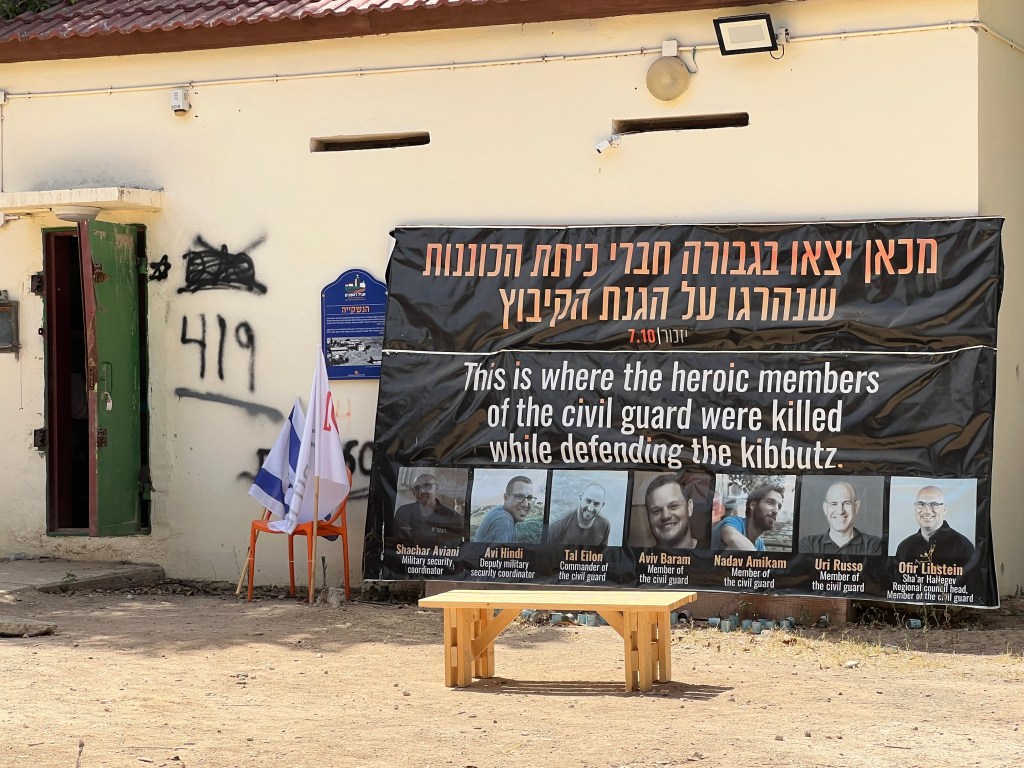
The armory where many of the Kibbutz’s defense force were killed

We toured the Kibbutz and saw the houses that were burned with people inside.  We saw the border and how close Jabaliya is to the Kibbutz (less than a mile from where we stood).  We saw the street that is still closed, and pictures are forbidden because they are still working to identify some human remains there.  Every person on that street was either murdered or kidnapped and taken hostage in Gaza.  Every single person.  And entire street.  Imagine your street having every single person murdered or kidnapped and taken hostage.  It is beyond inhumanity.   We saw the youth area with the pictures of those murdered.  Banners with pictures of the hostages taken from the Kibbutz.  We got to enter two of the apartments where Hamas murdered people.  Their personal items are still there.  Outside of the massive damage due to grenades and bullets, it was a home.  Yet the person who lived there was brutally murdered by terrorists. 
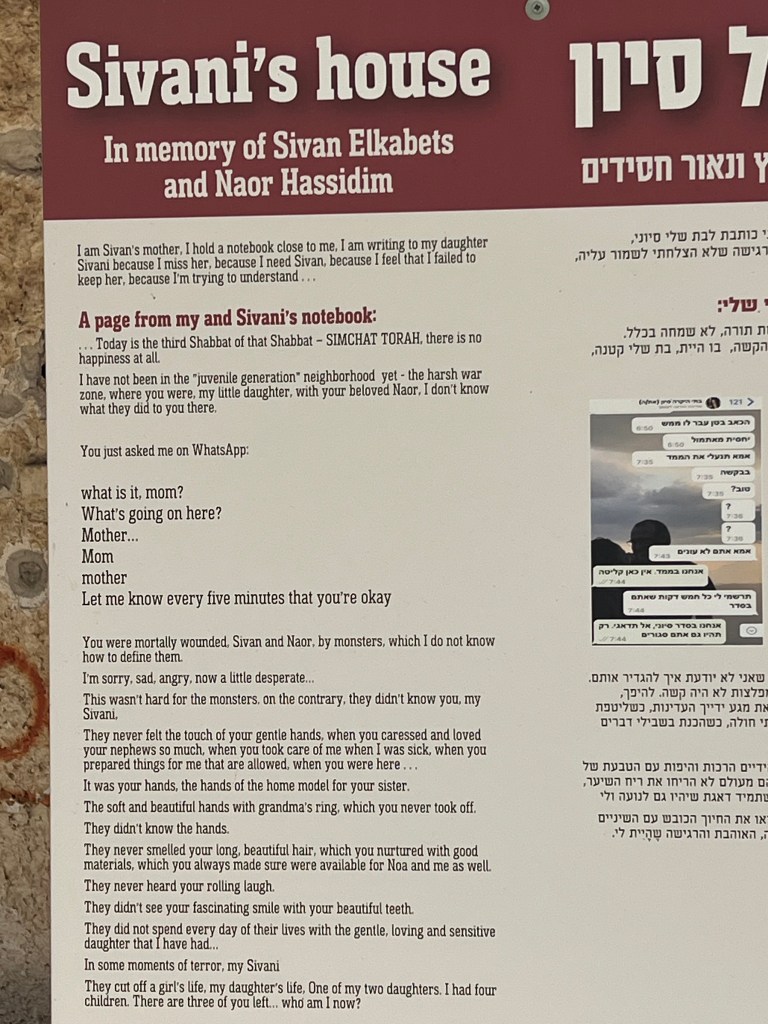
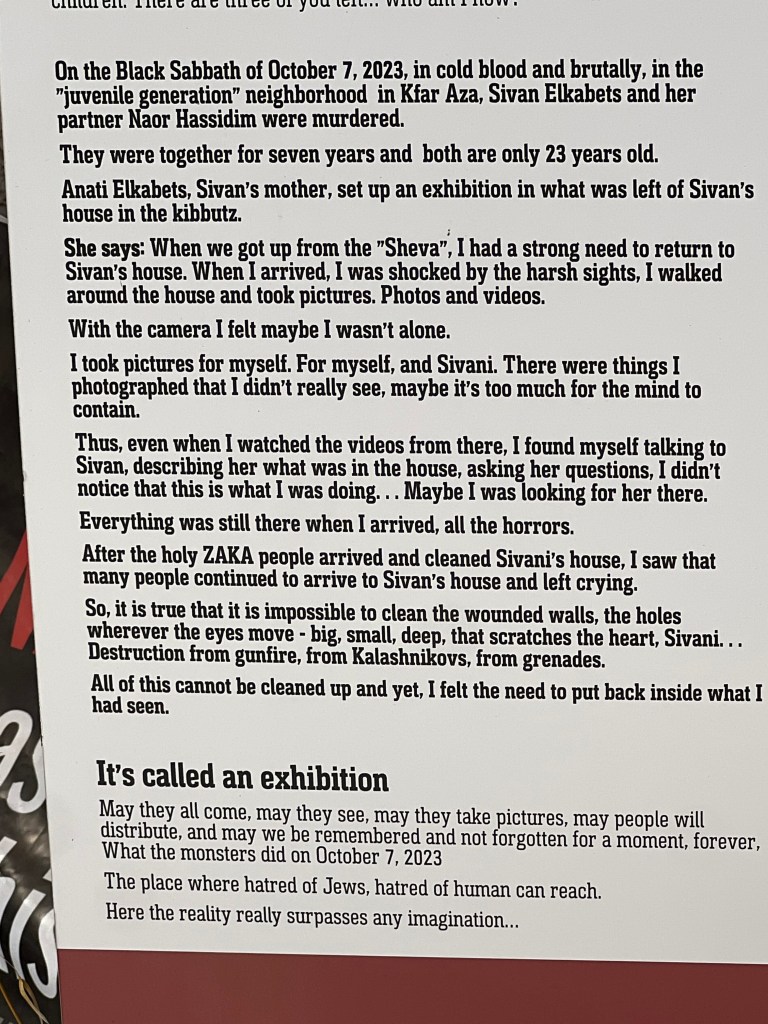
Sivan’s house was one that we could tour. The holes in the wall and the ceiling were unbelievable. Her bathroom was as she left it.

As I listened to Shachar and toured the Kibbutz, my stomach was in pain.  It was a deep gut pain.  My insides were twisting with each story.  The more Shachar talked, the more it hurt.  When he finally went back to work, he told us that in the middle of a dangerous job, he just froze.  People noticed and asked if he was ok.  When he told them no, they came to take over for him.  He hasn’t tried to work since then. 

Yet at the end, Shachar stunned me.  He told us that he still hopes for peace.  After all that he has seen and experienced, he still wants peace.  He isn’t sure when it will come but he believes and hopes that it will.  He invited us all to come back and visit him.  To stay at his house.  He loves Kfar Aza.  He doesn’t want to ever move and won’t leave.  He wants us to come visit and really experience it.  Most of all, he still wants peace.

Shachar talking to us

Last month, I wrote about how the bombs going off in Jabaliya were the only thing that gave me comfort during the visit.  It bothered me then and it bothers me now.  It’s not who I am yet is was who I was at that time.  This trip was different.  While we heard jets above us, saw missiles fired, heard explosions and gunfire, it wasn’t comforting.  It felt necessary.  Hearing the personal story of Shachar reinforced the evilness of Hamas.  He had told us how after Hamas had murdered, raped, and kidnapped people, the civilians of Jabaliya came across the border into the Kibbutz, looting homes and stealing whatever they could.  He saw a man with a crutch tying a TV to his back to take back to Gaza.  While I am sure there are some innocent civilians in Gaza, the behavior of civilians on October 7th shows that most are not.  From the celebrations on October 7th, the civilians who joined in the murdering, and those who came to loot and steal, the evidence is clear. 

As we come closer to the end of the war in Gaza and elimination of the last battalion, it is clear that Hamas cannot remain.  The textbooks provided by UNRWA cannot remain.  UNRWA itself cannot remain.  For there to be any peace, there needs to be both a change in leadership as well as a change in the taught hatred.  Without that, we will continue to have ongoing attacks and repeated wars. 

Shachar showed us that the desire for peace from Israelis remain.  There are serious conditions that must happen before that can occur.  The hostages must be returned.  Hamas must be eliminated from any type of power structure.  Gaza needs to be rebuilt with leaders who want to build a civil society with their neighbor, the Jewish State of Israel.  Anything less is unacceptable.  If people tell you Israel should accept anything less, tell them the truth.  Anything less is not acceptable.  It is not feasible.  It is not acceptable.  And it will not happen.

The Jewish people will not go away.  We will not allow our extermination.  If it becomes ‘us or them’ we will ensure it us.  Am Yisrael Chai.
The path back from the cliff isn’t easy but it is there. Will you take it?

I boarded the flight to Israel today around 11 am.  We took off at noon for the 11 ½ hour flight from Miami to Tel Aviv.  This is my least favorite flight to take as it’s very difficult to sleep during the daytime after a good night’s sleep and when we land, it’s the start of a brand-new day.  It’s great to land and have the full day in front of you, but when you are tired and it feels like midnight, it’s not always so easy.

On the flight, I chose to get the internet package. Knowing it was daytime and I’d be awake for most, if not all, of the flight, I thought it was a good investment.  As I spent the flight checking emails and responding to texts, I realized that when we landed in Israel, not only were we going to start by volunteering to help by picking fruits and vegetables, but we were also going to spend the afternoon at the Kotel, the Western Wall, one of the holiest sites in Judaism.  One of the traditions is to write prayers and put them into the wall so they are close to God.  Since I had such a long flight, I went on social media and offered to put prayers into the Kotel for whoever wanted one.  All they had to do was message me what they wanted the prayer to be.

I didn’t think much of it and expected a few people would respond.  I was overwhelmed as the requests kept coming in.  Without sharing any specific people or what they requested, I will say that a great deal of them were related to health issues.  It is a reminder that there is a reason the saying is, “healthy, wealthy, and wise.”  Health comes first.  Without health, we have nothing.  There were requests for a better world.  Requests to help loved ones who are struggling.  Nobody was asking for the ‘wealthy and wise’ part of the saying.  All the requests were truly selfless.  A few people thanked me for offering to do this for them.  I often take going to Israel for granted.  This is my 22nd trip and the 23rd is already on the books this year.  Israel is truly a core part of my soul and my personal identity.  Today, on the flight, these requests were a reminder of how lucky I am to go to Israel once, let alone 22 times. 

These requests also got me thinking about the world we live in today and the world it appears most people want to live in.  They are not the same place.  The world we live in is filled with selfishness.  It is filled with ‘haves’ and ‘have-nots’.  It is filled with people who desperately want to obtain and keep power.  It is a world filled with ego.  When half of the United States hates the other half, we are not living in the world that most people want. 

These requests made me think about the world we would like to live in.  A world where we cared about other people.  A world in which doing the greatest good really mattered, whether it helped the individual or not.  A world filled with love, not hate.  A world in which we were more concerned with giving than getting, with doing rather than taking.  What would it look like to live in a world where kindness was the most valued commodity? 

Imagine a world where we didn’t hate but rather worked to understand each other.  Our differences were celebrated rather than used to create a reason to hate.  As I watched this video, I couldn’t help smiling when he said, “Babka is my middle name” or when he called rugelach, “roo ga losch”.  He is filled with curiosity.  He wants to explore a different culture. I want to watch him try gefilte fish, kasha varnishkas, shakshuka, cholent, and so much more.  How much fun would it be to watch people of different cultures explore the unique foods of another culture?

On this trip to Israel, we have 12 young adults.  6 males, 6 females.  Twelve very different people, who come from different backgrounds, with one similarity. As I met most of them for the first time, I loved their differences.  I can’t wait to spend two weeks exploring a post October 7th Israel, leadership, and Jewish thought with them.  I can’t wait to hear their thoughts, their impressions, their opinions, and their ideas.  As I write that, I can’t imagine our world leaders saying the same thing about each other.  I can’t imagine our country’s leaders saying that about each other.  It shows me that there is a path back from the cliff we are on, if we want to take it.  It’s not easy.  It’s not comfortable. 

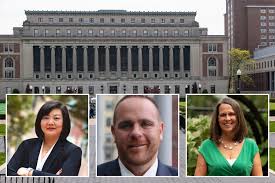
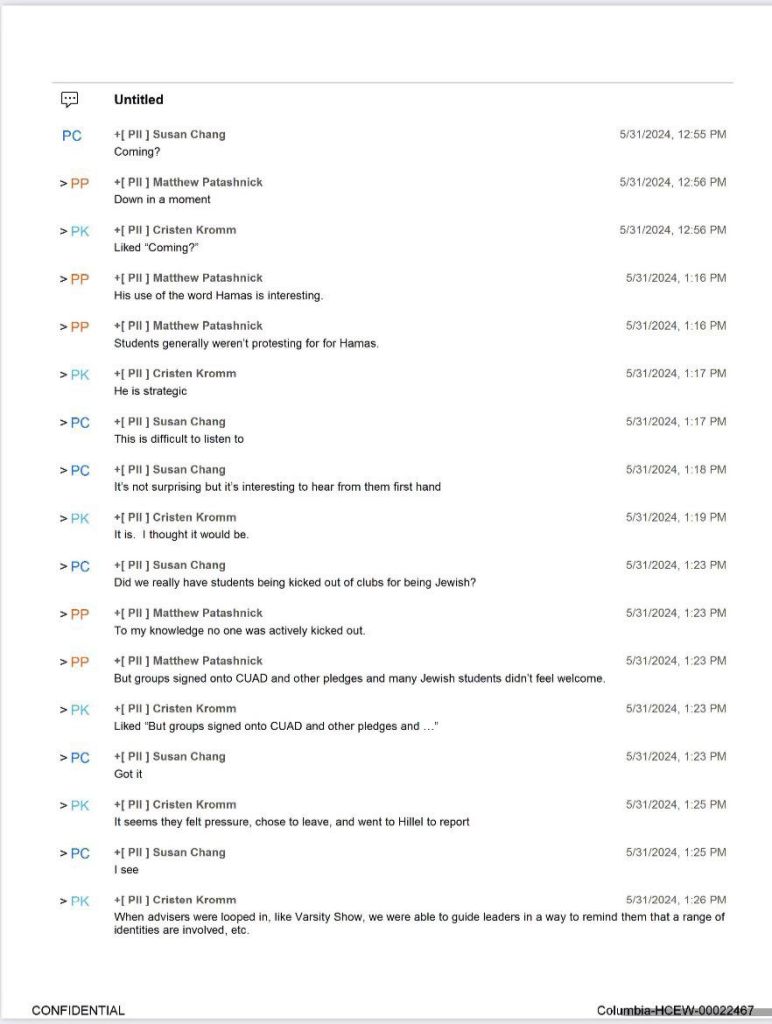
A perfect example of how close to the cliff we are is the text exchange between Deans at Columbia University that was released by the Department of Education.  The texts are bigoted.  They are hateful.  They are unbecoming a leader and an educational institution.  Three of the Deans are currently suspended pending an investigation while one, Joseph Sorett, has falled on his sword and not only won’t be suspended, he is guaranteed to keep his job.  Normally, with evidence this damning, you could count on them getting fired.  Yet in the world we live in, with what we have seen in the past 3 months on college campuses, there remains a good chance they will all return to their positions with merely a slap on the wrist and by making an insincere apology.  As you read the text thread, your blood may boil the way mine did.

Instead of approaching this with empathy, care and concern for Jewish students at Columbia, these four Deans, Susan Chang-Kim, the Vice Dean and Chief Administrative Officer, Matthew Patashnick, the Associate Dean for Student and Family Support, Cristen Kromm, the Dean of Undergraduate Student Life, and Josef Sorett, the Dean of Columbia College, utilize stereotypes, antisemitism, hate, racism, and everything they are supposed to fight against to mock Jewish students, Jewish professional leadership, and antisemitism. Their titles show how powerful the positions they hold are.

The 3 Columbia Deans that have been suspended

We all have a choice. Do we want to be like the Deans of Columbia University or do we want to work to change the world, seek to understand rather than to be understood, strive for the best for humanity, be kind, and treat others with dignity and respect. It seems like a simple choice, however in the world we currently live, it isn’t.

I choose the latter. I choose to do things like meet with my Palestinian friend in East Jerusalem to have meaningful and respectful discussions. I choose to listen and learn both with and from the twelve young adults on this trip. I choose the harder path, one that leads to a better world but isn’t easy. When I go to the Kotel later today with all these notes from other people, detailing their prayers, their hopes, their dreams, I choose to be an instrument of good, placing each one carefully into the wall. With each one I place, I will ask God to grant them their prayer, their wish.

We are not stuck in the world we live in. We have the ability to change the world one step at a time, one day at a time, one action at a time. I hope you will join me.

Common Sense isn’t so common

We often generalize way too much.  My father used to tell me all the time to be specific. Be detailed. Don’t just generalize as you miss too much.  He was right.  I used to joke that the older I got, the smarter my dad got.  As a parent, I now joke that the older my kids get, the smarter I get.

Today’s world is crazy.  The growing hatred is hard to believe.  The lack of basic knowledge is shocking.  Often, it is very easy to generalize about people, places, things, beliefs, etc. and wish it all away.  Fortunately, that isn’t true and with just a little effort, it is possible to learn that generalizations don’t work, and that people are people.  It’s possible to make friends with people who have different political beliefs, different religions, different ethnic backgrounds, come from a different socio-economic status, have different criminal histories, different educational backgrounds, come from different parts of the country or different countries, and speak different languages.  We can choose, if we desire, to focus on our similarities, not our differences, and make the world a better place.

When I was in Israel in May, I made it a point to go visit my friend Mahmoud, a Palestinian Muslim who lives in East Jerusalem.  I wanted to walk there, through East Jerusalem, through Arab neighborhoods, because I chose not to believe the stereotypes and generalizations.  It was a beautiful walk and I saw many families and people living their daily lives.  It was not what you see on television.  It was not what you read in the newspapers.  It was real life. 

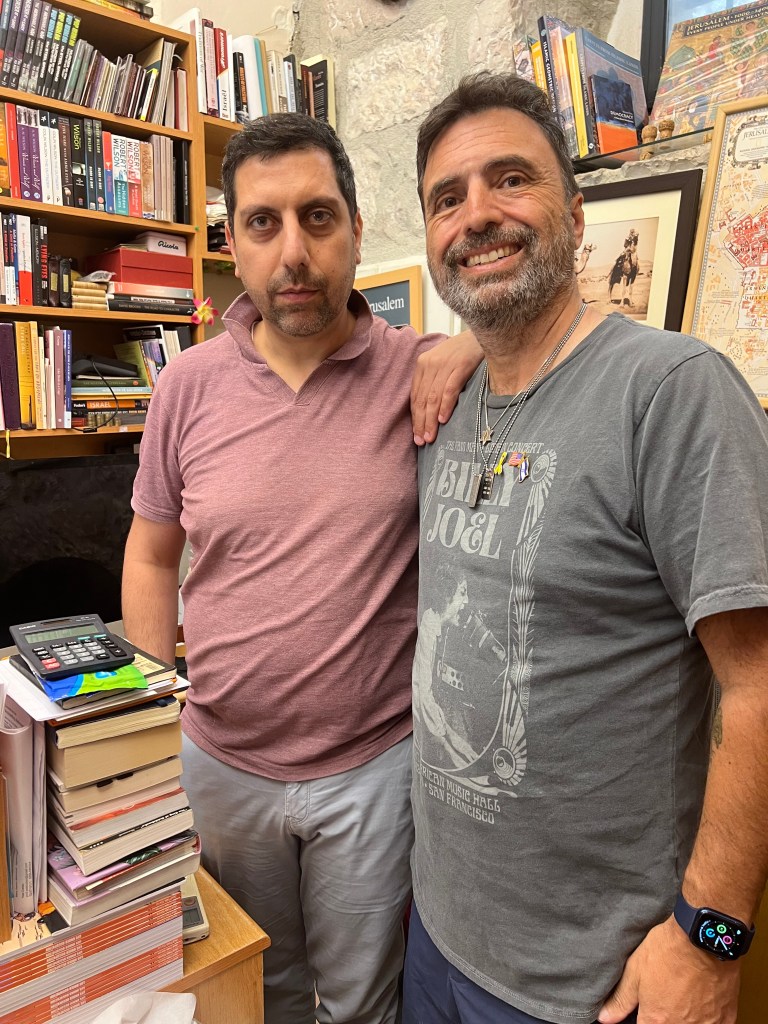
Mahmoud and I have many different beliefs.  We come from different backgrounds.  I’m an American Jew who loves Israel.  I have lived my entire life in the United States with the safety and privileges that come with living in the US.  Mahmoud is a Palestinian Arab, who has lived his entire life in East Jerusalem.  He has lived with the challenges that come with living in that region, not being an Israeli citizen, and having a limited voice in his government.  We could easily not be friends.  We could easily be enemies. We could easily demonize each other.  Instead, we have chosen to invest time in a relationship based on mutual respect, on trust and on respect.  Our conversation in May was challenging in many ways.  It was refreshing in others.  I was relieved by some things he said and discouraged by others.  We spend 90 minutes talking deeply as friends, sharing thoughts, feelings, and opinions.  I wish I had more people in the United States that I could talk with the way that Mahmoud and I talked.  I’ll be back in Israel in July and hope to be able to see him again and talk more.  Invest more in our friendship. 

With my friend Mahmoud. I hope to see him again in a few weeks when I am back in Israel.

There are often generalizations about liberals and conservatives.  That there is no real center left or center right.  That a Democrat can’t talk to a Republican and vice versa.  That there is no common ground – you choose a side and that’s where you have to be.  I hate that absolutist way of thinking because that isn’t real life.  Real life is complicated.  Real life is complex.  Absolutes rarely, if ever, work in real life.  It is truly consumed by the gray and how we navigate the gray.

I consider myself a slightly right of center person.  I am liberal on most social issues and conservative on most fiscal issues.  I believe in small government and the rights of the individual.  I’ll be vulnerable here and share some of what that means for me. It means I am pro-choice (which isn’t pro-abortion, it means that a woman has the right to choose whatever is best for her).  It means I don’t want the government telling me what I can and can’t do in my personal life.  I am pro-marriage equality because people love who they love and should be able to marry who they love.  As a fiscal conservative, more marriages (and then divorces) mean a better economy so there is a practical side of it as well.  People should be able to use the pronouns that they want because it matters to them.  It doesn’t affect my life in any way to use somebody’s preferred pronouns once they tell me what they are.  Just like I don’t need to share mine if I don’t want to. 

We live in a time when common sense isn’t so common.  We focus on the things that don’t affect us because somebody else tells us it should matter.  Don’t believe in marriage equality?  Then don’t marry somebody of the same sex.  Other people’s life choices are their choices.  Let them make them.  Common sense.

Let’s use common sense and focus on the things that do matter.  How do we keep people safe so they can enjoy their inalienable rights of “life, liberty, and the pursuit of happiness?”  How do we not discriminate against people when it comes to things like jobs, housing, or education?  What can we do to ensure equal access to things like jobs, housing, or education?  Instead of fighting about forgiving student loans, how do we find a solution to the exorbitant cost of a college and/or graduate school education?  How can we use our intellect to find a solution to the rising cost of housing instead of trying to socialize housing?  What can we do to deal with the rising costs of food and clothing?  A number of years ago, I was very frustrated by the government’s incentives to put solar panels on your roof.  You had to have the funding or the ability to get a loan to pay for the panels and at the end of the year, when you filed your taxes, you’d get the money back.  Why not just have the government pay that money to the solar company upon installation so it was affordable?  Simple solution.  Same money.  Only now it would be accessible.

It used to be that our leaders and most Americans wanted the same things, and it was merely a question of how to get there.  We focused on how to improve lives, how to improve our country, how to keep the world safe.  It was about the HOW, not the WHAT.  Today, I’m sure we even agree on the “what”.  The hatred that comes from the far left and the far right is powerful but isn’t the majority, even when it feels like it.  We have the ability to take the narrative back.  We have the ability to build relationships with our elected officials to get things back on track.

I have the gift of working with many local, state, and federal officials.  I have their cell phone numbers, we text, we meet, and we talk.  I choose to invest my time talking with our elected officials, regardless of their party, about the challenges we face.  I don’t care whether they are a Democrat, Republican, or Independent.  I care about what their positions on issues are.  I care about the policies they believe in.  Like with my friend Mahmoud, we can differ on many things but that doesn’t mean we can’t talk about them and have meaningful and deep conversations.  It doesn’t mean that I can’t learn something from them, or they can’t learn something from me. 

Our country was built on being able to talk with our representatives and share our views, our hopes, dreams, needs, concerns, and fears.  It seems we have forgotten that.  I live in Central Florida and have relationships with all my local elected members of the US House of Representatives.  I have a relationship with both Florida Senators.  I have relationships with Florida Representatives and Senators.  Not because I am special.  Not because I have any sort of special access.  It is because I made the effort to connect with them.  I spent the time and continue to spend the time investing in a relationship with them.  When there is a new candidate who I want to get to know better, I reach out and introduce myself.  We can get coffee.  Talk about why they are running for office.  Talk about my concerns.  It’s building a relationship.  We can all do this if we want. 

Larry Hogan, former Governor of Maryland and a current candidate for the US Senate from Maryland, wrote a letter to 60 Maryland Rabbis concerned about rising antisemitism and Jew hatred.  In it, he wrote:

“This is a moment when our leaders must be held accountable for their words and their actions. There are times in history when leaders must stand up for what is right regardless of party affiliation or personal interests.”

This is what we can each make happen with our own advocacy.  This is within our individual power.  Pick up the phone and call your elected officials.  Local and state elected officials will easily meet you for coffee and begin a conversation (not an argument) and build a relationship.  Write to your US Representatives and call their office to request a meeting.  It may take a few months, but you can get the time with them.  Make an appointment in their local or DC office.  You may get 30 minutes so use it wisely.  Ask questions, listen, highlight your concerns. 

I often highlight the movie, The American President, because the writing is so brilliant.  The last speech by President Shepard speaks to this and still gives me chills decades later. 

“America isn’t easy.  America is advanced citizenship”. 

“We have serious problems to solve, and we need serious people to solve them.”

Despite the challenges of our Congress not working, despite the challenges we face in our individual states with their legislation, we do have serious people ready to work to solve our serious problems.  It’s our job to make sure they know that it matters to us. It is our job to make sure they know that when they take on this work, we have their back.  It is our job to be their citizen partners as they address these problems.  And it is our job to get to know them so that if they are not serious people ready to take on serious issues, we replace them with people who are. 

That means we vote.  I always vote.  I hate it when people say, “what does one vote matter?”  Many years ago when I was in graduate school, I went to vote and there were two local positions where nobody was running.  As a joke, I voted for my roommate and ‘brother from another mother’, Aric, for both of them.  I told him that he could tell his future children that he got votes in an election and would have the proof for it.  We laughed and forgot about it.  A few weeks later he got TWO certified letters.  He had won BOTH elections with my ONE vote.  While he didn’t choose to serve in either role, it shows the power of one vote.  If you choose not to vote, you don’t get to complain because you were not part of the process.  I don’t care who you vote for, just vote.

Common sense isn’t so common.  That doesn’t mean it doesn’t exist.  It doesn’t mean we get to throw up hands up and quit.  It means we double down on our efforts.  It means we advocate for the things that we value with the decision makers.  It means we build relationships with them.  It means we hold them accountable in a respectful manner.  It means we actively vote and encourage others to vote. 

The time to take action is here.  What are you going to do?  That’s the question that only you can answer. 

Nes Gadol Hayah Sham, a great miracle happened there.

There hasn’t been a lot of joy since October 7th.  Sure, there have been family simchas.  There have been birthdays and anniversaries.  Life continues which means meaningful events occur, but there hasn’t been much sheer joy.  Briefly when the hostages were released in December after 50 days of captivity.  There has been a lot of stress, a lot of grieving, a lot of worry about friends and family members serving in the IDF.  Concern with the rise of antisemitism on campus and in our cities and towns. 

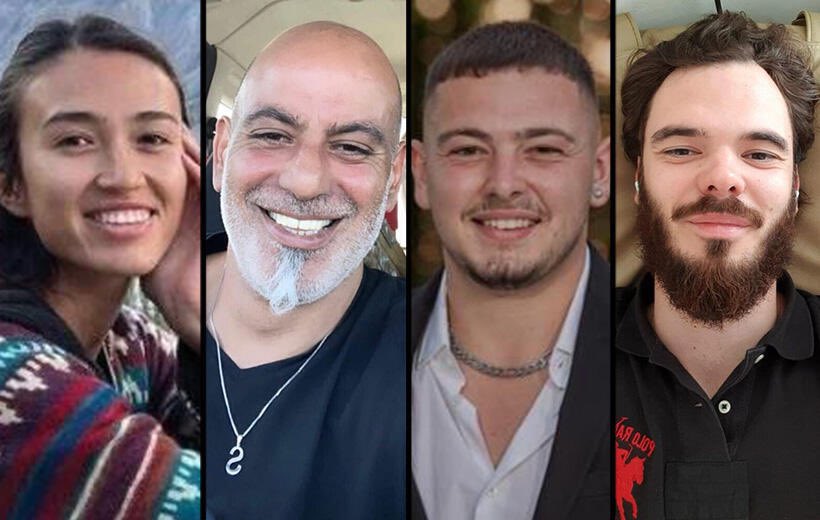
This morning was joy.  It was announced that four (4) of the hostages were rescued from the market in Nuseirat.  They were being held captive in private homes by ‘civilians’.  The same ‘civilians’ that participated on October 7th.  The same ones that held hostages after October 7th.  The same ones that hide guns and rockets in their children’s bedrooms, a baby’s crib, in the schools and in the hospitals. 

Noa Argamani (25), Almog Meir Jan (21), Andrey Kozlov (27) and Shalom Ziv (40) are free today. The IDF had a very detailed and daring rescue planned and got them out. They were being held in “civilian homes’.

Almog Jan spoke after being released and said that they were moved from house to house during the 8 months of captivity. When the media and other groups talk about the innocent people being killed, remember that the innocent people helped with October 7th. They were involved with the second and third waves of the attack. They turn their homes into military bases, even their children’s rooms and baby’s cribs. They hide hostages in their homes. The definition of ‘innocent’ seems to not fit very well.

The rescue of the hostages has reverberated throughout the Jewish world. Friends in Israel reached out with a joy I haven’t heard in a long time. Friends in the US shared their excitement and gratitude. It has been the topic of the day. These two videos are what it is all about. It’s the importance of Jewish community. They are why we want and need Israel. When I read that Noa Argamani said, ‘There was a knock on the door. A voice said, “It’s the IDF. We’ve come to take you home.’” I got chills.

Noa Argamani reuniting with her father. I cried watching this.

Shlomi Ziv talking to his wife for the first time in 8 months.  I am not embarrassed to admit that I cried watching it too.

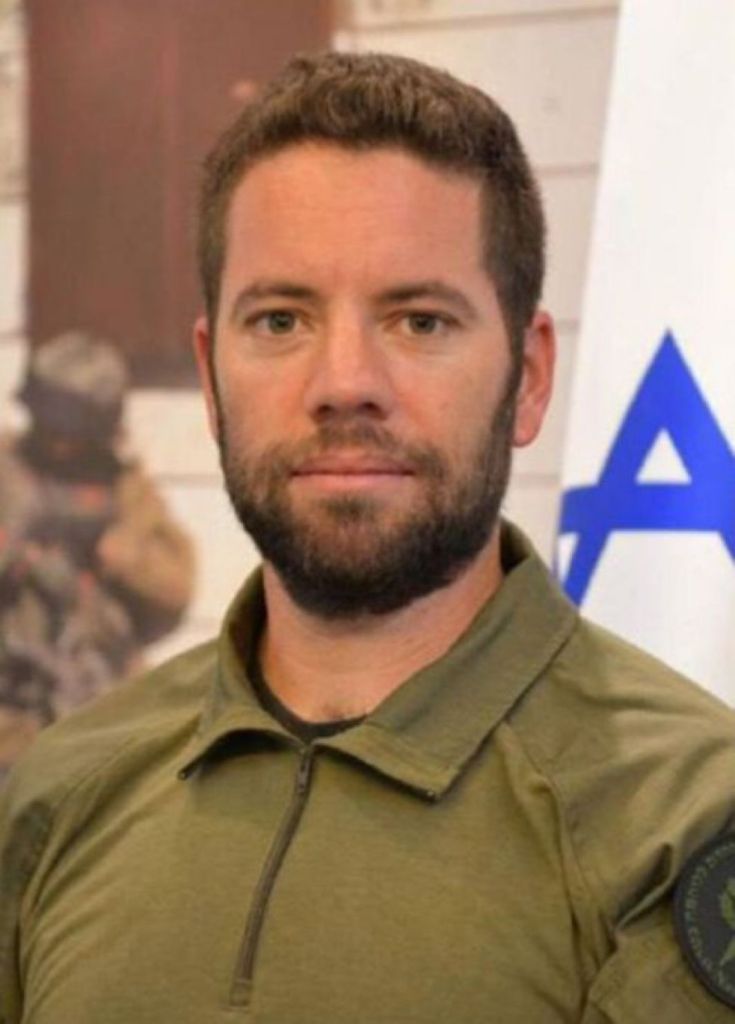
As wonderful as the news of the rescue of the hostages was, there was sad news as well. Arnon Zamora (z’l), an IDF soldier who was a part of the force that broke into the apartment where the hostages were being held, was severely injured during a battle, and later died in the hospital. This brave IDF soldier risked, and lost, his life for Israel, for the Jewish people, and for the hostages. Arnon left behind a wife and two children. On October 7th, he led the battle at the Yad Mordechai Junction, eliminating dozens of terrorists and preventing the terrorists from infiltrating northwards. He then went on to fight in the battle at Kibbutz Nahal Oz and Kibbutz Be’eri. Unlike America, who still does nothing to rescue the American hostages in Gaza, Israel takes action. Arnon knew the risks. He also understood that rescuing the hostages was far more than saving these four people. It was saving a nation. It was saving the Jewish people. What a hero. What a huge loss. What a lesson. What an inspiration.

Arnon Zamora (z’l), killed in the rescue of the four hostages. May the memory of this hero always be for a blessing.

Almog Meir, shown above with his grandfather, learned today that his father died today. When they went to notify Yossi Meir about his son, they found his body. Yossi died before learning his son was alive and had been rescued. I can’t think of much worse for a parent, not knowing if your child is alive or what type of abuse they are undergoing as a hostage. Almog celebrates his freedom by preparing for the funeral of his father a day later. I can’t imagine what he is going through. Hamas stole his time with his father and may even be the reason his father died, so worried about the fate of his son.

Those who hate Israel and Jews have already come out strong with criticism. They focus on the approximately 200 dead and 400 injured in Gaza during the rescue. They like to overlook the fact that the hostages were kept in personal homes. They like to forget that the market and the UNRWA camp had become Hamas military installations. They don’t like to admit that Hamas firing at the IDF killed many of the people. They call them ‘innocent civilians’ despite the fact that they participated in the keeping of the hostages, they allowed Hamas to have military bases inside their community, and were actively involved with Hamas.

They also use the pictures of Noa Argamani and claim that she wasn’t raped (we don’t know if she was or wasn’t on October 7th or since then) so there was no sexual violence or rape by Hamas and that she gained weight so was treated great and somehow got food when there is none available and Gazans are starving. In their rapid Jew hatred, they actually are proving that UNRWA is giving the food to Hamas and not the people. They are showing their Jew hatred because Noa isn’t pregnant which automatically means there was no rape or sexual violence by Hamas. The rabid antisemitism is unbearable to watch especially with the lies they spread.

They criticize the tactical approach Israel used which involved pretending to be humanitarian vehicles to get into the area. They neglect all the times Hamas has used ambulances, hospitals, schools, and mosques to attack Israel and Jews. It’s a very self-indulgent approach to attack Israel and the Jews. It is their pattern. We cannot allow it to continue. We must call out the lies every time we hear or read them. We must call out the Jew hatred and antisemitism when we see it.

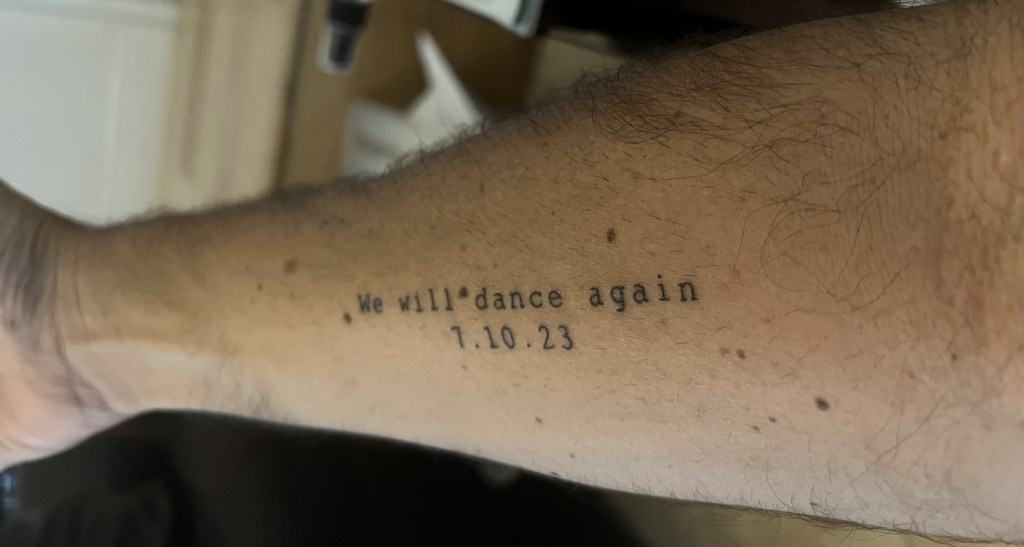
The IDF showed us today the importance of fighting back. We each have that responsibility. We cannot allow the lies and half-truths to stand unchallenged. We cannot allow the facts to be manipulated and twisted. At my age, I can’t join the IDF to fight back but I can fight back with advocacy, with knowledge, and with relationships. I can stand up and speak out. I wear my Magen David everywhere. I wear my dogtags for ‘We will dance again’ and for ‘Bring then home now’. I wear my lapel pins, one for the hostages and one with the US and Israeli flag on it. I wear short sleeves to show off my ‘We will dance again’ and ‘Nova’ tattoos.

The world we live in is one filled with Jew hatred. We have a choice. We can fight back or we can try to hide. Throughout history, our attempts to fit in and hide have not worked. Fighting back has been the only way to ensure our safety. I choose to fight back. Just like the IDF rescuing the 4 hostages today by fighting back, so will I fight back. I refuse to run and hide. I refuse to pretend I am not Jewish and try to fit in, hoping that they will leave me alone. Those who side with evil because they hope they will be spared should look at history. It never works out that way.

Israel and the IDF showed us how we fight back today. They showed us how every Jew matters. They inspired us. Now it’s our turn to show them how we fight back. How every Jew matters to us. We need to inspire them. We fight back by speaking up. We fight back by writing to our legislators and holding them accountable. We fight back by voting and making sure the incumbants and challengers know that Israel matters to us. We insire our Israeli brothers and sisters by our actions. We visit Israel to show them we care and they matter. We visit the Kibbuzim that were devastated on October 7th, the Nova festival site, the displaced Israelis from the North and the South, and soldiers on bases to give them a hug and remind them that they matter to us. After my trip to Israel in May, it became clear how important just showing up was to Israelis. I’ll be back in July in part to do the same thing all over again.

Today was a great day as 4 hostages were rescued. There are 120 more to get home. The leadership of Hamas must be stopped. There is a lot left to do. One of the famous sayings in Pirke Avot, the Ethics of our Fathers, is, “You are not required to finish your work, yet neither are you permitted to desist from it.” This holds true with the war in Gaza. We must engage. We must fight back. The world thinks they can bully us and as the IDF showed today, they are wrong. Let’s make sure they see it from all of us.

Meeting with my friend Mahmoud, a Palestinian living in East Jerusalem

I met Mahmoud in 2019 on my Encounter trip.  You can read about the trip starting with this blog post and continue forward.   It was great to see Mahmoud and we hugged when we saw each other.  He asked us to sit as we caught up on our families, work, and life changes.  This of course brought up the war which has impacted him both economically and in terms of how safe he feels for his family.  It was another connection point as I have those same feelings as a Jew in the United States. 

Mahmoud is incredibly smart.  The conversation was deep and not stuck on talking points or things that often impede real conversation.  It was refreshing to have somebody to talk with about what is happening without the incitement of specific words.

We didn’t use words like Genocide.  We both agreed that lots of people were dying, and we wanted that to stop.   We didn’t use words like forced famine.  We agreed that not enough food was getting to the people, and they were hungry.  He doesn’t believe enough food is getting in even if it wasn’t being stolen and sold.  He said there were fewer trucks going in now than before the war.  From what I understood that wasn’t accurate but I didn’t have the facts in front of me so chose not to dispute that point and just agree that people were hungry.  We agreed that the Hamas attacks on October 7 were unacceptable. We agreed that Hamas was evil.  We agreed that Hamas must be removed and cannot continue to exist in power. The murders, rapes, burning of bodies, and other actions were evil and unacceptable.  He shared that he and his friends were horrified when they learned of the attack.  We agreed that taking the civilian hostages was unacceptable and he shared that his hope was that they would be released the very next day.  He also said that he felt the taking of soldiers was different as this was an act of war by Hamas and taking military personnel for future prisoner swaps was ok.  While I understand his position on this, I struggle with it because of how Hamas treats prisoners. 

We talked about Zionism.  When we met in 2019, he made the comment that, “If Zionism means the Jews have a right to the land and we do as well, then I am ok with Zionism.”  When I said that the definition of Zionism is that the Jews have a right to a homeland and says nothing about anybody else, he commented that too many people disagree with me.  There are people who believe all of historical Israel belongs to the Jews and not only should we have the West Bank/Judea and Samaria but also Jordan and more.  That Greater Israel should be ours.  Just like there are Palestinians who believe there should be no Jewish state at all.  They believe the entire land should be Palestinian.  We can’t listen to the extremes and that’s where we are at the current time.  The media only covers the extremes.  That is what sells.  That’s what gets ratings and advertisers. 

We talked about the campus protests.  He wasn’t aware of the number of outside agitators that were involved with them.  As we discussed it, he commented that the fascists and communists always do that.  This is their pattern throughout history, so it isn’t a surprise.  I shared that in my opinion they were stealing his story and his pain for their own agenda which had nothing to do with Palestinians.  It was about anarchy and changing the United States government.   He agreed.

We discussed how the status quo in the relationship between the Israelis and Palestinians was not something that could continue long term.  When I participated in the Encounter trip, one thing that was clear to me was that the status quo couldn’t continue.  We agree on that.  From the day I met him, Mahmoud has been a proponent of a one state solution.  For him this doesn’t mean someplace that is free of Jews.  It is his position that Israel already controls the entire area and that it is already one state in which some of the people who live there get treated differently.  The challenge of a one state solution is that it would mean that Israel would no longer be a Jewish state.  That’s the cost of peace in a one state solution.  Unfortunately, I agree with him that the cost of a one state solution is the loss of Israel as a Jewish state.  I chose not to tell him that this would be unacceptable to the world Jewish community as the entire purpose of having a state of Israel is to have a Jewish state.  It is why I believe a one state solution will never occur.  The Palestinians would have to agree to leave the land and they are not going to do that.

He was pessimistic about any chance of a two-state solution working.  He made the point that Gaza was effectively a two-state solution. We see how that worked out.  I agree with him.  The challenge of a two-state solution is that the Palestinian leaders and people need to not just accept that Israel exists as a Jewish state but also there will be travel limitations and challenges because there are two countries with sovereign boundaries.  This also doesn’t even consider the trust factor needed.  The current trust factor is at best zero right now.  When I made the comment that it might take ten (10) years to get to a real two-state solution he shook his head and told me that was likely too long.  He said if it is going to take 10 years, it is dead.  I don’t agree with him here and we spent a lot of time talking about leadership. 

For those who have been reading my blog, you know how critical I have been about our lack of leadership.  This lack of leadership exists in the Jewish community, in America, in Europe and certainly in Israel and with the Palestinians.  The Palestinian Authority President Abbas was elected to a 4-year term in 2005.  There have not been elections since.  He is in year 20 of a 5-year term.  The world stays silent and supports him.  Prime Minister Netanyahu has been in power longer than any other Israeli Prime Minister.  While he has been in and out of power due to free elections, there is a reason why many countries have term limits for these and other positions.  A new voice is needed.  New leadership.

Both Mahmoud and I expressed our concerns about future leadership.  Who might it be?  Mahmoud is concerned Israel will elect Ben-Gvir, Smoltrich, or somebody on the far right like them.  I don’t share those same concerns as the Israeli people are not far right like them.  They are given a far too large platform because Netanyahu needs them to remain in power.  I am concerned that the leadership that will follow Abbas is going to be Hamas or Hamas like.  Somebody who will not lead towards peace but will lead back to the days of the intifadas and violence.  Both of us are stunned that in the United States, with well over 300 million people, these are the two candidates we have for President.  Because of their age, it is unlikely that either of them will be running in 2028 (one won’t be eligible per our constitution) so perhaps we can see some change in the US in four years but no matter who wins, it will be a very challenging four years.  With all this negativity about leadership, Mahmoud wanted to talk more about the people rather than leadership. 

His concern is that leaders are elected by the people.  His concern is that the anger and rage at Hamas is spilling over to the Palestinian people and will make things worse.  There are people who say, “just bomb them all” or “flatten Gaza and kill them all” or “they are all terrorists”.  I shared with him that as I was in Kfar Aza and at the Nova site, I felt rage.  I didn’t share that at Kfar Aza, as each bomb exploded in Jabaliyah, I felt better, as not only does that really bother me that I felt that way but also it would have been counterproductive to our conversation.  He isn’t wrong.  Israel is not the same country as it was on October 6.  The people of Israel are not the same.  The events of October 7 have altered the people and the country.  I don’t know where it is going to end up.  I told him I remain hopeful that when the war ends, and the war will end at some point, I am hopeful that the Israeli people can heal and look to a future where there can be peace and something like October 7 will never happen again.  He was much more pessimistic and really fears that the long-term impact on the Israeli people will be to radicalize them further and further to the right.  I shared my hope that after the war, it would bring them back towards the center due to the desire to live life. 

We also spent time talking about how important it is for Jews and Palestinians to talk the way we were.  To respect each other and share ideas, not ideology. To work towards finding solutions, not arguing and fighting for the sake of arguing and fighting.  He shared that while some Israelis do some to talk with him, he has no platform in Israel to do this.  Coming to the United States to talk to Israelis and Jewish communities isn’t the answer either.  We need more dialogue.  We need more discussion.  This brought me back to my points about leadership and how they can’t and won’t do this.  Perhaps after the war ends and Bibi is replaced and in the next few years when it is likely that Abbas will die, we will have a chance for new leadership that is willing to engage with each other and really work for the benefit of their people rather than to remain in power.  Maybe I am overly optimistic.  Maybe I am being too positive and too hopeful.  I don’t see another way to live.

As we wrapped up our 90-minute conversation, there is much to think about and much to contemplate.  We hugged goodbye and made plans to get together on one of my future trips to Israel.  Because of the time and the heat, we chose to take a cab back instead of walking.  Matthew and I began to talk a little about the experience, but those conversations will happen back in the US over a coffee or twenty. 

I appreciate Mahmoud for giving his time.  For sharing his opinions and concerns.  For listening to both Matthew and my comments, concerns, and opinions.  For being open to a real discussion and conversation.  For looking to the future and not being stuck in the past.  As we said during the conversation, we can’t change the past, but we can change the future.  I look forward to future conversations with Mahmoud and to a future where there is peace. To a time when the Palestinians can live in peace with their neighbor Israel.  When the thought of another October 7th isn’t on everybody’s minds. 

My friendship with Mahmoud and a number of other Palestinians living in East Jerusalem and the West Bank/Judea and Samaria (two names for the same place) are examples that we can live together. We can have difference and get beyond them and live together. It gives me hope that when we finally get new leadership who truly cares about a different future, we might be able to have peace.

The journey begins – return to Israel post October 7th

The journey begins.  My son took me to the Orlando Brightline station so I could take the train to Ft. Lauderdale so I can board me El Al flight to Israel.  My bags are heavy, filled not just with my clothes but also with things to give away to my friends serving in the IDF and their fellow soldiers.  I usually bring some things to give away but this time it feels like a holy mission as they mean more than the usual knickknacks. 

When I go to Israel I tend to write a lot, often daily.  So, I hope you bear with me as I chronicle this trip.  It already feels different.  My family really doesn’t want me to go but they could only delay this trip for so long.  Israel is in my entire being.  It isn’t just my heart and soul but it is core to my identity.  This is my 21st trip but is very different than any before.  I came during the start of the first intifada and again during the second intifada when few Jews were traveling to Israel.  It broke my heart every time somebody thanked me for being Jewish and coming to Israel because all they had seen were Christians on a pilgrimage.  I was here when Jordanians were massing on the border and we could hear gunfire from our hotel room on their side of the border, not knowing they were going to breach the border.  I came during Covid, before the country even was open.  We got special permission and were limited to one of three flights.  We had to have been vaccinated and boosted, get a Covid test before we left, two when we arrived plus a blood test.  We were forced to quarantine for a day until the results came back. 

As you can tell, I’ve been here under a variety of circumstances.  Yet none is like this.  It is not because it is an active war zone.  It is not because there are still three active fronts (Hamas in Gaza, Hezbollah in the north, and the Houthis).  It is not because this is a solidarity mission, as I have been to Israel for that in the past.  This trip is about healing the rip in my soul that happened on October 7, 2023.  Similar to the Harry Potter story when Voldemort ripped his soul into many parts, mine was torn and damaged as I watched the horrifying events unfold on television.  The frantic texting and WhatsApp messages to my friends and family throughout Israel to check on how they were doing.  I remember one telling me about those dead at one of the kibbutzim near the Gaza border and I thought she was telling me about the Moshav that she and her husband lived on.  For more than an hour, I thought they were under attack and the terrorists were near their house until she corrected me.  My friends who were in the IDF reserves who didn’t respond to me because they were responding to the attack.  Were they alive?  My friends who had children in the IDF.  Were they alive?  Who did I know that might have gone to the Nova music festival?  While the initial reports were bad, they were nowhere close to as horrifying as what really happened there. 

I lived near Three Mile Island when it almost melted down. We evacuated, not knowing when or if we could go home.  On 9/11 I had a campus of Jewish students at University of Florida who were scared and unsure what was happening.  I had to let people go during the financial crash of 2008 for no fault of their own.  I had to lay off 136 employees when Covid shut down The Roth Family JCC in 2020.  I’ve dealt with crises before.  Nothing prepared me for the internal impact of October 7th.  This trip is entirely about that.  It is a healing journey for me. 

When I arrive, Yom HaZikaron, Israel’s Memorial Day will begin.  This is the third time I will be there for it and both were incredibly impactful.  This one will be very different.  The next day is Yom Ha’atzmaut, Israel’s Independence Day.  I have also celebrated two of these in Israel.  It’s usually a joyous day, filled with celebrations, parties, fireworks, barbecues, and a parade of boats and planes on the beach in Tel Aviv.  It’s one of my favorite days of the year when I can be in Israel for it.  This year will be very different.  We will go to the south, to a Kibbutz that was attacked on October 7th.  Visit the Nova music festival site.  Go back to Sderot, a place I have been many times but looks nothing like it did prior to October 7th.  I will spend a few days with two friends who are IDF reserve officers.  One spent the first four months in a high-ranking role in Gaza, the other spent the same time in a high-ranking role in the north.  My visit to the Kotel (Western Wall of the Temple) will be unlike any before.  We will volunteer on a farm, picking fruit and vegetables.  That is one of the things people have either forgotten or don’t know.  The people who worked in the fields were largely either Thai or Palestinian.  Since October 7, the King of Thailand won’t allow any workers to come to Israel and Israel has not been able to allow the Palestinians to come to work in the fields for security reasons.  Volunteers have been ensuring produce is harvested and food is available.  Imagine taking a day off from your work to go into the fields and pick produce that will help feed the entire country.  Not once.  Not twice.  It is now seven months. 

One thing will be the same.  When I walk out of the airport, that first breath of air will be sweet.  The sound of Hebrew spoken everywhere will warm my heart.  When I get to Tel Aviv tonight, I will go for a walk on the beach, feel the sand in my toes and see and smell the Mediterranean Sea.  I will dip my feet in the water and realize that I am home.  In a few days when we pull into Jerusalem, the city of Gold, I will see the breathtaking view as we drive in and be captivated.  When I go into the old city of Jerusalem, I will be overwhelmed with a closeness to God that I will work to keep with me when I am not there. 

The view of the beach and the Mediterranean Sea from my hotel balcony

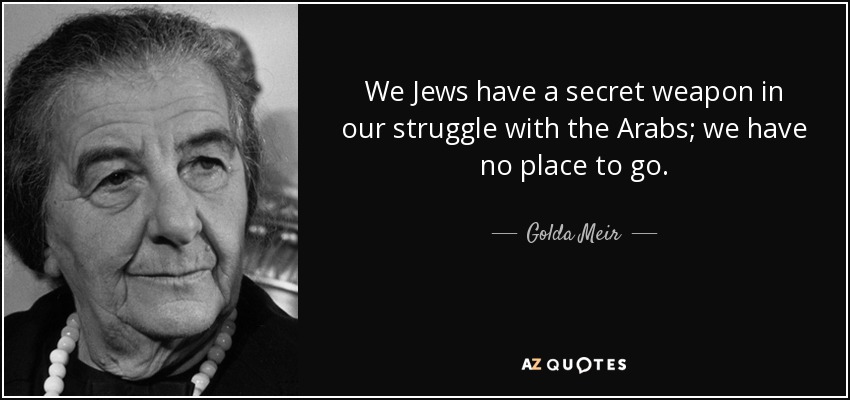
I’ll miss going to the north, where it is not safe due to the Hezbollah rockets that land daily.  I’ll miss going to Tzfat, one of my favorite cities for its mysticism and beauty, because it is too close to the north.  I’ll miss being on the top of Masada and at the Dead Sea because that’s not what this trip is about.  I’ll miss the opportunity to go to Hebron and visit the tomb of the Patriarchs and Matriarchs due to security issues.  Those are all things I can do on a future trip.  There will be future trips.  Israel will win this war and survive.  That is what the media doesn’t communicate.  Israel is fighting for her survival.  And as Golda Meir said, our secret weapon is that we have no place else to go. 

Gen X, Israel vs. the US, Free Speech and the Roman Empire

For many obvious reasons, I have been thinking a lot about the world we live in today and the attitudes people have today.  It is truly a fascinating time to be alive in so many ways, not all of them good. 

I am part of Gen X.  I think this has a huge impact on the way I view the world.  I know it has a huge impact on how I both raised my children and how I see what is happening on college campuses, in the school systems, and in our country.  My generation grew up with freedoms that future generations didn’t have.  We were latchkey kids.  Most of our parents worked so after school we were free to do what we wanted. 

We didn’t have computers or screens.  There was no internet or cell phones.  We played outside until the streetlights came on.  Often times our parents had no idea where we were after school and that didn’t bother them.  We were independent.  We’d ride our bikes miles to get to other friends’ neighborhoods.  Our friends were our friends because of who they were.  Race, religion, sexuality didn’t matter.  My public school was closed for Rosh Hashanah and Yom Kippur because 1/3 of the students and teachers were Jewish.  We were also closed the first day of deer hunting season because 1/3 of the students and teachers would be out hunting.  We were an eclectic group of people tied together.  I grew up with friends that came from family’s that had lots of money, those who were middle class, and those who didn’t have much money.  It didn’t matter.  Many of us are still in touch today.  We had real friendships that stand the test of time.

I remember when two of my childhood friends finally came out.  I, like the rest of our friends, were happy for them that they felt comfortable coming out.  We also knew they were gay when we were in elementary school, so it wasn’t a big deal and changed nothing as far as we were concerned.  We paid attention to who people were, not identity politics. 

As I look at the world today, I wonder how we lost that specialness from my childhood.  We are more divided than any time since the civil war.  We no longer focus on the quality of the individual but on what sets them apart from us.  We no longer care about who people are but rather how they identify.  When I was running nonprofits, my goal was always to hire the best person for the job.  It didn’t matter to me if it was a man or a woman, what their race or their religion was.  I didn’t care about their sexuality.  I wanted the best person for the job.  Today’s world seems to have more and more focus on the identity of the person as we focus on how we are different instead of how we are similar.

My older son is home for a bit and he took me to the Brightline station (high speed rail between Orlando and South Florida) so I can get my flight to Israel later tonight.  As we were talking, he told me about how many of his ‘friends’ he has had to block on social media because of how they were minimizing what Hamas did on October 7th and the need for Israel to eliminate Hamas to ensure the safety of Israelis and to free to people of Gaza.  It saddened me to hear this.  I don’t know how all my childhood friends feel about the conflict.  What I do know is that the vast majority of them have reached out in support of me.  I’m not asking them to believe what I believe.  I am asking them to be my friend and understand what I am going through as a Zionist and as a Jew since October 7th

I have long looked at the difference between Israeli youth and American youth.  From the time I first began to engage with 18-21 year old Israelis, serving their country in the IDF, and comparing them to my own college experience and then, when working on the University of Florida campus, with the UF students.  The similarities and differences were dramatic.  On the many Birthright Israel trips I staffed, we had 8 Israeli soldiers join us.  They were the same age as our students on the trip.  When they showed up in uniform, they were imposing.  Awe inspiring.  A few minutes after arriving, when they changed out of their uniforms, they became peers with our college students.  For the part of the trip they were with us, the similarities between the Israelis and Americans was striking.  When they first arrived and then, when they put their uniforms back on at the end of their time with us, the differences were striking. 

As a result, it didn’t surprise me that after October 7th, so many members of the IDF reserves showed up.  I read that Israel recalled 250,000 reserve soldiers and hoped to get 200,000 to actually show up.  Instead, 300,000 showed up.  People in America were doing all they could to get flights to go back and serve.  My friends who were retired IDF soldiers in the 40s and 50s showed up to serve.  They understood the existential threat that Hamas is as a result of October 7th.  Many of them went from protesting the Netanyahu government and some of their policy positions to a united front for Israel.  It was extraordinary but if you know Israel and Israelis, it was also not unexpected.

Last week, Douglas Murray, one of my favorite people to follow, was given the Alexander Hamilton Award for his ‘unwavering defense of Western values.’  His speech, in text here and the video of it below, was extraordinary. 

He spoke about “What it Means to Choose Life”.  He uses examples of both the Ukrainian people and Israeli people that make me long for the days of my youth.  Unlike our entitled generation that believes everything should be given to them, the people he talks about understand that everything comes with a price.  Unlike the protesting college students who think they have the right to incite violence, take over buildings, violate campus rules and break laws without any consequences, the people Murray talks about understand that everything comes with a cost. 

I want to be clear that I am not saying the college students shouldn’t protest.  Protesting, especially on college campuses, is a right of passage.  We have freedom of speech in the United States and as President Andrew Shephard says in the great movie, The American President,

“America isn’t easy. America is advanced citizenship. You’ve gotta want it bad, ’cause it’s gonna put up a fight. It’s gonna say, “You want free speech? Let’s see you acknowledge a man whose words make your blood boil, who’s standing center stage and advocating at the top of his lungs that which you would spend a lifetime opposing at the top of yours.” You want to claim this land as the land of the free? Then the symbol of your country cannot just be a flag. The symbol also has to be one of its citizens exercising his right to burn that flag in protest. Now show me that, defend that, celebrate that in your classrooms.  Then you can stand up and sing about the land of the free.”

I disagree with the campus protesters position, and I disagree with how they characterize what is going on in Gaza.  I also firmly stand with their right to peacefully say it.  To gather in the public allowed space, in the manner that is allowed for everybody, and protest and hold signs, and say what they want.  Crossing the line to blocking Jewish students from going to class, harassing them as they walk on campus, threatening them, physically assaulting them, breaking the campus rules and breaking laws is not acceptable and comes with consequences. 

I laughed when the spokesperson for the student protesters who took over Hamilton Hall at Columbia University asked for ‘humanitarian aid’.  Nobody was forcing them to stay in the building.  They could walk out of the building to get food and water any time they wanted.  The entitlement was absurd.  The students at Princeton who have decided to hold a hunger strike to protest the war in Gaza also made me shake my head.  Nobody is forcing them to go on a hunger strike.  They aren’t in prison or jail where their care belongs to the state and monitoring them is therefore the state’s obligation. They are choosing not to eat and as a result, they are responsible for their own health monitoring.  When they got upset that the University wasn’t monitoring their health as they were on the hunger strike, I thought to myself, ‘What entitlement’. 

I missed the protests of the 60s and 70s because I was too young.  I have had the opportunity to talk with many people who were part of those protests.  Every single one that I spoke with could tell me how many times they were arrested for their protest.  Every single one of them was proud of their arrest.  They knew there would be consequences for their protest, and they embraced it.  They didn’t whine and cry when the consequences came.  They had that level of conviction.  Today’s protesters seem to lack that conviction.  They want the best of both worlds.  They want to protest with no consequences and have the rest of the world cave to their demands because they protested once.  There are Universities who have done this, and I believe they will face long lasting consequences for doing this.  Others have held their ground and ensured that freedom of speech is protected, and inappropriate actions are held accountable and face consequences.  Those who have made the second choice are also bearing the fruits of this effort.  Their students feel safe.  Their graduations are not cancelled.  Their donors and alumni are not up in arms.  Their University Presidents are not having to testify in front of Congress about how they are failing to protect Jewish college students. 

Our world today has the ‘news’ in the ‘entertainment’ department.  We have the 24 hour ‘news’ cycle and each station has its own agenda to push.  The days of Walter Cronkite reading the news and you getting to interpret it are long gone.  Whatever channel you watch feeds you their narrative.  Critical thinking is dying.  Deep conversations are dying.

On this trip to Israel, one of my hopes and plans is to go visit my friend Mahmoud in East Jerusalem.  Mahmoud is a Palestinian Arab, and his family owns the big Palestinian bookstore in East Jerusalem.  When we met in November 2019, he pushed some of my buttons and challenged me to think deeper and in different ways.  In the 4 ½ years since we met, I have thought deeply on many things he said to us and very much look forward to sitting down for a few cups of coffee or tea, a bite to eat, and having a robust and deep conversation.  We won’t settle the conflict, but we can do our little part to build friendships, understanding, and perhaps share what we learn from each other with our other friends that might impact change.

I think that’s the most important lesson of all of this.  I remember hearing the stories of how President Ronald Reagan and Speaker of the House Tip O’Neill would argue and fight all day long and then go have a beer together.  Mahmoud and I will come from different points of view and will sit over coffee and talk and share.  Even as I write this, a friend reached out to share information I wasn’t aware of and it changed my mind and I went back and edited something that I wrote as a result of this new information.  We need to find a way to get back to that being the norm.  Yelling at each other, only speaking with people who agree with you, repeating lies because they advance your point of view, and anything else that fits into this area does not solve problems.  It doesn’t get us to solutions.  It doesn’t bring us together.  It divides us.  It separates us.  It leads to physical harm.  It degrades us as human beings and as a civilization.

There was a fascinating September 2023 CBS News report that said most men think about the Roman Empire once a day, and some think about it as often as three times a day.  My wife asked me about it and I said that I think about it at least once a week.  She was stunned.  Why do men think about the Roman Empire so often?  My theory is that the Roman Empire is a symbol of amazing strength and power.  Incredible things came from the Roman Empire.  It seemed to a power that would last forever.  And it fell.  I always wondered how the Roman Empire could fall.  It had a strong military, powerful leaders, good economy, art, and culture.  It seemed to be the type of society that would last forever.  Yet it didn’t.  The past few years have given me an indication of how it could have fallen.  Internal bickering.  Divisiveness.  Lack of humanity.  Lack of understanding.  Growth of hate.  Poor leaders in control.  I hope that we can learn the lessons from the fall of the Roman Empire to avoid the fall of the American experiment.  Freedom, democracy, and our future are too important to just throw away the way we are. 

Fight, Flight or Die – you get to choose

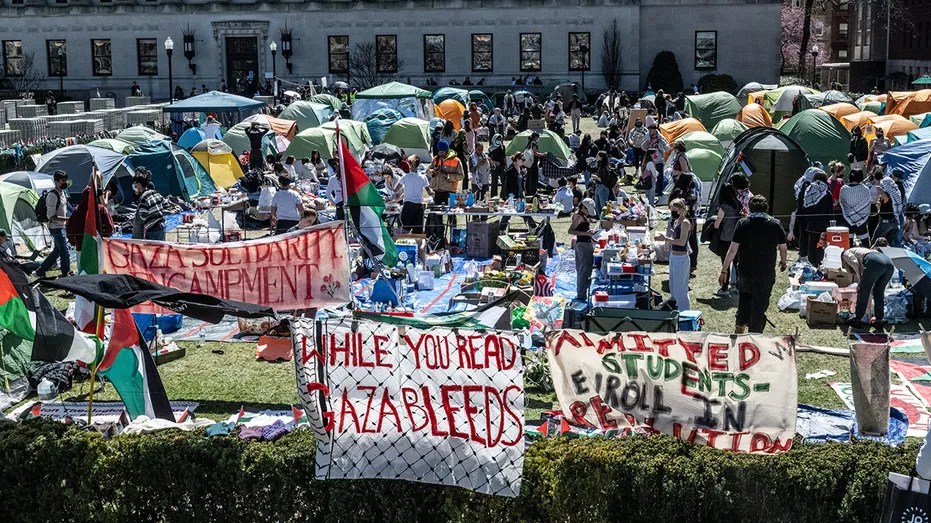
Columbia University has been in the news for the past few weeks due to their anti-Israel and anti-Jewish encampment.  UCLA has been for the same reason.  Portland State.  Northwestern.  Harvard.  Yale.  Penn.  University of Michigan. George Washington.  Cal Poly Humboldt.  Brown. Cornell.  Princeton.  University of Southern California.  Arizona State.  CCNY.  CUNY.  Plenty of Universities where students went beyond free speech and protests, violated University policies, intimidated Jewish students, blocked access to campus, and in the case of UCLA, violently attacked and beat a Jewish woman, Yale where a Jewish woman was stabbed in the eye, and Columbia where two Jewish men were attacked.

Then there are Universities like the University of Florida, University of Texas, Florida State University, University of South Florida, University of North Carolina.  University of Utah, University of Illinois, Mary Washington, Northeastern, Indiana, Wash U in St Louis, University of Pittsburgh, UConn, University of Utah. VCU, University of Georgia, Tulane, and Virginia Tech.  At each of these Universities, the University Presidents and leadership allowed free speech and protests but enforced their campus rules and regulations.  As such, when the protests went beyond free speech, they were broken up and people arrested.

For the most part, it’s the first group of schools that have been in the media.  That’s because of the old news adage, ‘If it bleeds, it leads.’  We saw an incredible lack of leadership by the University Presidents at those schools.  Columbia President Minouche Shafik, fresh off her testimony to Congress, enabled the protesters, didn’t enforce the campus regulations, finally called in the NYPD, and then promptly apologized for doing it.  Jewish students were encouraged to finish the semester away from campus, being denied the equal protection of the law and equal access to the education they are paying for.  Chants of “go back to Poland”, ‘We are Hamas’ and ‘Globalize the intifada’ occurred on campus.  US Representatives Ilhan Omar and AOC showed up to support the active hatred of Jews on campus.  Omar even said, “We should not have to tolerate antisemitism or bigotry for all Jewish students, whether they are pro-genocide or anti-genocide.” 

Khymani James, a student at Columbia and one of the leaders of Columbia University’s anti-Israel encampment threatened to kill Jews in a live stream meeting with the school.  Nothing happened until it became public when he was barred from campus.  He was then let back on campus until they were exposed again and he was suspended.  Columbia chose to be complicit with threats of violence against Jews.

These are threats to Jewish students.  The encampment grew and got more violent and more active.  Finally, they took over a campus building, barricading themselves inside and doing damage to the building.  After a ridiculous press conference with a student leader who demanded ‘humanitarian aid’ for those who chose to occupy the building and could leave at any time, did President Shafik relent and call in the NYPD to break up the protest.  She wasn’t interested in protecting the Jewish students, only protecting her campus buildings.

Northwestern President Michael Schill chose to give in to the student terrorists holding his campus hostage.  Brown University did the same thing.  Their leadership caved to the students’ bad behavior, breaking of the campus rules and regulations and criminal activities.

These Presidents and their administration have failed their test of leadership.  They have abandoned their Jewish students.  There are calls for their resignations as a result.  I can’t imagine any other group facing what Jewish students have faced in which the actions and behaviors of these Presidents and administrations would be acceptable.  At UCLA, their failure, along with the assault on a Jewish woman, resulted in Jewish students believing they had been abandoned and taking matters into their own hands, working to break up the antisemitic, illegal encampment resulting in a riot. 

We have a serious leadership problem on our campuses.  By not holding students and faculty accountable to the rules when it comes to Jewish students, they are guilty of endangering Jewish students’ safety.  They are committing Title VI violations and there may be civil rights lawsuits against them.  They have become a national joke, and the Universities are viewed unfavorably by most.  There is a reason you don’t negotiate with terrorists.  Reinforcing their bad behavior only ensures more bad behavior in the future. 

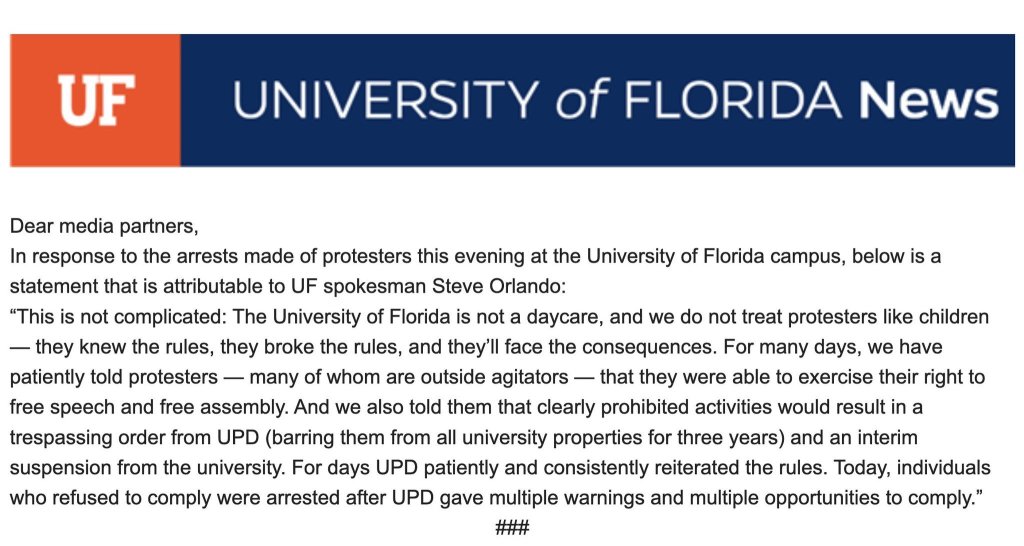
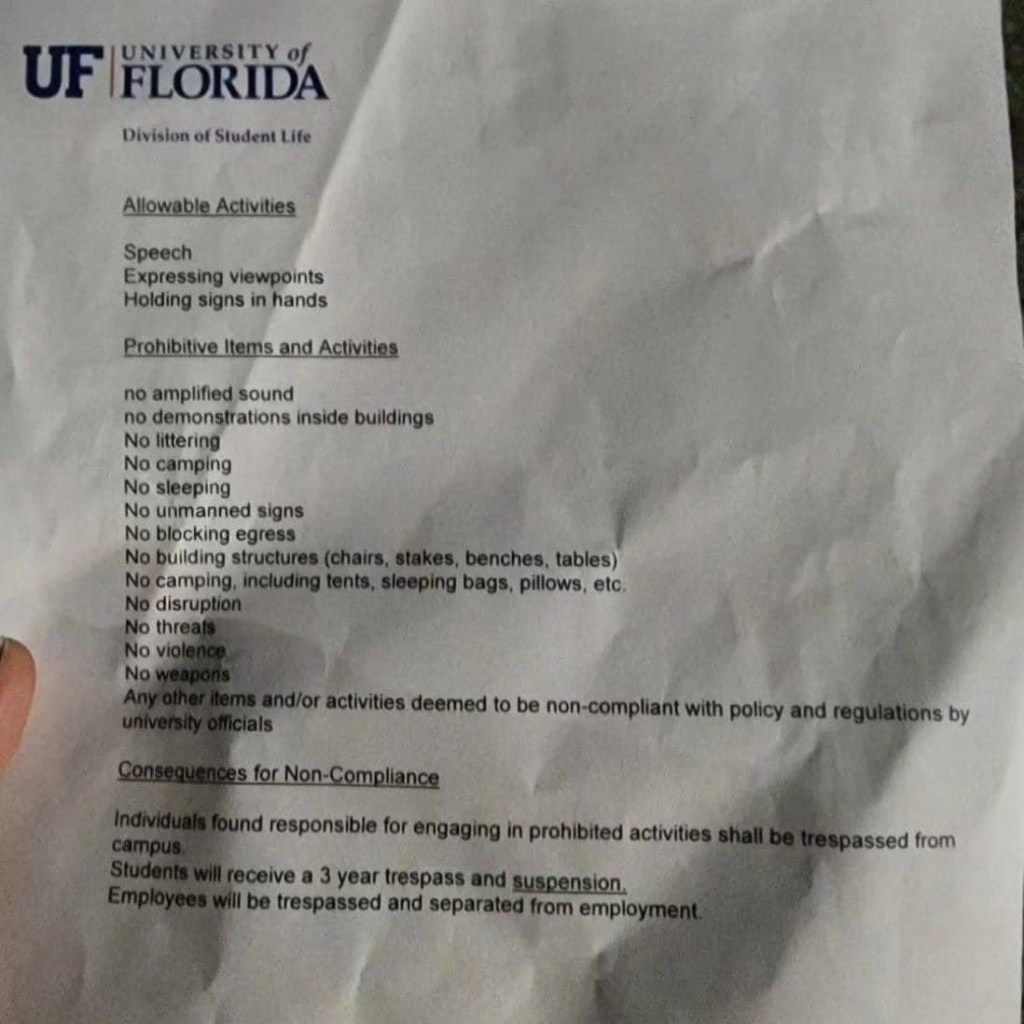
Compare that to the University of Florida, who’s President, Ben Sasse, provided the campus rules and regulations in advance along with the consequences for violating them.  When the protesters went beyond free speech and violated the campus rules, the consequences were enforced. 

Other universities took action after letting the protesters know they were violating the campus rules and would be arrested if they didn’t disperse.  When they didn’t, the police came in and arrested them. Actions have consequences. Failing to obey the rules and the law is illegal.

I want to be clear.  Free speech is important.  Being able to protest is important.  However, when people decide to break the rules or break the laws, there are consequences for their actions.  That’s what they were arrested for, their actions.  Protests matter and there is a line that cannot be crossed.  When the line is crossed, leadership has an obligation to act.

When I see some of our country’s leaders in an uproar because the protesters are held accountable, I get angry.  They know better and they know it is only happening because it is against the Jews.  When I see our country’s leaders and our Jewish communal leaders be silent about what is happening to Jewish students on campus, I get angry.  We cannot put our heads in the sand and hope it goes away.  We know better.  We know what comes next.  I’m grateful to our country’s leaders and our Jewish communal leaders who have spoken up and taken public positions.  There are far too few of them. 

Sen. John Fetterman, Rep. Elise Stefanik, Rep. Ritchie Torres, and Speaker Mike Johnson have been leading public advocates to protect Jewish students on campus.  Others have joined them.  Yet far too many have been silent or supporting these encampments designed to terrorize, intimidate, and block Jewish students and faculty from entering campus.  In many cases they assaulted Jewish students. This has nothing to do with the war in Gaza.  It has nothing to do with humanitarian aid.  It has everything to do with antisemitism, Jew hatred. 

Chris Cuomo, a TV talking head, spoke out eloquently against the rise of Jew hatred on these college campuses.  His comment on Twitter when he posted it was shocking.  “I never thought in America I would have Jewish people thanking me for arguing that they have a right to exist.”  It is worth watching.

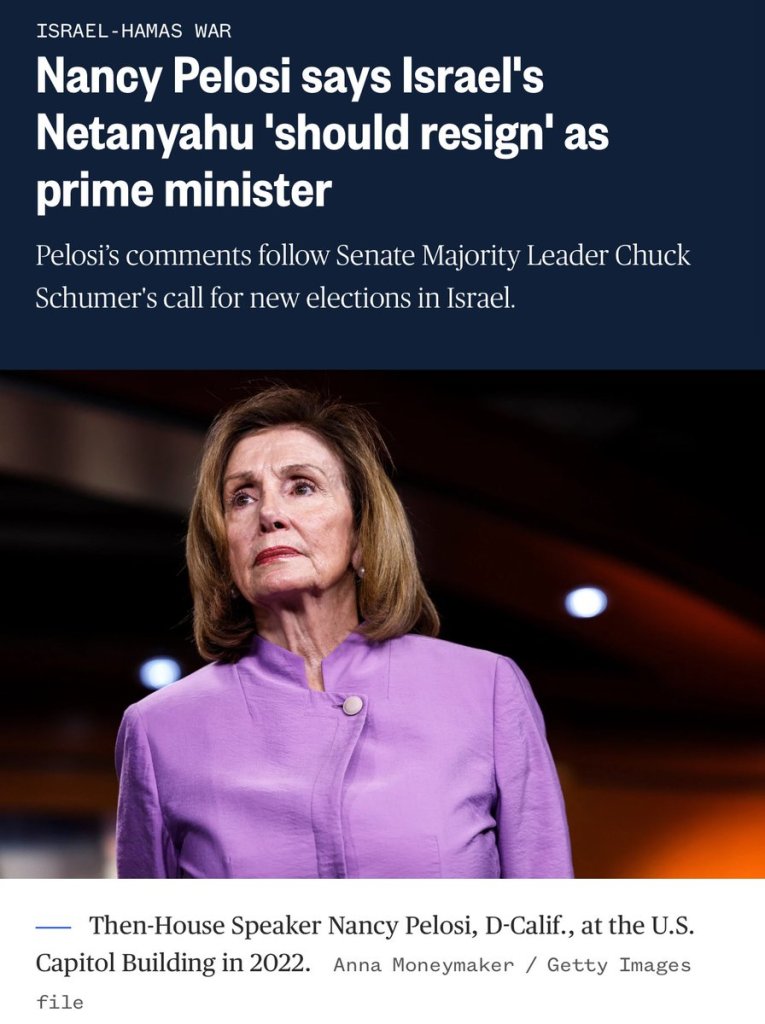
UNRWA came out with an announcement that there is plenty of food available in Gaza but there isn’t money to buy it.  This is humanitarian aid, provided for free, that UNRWA is either allowing Hamas to steal or selling to Hamas who is selling it on the black market.  The more facts that come out, the worse people like AOC, Ilhan Omar, Cori Bush, Jamaal Bowman, Nancy Pelosi, Rashida Talib, and these protesters look. 

May 1 starts Jewish Heritage Month.  President Biden issued a proclamation in which he references protecting the Jewish community in the United States but fails to mention anything happening on campus.  He talks about the hostages but has failed to pressure Qatar, who houses the leaders of Hamas, and continues to provide Iran, the funder of Hamas, with more money.  His words don’t match up with his actions.  We need to demand more of President Biden and of Congress.  We need to make our voices heard loudly.

As antisemitism, Jew hatred, increases in the United States, I see and hear more and more Jewish people speaking up and being outraged.  I am part of a group of parents who are concerned about what is happening on college campuses and I see the change as Jewish parents and students no long look to the Ivy League schools and look for safer campuses.  I have received calls and emails from parents who want to take advantage of Governor DeSantis’s decree that he will waive many of the transfer requirements for Jewish students to transfer to Florida Universities.  Yeshiva University extended their transfer deadline.  The Technion in Haifa has openly offered sanctuary for Jewish students, graduate students, and faculty who don’t feel safe at their University. 

This is America in 2024.  We need to face reality and act.  Raise our voices and speak out and speak up.  We need to thank our allies in other communities.  We need to thank our politicians who are supportive and make sure our voices are heard by those who hate Jews and fight for there to be more antisemitism, more Jew hatred.  If you haven’t been an activist, it’s time to become one.  Our collective silence has brought us to this point.  It is our collective action that will defeat Jew hatred.  It’s your choice, fight, flight, or die.

Is making Aliyah the answer?

I’ve been captivated by watching what is happening on the various college campuses in the United States over the last week.  I admit that when I was in college, I was not an activist.  It was the mid to late 1980s and while there were some protests on campus, it was largely calm and quiet and a wonderful place to be.  I had way too much fun and not enough studying and almost no activism.  When I began working at the University of Florida Hillel in 1998 that began to change and by the time my tenure at UF Hillel ended in 2013, I was a full-fledged campus activist.  My focus was on understanding, partnership, friendship, communication, and inclusion.  Focusing on our similarities rather than our differences became a passion of mine during those 15 years and remains one today.  So as I watch these ‘activists’ on college campuses and how the ‘leadership’ at each University chooses to handle their behavior I am fascinated by what is happening.

I grew up in an era where we had a lot of freedoms.  My mother was famous for teaching us, and our friends, that you do whatever you want as long as you were willing to pay the consequences.  It was a lesson I learned early in life and have continued to use today.  Actions have consequences.  Take the risk, accept the consequences.  This lesson is part of what I find so challenging as I watch what is happening now.

These ‘campus activists’ (I use quotes because many of them are not from the campus nor are they activists, they are imported to agitate and inflame the situation) fully expect that there will be no consequences to them for their actions.  They expect others to have consequences.  Delays in getting places.  Inability to access campus.  Having to take classes remotely.  They don’t get the permits they need or if they get them, they don’t follow the rules that are affiliated with the permit.  Their entitlement is amazing to witness. 

You see it being taught by their professors.  As the videos of professors being arrested because they thought they were above the law are shown, I find it humorous.  These entitled individuals are shocked that anybody would actually hold them accountable.  The students and the professors have grown up in a world in which nobody taught them that actions have consequences.  That if they take the risk, they have to be willing to accept the consequences.  We see it with the University Presidents who choose to allow these encampments to remain and who won’t discipline or remove the discipline from those who violate the rules.  They aren’t doing these students or professors a favor. 

Emory Professor being arrested because she isn’t follow police directions and is breaking the law

And then there are those who do hold people accountable for their actions.  President Ben Sasse at The University of Florida ensured there would be no encampment by reminding everybody in advance what the rules are and what the consequences are for violating them.  Nobody questioned whether he would enforce the consequences of their actions and as a result, free speech was maintained as was the safety of Jewish students.  At places like The University of Minnesota, The University of Texas and Emory University, those violating the rules and/or breaking laws were arrested.  When they chose not to listen to the police officers, they were forcibly removed.  That’s the real world.  Actions have consequences. 

Growing up in the 70s and 80s, I admit my generation was different.  It’s something that we need to look back upon and see how far we have gone off the rails in the name of ‘protecting’ our children.  This video, while intended as humor, also shows the difference.

The rise of hate speech isn’t new, and it doesn’t begin in 2016 with Donald Trump like many want to believe.  For proof, I offer this 2010 letter to the Editor that I wrote in the University of Florida campus newspaper, The Alligator, calling out hate speech

It was more civil in 2010

In July 2014, the Pacific Northwest head of the National Rifle Association (NRA) came out and said that The Holocaust wouldn’t have happened if Jews had guns in Nazi Germany.  At the time, I called the statement, “Idiotic, simplistic, and simply wrong.”  I stand by those words today.   More Nazis would have been killed but likely more Jews as well.  It was a statement based on the belief that Jews are weak and won’t fight back and need guns in order to be allowed to exist.  I’m not anti-gun at all.  You can ask those who know me.  I am anti-hate and anti-stupidity.  As a child, my mom would often complain that I had no tolerance for stupid people, and it caused me problems then as it does today.   Smart people can act stupidly at times.  We see that today.  My fight with the NRA in 2016 over this person’s comment and antisemitism got national attention and you can read about it in the Seattle Times.  Or just google me and the NRA and it comes up. 

https://www.seattletimes.com/seattle-news/jewish-group-says-gun-remarks-lsquoidiotic-simplistic-and-wrongrsquo

And since 2014 it has gotten much less civil.  On June 26, 2016, this op-Ed I co-wrote was published in the Seattle Times. 

https://www.seattletimes.com/opinion/recognize-and-speak-out-against-anti-semitism

A few weeks later, on July 10, 2016, the following response denying and minimizing the rise in antisemitism was published.

https://www.seattletimes.com/opinion/dont-believe-that-washington-state-is-awash-in-anti-semitism

Over the last 8 years it pretty clear that I was right and the author of the second piece, who likely approves of the antisemitic, hate filled, violence driven campus actions, was wrong.  Some people won’t learn even when they are the target.

Seven (7) years ago we got this warning from the UAE’s Foreign Minister and failed to heed it.  It helps explain why were are where we are today.

Today we see elected officials like US Representative Ilhan Omar (D-MN) join the antisemitic and violent gathering at Columbia and publicly make the following statement while facing no serious consequences.

“I think it is really unfortunate that people don’t care about the fact that all Jewish kids should be kept safe and that we should not have to tolerate antisemitism or bigotry for all Jewish students, whether they are pro-genocide or anti-genocide.”

While she is trying to say that Israel is committing genocide, a factual lie.  In reality it was Hamas who did commit a genocide on October 7th.  And intended to kill more Jews.  And has openly stated that they will continue to kill Jews until they are all eliminated.  That is the definition of genocide.  Yet Rep. Ilhan Omar faces no backlash.

We see Representative Alexandria Ocasio-Ortiz (AOC) (D-NY) also visit the Columbia cesspool of hate and then posting on X (Twitter)

“Calling in police enforcement on nonviolent demonstrations of young students on campus is an escalatory, reckless, and dangerous act. It represents a heinous failure of leadership that puts people’s lives at risk. I condemn it in the strongest possible terms.”

They are peaceful to her as a woman of color who isn’t Jewish.  In this case, she is the one with the privilege she often rails against.  Calling the police on people breaking the law is what we do in the United States, unless you live in New York.  Enforcing our laws is what happens in countries ruled by laws unless you live in New York.  I do agree with her that we have a ‘heinous failure of leadership that puts people’s lives at risk’ but I assign that failure of leadership to Columbia University President Manouche Shafik who chooses daily not to enforce the rules of Columbia.  I assign it to the leadership of Columbia University who continue to allow President Shafik to remain in her role when she is showing daily that she isn’t able to do her job and protect ALL students, which includes Jewish students. 

Representative Jamaal Bowman (D-NY) was also at Columbia University, not protecting the Jewish students from his district but to encourage those breaking the law and violating Columbia’s policies to continue doing it.  To continue to chant things like ‘Death to America’ and ‘We are all Hamas’.  To harass and threaten Jewish students.  As one Jewish student recounted,

“They were pushing and shoving me. . . They threw rocks at my face. At that moment, my life was totally threatened. And there was no safety authority on campus.”

At least Representative Bowman is losing his primary race and will hopefully not be in office in just a few months.

I grew up in a Zionist home with parents and grandparents who were Zionists.  We all support the existence of a Jewish homeland, the State of Israel.  The fact that there was a country that we could be a citizen of just by showing up sounded really amazing and empowering.  The thought of actually making Aliyah, moving to Israel and claiming citizenship, was a fantasy throughout my youth.  My cousin actually did it in 1980 and was the outlier we all used as our token Israeli relative.  During and after college I had a few friends who made Aliyah and I thought it was cool for them.  During my 15 years at UF Hillel I had many students who chose to make Aliyah, become lone soldiers and serve in the Israeli Defense Force (IDF).  It wasn’t until the 2000s that I thought maybe some day it would actually be something that I would want to do.  The more I went to Israel, the more time I spent there, the more the fantasy became a dream and maybe even a goal and objective. 

Just a couple of years ago, in my mid-50s, I realized that I didn’t really want to make Aliyah.  It was a fantasy.  I wanted to live as an American in Israel.  Expensive apartment.  Eating dinner out at fancy restaurants.  Not have a real job to go to every day.  I changed my fantasy to spending a month in Israel every year at some point.  That seemed more realistic.  It became something to being to save and plan for.  I knew my wife would never really want to make Aliyah and be that far from our kids and her parents and siblings but a month a year was something I could discuss with her. 

Since October 7th, I have been questioning everything.  As America becomes more and more unsafe for Jews, my fantasy of being an American spending a month in Israel every year has gone back to considering if maybe we did need to move there in order to be safe.  A country under attack from at least 4 fronts (Hamas, Hezbollah, the Houthis in Yemen, and Iran), in an active war zone, was safer than America.  What a scary thought.   Yet I also know I am not the only one who struggles with that concept and that thought.  I talk about it with friends.  We look back at those who saw the signs in Germany and Europe and left when it was possible compared to those who were stubborn and stayed until they went to the death camps and want to learn from their sacrifice.  From their murder. 

And then I find Arabs speaking out against Hamas and trying to speak sense to these radicalized students and professors.  People like my friend Ali Abu-Awaad.  People like Loay Alshareef, who I have reached out to, who is traveling to campuses all over America and posting on social media. Watch a few of his posts and you may have hope that there is a future with peace.

So maybe I need to stay and fight.  Maybe there is a third option that our ancestors in Germany and Europe didn’t have.  Instead of running to safety or sticking our heads in the sand, maybe we can stand up together and fight back.  We can be the nonviolent version of Mordechai Anielewicz, who at 20 years old was trying to get Jews to return and fight against the Nazis.  Who just before he turned 20 began to fight back in the Warsaw Ghetto.  And who at 23 led the actual uprising against the Nazis.  Their valiant effort didn’t defeat the Nazis but it showed that Jews could and would fight back.  It inspired the future leaders of the new State of Israel to fight and defend themselves.  He and those who fought with him inspire me not give up hope and to keep fighting. 

Mordechai Anielewicz didn’t do it along.  There were other leaders who joined him.  Icchak Cukierman, Tosia Altman, Marek Edelman, Cywia Lubetkin

One of the great things about being Jewish is we have thousands of years of role models. Not just the biblical ones we learn about but recent ones like Mordechai Aneilewicz. Ruth Bader Ginsburg. Natan Sharansky. David Ben Gurion. Moshe Dayan. Golda Meir. Elie Wiesel. Betty Freidan. Harvey Milk. Louis Brandeis. Judy Blume. Rabbi Abraham Joshua Heschel. There are many more. And that’s just recent role models.

I choose to follow the role models I mentioned and fight. I choose to not give up and not be quiet. I choose the third option. What will you choose?

Responsibility and Leadership go hand in hand. We need both and have far too little of each.

I’ve been thinking a lot about responsibility lately.  Personal responsibility, parental responsibility, spousal responsibility, family responsibility, community responsibility and worldwide responsibility.  What about the responsibilities as a leader and of our leaders?

I was inspired to think about this by a number of different things happening right now.  The lack of leadership being shown by University Presidents both in their testimony in front of Congress and recently with the pro-Hamas demonstrations on many campuses.  Columbia University gets the most attention, but they are going on at 40 campuses, highlighted by Harvard, Penn, Brown, The University of Michigan, Yale, MIT, Cal Tech, Northwestern, and George Washington. We have also seen University Presidents and administrators break up these protests at University of Minnesota, University of Texas at Austin, University of Southern California, Emory, Princeton, and Emerson College.  The difference in the two groups of campuses is entirely based upon the University’s leadership.

Columbia University has turned into a cesspool of antisemitism and Jew hatred. Much of this is due to a lack of leadership from the University President.

There is little doubt that had these encampments been created to protest any other ethnic group in existence, all of the Universities would have shut them down.  An anti-LGBTQ+, anti-Muslim, anti-Black, anti-Christian, anti-Hispanic, or anti-woman protest with racial/sexual epithets being shouted at these students and threats of violence along with actual violence would not be tolerated.  So, what is the difference?  Why is it ok when it’s Jews being targeted?

Many people say it’s the influx of Arab money, specifically from Qatar.  Others cite the latent antisemitism that has existed for generations at many of these schools.  Still others cite the woke movement in which Jews are considered white and privileged and not deserving of protection.  While all these play a part, I think it is entirely about a lack of leadership at these Universities.  The leadership of those Universities are choosing not to protect Jewish students and instead protect the racists, bigots, and those assaulting other students.  Columbia actually created an arguably apartheid situation where Jewish students must take classes and final exams online while those who harass and attack them are allowed to take them in person.  The lack of leadership enables and encourages bad behavior.  The lack of leadership means there is no consequence for inappropriate actions.  After giving a midnight deadline for the encampment to be taken down, Columbia President Minouche Shafik promptly did not enforce it and a few days later, nothing has happened.  That’s a serious lack of leadership.  USC cancelled graduation ceremonies because they can’t control the protestors.  That’s a serious lack of leadership.  At the Universities where there were involved leadership, these encampments were taken down, often by law enforcement, those not following the campus rules and regulations were arrested and face consequences.  Their graduation ceremonies are not in jeopardy of being cancelled. In a country ruled by law, this is how things need to be handled. 

Compare that to the University of Florida, where the Chabad Seder had over 1,000 in attendance, including UF President Ben Sasse. President Sasse addressed the crowd, stating, “What is happening on campus at Columbia and Yale the last few days is grotesque, and we don’t want anyone here to be confused.  We are delighted that the University of Florida is the most Jewish campus anyplace in North America.  We don’t want anyone to be unsafe, or to feel unsafe….”  That’s leadership.  Two sentences is what it took.  And there is no doubt that had he been speaking to any other group that was facing similar situations that he would have said the same about and to them. 

UF President Ben Sasse at the 1000+ person Chabad Seder on campus. He continues to show great leadership.

This week, an anti-Israel, anti-Jewish protest happened on the campus of University of Florida.  Why is it not in the news?  Because the leadership of UF did what leaders do.  They led.  They set in place the enforcement of their campus rules and regulations THAT WERE ALREADY IN PLACE.  They promised to hold students, faculty, and anybody else attending the rally accountable for their actions.  Look at the rules that UF published for everybody to see and follow.  There was no encampment at UF, no violence and calls for death of Jews. Free speech is being permitted.  That is how leaders act. 

University of Florida shared the existing rules for any gathering and the consequences for not following them. This should be the expectation for all Universities.

It’s not just on the college campuses where leadership is missing.  President Biden finally made a big deal about the hostages held by Hamas on Thursday April 25th when he issued a statement along with leaders of 17 other nations calling for their release.  Why it took over 200 days of captivity for this to happen is beyond me. 

How we still have members of Congress calling the war between Hamas and Israel “Bibi’s War” or “Netanyahu’s War” is beyond me.  Hamas began the war on October 7th with their attack.  If Hamas released the hostages and surrendered, the war would be over.  This is Hamas’s war.  This is Iran’s war.  Israel is doing what is needed to protect herself but has not nor been the aggressor.  While we have seen some of our leaders being very public about the war and antisemitism on campus, particularly Senators John Fetterman (D-PA) and Rick Scott (R-FL) along with Rep Ritchie Torres (D-NY), Hakeem Jefferies (D-NY), Cory Mills (R-FL), and Speaker Mike Johnson (R-LA), many others have been silent or playing both sides for election politics.  That’s not leadership.  Hamas and Iran are evil.  The people of Gaza and Iran want regime change.  Instead, we get Rep Nancy Pelosi and Sen Chuck Schumer calling for early elections in Israel, which is totally inappropriate for an ally and another democracy. 

President Eisenhower is the example of what is needed.  Jason Riley in the Wall Street Journal says it best:

“In 1957, white mobs in Little Rock, Ark., in defiance of the [Brown vs. Board of Education] ruling, were preventing black students from safely attending school. President Dwight Eisenhower decided to do something about it. In a prime-time television address, the president explained that ‘demagogic extremists’ and ‘disorderly mobs’ were thwarting the law and that he had an ‘inescapable’ responsibility to respond if Arkansas officials refused to protect black students. ‘Mob rule cannot be allowed to override the decisions of our courts,’ he said. Then Eisenhower sent in the 101st Airborne Division. The particulars then and now may differ, but the same principle is at stake. The federal government was obligated to come to the aid of an ethnic minority group being threatened by mob violence. Jews in 2024 deserve no less protection than blacks in 1957. And if university officials can’t handle the situation, or won’t let police deal properly with the unrest, Mr. Biden needs to step up.”

When will our leaders actually lead instead of worrying about re-election campaigns?  I’ve said for a long time that I want leaders who lead and will support them for doing it.  And when they worry about being re-elected instead of doing their job, I won’t.  It goes back to the classic line in the movie, The American President, when Michael Douglas as President Andrew Shepard, says the following line, “I was so busy keeping my job I forgot to do my job.”  It’s time for our leaders to remember to do their job instead of being busy keeping their job.

The full speech that includes the line above. Inspired leadership.

Recently, Representative Jamaal Bowman (D-NY), an avid antisemite, began accusing those who disagree with him and are supporting his primary opponent, George Latimer, of only doing so because of his race.  We cannot tolerate this any longer.  Rep. Bowman has a history that is being attacked which has nothing to do with his race or ethnicity.  He has taken public stands that people disagree with and that’s why he is being targeted in the primary and that’s why he will hopefully lose the primary.  When our leaders fall to this level of excuse, it minimizes the situations when it is real.  When students are targeted on college campuses.  When a Jewish woman is raped in France to ‘Free Palestine’.  When people are attacked for being Jewish or wearing things that identify them as Jewish, Muslim, or a member of the LGBTQ+ community. 

Even J Street finds Jamaal Bowman not worthy of being in Congress

Our Jewish communities struggle with leadership as well.  The time when significant leaders went through a serious training process and there were being mentored and trained by significant and serious leaders is gone.  In some communities there are still roles and a pathway to leadership positions.  In most there is not.  Whoever is willing to take the board leadership position often gets it, whether they have the training, experience, and knowledge or not.  The serious involvement in the National Young Leadership Cabinet of JFNA is no longer emphasized by most Jewish organizations. 

Our Jewish professionals are not getting the training they need either.  There are some excellent programs available however not enough of them nor are there enough participating.  I was lucky to have an incredible mentor/coach when I was first beginning my career.  He spent a week a month on the road with me for an entire year and we spoke weekly when we were not together.  I learned at his feet, and I will always appreciate his mentorship and teachings.  I still think of the lessons he taught me and hear his voice in my head on a regular basis, guiding the decisions that I make.  As I have now taken on that role for others, it is a combination of my profession and paying it forward.  If we want to have excellent Jewish communal leaders, investing in our volunteer and professional leadership training and development is essential.  Great leaders don’t just happen.  They are taught.  They are given experiences and responsibilities to build upon and grow and develop.  I talk with a number of my friends and former colleagues about the challenges in the Jewish world and leadership is one of the big ones. 

I always think of the stories I heard about the old guard in Seattle.  The “triumvirate” of Seattle, Jack Benaroya, Sam Stroum, and Herman Sarkowsky, would make sure that the people they did business with who were Jewish were investing philanthropically in the Jewish community.  They would make sure that anybody who was going to ‘make it big’ in a deal with them, understood that part of their new wealth included a responsibility to philanthropy and giving back.  If people didn’t want to follow their lead, they would do business with other people instead.  They taught many of the large philanthropists of today about the importance of giving.  Some of those they taught also taught others.  Far too few people do that today.  Without the guidance and training from ‘the old guard’, there will be no ‘new guard’. 

Which brings me to my favorite leadership development program, The Jewish Leadership Institute (JLI).  Founded more than 30 years ago by Rabbi Mayer Abramowitz (z”l) and now run by his son and my friend David Abramowitz, this is the premier leadership training program in the country for college students.  Taking students to Israel for 2-3 weeks for an immersive and intensive leadership development program, they get results.  I admit I am biased.  I had the privilege of sending students on this trip for the 15 years that I ran University of Florida Hillel and got the benefit of the experience when they returned.  It changed their lives.  It changed our campus.  And it continues to change the world as the students who had the experience are now adults and making a difference in the world.  There is going to be a trip in July 2024 (July 2-16) and this incredibly subsidized trip (only $395 INCLUDING AIRFARE FROM MIAMI) will change lives, change college campuses, and change the world.  I encourage Jewish student campus leaders to apply and go. 

JLI participants. This program changes lives and changes the world.

In addition, we are working on a JLI young leadership trip in early 2025.  This will also be a highly subsidized trip and I can’t wait to share more information about this as it is developed and confirmed.  As somebody who believes in leadership development, believes in leadership training, mentoring, and role modeling, I am excited to work on this with David and make it into a reality. 

Leadership and responsibility go hand in hand.  We have many people who have the title ‘leader’ but are not.  In the words of Winston Churchill, “The price of greatness is responsibility.”  Many of our ‘leaders’ merely think they are great but shirk their responsibility.  Those who are truly great, embrace the responsibility.  I found this quote by Warren Bennis and Burt Nanus about great leaders and believe it to be true. 

“While great leaders may be as rare as great runners, great actors, or great painters, everyone has leadership potential, just as everyone has some ability at running, acting, and painting.”

Leadership potential doesn’t become true leadership without training, mentoring, and guidance.  The same is true with responsibility.  People don’t understand responsibility and how to act that way without training, mentoring, and guidance.  We’ve seen enough of our ‘leaders’ exhibit no leadership and no responsibility.  It is time for us to change that by investing in our future leaders.  By holding our current leaders accountable for their actions.  For not settling for what we can get but demanding what we desire.  It’s only through our efforts to improve our future leaders and to hold our current leaders accountable that we will get the change we so desperately need.