The world seems to get crazier and crazier. The stock market plummets and then returns. Tariffs are high and then are gone, delayed, or small. The only constant seems to be Jew hatred, lies, and the hostages being ignored by the UN, Red Cross, and the world.
May 15th is the day of Israel Independence on the secular calendar. 77 years ago, David Ben Gurion stood in Tel Aviv, in what is now Independence Hall, and declared Israel to be a State. Every time I stand in Independence Hall, look at the seats set up as they were that day, and listen to Ben Gurion’s voice declaring the State, I get chills.
That declaration by Ben Gurion was a statement about the Jewish love of life. Of how we never forget. Of how we place life ahead of everything. This week, there were two examples of this. It was recently announced that Israel had recovered a number of documents and items from Syria that belonged to Eli Cohen. Captured as a spy by Syria and hung as punishment, Cohen is one of the great stories of Israel. I knew about what he did long before I knew his story. The actor Sasha Baron-Cohen played him brillantly in the Netflix mini-series, The Spy.
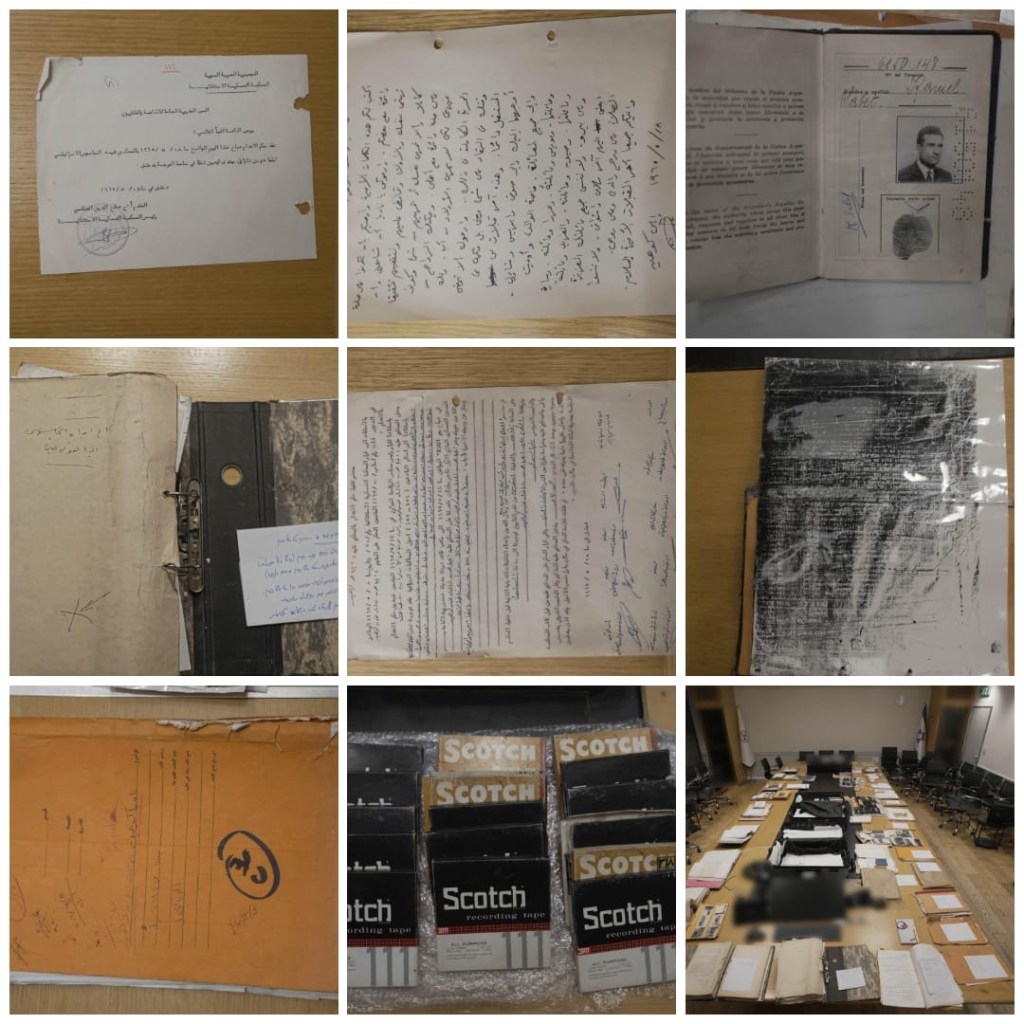
Top row, center: Cohen’s final will, handwritten in Arabic just hours before his death on May 18, 1965. Addressed to his wife Nadia and children, the letter is a heartfelt farewell filled with guidance, dignity, and emotional clarity.
Top row, right: A forged Argentine passport issued under the alias Kamel Amin Thaabet, the identity Cohen used to infiltrate the highest levels of the Syrian regime.
Middle row, right: The official death sentence, signed by Syrian military judges, condemning Cohen for espionage.
Bottom row, center: Scotch-brand audio tapes, used by Syrian intelligence to record Cohen’s interrogations and radio transmissions
While we have now retrieved more than 2,500 documents and artifacts related to Eli Cohen, we still don’t have his body back. Executed in 1965, 60 years ago, we have never forgotten him or the desire to get his body back.
This past week, the IDF and Mossad were able to recover and return the body of Sergeant First Class Tzvika Feldman. 43 years after he was killed in the Battle of Sultan Yacoub during the First Lebanon War. Syrian soldiers transferring his body to Syria until this past week when his body was returned to Israel. We love and treasure life. We don’t ever forget.
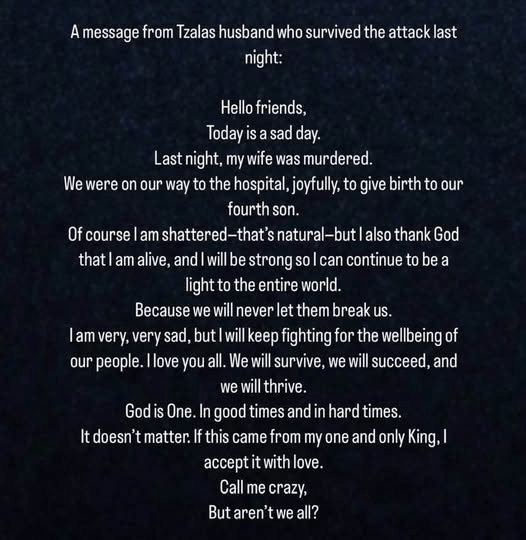
This week, Tzeela Gez and her husband Hananel, left their home in the northern West Bank community of Bruchin to head to the hospital so she could give birth to their fourth (4th) child. A terrorist shot at their car, wounding them both. A few hours later, after an emergency C-section to deliver their newborn son, Tzeela died.

The media barely covered this brutal attack. They don’t cover the violence against Israelis in the West Bank. They don’t cover the rockets that are launched at the citizens of Israel. They don’t address or condemn the ballistic missiles fired by the Houthis from Yemen targeting civilians. It is up to us to remember, to never forget. It is up to us to ensure that the souls of Eli Cohen, Tzvika Feldman, and Tzeela Gez are never forgotten. It is up to us to ensure that future Hersh, Carmel, Alex, Eden, Or, and Almog’s know who they are named for and what their obligation is to honor those they are named for.
The message below from Tzeel’s husband Hananel is the essence of Judaism. We have never and will never let them break us. We will fight for our people no matter how sad or downhearted we are. We will survive, succeed, and thrive under any and all circumstances.
Our effort to survive, succeed, and thrive means that we fight for truth. Even when it is inconvenient. Even when it is difficult. Even when the world doesn’t want to see, hear, or recognize it when it’s right in front of their face.
A friend of mine shared this piece about the history of the term Nakba that was written by Adam Louis Klein. It is a fascinating history that shows the power of the media and of repeating a lie long enough and loud enough that people think it is the truth
The term Nakba, now central to Palestinian national memory, was coined by Constantin Zureiq, a Christian Arab nationalist and key figure in shaping modern Arab nationalist ideology. As detailed in a recent article in Fathom Journal by David Szeftel, Zureiq was part of an intellectual movement in the 1930s and 40s that openly admired fascist and even Nazi models of anti-Western power, seeing them as templates for Arab revival.
When he introduced Nakba in his 1948 book Ma’na al-Nakba (The Meaning of the Disaster), it did not refer to Palestinian suffering or displacement. It referred to the Arab League’s failure to destroy the newly declared State of Israel and the humiliation of Arab armies. It was a political lament over defeat, not a humanitarian reflection on refugees.
Only later was it linked to the “right of return” for Palestinian refugees, a policy heavily promoted by the Arab League and eventually formalized through the United Nations. But this “right of return” wasn’t about refugee welfare—it became a political tool designed to prevent Israel from continuing to exist as a Jewish state by flooding it demographically.
This strategy also led to the unprecedented perpetuation of refugee status across multiple generations (see Einat Wilf’s work on this). Unlike any other refugee situation in history, Palestinians were deliberately kept in a state of statelessness by Arab regimes, denied full citizenship rights even in places like Egypt and Jordan, which directly controlled Gaza and the West Bank after 1948. In effect, the Arab League actively denied Palestinians the right to rebuild their lives in order to weaponize their suffering and make Israel appear impermanent and illegitimate.
Over time, the meaning of the Nakba shifted. It became less about the Arab world’s military failure and more about constructing a permanent Palestinian grievance narrative. The historical record was rewritten to erase the Arab invasion and rejection of the UN’s two-state partition plan, portraying the events of 1948 instead as unprovoked Israeli aggression. This narrative also conveniently erased Jordan’s displacement of Jewish communities from the West Bank, the appropriation of their land and property, and suppressed the mass dispossession of Jewish communities across Iran and Arab countries after 1948.
Eventually, the displacement of Palestinians was rebranded as a case of “ethnic cleansing” and “settler colonialism,” rather than what it historically was: the tragic outcome of a war of independence triggered by the Arab world’s invasion of the newly declared Jewish state—though it’s important to acknowledge that some forced expulsions of Palestinians did occur amidst that war.
In short, Nakba has evolved from a term describing the Arab world’s military failure to a political myth that erases historical complexity in favor of a one-sided narrative of perpetual grievance.”
I’ve been the Aida ‘refugee camp’ in Bethlehem. It is a city. They live in apartments, not tents. They have schools and community centers. Their schools and community centers teach them hate. In 2019, I met with and talked to the head of their community center. He bragged about the suicide bomber that he helped raise and create. Openly. Publicly. The world loves their Jew hatred and they will continue to use whatever and whoever they can in their effort to eliminate us. From the Assyrians to the Babylonians to the Persian to the Greeks to the Romans to the Byzantine empire to the Spanish Inquisition to the pogroms in Russia to the Nazis in the 1930s and 40s, to today, whatever it takes to attack us is free reign.
The difference is that today we fight back. Today we don’t cower in fear. We don’t allow others to determine our fate. The world can hate us and we will still fight. The world can lie about us and we will still fight. Survival isn’t an option and we won’t allow survival to be under the control of anybody else. Today we have the IDF. Today we have Israel. Today we won’t stay silent and we will fight back.
Am Yisrael Chai.
 keithdblog