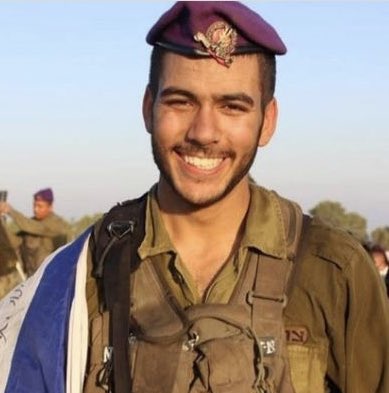
Let’s discuss Zionism

I am a proud Zionist. I’m not afraid to say it. I’m never going to deny it. Those who hate Jews continue to attempt to turn that word in a slur. They want it to be something evil. They don’t understand what it even means. Their Jew hatred has them blind to what it means.

In response to this Jew hatred and attempt to reclaim the word Zionism, those who love Israel have fallen into the simplicity of hasbarah. For those who don’t know, Hasbarah is pro-Israel propoganda. It reduces the concept of Zionism and Israel to talking points without depth, without understanding.

So here we are today – people who hate Jews thinking Israel and Zionism is a racist and hateful ideaology. And people who love Israel thinking that Zionism means that Israel does no wrong. It’s not a helpful place and won’t address the core need.
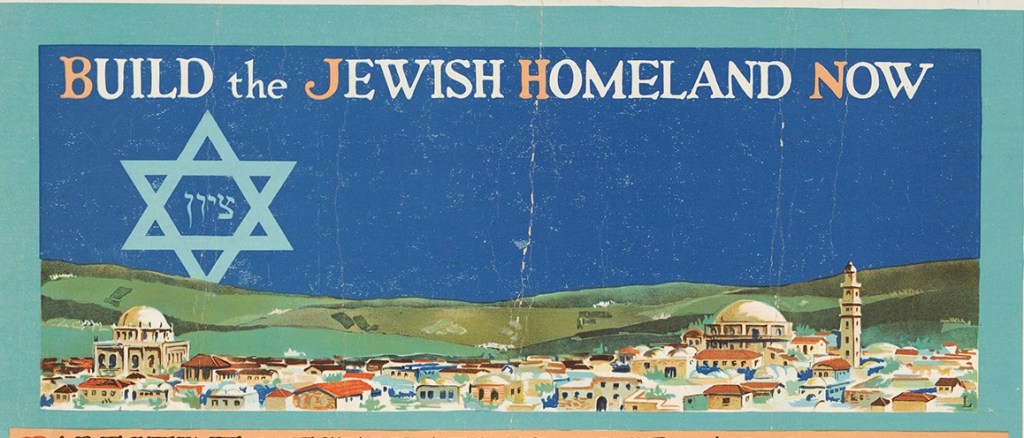
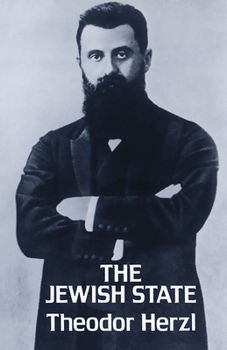
As I spent a few days with my colleague from Dror Israel this week, we talked a lot both among ourselves and with those we were meeting with about Zionism. About what it really means. About the origin. Herzl defined zionism as a political and nationalist movement to establish a sovereign Jewish state in the ancestral Jewish homeland. It came during a time of rising antisemitism as a solution for the homeless Jewish people. Herzl believed that Jews were a nation without a homeland. As a result, the Jewish people had become unwelcome strangers in other nations; a target for hatred. His vision was designed to be both a political and practical one, creating a Jewish national home secured by public law, providing Jews with self-determination and security.  Yet it wasn’t just about the land. Herzl emphasized the importance of restoring the “inner unity of the Jewish soul” and building a strong Jewish consciousness. He famously said, “Zionism is a return to Judaism even before there is a return to the Jewish land”.  It’s far more than just the land although the land is a critical part of it.
If we want to call ourselves Zionists, it means we must know that yes, it is about having our ancestral homeland but it is also about being Jewish. The Zionist experiment, like the American experiment, is far from perfect and far from finished. When David Ben Gurion read the In Israeli Declaration of Independence, he said these words that are written in it:

“THE STATE OF ISRAEL will be open for Jewish immigration and for the Ingathering of the Exiles;
it will foster the development of the country for the benefit of all its inhabitants; it will be based on
freedom, justice and peace as envisaged by the prophets of Israel; it will ensure complete equality
of social and political rights to all its inhabitants irrespective of religion, race or sex; it will
guarantee freedom of religion, conscience, language, education and culture; it will safeguard the holy places of all religions; and it will be faithful to the principles of the Charter of the United
Nations.”

This is what Israel and Zionism is about and strives to be, no matter what anybody else tells you. The simpler explanation that keeps resounding in my head was shared by my colleague Noam, from Dror Israel. He said that Zionism is about being a “just, safe and equally prosperous home for all of its inhabitants.” That is a great summary of Israel’s Declaration of Independence. You may ask, “what about Smoltrich and Ben-Gvir?” To that I would reply, that they are politicians and but a part of a democracy and the Israeli and Zionist experiment. Every country has their outliers and that’s who they are. You may ask, ‘What about Bibi?” and I would reply that in a democracy, sovereign nations have the right to elect their leaders. They don’t always choose who we may want or make the best choices. All you have to do is look back at the history of the American experiment to see that.
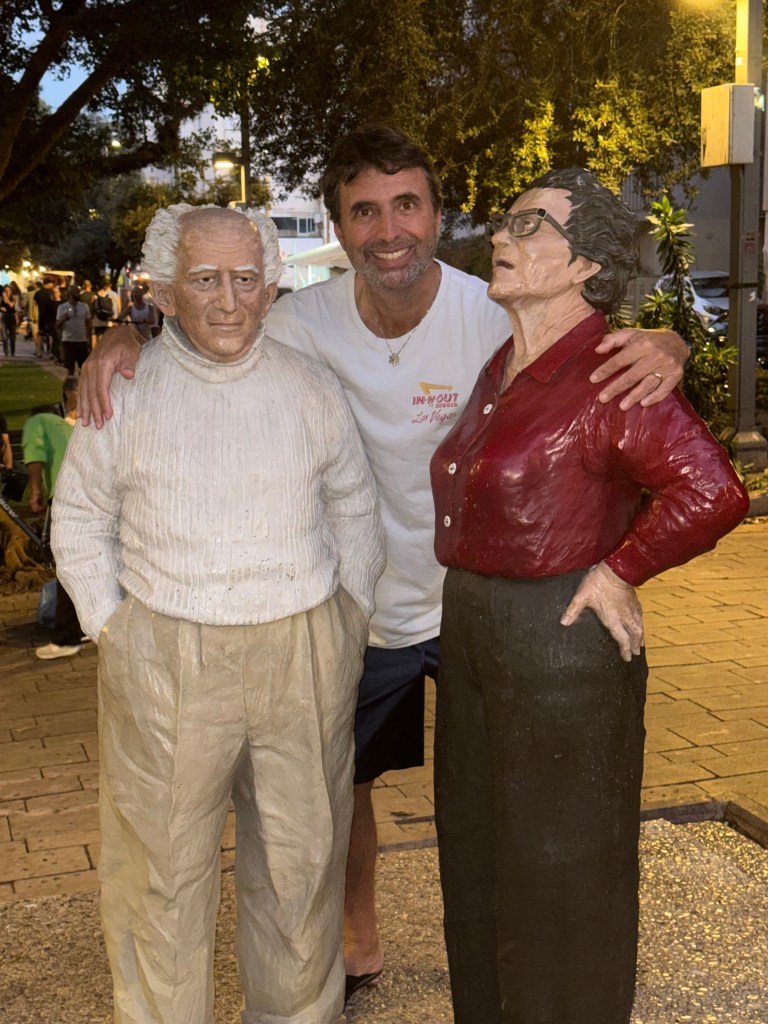
The more I learn about David Ben Gurion the more I am inspired by him. With the statues of him and his wife Paula near their home in Tel Aviv.

The American experiment is very similar to the Israeli and Zionist experiment, tying back to the words of the American Declaration of Independence where it states that, “We hold these truths to be self-evident, that all men are created equal, that they are endowed by their Creator with certain unalienable Rights, that among these are Life, Liberty and the pursuit of Happiness.” Yes, it’s clear that women and people of color were omitted in 1776 and the American experiment has adjusted for and continues to adjust for this throughout the years. The Free Press had a great article about the writing of that sentence today and how it got to it’s final form. Both Zionism and America are experiments that require adjustment, change, and constant work. They are not in their final form.

It’s also important to remember that the Israeli and Zionist experiment is only 77 years old. To put that in context, when the American experiment was 77 years old, we were in the middle of the civil war. Israel is a young country, the Zionist and Israeli ideals are being tested, just like the American ideals were tested in 1853. Slavery wasn’t abolished until 1865 when America was 79. Women didn’t get the right to vote until 1920, when America was 144 years old. We didn’t codify comprehensive civil rights into law in America until 1964, when America was 188 and marriage equality wasn’t made into law in America until 2015, when America was 239 years old. Perhaps giving some time and grace to a 77 year old country is a good idea. Unless you are obsessed with Jew hatred.

Those of us who identify as Zionists also need to let go of the belief that everything Israel does is perfect and right. The country, the leaders, and the people make mistakes. Unfortunately, due to the incredible Jew hatred that we face, we think that we can’t admit when things happen that aren’t correct. We buy into the Jew hating world view that any mistake made by Israel, her elected or military leaders, or any Israeli people, means the country itself should not exist and extended further, that Jews should not exist. This is a fallacy that we cannot afford to buy into. Admitting Israeli’s mistakes is how we truly become that “just, safe and equally prosperous home for all of its inhabitants.”

I have spent most of my career as a servant leader for the Jewish people. As a result, I have chosen not to serve in volunteer leadership for many organizations. The one that I have chosen to serve is the Center for Israel Education. Why have I chosen that one to serve? Because it is truly about what its name says. Israel Education. Not hasbara. It is fact based, uses source documents, and tells the story of Israel, warts and all. It provides knowledge so that those who want to support Israel, who want to defend Israel, have the real information, the whole story, and can address the lies told by so many who are really just Jew haters. If you haven’t been to their website, I urge to you go and to explore. Get lost in the information. Search for things you may have heard something about but don’t know the whole story. Read the original documents so you know what they say, not what somebody who is doing hasbara tells you they say nor what those who hate Jews tells you what happened.
If we truly believe in the State of Israel, in Zionism, and in Jewish self-determination, we need to make sure we know exactly what we are saying and what that means. Those who hate Jews don’t know what it means – it’s simply a line and word they can use to express their Jew hatred. When I was in Israel a few weeks ago, I had the opportunity to talk to my friend Shadi, who lives in an Arab village in Israel, and is Israeli, Arab, and a Zionist. We began an incredible conversation about the challenges he faces being Israeli, Arab, and loving the State of Israel in these tumultuos times. We need to have these conversations. We need to continue to work to ensure that the words of Israel’s Declaration of Independence remain our guiding principle. Israel needs to be a country for the benefit of all its inhabitants; based on freedom, justice and peace as envisaged by the prophets of Israel; ensuring complete equality of social and political rights to all its inhabitants irrespective of religion, race or sex; and guaranteeing freedom of religion, conscience, language, education and culture. When we are clear about what we are fighting for, we can fight for real Zionism and truly fight the Jew haters who want to steal the word from us. Make the effort to learn.
As I process my time in Israel, a few early thoughts

Processing my recent trip to Israel has been a challenge.  This is my 21st trip yet the first since October 7th.  In many ways, this makes it my first trip to Israel.  Rather than being able to sum up the trip in one blog post, I am going to take bits and pieces and talk about them.  Take bites out of this experience and share them.  As I was talking to somebody this morning about the trip, we discussed how it really was an overwhelming experience filled with emotion. I’m going to begin by writing about three things.

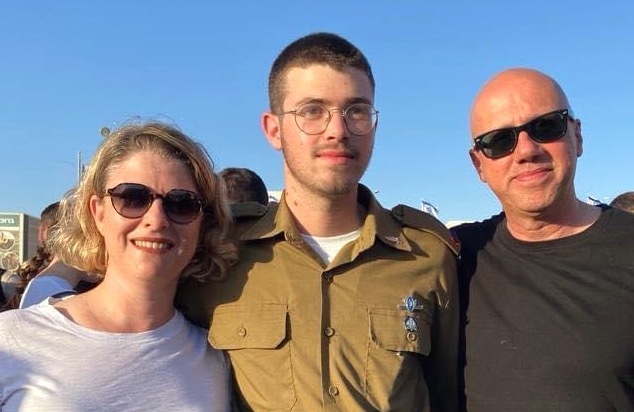
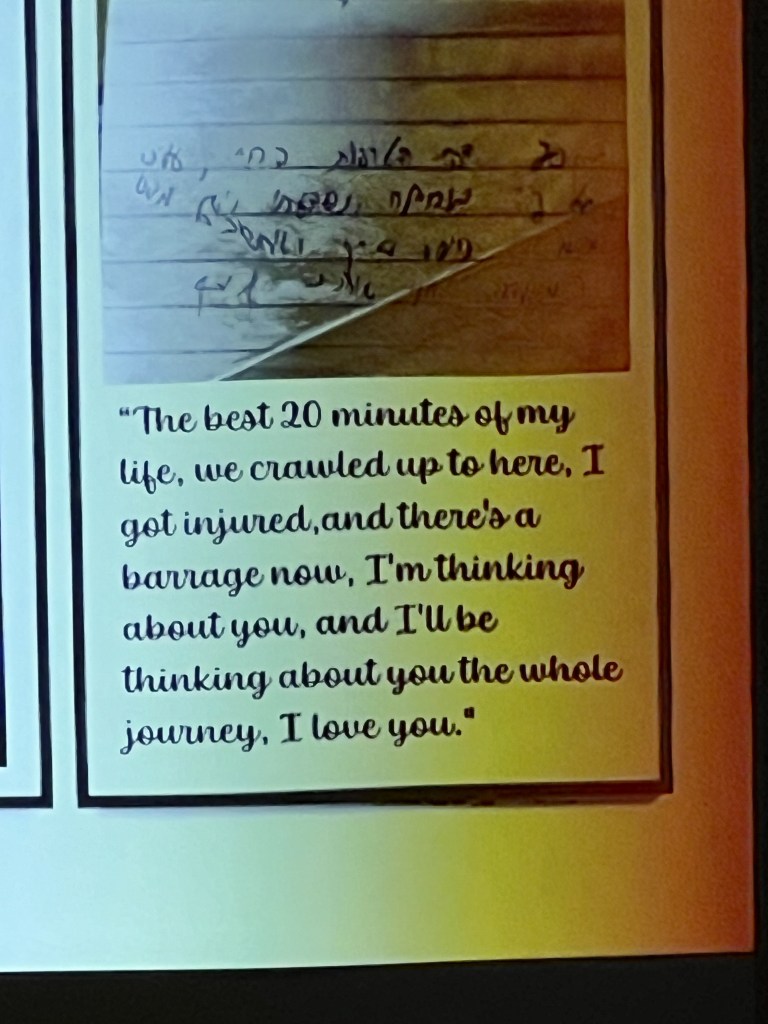
In 2021 I participated in my first Momentum trip.  One of the people on our trip was an Israeli man named Alex Malayev.  While we didn’t become close friends on the trip, we did get to know each other.  Throughout the years after the trip, we kept in touch through our WhatsApp group.  He shared with us in the group that his son Yoav was in the IDF and killed fighting Hamas on October 7th.  It was devastating to hear this news and my heart broke for him.  On the trip, he talked about his son and shared what Yoav wrote, after he was mortally injured and was dying.

Yoav Malayev z”l with his father Alex and mother Maya

“The best 20 minutes of my life, we crawled up to here.  I got injured, and there’s a barrage now.  I’m thinking about you, and I’ll be thinking about you the whole journey.  I love you.”

It brought tears to my eyes then and brings tears to my eyes now. As this 19 year old boy was injured and dying, his thoughts were on defending Israel, defending the Jewish people, and how much he loved his family. He was proud of his effort to defend the Jewish people and the Jewish homeland. The best 20 minutes of his life. What bravery. What inspiration. When I first heard it from Alex and read it on the page, I felt like I was being slapped in the face. He was willing to sacrifice his life for the Jewish people and the Jewish homeland. What am I willing to do? What am I willing to risk? How important is it to me? As I sit on my comfortable couch back in America, I continue to ask myself that question. I thought I did enough before this trip. After hearing Yoav’s story, I know I am not. I have to do more. I have to advocate for Israel. I have to advocate for the Jewish people. I can’t be silent because I am worried about my safety. He didn’t worry about his safety.

Alex’s son Yoav may have died but he didn’t die in vain. Not only did he help protect Israel and the Jewish people, his life and death is an inspiration to us all to do more. To give more. To take bigger risks. To represent being Jewish in a public way. We have a collective responsibility. When Israel called, 350,000 reservists answered right away. More than were expected. The Jewish people are calling. Israel is calling. We need to respond. I know that I will. The next few weeks will be figuring out exactly how. I urge you, if inspired by Yoav, to do the same.

The second thing I want to talk about is when we went to the Shura army base. When we arrived, we got there just as the body of Nachman Vaknin z”l was being loaded into the van to be taken to Eilat for burial. Nachman had been killed in battle a few days earlier. It was incredibly powerful watching his coffin being loaded into the van. Then, the doors were kept open so one of our group, who was saying mourners kaddish for his mother, could say kaddish there for both him other and for Nachman. When he finished, we were given the honor of escorting Nachman out of the parking lot and on his final journey home, where he would be buried later that day.

Nachman Vaknin z”l

None of us had known Nachman yet all of us felt we lost somebody close to us. This 20 year old boy was defending us. He was defending Israel. He was defending the Jewish people. On Thursday, we had been in Kfar Aza, less than a mile from Jabaliya. Before that, we had been working on a farm in the Gaza envelope where we could see Khan Yunis. After Kfar Aza we went to the site of the Nova music festival. Both Kibbutzim and the Nova festival were attacked on October 7th and suffered losses. Two of the three also had hostages taken. In the middle of the war, we knew that we could have been attacked at any time at those sites. Nachman was killed on Saturday, just two days after we were in the area. I think all of this combined to make him feel like an additional son to all of us.

We were incredibly moved by being there for Nachman as he was put into the van and driven away. It made us think about life. Earlier on the trip, Saul, our trip leader, had talked to us about what we would die for determining what we would live for. I know that as I stood there with Nachman’s body, I knew what he would die for and so I knew what he lived for. It continued the spin in my head. What would I die for? Because I know that determines what I live for. Now that I am home, that spin in my head hasn’t stopped. Yoav and Nachman both knew. My head still spins. They were 19 and 20 yet they knew. I am 56 about to be 57 and I am not sure. My family is one thing that I would die for. I know that and have known that for a long time. What ideals? What values? It goes to my core which is what makes it so difficult. A core value of mine is honesty but would I die rather than tell a lie? I don’t think so. Where that line is a challenge for all of us to ask of ourselves. This trip has truly highlighted it for me and I want to be like Yoav and Nachman and know to my core what I would die for. Then I know what I truly live for.

The final thing I want to write about also is from the Shura army base. After we said l’hitraot to Nachman on his final trip, we were introduced to Noa, who talked to us about the forensic center located at the base. Noa has 8 children and on October 7th, 7 of their family were called up from reserves. This includes both her and her husband. This means 7 of 10 people in her family have been active duty in the war since October 7th. It makes the story in Saving Private Ryan seem tame as he was one of 4 brothers and these are 5 siblings and 2 parents. Her job at the forensic center was to prepare the bodies of those who were murdered on October 7th for burial. One of the beautiful things she said that she always believes that the neshama, the soul, of the person who died is in the room with her. You can listen to her talk in this first video.

Noa speaking to us and introducing herself and the base.

Noa was truly amazing and inspiring. She talked about how they got not just the bodies of soldiers but of civilians as well. Men, women, and children. They also got the bodies of terrorists. This made it challenging as many of their bodies were booby trapped with bombs and grenades. Imagine working to humanely treat the bodies of the dead and having to rush out because there is concern one of the bodies has a grenade or bomb that could go off. As she talks about how many bodies were there on October 7th in such matter of fact voice was chilling. She finishes talking about an injured soldier with a twin brother and how she can’t make a mistake in the identification.

Noa talking more about the base and what she does.

When we went inside the thing Noa talked about that stuck with me the most was how after all the horror she saw, after all the blood she described dealing with, after seeing the mutiliated and abused bodies, she finds that she must still look for the positive. She still has to think about how to make the family a more delicious dinner. How to be a better wife and mother and friend. After all the horrors, instead of being stuck in them, she looks for the beauty in life. She looks for ways to make life better not just for herself but for those she cares about and loves. What a beautiful concept.

After she talked about that, I found myself thinking about the things that I struggle with that keep me from focusing on the beauty of life. What things am I allowing to keep me from asking how I can be a better husband, father, and friend. What more delicious dinner should I make? What keeps me focused on the negative instead of the positive? And if Noa can do this after what she has seen, what stops me from doing it? It should be so much easier for me as I haven’t seen the gore she has. I haven’t dealt with the inhumanity that she has.

Now that I am back in the United States, far away from the active war, I want to do better. I want whatever comes to my life to only make me want to do more. To do better. I have seen religious people talk about this often in the past, regardless of their religion, and always questioned it. After October 7th, after meeting Noa, after seeing the sacrifice made by Yoav and Nachman, after being at Kfar Aza and the Nova music festival site, I feel like it is my obligation to find ways to bring more light to world. Not to allow the darkness we all face to win. Noa actively shoves the darkness away and doesn’t merely make room for the light, she is the light. She fills the room with light. We were all amazing by Noa. Who she is as a person. What she does for Israel, for those who die in service to Israel, and for their families. The type of mother, sister, and wife she is. Who she is as a human being.

Three amazing people to inspire me and hopefully inspire you. Yoav, who while giving his life for the state and people he loves not only celebrates the opportunity but shares his love for his family. Nachman, who paid the ultimate price to keep us all safe and while we didn’t know him, felt like a family member to us all, and Noa, who took care of those from October 7th and every female soldier since so they get treated with dignity and respect before burial. Who makes sure the families going through intense pain and loss know somebody was caring for their child until they are buried. All three knew what they’d die for. All 3 knew what they live for. While only one remains alive today, all three have full lives. All three have changed my life. I hope that over the rest of my life, I can live up to the standard they have set. I know I have work to do.