There is something special about Fridays in Israel. While Shabbat happens everywhere in the world, Friday in Israel, especially in Jerusalem, just seems different. There is a different energy, a different vibe. There is a buzz in the air, an excitment about it almost being Shabbat. It is something I don’t think I can adequately explain – it’s something you have to feel, you have to experience. This Friday was no exception, especially because it is Jerusalem. There was an energy in the air, a vibe that you can’t describe, you can only feel.
Being in Jerusalem always creates a desire for me to learn. One of my favorite teachers, Ari Ben-David joined us to explore some facinating questions. Today’s topic was “What am I?” A great and deep question. Being in Israel and in Jerusalem, we went to the Torah to explore it.
If you are like me, the image of torah study that I grew up with was boring. Reading these stories with no context and taking them literally. Over the years, I have learned that is not torah study. It’s simply reading stories. Torah study involves discussion, analysis, questioning, and debating. That’s what we did, led my friend and amazing educator, Aryeh Ben-David. Aryeh took us through Genesis chapter 1, verse 1 and half of verse 2. That’s it. All we needed to spend an hour or more discussing the deep topic, “What am I?”
He asked us to pick one line in chapter 1 and one line in chapter 2 that most answered the question. In chapter 1, we agreed on verse 26, “And God said, ‘Let us make man in our image, after our likeness.” In chapter 2, we agreed on verses 7 and 8, “the Lord God formed man from the dust of the earth. He blew into his nostrils the breath of life, and man became a human being.” So we are the image of God, have God inside us, and are dust. Simple points.
It doesn’t end there. Dust is our physical being but the image of God and having God inside us is our soul. That’s the competition we face every single day. Every single decision. Dust (physical wants and needs) vs. soul (the greater good). Dust is about the self and immediate pleasure. The soul is about all and comprises the past, present, and future. What will we choose when faced with the decision? That’s the key question that each of us answer every day with every decision. It’s not about always choosing one over the other – there are times when we need to choose dust and there are times when we need to choose the soul. It’s about being conscious of the decision. What a mind blowing realization on a Friday morning in Jerusalem? With Shabbat approaching quickly, it’s a deep thought to take to the Kotel.
I love the energy of Machane Yehuda, the shuk, especially on a Friday. I went to help bring the catered food for Shabbat dinner to our room and get everything set up before heading to the shuk. A little bit of soul work. When I got to the shuk, as usual it was packed. I wanted to get to my favorite gluten free bakery there to get a bunch of challah, challah rolls, babkah, dates and walnuts. Most I will bring home and freeze, but I wanted a challah I could eat for shabbat and dates with walnuts to snack on. It was 100% for dust, for my own wants and needs. While there, I got to buy some desserts for Shabbat dinner (parve rugalach from Marzipan) and wine for those at dinner. A little bit of soul, doing things for others, since I wasn’t eating the rugalach or drinking the wine. Torah into action.
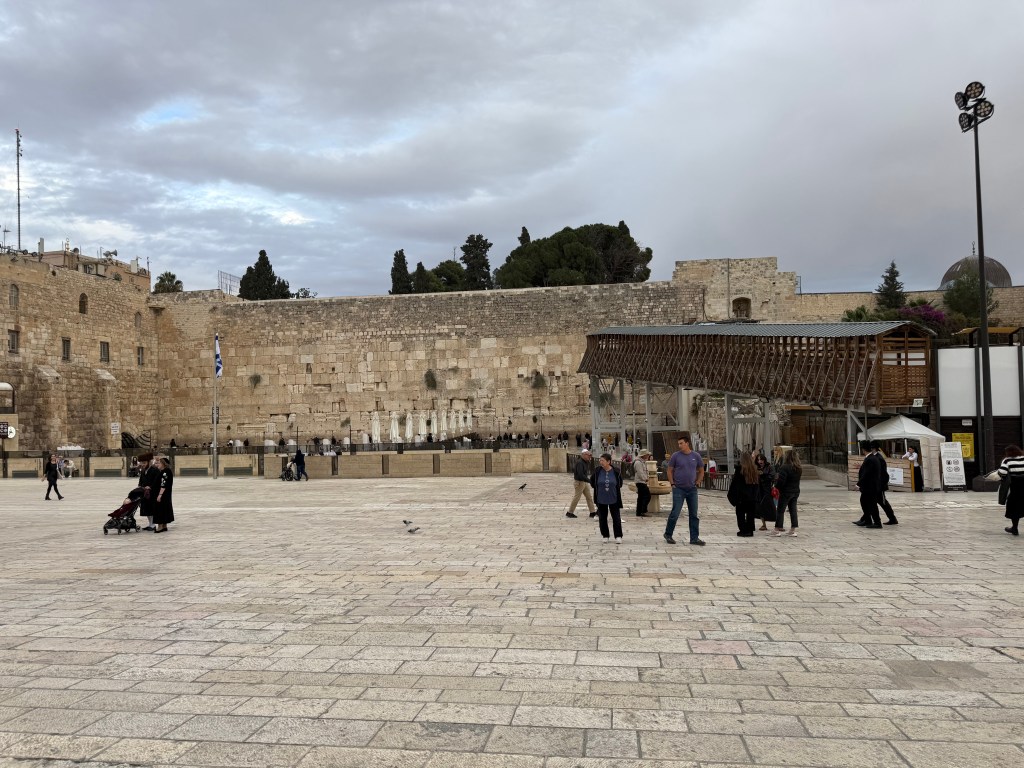
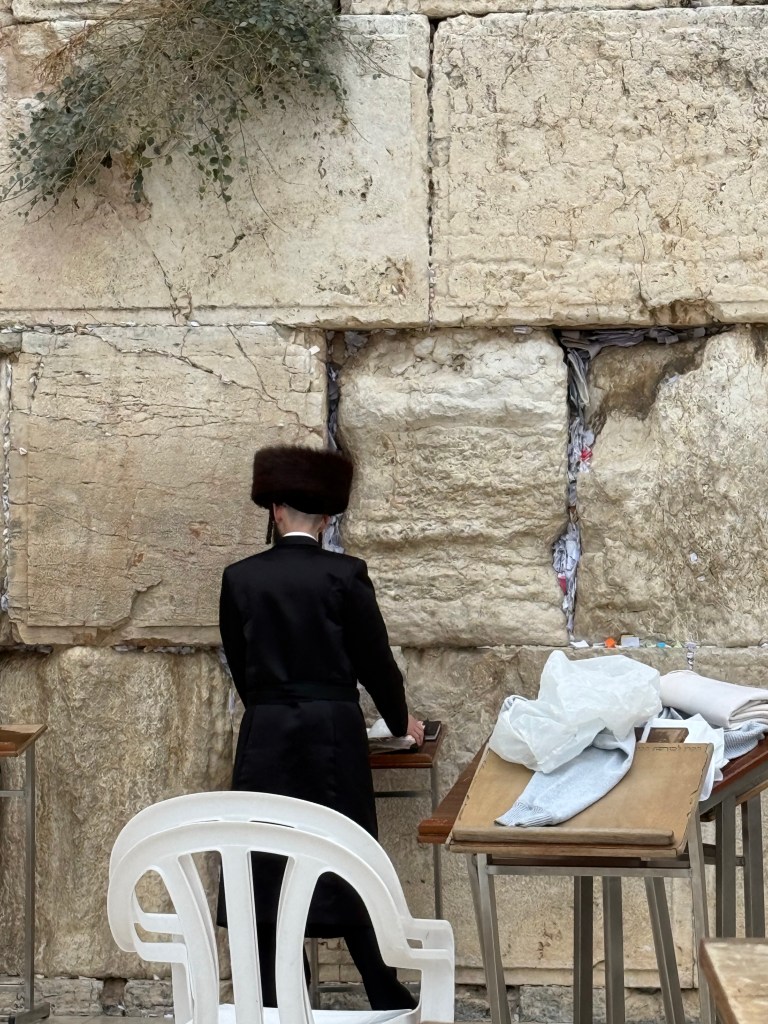
We got to the Kotel for shabbat very early. It was fairly empty when we arrived which gave us time to spend at the wall in deep thought and prayer. For the first time in a very long time, I had the time and space to sit in a chair at the kotel and just be. To let the air and the spirituality overwhelm me as I did nothing but sit and be. It was incredibly peaceful and powerful. I looked at the notes in the Kotel that others had left – their prayers, hopefully answered. I saw Jews of all shapes and colors arrive and pray. As the sun began to set, I felt the quiet and peace around and inside me.
If you’ve never been to the Kotel for Shabbat, it’s quite an experience. It never gets old for me. The singing, dancing, ruach (spirit) and connection is incredible. This was no exception. We gathered together in the plaza and prayed, sang, danced, and connected. We listed as others, in bigger groups, did the same but even louder. It was more than personal prayer – it was the feeling of a people coming together as one. As somebody who doesn’t love services, I always love Friday night at the Kotel. When we finished our prayer, I wanted to go join one of the others.
Instead we began our walk from the old city to where we were having Shabbat dinner. It was about a 40 minute walk, on a beautiful night, exiting through the Armenian Quarter and continuing up Jaffa Street until we arrived. The table was set for 15, the food was plentiful, and the company divine. I love the Shabbat table where you have a little bit of prayer, a little bit of ritual, and a lot of food and conversation. We prayed, ate, sang, and talked for a few hours, getting to know each other better, sharing pieces of ourselves, and enjoying the beauty of peoplehood, Shabbat, Jerusalem, and Israel.
During our learning with Aryeh he asked us what Jerusalem really was. We threw out a bunch of answers before he gave us his. He said, “Jerusalem is the hospital for broken souls.”. Powerful, beautiful, and true. Each of us has our own cracks in our soul. It’s part of being human. In Jerusalem we can get the treatment to begin the healing process for our soul. I’ve always loved Jerusalem but never really had a deep understanding why. Aryeh’s explanation fits. When I’m hear, my soul gets the treatment it needs to heal. To improve. To be better. I can get out of focusing on the dust, on my wants and needs, and instead focus on my soul. On the bigger picture. On being of service instead of what’s in it for me.
If you’ve never been to Jerusalem, I encourage to visit. To explore. To open your heart and heal your soul. If you’ve been – come back. It’s time for another treatment.
This was a wonderful Shabbat filled with happiness, joy, friendship and peace. I want to do my part to make sure they are all like this, no matter where I am.
I arrived back in Israel at 6:30 this morning. I didn’t sleep much on the plane which meant this was going to be 2 days back to back with just a few 15 minute power naps to get me through. Good thing it’s Israel, since that always inspires me and gets my blood flowing.
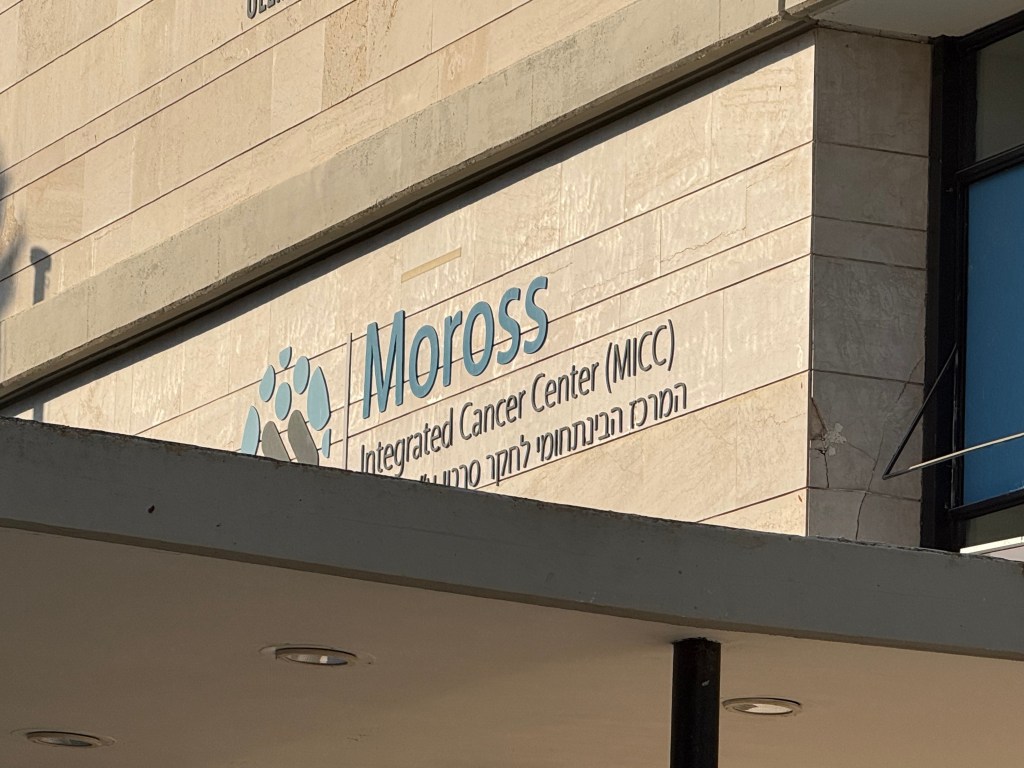
After clearing passport control and customs and getting on the bus, we headed towards Rechovot for two different purposes. The first was to see the Weitzman Institute, a truly incredible research facility. The Weitzman Institute was targeted by Iran with their ICBMs in June of this year. They took a direct to one of their research facilities, destroying it. Their cancer research facility was also heavily damaged, resulting in the loss of priceless research that could have cured cancer.
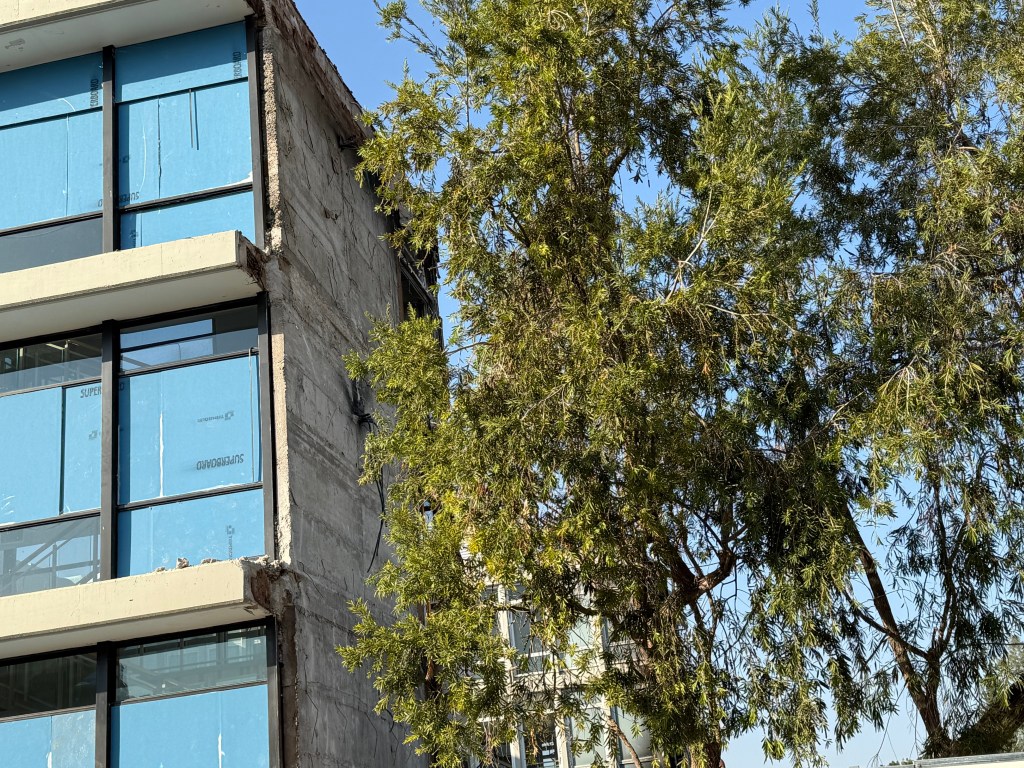
At the Weitzman Institute, they have already been rebuilding. It’s amazing to see how quickly they repaired the damage and how important this research facility is. You can see the damage at some buiildings on the side and with missing windows but the destruction has been cleared, the frames of the new buildings in place. The cancer center images below show the damage on the side but the buildings that existed next to this one have been demolished and the new ones will be built soon. The building above now looks like new construction and it won’t be long before it is finished and operational again.
The Weitzman Institute is symbolic of Israel, Israelis and the Jewish people. We are resilient. We bounce back. We may be damaged but we won’t be destroyed. This is the Israel I saw in October and see today. An Israel bouncing back. A Jewish people determined not just to survive but to thrive. This is our ‘secret sauce’. We refuse to give up. We refuse to die. Our enemies have tried to kill us for thousands of years and we simply refuse to go away. Driving through the Weitzman Institute, seeing the mix of beauty and destruction, of live and commitment to the future through their research, reminded me that we all have our part to play and we all need to play our role. We aren’t asked to do more than that yet we are expected to do our part.
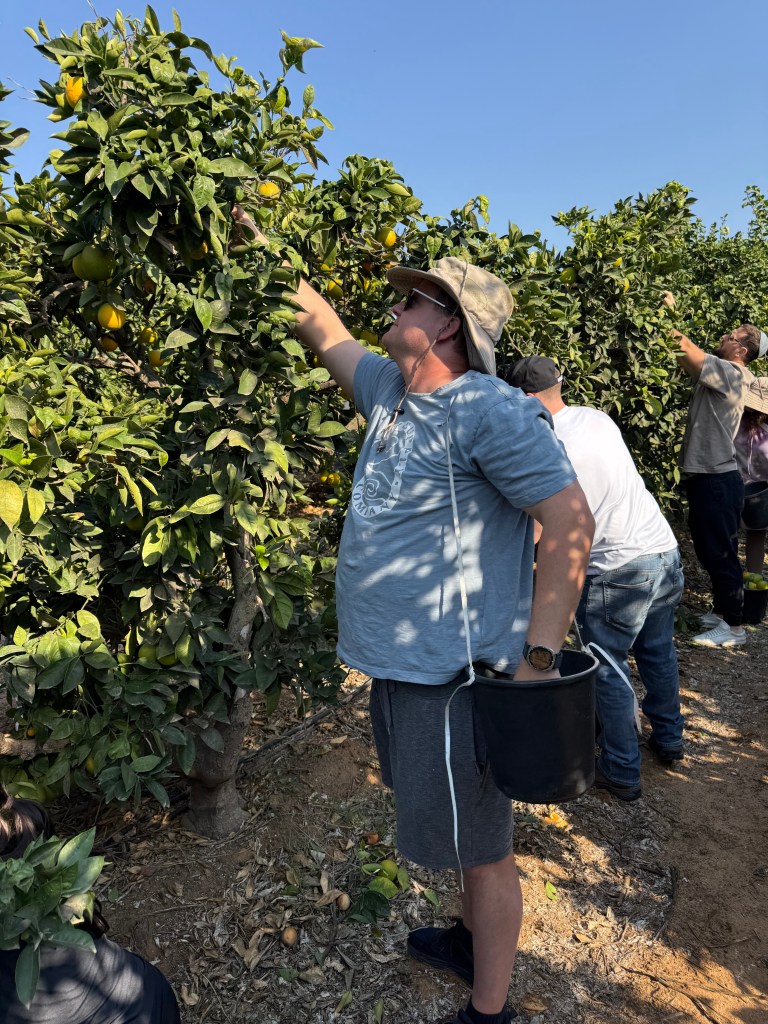
After leaving the Weitzman Institute, we headed to one of my favorite places in Israel, Ha-tov veHamtiv, outside of Rehovot. What is Ha-tov veHamtiv? It’s a farm, and orchard, owned and caretaken by an incredible man, a true Tzaddik (righteous person). Sandy, one of Israel’s most successful patent attornies, began this effort more than 40 years ago as a community garden. Today, this more than 200 acre facility, grows more than 35 different fruits and vegetables, depending on the season. All the food grown is donated to those in need. Sandy funds the entire project. Volunteers come and pick the fruit and vegetables. Last year, in July, we picked apples. This year, in December, we picked oranges. We picked them, we ate them, we worked the land, and we got energized. Less than 2 hours off the plane from Miami, we were out in the sun, working the land. Instead of being tired from a more than 11 hour flight and having little to no sleep, we were filled with vigor. It didn’t take long for us to fill up two big bins of oranges. We connected with the land. We connected with our ancestors. We connected with Israel and the founders of the modern state of Israel.
Sandy came to talk to us. What an incredibly understated and humble man. He was filled with joy at being in the orchard. He was filled with emotion, seeing us working the fields, working the land, being in Israel. Then he shared an incredible fact with us. His 200 acres provide more than 50 tons of food to those in need EVERY WEEK. This one man, through his effort, philanthropy, commitment, and working with others is providing more than 2,600 tons of food to those in need every year. Who says one person cannot change the world. Think about that – more than 2,600 TONS of food a year. That’s more than 5.2 MILLION pounds of food every year. How amazing and incredible is that. One man. With a dream. With a vision. Responsible for more than 5.2 million pounds of food being given to those in need. Feeding the hungry. I was humbled to meet him, to be in his presence, not because of his wealth or business success, but by the 5.2 million pounds of food he is responsible for providing every single year. He gives us something to strive for. One little (or not so little) orchard/farm outside of Rechovot in Israel. Imagine what we can each do with somebody like him as our role model.
We hopped on the bus, stopped for some coffee, and continued on to Har Adar, an incredible overlook in the Jerusalem mountains. It was the sight of key battles in the War of Independence (1948) and the Six Day Way (1967), with tanks left there to memorialize those battles. Israel and her geography can be challenging for those who have never been to visit and seen how small the country is, how much the topography matters for security. Har Adar is a great location to understand the challenges and talk about where we have been, where we are, and where we hope to one day be.
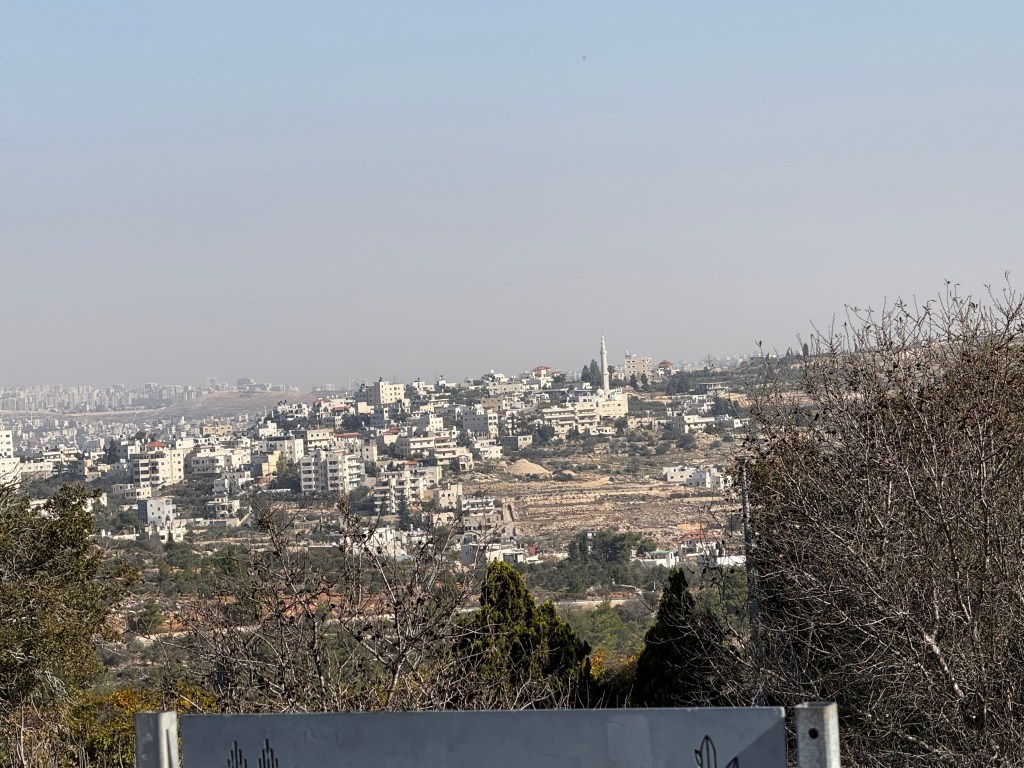
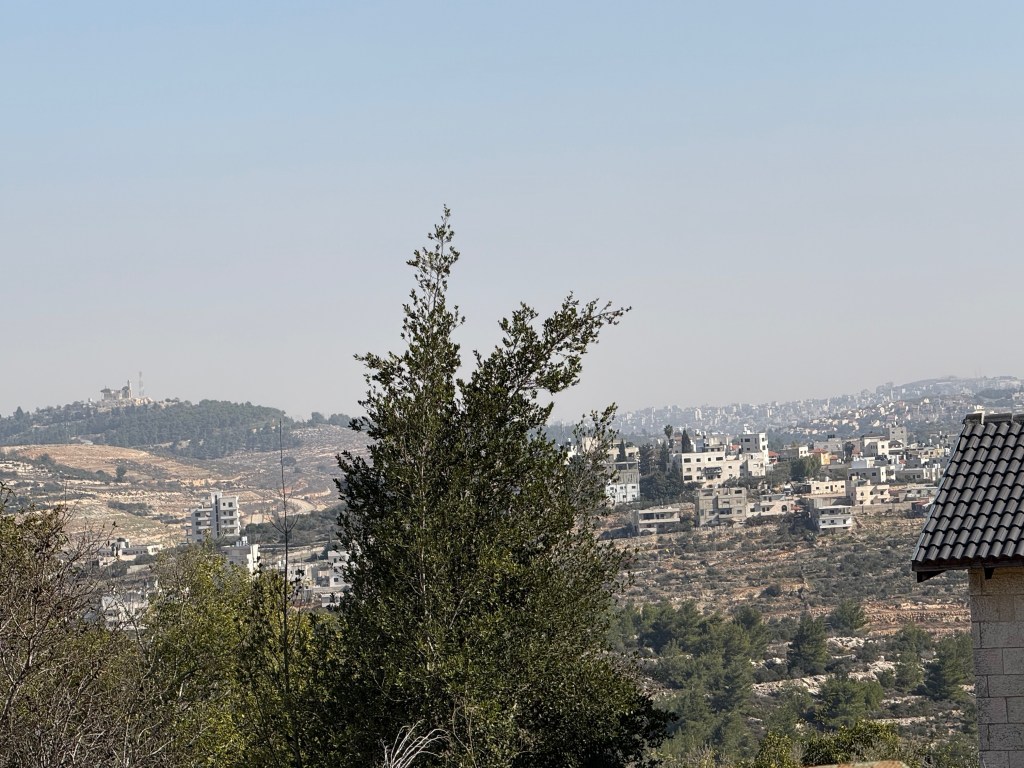
David Abramowitz speaking to the group at Har AdarThe view from Har Adar into Judea/Samaria/West BankThe view from Har Adar into Judea/Samaria/West Bank
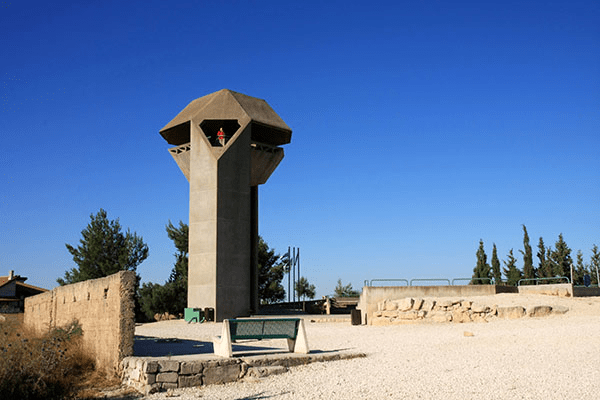
The villages in the background of these photos are looking into Judea/Samaria/West Bank (names are political so I use them all). Deep in the background is Ramallah. Up front are Arab villages. Off to the right is Jerusalem. You get a feel for how close everything is. Before the second intifada (Sept 2000 – Feb 2005) it was common to walk easily between the villages in Judea/Samaria/West Bank and towns like Har Adar. Due to the violence of the second intifada, Israel needed to install the security fence to stop terrorists from coming through and becoming suicide bombers, murdering innocent civilians. The cost of this was that innocent civilians in those villages now had to go through checkpoints, needed approval to enter Israel proper, and had their lives made more difficult. After October 7th, it became more difficult. Just last summer we were able to climb up the tower at the scenic lookout to get a high view of the area. Today the lookout is padlocked and we couldn’t enter. Security cameras were installed since July 2024 to monitor the area. Our reality makes me sad.
Har Adar was once an affluent community. People have left because they don’t feel safe living that close to the border. Sitting by the tanks, eating our lunch, looking over the outlook, all I saw was a lost past and a lost future. Will we ever be able to return to the days where the security fence and checkpoints aren’t needed? Where we can live together in a shared society? I hope. I dream. I’m not sure that I believe. It makes me sad.
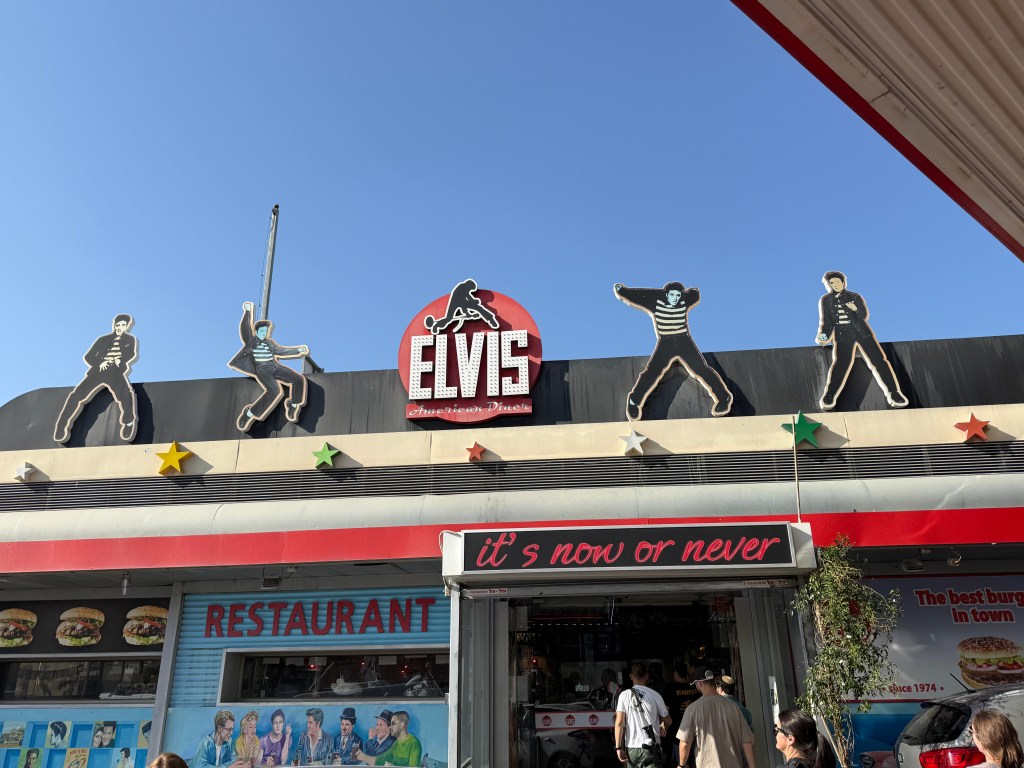
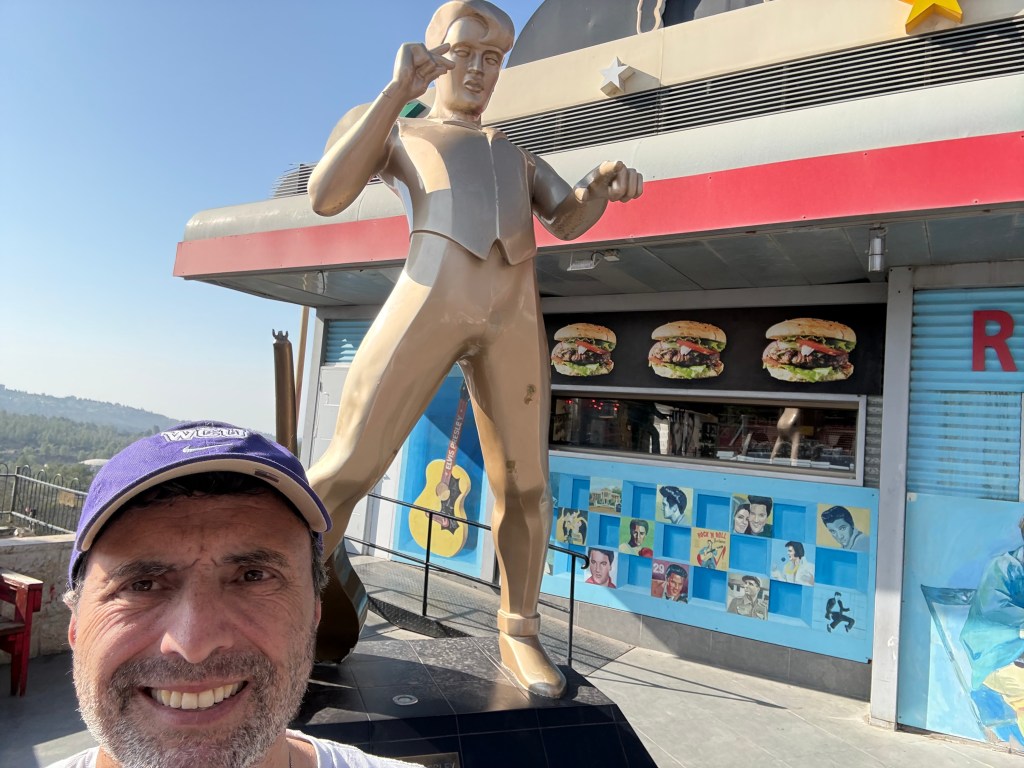
From Har Adar, we made a quick stop at the Elvis Presley Diner to use the bathrooms (the bathrooms at the Har Adar lookout were locked – another security change) and it was fun to experience it. Lots of kitchy things to buy but we couldn’t stop because we were off to the old city of Jerusalem.
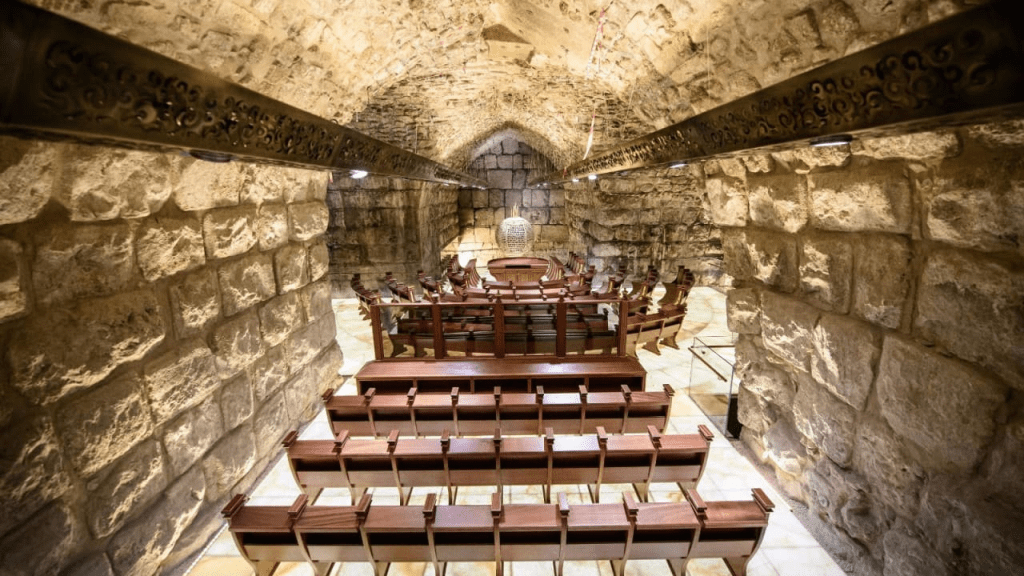
In the Old City, we were going to explore the tunnels under the Kotel, under Temple Mount. I’ve been through them many, many times and it never gets old. The education about what Temple Mount is, the history of this area from Abraham and Isaac, to Kings David and Solomon, the Macabees of the Hanukkah story, and King Herod, ties together so much of Jewish history. When you go into the tunnels, that history comes alive. You see the actual walls built by King Herod. In their natural status from 2,000 years ago. You see the actual destruction of the second Temple by the Romans. You get to walk on the actual street from second temple times, the same street our ancestors walked on more than 2,000 years ago. Our feet were on the same street that people walked on during second temple times. It may be the same street that Judah Macabee walked on. As we stood on that street, overcome with the connection we were all feeling, we joined together to sing Am Yisrael Chai – the people of Israel live. We do live. We will continue to live. We will not just survive but thrive. If you told the Jewish people who were being taken into slavery and exile in the year 70 CE that in 2025 their ancestors would be standing on that street, singing Am Yisrael Chai, in the country of Israel, they wouldn’t have believed it.
There is a Jewish tradition that at age 70, you begin counting again so when you turn 83, you can have a second Bar/Bat Mitzvah. I’ve decided that when I’m 83, I want to have my second Bar Mitzvah here, in this synagogue, in the tunnels beneath the Kotel, beneath the Temple Mount. I’ve got a while to go yet it is something that gives me hope, that gives me joy. To think that I may be there in 25 years, with my family, my wife, siblings, children, grandchildren, and maybe even great-grandchildren chanting from the Torah and leading services for my 2nd Bar Mitzvah makes me smile. It gives me hope. When that happens, you are all invited!
Israel is a powerful place. As I woke up this morning in Jerusalem and will be spending Shabbat at the Kotel, the Western Wall of the Temple, I can’t help but be filled with gratitude. Despite the challenges in the world today, despite the rise of antisemitism, of hatred, and of division, here I am. In Israel. In Jerusalem. I’m reminded of Psalm 137, verse 5 (and I’m not a Torah scholar but this one is a goodie).
I’ll never forget Jerusalem. I’ll never forget Israel. And I get to be here right now, today. Am Yisrael Chai.
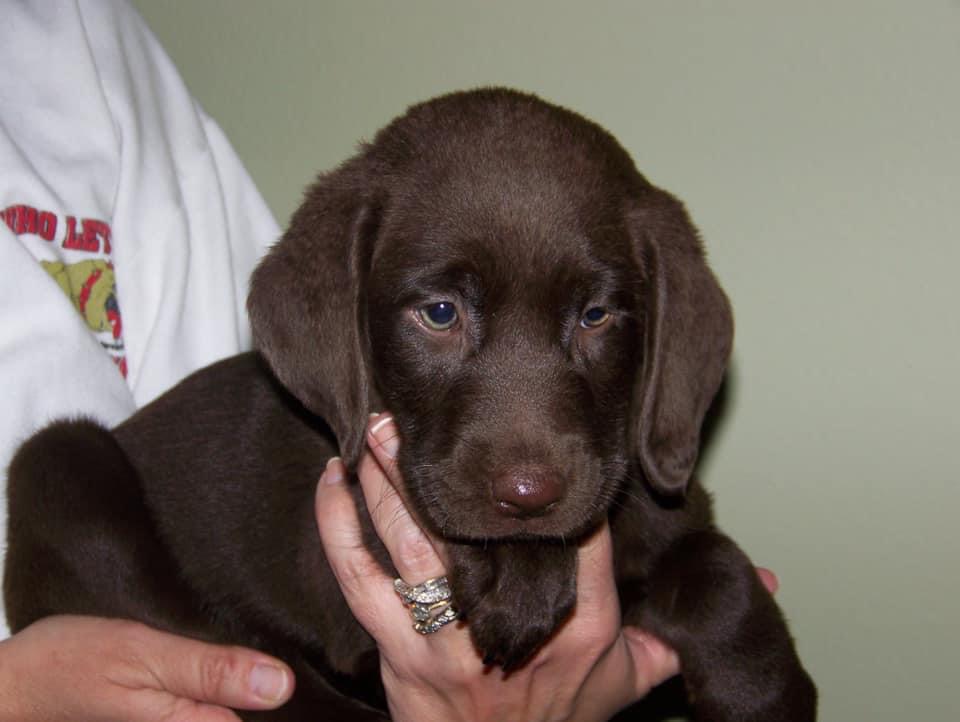
Our 13 ½ year old chocolate labrador, Bella, crossed the Rainbow Bridge last month. We got her as a Hanukkah present on December 1, 2010, and she has been a constant in our life and our family ever since. She taught us about unconditional love, how important playing is in life, the joy of treats, and the joy in just being together.
Bella as a puppy when we first got her and took her for her first checkup
Almost exactly a year ago, she almost died. While being boarded, something we hadn’t done in many years, she developed 3 major infections and had 3 major open wounds. She couldn’t eat, walk, or do much of anything. We were preparing to say goodbye and tried one last Hail Mary attempt before saying goodbye. That last attempt miraculously worked and for the last year Bella fought every day to be with us and to do whatever she could do. She went on walks. She climbed the stairs. She did some physical therapy in a swimming pool. She would climb up in my lap.
The last few months she would come upstairs at 2 am to wake me up and make me go downstairs and sleep on the couch next to her. She liked sleeping on the travertine tile floor but didn’t want to be alone, so it was my job to be close to her. Most of the time, as soon as we got downstairs together, she would lay on the floor and be content and sleep through the night. Every so often she would let me spend the entire night sleeping in bed, but it was a rare occurrence. I didn’t mind (much) because I knew how important it was to her.
Bella reminds me in many ways of Israel. Israel is 76 years old. When the US was 76, we hadn’t even fought the civil war yet. Israel is still a baby, or maybe a middle school student. It is start-up nation. It is innovation. We joke that the national bird is the crane because when you are in Tel Aviv or Jerusalem, there is so much construction that you see so many cranes all over the place. My relationship with Israel is similar to the relationship I had with Bella. It is one of mutual love. It is one where we learn from each other every day. It is unconditional love. It doesn’t mean that I was happy when Bella stole the challah or that I am happy when the Israeli government makes what I consider to be a bad decision. It does mean that I love Bella no matter what she does, just like I love Israel even when the government or some of the people make very poor decisions.
My relationship with Bella started the day I picked her up, December 1, 2010, and brought her to our home and our family. While she is physically gone, it is a relationship that will last forever. My relationship with Israel began as a child, shaped by my grandparents and parents. It deepened when I made my first trip there in the summer of 1989 and has continued to grow on each of my 21 subsequent trips since that first one. Just as my relationship with Bella deepened as she got older and we spent more time together, so has my relationship with Israel. Each visit takes me deeper into my own Jewish identity. Each visit helps me explore who I am, who I want to be, what my values are, how do I want to spend my life, and answer the question I have previously written about, “What would I diefor?”, which tells me what I am living for.
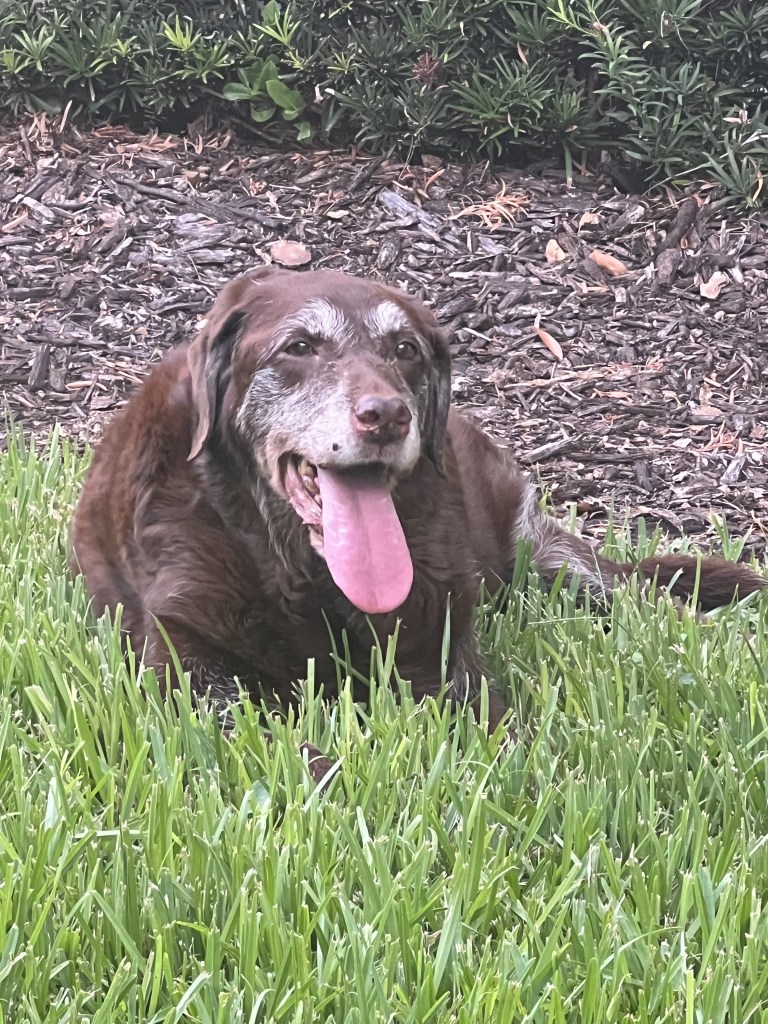
Israel is not a tourist attraction that you go to once and that’s it. It is a fine wine. A good bourbon or scotch. Incredible music. It is to be savored. That first taste is exactly that, a taste. It’s wonderful and exciting and exhilarating. Floating in the Dead Sea, climbing Masada (or taking the cable car), going to the Kotel, touring the old city of Jerusalem. Exploring Tzfat and spirituality. Visiting the Kinneret. Rafting down the Jordan river. Hearing the Muslim call to prayer from the minarets, as you are in the middle Jewish or Christian prayers. Exploring Haifa and the Baha’i Gardens. I could go on and on and on. Yet it’s just a taste. A first sip. Your toe in the ocean. There is so much to explore, so much to invest, so much to learn and grow. Just like every relationship. Just like my relationship with Bella. The day I brought her home, I was in love. She was adorable and cute and fun. The day before she died, we were sitting outside together, she way laying the grass, happy as can be, a totally different and deeper experience. My first trip to Israel was exciting and exhilarating. I soaked it all up and have vivid memories from that trip, 35 years ago. My trip to Israel last month was also powerful and deep in a very different and more mature way. My trip this month was a deeper exploration into what Israel stands for, what she means, what her values are, and my personal connection that as a Jew, started when Abraham listened when he was told by God to “Lech Lecha”, go forth, and was guided to this land. Just like sitting outside with Bella during her last weeks as she laid in the grass instead of playing frisbee or chasing a ball, it was even more special despite the vast difference.
Bella in the yard just before she died. She was happy until the end and gave us love her entire life
As we toured the old city of Jerusalem this time, our guide challenged us to view it very differently. He urged us not to see buildings, walls, rocks, and rubble. Instead, take a look at what happened. What are the stories? What does it all mean? When he took us through the tunnels under the Kotel, he posed the same questions. It was a remarkable two tours with Eytan. He spent three hours each time with us, pushing us to keep moving with him as he made the old city come alive in a completely different way. I felt like I was there in the 1948 war for the old city. My love for Jerusalem was captured during the tour as I asked myself what I would do to defend Jerusalem. The old city will never be the same for me as I turn every corner and there is deeper meaning.
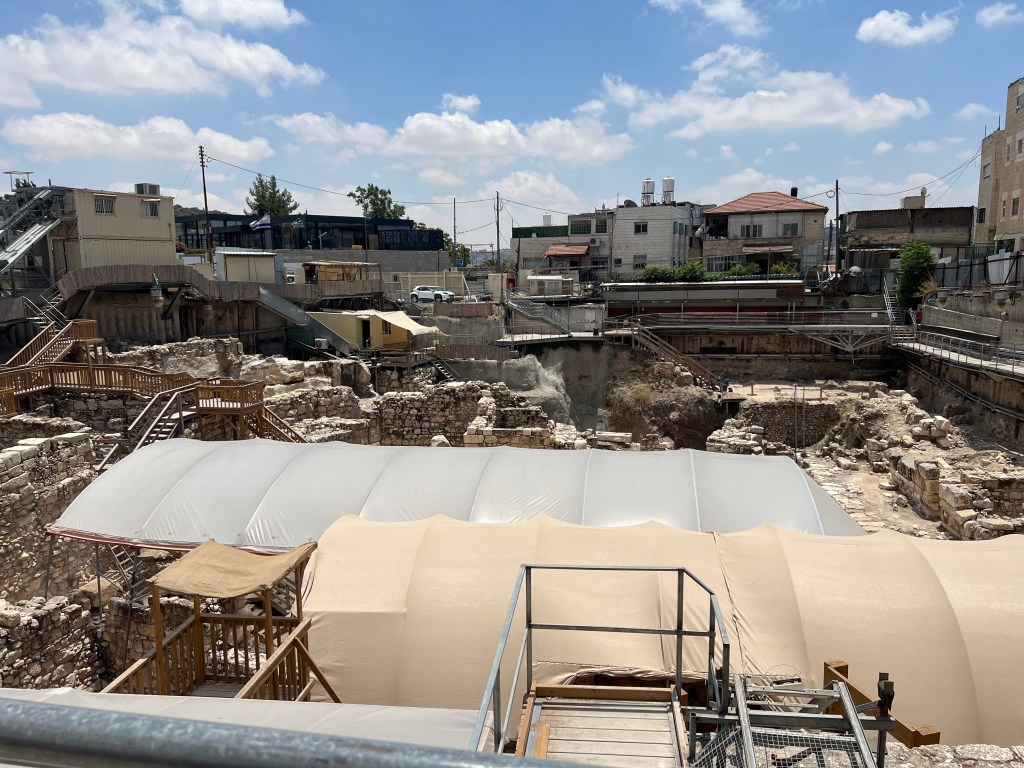
As he took us through the City of David, we stood where King David’s palace likely was. There is enough archeological evidence to show this is where it would have been. You could imagine what happened in that area. The poetry of King David being written. The decisions he had to make, both good and poor. As we moved to the current excavation site, you could imagine the city that once existed there, more than 3,000 years ago. The vibrancy of the people. We walked through the drainage system, designed to capture the rainwater from the mountain to bring fresh water to the cisterns of the city below. The system was small and narrow. I couldn’t stand straight up and banged my head a few times. It felt tight and constricted. All I could think of as I walked through this tight place was the hostages and how they live like this every day. A 3,000-year-old water collection system teaching me about life today. I’m not sure there is anything more Jewish than that.
I miss Bella every day, just like I miss Israel. There are a few images that will stay with me from this trip for a long time.
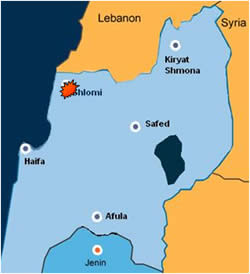
Our hotel is where the residents of Shlomi, a town in the north of Israel, have lived since October 7th. They are right on the border with Lebanon and were bombed by Hezbollah and had to evacuate. Throughout the hotel, we had families living their lives. Kids running around, riding tricycles, women doing laundry at the specially installed washing machines because this was now their home. A Gan (kindergarten) still functioning as the other children are now enrolled in local schools. The hotel lobby had become a community center. Shlomi is a religious community and as we prayed each day, said the Birkat Hamazon (grace after meals), and learned Torah, they watched. They came up to one of our leaders and spoke to him in Hebrew, telling him how much we inspired them. How proud they were because of what we were doing and because we were there. Imagine being forced from your home and living far away in a single hotel room with your 5-7 children for over 9 months. And young people, choosing to come to Israel during the war, doing Jewish traditions, inspire you.
You see how close Shlomi is to the Lebanese border
I watched as their Gan began the day. The children were adorable. The teacher filled with excitement and passion. The joy in the room at the hotel was palpable. These 4-year-old children who have had their life turned upside down had normalcy. I was inspired. I watched and smiled. Life doesn’t just go on. It flourishes. That is Israel. Even in the worst of times, there is joy and plans for a better future. As we visited the Kotel before leaving Israel, what did we see? Another group of children, dressed in costume, learning at the Kotel. It was a beautiful site. No matter how much people try to kill us, try to villify us, try to isolate us, try to mock us, try to eliminate us, we will not give up. We will not forget who we are.
The joy of being at Machane Yehuda in the day, as a bustling shuk (market) and then in the evening as a crazy fun group of nightclubs is amazing. The energy, the passion for Judaism and Israel expressed at both times is amazing. When in Jerusalem at the shuk, the singing is loud, the passion is raised, and there is a strong and powerful pride in being Jewish. Why can’t we keep this when we return? Why do our voices suddenly get quiet? As you watch this video of the shuk, feel the energy, the passion, the joy and make sure you bring it with you every day when it comes to being Jewish.
Can we always sing Am Yisrael Chai with this passion and love?
I have been to Israel 22 times now and will be back at least once more this calendar year. As I walked and talked with one of our participants who was on her first trip to Israel, she talked about how surprised she was at how she felt in Israel. She talked about how much she wished we had an extra week or two on the trip, with the group, to continue learning and having the experience. She talked about how much she wanted to come back and maybe next summer would work. Once you have been to Israel this will make sense to you. Until you go, you can’t really understand it. It brings up the existential question, how to do we maintain this connection to Judaism, to our history, to our family and community, and to God, when we aren’t in Israel? How do we bring it home with us so that it lives within us all the time, not just when we are in Israel?
Many people and organizations have tried to answer this question over the years, some with some success, others not so much. What I do know is that as long as those of us who aren’t super religious can inspire the religous people of Shlomi with our effort, we are doing ok. As long as we continue to make the effort to do it, we are having success. It truly is a journey, not a destination.
P.S. – Here is a little something to put a smile on your face – the Jerusalem Youth Choir with Arab and Jewish youth singing on America’s Got Talent.
I’m here in Israel for two weeks with a group of young adults on a leadership program. The Jewish Leadership Institute (JLI) was created by Rabbi Mayer Abramowitz more than 30 years ago. He was a visionary. He understood in the early 1990s that the future was on the college campus and that providing answers to the WHY of Judaism was critical to developing Jewish leaders. I was introduced to the program in 1998 and have been a fan ever since. Now I get to work with my friend David, Rabbi Abramowitz’s son, on JLI and the future of JLI.
While the focus of the trip is on the young adults, it is impossible not to be inspired by both them and the content. I find myself thinking deeply throughout the different experiences and while I am not the intended target of the program (nor are you) the impact is felt.
Yesterday we had an amazing tour guide, Eytan Rund, take us on a tour of the Old City of Jerusalem. I’ve been on many tours of the Old City. Too many to count. I love the Old City. Last month, our guide gave a totally different view of the Old City that I wrote about. Eytan spent two hours with us giving one of the most amazing tours I have ever experienced of the Old City.
Eytan’s focus was on the difference between seeing old stuff and seeing stories, history, and memory. The Old City was his muse to talk about peoplehood. To talk about the Jewish collective. To talk about what being Jewish means – being part of a mishpacha, a family, that is thousands of years old. As we looked down into the ruins of Jerusalem from the time of the first Temple, he explained this was this built 3,000 years ago by Jews. Well before Christianity. Well before Islam. This is our homeland that we built. He talked about how after the destruction of the first Temple, Jerusalem was filled in with sand to make an entirely new ground, well above the prior city. It is always amazing to look at the areas from the time of the first Temple however this was different. He tied it to us. We built the first Jerusalem. We built the second Jerusalem. And we built the current Jerusalem. It was powerful.
As we walked through the Old City, he focused on 1948 and the battle for the Old City as well as the battles with the Assyrians, Persians, and Romans. The stories were vivid. They were personal. On my trip last month, Saul Blinken, our trip leader, talked about what a miracle it is that we get to wake up in Jerusalem. We walk the streets of Jerusalem. We breathe the air of Jerusalem. That was incredibly impactful for me. I am fulfilling the dreams of my ancestors from 2,000 years ago and I can never forget that. Eytan reiterated that in his own way. The modern state of Israel is truly a miracle that our ancestors who were conquered by the Romans could never imagine.
It made me think of a story that my friend Harry Rothenberg told me a few years ago as we were climbing Masada. I challenged him to do some on the spot Torah teaching about climbing a mountain. He said that when God told Moses he would not be permitted to enter the land of Israel, Moses begged God thousands of times to be allowed to enter. God refused every time. God finally told Moses that if he climbed this mountain, he would be able to look into Israel and see the entire land. Moses climbed the mountain, saw the land, and his love for the land he saw but could not entered is a part of all of us. That is why we love Israel. It’s a great teaching about how our love for this land goes back thousands of years. It’s not since 1948. It’s not since the late 1800s and Theodore Herzl and the creation of modern Zionism. It goes back to Abraham. To Moses. To King David and King Solomon. It is a part of who we are.
One of the things I love about JLI is our morning services. As somebody who does not like services, that is an interesting statement to make. The reason I enjoy these services so much is because they focus on the WHY not the WHAT. As we continued to discuss the prayers about thanking God for restoring our soul and for the rooster knowing the difference between day and night, we talked about time. Previously I wrote about how Judaism marks the passage of time, so we don’t lose our focus. Today we talked about how we are always trading time.
It is a fascinating concept that most people don’t really think about until they are older. That is when we begin to realize that time is our most precious commodity. We can always make more money, get a new car, a new house, new clothes, TVs, computers, etc. What we can never get back is time. Life is about the value of time and what we are willing to trade time for.
For many years, I was willing to trade time for money. For career. For ego and for title. For status. For the nicer house and the better car. I wouldn’t trade time with my children – I took them to doctors appointments, went to their sporting events and music performances. I specifically remember having a small counseing practice and when I did the analysis of what insurance was paying me, realized that I would rather have dinner with my family than make money. Until I got a bigger job.
The bigger job, for some reason, changed the equation. I began to trade time more freely. I didn’t realize that’s what I was doing. I knew I didn’t like it but I continued to do it. After a few years, I realized that among many things, I wasn’t willing to trade that time for the money, title, and prestige of that job. So I left. My new job was still demanding but not in the same way. The trading of time was different. Perhaps it was because my children were a little older.
The question to ask ourselves is what is each experience worth? What would I trade it for? As one of our teachers here in Israel asked, ‘Would you trade your elbow for a million dollars? How about both elbows for ten million dollars?’ Over the past almost year, my equation for trading time has changed. I am eternally grateful for the last three weeks of my father’s life when I was able to be there for him and my mom. It is time I can never get back and I’m glad I didn’t trade that time for money, prestige, power, or anything else. I am not willing to trade time with my children the way I used to be. I won’t trade the time with my wife the way I used to be. My job today requires travel and it is not always balanced (July is a month of almost entire travel) but I built in time for a trip with my wife.
As we evaluate our lives, time is the ultimate measuring stick. Not money. Not titles. Not power nor prestige. At the end of the day, it is the time I spent with my family, with my wife, my children, my parents, that matter the most. It’s a lesson I continue to learn and I’m far from where I want to be with my willingness to trade time but I am much better than I was just a year ago.
Maybe this comes with age. Maybe it comes with losing a parent. I’m excited to take trips this fall to watch my older son coach college football. Sure it’s a 10 hour drive each way but who cares. It is likely either my wife or younger son or both will be in the car with me. Plus I get to watch him do what he loves. I’m excited to take trips with my younger son to sporting events, concerts, and other things. I look forward to planning the things my wife and I will do together and when not traveling for work, the time we just spend together as I get to work from my home office those days.
Life is far too short to give away our most valuable possession. Time.
How do you value your time? What are you willing to trade for time with your spouse, your children, your parents, your friends? Once you trade that time away, you can never get it back.
As I continue to process my 10 days in Israel this month, I can only do so in bite size pieces. Here is my second bite at the experience and what it has meant to me and what I have learned.
On my trip in 2021, we had a number of Israeli men on our bus. I wrote about Alex, whose son died on October 7th, in my last blog post. Another person I met on that trip has become a close friend. I can’t use his name or pictures for security reasons.
There were a few things that he spoke about that really resonated with me then and as I unpack the time in Israel, reinforce common themes that have come out of the trip and that I want to apply in my life. One of the most significant was when he talked about holding his son’s bar mitzvah at Kibbutz Be’eri. After being decimated on October 7th by the Hamas terrorists, he wanted to bring light and life to Kibbutz Be’eri, so that is where he held his son’s bar mitzvah. It’s like saying that I want to get married on the still smoldering ruins of the Twin Towers in 2001. Let’s celebrate a significant event at the devastated site of the apartment building in Sunny Isles, Florida. Let’s celebrate our 50th wedding anniversary at any of the sites of school shootings a few months after children were murdered there. In many ways, it doesn’t make sense.
Yet through a Jewish lens, it makes total sense. We value human life more than anything. The Talmud teaches that Whoever Saves a Life Saves the World. The idea of bringing light and life to a place where light and life was destroyed is incredibly Jewish. It’s similar to what Noa was saying at Shura Army base when she spoke about making a better dinner for her family, being better for her children and husband. We can take the sad, the dark, the bitter, and find a way to make the light shine again. That’s what he and his family did at Kibbutz Be’eri. They door a place stained with death, kidnapping, torture and pain and brought light to it. They brought joy to it, if even for just a few hours or a day.
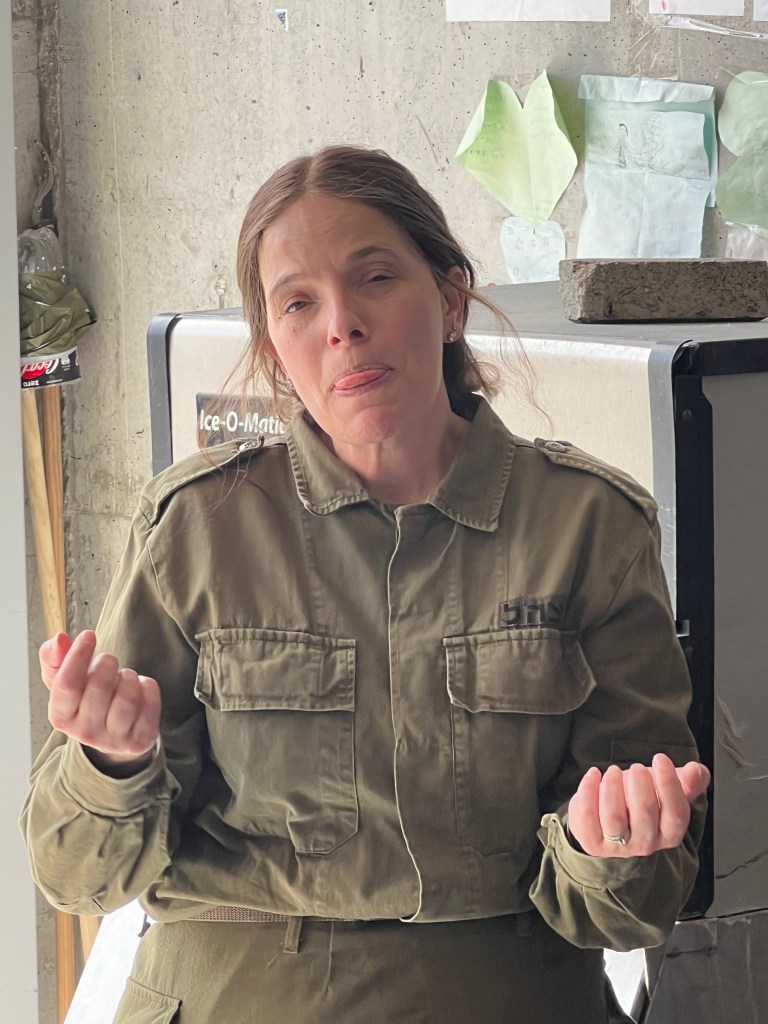
Noa, a true inspiration about how to live life. Our teachers show up when we are ready to learn.
The lesson I take from this is that we all have an opportunity to bring light and joy to the world every single day. It doesn’t matter what is happening in our own lives, in our country, or in the world. We have the ability to make a conscious decision to do things that bring light to the world. Sometimes it can be something as simple as holding the door for somebody. Helping somebody cross the street. Say a kind word to somebody that you see even if you don’t know them. It doesn’t take much to bring light to our lives and the world. It does take a conscious effort. After this trip, one of the things I am going to do is find ways to bring light to the world around me. Pay attention to the opportunities that present themselves every day and act. The small random acts of kindness brighten somebody’s day and improve the world. Thank you Yaron and Noa for inspiring and teaching me.
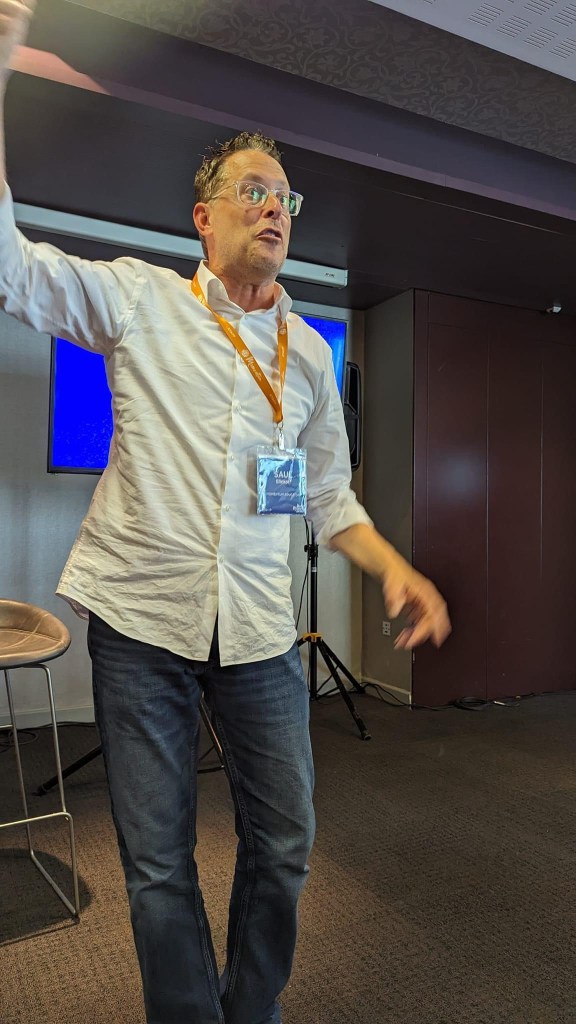
Our trip leader, Saul Blinken, was incredibly inspiring. We spent most of our time based out of Jerusalem and he said something that had an immediate impact on me. Saul said that every day we wake up in Jerusalem, it’s a miracle. Every day we breath the air in Jerusalem is a miracle. Every day we walk the streets of Jerusalem, it’s a miracle. And every night we go to sleep in Jerusalem, it’s a miracle. He asked us to imagine if somebody told the Jews who were being exiled by the Romans not to worry, that 2000 years later the Jews would be back in Jerusalem and there would be a Jewish state. They wouldn’t believe it. Yet it happened.
Saul passionately speaking to us. What an incredible teacher and friend.
From the time Saul said that I took it to heart. Every day when I woke up, it was an incredible feeling to know that I was waking up in Jerusalem. As I walked the streets, I had a deeper appreciation of what it meant to be able to do that. Going into the old city, visiting the Kotel, walking freely throughout the city – everything became a WOW moment. It reminded me of what my friend Roni Akele, the Director General of the Ethiopian National Project said about being a Jew in Ethiopia. He said that they always dreamed of returning to Jerusalem. Everything was about Jerusalem. The psalm we sing is “If I forget you, oh Jerusalem….”
I fell in love with Jerusalem on my first trip to Israel in 1989 and it has never changed. I am not an overly religious person, yet going to the Kotel is powerful. This trip I got to visit Temple Mount for the first time. Incredibly powerful. As we stood there and said the Shema, I felt a connection that is indescribable. Saul’s words hit home and deeply. I’ll never take Jerusalem for granted again. I’ll never take for granted all the time I have spent there, all the sites I have seen, all the friends I have who live there.
It’s an opportunity to think deeply about gratitude. This was my 21st trip to Israel and I hope to be back in Israel a few more times this year. I don’t think much about it yet now I am filled with gratitude that I have these opportunities. Each time I go to Israel, I get a deeper connection to Judaism and to understanding myself. As I have said, I’m not very religious but I am very Jewish. Israel brings that home to me.
I also think about how many things I have to be grateful for in my life. Jerusalem can easily be representative of so many important things. My family. My health. Doing work that is personally meaningful. The success of my children as people and in life. The life I have is truly beyond my wildest dreams. It is easy to lose track of that and focus on the things that aren’t going well or that I don’t like. Temple Mount was a good example. I wish we could go there whenever we want. I wish we could openly pray there and celebrate that holy space. I could focus on the things we don’t have. Or I can focus on the fact that we can go there. That I did find a private place to pray quietly. That I did feel the connection with God in this special place. Our choices determine everything. Do I want to focus on what I don’t have or what I have? Do I want to be bitter about the things I think I deserve or be grateful for the wonderful things I actually have? Just like I’ll never take Jerusalem for granted again, I won’t take the wonders and gifts of my life for granted either. Nothing is perfect but it sure can be great.
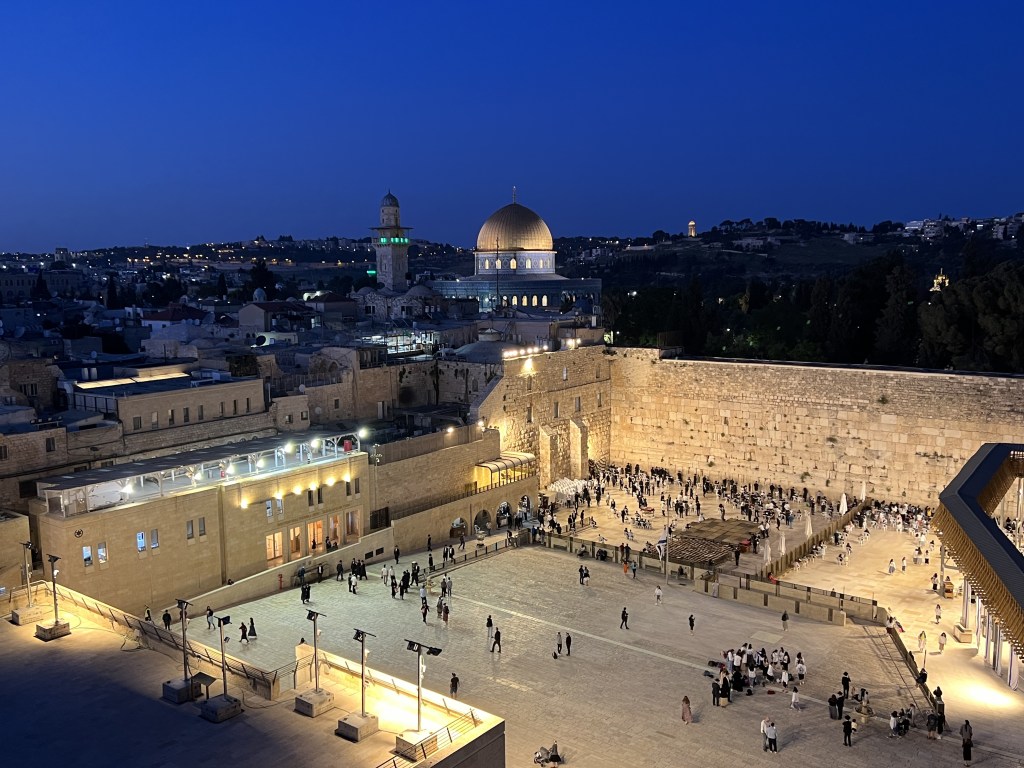
A picture I took overlooking the Western Wall plaza. The beauty never disappoints.
The last thing I want to unpack in this post relates to Israelis. Not since the second intifada have I been in Israel where I was thanked so much by Israelis for being there. During the second intifada they were happy to see Jews coming because most were not. It was the Christians who were coming to visit. This time they were grateful for Jewish solidarity. For knowing the Jews of the diaspora love Israel and support them as brothers and sisters. That we are willing to come in the middle of a war because of our love for Israel and the people of Israel. That the Jewish community truly is global. There was a unity we felt and that they needed. I never expected to get the thanks we did or for it to mean as much as it did to me.
During the second intifada, part of the thanks was due to the economic benefit the country needed by our visiting. While that is very true right now, that wasn’t what I was being thanked for. The Israelis need to see us in person. They need get our hugs and love. They need to know they aren’t alone. When the guys on our bus from an LA Jewish Day School gave the soldiers letters from kids at the school, they were deeply moved. October 7th, the hostages, and the ensuing war is taking an incredible toll on the entire country. Seeing their Jewish brothers and sisters from America and the rest of the world makes an incredible difference.
It’s a reminder to me that not only do I need to show up both through WhatsApp and in person for my Israeli brothers and sisters, I need to do the same for my friends and family. That random phone call, text, or email may often mean far more than I ever thought. Checking in on friends and family doesn’t take much effort and the payoff is always significant and meaningful. This trip reminded me that the 30 seconds it takes to send a text or email, or the 15 minutes I allocate for a phone call, may change a person’s entire day and outlook. It doesn’t matter if they reply or if they answer the phone. The effort is what is meaningful.
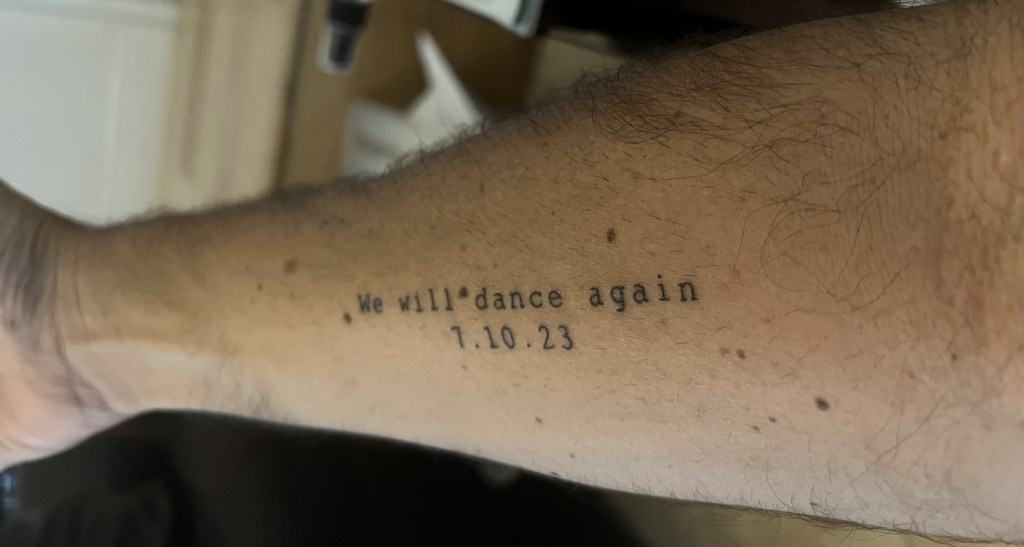
The other thing that was surprising to me was the Israelis response to my tattoos related to October 7th. I got them because of their meaning to me. My children could have been at Nova. I could have been there with them. It hit home and hard. The Mia Schem quote, “We will dance again” and the tattoo she got inspired me as well. It is a reminder that we never give up hope. We will overcome the challenges and not just survive but thrive. Whatever is taken from us, we will get back. They will never take our spirit or our soul. Here in America, I get very few comments on them. People are very used to tattoos and I have been surprised at the lack of comments or questions because of the uniqueness of them. In Israel it was just the opposite. Not only did they notice them, but people were stunned that October 7th meant that much to me. ‘Wow’ was the most common thing said to me, followed by questions and a conversation. At a t-shirt store where I got a few meaningful ones for myself, the owner was so taken by my tattoos that he asked if he could take pictures of them and use them on t-shirts he would sell. Of course I said yes. On my next trip, I’ll swing by and see if he has them on a t-shirt. How cool would that be??
Nova music festival – it could have my kids and me.The Mia Schem saying and tattoo
Standing up for what you believe in matters. The old saying, “If you don’t stand for something, you will fall for anything” really holds true. I’m not advocating that everybody should get a tattoo. I am advocating that whatever matters to you, whatever you stand for, make sure that you actually do it publicly. It matters. People notice what you say and do and what you don’t say and don’t do. If they are your values, make it public.
Trips to Israel, especially the Momentum Men’s Trips, always have me returning with my head spinning. There is always much to unpack. More is coming as I continue to process the time I spent there, the people I met, the things I saw, and how I felt. If you have never been, I urge you to go. If you have been, I urge you to return. It truly does change your life.
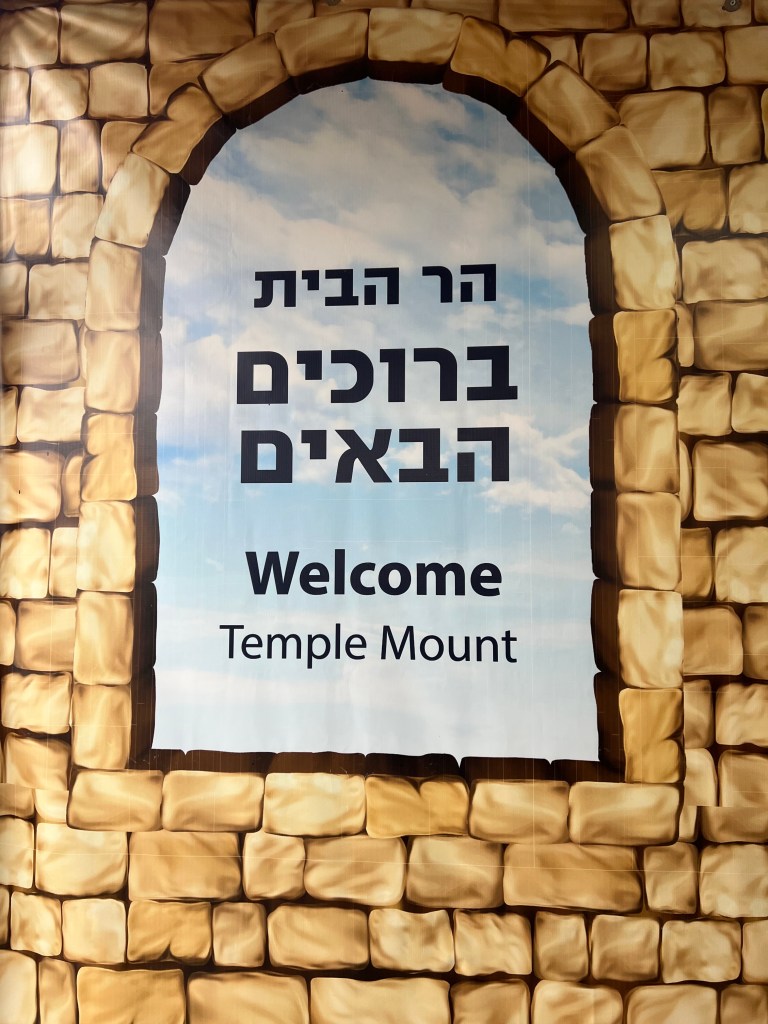
One of the things I have always wanted to do is visit Temple Mount. On my prior trips, I never had the opportunity to do it for many reasons. The first intifada. The second intifada. Jews not being allowed on Temple Mount. A schedule planned during the limited time that it is open to Jews. This time it was different. Jews are allowed on Temple Mount from 7 am until 11:30 am during the week. I had nothing planned for the day so I could get up early and go up onto Temple Mount.
Every time I have seen the line to go up on Temple Mount it was long. I expected a wait, so we left the hotel at 7:30 to we would make sure to have some time up on Temple Mount. When we got there, there was one person in front of us. I guess war changes everything, including those who want to go up on Temple Mount. The man who was in front of us had on his tallis (prayer shawl) and tefillin (the boxes on his forehead and arm). The rules for Temple Mount are controlled by Jordan. This has been the agreement since 1967 to attempt to limit conflict. This is why access is limited for Jews and at times has been prohibited. Of the rules is that we are not allowed to enter any of the buildings now, including the mosques. There was a time that we were allowed to do that. Another rules I that Jews are not allowed to pray on the top of Temple Mount or use obvious prayer symbols like this man was wearing. He was arguing with security who would not let him through. It was clear he wanted to provoke something. We passed the first part of security and headed up. There was an area with information and clearly could be used for prayer. We decided to keep on going. On our way up, we passed a large number of Israeli security forces. It was far more than I have seen at any other site in Israel, including Jacob’s tomb in the West Bank. One final security officer greeted us to go over all the rules of Temple Mount including the hours, so we knew when we had to leave. A few minutes later we stepped on the ground of Temple Mount.
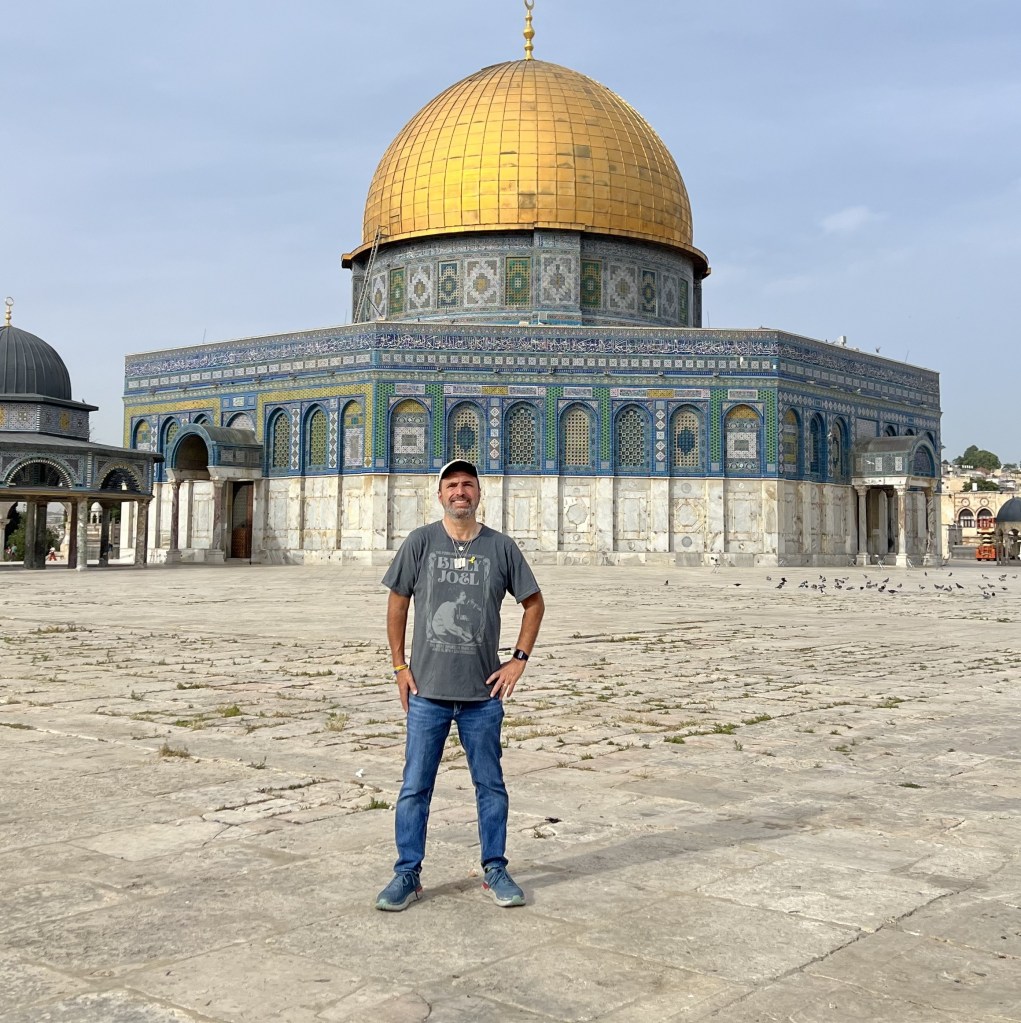
It is hard to describe what it felt like to step on Temple Mount for the first time. It was something I always wanted to do but never really expected I would get to do. Knowing that I was standing on ground that was the center of Judaism from over 2000 years ago was incredible. It was more powerful than being at the Kotel because I was actually even closer to the holiest place in Judaism where the actual Temple would have been. I know that the Temple that Solomon built was smaller and likely in a different location on the mountain that the second Temple built by Herod, but it was likely in the area that I was now able to walk and explore. I am not a religious person, but I had the urge to say a prayer now that I was up there. My friends felt the same way, so we headed to a vacant area near the edge where we quietly said the Shema together. It was a powerful moment and one that I will never forget.
Shema Yisrael
The door to the Al Aqsa Mosque was open, so we went to try to take a peek inside. My friend Michael got a little too close to the door and the people there thought he was trying to enter so he was shooed away. It was clear this was no joke. We wouldn’t walk that close to another open door the rest of the time on Temple Mount. The Kotel is a retaining wall built by Herod to support the floor of the Temple Mount on which the Temple was built. It is the holiest place we have to pray as it is the holiest place we have access to 24/7. It made me sad and a bit angry that as a Jew, in Israel, I was limited where I could go on the holiest place we have.
We continued to walk around and explore the Temple Mount. Despite the security and having to use a special entrance to get there, for Muslims there were multiple easy access points. All had Israeli security at them, but they are there to keep non-Muslims from entering. A number of years ago, our tour guide showed us one of the entrances from the Arab shuk in the Muslim Quarter. As we got close to the entry, we were quickly approached by security who told us not to enter. The difference in access was palpable. There was an open park with its own access to and from the Muslim Quarter. I didn’t expect that either. I thought that we would be able to stand on the top of Temple Mount and look down on the Kotel but learned that there were buildings that blocked that area.
We still couldn’t believe we were actually on Temple Mount just walking around and exploring. My friend Matthew took a picture that mimicked one from his family 50 years ago. Michael and I did the Gator Chomp on top of Temple Mount (I don’t think we were the first to ever do that, but we wanted to make sure we did it).
Doing the Gator Chomp on Temple Mount. Go Gators!!
Then, with nobody around us, we decided to sing very quietly Am Yisrael Chai. I guess another benefit of war is that so few people were on Temple Mount that we had the ability to be alone and do this. We did it quietly because we didn’t want to offend anybody. We also wanted to be Jewish on Temple Mount. Maybe we shouldn’t have. Maybe I shouldn’t be writing this. To both say the Shema and sing Am Yisrael Chai on Temple Mount was very meaningful. Since nobody saw it and we didn’t offend anybody, it was worth it.
We headed down from Temple Mount through the exit in the Muslim Quarter and in 5 minutes were standing at the Kotel. We went to put on our own Tefillin and go to the Kotel to say our own prayers. I had a note from a friend that she asked me to put in the Kotel so I did that for her and then began my own prayers. I decided to try what Rabbi Palatnik told me from Maimonides and included all three components this time. First, I acknowledged the presence of God and the greatness of God. Then I asked God for what I wanted. It felt a little weird to be doing this as I haven’t done this for a very long time. Finally, I thanked God for everything in my life. All around me there were different groups of people praying Shacharit, the morning service. It was a cool way to spend the morning and when we finished, it wasn’t much past 9 am!
In front of the Kotel
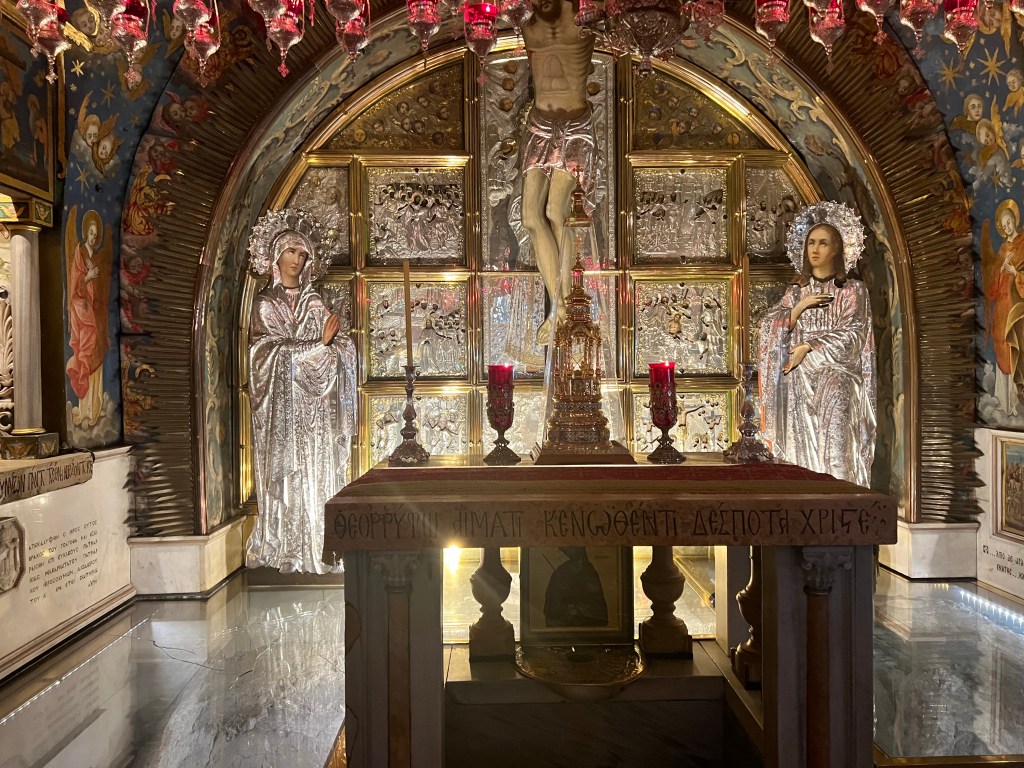
Off we went to the final stop in our morning exploration of the Old City. Both Michael and I had been to Church of the Holy Sepulchre before, but Matthew never had and wanted to. It took us a little longer to get there because we made a wrong turn but in a few minutes we were there. It is a reminder of how close these three important places to Jews, Muslims, and Christians are. For me it is a reminder that no matter what you believe, something happened here. The church is nondescript from the outside and home to seven (7) different churches representing seven different types of Christianity. Home to the spot of the crucifixion, the place where Jesus’s body was ritually washed and anointed, and the cave in which he was buried and then was resurrected, it was originally built by the mother of Emperor Constantine who converted the Roman Empire to Christianity on his deathbed. If you want a detailed accounting of that, read Constantine’s Sword (spoiler alert – it is a very long book). As we entered, once again I noticed how empty it was. The Greek Orthodox church was preparing for a ceremony. We stood to the side and watched the ceremony. You can see some of it below. It is the second time I have been there when there was a mass/ceremony by one of the churches and it was cool to watch.
We stood by the area where Jesus’s body was washed and anointed as a nice, out of work tour guide told us about the church. It was clear how much he was enjoying having somebody to share his knowledge with.
Where Jesus’s body was washed and prepared for burial and then annointed.
We went upstairs to the spot of the crucifixion. I have been up there a number of times but there was always a line to pray at the spot and I never wanted to impede somebody who found it spiritually meaning to just see something that I found interesting. This time there were two people praying and when they left, I was able to walk up and see the spot undisturbed.
The site of the crucifixion
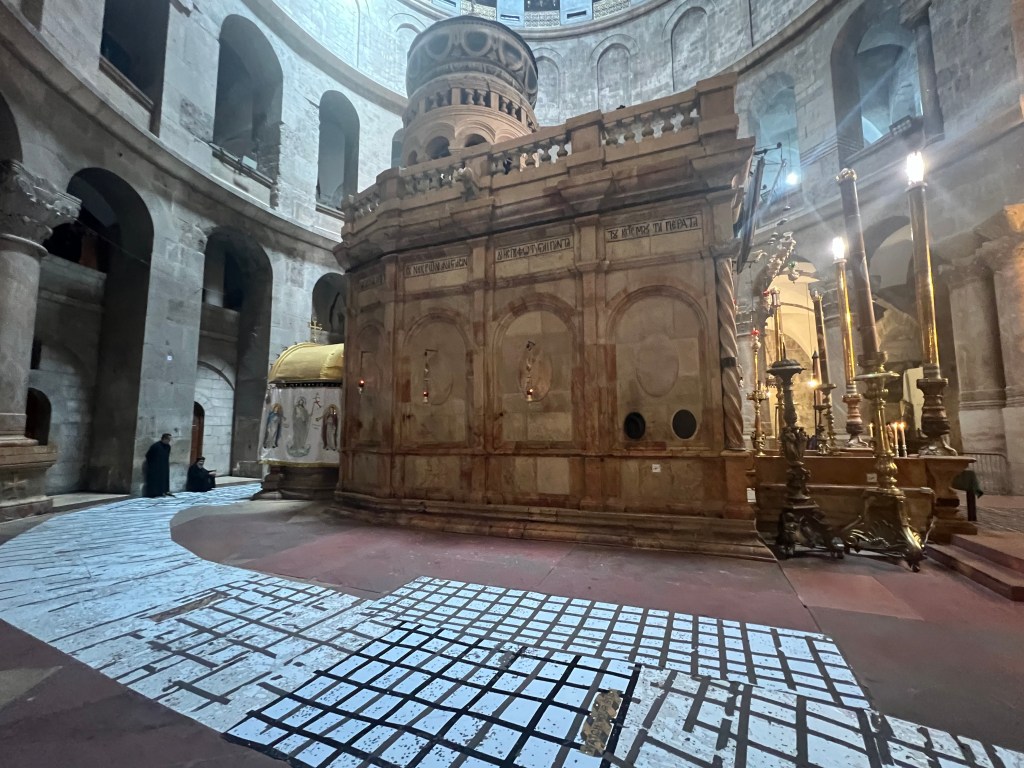
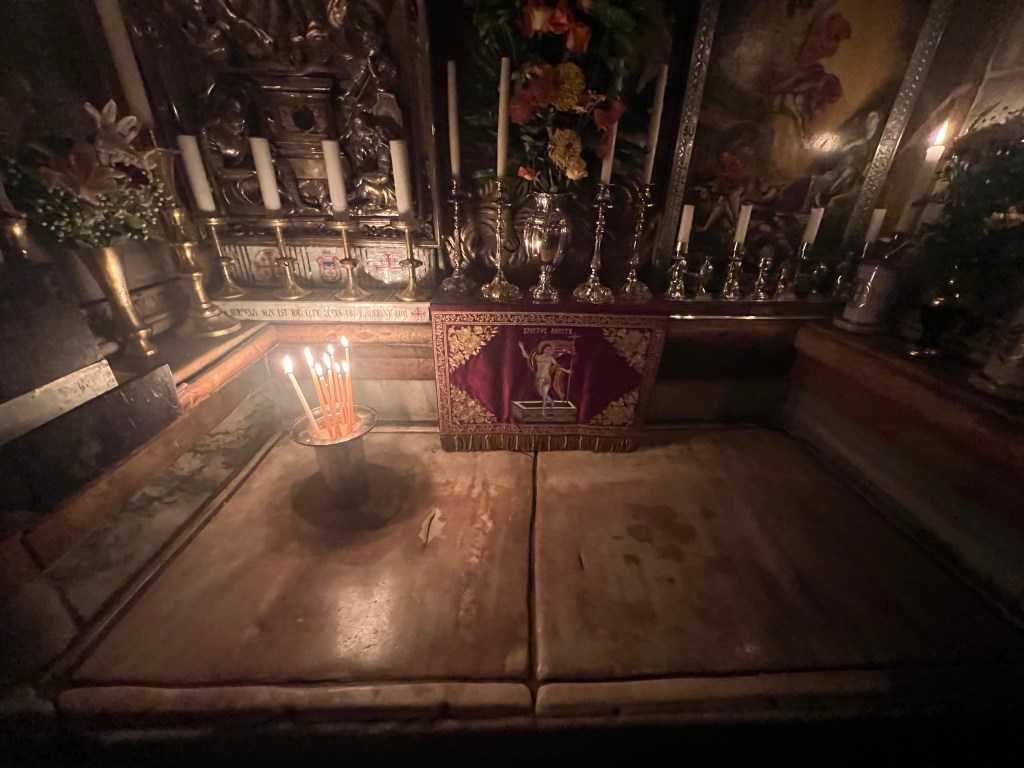
We went downstairs and stood in line to enter the building that protected the cave where Jesus was buried and then the cave itself. Usually, the line wraps around a number of times and it is easily a 15–30-minute wait to get inside. This time there were two (2) people in front of me. Two nuns then came up and we let them go in front of us to enter the cave where Jesus was buried so they could pray. Then we entered one at a time. It is a small area and the place where his body was laid was accessible. The first time I was there, the line was long, so we were rushed. This time there was time to look around and spend a few minutes there. It isn’t what I believe and doesn’t have spiritual meaning to me. It was very meaningful to be in such a holy site to so many of my friends and others in the world. I realized how many of my friends would never have the opportunity to be right where I was at that moment. Gratitude flooded me.
The building protecting the cave where Jesus was buriedWhere Jesus was buried. His body was laid on this slab
We left the church and headed to Ben Yehuda Street to do some shopping. Our trip was busy, and we didn’t have much time to buy anything. I had requests to buy three things. My oldest son wanted a Star of David necklace. My younger son’s girlfriend wanted a piece of art to put on her wall. And all three of them wanted the ‘cow chocolate’ from Israel (it is a special brand that is delicious). Since it was still only 5 am at home, I shopped, took pictures and sent them for them to view when they woke up hours later so I could go back and buy what they wanted, and enjoyed a quiet Ben Yehuda Street.
In 2019 I participated in a program called Encounter. It takes Jewish leaders into the West Bank/Judea and Samaria for four (4) days to interact with members of Palestinian Civil Society. It was a powerful trip for me. You can read about it in my many blog posts starting here. One of the people that I met at that time was named Mahmoud and during the day we spent together he said a lot of things that stuck in my head. Some I agreed with. Some I disagreed with. Some just stuck and I have been chewing on for 4 ½ years. I had reached out to him over the past four years a number of times to check on him during Covid and the start of the war. Since I was coming to Israel I asked if he would be willing to meet and spend some time talking. Today was that day. Matthew came with me as this would be the first Palestinian that he would meet and listen to. We walked from Ben Yehuda Street through a number of Arab/Palestinian neighborhoods until we got to the American Colony Hotel where we were meeting. On the way there was a Palestinian Christian school letting out and we saw the kids with their backpacks being picked up by their parents. It could have been any private school anywhere in the world and was a beautiful thing to see. Matthew and I talked on the walk about how few people would do this out of fear, yet we felt safe as we walked.
My morning was a great and meaningful morning. For my final day in Jerusalem, it was an amazing way to connect spiritually and appreciate how lucky I am to go to sleep in Jerusalem, wake up in Jerusalem, and walk the streets of Jerusalem. This was a dream for my ancestors for 2000 years that I get to do on a regular basis. I think prior to this trip I took that for granted. I won’t any longer.
Rather than continue with my conversation with Mahmoud which would make this post far, far too long, I am going to stop here and my next post will be about that conversation. This morning was about celebrating the beauty of Jerusalem and the freedom Israel provides to all religions. The access I had today to these three sites has only been possible since 1967 under Israel. I won’t ever take that for granted.
Approximately 20 years ago at an AIPAC Policy Conference, I attended one of the breakout sessions to learn a bit more about a detailed topic. The presenter, Professor Ken Stein from Emory University, blew my mind with details and facts that I didn’t know. I sat there taking notes with tons of questions forming in my mind. There were so many of them, I had to write those down as well. After the session, I went up to talk with him and ask some of those questions. It was an inauspicious start of a friendship and professional relationship that lasts until today.
My friend Professor Ken Stein
I made it a point to always attend Ken’s sessions at AIPAC. I was amazing that he was the only speaker on Israel that I found nobody had a problem with. They may ask tough questions, but Ken wasn’t trying to do Hasbara (trying to convince somebody you are correct) but rather shared the facts and allowed you to determine your own beliefs. As a result of this, I brought Ken to Seattle and then to Orlando to teach about the history of Israel.
In 2008, Ken created the Center for Israel Education (CIE), a nonprofit dedicated to educating the public about modern State of Israel. Using source documents, CIE provides context to a challenging topic. A number of years ago, I was honored when Ken asked me to join the board of directors and I have been a member ever since.
Each week, CIE provides information that is both timely and interesting. Sometimes it is related to, “This week in Israeli history” while other times it relates to what’s happening in the world. I find it interesting and learn a lot about people and policies that I didn’t know. This week’s information was particularly interesting for two reasons.
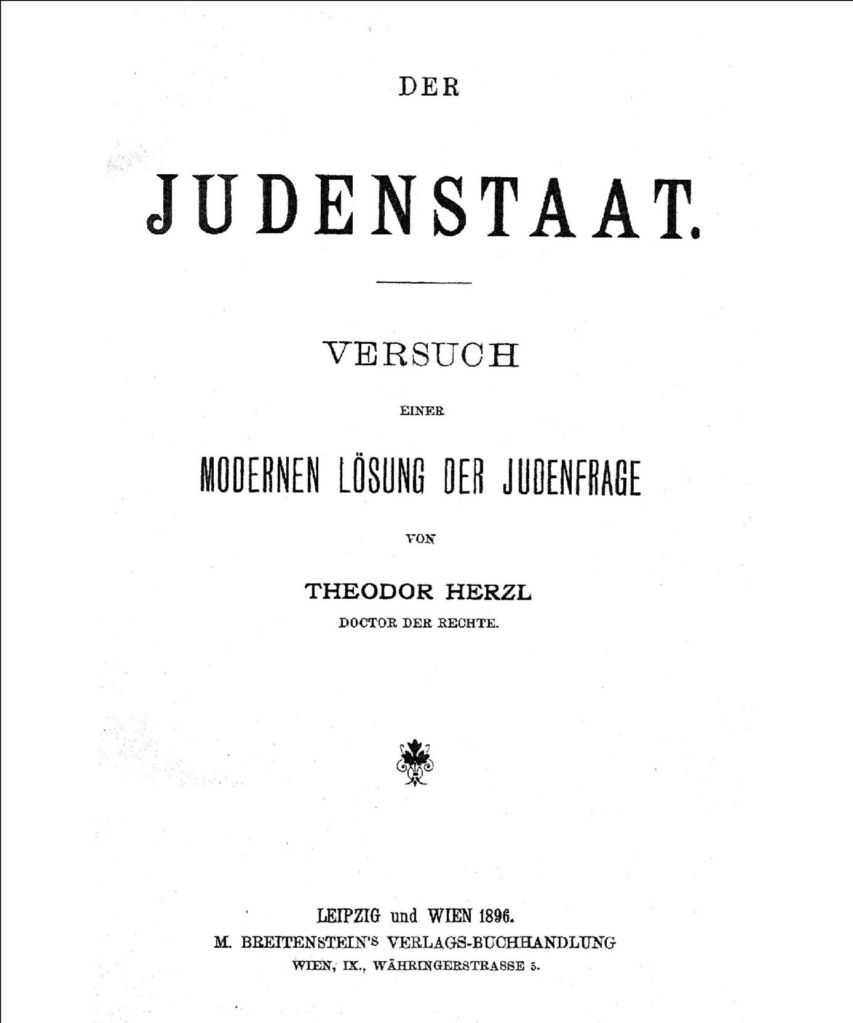
The first reason relates to ‘This week in Israeli history’. On Feb. 14, 1896, Vienna journalist Theodor Herzl published 500 copies of a pamphlet entitled “Der Judenstaat” (“The Jewish State”), declaring the need and justice of Jewish sovereignty 18 months before he convened the First Zionist Congress. I’ve been to Israel 20 times and been to Herzl’s grave at least 20 times. It’s a powerful place to visit as he was the person who had the vision of a Jewish state. Whenever I am there, I find myself humbled by his vision and always remember his famous quote, “If you will it, it is no dream.” That quote has inspired me throughout my career.
Theodore Herzl – the founder of Zionism
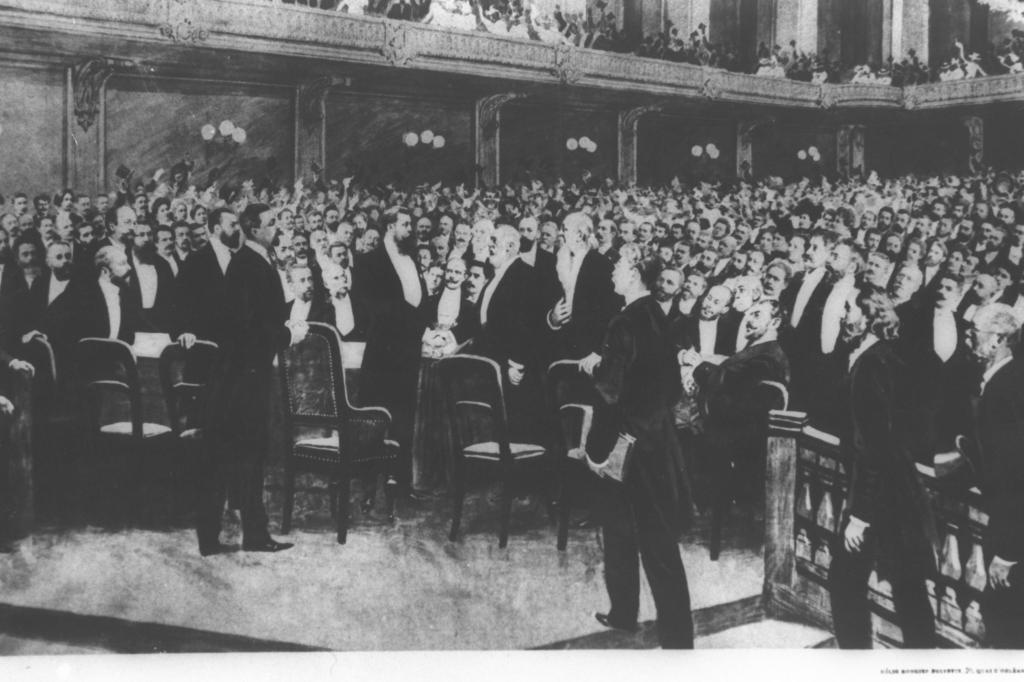
Interestingly enough, Herzl’s idea wasn’t limited to the middle east or to the historic greater Israel. He merely wanted the Jewish people to have their own land where they were in charge and had self-determination. He wrote about It wasn’t until the First Zionist Congress held in Basel, Switzerland with 200 delegates from across the Jewish world, that the goal to establish a Jewish State in the Land of Israel were explicitly adopted by the new Zionist movement.
Theodore Herzl at the First Zionist Congress in Basel on August 25, 1897
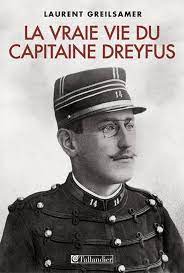
Herzl, as a secular Jew and journalist, was inspired by the Dryfuss Affair to find a way to keep Jews safe. It was his vision to have a Jewish State, a homeland, where Jews would be in charge and Jews would be safe. Where Jews would have the power of self-determination. He didn’t care where it was, only that it existed. It was at the First Zionist Congress that non-secular Jews, who understood the tie to the biblical land, ensured that the land would need to be in our historic homeland, not just anywhere.
The Dryfuss Affair on the cover of The New Yorker
Captain Alfred Dryfuss, wrongly convicted because he was a Jew.
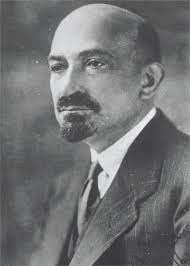
It ties to the famous Chaim Weizmann quote. When a member of the House of Lords asked him, “Why do you Jews insist on Palestine when there are so many undeveloped countries you could settle in more conveniently?”
Weizmann answered: “That is like my asking you why you drove twenty miles to visit your mother last Sunday when there are so many old ladies living on your street?”
Wiezmann said, ‘Mr. Balfour, if you were offered Paris instead of London, would you take it?’ … He looked surprised. He said: ‘But London is our own!’ Weizmann said, ‘Jerusalem was our own when London was a marsh.’ He said, ‘That’s true.'”
Dr. Chaim Weizmann, one of the great founders of the State of Israel
Having been to Israel 20 times in my life, there is something special not just because it is a Jewish state and the only place that I am in the majority. Being in Jerusalem and standing at the Kotel is a direct connection to King Solomon. It’s a direct connection to the ‘holy of holies.’ To 5,000+ years of Jewish history.
Being at the Kotel is always such a special feeling
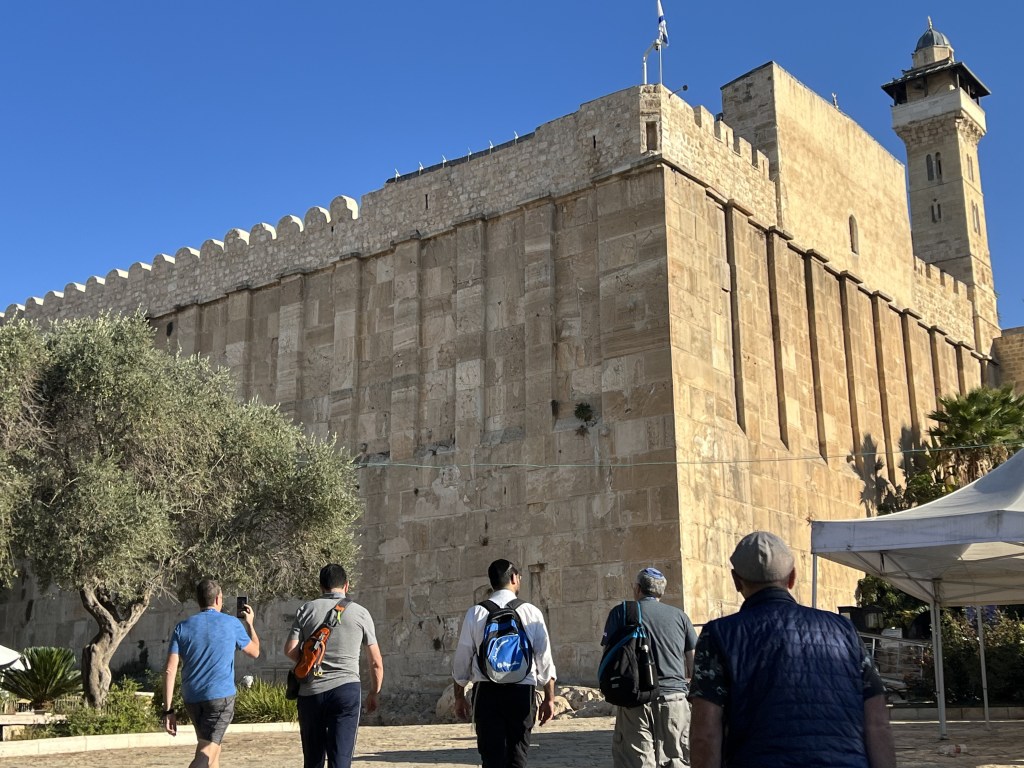
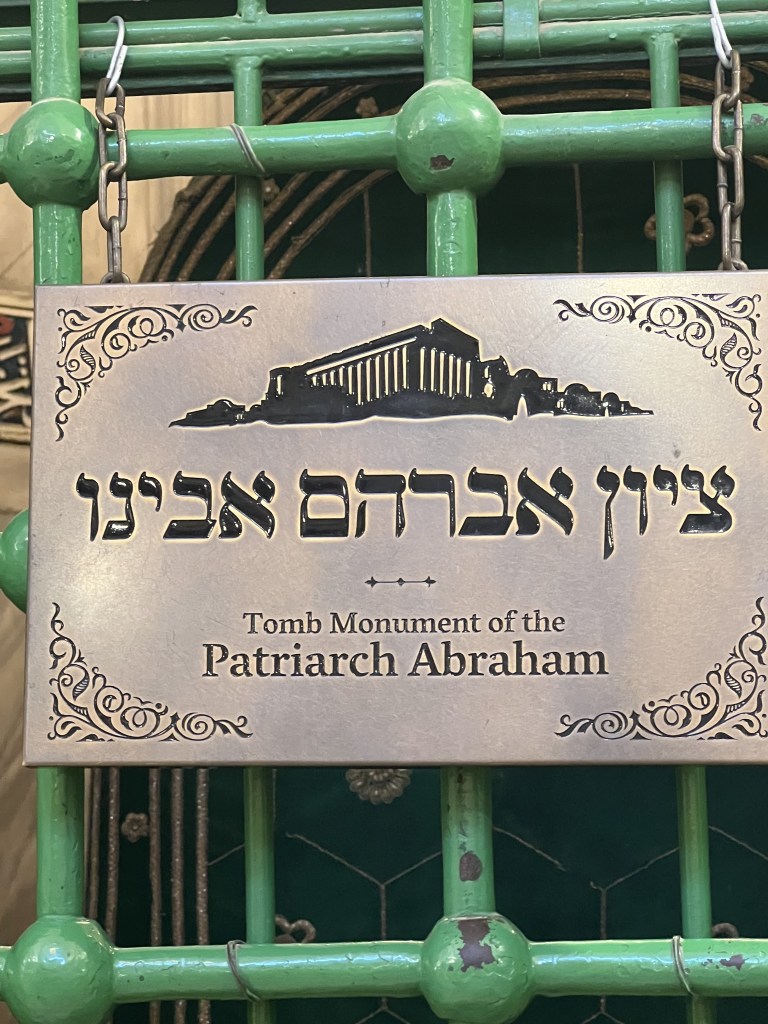
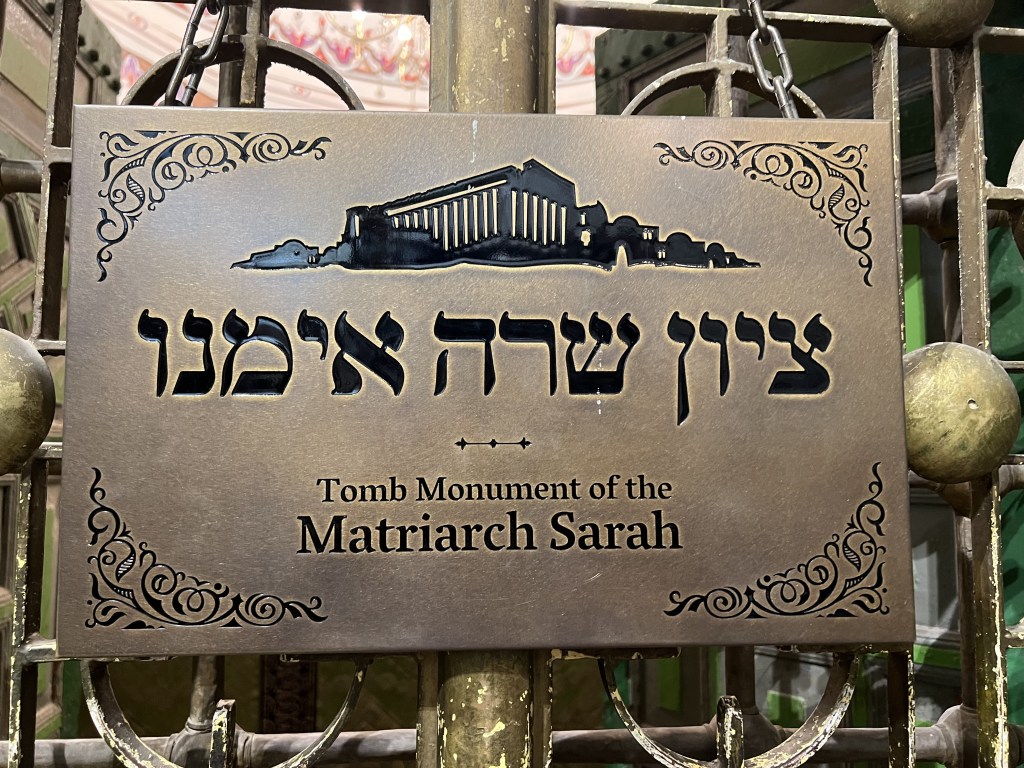
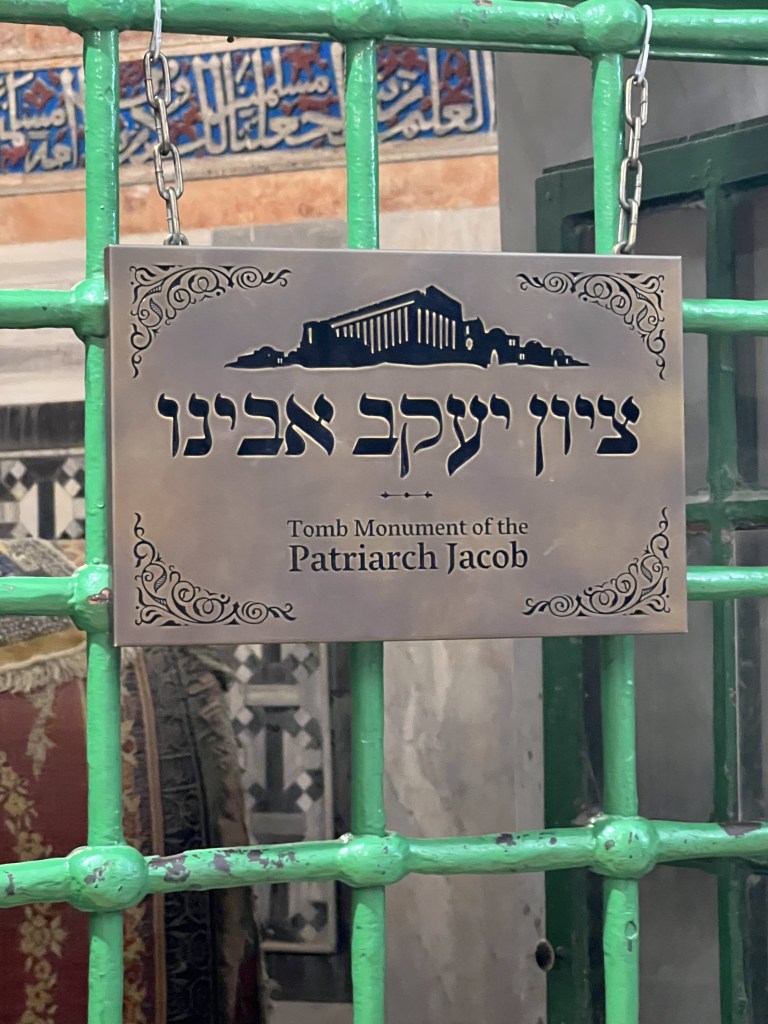
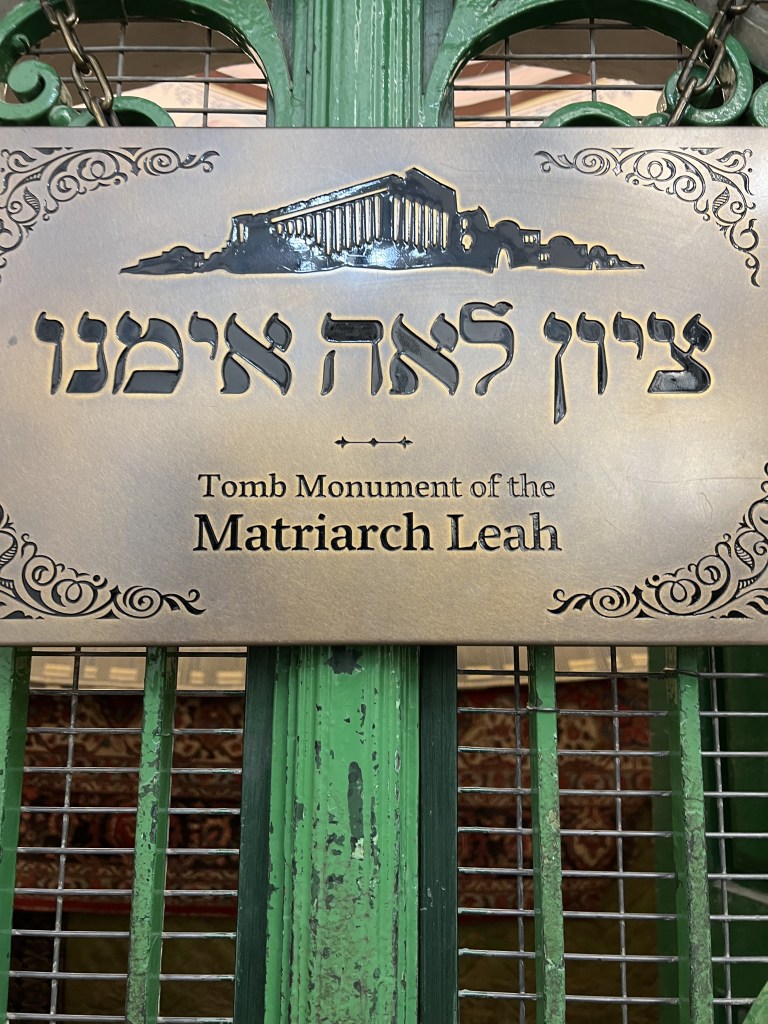
Going to Hebron and visiting the graves of Abraham, Jacob, Sarah, and Leah is a special feeling. (Isaac and Rebeca are also buried there but they are on the Palestinian side so Jews can only go there 10 days a year). I’ll never forget sitting between the graves of Abraham and Sarah as my friend Harry Rothenberg led us in a discussion focused on the text where Sarah was told by God that she would get pregnant when she was 90 years old, and she laughed. We explored not just the story but the love story of Abraham and Sarah. It was incredibly powerful to do this between their graves. It’s something I will never forget.
We also learned that one of times when all of the Tomb of the Patriarchs and Matriarchs is open to Jews, Christians and non-muslims is during the Shabbat of Chayei Sarah. This is when Sarah dies and is buried in Hebron. There are 40,000-50,000 people who come to spend Shabbat outside the Tomb. They bring in catered meals, tents, and it’s a huge party. Watching the videos of the celebration put this on my bucket list.
In Hebron, the oldest complete building still used for it’s original purpose in the world. Inside are the caves (graves) of the Patriarchs and Matriarchs.
Below is the cave with the grave of Abraham, the patriarch.
Across from the cave of Abraham is the cave of Sarah our matriarch, where Abraham buried her himself.
The grave of Jacob, our patriarch. He wrestled with the angel and got the name Israel. It’s unbelievable to be at his grave.
The grave of Leah, our matriarch. Rachel was buried on the road (her grave is in what is now Bethlehem) while Isaac and Rebecca are on the side controlled by the Palestinians and are only accessible 10 days a year to Jews.
I’ve been the Tomb of Joseph, not too far from Nablus. There is something unique and special being there, knowing his story and how integral he was to the Jewish people. It’s hard to explain the feeling of connection, of thousands of years of history, and of peoplehood that occurred for me there.
The tomb of Joseph in Nablus. When I was there it was packed with Jews praying over his grave.
Being in the Jordan River is another unique experience. This is where our people crossed over to enter the land of Canaan after leaving Egypt. The history and connection is amazing. It was smaller than I expected and reminded me of the Ichetucknee River outside of Gainesville, Florida, that I used to go tubing down in the summer. I had imagined this powerful river that was both wide and deep. It’s the same river my ancestors crossed thousands of years ago as they entered ‘the land of milk and honey’ for the first time.
Rafting down the Jordan River is always fun – on one trip we went with a group of Muslim women who were fully clothed while we were in bathing suits. They started a splash fight with us and we had so much fun with them.
As you drive through Israel you see the field where David slew Goliath. In Tzfat you see the fields where Lecha Dodi was inspired, the mikvah of the Ari, various ancient synagogues. In Akko the excavated buildings from the crusades exist. You can see the Dead Sea Scrolls. It’s a land filled with rich Jewish history everywhere that you turn. That’s what Herzl didn’t understand but was smart enough to listen the First Zionist Congress. It’s why the modern State of Israel is home to all of us. It’s not just a country of Jewish self-determination. It is our historic homeland, our past, present, and future. It is tied to our souls as anybody who has visited there, Jewish or not, will attest. I’m grateful that Herzl listened to the delegates at the First Zionist Conference and wouldn’t accept just anywhere. Israel is my mother that I travel 6,500 miles to visit and it’s worth it every time.
Looking out on the fields in Tzfat. This is what inspired L’cha Dodi and where they would walk out to meet the Shabbat Bride each Friday night.
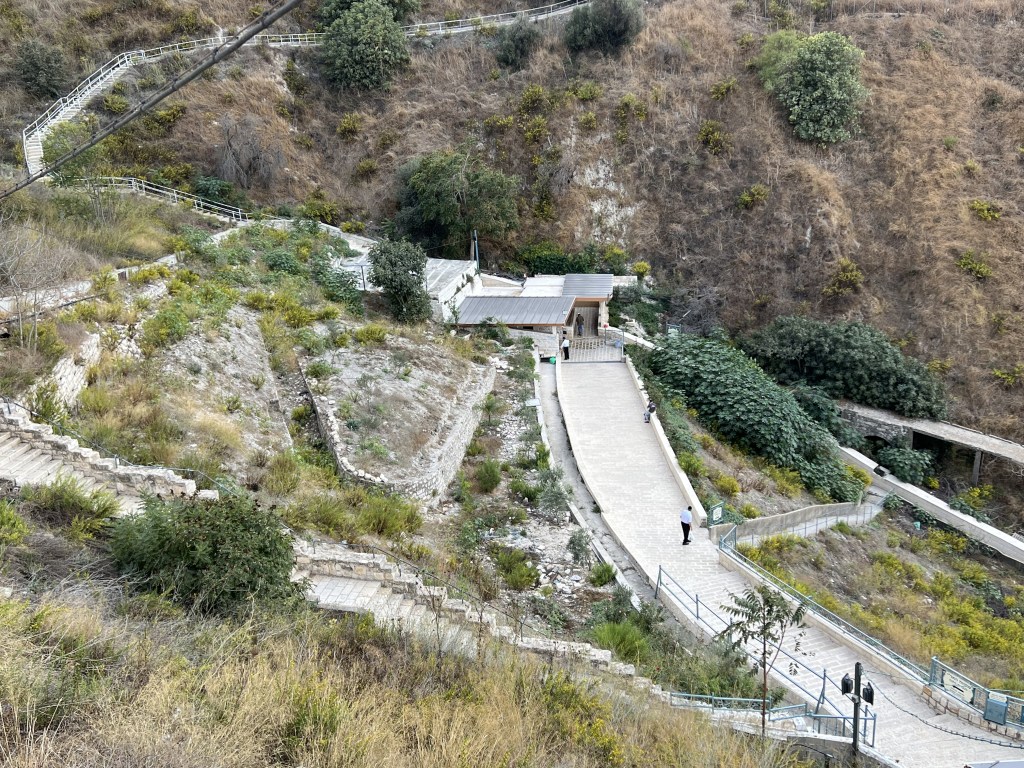
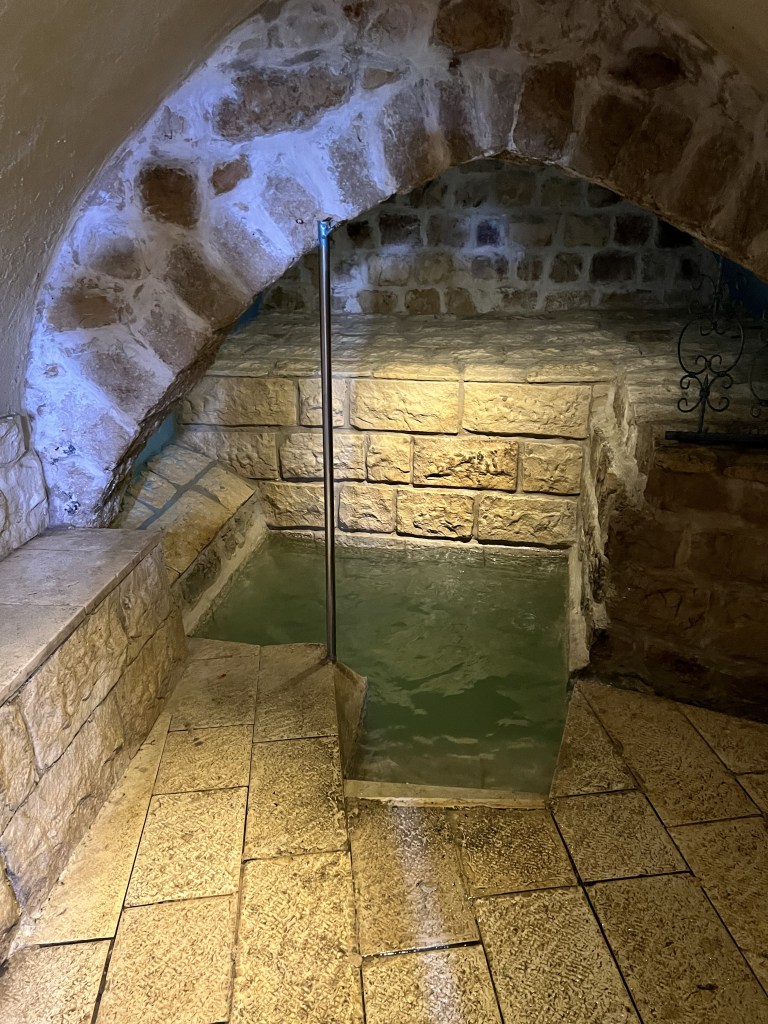
Looking down at the Mikvah of the Ari from the 1500s. It’s inside the building. He used in the 1500s and I used in in 2021 and 2022. That’s the power of Israel for Jews.
The actual Mikvah itself. The Ari used it in the 1500s, stepping into the same pool (not the same water) as I did in 2021 and 2022.
The second piece of information that I found fascinating goes back to 1993. During the Knesset debate over the Oslo Accords in September 1993, then Foreign Minister Shimon Peres warned that “There are in Gaza this year between 750,000 and 800,000 inhabitants. Within 20 years, there will be almost 2 million residents in the Gaza Strip. The population density leads to violence, the poverty leads to terrorism.” If you read his full remarks, it is fascinating to apply them to today.
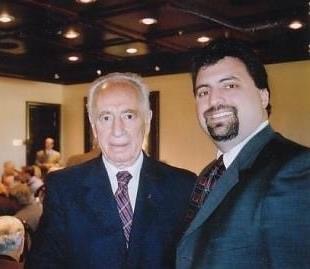
I met Shimon Peres more than 20 years (and 70 pounds!) ago. A truly special man and leader.
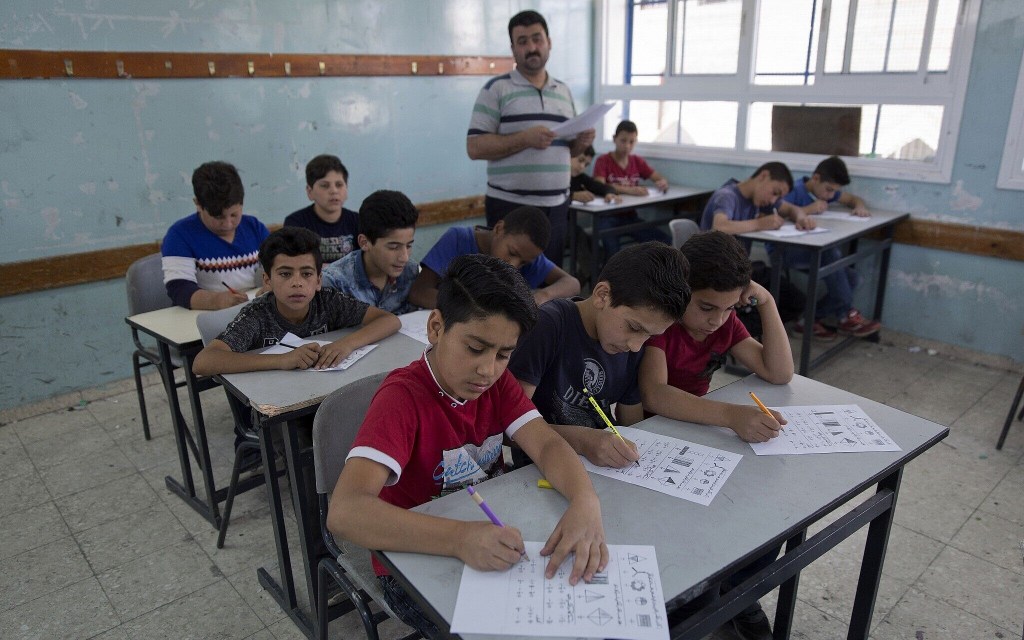
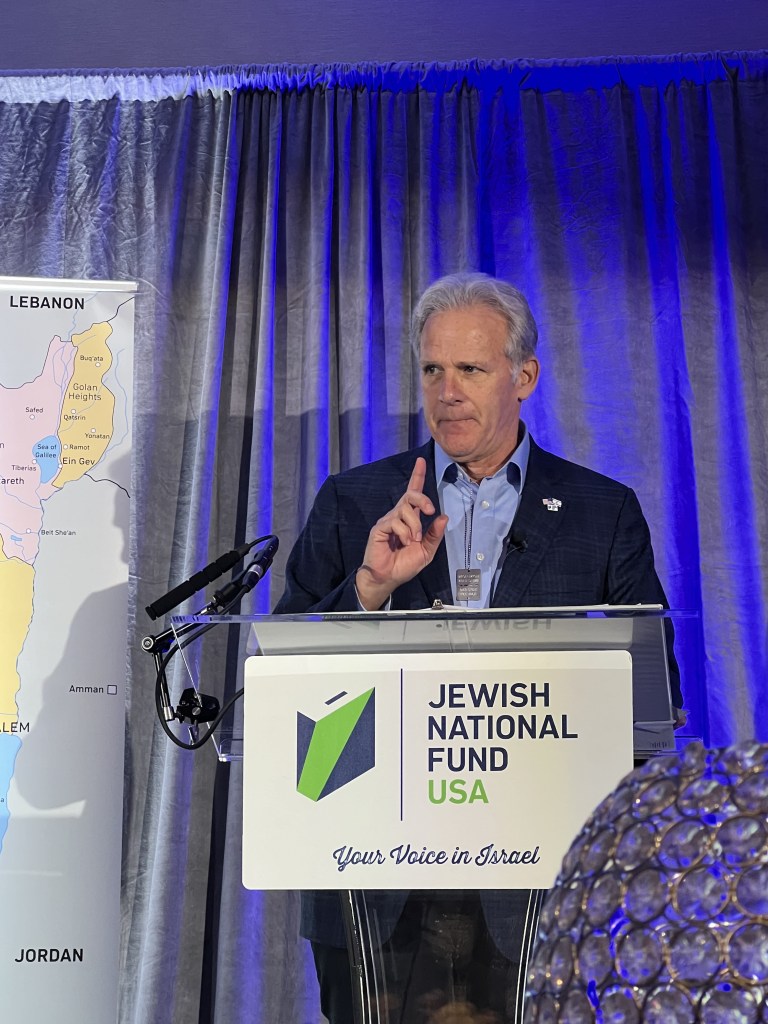
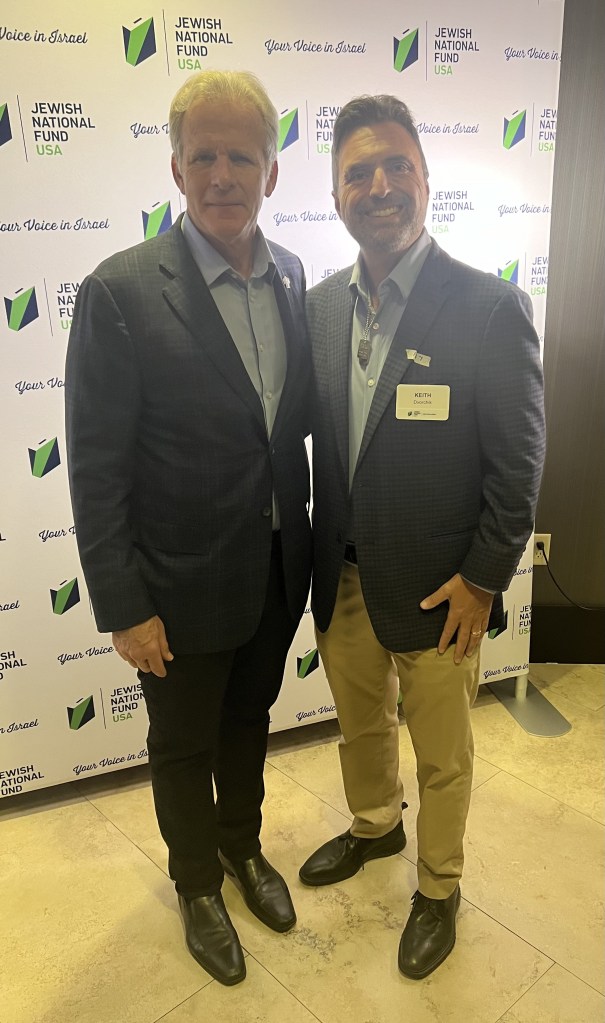
As Israel continues to respond to the horror of October 7th, there are more than 2 million people in Gaza. Life there has led to violence and terrorism. Hamas, UNWRA, and the UN have contributed to these problems. At a JNF lunch event today, Ambassador Michael Oren told us that Israel is figuring out how many of the terrorists on October 7th were taught at an UNWRA school. I’m afraid to see how high that number will be. UNWRA ignored or allowed the strategic headquarters of Hamas to be built in tunnels under the UNWRA headquarters. The textbooks are filled with antisemitism. Even children’s programming is targeted to hate and kill Jews. The Hamas version of Sesame Street, Tomorrow’s Pioneers, is focused on murdering Jews. This clip blames the Jews for a character cheating in school. Shimon Peres was right about the growth in Gaza and what the consequences would be. October 7th proved him right. The question is how do we move forward from here?
The textbooks provided by UNRWA to the Palestinian/Gazan children are filled with antisemitism and Jew hatred.
In the same warning, Peres stated, “Neither do I propose that we talk of economic cooperation. Why? Because the Arabs believe that the State of Israel wants to dominate the region. We do not want to do the Arabs any favors. I am not even suggesting economic cooperation with the Arabs. All I am telling the Arabs is this: There are problems that will remain unresolved unless we tackle them jointly. We should make a joint effort only when problems are insolvable without such a joint effort.”
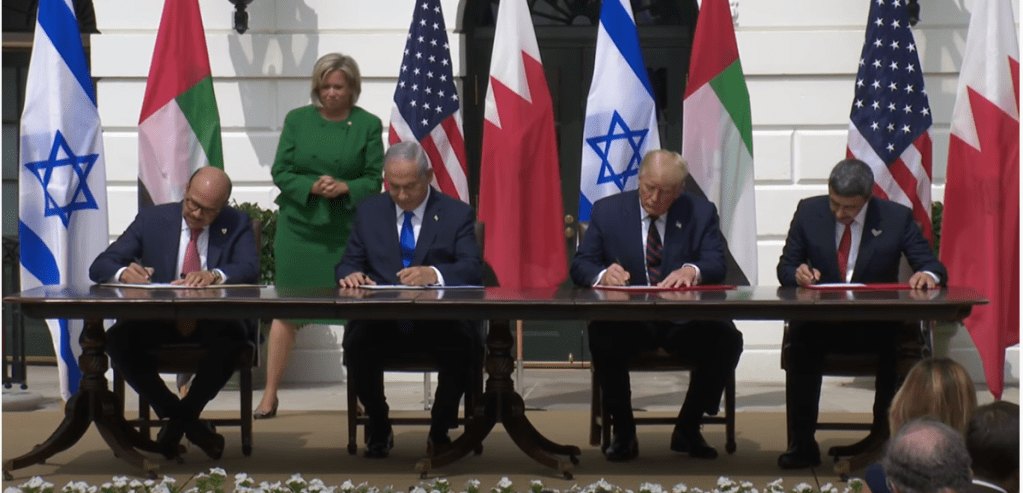
Was this Peres foreshadowing the Abraham Accords? The threat of Iran brought Arab countries together to recognize Israel, forever changing the dynamic. The Iranian problem was insolvable without a joint effort. After October 7th, these nations did not abandon Israel. They understand that Iran is the problem and that it’s insolvable without Israel being a part of the solution. Could this be the basis for a new government in Gaza and perhaps the West Bank/Judea and Samaria? Could this be the key to rebuilding Gaza and finally making it into the ‘Singapore of the Middle East’? Could this be the basis for peace and a willingness to live together?
An incredible picture of the signing of the Abraham Accords as more muslim countries recognize and normalize relations with Israel.
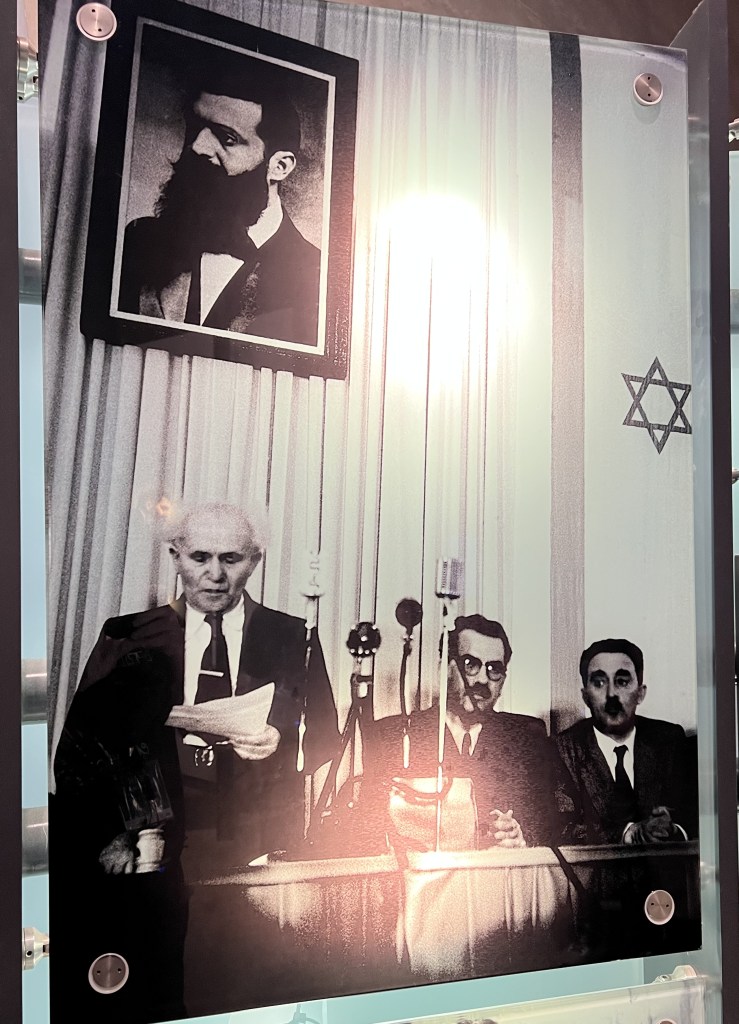
I find myself looking to some of the great Israeli leaders of the past for inspiration on a regular basis. David Ben Gurion. Golda Meir. Shimon Peres. Yitzhak Rabin. Moshe Dayan. Menachem Begin.
Picture of Ben Gurion reading the Declaration of Independence in Independence Hall
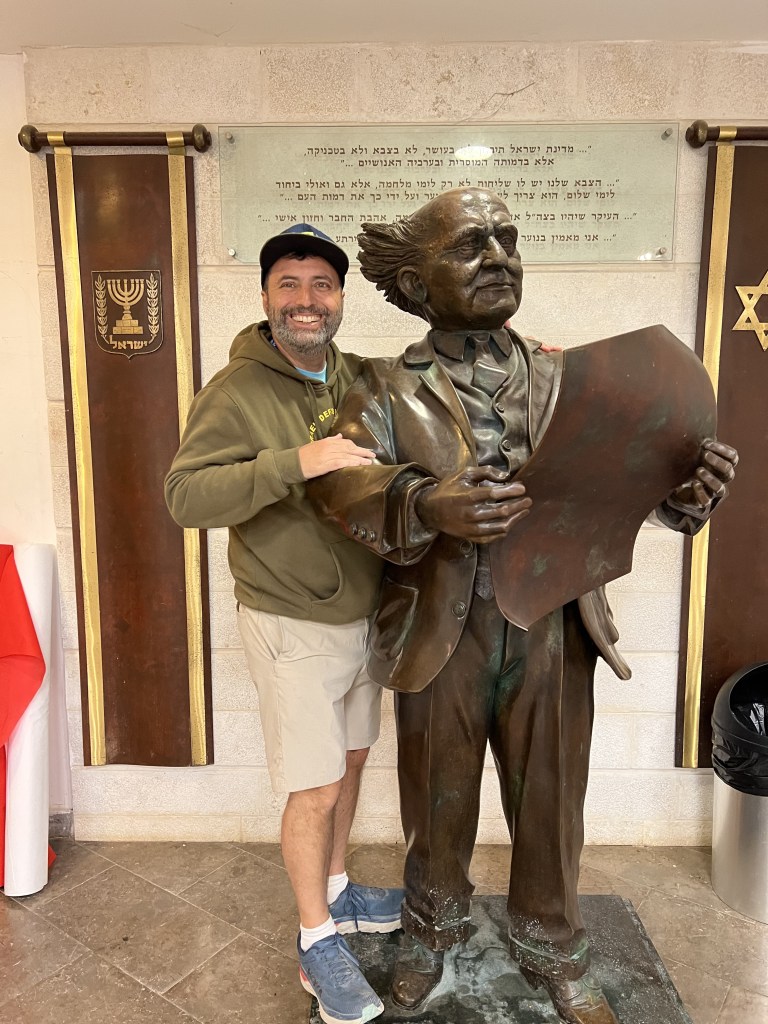
When I saw this statue of Ben Gurion, I had to get a picture with it. The more I learn about him, the more in awe I am of who he was and what he did.
I think of current Israeli leaders such as Ambassador Michael Oren, Ambassador Ron Dermer, and the many Consul Generals I have had the pleasure to interact with and befriend. We are wise to listen to their insights. Michael Oren has a substack that I now subscribe to. Their words are treasurers.
Michael Oren speaking in Orlando this week at a JNF event. A future blog will talk about what he said.
Talking with and listen to Michael Oren is truly incredible. A brilliant man to learn from
Two of my favorite Ben Gurion quotes are:
“Dare, Persevere, Succeed.”
“Pioneering is refusing to accept reality as it is.”
As I look back at Herzl and at the words of Peres; as I look forward to ‘The Day After’ and the Abraham Accords, these two quotes inspire me for the future of Israel. And they inspire me personally. We change the world by being daring, persevering, and succeeding. And by being pioneers and not accepting reality as it is, we have the opportunity to create a new reality. A new dream. “If you will it, it is no dream. Dare, persevere, succeed. Refusing to accept reality as it is.” Three quotes that sum up Israel and the Jewish people. Three belief systems that will change your life and change the world.

















 keithdblog