Goebbels died but his teachings are living on

“If you tell a lie big enough and keep repeating it, people will eventually come to believe it.”

Joseph Goebbels

I remember learning about the Nazi propaganda as I grew up.  What a masterful job they did spreading lies and breeding hatred.  Cartoons.  Videos.  Posters.  Slogans.  They kept at it, repeating the hate towards Jews until people believed it was true.  When I walk through Yad Vashem, Israel’s Holocaust Museum, they do an incredible job highlighting just how the Nazi’s did it.  With all the documentation available to us, I was sure the world wouldn’t fall for the same trick twice.  As the old saying goes, fool me once, shame on you.  Fool me twice, shame on me.

I was wrong.  Very wrong.  So wrong that it scares me.  I watched what happened on the campus of Columbia University and also at Harvard, Yale, UCLA, Michigan, and many others.  These ‘students’ who are supposed to be learning and challenging themselves were instead lemmings.  They were so strong in their chants yet so empty in their knowledge.  Most didn’t know what river or what sea.  Most didn’t even know what protesting was like or was about.  They expected catered meals.  Finals cancelled with everybody getting an A.  No consequences for their actions.  They weren’t protesting for things they believed in but rather for things they were told that aren’t true.  It was horrifying.  It was embarrassing. 

It escalated to potential violence many times until eventually there was violence.  The violence against Jewish students got minimal attention.  A woman stabbed in the eye at Yale.  Physically assaulted at Columbia.  Beaten unconscious at UCLA.  When it became clear that the University and the police were going to do nothing to protect them, the Jewish students and community tried to dismantle the tents themselves which resulted in more violence.  That violence did get media attention because it could be blamed on the Jews. 

I watch as ‘celebrities’ like Susan Sarandon, Mark Ruffalo, John Oliver, and John Cusack spew hate and lies.  Because of their celebrity status, they have a platform to spread their antisemitism and misinformation.  Key words like genocide, apartheid, famine, ceasefire are used to demonize Israel, regardless of any facts to back them up.  People believe what they hear, especially when it’s in bite size pieces and as Goebbels said, “If you tell a lie big enough and keep repeating it, people will eventually come to believe it.”

Chants are common now to ‘Globalize the intifada’ while most of those chanting it have no idea what the intifada was or what an intifada is.  Violent uprising.  Suicide bombers.  Innocent civilians murdered.  So, to stop innocent civilians from being killed during a war, we are going to murder innocent civilians.  Civilians killed in war at a ratio 9 times less than the UN and Red Cross accepted numbers is a genocide but calling for the murder of civilians because they are Jewish is acceptable?  This is the world we live in where Jew hatred is so strong that the obvious hypocrisy is allowed.

The use of the world genocide is right out of Goebbels playbook.  Genocide is a hot button word and is a horrific thing.  In Syria over 300,000 civilians were murdered by Assad.  Close to 200,000 people were killed in the Iraq war.  In 2022 more than 100,000 people were killed in the Ethiopian civil war.  Since 1996, more than 6 million people have been killed in the Congo war.  These are not called genocides despite the numbers being far more than the people killed in Gaza.  Yet despite not meeting the definition of genocide and the facts showing this war is anything but genocidal, the word keeps getting used over and over and over again.  There are people who now believe it because they have heard it so often.  What Hamas did on October 7th was genocidal.  They wanted to eliminate every Jew and Israeli just because they were Jewish or Israeli.  They publicly admit to genocidal wishes and yet people excuse it.  This is the power of constant repetition until people believe it’s true even when it is not.

Apartheid is another word inappropriately used to delegitimize the State of Israel and Jews in general.  Israel is not an apartheid state.  Citizens have equal rights regardless of their status as Arab, Christian, Druze, Baha’i, Bedouin, or Jew.  Those who are not citizens, like in any country, don’t have the same benefits as those who are citizens. That isn’t apartheid.  There are Arab members of the Supreme Court, the Knesset, in universities, serving in the military, and in every part of Israeli society.  There is apartheid happening in the middle east – in the Arab countries that won’t allow Jews.  Gaza was an apartheid state where Jews were not allowed.  I remember going through the Rafah crossing in 1989 as I took the bus from Jerusalem to Cairo.  That wouldn’t have been possible in 2023. 

The other word that gets used improperly and often is genocide.  Genocide is defined as, “the deliberate killing of a large number of people from a particular nation or ethnic group with the aim of destroying that nation or group.”  So, if you want to say Israel is committing genocide against Hamas, you might be correct.  They are a terrorist organization who had their own genocidal intentions on October 7th and continues to say they will do what they did on October 7th over and over and over again.  To say that Israel is committing genocide in Gaza is simply false.  If they wanted to commit genocide, then on October 8th they would have carpet bombed Gaza and nobody would be left alive.  Instead, Israel has been tactical.  They have done all they can to avoid civilian deaths.  This is shown in the ratio of combatants to civilians killed in this war.  According to the UN and Red Cross, the normal ratio is 9 civilians for every 1 combatant.  Depending on what Hamas numbers you believe, Israel is somewhere between 0.6 civilians to 1 combatant to 1.2 civilians to 1 combatant.  Well below the normally accepted ratio for every other country and every other war in the world.  Genocide is used to inflame people.  It’s used to inspire hate and physical attacks on Jews.  It is a bold-faced lie that gets repeated, especially by those celebrities, over and over and over again.

Occupation is the fourth word that gets used regularly.   Israel withdrew from Gaza and removed its citizens by force in 2005.  That’s the fact.  Since 2005, there has been no occupation of Gaza.  So, saying it is because of the occupation is simple another lie.  People may then talk about the blockade.  The blockade was put in place when Hamas took over and started firing rockets at Israel and building tunnels to kidnap Israelis.  It exists by both Egypt and Israel to do their best to limit rockets and missiles and guns from getting into Gaza.  It doesn’t limit food or medicine.  Saying occupation or blockade is merely a way for uneducated people to attempt to place the blame on Israel and the Jews.

The newest lie, which occurred tonight, is that Hamas accepted the ceasefire offered by Israel and Israel still attacked Rafah.  The reality is more like this:


Israel: Here is our ceasefire offer.

Hamas: No

Israel: Here is option 2 for a ceasefire.

Hamas: No

Hamas then bombs the reopened humanitarian corridor.

Israel: Fine, we will attack Rafah.

Israel begins to attack Rafah.

Hamas: We will take option 3 which you didn’t offer.  We accept the ceasefire that we negotiated with ourselves. 

The World:  Israel rejected the ceasefire offer that they offered, and Hamas accepted.

Once again, the truth doesn’t matter, and the lie gets repeated over and over and over again.  The media covers the lie.  The New York Times covers the lie.  Papers in Europe cover the lie. 

As we move into the next phase of the war, not just between Hamas and Israel but between those who hate Jews and Jewish people, we need to be vigilant with these lies.  We need to be loud and repetitive in combatting them and telling the truth.  We need to keep it simple and not give a lecture.  I recommend something like this:

Response to lie:  You are lying.

Response to lie:  That’s not true.

Response to lie:  False!!!

Response to lie:  You don’t know what’s true.

Response to lie:  Learn something before you lie about it.

Keep it brief.  Keep it simple.  If they want to know the truth, and most don’t, then they will ask, and you can tell them. 

This next phase will be the most challenging.  We see the violence occurring at UCLA and around the country.  We see it happening in Europe.  I’m afraid that the next phase will involve larger scale attacks against Jewish people, homes, and businesses.  Protect yourself.  Learn the law.  Take self-defense classes.  If you feel the need to be armed, make sure you both follow the laws of your state/country and get trained on how to use it.  The decision to be armed is not one to take lightly and it’s not a joke and guns are not toys. 

If Israel goes into Rafah and ends the war between Hamas and Israel, it will not end the war against the Jewish people.  It will not mean that we are safe in our countries.  It will not mean Israel is safe with Hezbollah, the Houthis and Iran still attacking.  We are preparing to move into a new stage that we only saw a glimpse of with the protests on campuses.  Be prepared.  Never again isn’t just a slogan, it means we are going to take action and do what we have to ensure that it never happens again. 
Yotam Berger wrote this

For the first time in the existance of this blog, I am not writing it. This was written by Yotam Berger, and Israeli PhD student at Stanford. I couldn’t have said it better or clearer so I’m letting his words say what I think and feel. Please read Yotam’s words and think hard about them. You can read the original post (in Hebrew) here. This translation came from Daniel Gordis’s substack Israel from the Inside.

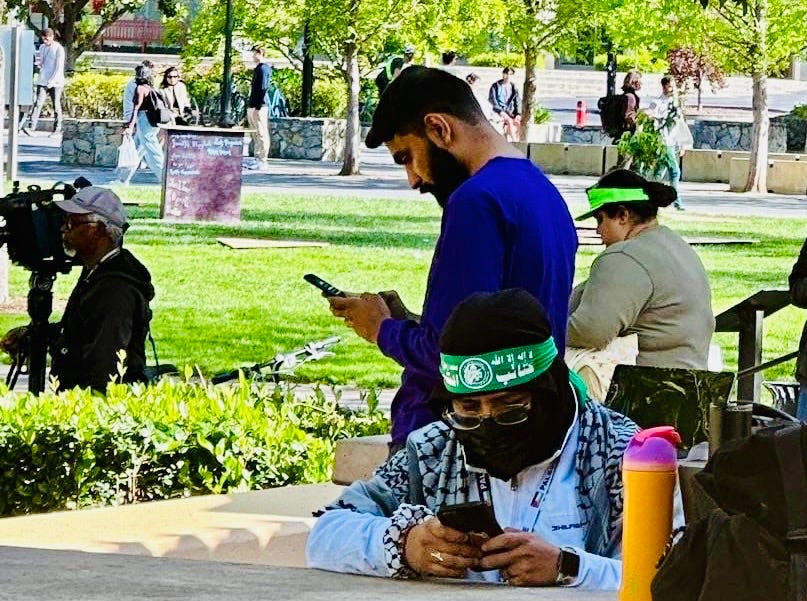
Man in a Hamas costume on the campus of Stanford this week.

Five lessons from Stanford, California 

The academic year in the United States is coming to an end. In a few weeks, the university students graduating will stand on the grass, in caps and gowns. They will excitedly take pictures, shake hands with the deans, and then fly away, making way for a new generation of their ilk.

Ahead of the graduation ceremonies, the anti-Israel student protests at American universities are also increasing. Let’s start with the “all clear” siren. Here at Stanford, at least, the students who sleep on the campus lawns and call for a “global intifada” are—as a rule—not dangerous in the physical sense of the word. But they are very dangerous in the medium and long term, as far as the image of the leader of the free world is concerned.

This is my second year at Stanford. When we returned here in September after the summer break, I intended to finish the year with an approved research proposal and a third of my PhD written. It’s hard to describe how far I am from meeting that goal. In my opinion, I’m not really unusual. Since October, many Israelis abroad have found themselves forced to choose between two options—to put their heads down or become ambassadors without a choice. Who can even write an article when his two brothers are fighting in Gaza? Instead, I found myself spending much of my time on “outreach” activities that I had no intention of taking part in.

Despite this, I learned some very important lessons this year that I will never forget. As the school year comes to a close, and in light of the wave of anxious questions from around the country in light of the current round of campus madness, I thought I’d share the five most important lessons I learned this past year at Stanford, California.

1. Whether we want it or not, we are always—first and foremost—the Jews.

The first year here was a fabulous academic experience like no other. I felt surrounded by international friends. I was given full access to the world’s brightest legal minds. The feeling was that endless opportunities lay ahead. Friends from Israel, who asked already last year if we suffered from anti-Israelism, sounded funny to me. No way!! I am a liberal Israeli. I wrote for the most leftist newspaper in Israel. I did my clerkship in one of the more liberal courts in the Western world. Why would anyone have a problem with me? I walked among those who I thought were friends as equals among equals. I could talk about Israel freely, criticize it and love it, have discussions that I thought were good and complex about the most sensitive issues even with those who clearly disagreed with me. I felt like a citizen of the world.

That was an illusion. There really is no such thing, it turns out, as a “Jew who is a citizen of the world,” as long as the Jew insists on his right to a national existence. For many of those whom I saw as friends, it turned out, I was first and foremost the Jew. At the moment of truth, few of them stood by me on a personal level. Almost none of them stood by me at the national level. Their double standards allowed Israel-hating students to say horrible things about me and my friends, but silenced our every attempt to oppose it. In some places, I had to choose between apologizing for my Israeliness and rejection. There was no choice to be made.

This eye-opening experience also has advantages. It is a litmus test for the human quality of those around us. Some of the people around me went out of their way to support me, or to show gestures of humanity. I found myself surrounded by strong and durable ties. I will not forget these friends easily.

2. America deserves Donald Trump.

An Israeli friend joked to me that if Trump is re-elected president in November, he will walk the halls of Stanford and hand out baklava. It’s a very funny joke only because it’s not entirely imaginary.

November 9, 2016 was a day that struck me with amazement. Like many all over the world, the fact that the United States of America elected Donald Trump as president was unimaginable. In a very deep sense, no matter how many commentaries I read, how many films and documentary series I watched—the appointment of this man seemed inexplicable to me. Unimaginable. Impossible. Even years later, when the words “President Trump” stopped feeling strange on the tongue, the choice of him seemed inexplicable to me. A glitch in the matrix. I couldn’t understand how his campaign could be successful.

This year I finally got it. No, if I were an American I still wouldn’t vote for Trump. But I now understand those who vote for him. Donald Trump is some Americans’ answer to the madness on the other side, a madness I didn’t notice until it turned its face in my direction. A madness no less terrible than Trumps’s madness. No, if I had the right to vote, I would not vote for Donald Trump. But America deserves him.

3. The progressive movement is not a political ally of liberal Zionists.

Last year, the progressive movement seemed like an amusing youth rebellion to me. Yes, the ceremony where everyone announces their gender at the beginning of class seemed strange to me, not always necessary, but not harmful. The fact that I had to declare my race on every form I filled out (and make sure to state that I was “Middle Eastern”) made me laugh, but didn’t upset me. I saw the American progressive movement as the infantile sister of liberal movements that I respected. I saw it as an ally. That was a mistake.

I saw the American progressive movement as the infantile sister of liberal movements that I respected. I saw it as an ally. That was a mistake.

The “progressive” movement is not an amusing anecdote. This week I was exposed to a particularly graphic expression of this. In the “Pro-Palestinian” encampment (in double quotation marks, since a significant number of its residents are unable to point to the country on a map, and it is doubtful that they are able to name a single Palestinian leader) that was re-established in the heart of the campus, a man was photographed in a full terrorist costume—including a black sock hat with a slit for his eyes, and a green Hamas ribbon on his head, next to students who are active for transsexual rights. This strange alliance [DG – since Hamas executes those it considers sexual deviants, which obviously includes transsexuals] is not funny to me.

The progressives are challenging much more than the state of Israel, or the right of the Jews to a nation state. I’m not sure how many of the people who identify as progressives actually hold these ideals, and how many of them are just repeating them over and over loudly, with the intention of gaining some kind of social sympathy. But those of them who hold this position really no longer believe in the existence of “truth,” or in the existence of facts.

I’m not referring here to those who express the opinion that it is difficult to get to the truth, or who think that the courts do not always succeed in finding out what the facts are, or who hold that different ideas are perceived differently through different eyes. I’m speaking about those who say unequivocally that there is no such thing as truth. They are not interested in presenting facts to support their arguments because they do not believe there is such a thing as facts, and they say so explicitly. They think that it is forbidden to use the term “jihadist” in front of jihadists, or to call supporters of terrorism by their names, because feelings are more important than facts (although, of course, first and foremost theirfeelings). They don’t believe there should be consequences for actions, because they don’t believe there should be consequences for anything. Everything can be disputed, because nothing is real. Life is a debate club. It’s not a treat, or at least not just a treat: it’s an ideology. This ideology challenges the existence of objective truth—attainable or unattainable—as an intellectual concept.

4. Always go straight. It is not so important what is said or written about you.

The denial and turning of the backs of those whom I saw as friends, or at least fellow travelers, came with a temptation: to lower one’s head. I do not belittle and I completely understand Israelis who chose this. At this stage, for now, being ashamed of being Israeli, suppressing Jewish symbols, trying to adopt the American accent—can ensure a reasonable quality of life even in places where hatred of Israel is very present. But when the temptation was placed in front of me—to some extent at least— I tried to remember what I had learned from two teachers in recent years.

Attorney Momi Lemberger usually tells his interns to “always walk straight.” When a decision is made in a case—should an indictment be filed? Should the charges be dropped?—The only thing that matters are the facts and the law. It is easy to be tempted to consider what was written in the newspapers. What the minister says. The chance to advance in the system. But considering such considerations inevitably leads to bragging, to losing one’s way. Judge George Kara used to tell his interns that “it doesn’t really matter what they say or write about you.” The facts are more important. Making the right decisions is more important. There is no reason to align with vanities, even if it has some social or public cost.

These lessons are true in relation to greater and much more important decisions than the personal decision of whether to keep one’s head down or insist on externalizing and being proud of one’s Israeliness, even in unpleasant forums. But they are infinitely true when the heaviest price to pay for going straight is that some American PhD students will turn up their noses at you. Since October, I’ve learned that there’s no point in keeping your head down, while there is intrinsic value in the decision to always going straight, to calling a spade a spade.

5. The solution to the university crisis cannot come from below, but it can be parachuted from above.

The kids protesting in these university yards worked very hard to get accepted to Harvard, Stanford, Yale, and Columbia. Most of them are not the “Vietnam generation,” even if that is what they tell themselves. They are the equivalent of the 8200 children and IDF Radio in Israel. [DG – both very prestigious jobs in the army, the former in one of the most respected intelligence units, the latter on the radio, a position very hard to snag.] They worked very hard and paid a lot of money to get here, and they care a lot about how they graduate. More than that, they care what the characters they value think of them. True, they care what their classmates think. Most of them care just as much what the President of the University, the Dean of the Faculty, and even the lecturer in the course think of them.

For many of them, the current wave of protests can be an educational opportunity. American universities repeatedly emphasize the importance of freedom of speech in American culture, the centrality of the First Amendment to the Constitution which guarantees absolute freedom of speech in the American political atmosphere. They can’t shut them up. That is true. But the universities can, and are even obliged, to educate their students. They should not and cannot prevent these children from screaming their demands to spread the intifada or boycott Israel. But they can tell them that they hold very stupid positions.

If university presidents would stop trembling in their own shadows, they could tell their students that they have a right to express stupid views, but that shouting them out won’t make them any more correct. Lecturers cannot silence their students, but they can emphasize that anyone who expresses uninformed or unfounded positions with great confidence is an educational failure. An Israeli—as I discovered—cannot really convince his American counterpart that Israel is not committing genocide, even if there is not even a shred of evidence to support the argument that what is happening in Gaza is genocide. But if the president of the university were to look at his students and express sincere disappointment when they express such a preposterous position, something in a significant portion of those students might shift.

The effectiveness of the “direct information”—in front of the young students—exists, but is very limited and in any case organized bodies can hardly promote it in an inorganic way. The solution, in my opinion, lies in putting pressure on the presidents. And there is urgency in this—today’s generation of presidents and senior lecturers are still old and established people, who were educated in the 1970s and 1980s. They remember the Six Day War and Yom Kippur War. They are liberals, but they are liberals like Bill Clinton. They have respect for Israel. They have no intention of responding to the BDS demands that many of their students voice. In private conversations with Israelis, they also express their feelings of affection for Israel generously. But their feelings of fear of their American students are immeasurably stronger than their affection for their Israeli students. The pressure needs to be put on them. If they are freed from the terror that grips them of expressing their opinion, they can set boundary lines, and these may seep down—to those who want to participate in the “pro-Palestinian” festivals, to make an impression, but want more to be loved by important people in their professional lives.

If we do not take advantage of the present opportunity, we will find ourselves in a short time standing in front of a new generation of presidents and deans. It is not known if they will still have positive feelings—however repressed—towards Israel.