Let’s discuss Zionism

I am a proud Zionist. I’m not afraid to say it. I’m never going to deny it. Those who hate Jews continue to attempt to turn that word in a slur. They want it to be something evil. They don’t understand what it even means. Their Jew hatred has them blind to what it means.

In response to this Jew hatred and attempt to reclaim the word Zionism, those who love Israel have fallen into the simplicity of hasbarah. For those who don’t know, Hasbarah is pro-Israel propoganda. It reduces the concept of Zionism and Israel to talking points without depth, without understanding.

So here we are today – people who hate Jews thinking Israel and Zionism is a racist and hateful ideaology. And people who love Israel thinking that Zionism means that Israel does no wrong. It’s not a helpful place and won’t address the core need.
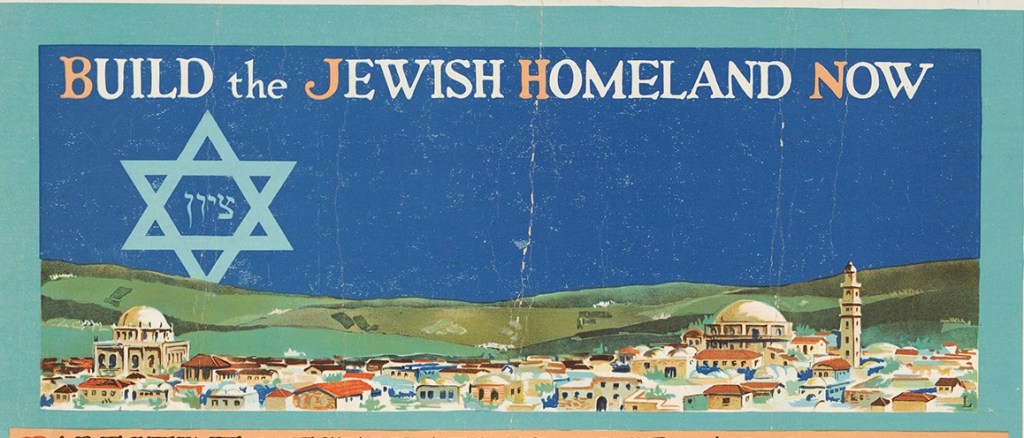
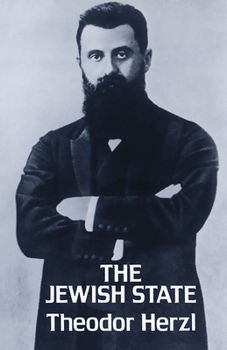
As I spent a few days with my colleague from Dror Israel this week, we talked a lot both among ourselves and with those we were meeting with about Zionism. About what it really means. About the origin. Herzl defined zionism as a political and nationalist movement to establish a sovereign Jewish state in the ancestral Jewish homeland. It came during a time of rising antisemitism as a solution for the homeless Jewish people. Herzl believed that Jews were a nation without a homeland. As a result, the Jewish people had become unwelcome strangers in other nations; a target for hatred. His vision was designed to be both a political and practical one, creating a Jewish national home secured by public law, providing Jews with self-determination and security.  Yet it wasn’t just about the land. Herzl emphasized the importance of restoring the “inner unity of the Jewish soul” and building a strong Jewish consciousness. He famously said, “Zionism is a return to Judaism even before there is a return to the Jewish land”.  It’s far more than just the land although the land is a critical part of it.
If we want to call ourselves Zionists, it means we must know that yes, it is about having our ancestral homeland but it is also about being Jewish. The Zionist experiment, like the American experiment, is far from perfect and far from finished. When David Ben Gurion read the In Israeli Declaration of Independence, he said these words that are written in it:

“THE STATE OF ISRAEL will be open for Jewish immigration and for the Ingathering of the Exiles;
it will foster the development of the country for the benefit of all its inhabitants; it will be based on
freedom, justice and peace as envisaged by the prophets of Israel; it will ensure complete equality
of social and political rights to all its inhabitants irrespective of religion, race or sex; it will
guarantee freedom of religion, conscience, language, education and culture; it will safeguard the holy places of all religions; and it will be faithful to the principles of the Charter of the United
Nations.”

This is what Israel and Zionism is about and strives to be, no matter what anybody else tells you. The simpler explanation that keeps resounding in my head was shared by my colleague Noam, from Dror Israel. He said that Zionism is about being a “just, safe and equally prosperous home for all of its inhabitants.” That is a great summary of Israel’s Declaration of Independence. You may ask, “what about Smoltrich and Ben-Gvir?” To that I would reply, that they are politicians and but a part of a democracy and the Israeli and Zionist experiment. Every country has their outliers and that’s who they are. You may ask, ‘What about Bibi?” and I would reply that in a democracy, sovereign nations have the right to elect their leaders. They don’t always choose who we may want or make the best choices. All you have to do is look back at the history of the American experiment to see that.
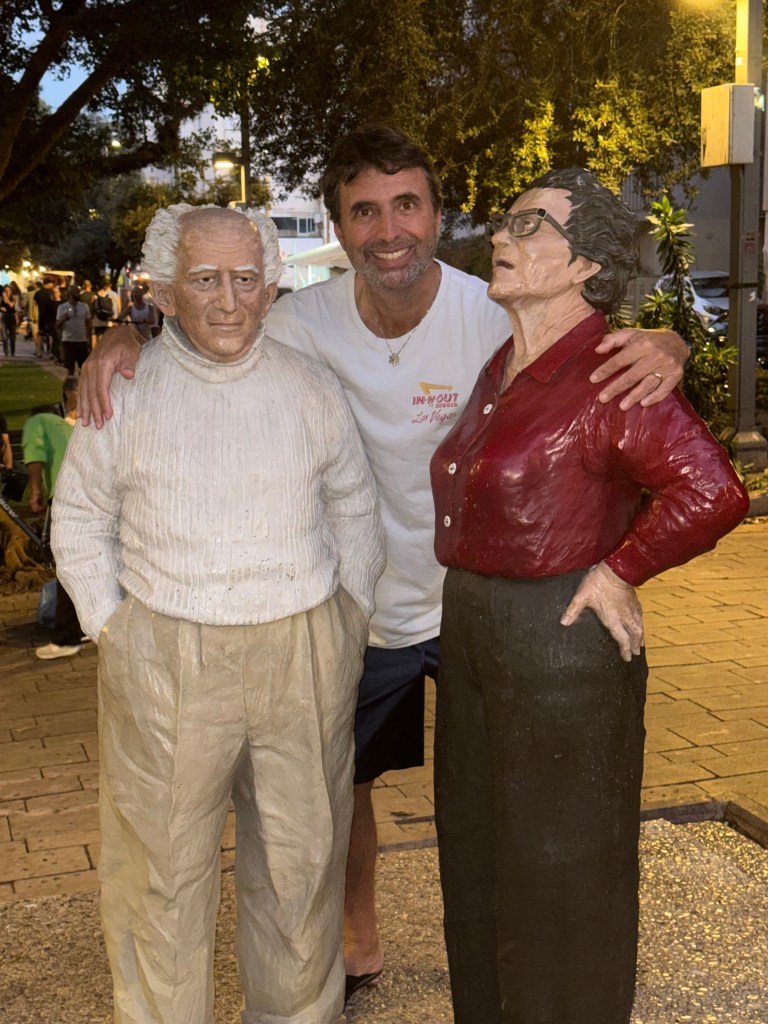
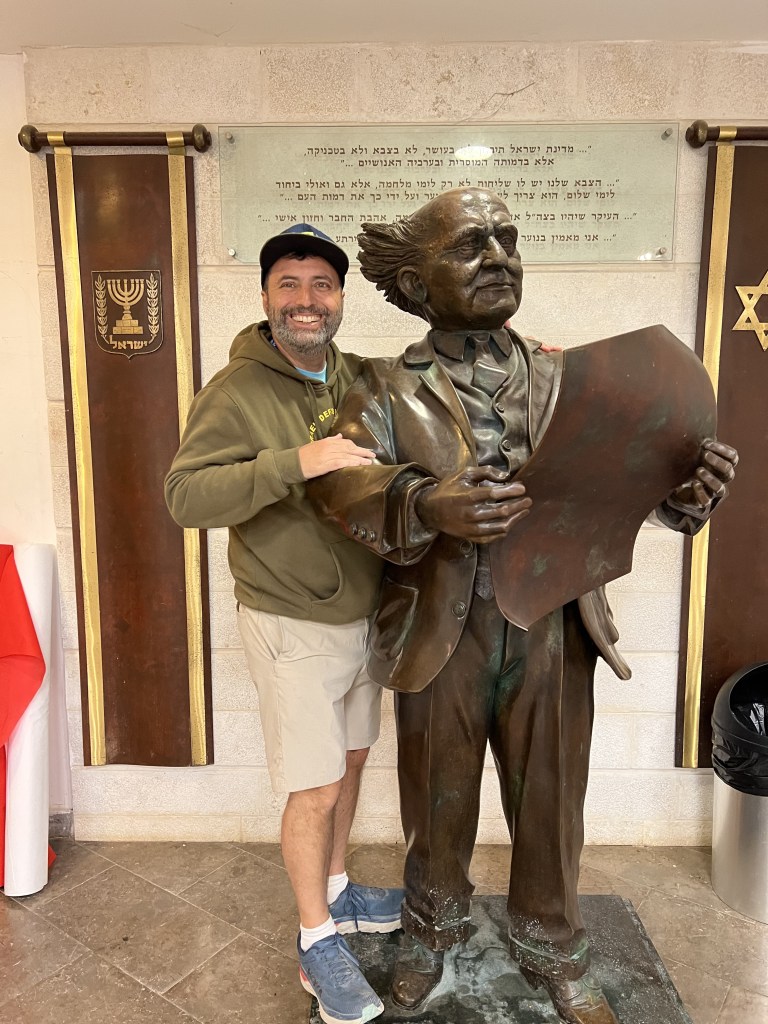
The more I learn about David Ben Gurion the more I am inspired by him. With the statues of him and his wife Paula near their home in Tel Aviv.

The American experiment is very similar to the Israeli and Zionist experiment, tying back to the words of the American Declaration of Independence where it states that, “We hold these truths to be self-evident, that all men are created equal, that they are endowed by their Creator with certain unalienable Rights, that among these are Life, Liberty and the pursuit of Happiness.” Yes, it’s clear that women and people of color were omitted in 1776 and the American experiment has adjusted for and continues to adjust for this throughout the years. The Free Press had a great article about the writing of that sentence today and how it got to it’s final form. Both Zionism and America are experiments that require adjustment, change, and constant work. They are not in their final form.

It’s also important to remember that the Israeli and Zionist experiment is only 77 years old. To put that in context, when the American experiment was 77 years old, we were in the middle of the civil war. Israel is a young country, the Zionist and Israeli ideals are being tested, just like the American ideals were tested in 1853. Slavery wasn’t abolished until 1865 when America was 79. Women didn’t get the right to vote until 1920, when America was 144 years old. We didn’t codify comprehensive civil rights into law in America until 1964, when America was 188 and marriage equality wasn’t made into law in America until 2015, when America was 239 years old. Perhaps giving some time and grace to a 77 year old country is a good idea. Unless you are obsessed with Jew hatred.

Those of us who identify as Zionists also need to let go of the belief that everything Israel does is perfect and right. The country, the leaders, and the people make mistakes. Unfortunately, due to the incredible Jew hatred that we face, we think that we can’t admit when things happen that aren’t correct. We buy into the Jew hating world view that any mistake made by Israel, her elected or military leaders, or any Israeli people, means the country itself should not exist and extended further, that Jews should not exist. This is a fallacy that we cannot afford to buy into. Admitting Israeli’s mistakes is how we truly become that “just, safe and equally prosperous home for all of its inhabitants.”

I have spent most of my career as a servant leader for the Jewish people. As a result, I have chosen not to serve in volunteer leadership for many organizations. The one that I have chosen to serve is the Center for Israel Education. Why have I chosen that one to serve? Because it is truly about what its name says. Israel Education. Not hasbara. It is fact based, uses source documents, and tells the story of Israel, warts and all. It provides knowledge so that those who want to support Israel, who want to defend Israel, have the real information, the whole story, and can address the lies told by so many who are really just Jew haters. If you haven’t been to their website, I urge to you go and to explore. Get lost in the information. Search for things you may have heard something about but don’t know the whole story. Read the original documents so you know what they say, not what somebody who is doing hasbara tells you they say nor what those who hate Jews tells you what happened.
If we truly believe in the State of Israel, in Zionism, and in Jewish self-determination, we need to make sure we know exactly what we are saying and what that means. Those who hate Jews don’t know what it means – it’s simply a line and word they can use to express their Jew hatred. When I was in Israel a few weeks ago, I had the opportunity to talk to my friend Shadi, who lives in an Arab village in Israel, and is Israeli, Arab, and a Zionist. We began an incredible conversation about the challenges he faces being Israeli, Arab, and loving the State of Israel in these tumultuos times. We need to have these conversations. We need to continue to work to ensure that the words of Israel’s Declaration of Independence remain our guiding principle. Israel needs to be a country for the benefit of all its inhabitants; based on freedom, justice and peace as envisaged by the prophets of Israel; ensuring complete equality of social and political rights to all its inhabitants irrespective of religion, race or sex; and guaranteeing freedom of religion, conscience, language, education and culture. When we are clear about what we are fighting for, we can fight for real Zionism and truly fight the Jew haters who want to steal the word from us. Make the effort to learn.


Zionist vs. Patriot

I’ve been a proud Zionist all my life.  My great-grandmother, who I knew, was a Zionist.  My grandparents were Zionists.  On a visit to Israel a number of years ago, I went to the JNF building and found the books that had their name in it for their support of JNF back in the 60s.  My parents were Zionists.  I grew up filled with a love for Israel and a strong belief in the importance of a Jewish homeland. 

All four of my grandparents went to Israel.  My parents went to Israel.  My in-laws went to Israel.  My brother and sister-in-law have been to Israel.  My sister and brother-in-law have been to Israel.  My wife has been to Israel and this last trip was my 22nd trip to Israel.  The proof is in the pudding as they say.

On this recent trip, while sitting in the back of the bus with one of the participants, he posed an interesting question to me.  “Why do we still call it Zionism?”   After all, Zionism is the belief that the Jewish people should have their own state and be able to have their own self-determination.  We have that.  We have had it for 76 years.  In 1776, the Americans were revolutionaries.  We no longer call ourselves revolutionaries nor have we for more than two centuries.  We are patriots because America is a country, and we no longer have to fight for our freedom from another country’s rule.

In 1948, in the former home of Mayor Meir Dizengoff, David Ben Gurion declared independence for the State of Israel.  While we have fought many wars since then, from that point forward the Jewish people have had a state.  We have had our homeland.  We have had self-determination.  So why are we still calling it Zionism?  Shouldn’t we just be patriots as well?  Haven’t we accomplished the goal of Zionism, the creation of a Jewish homeland?

It is a question I find myself struggling with for many reasons. While we have a Jewish homeland, the State of Israel, there are so many people and countries that want to eliminate our homeland and right to self determination that we must always be vigilant. So while we have our Jewish state and self determination, we cannot afford to sit on our laurels. We must continue to fight to maintain it. As a Zionist, I fight for our homeland and won’t let it be deligitimized. Today, more than ever, that is critical. The United Nations, UNRWA, and the International Court of Justice (ICJ) are actively working to eliminate our homeland. If we are merely patriots, do we lose the urgency needed to defend Israel? Do we forget how long it took us to have our homeland after the Romans sent us into exile? Do we lose the passion of Zionism when we become Patriots? I don’t have the answers but I do have the questions.

On the flip side, we have our country. We have the right to self determination. Do we really need to be fighting for something that we already have? Defend it as patriots, yes. The Zionist dream is real and has been for 76 years. We accomplished the goal of Theodore Herzl. His radical idea, “the restoration of the Jewish State”, has come to pass. Are we using a word that we don’t need to? Are we creating challenges for ourselves because of that? Is it time to change the paradigm, to not live in fear that we will not have a Jewish state, because we actually have one?

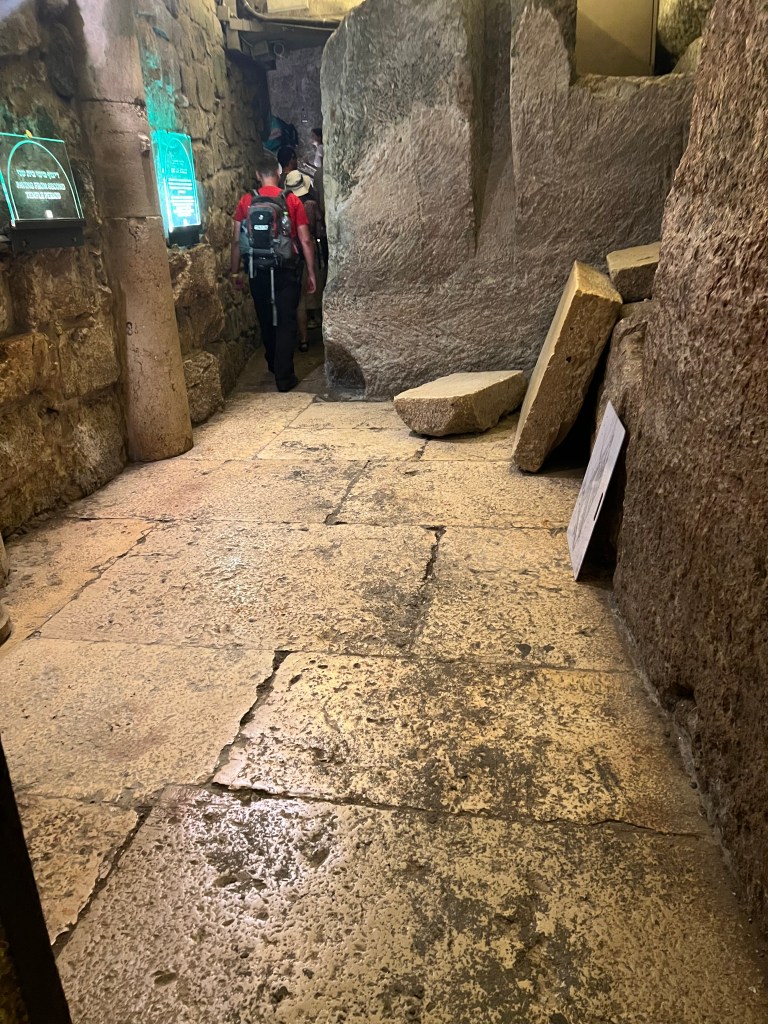
As a Zionist, that word ties me to generations of my family. It ties me not only to my Great-great-grandparents and the time of Herzl but to ancient Jews and receiving the Torah. It is being a part of the Jewish people. Generations upon generations. When I was recently in Israel, walking on 2,000 year old streets, looking out at where King David’s castle was, praying at the Kotel, the base of Temple Mount, it all came together. My ancestors from thousands of years ago stood where I was standing.

Original streets from more than 2,000 years ago, beneath the Kotel.

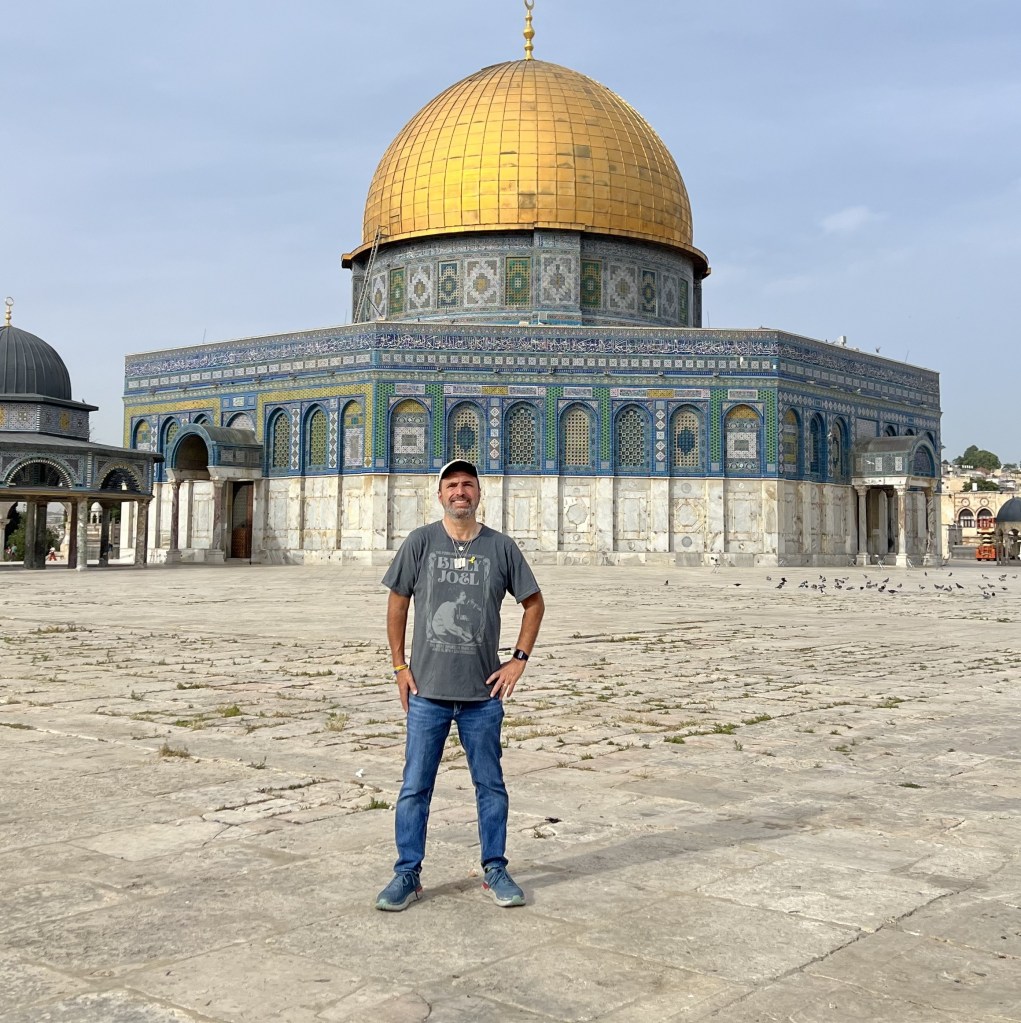
In May, when I stood on top of Temple Mount, it was a connection to the Temple built by Solomon and then rebuilt and modified by King Herod.

In front of Dome of the Rock on Temple Mount, where the Temple used to stand

At Passover every year, we remember that God took us out of Egypt. Not just our ancestors but us. We were all at Sinai for the giving of the Torah. Judaism isn’t about what happened to others. It’s about what happens for us. So yes, the Zionistic dream of Herzl has been attained. But Zionism remains for all of us to defend. To fight for. To advocate for. Our history shows us that if we take it for granted, we will lose it.

After lots of thinking about the word Zionist and comparing it to Patriot, there is no question in my mind that Zionist is the right word. Our homeland is too precious to be diluted. As I watch so many Jews not understand the importance of Israel, having never been to Israel, not seeing the historical connection and minimizing what Israel means to Judaism and the Jewish people, I am not sure the fight for Zionism will ever be over. We owe a huge debt of gratitude to those who came before us and fought for Zionism and for the existance of Israel. They are giants on who’s shoulders we continue the fight.

I won’t change from Zionist to Patriot. I won’t stop advocating for Israel and the Jewish state. And I won’t stop being public with my Jewish identity and passion for Israel. Each trip I video walking the streets to show those who have never been what it’s really like. I post images and tell stories. Zionism is more than a national identity. It is core to the Jewish people. From Abraham to Moses to Joshua to King David to King Solomon, from the Mishkan to the First Temple to the Second Temple. If you don’t believe me, take a trip to Israel and see it yourself.

Am Yisrael Chai!

The Center for Israel Education inspires and teaches

Approximately 20 years ago at an AIPAC Policy Conference, I attended one of the breakout sessions to learn a bit more about a detailed topic.  The presenter, Professor Ken Stein from Emory University, blew my mind with details and facts that I didn’t know.  I sat there taking notes with tons of questions forming in my mind.  There were so many of them, I had to write those down as well.  After the session, I went up to talk with him and ask some of those questions.  It was an inauspicious start of a friendship and professional relationship that lasts until today.

My friend Professor Ken Stein

I made it a point to always attend Ken’s sessions at AIPAC.  I was amazing that he was the only speaker on Israel that I found nobody had a problem with.  They may ask tough questions, but Ken wasn’t trying to do Hasbara (trying to convince somebody you are correct) but rather shared the facts and allowed you to determine your own beliefs.  As a result of this, I brought Ken to Seattle and then to Orlando to teach about the history of Israel. 

In 2008, Ken created the Center for Israel Education (CIE), a nonprofit dedicated to educating the public about modern State of Israel.  Using source documents, CIE provides context to a challenging topic.  A number of years ago, I was honored when Ken asked me to join the board of directors and I have been a member ever since. 

Each week, CIE provides information that is both timely and interesting.  Sometimes it is related to, “This week in Israeli history” while other times it relates to what’s happening in the world.   I find it interesting and learn a lot about people and policies that I didn’t know.  This week’s information was particularly interesting for two reasons.

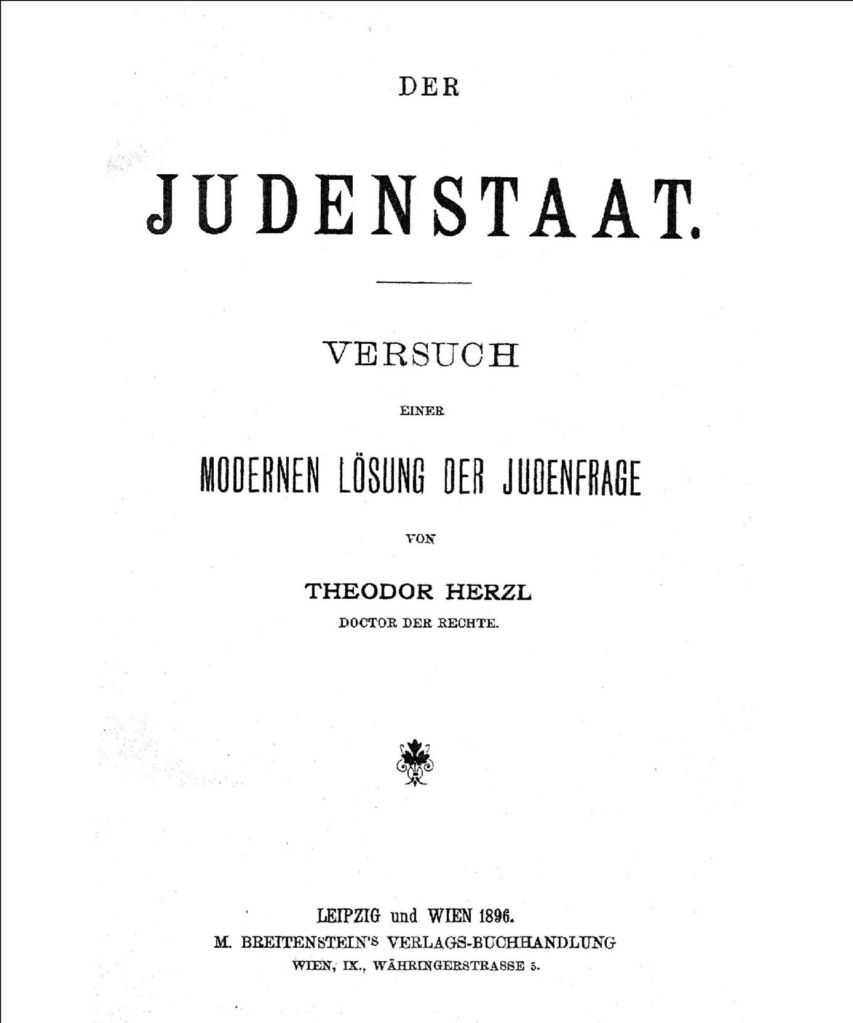
The first reason relates to ‘This week in Israeli history’.  On Feb. 14, 1896, Vienna journalist Theodor Herzl published 500 copies of a pamphlet entitled “Der Judenstaat” (“The Jewish State”), declaring the need and justice of Jewish sovereignty 18 months before he convened the First Zionist Congress.  I’ve been to Israel 20 times and been to Herzl’s grave at least 20 times.  It’s a powerful place to visit as he was the person who had the vision of a Jewish state.   Whenever I am there, I find myself humbled by his vision and always remember his famous quote, “If you will it, it is no dream.”   That quote has inspired me throughout my career.

Theodore Herzl – the founder of Zionism

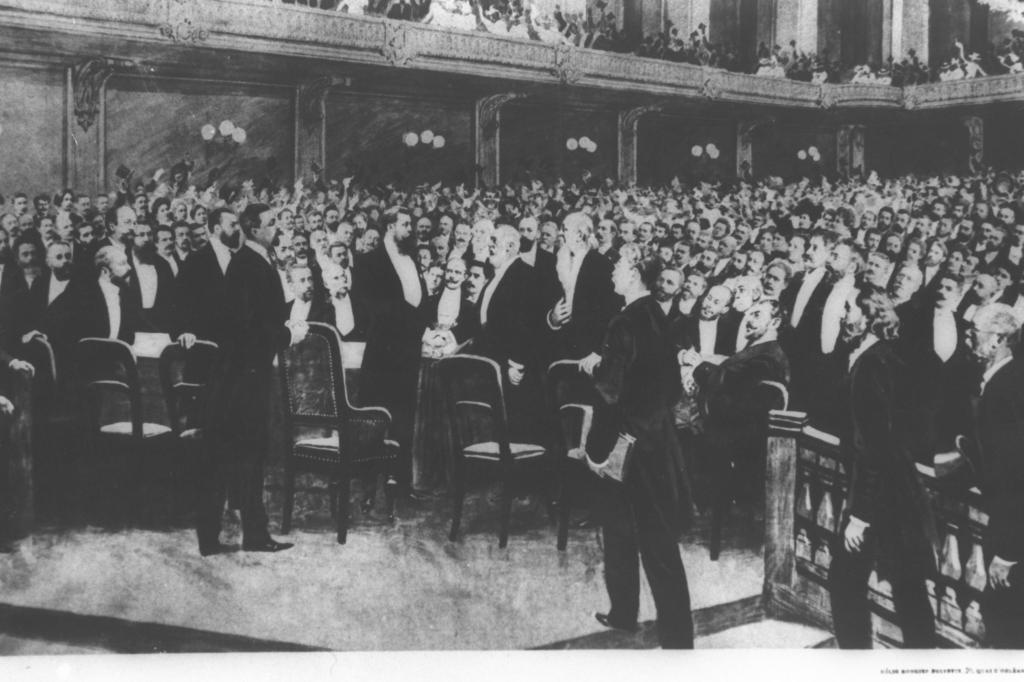
Interestingly enough, Herzl’s idea wasn’t limited to the middle east or to the historic greater Israel.  He merely wanted the Jewish people to have their own land where they were in charge and had self-determination.  He wrote about It wasn’t until the First Zionist Congress held in Basel, Switzerland with 200 delegates from across the Jewish world, that the goal to establish a Jewish State in the Land of Israel were explicitly adopted by the new Zionist movement.

Theodore Herzl at the First Zionist Congress in Basel on August 25, 1897

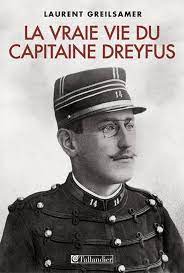
Herzl, as a secular Jew and journalist, was inspired by the Dryfuss Affair to find a way to keep Jews safe.  It was his vision to have a Jewish State, a homeland, where Jews would be in charge and Jews would be safe.  Where Jews would have the power of self-determination.  He didn’t care where it was, only that it existed.   It was at the First Zionist Congress that non-secular Jews, who understood the tie to the biblical land, ensured that the land would need to be in our historic homeland, not just anywhere.

The Dryfuss Affair on the cover of The New Yorker

Captain Alfred Dryfuss, wrongly convicted because he was a Jew.

It ties to the famous Chaim Weizmann quote.  When a member of the House of Lords asked him, “Why do you Jews insist on Palestine when there are so many undeveloped countries you could settle in more conveniently?”

Weizmann answered: “That is like my asking you why you drove twenty miles to visit your mother last Sunday when there are so many old ladies living on your street?”

Wiezmann said, ‘Mr. Balfour, if you were offered Paris instead of London, would you take it?’ … He looked surprised. He said: ‘But London is our own!’ Weizmann said, ‘Jerusalem was our own when London was a marsh.’ He said, ‘That’s true.'”

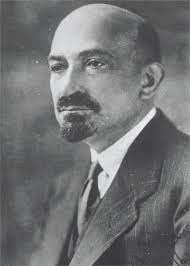
Dr. Chaim Weizmann, one of the great founders of the State of Israel

Having been to Israel 20 times in my life, there is something special not just because it is a Jewish state and the only place that I am in the majority.  Being in Jerusalem and standing at the Kotel is a direct connection to King Solomon.  It’s a direct connection to the ‘holy of holies.’  To 5,000+ years of Jewish history.  

Being at the Kotel is always such a special feeling

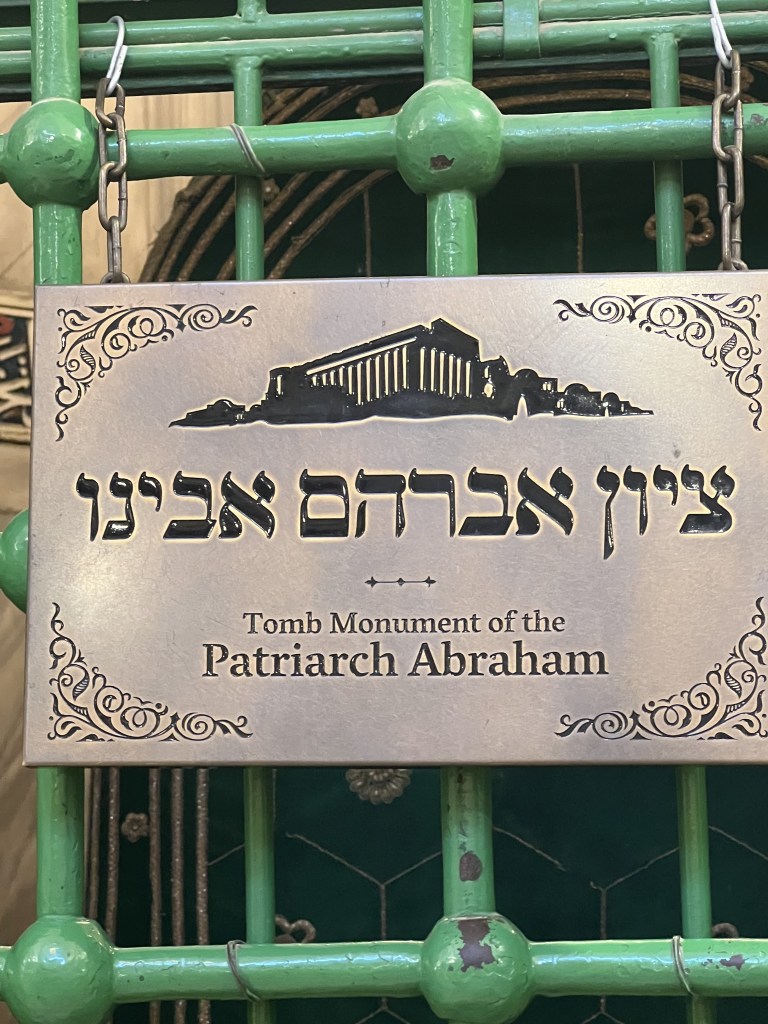
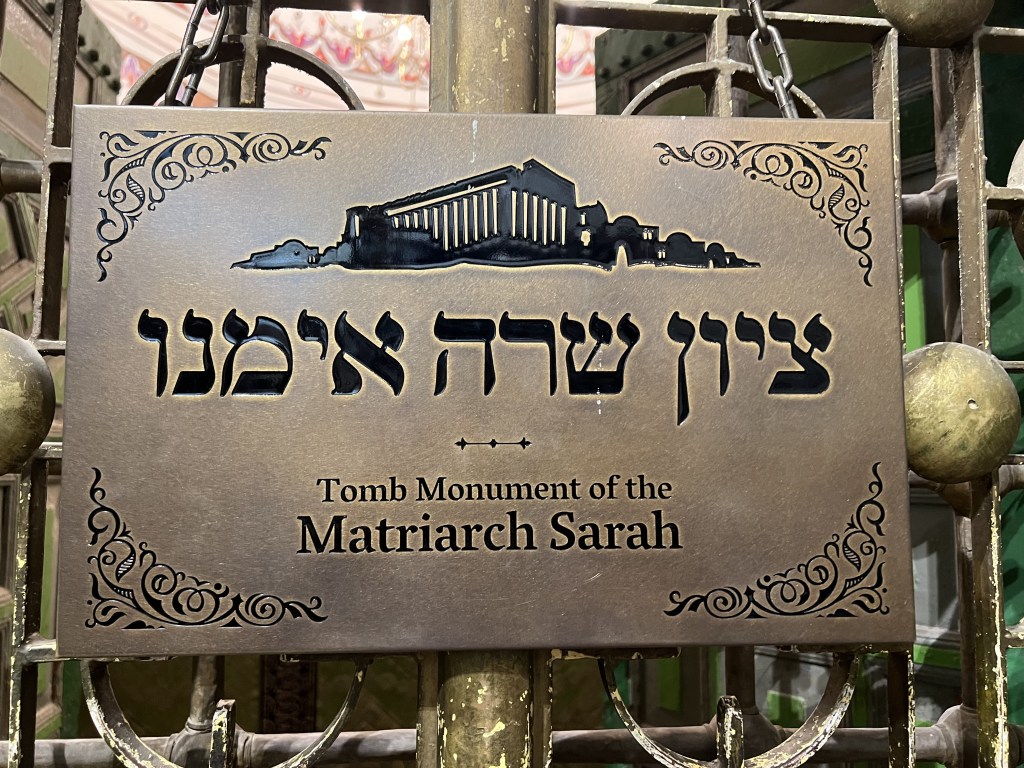
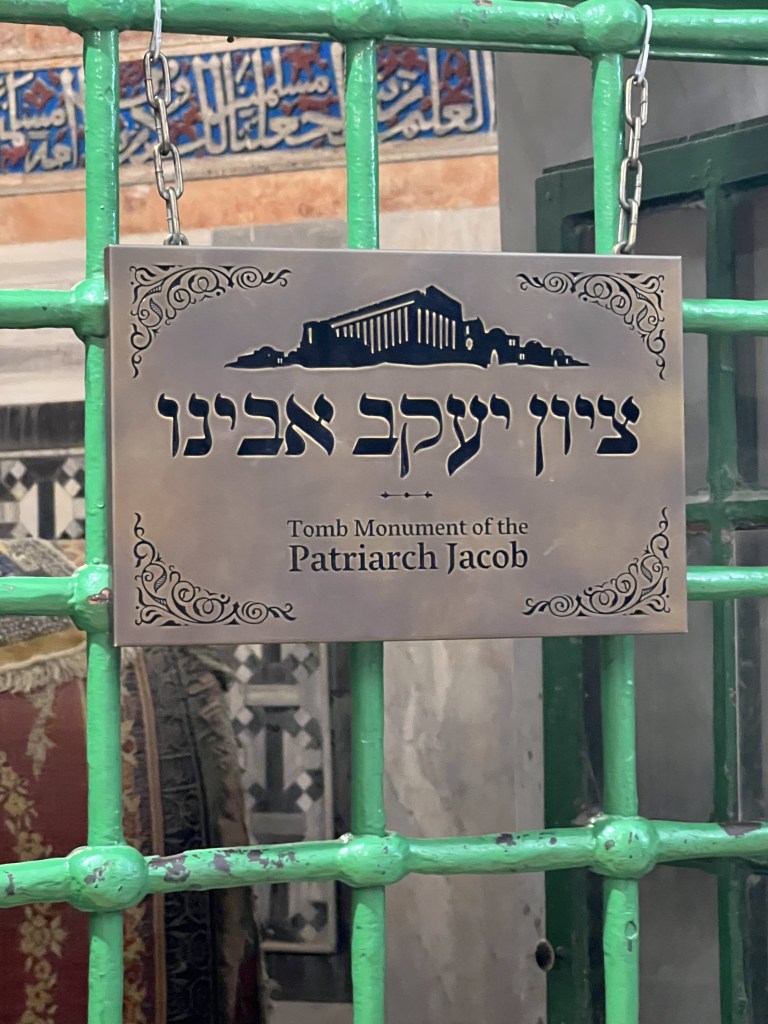
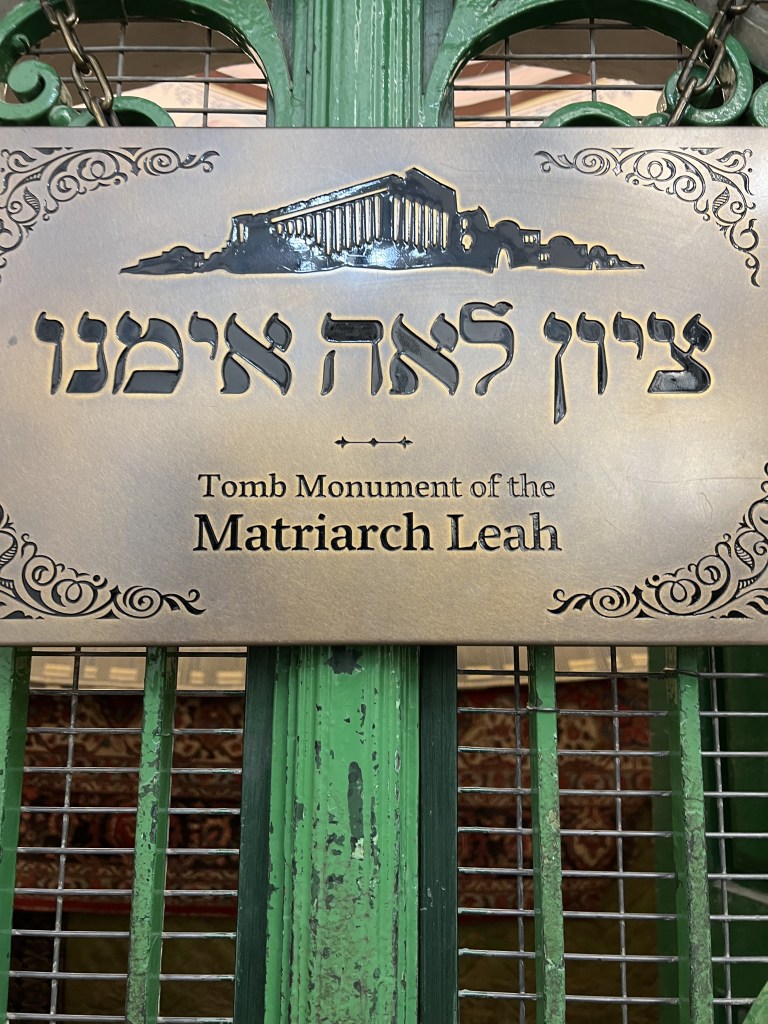
Going to Hebron and visiting the graves of Abraham, Jacob, Sarah, and Leah is a special feeling. (Isaac and Rebeca are also buried there but they are on the Palestinian side so Jews can only go there 10 days a year).  I’ll never forget sitting between the graves of Abraham and Sarah as my friend Harry Rothenberg led us in a discussion focused on the text where Sarah was told by God that she would get pregnant when she was 90 years old, and she laughed.  We explored not just the story but the love story of Abraham and Sarah.  It was incredibly powerful to do this between their graves. It’s something I will never forget.

We also learned that one of times when all of the Tomb of the Patriarchs and Matriarchs is open to Jews, Christians and non-muslims is during the Shabbat of Chayei Sarah. This is when Sarah dies and is buried in Hebron. There are 40,000-50,000 people who come to spend Shabbat outside the Tomb. They bring in catered meals, tents, and it’s a huge party. Watching the videos of the celebration put this on my bucket list.

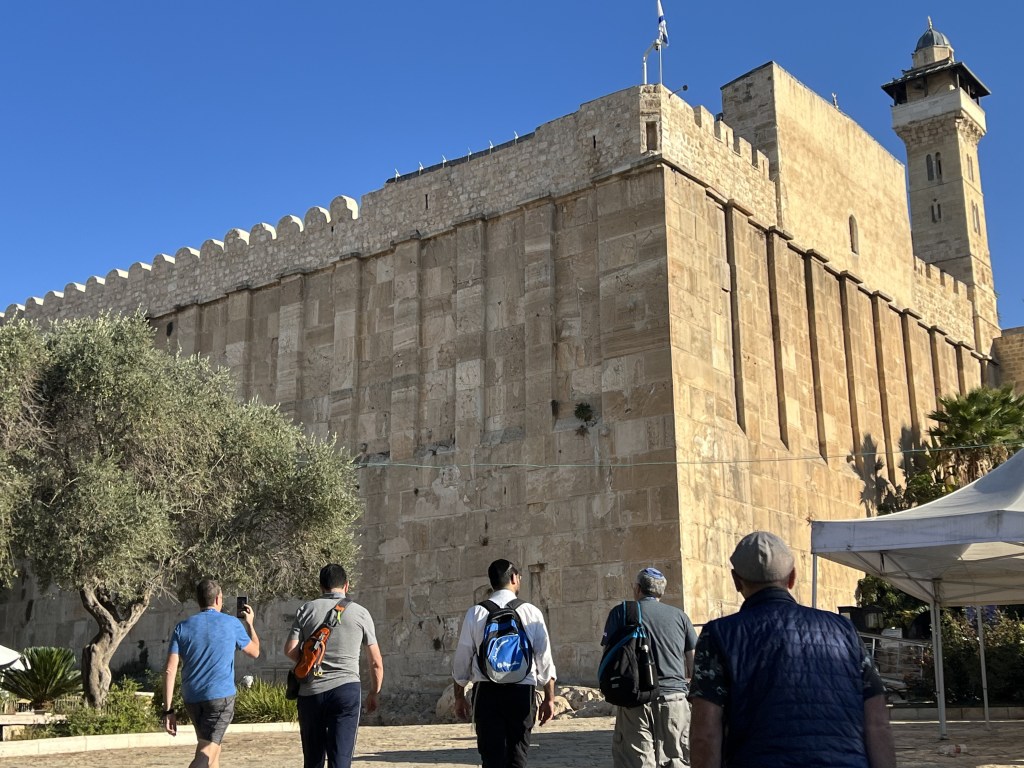
In Hebron, the oldest complete building still used for it’s original purpose in the world. Inside are the caves (graves) of the Patriarchs and Matriarchs.

Below is the cave with the grave of Abraham, the patriarch.

Across from the cave of Abraham is the cave of Sarah our matriarch, where Abraham buried her himself.

The grave of Jacob, our patriarch. He wrestled with the angel and got the name Israel. It’s unbelievable to be at his grave.

The grave of Leah, our matriarch. Rachel was buried on the road (her grave is in what is now Bethlehem) while Isaac and Rebecca are on the side controlled by the Palestinians and are only accessible 10 days a year to Jews.

I’ve been the Tomb of Joseph, not too far from Nablus.  There is something unique and special being there, knowing his story and how integral he was to the Jewish people.  It’s hard to explain the feeling of connection, of thousands of years of history, and of peoplehood that occurred for me there. 

The tomb of Joseph in Nablus. When I was there it was packed with Jews praying over his grave.

Being in the Jordan River is another unique experience.  This is where our people crossed over to enter the land of Canaan after leaving Egypt.  The history and connection is amazing.  It was smaller than I expected and reminded me of the Ichetucknee River outside of Gainesville, Florida, that I used to go tubing down in the summer.  I had imagined this powerful river that was both wide and deep.  It’s the same river my ancestors crossed thousands of years ago as they entered ‘the land of milk and honey’ for the first time.

Rafting down the Jordan River is always fun – on one trip we went with a group of Muslim women who were fully clothed while we were in bathing suits. They started a splash fight with us and we had so much fun with them. 

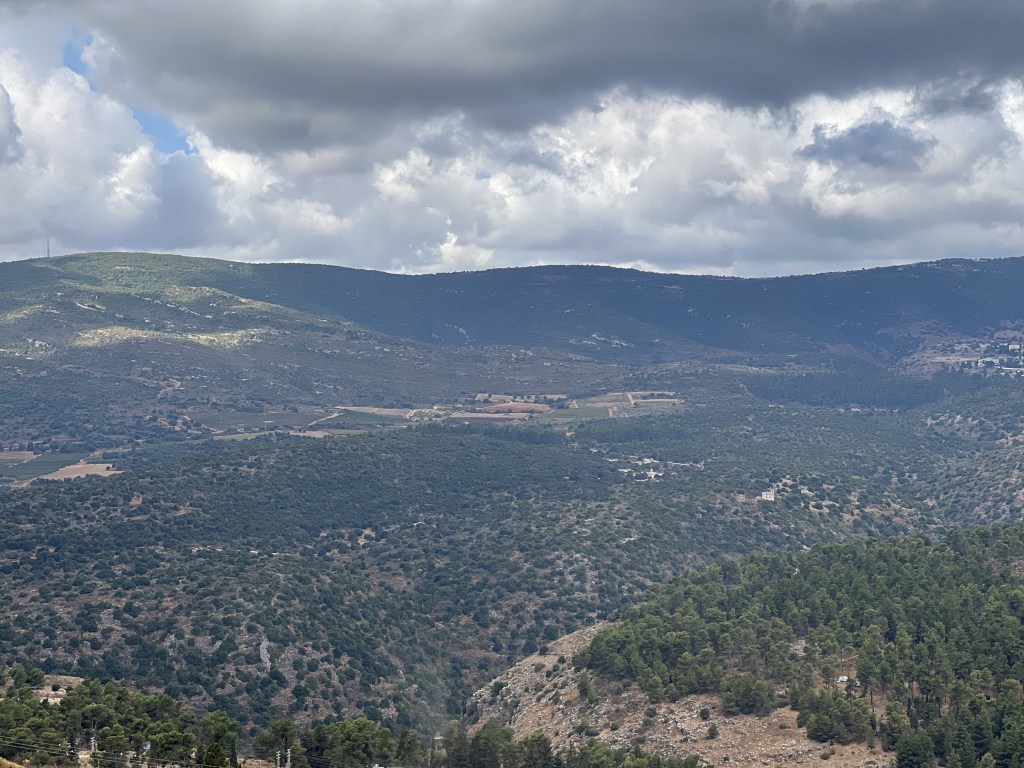
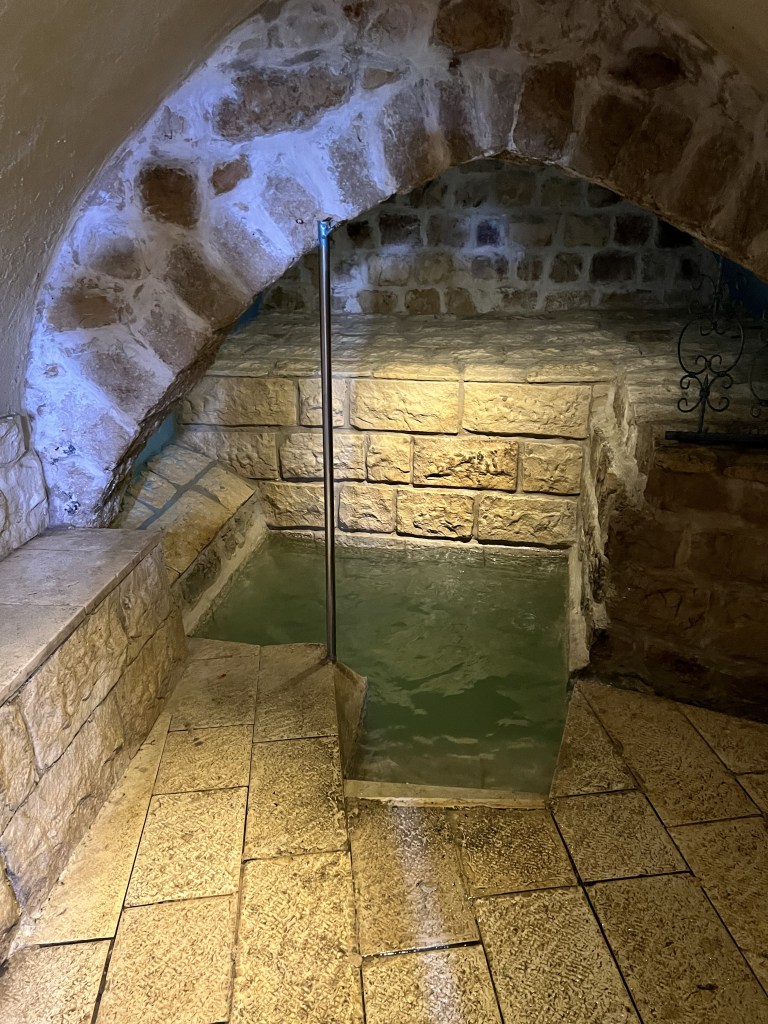
As you drive through Israel you see the field where David slew Goliath.  In Tzfat you see the fields where Lecha Dodi was inspired, the mikvah of the Ari, various ancient synagogues.  In Akko the excavated buildings from the crusades exist.  You can see the Dead Sea Scrolls.  It’s a land filled with rich Jewish history everywhere that you turn.  That’s what Herzl didn’t understand but was smart enough to listen the First Zionist Congress.  It’s why the modern State of Israel is home to all of us.  It’s not just a country of Jewish self-determination.  It is our historic homeland, our past, present, and future.  It is tied to our souls as anybody who has visited there, Jewish or not, will attest.  I’m grateful that Herzl listened to the delegates at the First Zionist Conference and wouldn’t accept just anywhere.  Israel is my mother that I travel 6,500 miles to visit and it’s worth it every time. 

Looking out on the fields in Tzfat. This is what inspired L’cha Dodi and where they would walk out to meet the Shabbat Bride each Friday night.

Looking down at the Mikvah of the Ari from the 1500s. It’s inside the building. He used in the 1500s and I used in in 2021 and 2022. That’s the power of Israel for Jews.

The actual Mikvah itself. The Ari used it in the 1500s, stepping into the same pool (not the same water) as I did in 2021 and 2022.

The second piece of information that I found fascinating goes back to 1993.  During the Knesset debate over the Oslo Accords in September 1993, then Foreign Minister Shimon Peres warned that “There are in Gaza this year between 750,000 and 800,000 inhabitants. Within 20 years, there will be almost 2 million residents in the Gaza Strip. The population density leads to violence, the poverty leads to terrorism.” If you read his full remarks, it is fascinating to apply them to today. 

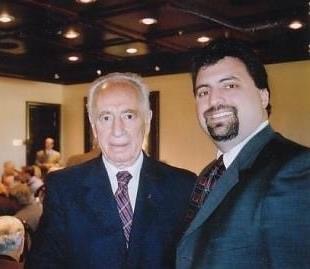
I met Shimon Peres more than 20 years (and 70 pounds!) ago. A truly special man and leader.

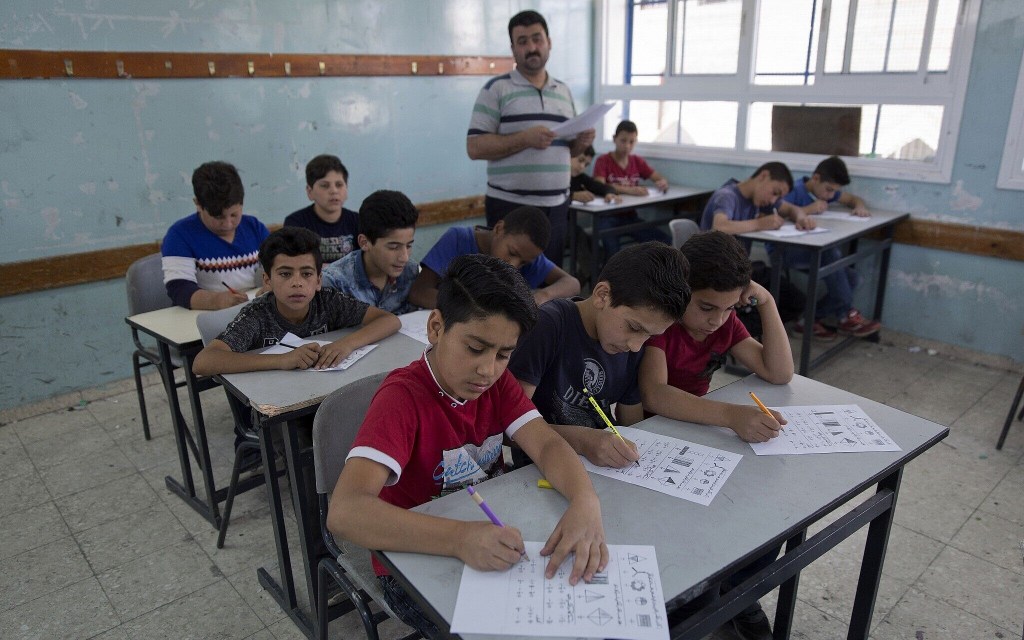
As Israel continues to respond to the horror of October 7th, there are more than 2 million people in Gaza.  Life there has led to violence and terrorism.  Hamas, UNWRA, and the UN have contributed to these problems.  At a JNF lunch event today, Ambassador Michael Oren told us that Israel is figuring out how many of the terrorists on October 7th were taught at an UNWRA school.  I’m afraid to see how high that number will be.  UNWRA ignored or allowed the strategic headquarters of Hamas to be built in tunnels under the UNWRA headquarters.  The textbooks are filled with antisemitism.  Even children’s programming is targeted to hate and kill Jews.  The Hamas version of Sesame Street, Tomorrow’s Pioneers, is focused on murdering JewsThis clip blames the Jews for a character cheating in school.  Shimon Peres was right about the growth in Gaza and what the consequences would be.  October 7th proved him right.  The question is how do we move forward from here?

The textbooks provided by UNRWA to the Palestinian/Gazan children are filled with antisemitism and Jew hatred. 

In the same warning, Peres stated, “Neither do I propose that we talk of economic cooperation. Why? Because the Arabs believe that the State of Israel wants to dominate the region. We do not want to do the Arabs any favors. I am not even suggesting economic cooperation with the Arabs. All I am telling the Arabs is this: There are problems that will remain unresolved unless we tackle them jointly. We should make a joint effort only when problems are insolvable without such a joint effort.”

Was this Peres foreshadowing the Abraham Accords?  The threat of Iran brought Arab countries together to recognize Israel, forever changing the dynamic.  The Iranian problem was insolvable without a joint effort.  After October 7th, these nations did not abandon Israel.  They understand that Iran is the problem and that it’s insolvable without Israel being a part of the solution.  Could this be the basis for a new government in Gaza and perhaps the West Bank/Judea and Samaria?  Could this be the key to rebuilding Gaza and finally making it into the ‘Singapore of the Middle East’?  Could this be the basis for peace and a willingness to live together?

An incredible picture of the signing of the Abraham Accords as more muslim countries recognize and normalize relations with Israel.

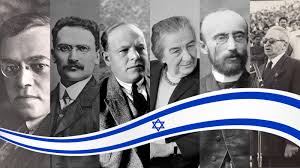
I find myself looking to some of the great Israeli leaders of the past for inspiration on a regular basis.  David Ben Gurion.   Golda Meir.  Shimon Peres.  Yitzhak Rabin.  Moshe Dayan.  Menachem Begin. 

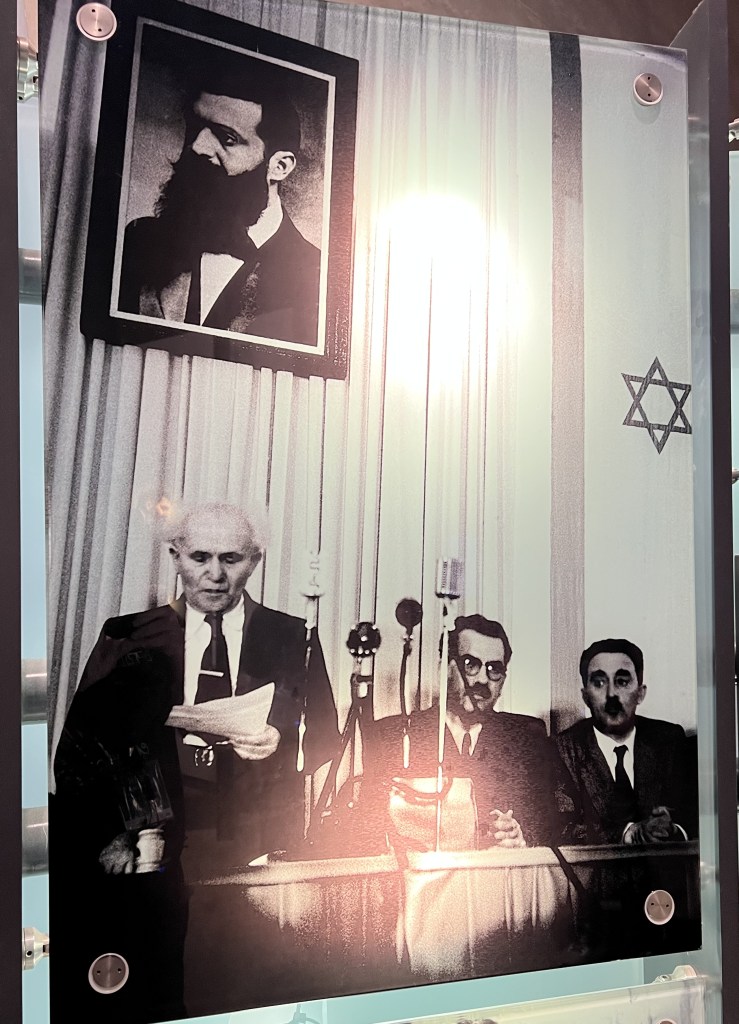
Picture of Ben Gurion reading the Declaration of Independence in Independence Hall

When I saw this statue of Ben Gurion, I had to get a picture with it. The more I learn about him, the more in awe I am of who he was and what he did.

I think of current Israeli leaders such as Ambassador Michael Oren, Ambassador Ron Dermer, and the many Consul Generals I have had the pleasure to interact with and befriend.  We are wise to listen to their insights.  Michael Oren has a substack that I now subscribe to.  Their words are treasurers. 

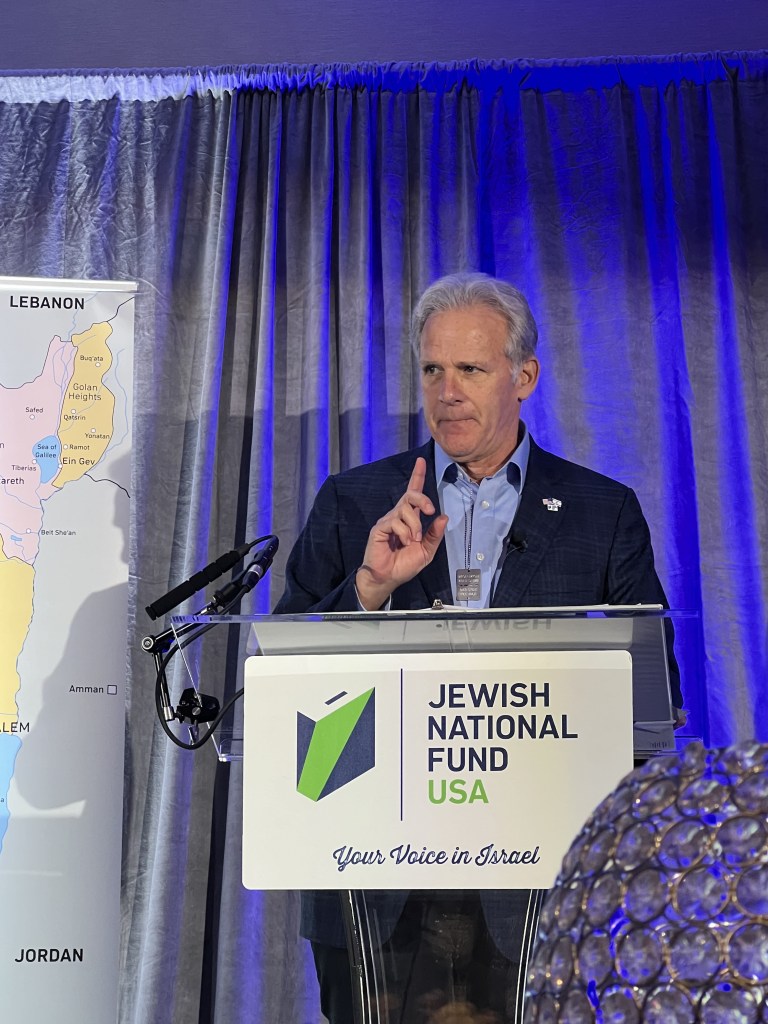
Michael Oren speaking in Orlando this week at a JNF event. A future blog will talk about what he said.

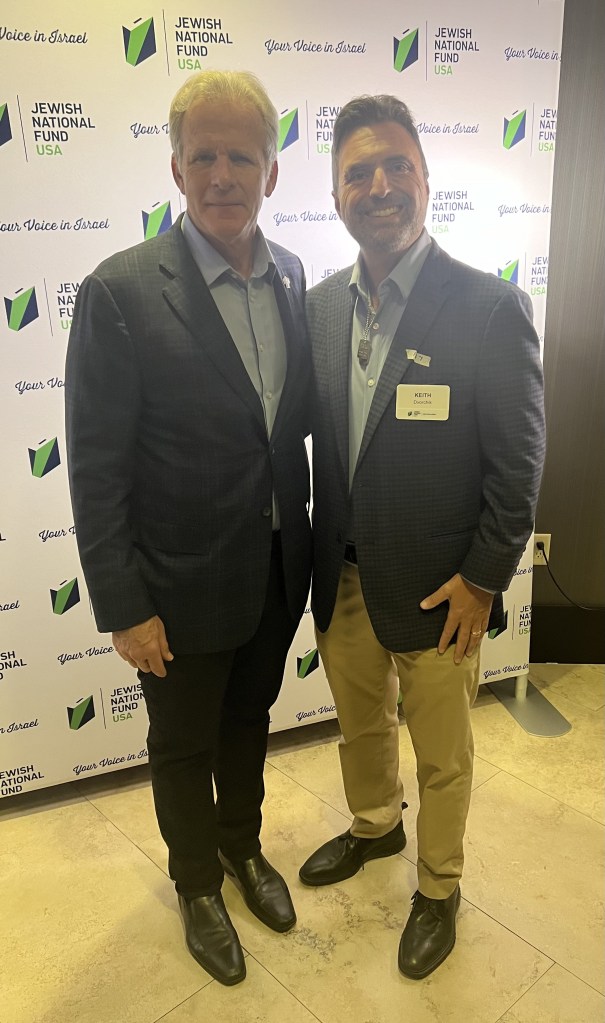
Talking with and listen to Michael Oren is truly incredible. A brilliant man to learn from

Two of my favorite Ben Gurion quotes are: 

“Dare, Persevere, Succeed.”

“Pioneering is refusing to accept reality as it is.”

As I look back at Herzl and at the words of Peres; as I look forward to ‘The Day After’ and the Abraham Accords, these two quotes inspire me for the future of Israel.  And they inspire me personally.  We change the world by being daring, persevering, and succeeding.  And by being pioneers and not accepting reality as it is, we have the opportunity to create a new reality.  A new dream.  “If you will it, it is no dream.  Dare, persevere, succeed.  Refusing to accept reality as it is.”  Three quotes that sum up Israel and the Jewish people.  Three belief systems that will change your life and change the world.