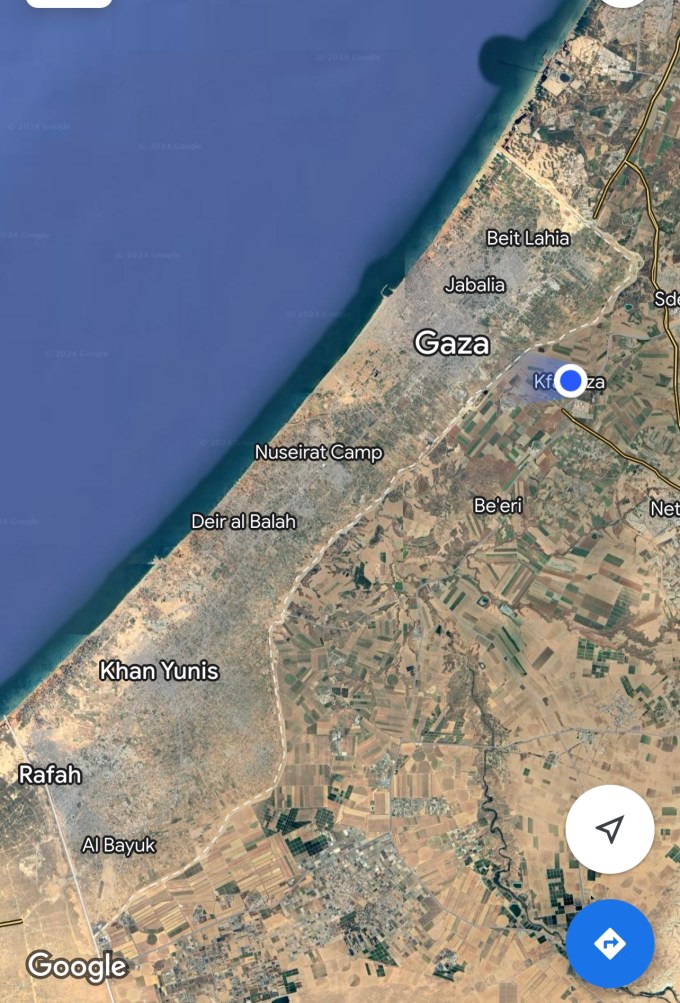
I’ve been close to the Gaza border twice, In May 2024 I visited both Kfar Aza and the Nova site and in July 2024 I returned to both Kfar Aza and Nova along with Kibbutz Alumim. I was about a mile from Gaza on both occasions, heard and saw the drones and jets fly over Jabalya, and saw and heard bombs drop, gunfire, explosions and building collapse. Both were intense experiences as it felt strange to be so close to an active war zone.
Google Maps view from my May 2024 visit to Kfar Aza
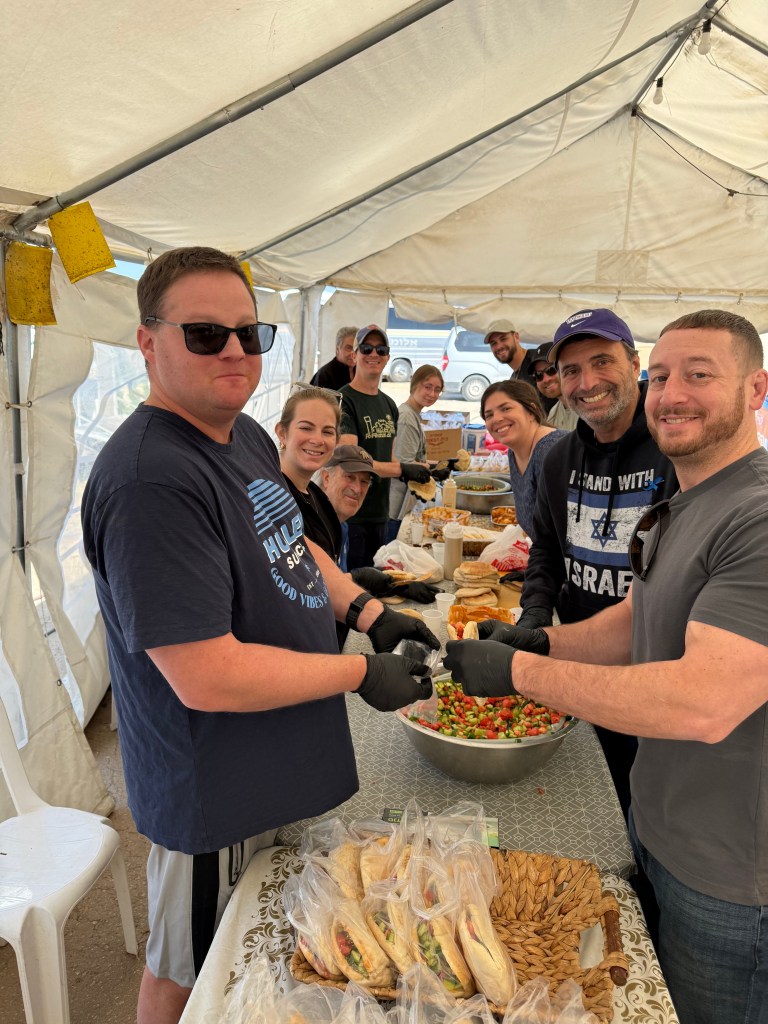
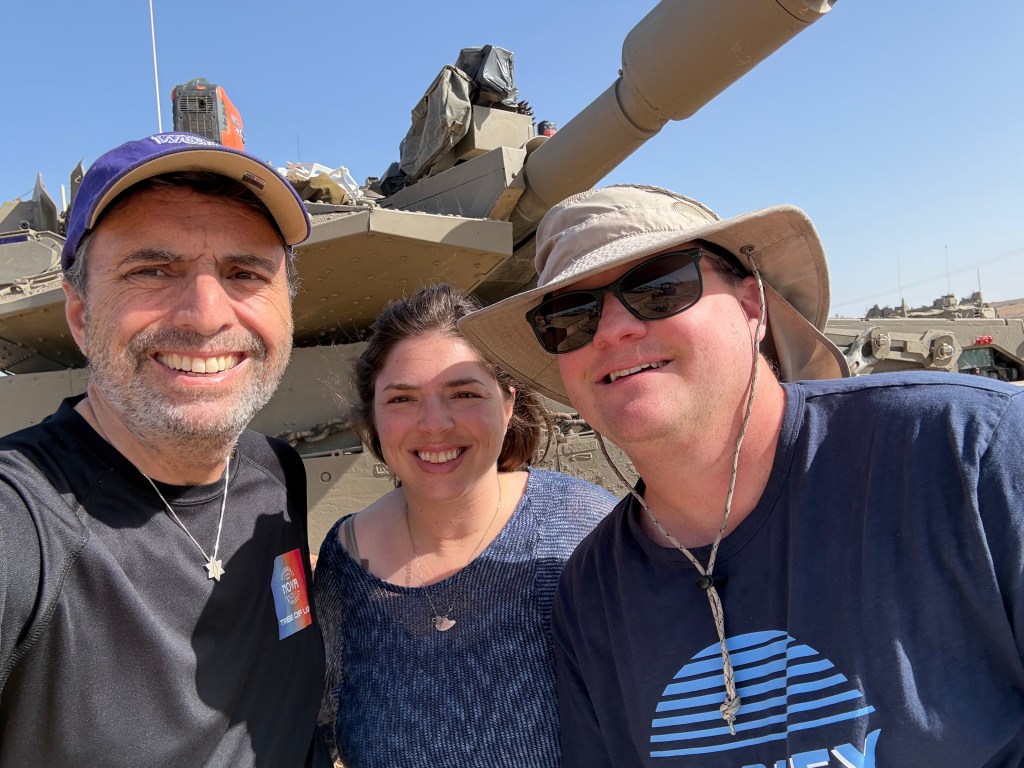
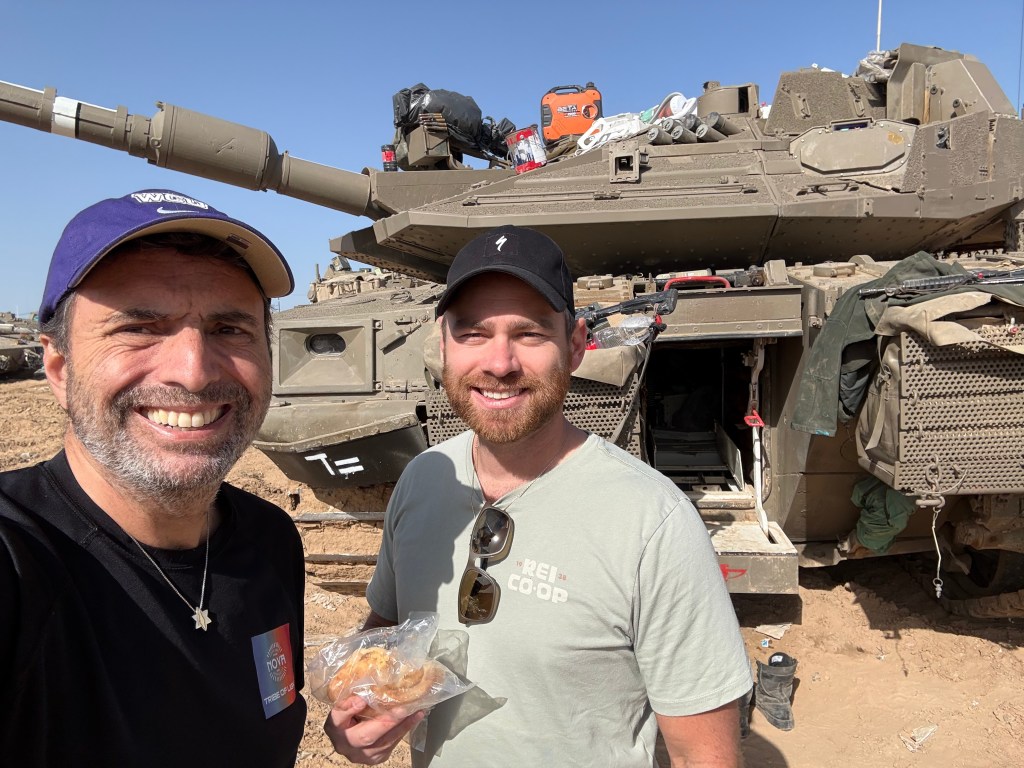
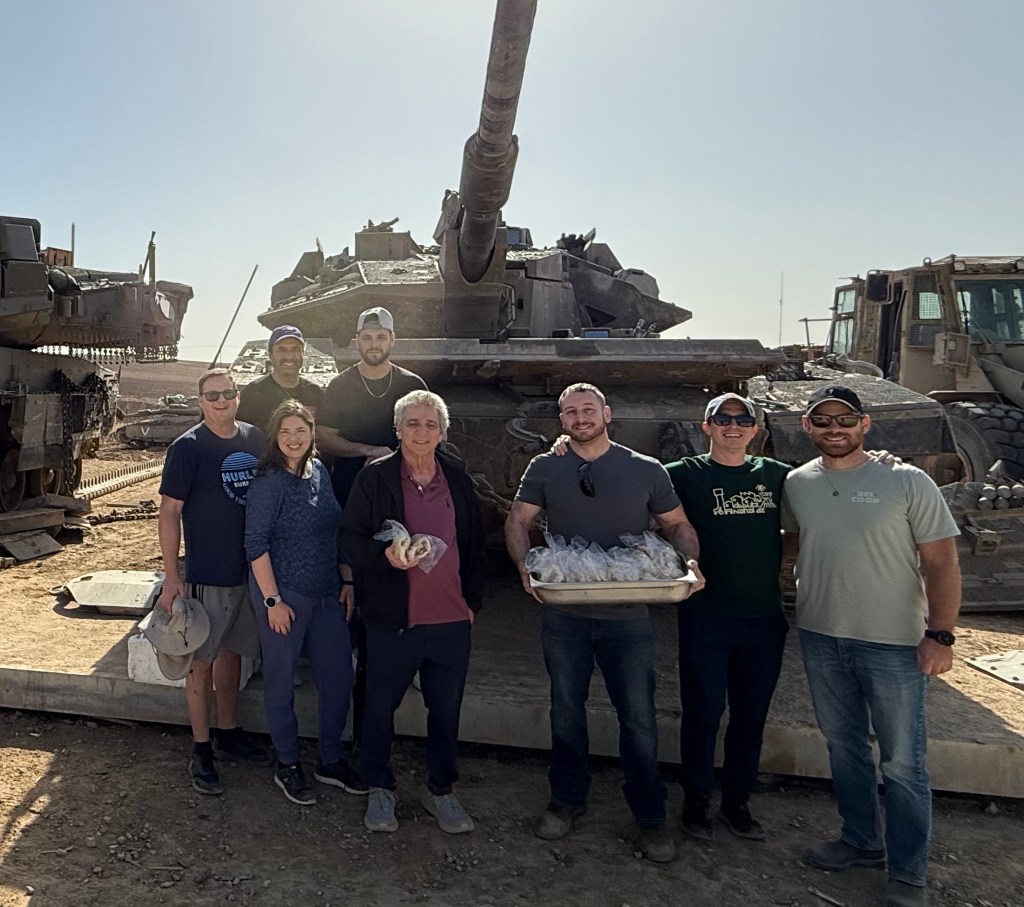
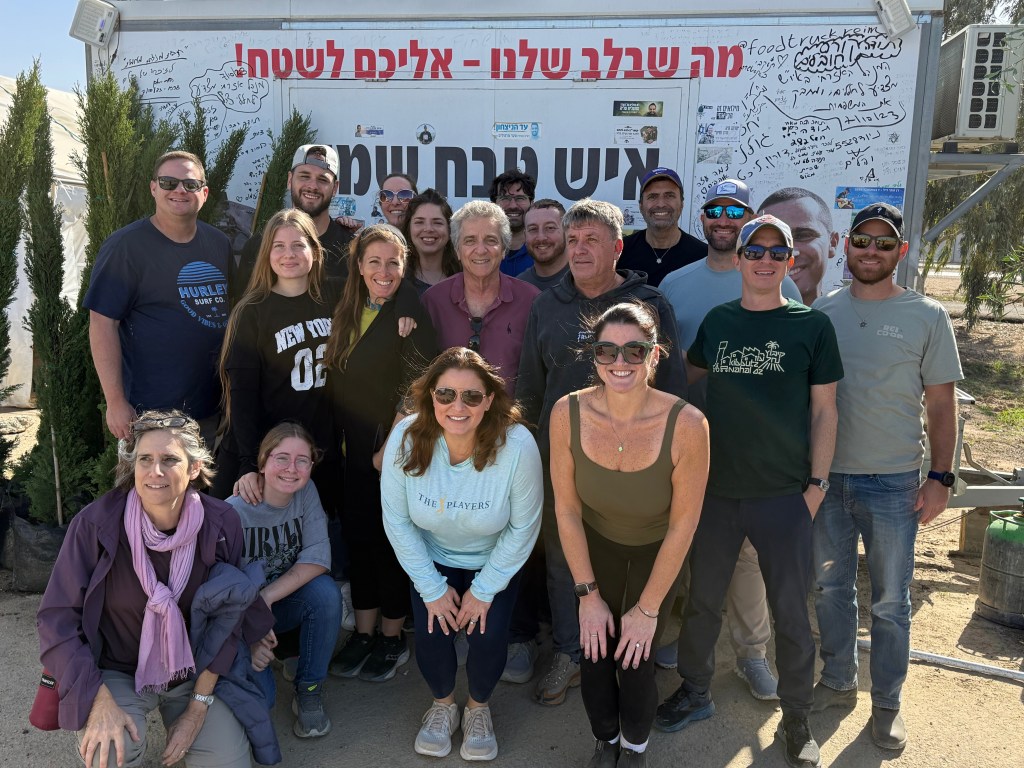
Today I got even closer. We had the opportunity to go to Shlomi’s Food Truck, right outside Kibbutz Be’eri, and make sandwiches to feed soldiers fighting in Gaza and on the border. We cut vegetables, stuffed pita with schnitzel, salad, hummus and tahini, bagged them and filled up box after box after box, then loaded them into a truck and van, and left for the border.
Shlomi showed up outside Kibbutz Be’eri on October 8, 2023 and began making sandwiches for the soliders. Every Sunday to Thursday since then, he shows up, makes sandwiches and gives them to soldiers on the border. Volunteers, like us, began coming to help him. He has paid for this out of his own pocket for more than two years. It costs about $5,000 a week to do this. You can do the math on how much of his own money he has spent over the past more than two years feeding soldiers. It’s a passion, a mission, and an obligation for him.
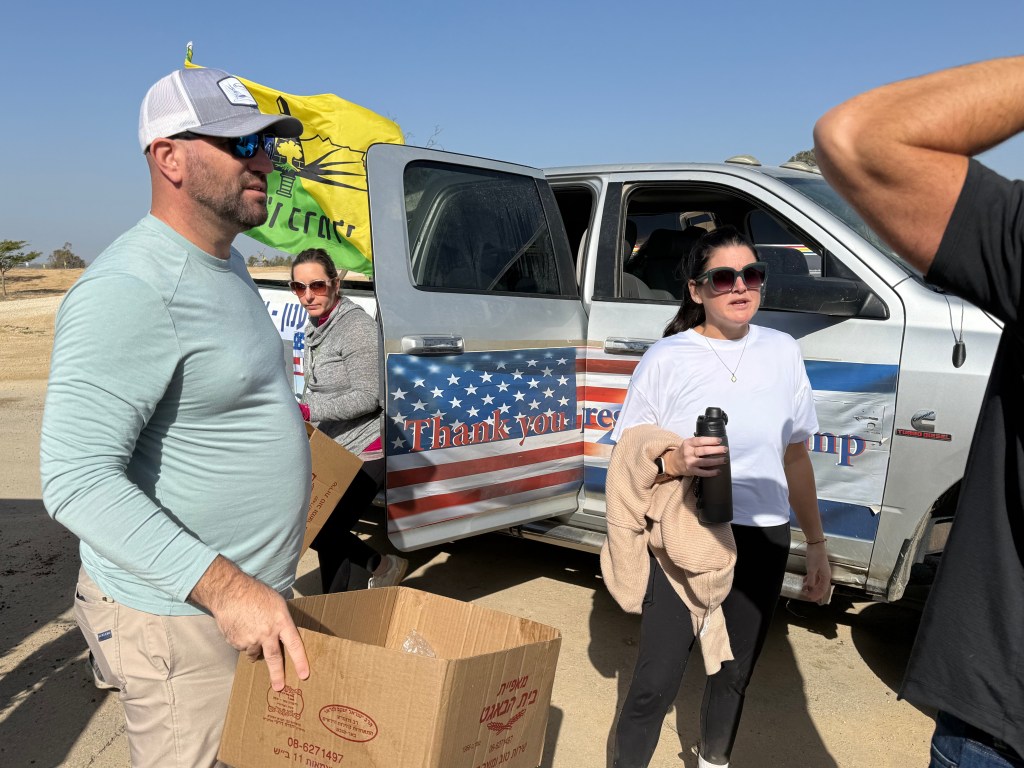
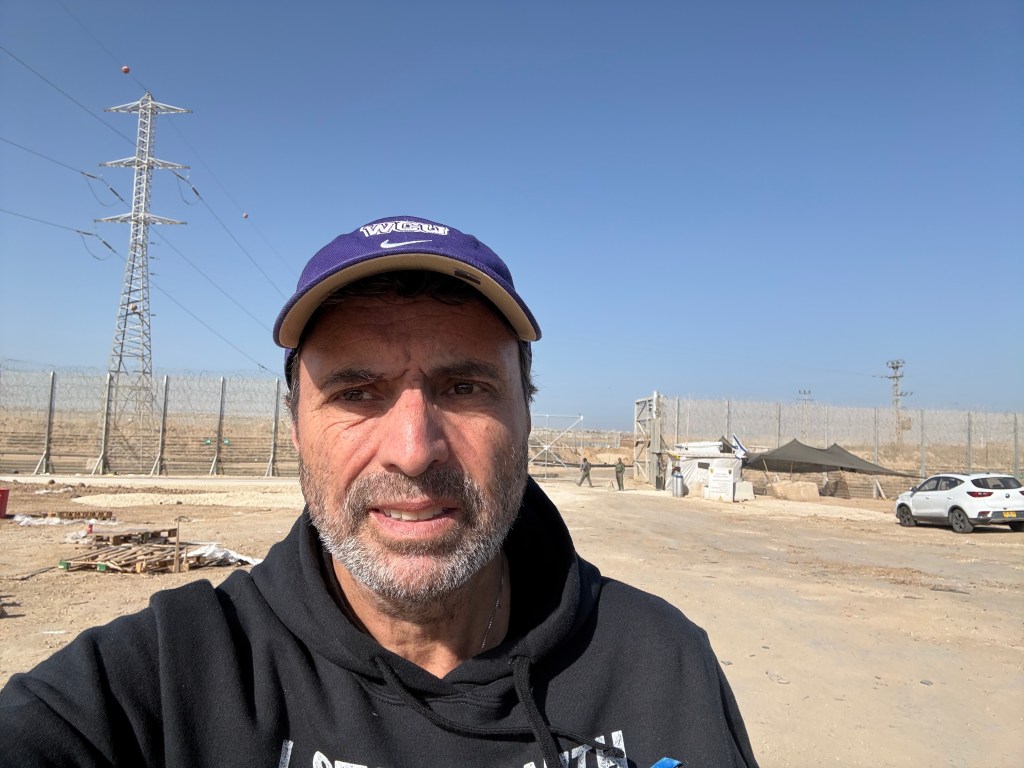
Going to the border was an unbelievable experience. We drove right along it, went into the area where the soldiers were working, offering them lunch. The smiles on their faces, the thank you’s that we received are priceless. I kept thanking them. It is them who are risking their lives, going into Gaza, keeping Israel and the world safe. All we did was make and deliver some sandwiches. We walked all through the area as they worked on their tanks, handing out lunch. We met soldier and soldier after soldier. Being right there on the border with Gaza and getting to make sandwiches and then feed the soldiers was an incredible experience. It’s not something I will ever forget.
As we prepared to finish our work, we ran into a bunch of soldiers from the Carmeli unit, about to go into Gaza. Watching these brave soldiers load up into the truck, smiling, laughing, and prepared to do whatever it takes to keep Israel and the world safe, was incredibly powerful. I lifted a box of sandwiches to them in the truck so they could take them into Gaza and give them to soldiers who couldn’t come back across the border. This picture of them in the truck was possible because they all had their backs to the camera at that moment. The hate for Israel and Jews around the world means we can’t take pictures of their faces. The flag is their unit’s flag. It’s something I will always remember.
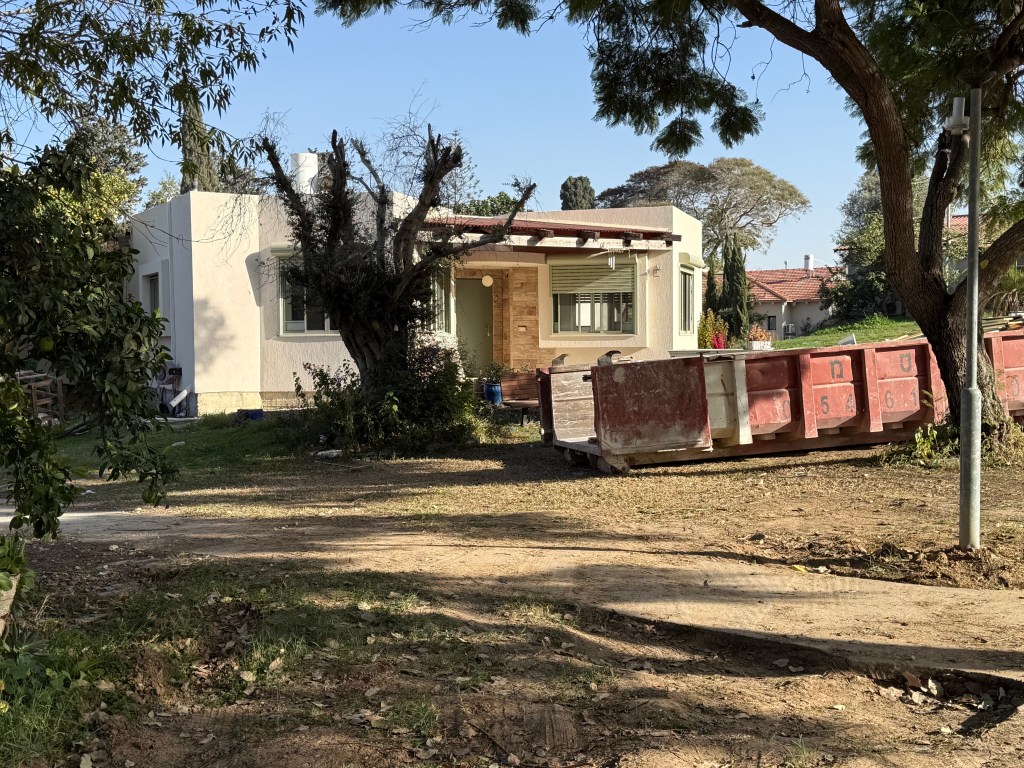
After lunch at Kibbutz Alumim, we headed to Kfar Aza. As I said, I’ve been there before. In May 2024, the devastation was incredible. The blatent brutality was in my face. By July 2024 they had begun to make some changes. This time the changes were incredible. The burned and shot up homes had been demolished and new construction was in place. Most of the kibbutz was no longer witness to the devastation of October 7th, it was a sign of life and the resilience of the Jewish people. This house is an example. In May and July of 2024 it was a symbol of the savagery of Hamas. In December 2025 it is a symbol of life, a beautiful new house in a beautiful area of the Kibbutz. As I looked at it, I could imagine myself living there. The dichotomy of my visits in 2024 and 2025 are symbolic of the Jewish people. We face many challenges and get repeatedly knocked down. But like the beautiful new house in 2025, we always get up. We look to the future with hope and with dreams. We won’t stay down, we won’t allow others to defeat us.
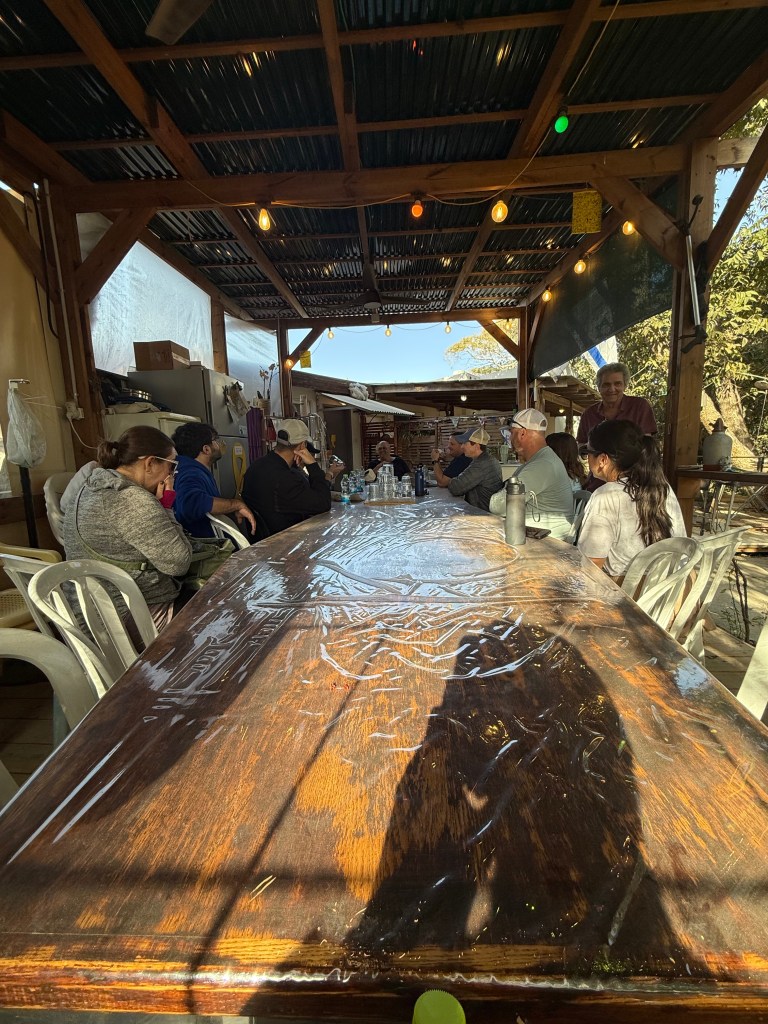
We met with Schacher, a resident of Kfar Aza. He told me his story and gave us the tour of Kfar Aza in July 2024. As we sat on the deck of his house, he told us what it was like on October 7th, hiding in his safe room as those around him were murdered and kidnapped. Why the terrorists didn’t come into his safe room we will never know. They came into his house, ate his food, and used his deck, the same deck and chairs we were sitting at, as their headquarters for the attack. It was surreal to be sitting in the same place that the terrorists were on October 7th.
Schacher’s table and deck, where the terrorists sat and planned their attack on October 7th at Kfar Aza.
Schacher took us around Kfar Aza, showing us where terrorists murdered people, where they kidnapped people, and told us stories of those who died and those who survived. It was incredibly powerful to experience. It was also a bit surreal as the changes since my last visit in July 2024 were obvious. While people haven’t moved back en masse yet, it was still a place of life now, not of death. Until we got to the young people’s section of the kibbutz. This area was targeted by Hamas for kidnapping and murder. The devastation remained. There are two homes we can walk in, one because the family gave permission as they want people to see the brutality of Hamas and how their daughter was murdered, the other because it was empty on October 7th. I also saw the home of Netta Epstein. I met Netta’s mother in November 2025 and her story and how Netta died was powerful and painful. Netta and his fiance were at home when Hamas stormed Kfar Aza. Hamas began throwing grenades into their small home and Netta threw them out. Until he couldn’t get to one fast enough. He jumped on the grenade to save his fiance, sacrificing his life. She was taken hostage and ultimately released. When I look at his picture, I see somebdy like my kids, with a bright future ahead. Hamas stole that from Netta, from his family, and from the world.
I wasn’t as angry at Kfar Aza this time because it was clear life was returning. It is a good lesson for us all and perhaps the true secret of why the Jewish people have continued to survive for thousands of years. We focus on life, not on death. We can grieve those who were murdered but we can’t bring them back. What we can do is live fully in their memory. We can make sure that their being murdered for the crime of being Jewish doesn’t become meaningless.
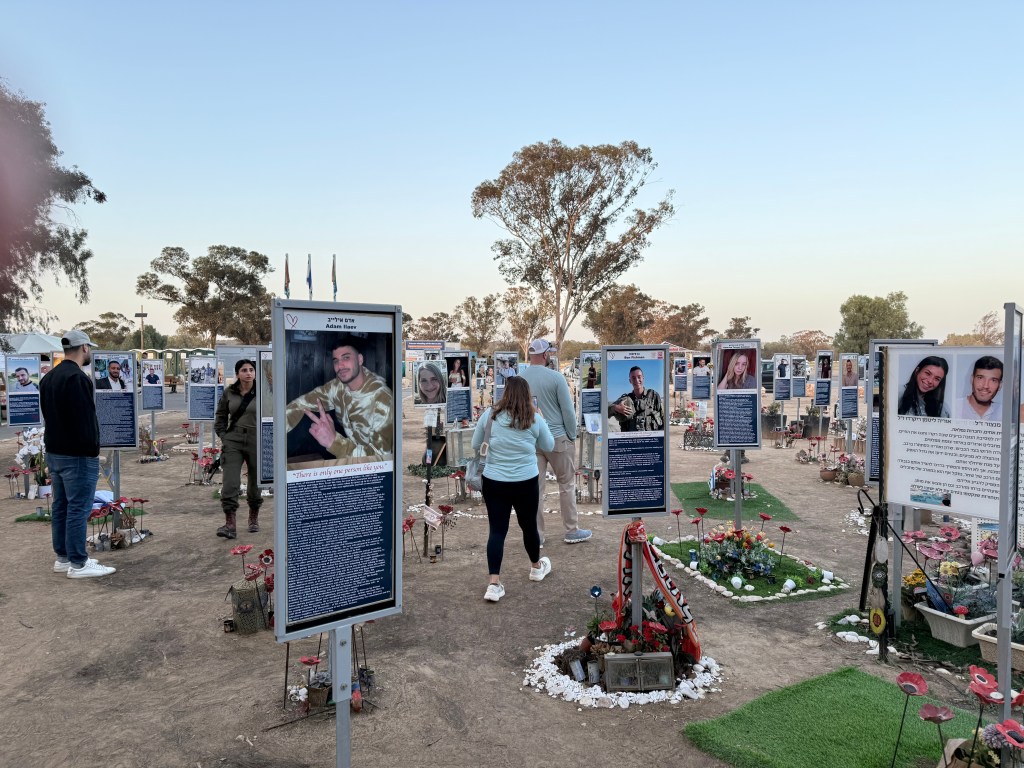
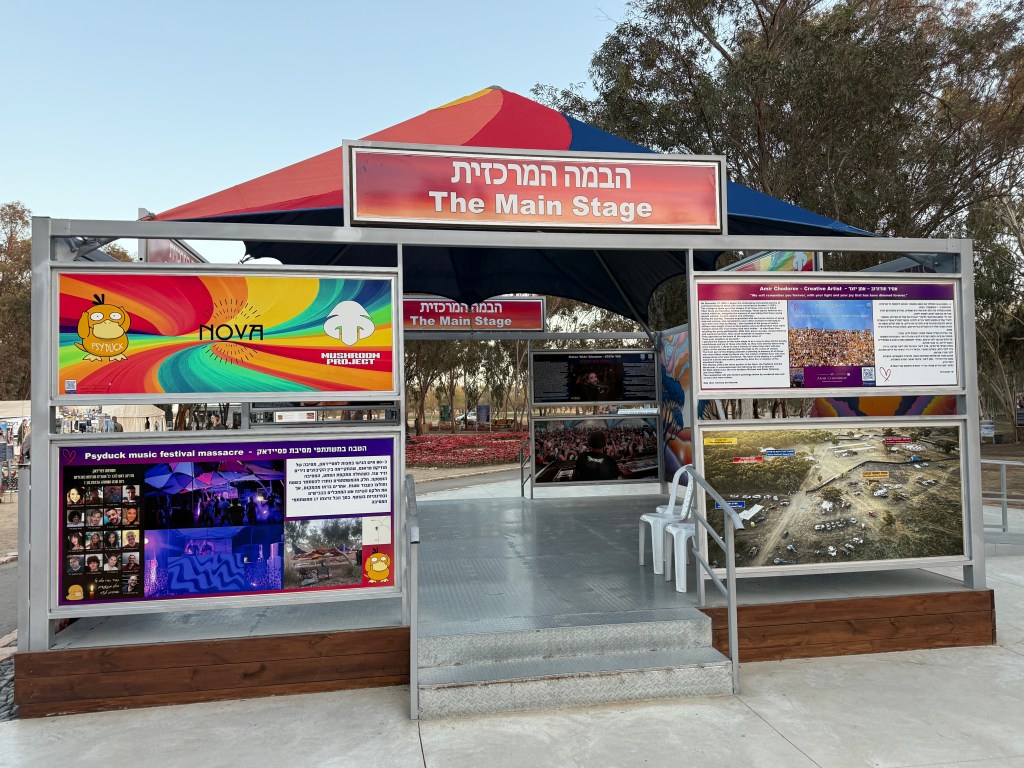
Our final stop in the south was the Nova festival site. I had heard from others how it had changed and been built up since my last visit but I wasn’t prepared for what I saw. Two new forests were built by Jewish National Fund (JNF) to honor those murdered there. There was a new area for the main stage and for the big yellow dumpsters. Seating areas had been built and real bathrooms now existed. The dirt road was replaced with paved road. Even the pictures in the field to memorialize the victims had been upgraded. It left me with conflicted feelings
The updated and upgraded Nova memorial
Part of me appreciated the need to make this into a true memorial for the country. To add exhibits and make it look more professional. Yet another part of me really appreciated the simplicity and raw emotion that the earlier version offered. Change is difficult and for me, the impact of the first two times I visited the Nova site was strong. This is a different version of the site. Yet when I watched how it impacted those on the trip who had never been to Nova before, I saw them having the same experience I had my first time. Perhaps it really is just me and what I wanted to see rather than the impact that it had. I enjoyed the main stage exhibit and the big yellow dumpsters exhibit. They were new and really added something to the experience.
The Main Stage exhibitA part of the Main Stage exhibit
We finished out time at Nova by gathering in a circle and singing. All three times I have visited Nova, we have sung. As the memorial site to those brutally murdered at a music festival, I think it is important to bring music, even if just one song, to the visit. This time we gathered together and sang Hatikvah. Not only is it the Israeli National Anthem, it means “The Hope.” On a day that involved being on the border with Gaza, visiting Kibbutz Alumim, Kibbutz Kfar Aza, and the Nova Site, hope is essential and fitting. Yet after we finished singing, we discussed the lyrics.
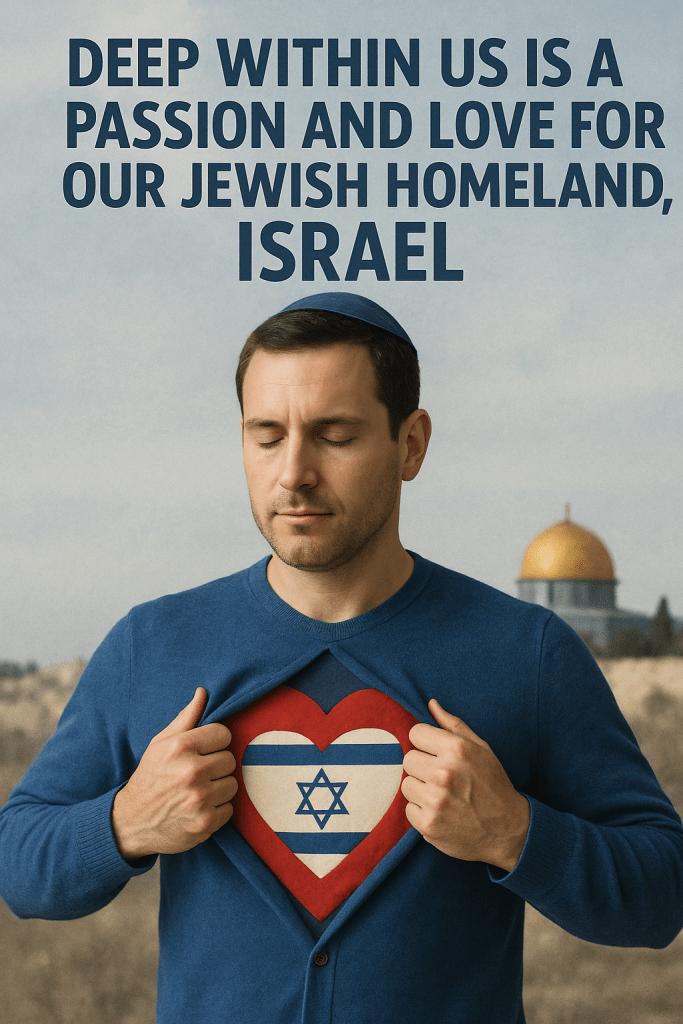
The song begins, “As long as the heart within the Jewish soul yearns, and towards the eastern edge, onward, and eye gazes to Zion.” The hope for the Jewish State of Israel in this song is not unconditional. In fact, it is very conditional. Our hearts must yearn towards Zion, towards Israel, in order to have a Jewish state. It has to be within us, a part of our being. That’s what makes Israel so special – the longing we have for her. The deep within us passion and love for our Jewish homeland. Without that passion and love, deep within our heart exists, so will Israel. I don’t know about you, but I know that I have that deep yearning of my soul, in my heart, for Israel, our Jewish homeland. I gaze towards Israel often, come visit whenever and as often as I can, and love being here. I hope that you do as well. It is a remarkable country on so many levels.
I remember being in high school and learning the ancient Chinese curse, “May you live in interesting times.” and thinking to myself, what could be better than interesting times? I hate being bored, so interesting times would be exciting and fun.
Ah, the naivety of the young.
These are interesting times and as such are not so wonderful times. The rise of hatred over the past decade is frightening. The rise of antisemitism over the same time period and the exponential growth in the past 6 months is overwhelming. I read and listen to so much discussion and none of it seems to focus on the real challenge and the real solution.
We have been taught not to like each other. We have been taught that ‘the other’ is against us, will harm us, and that if they get what they want, we won’t get what we need. This seems to be fairly universal, regardless of who you are and who ‘the other’ is. We villainize them. We make broad generalizations about them. We make assumptions about them. The one thing we don’t do is actually engage with people who are different from us. That one thing we don’t do is the one thing that we need to do.
In November 2019, I had the honor and privilege of participating on an Encounter Immersive Experience. We spent 4 days meeting with, listening to, and learning from members of Palestinian civil society. I said it and used the word – Palestinian. So let’s set some ground rules for the rest of this post.
The Palestinian people do exist. They may have had different names over the years from Arabs to Bedouins, to Palestinians. We, as Jews, used to be called Hebrews and Israelites. Accept the fact that these people do exist, they live in what I will call ‘Greater Israel’, and aren’t going anywhere.
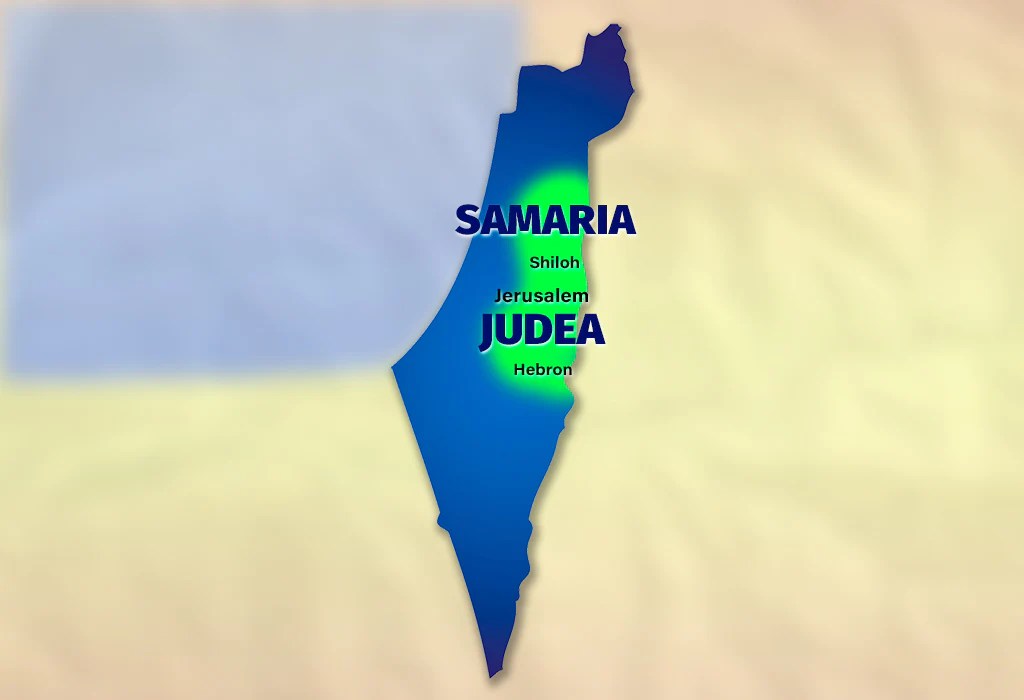
As a result of the 1967 war, Israel conquered territories. This happens in many wars and is a reality of millenniums. The area on the west bank of the Jordan River has different names. For purposes here I am going to call is Judea and Samaria, the ancient names for that land. Some may call in the West Bank. Some may call it Palestine. I am calling it Judea and Samaria.
Hamas, Hezbollah, and the Palestinian Authority (PA) are evil. Most Palestinian people don’t like them. I will discuss this later in this post however understand that there is a difference between Palestinian people and terrorists. If you insist on generalizing that they are all people or are all terrorists, you can stop reading here if you want. There is a difference.
Now back to my 4 days with leaders of Palestinian Civil Society. I remember thinking how 4 days seemed so short. This is such a complex issue; how could we only spend 4 days with them? There were 4 of the most intense days of my life. By the third day I was grateful that it was only 4 days because on how intense they were.
During these 4 days, which I wrote about at the time, and you can find about 17 blog postings in the beginning of this blog from that time period, I had the ability to meet with many different people. I had a chance to ask questions, listen to other points of view, and listed to people who had an entirely different history and narrative than I do. I met people who I really like and stay in touch with even today. I met people who I despised and who I am sure despised me only because I am Jewish. I met people whose effort to change and challenge everything that they know were inspiring. I met people who are a direct cause for the increase in hate, terrorism, and everything that led up to October 7th. I saw things that made me sad. Some were out of necessity, and some were simply terrible government policy. It was a life altering experience that only made me a stronger and more powerful Zionist but also made me a better human being because I began a journey of understanding some of the deep challenges and how much work it will take to find a solution, to make peace, and to get beyond the damage that has been done in the past so that we can live in a different future.
I have written a lot about how October 7th has impacted and changed me. I wrote about what seeing the 47-minute Hamas video was like. Recently I saw the documentary about the massacre at the Nova Music Festival and I shared what that was like. The past 6 months have been focused mostly on being a Jew in today’s world and in the United States. It has been focused on the challenge of being a Zionist, loving Israel, in a world that is openly hostile, willingly believes lies and knowingly uses inflammatory language that is not accurate. I have paid attention to my friends called up in the reserves, their children, either called up or who are currently serving in the IDF. What I haven’t done is think too much about my Palestinian friends and what life has been like for them.
Over the past few weeks, I have been talking a lot with various people about the future. As the US is demanding a permanent ceasefire and a 2 state solution (Hamas is the obstacle to the ceasefire as they have openly called for more October 7th massacres and still are holding hostages), I found myself thinking about who would be that partner for peace. Obviously, Israel and the government have to make their own changes and hopefully that will come soon. But what about the partner? Who would it be? It’s not Hamas or Hezbollah. It can’t be the Palestinian Authority (PA) who not only is corrupt and whose people hate them, still has not condemned the October 7th massacre nor have they had elections in 19 years! So again, who can this partner be?
I found myself thinking of my friend Ali Abu Awwad, founder of Taghyeer, the Palestinian National Nonviolence Movement. I met Ali on that trip and was amazing at what he said. There was real leadership about building a country that would live in peace with Israel. The line he said that I will always remember is, “Peace will not come through Jewish blood. It will come through Jewish hearts.” He then added, “we need to prove to the Jewish people that they can trust us because we have only showed them that they cannot.”
Ali and me together when he visited Orlando and spoke to our community.
Imagine leaders who are not calling for ‘intifada’ or ‘jihad’ but instead are calling for peace and understanding. Imagine leaders who came from a place of hatred and have overcome it to work with Jews, with Israeli, to build a better society. Imagine a leader whose mother was a high-ranking PLO leader, who spent time in an Israeli prison at the same time as his mother and was able to move beyond hatred. Imagine a leader whose brother was killed by the IDF and found peace and acceptance by spending time with a Rabbi whose son was killed by terrorists. That is Ali Abu Awwad. Just before Covid shut the world down, Ali spoke in Orlando. The room was at least half Israeli. They were primed for a fight. They were primed to hear somebody blame Israel and make the Palestinians innocent victims. They didn’t get what they expected. They heard somebody taking responsibility for their part in the hate. They heard somebody who gave hope for a different future.
I realized I hadn’t reached out Ali in quite a while. I hadn’t checked on him and asked how he was doing? then I began to think of some of the other Palestinian people that I met and considered friends. I hadn’t reached out to them either. What type of friend am I to be so overwhelmed with my own grief that I don’t check on my friends. So I began doing so. I reached out to Ali and am awaiting his reply.
I reached out to my friend Mahmoud. His family owns the Educational Bookshop in East Jerusalem. I spent a day with Mahmoud in 2019 walking around East Jerusalem, visiting the Palestinian theater, learning about the Palestinian arts community, and having coffee and a conversation at the bookshop. We finished the day at his home with another deep conversation. I wrote about that day in this blog post.
The day with Mahmoud was difficult and very meaningful. It is something that I think about regularly because of the power of his words. He is not a fundamentalist. He does not hate Jews. He does not want the destruction of Israel. He wants to live freely. He wants a government that represents him and takes care of him. It was very difficult to hear him say that if there was a public works project in his neighborhood, he wouldn’t ask the municipality of Jerusalem to fix it because they wouldn’t. And he wouldn’t/couldn’t ask the PA to fix it because even if they could, they wouldn’t. He felt helpless so he would just get people together to fix it himself or live with it being broken.
Mahmoud and the Educational Bookshop. I look forward to returning for another cup of coffee with him.
He talked about how challenging it was for him to be in West Jerusalem and how he felt there, how uncomfortable and that he was a focus of constant attention. He shared how he didn’t feel he belonged or was welcome there and how much that bothered him. It bothered him so much that he didn’t like going. He talked about how he would go to Tel Aviv, and he felt he didn’t stand out, he wasn’t a focus of attention like he was in West Jerusalem. And how that both made him feel welcome and how it also troubled him – why was it so different? He could disappear in Tel Aviv and just be a person while he felt he couldn’t do that in West Jerusalem. It didn’t sit well with me then – that’s not the Israel I love – yet with the rise of antisemitism in the past six months I have begun to understand it in a way that is very uncomfortable.
I watch what is happening in places like New York, California, Michigan, and Canada, and feel very uncomfortable and unwelcome as a Jew. This isn’t the America that I love. There are places around the world that I won’t visit now as a Jew. This isn’t the world that I want to live in.
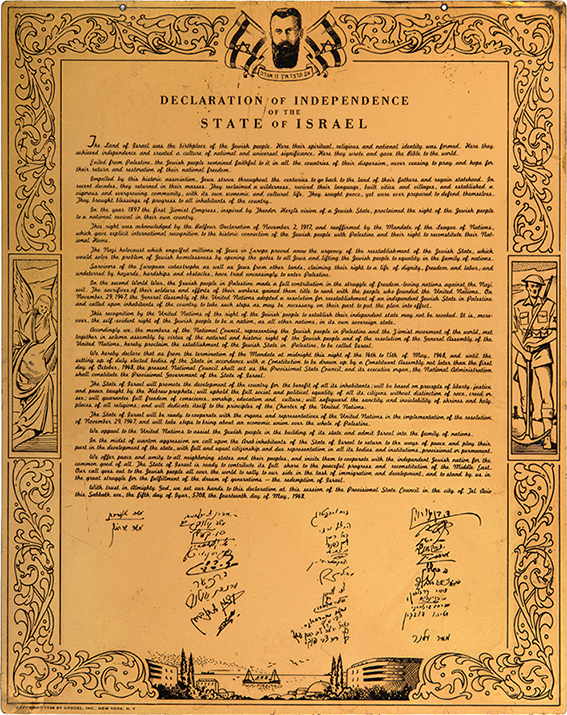
I think often of something that Mahmoud said to us in his home. He said that if Zionism means that the Jews have a claim to the land and that the Palestinians also have a claim to the land, then he supports Zionism. It was incredibly powerful when he said it and even more powerful today. When a Palestinian man living in East Jerusalem can come to that type of understanding, it gives me great hope for the future. Zionism isn’t colonialism. It isn’t racism. It is the belief that the Jews have a right to self-determination in our historic homeland. In fact, the Declaration of Independence has some very clear definitions in it that need to be highlighted. They include:
This right is the natural right of the Jewish people to be masters of their own fate, like all other nations, in their own sovereign State.
Simply put, we have a right to our own sovereign State and self-determination. It’s very clear.
THE STATE OF ISRAEL will be open for Jewish immigration and for the Ingathering of the Exiles; it will foster the development of the country for the benefit of all its inhabitants; it will be based on freedom, justice and peace as envisaged by the prophets of Israel; it will ensure complete equality of social and political rights to all its inhabitants irrespective of religion, race or sex; it will guarantee freedom of religion, conscience, language, education and culture; it will safeguard the Holy Places of all religions; and it will be faithful to the principles of the Charter of the United Nations.
While Israel is a Jewish state, it is a place for everybody who lives there. It is based on freedom, justice and peace – this language is very different from the charter of Hamas and the PLO. And it guarantees social and political rights to all. Unlike Hamas, Hezbollah, Iran and others, we do not want to a place for us alone.
WE APPEAL – in the very midst of the onslaught launched against us now for months – to the Arab inhabitants of the State of Israel to preserve peace and participate in the upbuilding of the State on the basis of full and equal citizenship and due representation in all its provisional and permanent institutions.
Full and equal citizenship and due representation. Powerful words. Powerful ideals.
WE EXTEND our hand to all neighboring states and their peoples in an offer of peace and good neighborliness, and appeal to them to establish bonds of cooperation and mutual help with the sovereign Jewish people settled in its own land. The State of Israel is prepared to do its share in a common effort for the advancement of the entire Middle East.
That last line is so important, especially during these times. While we may not have a current partner for peace with the Palestinians, that doesn’t mean we shouldn’t do our part to find one. The Abraham Accords and potential normalization with Saudia Arabia and Indonesia create even more opportunities. We cannot let the horrors of the past stop us from the beauty of the future. When I think of Mahmoud’s words back in 2019 and Ali’s passion and mission, that’s what I find myself going back to.
We cannot let the horrors of the past stop us from the beauty of the future.
Ali and Mahmoud both want a world where people live in peace, together, building countries that care about their people. They are both incredible leaders with a following. We cannot afford to ignore them and let those who preach hate; Hamas, Hezbollah, Iran, the Palestinian Authority, etc., be in control.
Mahmoud and I have been emailing and when I’m in Israel in May, we are planning for me to go visit him at his bookstore in East Jerusalem, walk around the neighborhood once again, talk, share a long cup of coffee or tea, maybe have lunch or dinner, and talk. And talk. And talk. Learn from each other. Deepen our friendship. Because we both want the same thing. A brighter future together.
One of my favorite people that I met on this trip was Mohammad. I wrote about them in this blog post at the time. He and his wife Hiba, and their baby son hosted us for dinner at their home in East Jerusalem. They come from an amazing family. Hiba’s family is the Muslim family that holds the keys to the Church of the Holy Sepulchre. It’s an amazing story and if you don’t know it, you can begin to read about it here. They both had Master’s degrees. She worked for the UN, he worked for an NGO that took him into Gaza on a monthly basis. We formed an instant connection and talked at length about the different challenges. The fact that the PA hasn’t had elections since 2005. How corrupt the PA is and how they do nothing for the people except steal money. How if there ever were elections, they could never vote for the PA, meaning that even Hamas would be a better choice because MAYBE they would do something for them (we haven’t talked about that since October 7th and I look forward to it in the near future) while they know the PA won’t do anything. I asked about them running for office and their response was demoralizing as they didn’t believe that they would win and if they did, they wouldn’t be able to do anything without being killed.
Mohammad, Hiba, their son and me at their home in East Jerusalem.
We made a promise to get together again on my next trip so he could take me to his favorite restaurants, bakeries, ice cream shops, and we could continue our conversation. Covid delayed my next trip, but I reached out before it, only to learn that Mohammad and his family had moved to Japan where he was working on a Ph.D. We haven’t been able to coordinate his trips back with my trips back yet, but in our last correspondence we are going to try later this summer when they will be there for a few months. In the meantime, they have a new baby that I want to meet. He offered his home for me to stay when I visit, and I plan to take him up on the offer. This is a beautiful family. Wonderful people. True friends. And Palestinians. It is possible.
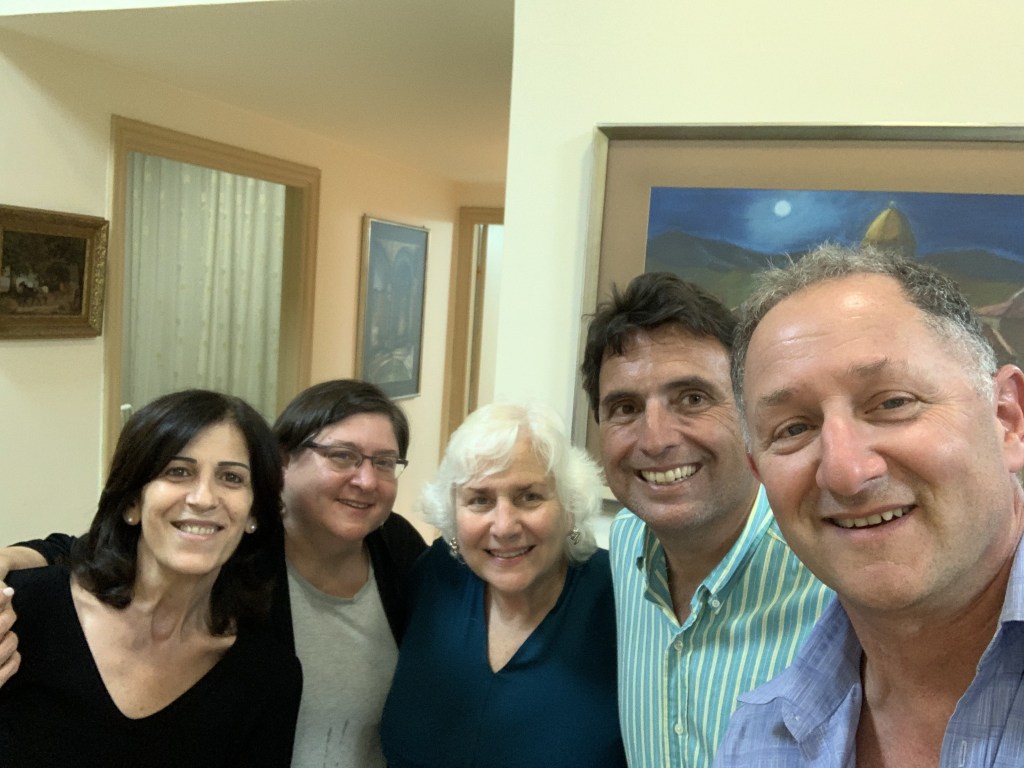
The last friend from this trip that I have been in contact with is a woman named Suzan. She is a Palestinian Christian who lives in Bethlehem. She also hosted us at her home for dinner where we had an amazing conversation. She worries about the declining number of Christians in Bethlehem. She worries about the role of women in Bethlehem. She is privileged because she also has a German passport so is able to travel much easier.
Suzan (far left in the black dress) and four of us at her home for dinner.
Suzan is an artist and runs an art studio. The Bethlehem Fair Trade Artisans shop is an amazing place highlighting a variety of artists, mostly women, and I encourage you to check it out and if you see something you like, to purchase it. (Full disclosure – I encourage you to purchase as much as you can from Israeli artists and Israeli businesses. I have purchased many pieces from Israeli artists since October 7th. If you need help finding Israeli artists or businesses, please let me know and I’ll be happy to share my favorites and many others with you.)
Her focus is on women artists and fair-trade practices. She was very frustrated that she was being told by the city government that her future shows and community events could not include Jewish women. She told us that she didn’t care what they said, she was still going to invite the Jewish women to participate. And she was going to continue to sell the works of Jewish women artists in her shop. She didn’t care what they said, she was going to do what was right. What was moral. What was ethical.
Put those words together. Moral. Ethical. Palestinian. Generalizations simply don’t work. There are terrorists. There are people who hate and are evil. I have met many of them, especially on that trip in 2019. There are also many good people. Great people. Caring people. People who you’d want as your neighbor. As your friend.
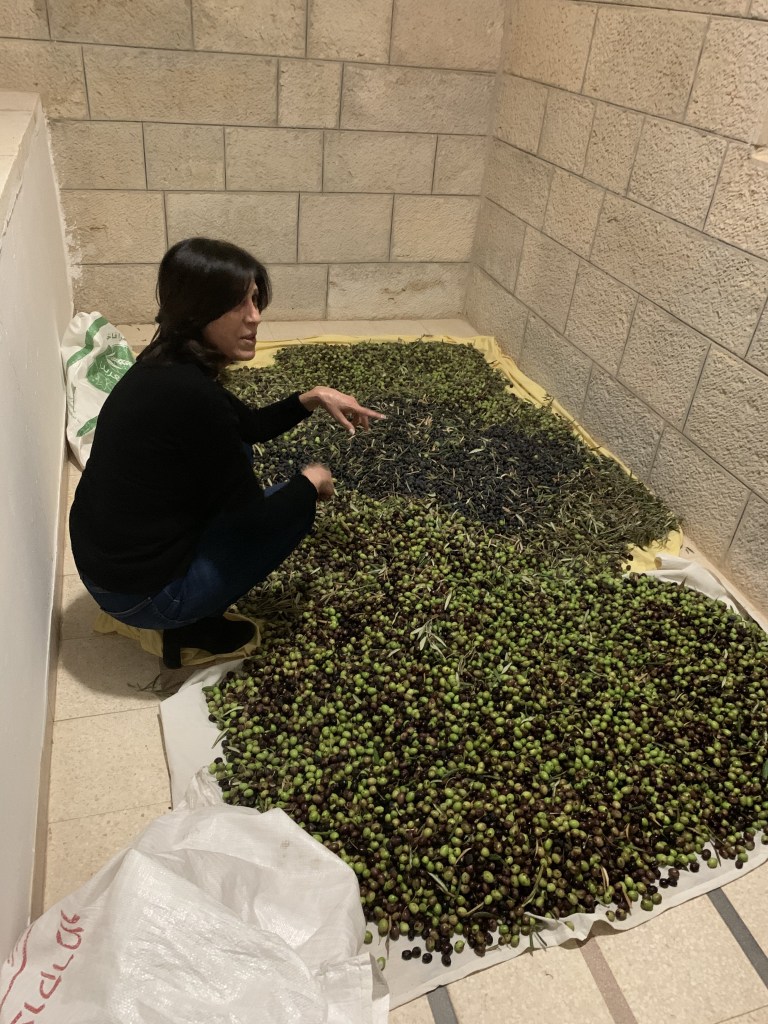
I hope to see Suzan either in May or later this year. When I met her, it was just after she harvested her Olive trees so I saw the harvest. Maybe this time I can see the trees filled with olives, filled with life. Wouldn’t that be an incredible symbol.
Suzan with her harvest of olives from her trees
These are four examples of wonderful, amazing people. People I call friends. People I would be honored to have as neighbors. People I trust. Good people.
I met terrorists. You can read about my lunch with a member of Hamas, a murderer, and a member of the Al Aqsa Brigade in this post. There is a difference between my friends who are Palestinian and the terrorists. And I met people who were terrorists and are on a journey towards something different. There is hope for the future but only if we are willing to do something different than the past. That difference isn’t just up to us but it can start with us. We can change our language. We can use our contacts to meet Palestinians who want peace, who don’t hate, who don’t support Hamas or the PA, who will invite you into their home, share a meal, a coffee, and who you will come to really like. We can help them rise up and together we can ensure the terrorists aren’t in power, don’t have the ability to kill Jews and oppress the Palestinian people.
I’m not being pollyannish. I’m not being naïve. I am being hopeful. I am talking about creating a systemic change. I’m talking about taking action to stop the funding to UNRWA and the PA. Ensure a new government ‘of the people, by the people, and for the people’ is set up in Gaza (sound familiar?) We can lobby our government to force elections in Judea and Samaria, so Abbas’s 4-year term finally comes to an end before he serves 20 years of a 4 year term. We can encourage the leaders in Israel to work with these leaders who want peace in a methodical manner to build trust. As Ronald Reagan famously said, ‘Trust, but verify’.
The Israeli national anthem is Hatikvah, the hope. Let’s make sure we don’t lost hope. Then the terrorists win and we all lose.
IDF soldiers singing Hatikvah after October 7th just before they prepare to enter Gaza and defend Israel.
I look forward to sharing stories, pictures, and maybe even some videos and conversations with my Ali, Mahmoud, Mohammad and Hiba, and Suzan. As deeply as October 7th has damaged and changed me, I won’t let it drive out hope. Hope in the good people. Hope for a better future. And in the words of Theodore Herzl, “If you will it, it is no dream.” I’m going to put the work in. I hope you decide to as well.
PS
I came across this video of IDF soldiers rapping about the lies that are told about them. It’s very powerful and timely.
Sadly, it was recorded 10 years ago, showing that these allegations have a long rooted basis in antisemitism, Jew hatred, and bigotry. Enjoy the video as it’s powerful.







 keithdblog