The trading of time

I’m here in Israel for two weeks with a group of young adults on a leadership program.  The Jewish Leadership Institute (JLI) was created by Rabbi Mayer Abramowitz more than 30 years ago.  He was a visionary.  He understood in the early 1990s that the future was on the college campus and that providing answers to the WHY of Judaism was critical to developing Jewish leaders.  I was introduced to the program in 1998 and have been a fan ever since.  Now I get to work with my friend David, Rabbi Abramowitz’s son, on JLI and the future of JLI.

While the focus of the trip is on the young adults, it is impossible not to be inspired by both them and the content.  I find myself thinking deeply throughout the different experiences and while I am not the intended target of the program (nor are you) the impact is felt.

Yesterday we had an amazing tour guide, Eytan Rund, take us on a tour of the Old City of Jerusalem.  I’ve been on many tours of the Old City.  Too many to count.  I love the Old City.  Last month, our guide gave a totally different view of the Old City that I wrote about.  Eytan spent two hours with us giving one of the most amazing tours I have ever experienced of the Old City. 

Eytan’s focus was on the difference between seeing old stuff and seeing stories, history, and memory.  The Old City was his muse to talk about peoplehood.  To talk about the Jewish collective.  To talk about what being Jewish means – being part of a mishpacha, a family, that is thousands of years old.  As we looked down into the ruins of Jerusalem from the time of the first Temple, he explained this was this built 3,000 years ago by Jews.  Well before Christianity.  Well before Islam. This is our homeland that we built.  He talked about how after the destruction of the first Temple, Jerusalem was filled in with sand to make an entirely new ground, well above the prior city.  It is always amazing to look at the areas from the time of the first Temple however this was different.  He tied it to us.  We built the first Jerusalem.  We built the second Jerusalem.  And we built the current Jerusalem.  It was powerful.

As we walked through the Old City, he focused on 1948 and the battle for the Old City as well as the battles with the Assyrians, Persians, and Romans.  The stories were vivid.  They were personal.  On my trip last month, Saul Blinken, our trip leader, talked about what a miracle it is that we get to wake up in Jerusalem.  We walk the streets of Jerusalem.  We breathe the air of Jerusalem.  That was incredibly impactful for me.  I am fulfilling the dreams of my ancestors from 2,000 years ago and I can never forget that.  Eytan reiterated that in his own way.  The modern state of Israel is truly a miracle that our ancestors who were conquered by the Romans could never imagine. 

It made me think of a story that my friend Harry Rothenberg told me a few years ago as we were climbing Masada.  I challenged him to do some on the spot Torah teaching about climbing a mountain.  He said that when God told Moses he would not be permitted to enter the land of Israel, Moses begged God thousands of times to be allowed to enter.  God refused every time.  God finally told Moses that if he climbed this mountain, he would be able to look into Israel and see the entire land.  Moses climbed the mountain, saw the land, and his love for the land he saw but could not entered is a part of all of us.  That is why we love Israel.  It’s a great teaching about how our love for this land goes back thousands of years.  It’s not since 1948.  It’s not since the late 1800s and Theodore Herzl and the creation of modern Zionism.  It goes back to Abraham.  To Moses.  To King David and King Solomon.  It is a part of who we are. 

One of the things I love about JLI is our morning services.  As somebody who does not like services, that is an interesting statement to make.  The reason I enjoy these services so much is because they focus on the WHY not the WHAT.  As we continued to discuss the prayers about thanking God for restoring our soul and for the rooster knowing the difference between day and night, we talked about time.  Previously I wrote about how Judaism marks the passage of time, so we don’t lose our focus.  Today we talked about how we are always trading time.

It is a fascinating concept that most people don’t really think about until they are older.  That is when we begin to realize that time is our most precious commodity.  We can always make more money, get a new car, a new house, new clothes, TVs, computers, etc.  What we can never get back is time.  Life is about the value of time and what we are willing to trade time for.

For many years, I was willing to trade time for money.  For career.  For ego and for title.  For status.  For the nicer house and the better car.  I wouldn’t trade time with my children – I took them to doctors appointments, went to their sporting events and music performances. I specifically remember having a small counseing practice and when I did the analysis of what insurance was paying me, realized that I would rather have dinner with my family than make money. Until I got a bigger job.

The bigger job, for some reason, changed the equation. I began to trade time more freely. I didn’t realize that’s what I was doing. I knew I didn’t like it but I continued to do it. After a few years, I realized that among many things, I wasn’t willing to trade that time for the money, title, and prestige of that job. So I left. My new job was still demanding but not in the same way. The trading of time was different. Perhaps it was because my children were a little older.

The question to ask ourselves is what is each experience worth? What would I trade it for? As one of our teachers here in Israel asked, ‘Would you trade your elbow for a million dollars? How about both elbows for ten million dollars?’ Over the past almost year, my equation for trading time has changed. I am eternally grateful for the last three weeks of my father’s life when I was able to be there for him and my mom. It is time I can never get back and I’m glad I didn’t trade that time for money, prestige, power, or anything else. I am not willing to trade time with my children the way I used to be. I won’t trade the time with my wife the way I used to be. My job today requires travel and it is not always balanced (July is a month of almost entire travel) but I built in time for a trip with my wife.

As we evaluate our lives, time is the ultimate measuring stick. Not money. Not titles. Not power nor prestige. At the end of the day, it is the time I spent with my family, with my wife, my children, my parents, that matter the most. It’s a lesson I continue to learn and I’m far from where I want to be with my willingness to trade time but I am much better than I was just a year ago.

Maybe this comes with age. Maybe it comes with losing a parent. I’m excited to take trips this fall to watch my older son coach college football. Sure it’s a 10 hour drive each way but who cares. It is likely either my wife or younger son or both will be in the car with me. Plus I get to watch him do what he loves. I’m excited to take trips with my younger son to sporting events, concerts, and other things. I look forward to planning the things my wife and I will do together and when not traveling for work, the time we just spend together as I get to work from my home office those days.

Life is far too short to give away our most valuable possession. Time.

How do you value your time? What are you willing to trade for time with your spouse, your children, your parents, your friends? Once you trade that time away, you can never get it back.

Who am I? Find for yourself a teacher.

As I have said many times, I am not a religious person.  I don’t go to synagogue often.  In fact, a monthly Sunday morning service is all I do right now.  And I only go because of the way it is done.  It is done in a meaningful and intentional way.  It is done not only for the ‘how’ of praying but more importantly for me, the ‘why’.  I began learning Torah with a Rabbi a few years ago because I valued the discussion and questions that came out of the process.  Studying Torah became about how I choose to live my life today rather than learning some stories verbatim and being able to repeat them back.

I often think that the challenge people have with religion and services, both in the Jewish and non-Jewish communities, is that we are taught only the HOW.  We are never taught the WHY.  One of my favorite parts of being Jewish has been that I have begun to ask the WHY question and don’t really care that much about the HOW.  The WHY is what matters. 

Simon Sinek’s amazing Ted Talk about Start with Why. The Why matters.

It’s interesting that for a guy who isn’t religious, doesn’t really like going to synagogue, doesn’t keep kosher, has his own definition of keeping Shabbat (I don’t do work but I drive, cook, drive a car, turn on the TV, etc.  I just don’t do professional work (most of the time)) that I find wisdom in the Torah.  As a few friends and teachers have told me, “The Torah is the instruction manual for life.”  I think it’s because of the teachers that I have found and the way they teach, how they explain the WHY of things rather than the literal story, that I find meaning and inspiration to be a better person.

I was excited that on this trip, the young adults and I were going to have the opportunity to learn some of the WHY from my longtime colleague and friend, Aryeh Ben-David.  From my experiences with him over the past 15 or so years, I knew that he would get to the WHY and boy did he.  He did in a brilliant and simple way, using only the first verse of the Torah. 

Genesis verse 1 talks about the creation of the earth.  Most of know the story of the six days of creation and the 7th day God rested.  None of this was what Aryeh discussed.  Instead, we focused on THE major life question.  WHO AM I?

Three words.  None more than 3 letters.  Yet it is perhaps the most asked and the most challenging question for all of us.  We start the Torah with the big question.  Judaism doesn’t mess around.  Let’s get right to it. 

As we discussed the question first in chevruta (pairs of two) and then as a big group, we were able to bring it together with Aryeh’s guidance to two things.  First, we are made in God’s image so that we are all perfectly as God intended.  This also means we have to strive to be more Godlike in life.  Secondly, we are both dust and soul.  The two don’t get along.  They fight constantly over us.  Are we focused on the here and now and pleasures of the body?  Or are we going to be focused on delayed gratification, making things have meaning, going deeper into what we are doing and why we are doing it?  Every choice we make is between the immediate pleasure or the delayed gratification.  The shallow or the deep.  One thing became very clear.  While there are people only for the dust (immediate pleasure), they are few and far between and typically easy to identify because they look like a caricature.  There are very few who are all about the soul (delayed gratification) and they are also easy to identify.  They are monks.  They deny the physical entirely, never marrying, living in isolation, depriving themselves of everything but the basics.  The challenge is the balance between the two.

There is a place for the dust.  We want nice things and there is nothing wrong with having nice things.  Good food.  Good wine.  A nice house.  A nice car.  Good clothes.  An enjoyable sex life.   Money in the bank.  The ability to travel.  The question is always, “at what cost?”  Where is the balance?  At what point are we only serving ourselves and not serving the larger community or God (and if you don’t believe in God, replace the word with nature or civilization or whatever you want).  Do we want to be like the wealthy attorney who owns the huge fields in Israel that we picked apples at and who donates all the food to those who are in need, or do we want to be the person who owns large parcels of land and lets them sit empty because they merely want to make a profit on the resale of the property?  Do we want to keep all our money, time, and talent for our benefit or do we want to give our money, time and talent to help others and improve the world.  These are the questions we need to ask.

In these crazy times that we currently live, this first verse of the Torah is more important than ever.  Do we want to fight hate or make money off it?  Do we want to hide and stay quiet, hoping it will pass us by or do we want to do the right thing and stand up against it?  Do we want to spend the time to get educated and understand the nuance or believe the soundbites and move on?  What are our morals?  What are our ethics?  What do we stand for?  The old saying, “If you don’t stand for something you will fall for anything” has never been truer.

We can even take this into the United State political arena.  Do you want to be part of the country that hates the other part of the country?  Do you want to live in hating the other political party and their candidates?  Would you rather work to solve our society problems?  These are choices we get to make every day.  Do we want to be spending more of our time on the dust, the physical plane or the soul, the spiritual plane.  Note that none of this has to do with religion or even being Jewish although the thought and questions come from the Torah. 

Each day we get to ask ourselves these questions.  Each day, when we wake up, we have the opportunity to make new choices.  In a different session, as we discussed a few of the prayers, there were two that jumped out at me.  The first, Modeh Ani, is what we are supposed to say every morning.  It is a simple thank you to God for letting us wake up.  It also ties into the dust and soul issue.  Our soul leaves us at night and returns in the morning.  Sleep is for the physical, the dust.  While I don’t usually say the Modeh Ani when I wake up, I do thank God every morning when I wake up.  It’s the first think that I do (maybe the second after using the bathroom).  I thank God for giving me the day ahead and everything that comes with it.  It takes me a minute or two and it’s really very simple.  “Thank you, God, for the day ahead and everything that comes with it.  I am excited to be alive today and grateful that you gave me the gift of life today.”  That’s the entire prayer.  Each morning when I say it, it inspires me to take action in the day, no matter what the day entails.  Sometimes I say it out loud, sometimes in my head.  I say it every day.

The second prayer that jumped out at me was the first prayer of the morning service.  It is a strange one.  We thank God for giving “the rooster understanding to differentiate between day and night.”  What a weird thing to say as the very first prayer of the service. We all sat there thinking about why we would say that.  What makes that so important to have it be the first prayer of the morning service.  Our teacher talked to us about how the most precious thing we have in life is time.  On a trip with a group of young adults, all under 26, that’s an interesting concept to discuss.  Time is endless for them.  They are in the beginning of living as adults.  We talked about how Judaism ensures we mark time to remember how important it is.  A bris or baby naming.  Bar/Bat Mitzvah.  Wedding/chuppah.  Yahrzeit (anniversary of somebody’s death).  We constantly mark the passage of time to not forget how important it is.  We say this prayer so that we notice not just the passage of time but also that we pay attention to all the little things that happen every single day that we take for granted.  The sun rising.  Food to eat.  Clothes to wear.  Shelter.  Loved ones in our life.  The rooster knowing the difference between day and night is to symbolize nature and all the things we take for granted.  We start each day with gratitude by saying Modeh Ani or our own thank you to God for the day ahead.  Then we thank God again for all the things we take for granted. 

What a way to start every day.  As most of you know, I’m not very religious so saying the Hebrew prayers isn’t something that I do regularly.  Every day, I do thank God for the gift of the day and now I have the opportunity to thank God for all the things I take for granted.  Maybe that will help me notice them during the day and not take them for granted. 

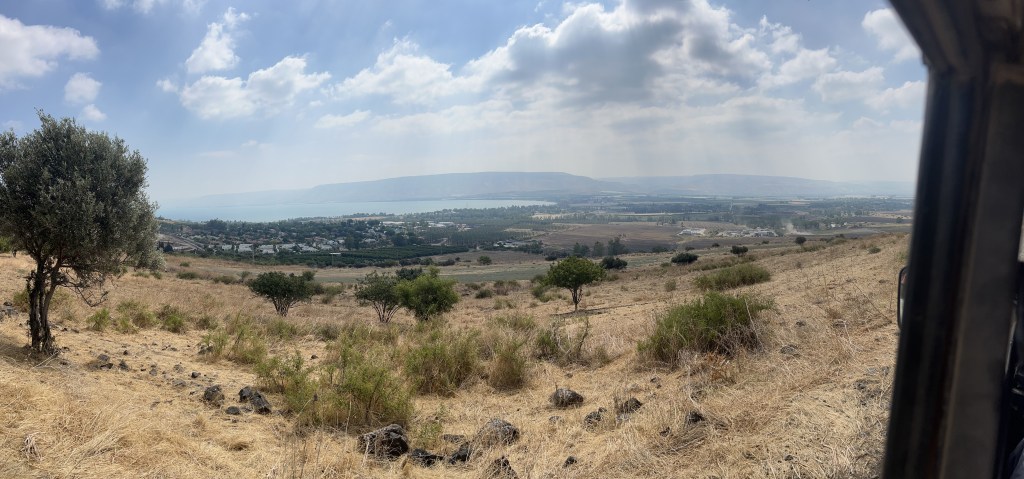
On my trip to Israel last month, we learned about what a miracle it is to wake up in Jerusalem.  To breathe the air in Jerusalem.  To walk the streets.  This morning, I woke up in the Southern Galilee to beautiful views.  God as an artist.  We rode jeeps around the area, looking at the fields growing fruit and vegetables.  At the mountains and the sky.  At the Kinneret (Sea of Galilee).  When we are in a different place and see the beauty around us, it is very easy to notice it.  What about in our own daily life?  What about in our own homes, looking at our own backyards? 

View of the lower Galilee. The Kinneret n the distance. Israel, Syria, and Jordan in the background.

As I spend two weeks of July in a country at war after spending 10 days here in May and planning another 10 days in August, I am so grateful for many things.  Grateful for the existence of the State of Israel.  Grateful to the IDF who protect this country.  Grateful that I have the ability to come to Israel as often as I have in my life.  Grateful for the pioneers who made the desert bloom.  Grateful to the leaders like David Ben Gurion, Moshe Dayan, Golda Meir, Shimon Peres, Menachem Begin, Yitzhak Rabin, Ariel Sharon, and many more who created this country.  I have the opportunity to live in the dust, enjoy being able to come here and enjoy the food, the people, the beach, and everything it has to offer.  More importantly, I have the opportunity to live in the soul as well, fighting on Israel’s behalf to educated and inform people about what it is really like and what is really happening.  I have the opportunity to let my soul open up while here and make sure it stays open when I return home. 

A short video from the lower Galilee with Israel, Syria, and Jordan in the background. It highlights how close everything is and is a way for me to educate and speak out on Israel’s behalf.

In Pirkei Avot 1:6, there is a famous line that I have chosen to live by.  To paraphrase it, we are charged to find ourselves a teacher, make them our friend, and judge others with grace and giving them the benefit of the doubt.  While all three are important, I sometimes struggle with the third and it is the first two that I am living by.  I have found myself not just a teacher but a few teachers.  They have become my friends.  They provide me guidance to be a better person.  They explain things and I ask lots of questions.  They make it relatable to my life today, in 2024.  One of my teachers, who I have been learning with and from for more than 20 years, told me a few weeks ago that I was now a yogi.  That was high praise from him and I’m not sure that I really believe that, but I have come a long way.  They all continue to inspire me.  I learn from all of them. 

So, who are you?  Where do you stand in the balance of dust and soul?  If you don’t know, that is totally ok.  Most people do not know.  Find yourself a teacher.  Make them your friend.  Learn.  It is not about being more religious.  It is about learning life lessons and how to apply them.  It is about finding meaning for you in what you choose to do.  It is a deeply personal journey and a powerful one.  I encourage you to begin the journey.  From my experience, it is one you will really enjoy.

My favorite band. One of their great songs. Who are you? That’s the key question.
In case you want to listen. Watching Keith Moon on drums is always a joy.

The Israel of today, the world of tomorrow

I’m back in Israel and have been for two full days.  They have been exhausting days, physically, mentally, and spiritually.  They have been uplifting days.  They have been challenging days.  Days filled with emotion and gratitude.  Days filled with joy and sadness.  Days that end in exhaustion and an inability to think any longer, let alone write.  It is Friday here and that means Shabbat.  Rest.  Recharge.  Gratitude.  Life.  Love.  Happiness.  Joy. 

I have been struck by a number of things on this trip so far.  Having just been here last month, coming back has felt different.  Normally there is a longing to return after 6 months, a year, or two years.  This trip, just a month later, has felt much more like really being home.  Not just a spiritual home or a Jewish home, but a real home.  The streets of Jerusalem are familiar because I was just walking them.  It’s a different feeling and very comforting.  Despite all that is going on here in Israel and in the world, there is both a feeling of being safe and a feeling of being where I belong.  It is a special feeling that is difficult to describe, especially in the crazy world we live in now. 

When we landed, we changed clothes and went to an orchard to pick apples.  Sammy, the man who owns the massive agricultural area is a patent lawyer who bought the land and cultivates it purely to feed those in needs.  Every bit of produce grown is donated to those in need.  Sometimes it is the IDF.  Sometimes it is families or even communities.  If you are hungry and want/need produce, you get it for free from these fields.  Volunteers like us do a great deal of the harvesting however he also hires at risk youth, those from challenging homes, those who need to earn money to help support their families, to come work the fields after school and in the summer.  Not only does he not make any money on this massive investment, it costs him money to pay the people to work.  It struck me that this is so Israel and is also the way to solve so many of our problems in the world.  Imagine if people like Bill Gates, Jeff Bezos, Mark Zuckerberg, Elon Musk, etc. used just a part of their immense wealth to follow this model.  Imagine if they took just a fraction of their fortune and dedicated it to both feeding those in need and helping provide an income for those who need it.  What would our country look like?  What would our world look like?

I write a lot about how we all have the ability to change the world.  This Israeli patent attorney is doing just that.  He took a fraction of his wealth and invested in people.  He invested in the future.  He invested in humanity.  As we filled up these two huge bins with apples, it was clear that his vision and passion had rubbed off on all of us.  We were working hard to pick the apples.  We were excited to see the bins filled.  It was hot and buggy, but we didn’t care because we were doing something that was meaningful and would feed people.  We were working the land of Israel.  We were making a difference.  I truly believe that people want to make a difference and want to give of themselves.  We need to do better on all level in making this possible.  This means people with the economic ability to invest like Sammy did.  It means the rest of us need to invest our time and effort like we and many others do.  It is possible with inspiration and commitment.  Are we willing to be inspired, to share the inspiration, and committed to doing our part in making the world better?

We finished the afternoon by going to the Kotel, the Western Wall, in the old city of Jerusalem.  Being in Jerusalem is always a miracle.  It is always special.  The place that King David built, thousands of years ago, as the center of the home of the Jews is incredible.  As we walked to the Kotel, we came upon an IDF unit being inducted at the Kotel. It was amazing to watch these young soldiers finish their training and take the oath as official IDF soldiers. Many will be sent to Gaza. Many will be sent to the north to prepare for a possible war with Hezbollah in Lebanon. There stood, proud to serve their country, proud to serve the Jewish people. It was powerful to see and be a part of.

I had 20+ prayers/notes from friends to put in the Kotel, to get them directly to God.  Each one I read, folded, kissed, and placed in the wall.  One after another.  The prayers were beautiful.  They were selfless.  It was all for the betterment of others or of the world.  It struck me that if we actually lived this way, our world would be so much better.  If our leaders truly were concerned about the betterment of others, the betterment of the world, doing the right thing no matter what, we would live in a magical place.  Is it too much to ask?  Maybe.  Or maybe we need to ask and hope, just not to expect.  Or maybe we need to ask, demand, and expect.  I don’t have the answer, I only know that if that was how we acted, we’d have the world we want.  When I finished with the notes, I placed my head against the Kotel, closed eyes, and thanked God for the life he has given me.  For my family, my friends, and the many gifts I get every single day.  I asked him to continue to do so and help me live in gratitude each and every day.  I asked him to take care of my family, friends, and the world.  I spent more time with the notes than I did with own prayers which felt right.  As we left, I couldn’t wait to return next week.

Yesterday we went to the Nova music festival site and Kibbutz Kfar Aza.  I was at both last month.  Nova was powerful and felt healing last month after visiting Kfar Aza.  We were doing it in reverse this time and I wondered how it would be different.  It was different.  We started with some music that would have been played at the festival.  Then we talked about what happened.  It was a powerful contradiction that we both felt and discussed.  Rami Davidian, a true hero of Octobetr 7th who spoke to us last month also spoke to us.  I recorded him so you can not only understand that we can all be heroes but also to see how this simple farmer changed 750+ worlds by saving 750 people on October 7th.  The risks he took.  The situations he put himself in to save people he didn’t know.  You can get a small understanding of what October 7th was like through his words. 

His story was even more powerful than before and inspired me to ask myself, what more can I do?  If Rami was willing to do what he did, put his life at risk for people he didn’t know, honor the dead, what am I willing to do?  One thing that he said that I want to add some context to.  When he talks about the dead women tied to the trees, they were naked, at least from the waist down.  They had been sexually abused.  Rami not only untied them, he honored them by covering them up, by respecting their bodies, and by saying the Shema over each body.  In a world with too many October 7th deniers, it is important to understand what Rami saw and hear his story.

We had a chance to wander the site.  Look at the posters of those murdered or kidnapped.  Put faces to names.  Some had stories about them as well to remind us of the person they were.  It was incredibly powerful.  As one of the students said, “I tried to find this one person’s poster but there were so many posters I couldn’t find it.  I kept going in circles until I finally gave up.”  The feelings were powerful and deep.  Not just the loss of life but the loss of the future.  Who among them was destined to cure cancer?  Who was going to solve our societal issues?  Who was going to write the song that inspired millions, the book that took the world by storm?  Who was the artist that was going to provide inspiration to millions?  The loss of future is immense.

Our final stop of the day was Kibbutz Kfar Aza.  Last month, as I toured Kfar Aza, I was filled with anger and rage.  The inhumanity infuriated me.  The way the world wants to forget or minimize October 7th fueled a deep rage as I went from house to house to house.  As I saw the houses ruined, burned, and the signs on the house that indicated how many people were killed in the house.  The stories we heard were painful.  In the young adult neighborhood of the Kibbutz the loss of life and future was palpable.  Last month my friend Ben was on his 7th visit to Kfar Aza when I was there for the first time.  As I told him how painful he was, he said, “This was my 7th time here and it gets worse every single time.”  I wasn’t sure what to expect this time.

This time our guide was a resident of Kfar Aza.  It was much more personal.  Shachar took us to his house to begin his story.  His next-door neighbor was away and his wife home alone.  The neighbor called Shachar and asked him to check on his wife.  He braved the risk of the terrorists to check on her and found her murdered.  He got back to his house and hid in his safe room with his wife, knowing that the terrorists came in next door and could come into his house at any time.  We sat on Shachar’s front deck under shade as he told us his story.  When he told us that the terrorists loved his deck and used it as a place to sit, plan, eat and drink, it was hard to believe that the chair I was sitting in right then was a chair the terrorists used to plan more murder and rape on October 7th.  It was personal.

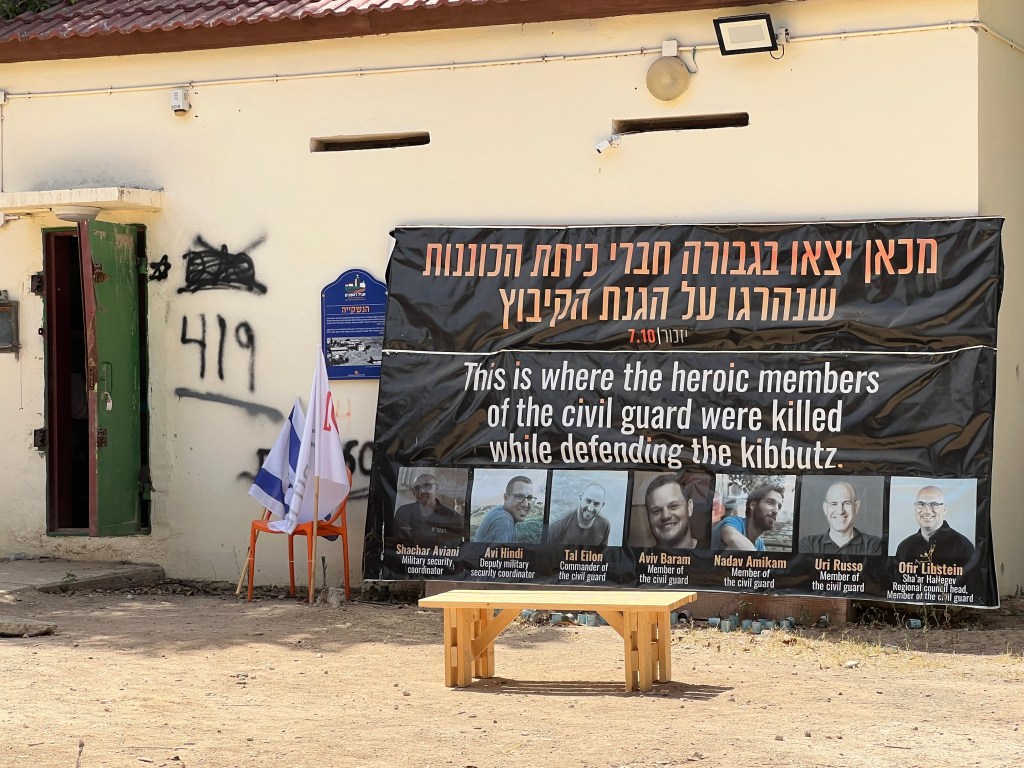
Shachar highlighted how the Kibbutz defense team of 12 was decimated in the first hour, leaving them without any defense for 3 hours until a group of 9 soldiers showed up.  They were soon injured or killed, once again leaving them defenseless.  There were an estimated 1,000-armed terrorists that entered Kfar Aza against a defense force of 12 and then 9.  You don’t have to be a military expert to know those are bad odds.  It took the army many hours to finally reach the Kibbutz and, in Shachar’s words, “retake Kfar Aza”.  Powerful words. 

The armory where many of the Kibbutz’s defense force were killed

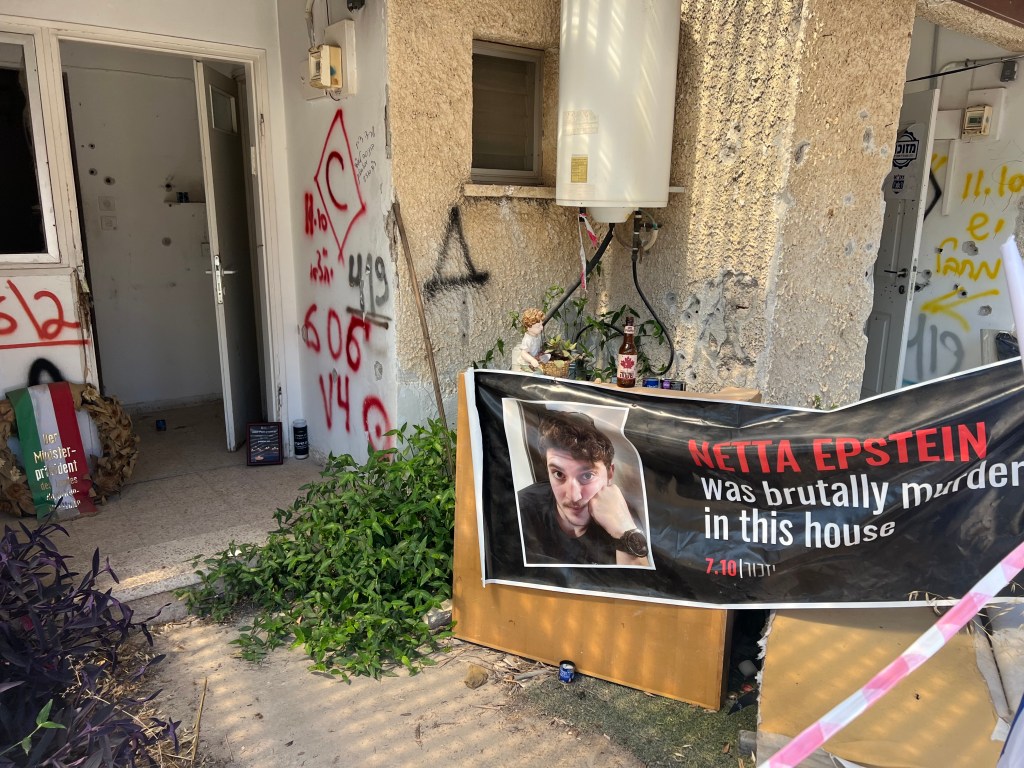
We toured the Kibbutz and saw the houses that were burned with people inside.  We saw the border and how close Jabaliya is to the Kibbutz (less than a mile from where we stood).  We saw the street that is still closed, and pictures are forbidden because they are still working to identify some human remains there.  Every person on that street was either murdered or kidnapped and taken hostage in Gaza.  Every single person.  And entire street.  Imagine your street having every single person murdered or kidnapped and taken hostage.  It is beyond inhumanity.   We saw the youth area with the pictures of those murdered.  Banners with pictures of the hostages taken from the Kibbutz.  We got to enter two of the apartments where Hamas murdered people.  Their personal items are still there.  Outside of the massive damage due to grenades and bullets, it was a home.  Yet the person who lived there was brutally murdered by terrorists. 

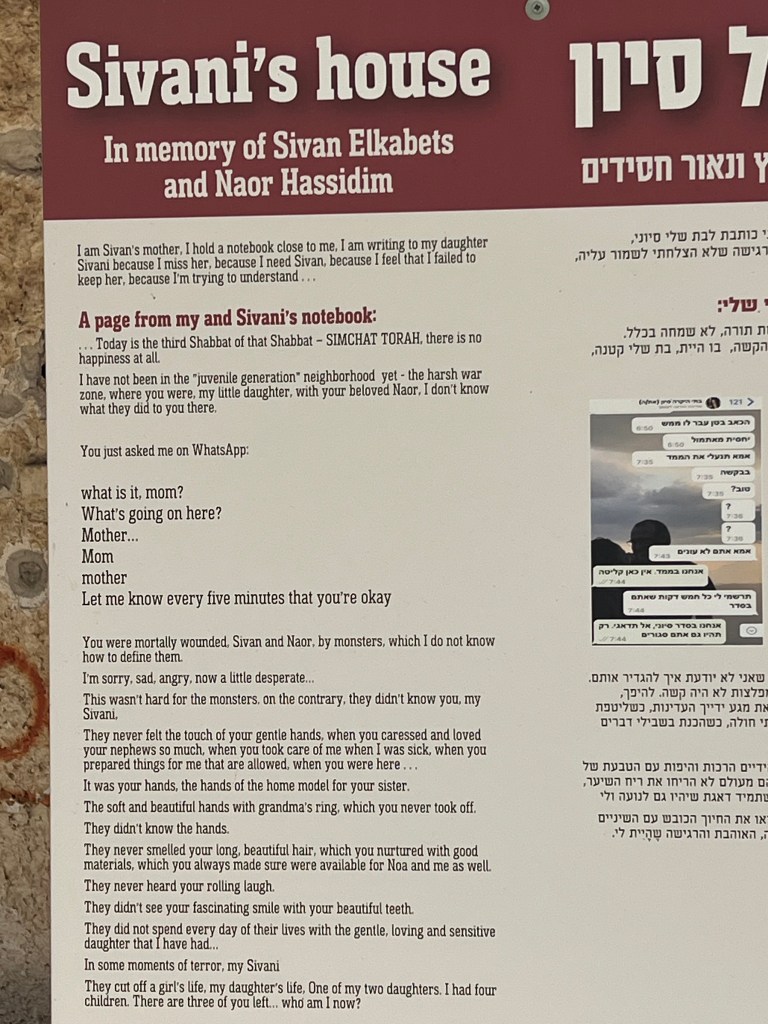
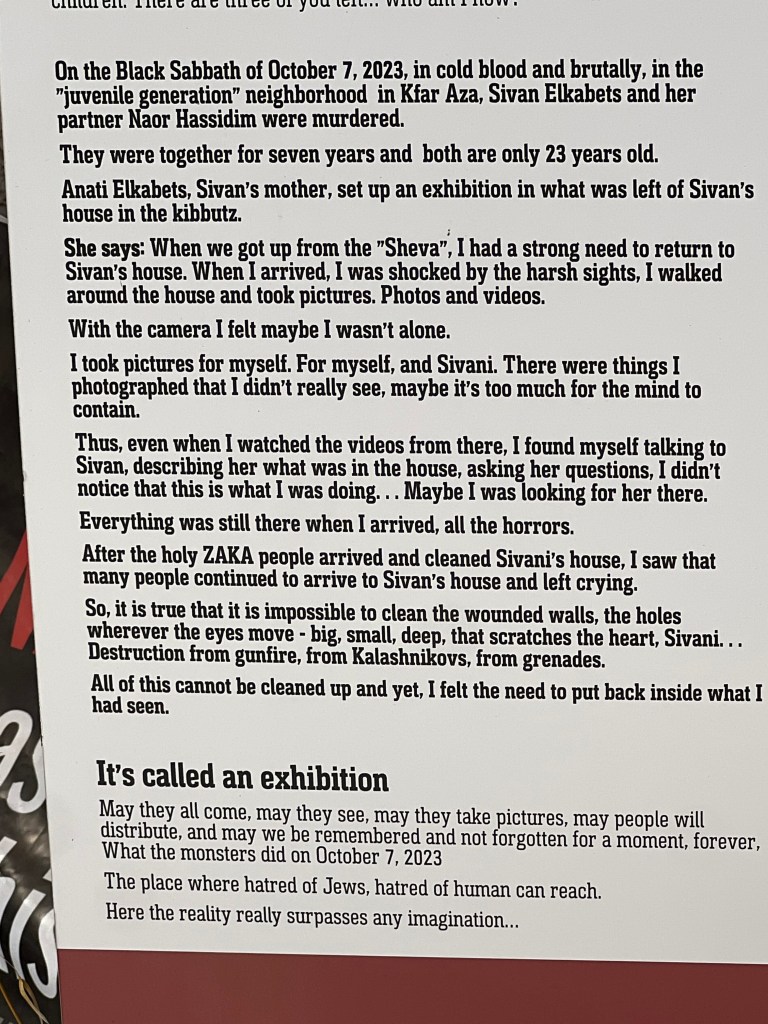
Sivan’s house was one that we could tour. The holes in the wall and the ceiling were unbelievable. Her bathroom was as she left it.

As I listened to Shachar and toured the Kibbutz, my stomach was in pain.  It was a deep gut pain.  My insides were twisting with each story.  The more Shachar talked, the more it hurt.  When he finally went back to work, he told us that in the middle of a dangerous job, he just froze.  People noticed and asked if he was ok.  When he told them no, they came to take over for him.  He hasn’t tried to work since then. 

Yet at the end, Shachar stunned me.  He told us that he still hopes for peace.  After all that he has seen and experienced, he still wants peace.  He isn’t sure when it will come but he believes and hopes that it will.  He invited us all to come back and visit him.  To stay at his house.  He loves Kfar Aza.  He doesn’t want to ever move and won’t leave.  He wants us to come visit and really experience it.  Most of all, he still wants peace.

Shachar talking to us

Last month, I wrote about how the bombs going off in Jabaliya were the only thing that gave me comfort during the visit.  It bothered me then and it bothers me now.  It’s not who I am yet is was who I was at that time.  This trip was different.  While we heard jets above us, saw missiles fired, heard explosions and gunfire, it wasn’t comforting.  It felt necessary.  Hearing the personal story of Shachar reinforced the evilness of Hamas.  He had told us how after Hamas had murdered, raped, and kidnapped people, the civilians of Jabaliya came across the border into the Kibbutz, looting homes and stealing whatever they could.  He saw a man with a crutch tying a TV to his back to take back to Gaza.  While I am sure there are some innocent civilians in Gaza, the behavior of civilians on October 7th shows that most are not.  From the celebrations on October 7th, the civilians who joined in the murdering, and those who came to loot and steal, the evidence is clear. 

As we come closer to the end of the war in Gaza and elimination of the last battalion, it is clear that Hamas cannot remain.  The textbooks provided by UNRWA cannot remain.  UNRWA itself cannot remain.  For there to be any peace, there needs to be both a change in leadership as well as a change in the taught hatred.  Without that, we will continue to have ongoing attacks and repeated wars. 

Shachar showed us that the desire for peace from Israelis remain.  There are serious conditions that must happen before that can occur.  The hostages must be returned.  Hamas must be eliminated from any type of power structure.  Gaza needs to be rebuilt with leaders who want to build a civil society with their neighbor, the Jewish State of Israel.  Anything less is unacceptable.  If people tell you Israel should accept anything less, tell them the truth.  Anything less is not acceptable.  It is not feasible.  It is not acceptable.  And it will not happen.

The Jewish people will not go away.  We will not allow our extermination.  If it becomes ‘us or them’ we will ensure it us.  Am Yisrael Chai.

The path back from the cliff isn’t easy but it is there. Will you take it?

I boarded the flight to Israel today around 11 am.  We took off at noon for the 11 ½ hour flight from Miami to Tel Aviv.  This is my least favorite flight to take as it’s very difficult to sleep during the daytime after a good night’s sleep and when we land, it’s the start of a brand-new day.  It’s great to land and have the full day in front of you, but when you are tired and it feels like midnight, it’s not always so easy.

On the flight, I chose to get the internet package. Knowing it was daytime and I’d be awake for most, if not all, of the flight, I thought it was a good investment.  As I spent the flight checking emails and responding to texts, I realized that when we landed in Israel, not only were we going to start by volunteering to help by picking fruits and vegetables, but we were also going to spend the afternoon at the Kotel, the Western Wall, one of the holiest sites in Judaism.  One of the traditions is to write prayers and put them into the wall so they are close to God.  Since I had such a long flight, I went on social media and offered to put prayers into the Kotel for whoever wanted one.  All they had to do was message me what they wanted the prayer to be.

I didn’t think much of it and expected a few people would respond.  I was overwhelmed as the requests kept coming in.  Without sharing any specific people or what they requested, I will say that a great deal of them were related to health issues.  It is a reminder that there is a reason the saying is, “healthy, wealthy, and wise.”  Health comes first.  Without health, we have nothing.  There were requests for a better world.  Requests to help loved ones who are struggling.  Nobody was asking for the ‘wealthy and wise’ part of the saying.  All the requests were truly selfless.  A few people thanked me for offering to do this for them.  I often take going to Israel for granted.  This is my 22nd trip and the 23rd is already on the books this year.  Israel is truly a core part of my soul and my personal identity.  Today, on the flight, these requests were a reminder of how lucky I am to go to Israel once, let alone 22 times. 

These requests also got me thinking about the world we live in today and the world it appears most people want to live in.  They are not the same place.  The world we live in is filled with selfishness.  It is filled with ‘haves’ and ‘have-nots’.  It is filled with people who desperately want to obtain and keep power.  It is a world filled with ego.  When half of the United States hates the other half, we are not living in the world that most people want. 

These requests made me think about the world we would like to live in.  A world where we cared about other people.  A world in which doing the greatest good really mattered, whether it helped the individual or not.  A world filled with love, not hate.  A world in which we were more concerned with giving than getting, with doing rather than taking.  What would it look like to live in a world where kindness was the most valued commodity? 

Imagine a world where we didn’t hate but rather worked to understand each other.  Our differences were celebrated rather than used to create a reason to hate.  As I watched this video, I couldn’t help smiling when he said, “Babka is my middle name” or when he called rugelach, “roo ga losch”.  He is filled with curiosity.  He wants to explore a different culture. I want to watch him try gefilte fish, kasha varnishkas, shakshuka, cholent, and so much more.  How much fun would it be to watch people of different cultures explore the unique foods of another culture?

On this trip to Israel, we have 12 young adults.  6 males, 6 females.  Twelve very different people, who come from different backgrounds, with one similarity. As I met most of them for the first time, I loved their differences.  I can’t wait to spend two weeks exploring a post October 7th Israel, leadership, and Jewish thought with them.  I can’t wait to hear their thoughts, their impressions, their opinions, and their ideas.  As I write that, I can’t imagine our world leaders saying the same thing about each other.  I can’t imagine our country’s leaders saying that about each other.  It shows me that there is a path back from the cliff we are on, if we want to take it.  It’s not easy.  It’s not comfortable. 

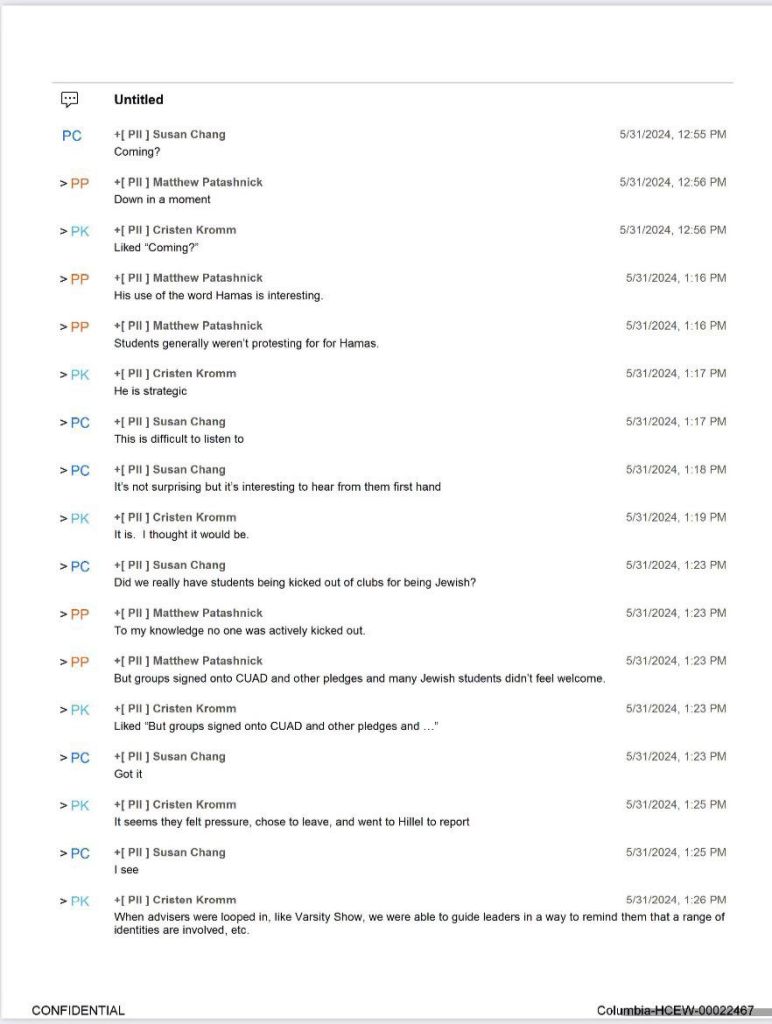
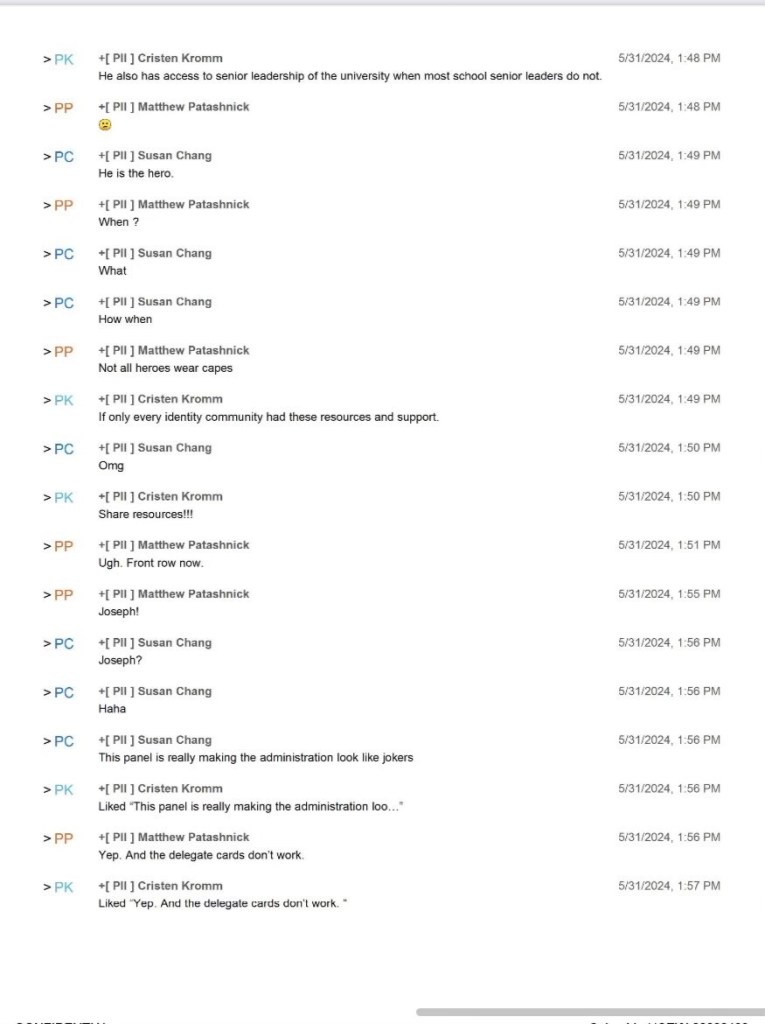
A perfect example of how close to the cliff we are is the text exchange between Deans at Columbia University that was released by the Department of Education.  The texts are bigoted.  They are hateful.  They are unbecoming a leader and an educational institution.  Three of the Deans are currently suspended pending an investigation while one, Joseph Sorett, has falled on his sword and not only won’t be suspended, he is guaranteed to keep his job.  Normally, with evidence this damning, you could count on them getting fired.  Yet in the world we live in, with what we have seen in the past 3 months on college campuses, there remains a good chance they will all return to their positions with merely a slap on the wrist and by making an insincere apology.  As you read the text thread, your blood may boil the way mine did.

Instead of approaching this with empathy, care and concern for Jewish students at Columbia, these four Deans, Susan Chang-Kim, the Vice Dean and Chief Administrative Officer, Matthew Patashnick, the Associate Dean for Student and Family Support, Cristen Kromm, the Dean of Undergraduate Student Life, and Josef Sorett, the Dean of Columbia College, utilize stereotypes, antisemitism, hate, racism, and everything they are supposed to fight against to mock Jewish students, Jewish professional leadership, and antisemitism. Their titles show how powerful the positions they hold are.

The 3 Columbia Deans that have been suspended

We all have a choice. Do we want to be like the Deans of Columbia University or do we want to work to change the world, seek to understand rather than to be understood, strive for the best for humanity, be kind, and treat others with dignity and respect. It seems like a simple choice, however in the world we currently live, it isn’t.

I choose the latter. I choose to do things like meet with my Palestinian friend in East Jerusalem to have meaningful and respectful discussions. I choose to listen and learn both with and from the twelve young adults on this trip. I choose the harder path, one that leads to a better world but isn’t easy. When I go to the Kotel later today with all these notes from other people, detailing their prayers, their hopes, their dreams, I choose to be an instrument of good, placing each one carefully into the wall. With each one I place, I will ask God to grant them their prayer, their wish.

We are not stuck in the world we live in. We have the ability to change the world one step at a time, one day at a time, one action at a time. I hope you will join me.

Jewish blood is no longer cheap

I’m on my way to Miami today so that I can fly to Israel on Tuesday at noon.  It’s one of my least favorite times to fly because you fly all day long and then it’s 7 am in the morning and you start a whole new day.  The good news is that by doing it this way, we will get a full extra day in Israel.

This trip is with the Jewish Leadership Institute (JLI), a program I am proud to have worked with for over 25 years.  Targeting 19-26 year olds for a 2 week leadership experience in Israel, JLI has had an incredible impact on the lives of those who participate.  Heavily subsidized, the program is available to everybody interested in developing their leadership in a Jewish context. 

It is amazing that post October 7th, in the middle of a war, with things heating up in the north of Israel with Hezbollah, we have a group of young adults who want to go to Israel for two weeks, volunteer, visit Kibbutz Kfar Aza and the Nova Festival site, learn, and connect Jewishly.  It is the essence of Jewish community.  It is hope for our future.

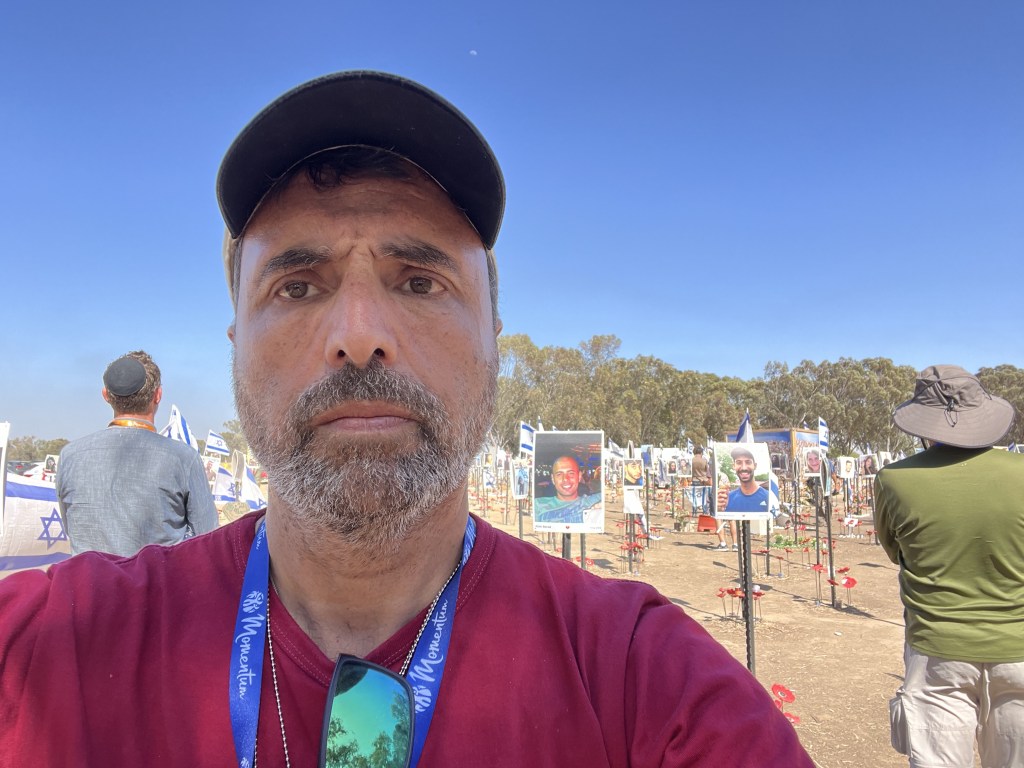
Standing at the Nova site

This will be my 22nd trip to Israel.  I began going after graduating college in 1989 and didn’t return for a decade.  Since then, I go as often as I can.  Israel is home.  There is a special feeling being there that you can’t explain to somebody who hasn’t been and that once somebody has been, you don’t have to explain.  I have been there during the first intifada, the second intifada, just as the country was about to reopen from Covid, and during this war.  I have been there during times of quiet and during bombings.  I have always felt safe in Israel.  Just last month, I walked from Ben Yehuda Street to East Jerusalem through Arab neighborhoods and felt safe.  The news tells one story and when you are there, you realize the media lies.

I am proud of the men who I went to Israel with last month.  You can watch a 23 minute video of our trip and feel the emotions we felt, experience the power of the trip and of Israel below.

An incredible video made by Saul Blinken of our trip. Like #23 Michael Jordan, this 23 minute video is great.

I am proud of the young adults I am going with now.  Years from now, my grandchildren and great grandchildren will ask what I did during this time.  My children will tell them that I went to Washington DC for the March for Israel rally after October 7th, joining nearly 300,000 other people on the National Mall in support of Israel.  I went to Israel multiple times.  I helped get the IDF supplies that they need and got them the mezuzahs they needed due to all the reserves called up and the battlefield housing.  (If you want to participate in the Mezuzah project, click here.)  I took young adults to Israel and worked with organizations that helped displaced Israelis because of the attack on October 7th and the war in the north.  I showed up and hope that my children, grandchildren, and great grandchildren will use that as inspiration to do the same.

In the movie, Independence Day, just like Israel currently faces incredible challenges in Gaza, from Hezbollah in the north, from Iran, from the Houthis, and from the international community, the world faced a threat from aliens that was seen as overwhelming.  Just like Israel, in the movie, the people didn’t give up and rose to the challenge.  The President gave a powerful speech before the attack.  It reminds me exactly of what Israel is facing and how we need to rise up and do what we can to support Israel and the Jewish people.

I used to say that I didn’t understand why the German Jews stayed in Germany as long as they did.  So many stayed until it was too late.  When I am in Israel and when I talk to my friends in Israel, they all ask me the same question.  Why are you staying in the US?  I hope you don’t stay until it is too late to get out.  You need to move to Israel.  This is not the Aliyah recruitment that I have experienced since my first trip to Israel in 1989.  This is not an effort to get more Jews to Israel.  This is true concern for our safety.  I find myself wondering if they are right.  Like most, I think this is a small minority with a loud voice creating chaos that the media love to cover because people watch, read, and click on it.  It’s good business for the media.  But what if I am wrong?  When will we know that it is time?  Will it be when it is too late?  I already have the person that will hide my family and me if it comes to that.  Does that mean I expect I won’t know it is time to leave until it is too late?

As Jews, spending most of our 3500-year history in exile and under the rule of others, we are used to trying to fit in.  We do our best to integrate into the culture of the country we live in and follow their rules.  We fool ourselves into thinking that we are just like them.  We have seen the consequences over and over and over again.  Are we doing it again?  The big difference this time is that we have the State of Israel.  We have the IDF.  We don’t have to fit in.  We don’t have to hide and hope they don’t harm us.  We fight back.  We defend ourselves.  We won’t be victims again.  For nearly 3400 years, we played defense.  We protected ourselves and tried to be invisible.  We tried to not be a target and always failed.  For the past 76 years that dynamic has changed.  Since the creation of the modern State of Israel, we now play offense.  When attacked, whether it was 1948, 1956, 1967, 1973, or on October 7th, we fight back.  It’s a dynamic the world doesn’t like.  Israelis don’t care.  Zionists don’t care.  Those who care are stuck in the past and would recreate the horrors of our past in order to be liked and to fit in.  They refuse to learn the lessons of the past.

As I head back to Israel for the second time in just over 7 weeks, this message resonates strongly with me.  I have seen the carnage at Kibbutz Kfar Aza.  I have heard from survivors of the Nova Music Festival.  I have seen the Hamas 47-minute video.  I have been to the Nova site and felt the loss of the souls there.  I have met with a hero of Nova who rescued 750 people that day (a truly remarkable number for a farmer in the area to do.)   I heard from the woman who had to identify the women’s bodies that were murdered on October 7th, then prepare them for burial.  I have spoken to friends who are serving in the IDF, called up from reserves and leaving their families behind.  I have heard from those who have lost their children fighting for Israel and the Jewish people and from fathers who have children that are still hostages in Gaza.  We are victims no more.  We refuse to allow harm to come to the Jewish people without defending ourselves. 

Kfar Aza – one of the most powerful and moving experiences of my life.

I don’t know what the future will bring.  War with Hezbollah and potentially Iran will be devastating but may be necessary.  Israel is already a different country since October 7th.  What will it be like after a war in the north?  How many people will die?  How much damage will be done?  Will the United States and NATO step in should Iran get involved?  Will this be the start of World War III (WWIII)?  There is much that is unknown.  What I do know is that Jewish blood will not be cheap.  Jewish safety matters.  No matter what the ICC, the UN, or other countries say, Israel will defend herself and the Jewish people. 

I also know that I have done, am doing, and will continue to do my part.  Will you?

Try it, you’ll like it!

I went to minyan this morning.  For those that know me or follow me, you know that I am not religious and rarely go to synagogue.  The Rabbi that I learn with has begun a monthly Sunday morning minyan and I have committed to going to support him.  I bring my tallis and tefillin (the prayer shawl and the black boxes that go on your arm and your head) and one of my many prayerbooks that I rarely use to join the group.  Somehow, the group is always a group of friends so it’s a bonus to see them too.

I have found that I really enjoy going.  It’s not because I have become religious, it is because the service is done in an intentional and meaningful way.  As we go through the prayers, what we are actually praying for and about is explained very briefly.  “This section is where we ask God to help the world in difficult times.”   Simple.  Clear.  It provides context to what we are saying and why we are saying it.  It’s a tour through the prayerbook.

It reminds me of the playbill at the theater where they tell you what each scene is going to be.  When I learn with my Rabbi friend, we start by exploring the Siddur.  When we started doing this, I wasn’t very excited.  Services haven’t been meaningful to me in a very long time and exploring the Siddur wasn’t on my list of things to do.  I decided to be open to it and as we discuss a prayer and I understand what it is and why we say it, it has become interesting.  It reminds me of what my friend Roie, an IDF soldier at the time, said after Shabbat services.  The conversation went as follows:

Roie:  So you know how to read the Hebrew words?  

Us:  Yes.

Roie:  And you know the tune to sing it?

Us:  Yes.

Roie:  But you have no idea what you are saying?

Us:  That’s correct

Roie:  I don’t understand!

This was repeated over and over again.  He couldn’t understand how we could know the words and the tune but not what we were saying or why we were saying it.  He understood that just knowing the words and the tune wasn’t enough.  It wasn’t meaningful.  We were missing out on the entire purpose of what we were doing.  How could Judaism be meaningful if we didn’t know what we were actually doing or why we were doing it.

I turn 57 this year and these minyanim are the first time that the parts of the service were actually explained.  As the different sections were explained, it began to make sense.  There was actual intention in each part.  There was a purpose to what we were saying.

One of the things that really struck me today was his explanation of the Modim Anachnu Lach prayer.  It was so simple and so basic.  He said, “Nobody can say thank you to God for you except you.  You have to thank God yourself.  That’s what this prayer is for.”

Wow.  Three short sentences and the prayer that I have said at services most of my life suddenly had real meaning.  What I have found is that Judaism has great meaning.  We simply don’t provide that type of content to our children and as a result, when they are adults, they aren’t interested.  When we show the meaning, people get engaged and excited. 

There was recently a great poem written by Lizzy Savetsky titled, “The Six Pointed Star”.  It talks about who we are and points out that the hatred of today provides us with a reminder of who we are and that perhaps, we need to get back to basics and remember we are Jews and what being a Jew means.  I hope you enjoy her reciting it as much as I did.

The Six Pointed Star

There is something special about being Jewish.  I am not saying that Jews are better than anybody else.  It’s a more than 3,500-year-old peoplehood.  My friend Avraham Infeld had many sayings that I love.  One was when he would say, “Judaism in NOT a religion.  We are a mishpacha (family) that shares a common religion.” 

Those words struck me not only the first time I heard them but every time after.  They resonated with me.  Being Jewish is about being part of a family.  It’s about being part of something bigger than yourself.  It’s why going to minyan this morning felt good.  I was with family.  We were spending our morning together.  We greeted each other with hugs.  We spent time after the minyan talking about our lives. 

It is why Jewish holidays are a big deal.  We get together for a Passover Seder, to light the Hanukkah menorah, to eat in the sukkah or to dress up and eat hamantaschen.  Every holiday is about being together.  This year, I spent Yom HaZikaron (Israel’s Memorial Day) and Yom Ha’atzmaut (Israel’s Independence Day) in Israel.  After October 7th and in the middle of a war, it was more important to be together.  It meant more to Israelis that we were there than ever before.  Their brothers and sisters from across the Atlantic came to support them.  Their brothers and sisters came to show support and love. 

Part of the reason Judaism and Jews are still here, more than 3,500 years later, is because we are more than a religion. Rabbi Harold Kushner z”l, in his book, To Life, asks the question, “What do you have to believe in order to be Jewish?” It is a great question. The answer is very simple. NOTHING! You don’t have to believe anything. You are born Jewish. If you convert, the minute you convert, you are now Jewish forever. Don’t believe in God? You are still Jewish. Don’t believe in keeping Kosher? Still Jewish. Don’t want to pray 3 times a day? Still Jewish. Don’t wear a kippah or follow the laws of Jewish purity? Still Jewish. Another of my favorite Avraham Infeld quotes is when he talks about people who convert to Judaism. He says there is no such thing a convert. The minute you convert, you are a Jew. Period. But, he says, there is a term ‘converted Jew’. This is somebody who is Jewish who converts to another religion. He says, “They only think they are the other religion. They are still a Jew.” We are more than a religion. We are more than a people. We are a mishpacha (family). So why not get to know your family a little better? Why not learn about your family? The more you learn, the more you will love your familiy and the more you will be happy and feel lucky to be a part of this family. As the famous Life Cereal commercial said, “Try it, you’ll like it”.

Lies, Damn Lies, and Hamas statistics

The lies continue to grow and get more absurd.  The newest one is that Israel has trained dogs to rape Palestinian women.  In 2018 it was that Israel sent lizards to spy on the Iranian nuclear program.

In 2010 it was Israeli sharks that were trained to attack Egypt and that Israel trained Eagles to spy on Hezbollah.  In 2011 it was Israel training vultures to spy on Saudi Arabia.

GENOCIDE

The lie of genocide is particularly appalling.  People use it because it is easy to say, a powerful word, and a way to get people to hate Israel and Jews.  They like accusing Israel of it while ignoring the real genocide that occurred in Syria and what is currently happening in Sudan and to the Uyghurs in China.  These are real genocides but don’t involve Jews.  Gil Troy addressed this lie powerfully, writing:

Genocide means trying to wipe out a nation. For years, Gaza averaged a growth rate of 1.99 percent, 39th in the world. Having started this war, Hamas is 100% responsible for every death, especially because its terrorists hide behind Gazans and Israeli hostages. Still, Israel has minimized civilian deaths in its just war of self-defense. Urban warfare, atop hundreds of tunnels, is treacherous. A U.S.-led coalition killed 10,000 innocents to defeat ISIS in Mosul. After Oct. 7, when Israel needed to protect its civilians from Hamas, and deter others from massacring innocents, what else could Israel have done? 

In fact, Jewish population in Arab countries decreased from 1948 to 2023 by 99.83%.  At the same time, Arab population in Israel increased by 1,296%.  That is not a genocide.  When the war is over, the facts will show that it was anything but a genocide.  In the meantime, we fight the lie that continues to be told over and over again.

ISRAEL IS AN APARTHEID STATE

Israel gets wrongly accused of being an Apartheid State because it’s an easy word to use, people know it is not a good thing, and most people don’t understand what it means.  It’s easy to repeat, easy to write on a sign, easy to post on social media.  Similar to the use of the word Genocide, it gets wrongly used by people who don’t know what they are talking about to convince other people who don’t know what it means to agree.  Gil Troy explains it well when he writes:

South Africa’s racist Apartheid Regime enacted 148 laws defining people as “white,” “mixed” and “colored.” No Israeli law ever defined anyone based on race or skin color. Israeli-Arabs enjoy equal rights. In the disputed territories, Palestinians and Israelis are often kept apart based on security and/or mutual preference. But apartness is not Apartheid. The Apartheid libel tries racializing the Israeli-Palestinian national conflict. Israel’s enemies want to demonize and Nazify Israel, finding it guilty of biological racism. This charge deems Israel evil and worthy of the international death penalty, rather than a country in a complicated, painful border dispute.

Knowing this information is important to combat this lie.  The facts are on Israel’s side.  Too many people prefer the easy language than learning what the facts and definition are for what they are saying.

ISRAEL IS A COLONIALIST EMPIRE

Gil Troy also addressed the issue of Israel being branded a colonialist empire.  He wrote:

“Colonialism” means settling a far-away land, to extract resources or extend power. Calling Israel “colonialist” negates Jews’ indigenous ties to their homeland, while rejecting Christianity too.  Jesus emerged in a deeply-Jewish land of Israel also called Judea. Jews are the original aboriginal people. They put the “in” in indigenous, being tied to the same land, praying to the same God, maintaining the same traditions and culture for millennia. Whether you’re religious and believe the Bible, or historically-oriented and trust archaeological evidence – or both! — “Eretz Yisrael,” the land of Israel, has always been central to “Am Yisrael,” the Jewish people.

Archeology proves the Jews were in the land thousands of years ago.  Just this week, a 3,300 year old shipwreck was found off the coast of Israel.  This was a Canaanite ship – the people in the land of Israel when the Jews arrived from Egypt.  That was 3,300 years ago! 

The archeological finds show the history of the Jews in Israel goes back thousands of years, not just to 1948.  The City of David, built by King David, has been excavated.  You can see the underground original city of Jerusalem from King David’s time at various locations in Jerusalem.  The Crusader capital city of Akko has been excavated and you see what things looked like in the 1100-1200s.  The Tombs of the Matriarchs and Patriarchs in Hebron go back even before the Canaanites to the time of Abraham.  In Rome, they have the painting on the Arch of Titus showing the Romans coming back after sacking Jerusalem, carrying the great menorah from the Temple.  Yet the lies continue. 

The Israel Antiquities Authority said the silver coin shows the obverse face with the chalice in the center, and above it the letter “Aleph” marking Year 1 of the outbreak of the revolt, and the inscription “half-shekel,” the value of the coin. (Emil Aladjem, Israel Antiquities Authority.)

ISRAEL IS CREATING A FAMINE IN GAZA

Israel continues to be blamed for the food crisis in Gaza despite the antisemitic UN saying there is more than enough food coming into Gaza.  The problem remains UNRWA giving the food to Hamas instead of the people.  Yet the media refuses to cover it and the Jew haters continue to state the lie over and over again.  You can read the UN report here.

There isn’t a question that the people of Gaza are not getting food. It is not because of Israel not sending food and aid nor is it because Israel is blocking the aid from entering Gaza.  There are plenty of pictures of the aid piled up, waiting for UNRWA to pick it up and distribute it.  The food stays there for days.  The food and supplies end up with Hamas.  As Israel clears the tunnels and other military encampments in schools and other places, they find more and more of the stolen aid.  The people of Gaza have commented that the food and aid is too expensive for them to buy.  This FREE aid is being sold on the black market instead of going to the people.  This is Hamas and UNRWA, yet the blame is put on Israel.

Mike Fegelman, the Executive Director of Honest Reporting Canada, wrote a great article about the famine lie in the National Post.  In it he states, “Not only is there a paucity of evidence to suggest there is an ongoing famine in Gaza, there is an overwhelming amount of data showing precisely the opposite: in addition to locally produced food, huge amounts of humanitarian aid enters the territory on a daily basis, thanks to Israel.”  

This is the full report for you to read.

ISRAEL IS KILLING MASSIVE AMOUNTS OF WOMEN AND CHILDREN

Every day, you will see new reports that are not cited nor documented by any facts, about more Gazan civilians being killed by Israel with almost all of them reported to be women and children.  This is another big lie.  The Gazan health ministry is run by Hamas, and they say whatever they want for the headlines.  People make up facts. 

In this BBC article, they report that on May 6, 2024, the UN reported 34,735 deaths – of which there were 9,500 women and 14,500 children, citing the Government Ministry Office (GMO) as its source.  Two days later, the UN released a further report, switching its sourcing to the health ministry.  The result of this was that although the overall recorded death toll was almost unchanged (34,844), the number of registered deaths of women (4.959) and children (7,797) had both fallen nearly 50%.  They consider children anybody under 18, so any Hamas terrorists who were 16 or 17 are not being counted as terrorists but as children. 

I chose to cite the BBC article and its statistics because they are not a fan of Israel.  They are typically anti-Israel so the facts really stand out. 

The death tolls being reported include NO Hamas terrorist numbers.  They include every natural death, and everybody murdered by Hamas.  The data is unreliable and has been proven to be unreliable.  Each time more research is done, the death toll changes, just like the famine issue was changed.  It is important to know the lie and to be able to address it.  The lie gets front page news, the correction and the truth gets buried on page 10 inside.

In a speech at the Sorbonne in Paris in 1910, Teddy Roosevelt spoke strongly about leadership.  He talked about those who actually get in the ring and fight.  Those who take action and those who take risks. If you want to end the lies, you must get in the arena and challenge them.  You must be the person Teddy Roosevelt talked about when he said:

“The credit belongs to the man who is actually in the arena, whose face is marred by dust and sweat and blood; who strives valiantly; who errs, and comes short again and again, because there is no effort without error and shortcoming; but who does actually strive to do the deeds; who knows the great enthusiasms, the great devotions; who spends himself in a worthy cause; who at the best knows in the end the triumph of high achievement, and who at the worst, if he fails, at least fails while daring greatly, so that his place shall never be with those cold and timid souls who know neither victory nor defeat.”

Teddy Roosevelt at the Sorbonne giving the historic speech

Are you willing to get in the arena? Are you willing to fight? To strive valiently for a worthy cause? I am. Come join me.

***Gil Troy’s full article about 12 Tough Questions and Simple Answers About Israel can be found here.

Racism and hate has always been here even if we didn’t want to see it.

I grew up in a very multicultural environment.  My friends were many different religions and came from many different cultures.  They were of many ethnicities.  They came from different socio-economic backgrounds.  Some had intact families, some had parents that were divorced.  Some were straight and while some were not ‘out’ yet, we all knew they were gay. It was a great way to grow up as people were just people.  Friends were friends because of who they were, not any other reason.  Growing up this way shaped me as person.  To this day, my friends are my friends because of who they are, not based on their religion, culture, ethnicity, socio-economic status, sexual orientation or identification. 

I didn’t realize that how I grew up was a bubble in a world that was not like that until much later in my life.  As a Jewish, middle-class kid, I didn’t feel any different than my friends.  I would go to their house; they would come to mine. We all played together, hung out together, dated each other, shared our hopes and dreams with each other.  I wrongly assumed that everybody felt the way I felt.

It wasn’t until I went away to college that I began to notice the difference.  We went to different colleges, and some didn’t go to college.  A number of my friends had children when they were 19, 20 or 21.  Even my friends who went to college with me ended up having different social groups that were more aligned with their personal identity.  I joined a Jewish fraternity.  I had friends that joined the historically black fraternities.  Some joined fraternities that didn’t like Jews or black people.  Others joined no fraternity and had a totally different social circle.

While I faced antisemitism in college, I didn’t see my friends facing prejudice because of their skin color or their ethnicity or their sexual identity.  It wasn’t something that I lived with and so it was easy not to notice.  I was blind to the discrimination they faced.  When my childhood friends came out, it wasn’t a big deal to me because I had already known they were gay since childhood.  While I was happy that they could now publicly be who they were, I didn’t understand what they were now facing as openly gay men.

It wasn’t until I was in my 40s and living in Seattle that I began to notice what my friends faced.  I saw the Jew hatred starting and saw others ignoring it or not standing up for it.  I saw hatred against the LGTBQ+ community and saw people ignore it.  A friend of mine there told me that my leadership reminded her of Harvey Milk, and I’m embarrassed to admit that while I knew the name and that he was a gay man and leader in San Francisco, I didn’t know his story.  I read about him, watched the movie (I highly recommend watching Sean Penn as Harvey Milk in the movie Milk) and was amazed that this incredible leader isn’t taught to children.  I was more stunned when I learned it was his murderer who got off on the ‘Twinkie Defense’ which I had heard of. 

Harvey Milk

When the murders happened at Pulse in Orlando, it was shocking to me.  After Eric Garner, Michael Brown, Philando Castile, Botham Jean, Breanna Taylor, and Ahmaud Arbery were killed, I remember a friend of mine posting about how her son was driving across country and how worried she was about his safety because he would be driving while black. That was a slap in the face for me.  My children were just a little younger than hers and while I worried about them driving safely, I wasn’t worried about them getting pulled over and ending up dead.  It deeply affected me and made me realize how much I was oblivious to because of how I grew up and my own life experiences.  My heart broke for her.  It broke for my other friends who faced the same thing and were not comfortable saying it publicly.

When my son was recruited to play football by Howard University, a historically black college, I was excited for him.  Howard is an excellent school with a great alumni base, and a childhood friend of mine was one of the coaches.  When they offered him a full scholarship, I really wanted him to choose Howard.  I was surprised by the pushback I got from people.  He decided to attend UCF instead and I was sad about the process.  When he thought about transferring, he was recruited by 4-5 other HBCs and I encouraged him to consider them.  Again, there was pushback by others which saddened me. 

I began paying more attention.  One of my childhood friends posts regularly about black history and important black historical figures.  Most of them I have never heard of and as I read about them, I am sad that I never had.  When The Free Press wrote an article about Bayard Rustin, the architect of the March on Washington in 1963, I was stunned that I had never heard of him.  I learned about the March on Washington, the Reverand Dr. Martin Luther King, Jr., and Malcom X.  Why had I never learned about Bayard Rustin? 

Bayard Rustin – if you haven’t seen the movie about him and the March on Washington, watch it!

When October 7th happened, it was my turn.  The pain I felt from the murders, rapes, and kidnappings that day was intense.  I was worried about my friends in Israel who lived in the south of Israel and could be murdered just because they were Jewish.  Those murdered and kidnapped from the Nova music festival hit me hard as that could have been my children and could have been me with them.  When my friend’s son was killed by the terrorists, it hit hard.  He was younger than both my sons.  When I learned of family members of my friends who were being held hostage, I was devastated.  As of now, there were 10 hostages that are related to my friends.  6 remain hostages to this date. 

When the violence against Jews increased after October 7th and people were silent, I was outraged.  When the denial of the rapes happened, I was outraged.  When the women’s rights groups are silent about the rape of Jewish women on October 7th, I was outraged.  When the hostages are forgotten or not mentioned by many of our leaders, I am outraged.  When Israel gets vilified for defending her citizens, I get outraged.  When the lies about what is going on become accepted, I get outraged. 

I got it.  While Jews marched with Dr. King and were active in the civil rights movement, that was 50 years ago.  Where have we been as real partners for other communities, building friendships and relationships, since then?  How could we expect them to be there for us when we haven’t been there for them?  Of course there are some people who have been, but as a community, we have not.  I made a commitment to not be that person any longer.  To build relationships with other communities so they know the Jews are there for them before we ask them to be there for us. To have my eyes open for hatred of all types and to stand up against it. 

On Thursday June 20, 2024, the SF Giants played the St. Louis Cardinals at Rickwood Field in Birmingham, Alabama.  It was a tribute to the Negro Leagues and to honor Willie Mays (z’l).  The fact that Mays died on June 18, 2024, days before the game, made it more poignant.  That June 19th is the holiday Juneteenth made it more powerful.  During the pregame interviews on television, Alex Rodriguez asked Reggie Jackson what it was like returning to a field that held so many memories of baseball’s past.  Reggie’s response was one of the most powerful things I have ever heard. He describes with bitter passion how horrible it was for him.  He shared the prejudice he faced.  How his manager, teammates, and even the owner, supported him.  How they likely saved his life because without them he would have reacted on his anger.  It made me commit even more to fight against racism and hatred.  Watch the interview – it is powerful.

Reggie Jackson sharing the powerful experiences he had with racism when he played in Birmingham

As I listened to Reggie talk, it hit me that we are back there again.  From violence against the black community, the LGTBQ+ community, the Asian community, the Muslim community, and the current horrific issues against the Jewish community, it is just like what Reggie described.  “No Jews” is now heard.  Being a Zionist means your teachers and other students will discriminate against you.  Being Jewish makes you eligible to be attacked.  Looking Jewish makes you a target for physical violence.  A 12-year-old Jewish girl was gang raped in France on June 19th because she was Jewish.  Jewish schools have been shot at in Canada.  The horrors Reggie faced are now being faced by Jewish students on college campuses, in public schools, synagogues, and other public spaces.  How have we come so far to be right back where we were?

This is why we need to do 3 things immediately.

  1. Get educated.  Learn the facts.  Don’t believe the lies and don’t just speak in generalities.  Know that Zionists so wanted a Jewish homeland that they accepted the partition plan immediately despite the challenges the plan presented.  It was a Jewish homeland, so they took it.  The Arabs rejected it and have continued to reject every opportunity for peace and a 2-state solution since 1948.  Most of the time rejecting with violence.  Learn about the State of Israel and the Arab supreme court Justice, the Arabs in the Knesset.  The Israeli-Arabs, the Ethiopian Jews, the Druze, the Bhai, the Bedouins, and the Christians.  Hasbarah is great but not enough.  Learn the history.  Learn the facts.  Be able to have an intelligent discussion and defend Israel.  Even when you are talking with people who know nothing.  Actually, especially when you are talking with people who know nothing. 
  • Defend Israel and the Jewish people.  The days of hiding or playing defense are over.  We play offense now.  We don’t take the beatings because we get to stay alive.  We fight back so we can live.  Go to Israel and be public about it.  Wear your Jewish pride, as a Star of David, a Chai, a kippah, a t-shirt, or whatever you want.  Stand up.  Speak out. 
  • Build relationships with other communities.  We need to have these relationships.  During Pride month, be visible as a Jew celebrating Pride.  During Black History month, be visible as a Jew.  Stand with the black community as they celebrate their history.  During Ramadan, go to a community Iftar and celebrate with your Muslim brothers and sisters.  Learn the right greeting and wish them a Ramadan Kareem or Ramadan Mubarak.  Know and use the greeting Eid Mubarak on Eid-al-fitr, the last day of Ramadan.  Build relationships with the Christian community, the Sikh community, and every other community you can.  We need them and they need us. 

Here is an example of what getting educated and defending Israel can look like.  Watch as this lie, this falsehood, is completely exposed by the speaker.

This is what we all need to be able to do.

And watch true experts, Douglas Murray and Natasha Hausdorff debate on behalf of Israel here.  Some highlights of the debate are below.

Some highlights of the debate.

Hate is on the rise.  Don’t think it isn’t.  Don’t think it hasn’t always been here.  I’m ashamed to admit that I didn’t see it for a long time while my friends had to deal with it.  I’m embarrassed it took what it took to open my eyes.  Now that they are open, there are only two options. 

  1. Keep my eyes open and take action to fight hate and bigotry.
  2. Put my head back in the sand and pretend that I never saw it. 

History has shown that only keeping our eyes open open and taking action has positive results.  This action includes making the effort to support other communities and show that we are there for them before we need them to be there for us. That’s my choice. What is yours?

Tikkun Olam? Tzedakah? Intention is how we change the world.

There is always a lot going on in the world and there is, unfortunately, always people who need our help.  One of the essences of Judaism is our responsibility to repair the world, Tikkun Olam, and to help those in need, Tzedakah.

We do this in many ways.  We support our local Jewish community through our schools, synagogues, JCCs, Federation, Jewish Family Service (JFS), Hillels, Chabads, and the many other organizations that make up our Jewish community.  We give of our time, talent, and our treasure. 

We support financially organizations that do important work in our local community, our state, and in our country.  We may support organizations in Israel like the Friends of the IDF, Jewish National Fund (JNF), or others that we learn of that inspire us.

We may donate to ‘Go Fund Me’ campaigns that help those we know or are friends of people we know who are in need.  We sign up for meal trains to provide food for those going through hard times.  We visit the sick, make shiva calls (visits to people who have lost loved ones), and help our friends with whatever their need may be at that time.

We lobby our local, state, and federal legislators to take action on the things that matter to us.  Jews are not monolithic so there are plenty of social and economic issues that matter to different people and we have the ability to do that.

This is and has been the standard Jewish way to give Tzedakah and to be involved with Tikkun Olam.  Now I am going to challenge you to look at the world in a slightly different way.

Every day that we wake up and take that first breath, we have an opportunity to make the world a better place.  It doesn’t take a lot of money.  It doesn’t take a lot of time.  It doesn’t even take a lot of effort.  It does take intentionality.  It does take a conscious desire.

When you have the conscious desire to make the world a better place every single day, it actually becomes really easy to do so.  Here is a brief list of six (6) things that you can do that take minimal/no money, minimal time, and minimal effort yet have maximum effort.

  1. Hold the door for others as you enter a building.  I do this regularly.  I let hold the door open and let people in before me.  Sometimes that means they get in line ahead of me.  They may get the table at the restaurant before me.  They may get the bank teller before me.  In the grand scheme of things, it doesn’t matter.  What does matter is the smile I get, the thank you I get, and the good feeling we both get from the interaction.  It can change their day and it certainly changes mine.
  • Offer to help somebody with their hands full.  The other day I was on a plane with my sons.  We had the bulkhead seats, and a mom came on board with her hands overloaded including two car seats.  Her kids were already in their seats with their grandmother.  It took no effort on my part to offer to help her take the car seats out of their carrying case, offer to help bring them back to the seats on the plane, or help with what she had in her hands.  The flight attendant did it and said he didn’t need my help, but afterwards thanked me for offering to help.  The mom got the help she needed.  The flight attendant felt appreciated and validated.  I was glad that I offered to help.  Everybody won.  All it took was the intention to help.
  • Pay attention at the grocery store and all around you.  There is usually an older person or a single parent with kids who is struggling to get through the checkout line or out to their car.  A few minutes helping them through the line and/or out to the car makes a huge difference in their day and has little to no impact on yours.
  • On the same flight, there were people who needed help taking their bags down from the overhead bin.  As I was taking mine down, I also took theirs down.  It took an extra minute to do that.  It made their life easier.  It had no impact on my time.  It took minimal effort.  It did take intentionality to ask if they needed help and then to give it to them.  A side benefit was to everybody else on the plane who didn’t have to wait longer to get off while they struggled with their bags. 
  • I was talking to a friend today who is very philanthropic.  She was telling me how much joy it gives her to give.  She gave me examples of not only gifts to organizations but how neighbors of hers had some significant unexpected expenses and didn’t have the financial ability to deal with them.  She gave them not only the money they needed but a cushion so that they didn’t have to worry and didn’t have to live with the stress.  It was something she could afford and had a huge impact on her neighbors and friends.  She got immense joy out of being able to help others directly.  Sometimes it only takes a little bit of money to make a huge difference in somebody’s life.  A couple hundred dollars may pay a utility bill that keeps it from being shut off.  A hundred dollars might clear a child’s school lunch bill, so they have dignity at lunch.  I know people who go to Wal Mart or K Mart and pay off layaway items so people can have gifts for the holidays.  It doesn’t always take big money, but it does always take intention. I promise you that helping somebody else will give you far more pleasure than anything you buy for yourself.
  • In 2018, on one of my trips to Israel, we stopped at the JNF headquarters in Jerusalem, and I had a chance to go through the records. I saw gifts that my grandparents made to JNF in 1967 and 1973.  It made me so proud to be their grandson.  My grandmother died in 1994 and my grandfather in 2001.  It was many years after the gift and after they died, yet their impact was still felt.  Intention.  Teaching your children and grandchildren about their responsibility to help others and make the world a better place is our obligation. Both sets of my grandparents did this. My parents did this. I do it with my children. If we use intention to teach our children and grandchildren, they will understand how important it is and they will make sure it is part of what they do in their lives.

Intention is always the key.  There are so many opportunities to make a difference, to change the world, that it is easy to miss them. I heard a story years ago about the father of the author Alex Haley. One interaction with one random man, changed his life forever. It allowed Alex Haley to become the person he was. The world got the gift of Alex Haley’s writing, all because of this one man, his intention, and his decision to help somebody in need. That man truly changed the world. Read the story, “The Man on the Train” and realize that you too can change the world, one person at a time.

I want to highlight two things that I have found to be meaningful and make a difference. Maybe one or both speak to you. Maybe neither does. I hope one or both do.

When I was in Israel in May, we met with Lt. Colonel Rabbi Yedida Atlas.  His title is Director of Special Projects.  What he really does is oversee the part of the IDF that ensures that their Torahs (yes, they have a torah with every unit) and their mezuzahs (yes, they have a mezuzah on all the doors of the barracks) are kosher.  As we talked, he mentioned that with all the reserves called up and with all of the new barracks being constructed near the Gaza border and now in the north, they need approximately 5,000 mezuzahs!! 

Rabbi Atlas talking to us about what they do and what they need. He is showing us the special IDF tzitzit that soldiers have asked to wear.

I work with a client that is in the business of providing fair trade, kosher mezuzahs, so I reached out and told Rabbi Atlas we would find a way to make it happen for the IDF and the soldiers.  Because Rabbi Atlas’s unit does the checking on the mezuzahs to make sure they are kosher, the cost is only $60 for each mezuzah.  That means our challenge is to raise $300,000.  Working with my client, we secured a match, reducing the need to only $150,000.

Each mezuzah now only costs $30.  So if you are interested in supporting the IDF and helping with them getting mezuzahs for their barracks, here is the link to buy them.  It’s also fully tax deductible!  You get to do a mitzvah, help the IDF, help Israel, get a tax deduction, and feel good about what you are doing.  How many ways do you need to win?

The second really amazing thing also has both a serious and fun component.  Many people don’t know that Israel has some amazing vineyards and a booming wine business.  Some of the wines from the Carmel mountains are incredibly highly regarded.  My friend Adam Bellos, founder of Wine on the Vine, has amazing Israeli wines available for sale.  So if you like wine and want to support Israeli vineyards you can order wine on his website.  That’s not the cool part of what I want to highlight.

On October 7th, not only were 1,200 people murdered, 257 were taken hostage.  There are 120 still hostages today.  Adam works with some of the families of the hostages and got their permission to use their pictures on certain bottles of wine to create Wines of Hope. As such, every bottle of wine tells a story. Wines of Hope tells the story of the 257 hostages who were taken captive by Hamas terrorists on October 7, 2023, and specifically the 120 people who remain there until today. With every sip you take, you drink the wine as a symbol of hope and a yearning for the return of the hostages.  One day, we will be able to drink together with them, fully rejoicing and celebrating true freedom.

In addition, one-third (1/3) of all the proceeds will be donated to the Hostages and Missing Families Forum.

You can support the families of the hostages, you can remember the hostages, you can support Israeli vineyards, you drink good wine, all while doing a mitzvah.  Imagine the conversations about the hostages while you drink the wine.  The awareness brought to those who may not know or really understand what happened on October 7th and what is happening with the hostages now. 

Hersh Goldberg-Polin, an American-Israeli who has been a hostage since October 7th.
Noa Argamani, recently rescued from being a hostage in Gaza.

You can order your bottles of wine here

We are often too focused on the people who can make large donations. Bill Gates. Mackezie Scott. Warren Buffet. Michael Bloomberg. Susan and Michael Dell. Mark Zuckerberg and Priscilla Chan. Bernie and Billi Marcus. The people who named the performing arts center in your town. In reality, we can all have the same effect every single day if we use intention. People don’t think about the big names every day, but they do remember the person who held the door for them. They remember the person who helped with their luggage on a plane or helped them at the grocery store. They appreciate the person who helped pay their utility bill or paid off the student lunch debt far more than the big name donors.

Intention is everything. If we live with intention, we change the world around us. The person that you help today may be the parent of the next Alex Haley. They may become the next Alex Haley. We never know what will happen, other than the life of the person we help will be better because of it and our lives will be better because we did something to make the world a better place.

What will you do today? How will you change the world today? Because you can. With intention.

Common Sense isn’t so common

We often generalize way too much.  My father used to tell me all the time to be specific. Be detailed. Don’t just generalize as you miss too much.  He was right.  I used to joke that the older I got, the smarter my dad got.  As a parent, I now joke that the older my kids get, the smarter I get.

Today’s world is crazy.  The growing hatred is hard to believe.  The lack of basic knowledge is shocking.  Often, it is very easy to generalize about people, places, things, beliefs, etc. and wish it all away.  Fortunately, that isn’t true and with just a little effort, it is possible to learn that generalizations don’t work, and that people are people.  It’s possible to make friends with people who have different political beliefs, different religions, different ethnic backgrounds, come from a different socio-economic status, have different criminal histories, different educational backgrounds, come from different parts of the country or different countries, and speak different languages.  We can choose, if we desire, to focus on our similarities, not our differences, and make the world a better place.

When I was in Israel in May, I made it a point to go visit my friend Mahmoud, a Palestinian Muslim who lives in East Jerusalem.  I wanted to walk there, through East Jerusalem, through Arab neighborhoods, because I chose not to believe the stereotypes and generalizations.  It was a beautiful walk and I saw many families and people living their daily lives.  It was not what you see on television.  It was not what you read in the newspapers.  It was real life. 

Mahmoud and I have many different beliefs.  We come from different backgrounds.  I’m an American Jew who loves Israel.  I have lived my entire life in the United States with the safety and privileges that come with living in the US.  Mahmoud is a Palestinian Arab, who has lived his entire life in East Jerusalem.  He has lived with the challenges that come with living in that region, not being an Israeli citizen, and having a limited voice in his government.  We could easily not be friends.  We could easily be enemies. We could easily demonize each other.  Instead, we have chosen to invest time in a relationship based on mutual respect, on trust and on respect.  Our conversation in May was challenging in many ways.  It was refreshing in others.  I was relieved by some things he said and discouraged by others.  We spend 90 minutes talking deeply as friends, sharing thoughts, feelings, and opinions.  I wish I had more people in the United States that I could talk with the way that Mahmoud and I talked.  I’ll be back in Israel in July and hope to be able to see him again and talk more.  Invest more in our friendship. 

With my friend Mahmoud. I hope to see him again in a few weeks when I am back in Israel.

There are often generalizations about liberals and conservatives.  That there is no real center left or center right.  That a Democrat can’t talk to a Republican and vice versa.  That there is no common ground – you choose a side and that’s where you have to be.  I hate that absolutist way of thinking because that isn’t real life.  Real life is complicated.  Real life is complex.  Absolutes rarely, if ever, work in real life.  It is truly consumed by the gray and how we navigate the gray.

I consider myself a slightly right of center person.  I am liberal on most social issues and conservative on most fiscal issues.  I believe in small government and the rights of the individual.  I’ll be vulnerable here and share some of what that means for me. It means I am pro-choice (which isn’t pro-abortion, it means that a woman has the right to choose whatever is best for her).  It means I don’t want the government telling me what I can and can’t do in my personal life.  I am pro-marriage equality because people love who they love and should be able to marry who they love.  As a fiscal conservative, more marriages (and then divorces) mean a better economy so there is a practical side of it as well.  People should be able to use the pronouns that they want because it matters to them.  It doesn’t affect my life in any way to use somebody’s preferred pronouns once they tell me what they are.  Just like I don’t need to share mine if I don’t want to. 

We live in a time when common sense isn’t so common.  We focus on the things that don’t affect us because somebody else tells us it should matter.  Don’t believe in marriage equality?  Then don’t marry somebody of the same sex.  Other people’s life choices are their choices.  Let them make them.  Common sense.

Let’s use common sense and focus on the things that do matter.  How do we keep people safe so they can enjoy their inalienable rights of “life, liberty, and the pursuit of happiness?”  How do we not discriminate against people when it comes to things like jobs, housing, or education?  What can we do to ensure equal access to things like jobs, housing, or education?  Instead of fighting about forgiving student loans, how do we find a solution to the exorbitant cost of a college and/or graduate school education?  How can we use our intellect to find a solution to the rising cost of housing instead of trying to socialize housing?  What can we do to deal with the rising costs of food and clothing?  A number of years ago, I was very frustrated by the government’s incentives to put solar panels on your roof.  You had to have the funding or the ability to get a loan to pay for the panels and at the end of the year, when you filed your taxes, you’d get the money back.  Why not just have the government pay that money to the solar company upon installation so it was affordable?  Simple solution.  Same money.  Only now it would be accessible.

It used to be that our leaders and most Americans wanted the same things, and it was merely a question of how to get there.  We focused on how to improve lives, how to improve our country, how to keep the world safe.  It was about the HOW, not the WHAT.  Today, I’m sure we even agree on the “what”.  The hatred that comes from the far left and the far right is powerful but isn’t the majority, even when it feels like it.  We have the ability to take the narrative back.  We have the ability to build relationships with our elected officials to get things back on track.

I have the gift of working with many local, state, and federal officials.  I have their cell phone numbers, we text, we meet, and we talk.  I choose to invest my time talking with our elected officials, regardless of their party, about the challenges we face.  I don’t care whether they are a Democrat, Republican, or Independent.  I care about what their positions on issues are.  I care about the policies they believe in.  Like with my friend Mahmoud, we can differ on many things but that doesn’t mean we can’t talk about them and have meaningful and deep conversations.  It doesn’t mean that I can’t learn something from them, or they can’t learn something from me. 

Our country was built on being able to talk with our representatives and share our views, our hopes, dreams, needs, concerns, and fears.  It seems we have forgotten that.  I live in Central Florida and have relationships with all my local elected members of the US House of Representatives.  I have a relationship with both Florida Senators.  I have relationships with Florida Representatives and Senators.  Not because I am special.  Not because I have any sort of special access.  It is because I made the effort to connect with them.  I spent the time and continue to spend the time investing in a relationship with them.  When there is a new candidate who I want to get to know better, I reach out and introduce myself.  We can get coffee.  Talk about why they are running for office.  Talk about my concerns.  It’s building a relationship.  We can all do this if we want. 

Larry Hogan, former Governor of Maryland and a current candidate for the US Senate from Maryland, wrote a letter to 60 Maryland Rabbis concerned about rising antisemitism and Jew hatred.  In it, he wrote:

“This is a moment when our leaders must be held accountable for their words and their actions. There are times in history when leaders must stand up for what is right regardless of party affiliation or personal interests.”

This is what we can each make happen with our own advocacy.  This is within our individual power.  Pick up the phone and call your elected officials.  Local and state elected officials will easily meet you for coffee and begin a conversation (not an argument) and build a relationship.  Write to your US Representatives and call their office to request a meeting.  It may take a few months, but you can get the time with them.  Make an appointment in their local or DC office.  You may get 30 minutes so use it wisely.  Ask questions, listen, highlight your concerns. 

I often highlight the movie, The American President, because the writing is so brilliant.  The last speech by President Shepard speaks to this and still gives me chills decades later. 

“America isn’t easy.  America is advanced citizenship”. 

“We have serious problems to solve, and we need serious people to solve them.”

Despite the challenges of our Congress not working, despite the challenges we face in our individual states with their legislation, we do have serious people ready to work to solve our serious problems.  It’s our job to make sure they know that it matters to us. It is our job to make sure they know that when they take on this work, we have their back.  It is our job to be their citizen partners as they address these problems.  And it is our job to get to know them so that if they are not serious people ready to take on serious issues, we replace them with people who are. 

That means we vote.  I always vote.  I hate it when people say, “what does one vote matter?”  Many years ago when I was in graduate school, I went to vote and there were two local positions where nobody was running.  As a joke, I voted for my roommate and ‘brother from another mother’, Aric, for both of them.  I told him that he could tell his future children that he got votes in an election and would have the proof for it.  We laughed and forgot about it.  A few weeks later he got TWO certified letters.  He had won BOTH elections with my ONE vote.  While he didn’t choose to serve in either role, it shows the power of one vote.  If you choose not to vote, you don’t get to complain because you were not part of the process.  I don’t care who you vote for, just vote.

Common sense isn’t so common.  That doesn’t mean it doesn’t exist.  It doesn’t mean we get to throw up hands up and quit.  It means we double down on our efforts.  It means we advocate for the things that we value with the decision makers.  It means we build relationships with them.  It means we hold them accountable in a respectful manner.  It means we actively vote and encourage others to vote. 

The time to take action is here.  What are you going to do?  That’s the question that only you can answer.