The Jewish Problem of people like Bernie Sanders

US Senator Bernie Sanders likes to use his Jewish heritage as a way to defend himself as he attacks Jews and Israel. He uses his personal hatred of Prime Minister Benjamin Netanyahu as a way to batter Israel and put Jews in the US and around the world in danger. He chooses to tell half truths and outright lies in his frantic, yelling style in an attempt to make them true.

Earlier this week, on December 16, 2025, he chose not to sign onto a joint statement issued Monday December 15, 2025, by Jewish Senate Democrats condemning the Sydney attack with a weak excuse about an earlier statement about antisemitism. This is the essence of Bernie Sanders. Lie, yell, deflect, and spew hatred against those you dislike, all while becoming wealthy while pretending to be one of the people.

This week he issued a very troubling statement, criticizing Netanyahu who linked the terror attack in Sydney, Australia, to Australian PM Canberra’s recognition for a Palestinian state. In the statement, he made four critical claims that need to be addressed. I’m sharing my thoughts on each of them.

DISCLAIMER: I am not going down the rabbit hole of ‘is there a Palestine or Palestinian people’? That is not a helpful or useful dialogue as the people exist and that’s how they are choosing to identify. That debate only creates division and doesn’t move us towards any hope for a better future.
Claim number 1: “No, Mr. Netanyahu. Speaking out on behalf of the Palestinian people is not antisemitic.

Here his claim in correct. Speaking out on behalf of the Palestinian people is certainly not antisemitic. Ignoring how they are damaged by the Palestinian Authority (PA) and Hamas while putting all the blame on Israel is 100% antisemitic. When I visited and met with leaders of Palestinian civil society in 2019, there were a number of things that were very clear. First, they had some major issues with the Israeli government and government policies. Many of their issues I agree with. Secondly, they had no use for the PA. The corruption of the PA, the lack of elections had the people I met with who were not on the PA’s payroll united that they were useless and harmful to the Palestinian people. Endorsing a Palestinian state that wants to eliminate Israel, that doesn’t hold elections, that has a government that rewards violence and the murder of Jews, is problematic. There is a very big difference between speaking out on behalf of the Palestinian people and blaming Israel for everything. Senator Sanders blames Israel for everything.

When I ran Hillel at UF, I used to publicly wonder why I was more pro-Palestinian than those in Students for Justice in Palestine (SJP). I wanted there to be a Palestinian state with free elections. A place with a thriving Palestinian economy, Palestinian universities staffed with Palestinian professors, meeting in buildings built by Palestinian construction companies. Places that turned out Palestinian doctors and nurses that worked in Palestinian hospitals that were built by those Palestinian construction companies. And most importantly, one that lived in peace with their neighbor, Israel. People like Bernie Sanders simply want no Israel. They don’t care when Hamas murders the civilians in Gaza. They don’t care when Hamas starves the people of Gaza. They only want to blame Israel. So yes, Senator Sanders, speaking out on behalf of the Palestinian people is not antisemitic but when you do so only to blame and vilify Israel, it certainly is.

Claim Number 2: Opposing the disgraceful policies of your extremist government is not antisemitic.

Senator Sanders claims that opposing the policies of a government is not antisemitic. He is 100% correct. There is nothing wrong with opposing the policies of a government. Even in thinking and staying that they are ‘disgraceful’ or calling the government ‘extremist’. That’s the beauty of a democracy. The protests in Israel against the current government have been massive. I was able to watch one outside my hotel in Jerusalem last year. It was amazing to see. The protests were non-violent. There is absolutely nothing wrong with opposing the policies of a duly elected, democratic government. The problem is that Senator Sanders doesn’t oppose the brutal government of Hamas in Gaza. He doesn’t speak out against the government of the Palestinian Authority, elected to a 4-year term on January 9, 2005! For all of Senator Sanders outspoken worries about President Trump not leaving after his term, he supports and doesn’t criticize Mahmoud Abbas, now finishing year 20 of a 4-year term! What hypocrisy!

People like Bernie Sanders hide behind their claims of criticizing the government while actually criticizing the legitimacy of the State of Israel. All they have to do is watch as hundreds of thousands of Israelis protest against the government, peacefully. They can watch disagreements in the Knesset, read the Israeli papers that criticize the government. Instead, they allow their hatred of Bibi Netanyahu to put all Jews around the world at risk.

Claim Number 3: Condemning your genocidal war, which has killed more than 70,000 people — mostly women and children — is not antisemitic.

The facts prove that there is no genocide in Gaza. According to a recent report by President Trump, there have been 67,000 deaths in Gaza with 58,000 of them being Hamas fighters. The 67,000 number comes directly from the Gaza Ministry of Health (Hamas). This means that the civilian to combatant ratio is 0.16 to 1. Israel has consistently reported the ratio in the 1:1 or 1.5:1 ratio. The UN average, or what is permissible in every war that doesn’t involve Israel, is 9 to 1. Facts matter except when it comes to Bernie Sanders and Israel. The data also shows that most of those killed in Gaza are not women and children but are men. Once again, Bernie lies.

Hamas uses women and children as human shields. They use the sick and the elderly as human shields. None of that matters to Bernie Sanders. His hatred for Netanyahu and his hatred of Israel means that he spreads the lies about genocide, putting all Jews at risk. That is antisemitic. Spreading the genocide libel is antisemitic.

Ignoring the actual genocides ongoing in the world while lying about a fake one is antisemitic. Christians are being massacred in Nigeria for the crime of being Christian. Sudan is experiencing the world’s worst displacement crisis and one of the world’s worst hunger crises with nearly 25 million people in need of assistance. No Jews, No News.

As for the fake genocide, the population in Gaza has actually INCREASED since the start of the war. If this was a genocide, it would make it the worst attempt at genocide in history.

Claim Number 4: Demanding that your government stop bombing hospitals and starving children is not antisemitic.”

Allowing Hamas to use hospitals as military bases while condemning Israel for attacking the sites that are firing rockets and missiles at them is antisemitic. The demand should be that Hamas stop using hospitals as military sites. Their use of hospitals as military sites is a war crime. No questions about it. Except that they are doing it against Jews, which is always the exception to a crime. Bernie and his crew totally miss the target here. Hamas digs tunnels under hospitals to use them as military sites. That’s the outrage. Hamas hid hostages in hospitals, that’s the outrage. Claiming Israel and the Jews are randomly bombing hospitals is not only wrong, it puts Jews at risk around the world.

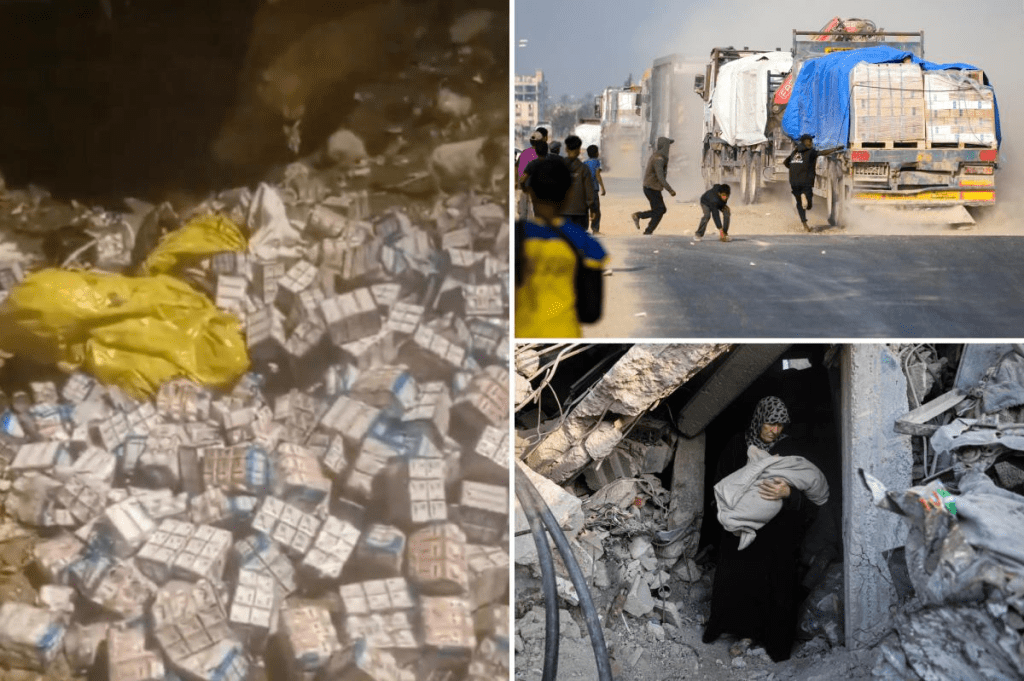
The claim of starving children is yet another lie. There are plenty of images of literal tons of food and aid being delivered to Gaza and sitting there, being undelivered, by UNRWA and the Red Cross. They refused Israel’s support in delivering the food, demanding that Hamas help them deliver the food and aid. The same Hamas that was stealing the food. The same Hamas that was selling the food on the black market. When the complaint from the people of Gaza is that the free food is too expensive, the problem is easy to see. Yet Bernie and his crew ignore the facts to once again blame the Jews.

Earlier this month, it was discovered that Hamas hid tons of baby formula to damage Israel with starvation claims. The images are damning. Yet the media ignores the truth and runs with the lies. People like Bernie run with the lies because it gets them time on TV, headlines in the paper, and helps make them rich. They don’t care about the people in Gaza, those in the hospitals being used as military bases, or the mothers who can’t feed their babies. They only care about blaming the Jews. The facts bear this out.

This isn’t to claim that Israel is blameless or perfect. This isn’t to say that criticism of Israel is automatically antisemitism. When it’s clear that Israel is being singled out, held to a different standard, the lies are getting the headlines while the truth gets buried, that is antisemitism.

People like Bernie Sanders put my life and my family’s life at risk. What happened at Bondi Beach on the first night of Hanukkah could have happened at any Hanukkah celebration around the world. It could happen at one that my family is attending. If you doubt that, read these accountings from the past WEEK in New York, published in this NY Post article.

In just the last few days, multiple alarming episodes of open Jew-hatred have shocked New York City.

Saturday night in a tony West Village eatery, a Jewish woman asked a bigot to cool it with his noisy antisemitic language. He screamed filthy slurs at her, calling her an “ugly f–king Zionist,” insisting, “we will rid this country of f–king you.”

Monday night in Brooklyn, a pair of nasty bigots harassed Hanukkah celebrants, and yelled “F–k the Jews” on a subway platform.

Once on the train, one thug grabbed a visibly Jewish man by the throat and threatened to kill him.

Then, Tuesday afternoon in Crown Heights, an unhinged pedestrian shouted antisemitic remarks at passersby and stabbed one in the chest.

This is New York. The United States of America. 2025. I’m afraid of what 2026 will bring with people like Bernie Sanders making outlandish and false claims against Israel and the Jews. We must stop the lies now. We must hold the liars accountable for their lies that incite violence. Freedom of speech does not mean freedom from consequences. Inciting violence is a crime and that’s what Bernie Sanders continues to do. He can hate Benjamin Netanyahu all he wants. He can hate Israel all he wants. He can even hate his Jewish heritage if he wants. He isn’t entitled to incite violence against people like me and my family.

It’s time to put an end to the hate. It’s time to demand more from people like Bernie Sanders.

Bondi Beach: The end of these glory days

I have been writing and talking about the rise of antisemitism and Jew hatred for over a decade. In July of 2016, I co-authoried this article in the Seattle Times calling for people to stand up and speak out against antisemitism. I’ve endured ridicule from those on the far left in the Jewish community and people telling me that this is America and we are safe here.

October 7th and the more than two years following that has changed some of that ridicule as more in the Jewish community are seeing the blatent Jew hatred around the world and in America. Yet, as we as Jews have done for centuries, we continue to see ourselves as members of the society we live in first and Jews second while the rest of the world sees us as Jews first, second, and third. Whether it’s Jews like Peter Beinert and Bernie Sanders or leaders like Zohran Mamdani, Rashida Tlaib, Ilhan Omar, Alexandria Ocasio-Cortez, or talking heads like Tucker Carlson, Candace Owens, Joe Rogan, and Nick Fuentes, we are being battered on all sides.

On Sunday, on Bondi Beach in Australia, we reached a breaking point. Two gunman attacked a Hanukkah celebration, murdering at least 15 and wounding at least 40. The death and injury count would have been even higher if not for the bravery of one man, Ahmad Al-Ahmad, a 43-year-old Muslim man, husband and father of two, who risked his life to save others, wrestling the weapon from one of the terrorists. The video is incredible and we can watch a true hero in action.

We’ve seen things like this before. Unfortunately they are too many to even list. There was a school shooting at Brown University earlier that day. Hatred and murder go hand in hand. As a world, we have emboldened hatred of ‘the other’ and this is the result. It happens time and time again. We have seen in the LGBTQ+ community, the African American community, the Muslim community, the Sikh community, with violence against women, and any other group that somebody deems as being ‘different’ or ‘the other.’ That isn’t the breaking point I refer to.

The breaking point I refer to is all the people who chanted, agreed with, failed to condemn, defended slogans like ‘Globalize the intifada’, condemning the attacks they they helped ensure would happen. It’s the leaders of countries who, by their actions and inactions, created the environents that make this type of violence and murder a reality, now condenming it. Public Jew haters like Rashida Tlaib, posting she is ‘heartbroken’ by the very thing that she advocates for on a daily basis. Brianna Wu’s comment is what we all should be feeling.

Australian Prime Minister Anthony Albanese speaks out after the shooting while failing to take responsiblity for his inaction despite warnings that Jewish gatherings were going to be attacked. He and the Australian government actively took steps prior to the shooting to encourage Jew hatred, to fuel antisemitism, and to make Australia not safe for Jews. The day before the murderous attack at Bondi Beach, this article was published, highlighting the rise in “unprecedented anti-Jewish violence” while the government does nothing. Nothing but try to play the victim and shirk responsibilitiy after their actions and failure to act resulted in mass murder of Jews.

Comedian Michael Rappaport’s comment on Mayor Elect Mamdani’s post states exactly what I am talking about. Set the stage for violence against Jews and then when it happens, call for peace.

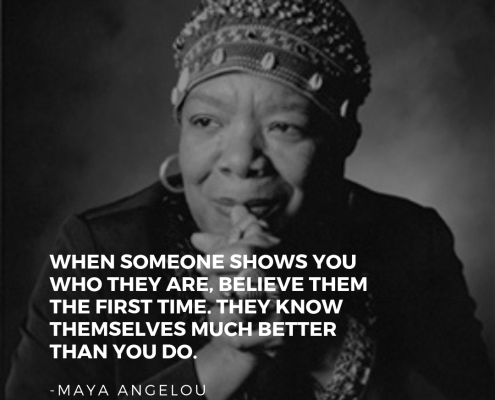
I’m beyond disgusted by these people who actively hate Jews, who do what they can to ensure the death of Jews, and then pretend after it happens that they are sad. I go back to the famous Maya Angelou quote. I’m tired of the two faced liars who want me dead and want me to help them murder me.

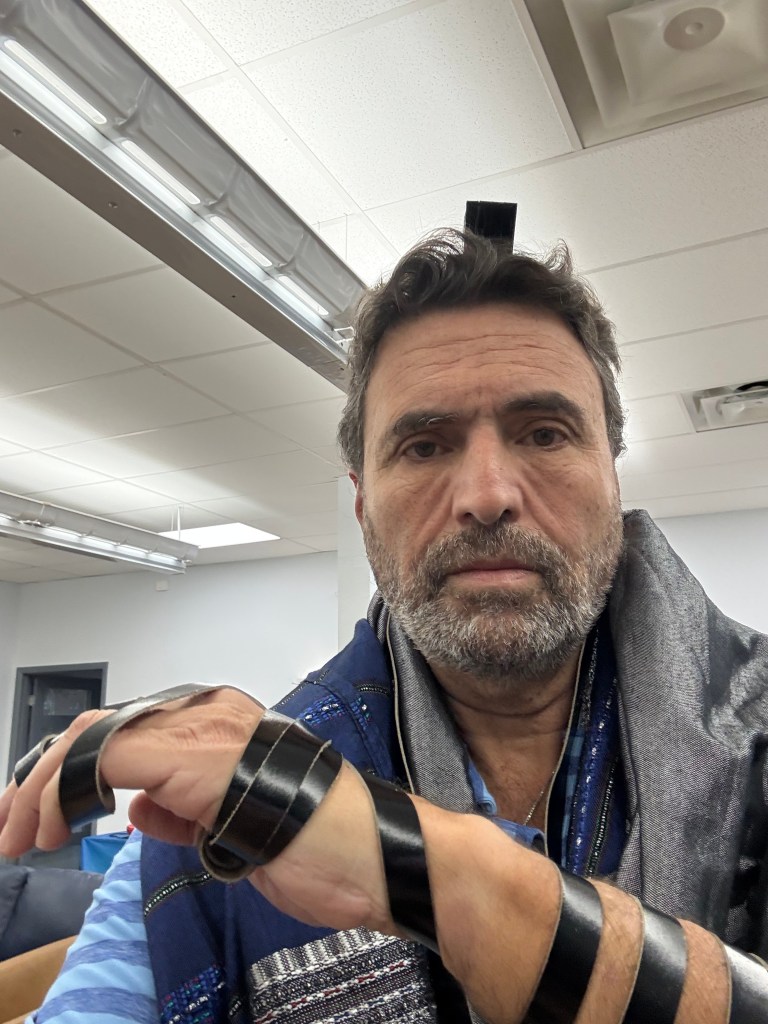
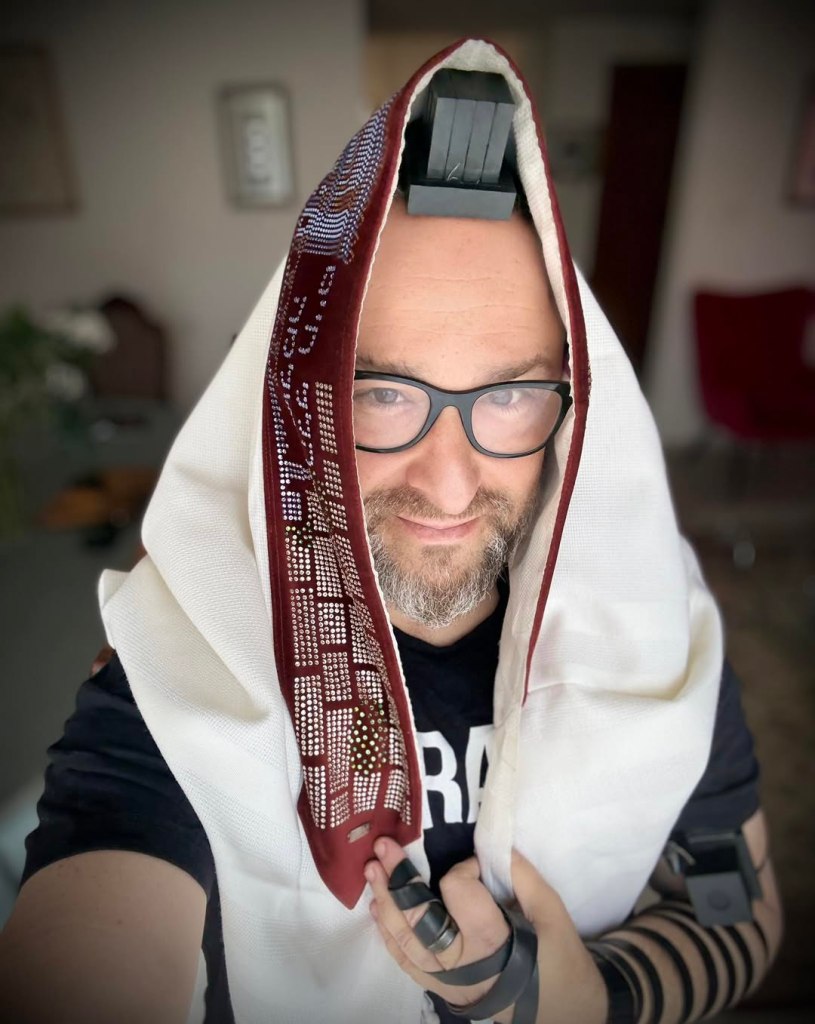
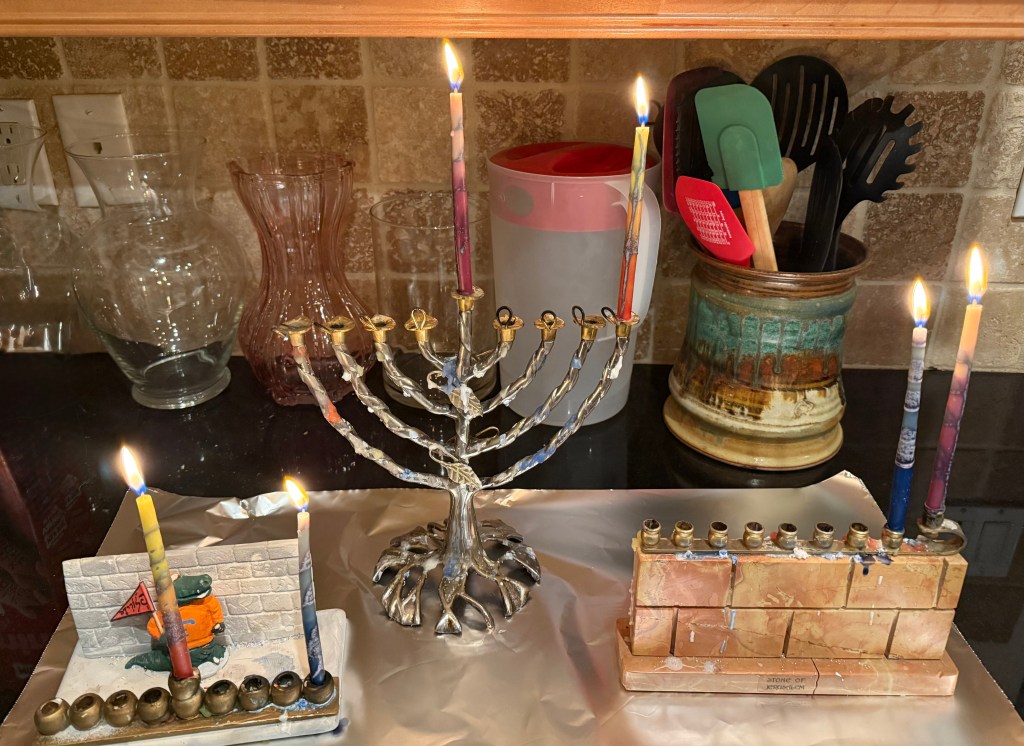
Last night was the big, public Hanukkah celebration in my town. I had been excited to go. I was excited to celebrate being Jewish publicly. The past few days, I have been feeling worn out from all my travel the past 10 weeks. North Carolina, Israel, Baltimore, Ft Myers, Tampa, DC, Seattle, Israel, Boca, and Gainesville. It has been an exhausting schedule. Yet after the Jewish massacre on Bondi Beach, after the Jew haters pretending to be sad that what they have advocated for, globalizing the intifada, policies that make Jews unsafe, I was physically ill. I simply couldn’t do it. As my grandparents used to say, ‘it just wasn’t in my kishkes” (translated from Yiddish it means “I don’t have the guts/stomach for it.”) It made me sad. But I also knew that I needed to protect myself. I stayed home, we lit the Hanukkah candles as a family, sang the blessings, and brought in Hanukkah together.

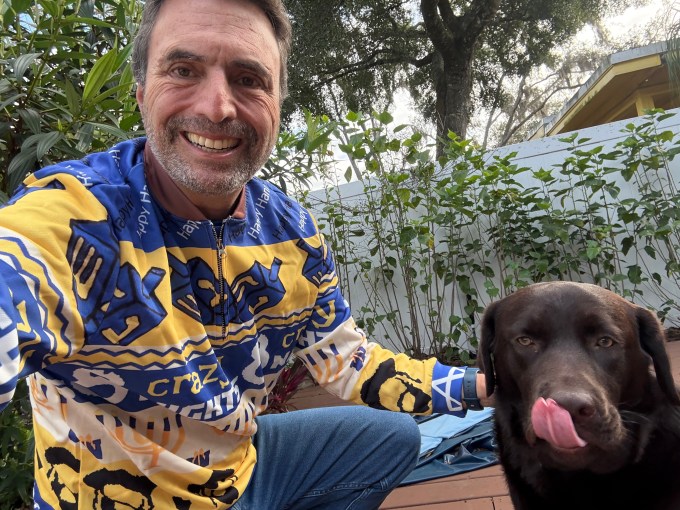
I put on my special Hanukkah pajamas – well over the top in outrageousness – but I didn’t care. The shooters on Bondi Beach, the politicians, talking heads, and even the Jews who take positions that make me not safe will not crush my Jewish soul. They won’t stop me from being Jewish, from celebrating being Jewish, and from doing my part to ensure that we continue, L’Dor V’Dor, from one generation to another as Jews.

I’ll be wearing my absurd pajamas every night during Hanukkah. I’m wearing my ridiculous Hanukkah long sleeve t-shirt today and have my absurd Hanukkah sweater to wear when I go outside. Hanukkah is about lighting the darkness. It’s about remembering that miracles do happen so embrace the darkness because we have the power to make it light. So enjoy my ridiculous picture in my ridiculous sweate and may it bring just a little more light into your life.

A day down south

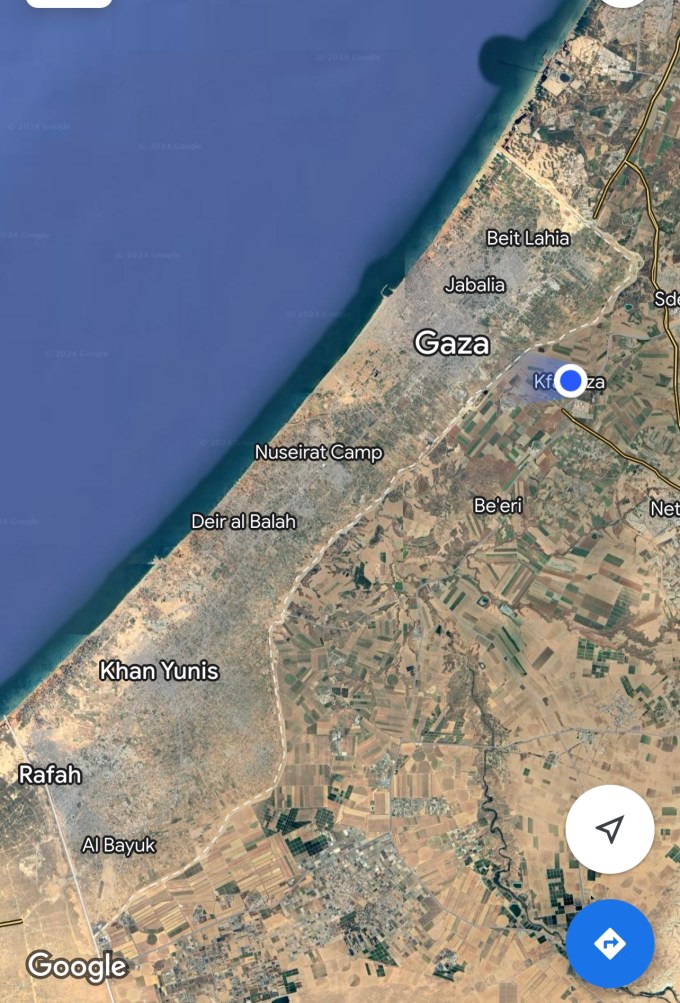
I’ve been close to the Gaza border twice, In May 2024 I visited both Kfar Aza and the Nova site and in July 2024 I returned to both Kfar Aza and Nova along with Kibbutz Alumim. I was about a mile from Gaza on both occasions, heard and saw the drones and jets fly over Jabalya, and saw and heard bombs drop, gunfire, explosions and building collapse. Both were intense experiences as it felt strange to be so close to an active war zone.

Google Maps view from my May 2024 visit to Kfar Aza

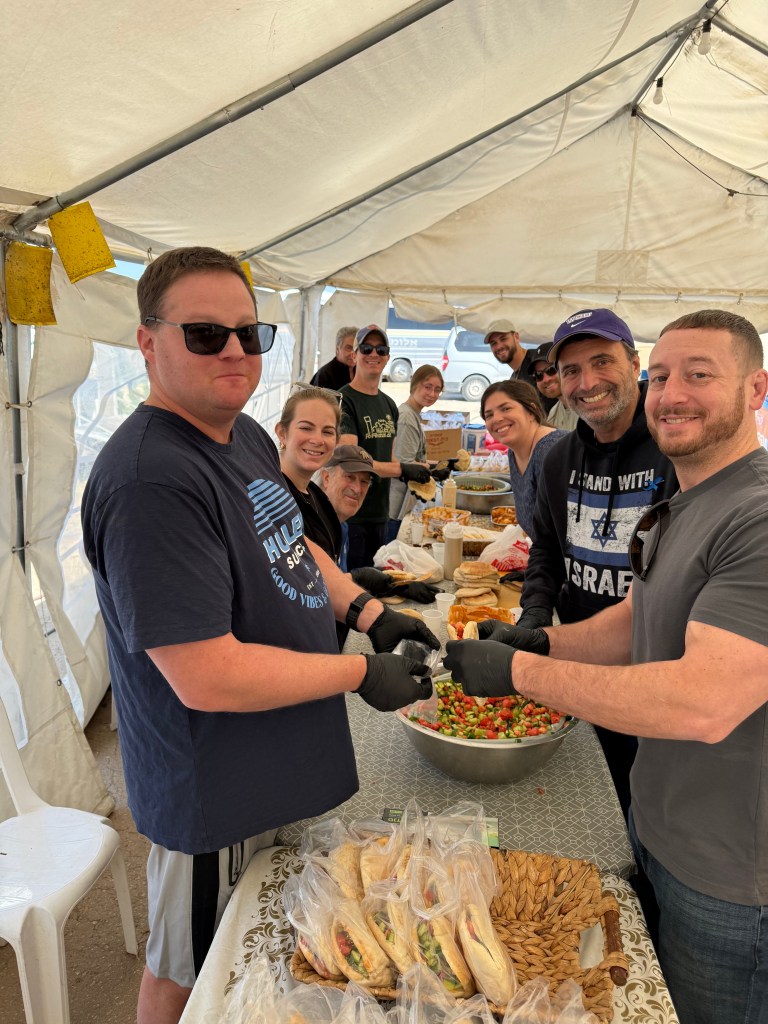
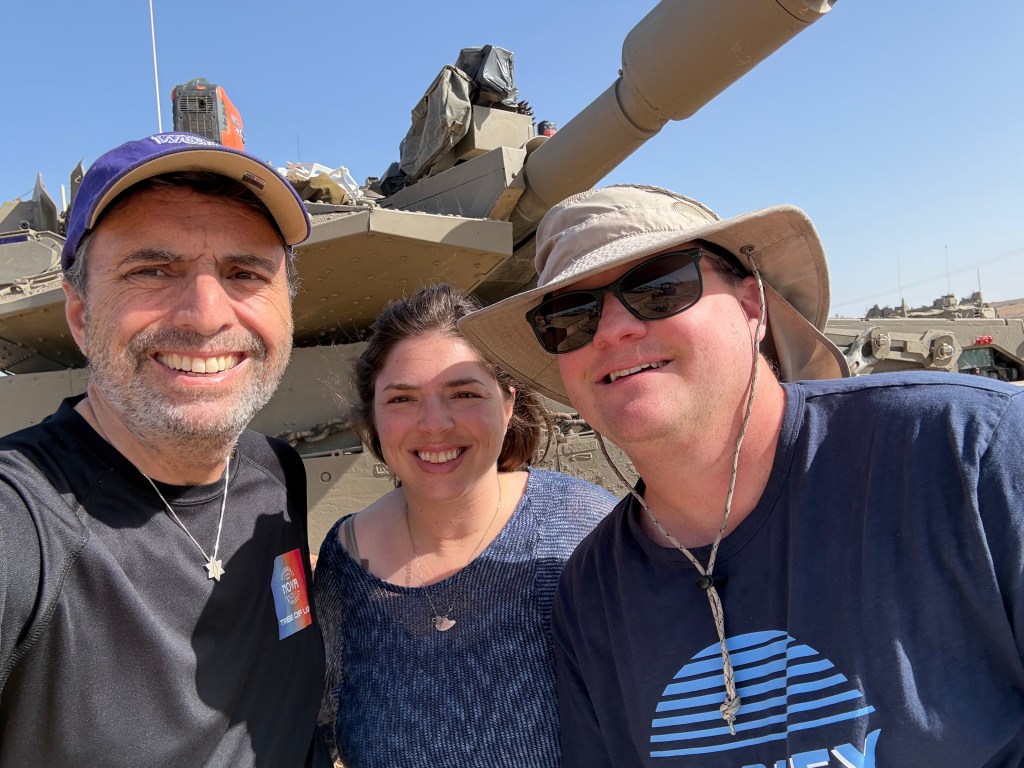
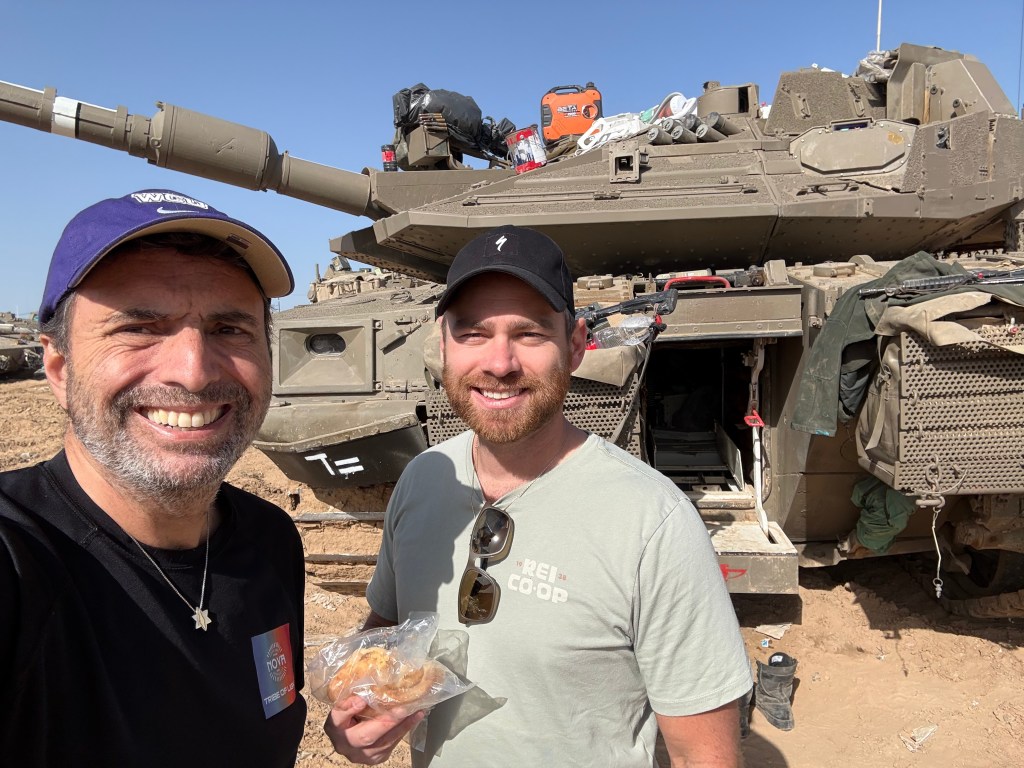
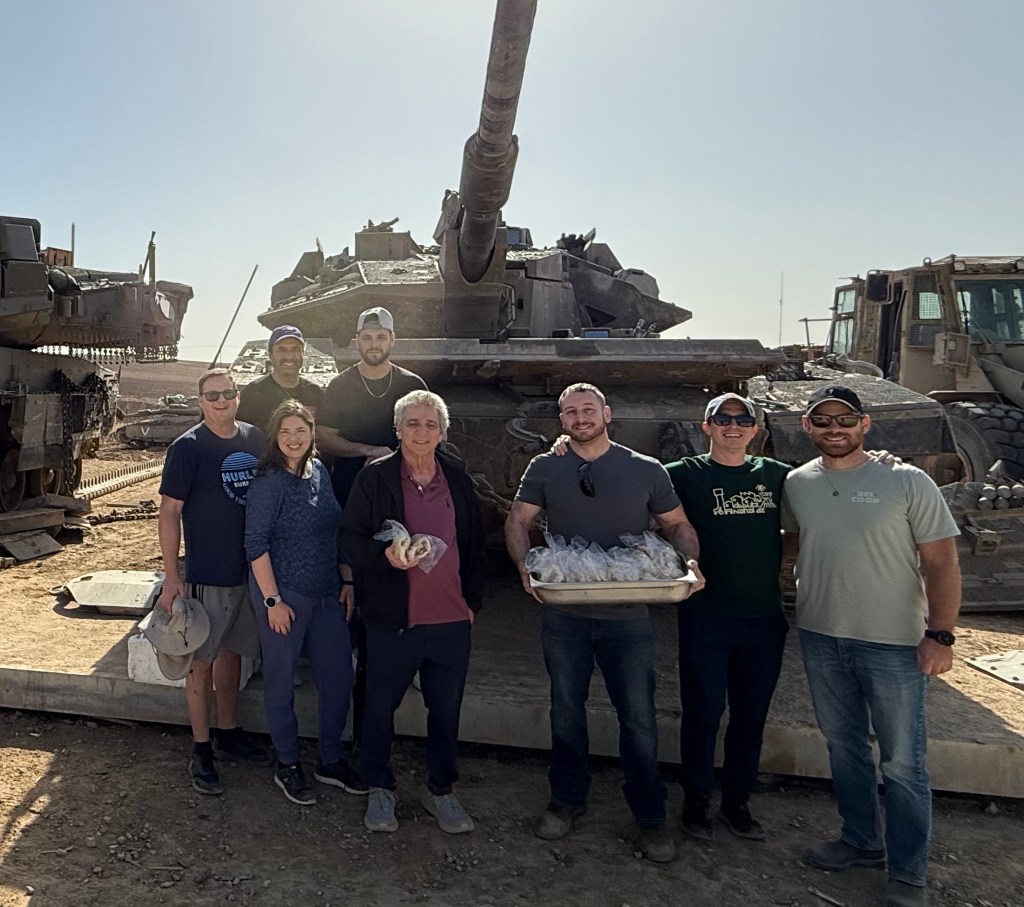
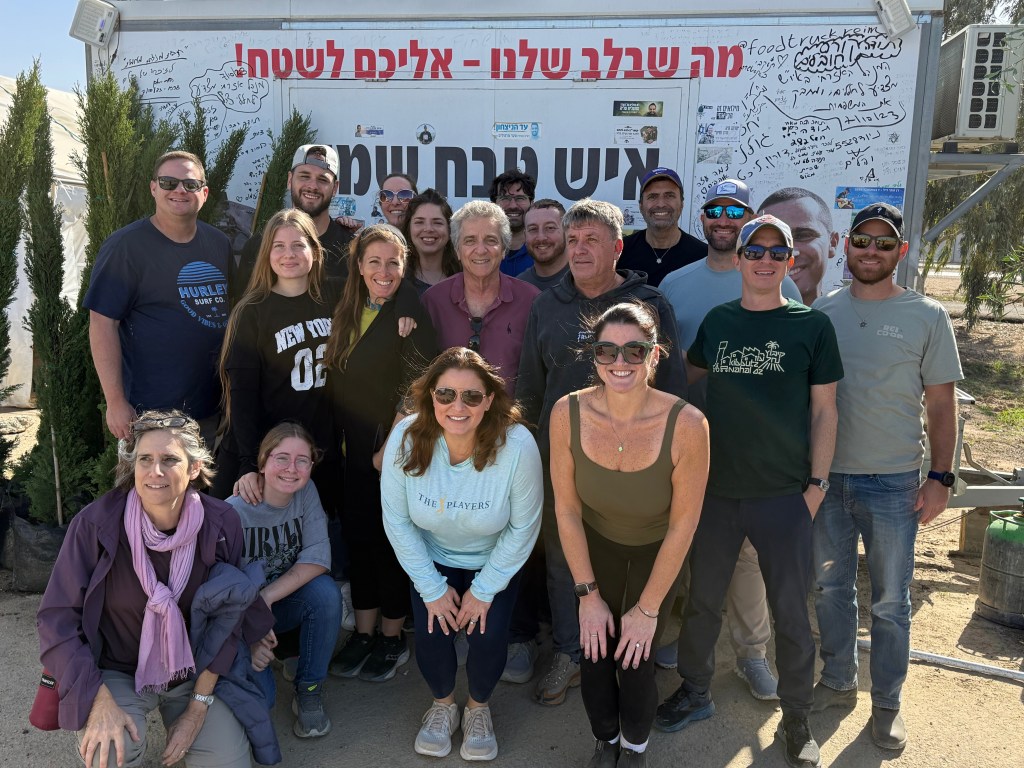
Today I got even closer. We had the opportunity to go to Shlomi’s Food Truck, right outside Kibbutz Be’eri, and make sandwiches to feed soldiers fighting in Gaza and on the border. We cut vegetables, stuffed pita with schnitzel, salad, hummus and tahini, bagged them and filled up box after box after box, then loaded them into a truck and van, and left for the border.

Shlomi showed up outside Kibbutz Be’eri on October 8, 2023 and began making sandwiches for the soliders. Every Sunday to Thursday since then, he shows up, makes sandwiches and gives them to soldiers on the border. Volunteers, like us, began coming to help him. He has paid for this out of his own pocket for more than two years. It costs about $5,000 a week to do this. You can do the math on how much of his own money he has spent over the past more than two years feeding soldiers. It’s a passion, a mission, and an obligation for him.

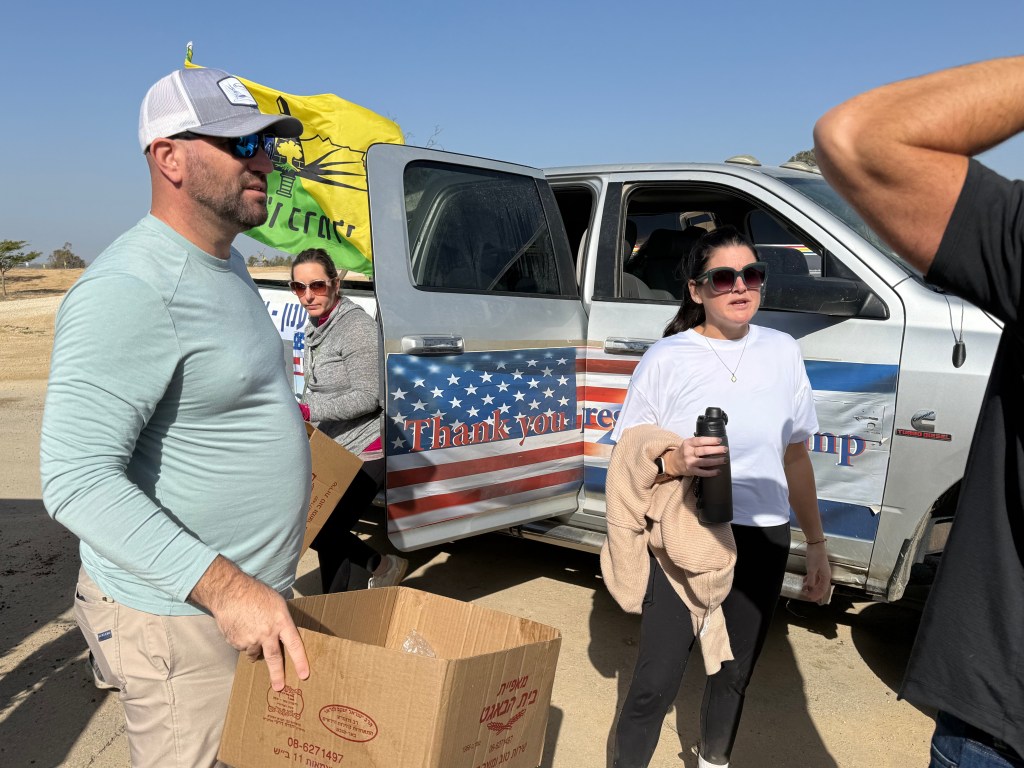
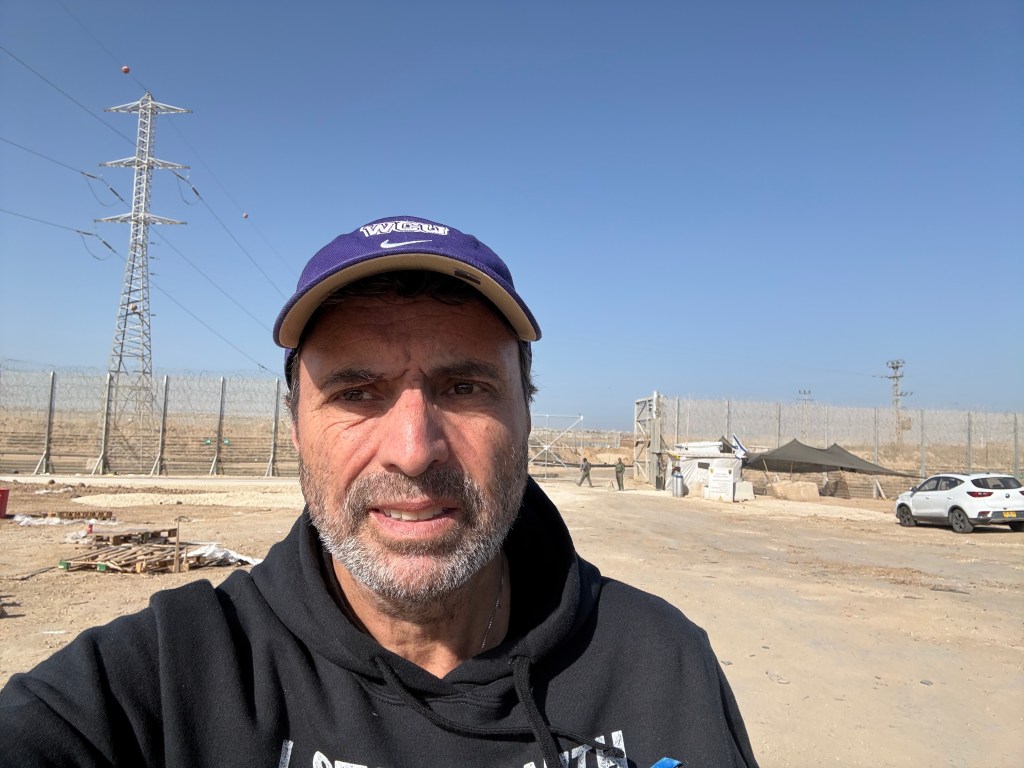
Going to the border was an unbelievable experience. We drove right along it, went into the area where the soldiers were working, offering them lunch. The smiles on their faces, the thank you’s that we received are priceless. I kept thanking them. It is them who are risking their lives, going into Gaza, keeping Israel and the world safe. All we did was make and deliver some sandwiches. We walked all through the area as they worked on their tanks, handing out lunch. We met soldier and soldier after soldier. Being right there on the border with Gaza and getting to make sandwiches and then feed the soldiers was an incredible experience. It’s not something I will ever forget.

As we prepared to finish our work, we ran into a bunch of soldiers from the Carmeli unit, about to go into Gaza. Watching these brave soldiers load up into the truck, smiling, laughing, and prepared to do whatever it takes to keep Israel and the world safe, was incredibly powerful. I lifted a box of sandwiches to them in the truck so they could take them into Gaza and give them to soldiers who couldn’t come back across the border. This picture of them in the truck was possible because they all had their backs to the camera at that moment. The hate for Israel and Jews around the world means we can’t take pictures of their faces. The flag is their unit’s flag. It’s something I will always remember.

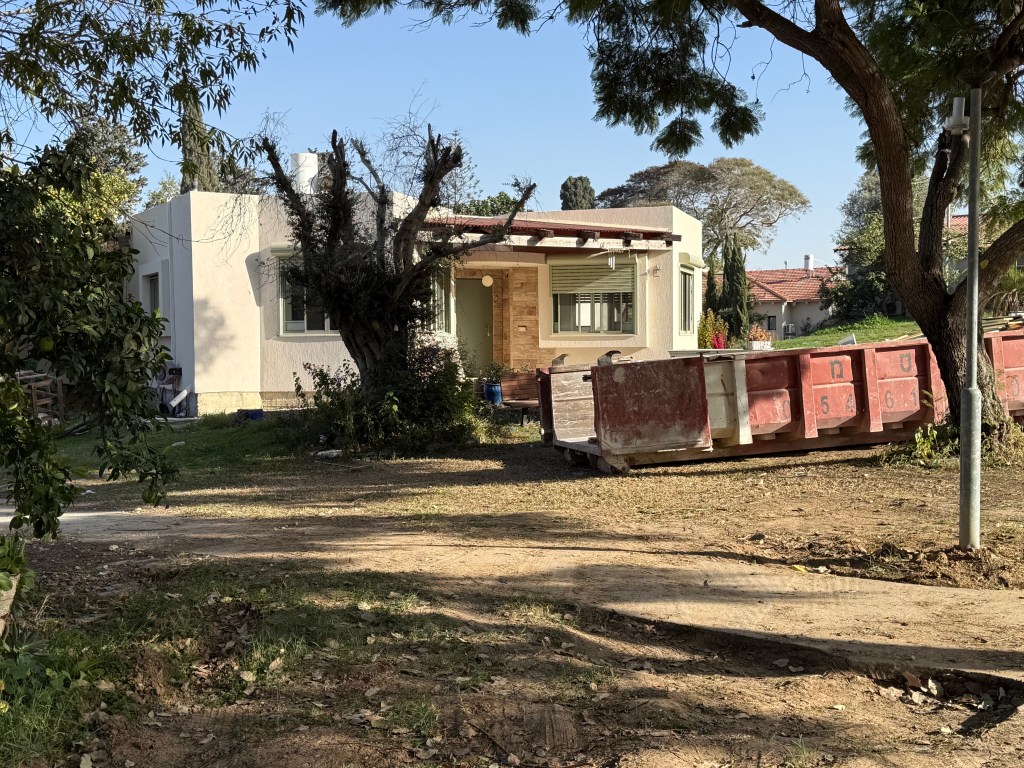
After lunch at Kibbutz Alumim, we headed to Kfar Aza. As I said, I’ve been there before. In May 2024, the devastation was incredible. The blatent brutality was in my face. By July 2024 they had begun to make some changes. This time the changes were incredible. The burned and shot up homes had been demolished and new construction was in place. Most of the kibbutz was no longer witness to the devastation of October 7th, it was a sign of life and the resilience of the Jewish people. This house is an example. In May and July of 2024 it was a symbol of the savagery of Hamas. In December 2025 it is a symbol of life, a beautiful new house in a beautiful area of the Kibbutz. As I looked at it, I could imagine myself living there. The dichotomy of my visits in 2024 and 2025 are symbolic of the Jewish people. We face many challenges and get repeatedly knocked down. But like the beautiful new house in 2025, we always get up. We look to the future with hope and with dreams. We won’t stay down, we won’t allow others to defeat us.

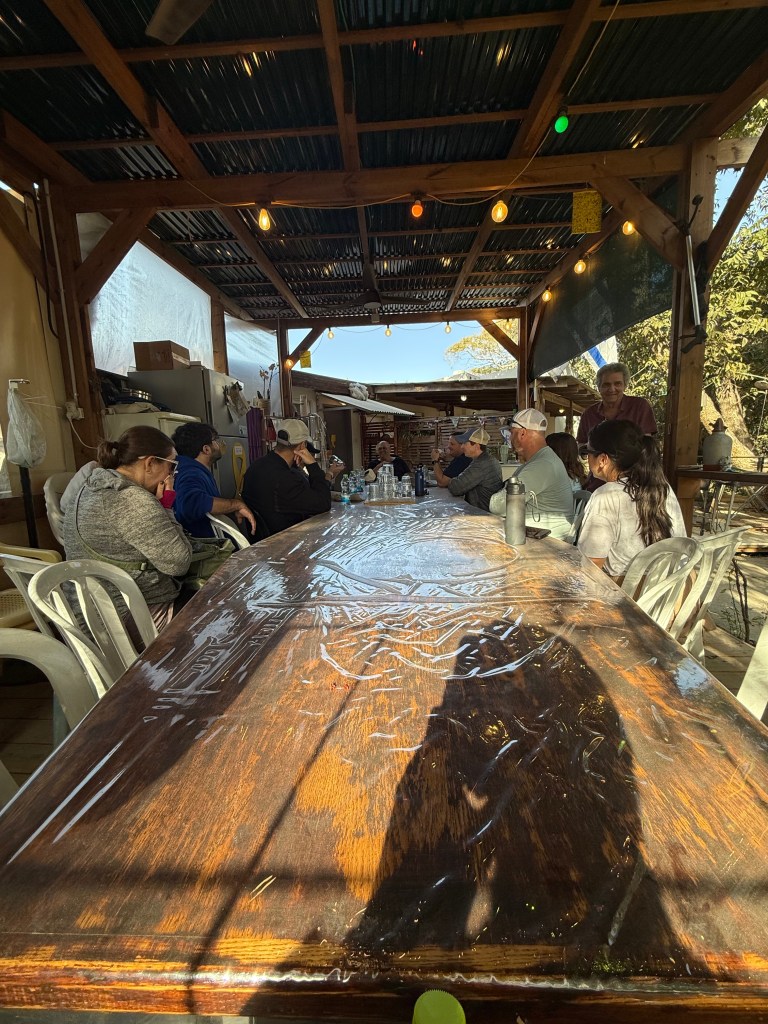
We met with Schacher, a resident of Kfar Aza. He told me his story and gave us the tour of Kfar Aza in July 2024. As we sat on the deck of his house, he told us what it was like on October 7th, hiding in his safe room as those around him were murdered and kidnapped. Why the terrorists didn’t come into his safe room we will never know. They came into his house, ate his food, and used his deck, the same deck and chairs we were sitting at, as their headquarters for the attack. It was surreal to be sitting in the same place that the terrorists were on October 7th.

Schacher’s table and deck, where the terrorists sat and planned their attack on October 7th at Kfar Aza.

Schacher took us around Kfar Aza, showing us where terrorists murdered people, where they kidnapped people, and told us stories of those who died and those who survived. It was incredibly powerful to experience. It was also a bit surreal as the changes since my last visit in July 2024 were obvious. While people haven’t moved back en masse yet, it was still a place of life now, not of death. Until we got to the young people’s section of the kibbutz. This area was targeted by Hamas for kidnapping and murder. The devastation remained. There are two homes we can walk in, one because the family gave permission as they want people to see the brutality of Hamas and how their daughter was murdered, the other because it was empty on October 7th. I also saw the home of Netta Epstein. I met Netta’s mother in November 2025 and her story and how Netta died was powerful and painful. Netta and his fiance were at home when Hamas stormed Kfar Aza. Hamas began throwing grenades into their small home and Netta threw them out. Until he couldn’t get to one fast enough. He jumped on the grenade to save his fiance, sacrificing his life. She was taken hostage and ultimately released. When I look at his picture, I see somebdy like my kids, with a bright future ahead. Hamas stole that from Netta, from his family, and from the world.

I wasn’t as angry at Kfar Aza this time because it was clear life was returning. It is a good lesson for us all and perhaps the true secret of why the Jewish people have continued to survive for thousands of years. We focus on life, not on death. We can grieve those who were murdered but we can’t bring them back. What we can do is live fully in their memory. We can make sure that their being murdered for the crime of being Jewish doesn’t become meaningless.

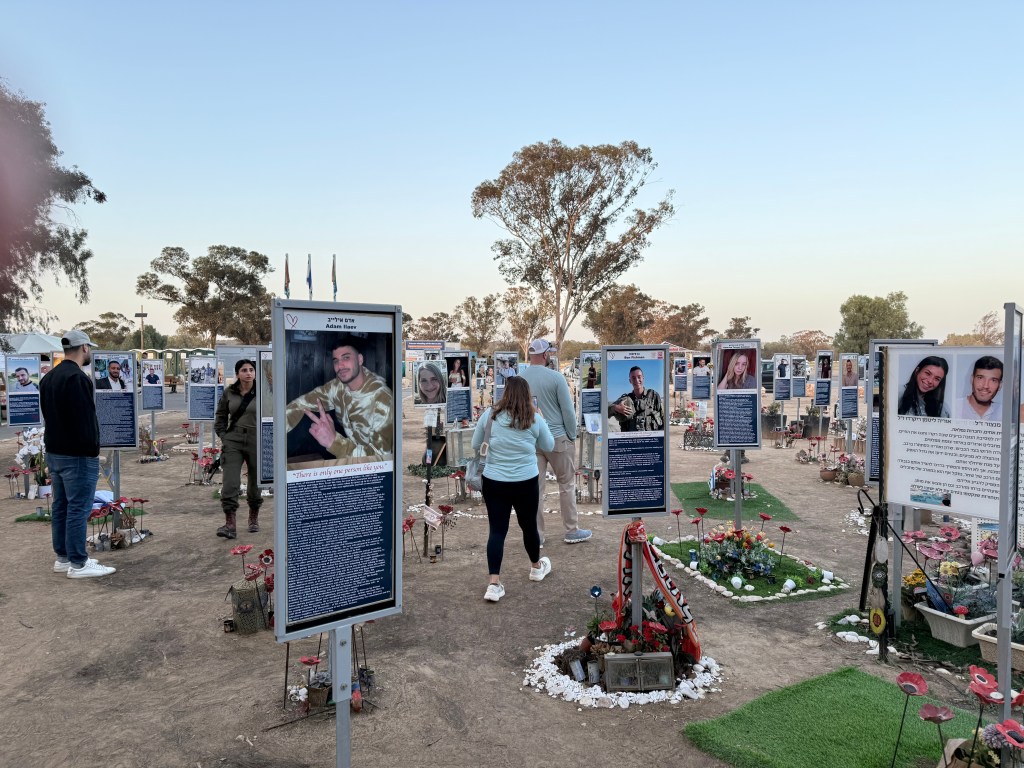
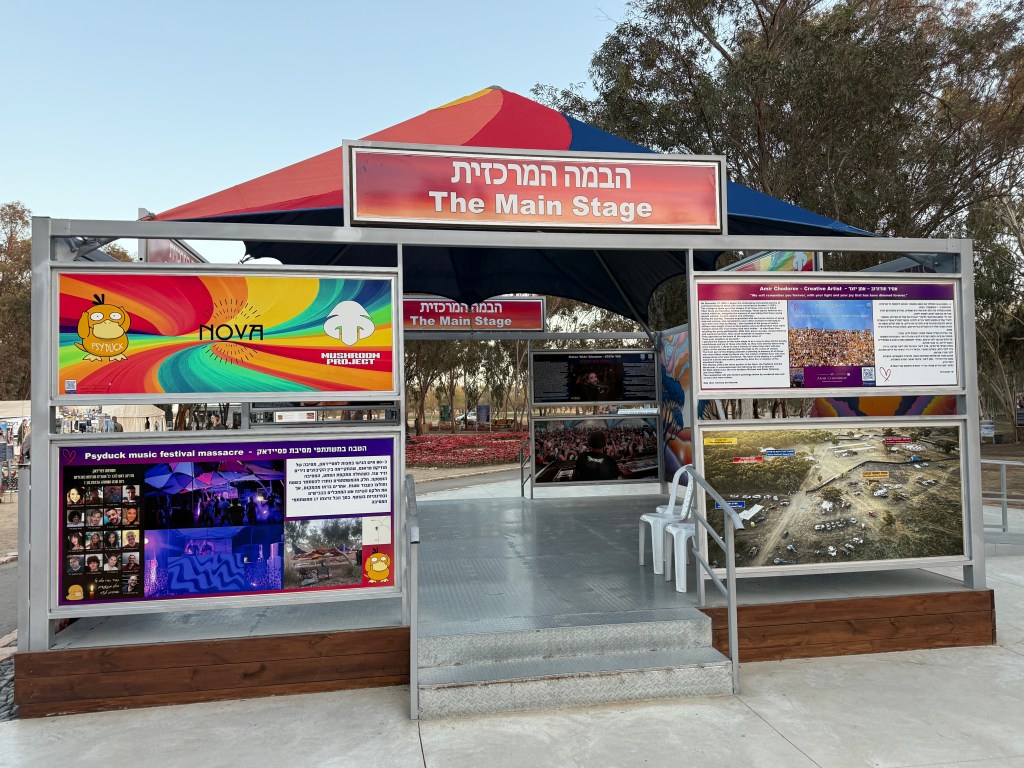
Our final stop in the south was the Nova festival site. I had heard from others how it had changed and been built up since my last visit but I wasn’t prepared for what I saw. Two new forests were built by Jewish National Fund (JNF) to honor those murdered there. There was a new area for the main stage and for the big yellow dumpsters. Seating areas had been built and real bathrooms now existed. The dirt road was replaced with paved road. Even the pictures in the field to memorialize the victims had been upgraded. It left me with conflicted feelings

The updated and upgraded Nova memorial

Part of me appreciated the need to make this into a true memorial for the country. To add exhibits and make it look more professional. Yet another part of me really appreciated the simplicity and raw emotion that the earlier version offered. Change is difficult and for me, the impact of the first two times I visited the Nova site was strong. This is a different version of the site. Yet when I watched how it impacted those on the trip who had never been to Nova before, I saw them having the same experience I had my first time. Perhaps it really is just me and what I wanted to see rather than the impact that it had. I enjoyed the main stage exhibit and the big yellow dumpsters exhibit. They were new and really added something to the experience.

We finished out time at Nova by gathering in a circle and singing. All three times I have visited Nova, we have sung. As the memorial site to those brutally murdered at a music festival, I think it is important to bring music, even if just one song, to the visit. This time we gathered together and sang Hatikvah. Not only is it the Israeli National Anthem, it means “The Hope.” On a day that involved being on the border with Gaza, visiting Kibbutz Alumim, Kibbutz Kfar Aza, and the Nova Site, hope is essential and fitting. Yet after we finished singing, we discussed the lyrics.

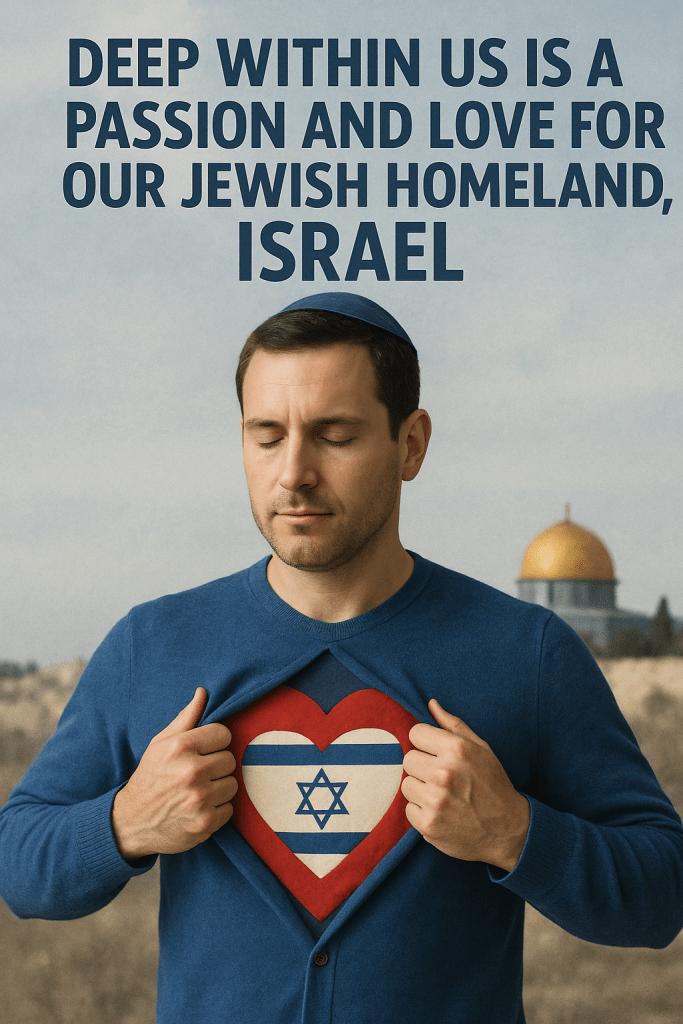
The song begins, “As long as the heart within the Jewish soul yearns, and towards the eastern edge, onward, and eye gazes to Zion.” The hope for the Jewish State of Israel in this song is not unconditional. In fact, it is very conditional. Our hearts must yearn towards Zion, towards Israel, in order to have a Jewish state. It has to be within us, a part of our being. That’s what makes Israel so special – the longing we have for her. The deep within us passion and love for our Jewish homeland. Without that passion and love, deep within our heart exists, so will Israel. I don’t know about you, but I know that I have that deep yearning of my soul, in my heart, for Israel, our Jewish homeland. I gaze towards Israel often, come visit whenever and as often as I can, and love being here. I hope that you do as well. It is a remarkable country on so many levels.

The Hospital for Broken Souls

There is something special about Fridays in Israel. While Shabbat happens everywhere in the world, Friday in Israel, especially in Jerusalem, just seems different. There is a different energy, a different vibe. There is a buzz in the air, an excitment about it almost being Shabbat. It is something I don’t think I can adequately explain – it’s something you have to feel, you have to experience. This Friday was no exception, especially because it is Jerusalem. There was an energy in the air, a vibe that you can’t describe, you can only feel.

Being in Jerusalem always creates a desire for me to learn. One of my favorite teachers, Ari Ben-David joined us to explore some facinating questions. Today’s topic was “What am I?” A great and deep question. Being in Israel and in Jerusalem, we went to the Torah to explore it.

If you are like me, the image of torah study that I grew up with was boring. Reading these stories with no context and taking them literally. Over the years, I have learned that is not torah study. It’s simply reading stories. Torah study involves discussion, analysis, questioning, and debating. That’s what we did, led my friend and amazing educator, Aryeh Ben-David. Aryeh took us through Genesis chapter 1, verse 1 and half of verse 2. That’s it. All we needed to spend an hour or more discussing the deep topic, “What am I?”

He asked us to pick one line in chapter 1 and one line in chapter 2 that most answered the question. In chapter 1, we agreed on verse 26, “And God said, ‘Let us make man in our image, after our likeness.” In chapter 2, we agreed on verses 7 and 8, “the Lord God formed man from the dust of the earth. He blew into his nostrils the breath of life, and man became a human being.” So we are the image of God, have God inside us, and are dust. Simple points.

It doesn’t end there. Dust is our physical being but the image of God and having God inside us is our soul. That’s the competition we face every single day. Every single decision. Dust (physical wants and needs) vs. soul (the greater good). Dust is about the self and immediate pleasure. The soul is about all and comprises the past, present, and future. What will we choose when faced with the decision? That’s the key question that each of us answer every day with every decision. It’s not about always choosing one over the other – there are times when we need to choose dust and there are times when we need to choose the soul. It’s about being conscious of the decision. What a mind blowing realization on a Friday morning in Jerusalem? With Shabbat approaching quickly, it’s a deep thought to take to the Kotel.

I love the energy of Machane Yehuda, the shuk, especially on a Friday. I went to help bring the catered food for Shabbat dinner to our room and get everything set up before heading to the shuk. A little bit of soul work. When I got to the shuk, as usual it was packed. I wanted to get to my favorite gluten free bakery there to get a bunch of challah, challah rolls, babkah, dates and walnuts. Most I will bring home and freeze, but I wanted a challah I could eat for shabbat and dates with walnuts to snack on. It was 100% for dust, for my own wants and needs. While there, I got to buy some desserts for Shabbat dinner (parve rugalach from Marzipan) and wine for those at dinner. A little bit of soul, doing things for others, since I wasn’t eating the rugalach or drinking the wine. Torah into action.

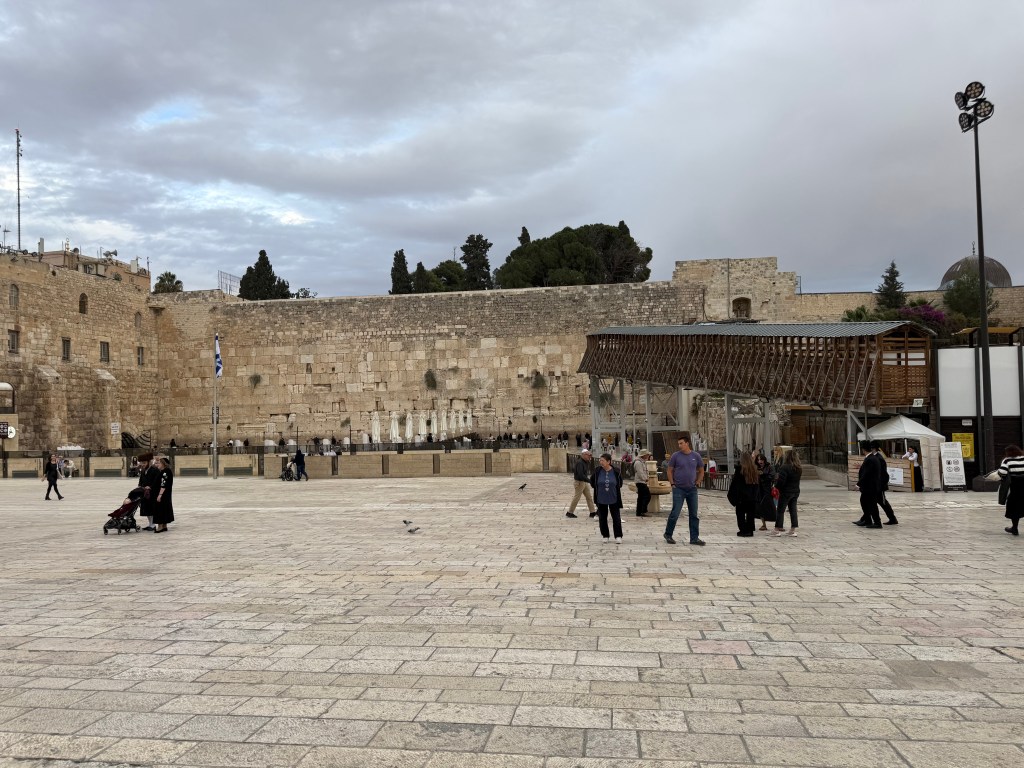
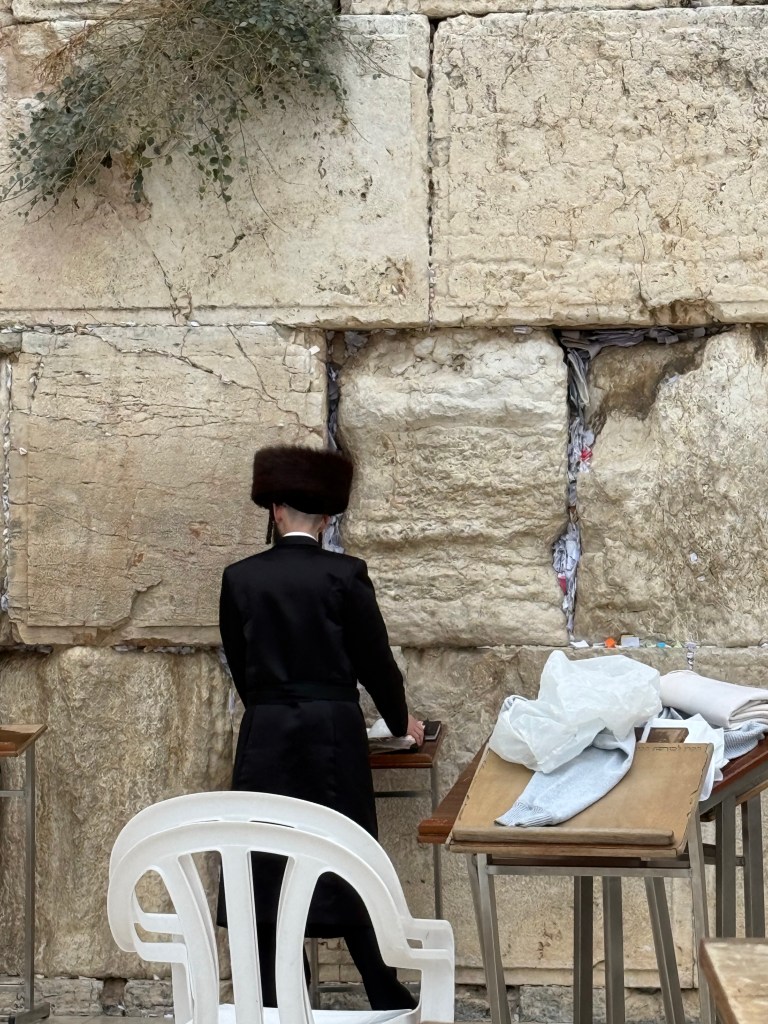
We got to the Kotel for shabbat very early. It was fairly empty when we arrived which gave us time to spend at the wall in deep thought and prayer. For the first time in a very long time, I had the time and space to sit in a chair at the kotel and just be. To let the air and the spirituality overwhelm me as I did nothing but sit and be. It was incredibly peaceful and powerful. I looked at the notes in the Kotel that others had left – their prayers, hopefully answered. I saw Jews of all shapes and colors arrive and pray. As the sun began to set, I felt the quiet and peace around and inside me.

If you’ve never been to the Kotel for Shabbat, it’s quite an experience. It never gets old for me. The singing, dancing, ruach (spirit) and connection is incredible. This was no exception. We gathered together in the plaza and prayed, sang, danced, and connected. We listed as others, in bigger groups, did the same but even louder. It was more than personal prayer – it was the feeling of a people coming together as one. As somebody who doesn’t love services, I always love Friday night at the Kotel. When we finished our prayer, I wanted to go join one of the others.

Instead we began our walk from the old city to where we were having Shabbat dinner. It was about a 40 minute walk, on a beautiful night, exiting through the Armenian Quarter and continuing up Jaffa Street until we arrived. The table was set for 15, the food was plentiful, and the company divine. I love the Shabbat table where you have a little bit of prayer, a little bit of ritual, and a lot of food and conversation. We prayed, ate, sang, and talked for a few hours, getting to know each other better, sharing pieces of ourselves, and enjoying the beauty of peoplehood, Shabbat, Jerusalem, and Israel.

During our learning with Aryeh he asked us what Jerusalem really was. We threw out a bunch of answers before he gave us his. He said, “Jerusalem is the hospital for broken souls.”. Powerful, beautiful, and true. Each of us has our own cracks in our soul. It’s part of being human. In Jerusalem we can get the treatment to begin the healing process for our soul. I’ve always loved Jerusalem but never really had a deep understanding why. Aryeh’s explanation fits. When I’m hear, my soul gets the treatment it needs to heal. To improve. To be better. I can get out of focusing on the dust, on my wants and needs, and instead focus on my soul. On the bigger picture. On being of service instead of what’s in it for me.

If you’ve never been to Jerusalem, I encourage to visit. To explore. To open your heart and heal your soul. If you’ve been – come back. It’s time for another treatment.

This was a wonderful Shabbat filled with happiness, joy, friendship and peace. I want to do my part to make sure they are all like this, no matter where I am.

Israel trip 25 begins

I arrived back in Israel at 6:30 this morning. I didn’t sleep much on the plane which meant this was going to be 2 days back to back with just a few 15 minute power naps to get me through. Good thing it’s Israel, since that always inspires me and gets my blood flowing.

After clearing passport control and customs and getting on the bus, we headed towards Rechovot for two different purposes. The first was to see the Weitzman Institute, a truly incredible research facility. The Weitzman Institute was targeted by Iran with their ICBMs in June of this year. They took a direct to one of their research facilities, destroying it. Their cancer research facility was also heavily damaged, resulting in the loss of priceless research that could have cured cancer.

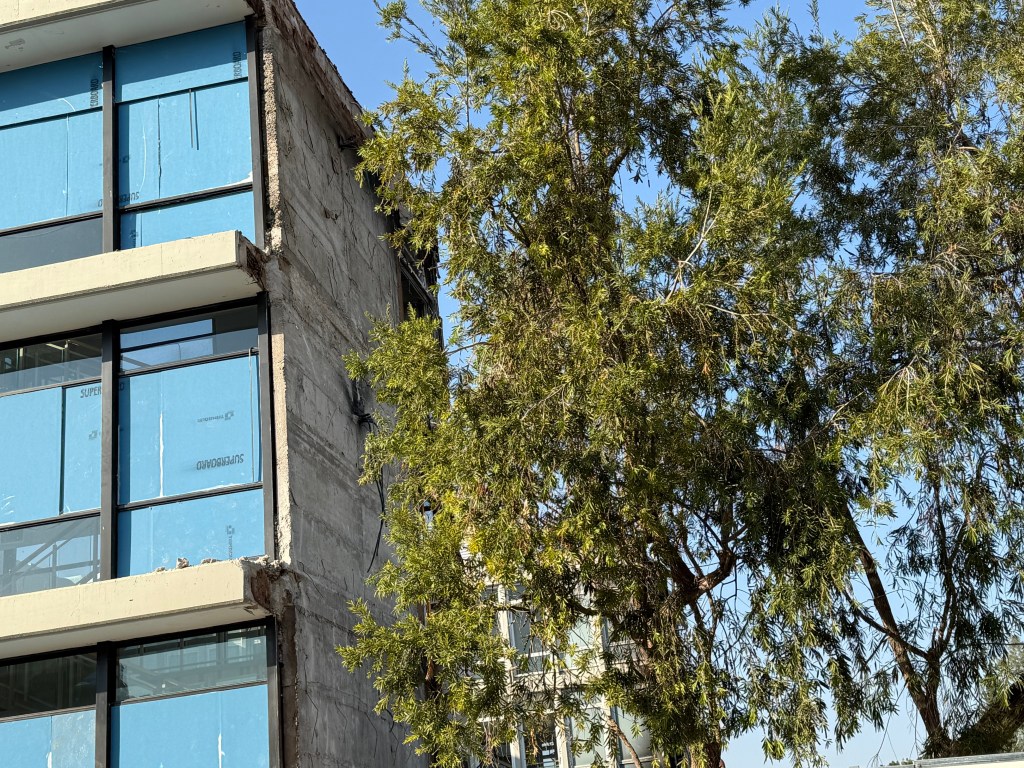
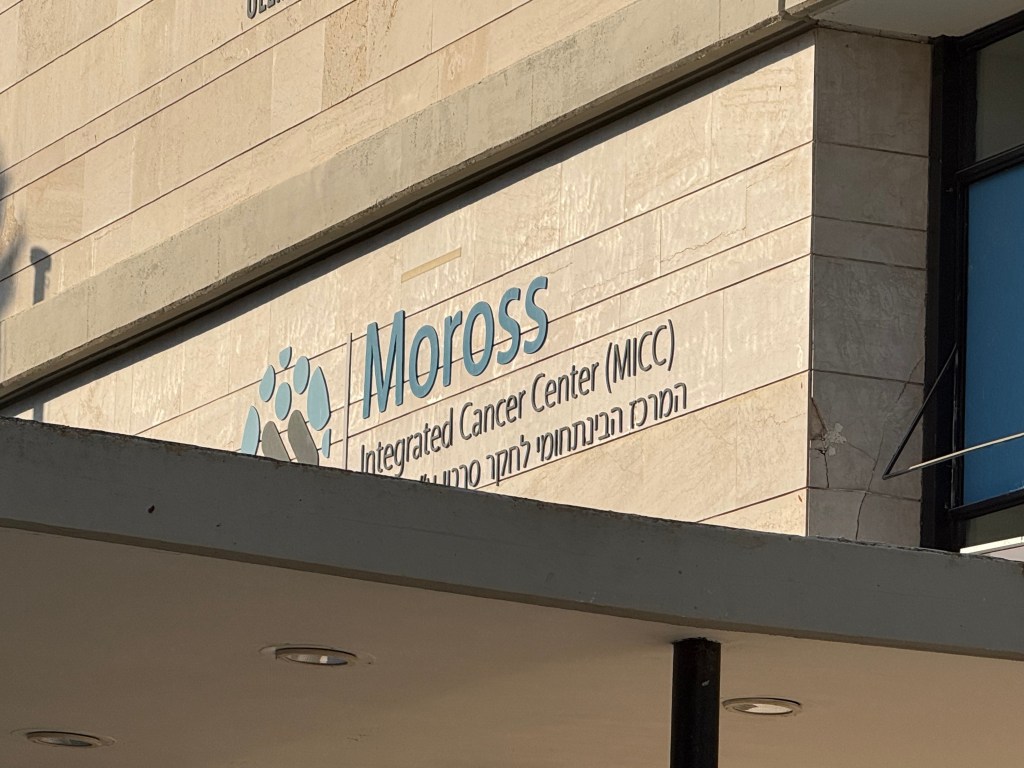
At the Weitzman Institute, they have already been rebuilding. It’s amazing to see how quickly they repaired the damage and how important this research facility is. You can see the damage at some buiildings on the side and with missing windows but the destruction has been cleared, the frames of the new buildings in place. The cancer center images below show the damage on the side but the buildings that existed next to this one have been demolished and the new ones will be built soon. The building above now looks like new construction and it won’t be long before it is finished and operational again.

The Weitzman Institute is symbolic of Israel, Israelis and the Jewish people. We are resilient. We bounce back. We may be damaged but we won’t be destroyed. This is the Israel I saw in October and see today. An Israel bouncing back. A Jewish people determined not just to survive but to thrive. This is our ‘secret sauce’. We refuse to give up. We refuse to die. Our enemies have tried to kill us for thousands of years and we simply refuse to go away. Driving through the Weitzman Institute, seeing the mix of beauty and destruction, of live and commitment to the future through their research, reminded me that we all have our part to play and we all need to play our role. We aren’t asked to do more than that yet we are expected to do our part.

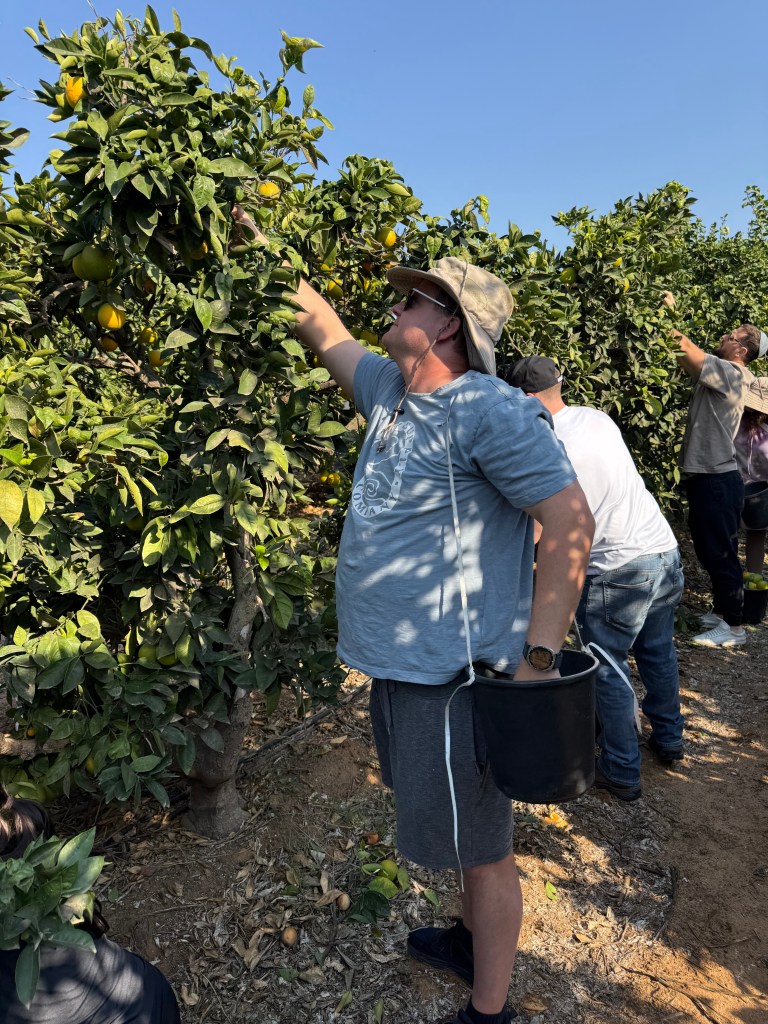
After leaving the Weitzman Institute, we headed to one of my favorite places in Israel, Ha-tov veHamtiv, outside of Rehovot. What is Ha-tov veHamtiv? It’s a farm, and orchard, owned and caretaken by an incredible man, a true Tzaddik (righteous person). Sandy, one of Israel’s most successful patent attornies, began this effort more than 40 years ago as a community garden. Today, this more than 200 acre facility, grows more than 35 different fruits and vegetables, depending on the season. All the food grown is donated to those in need. Sandy funds the entire project. Volunteers come and pick the fruit and vegetables. Last year, in July, we picked apples. This year, in December, we picked oranges. We picked them, we ate them, we worked the land, and we got energized. Less than 2 hours off the plane from Miami, we were out in the sun, working the land. Instead of being tired from a more than 11 hour flight and having little to no sleep, we were filled with vigor. It didn’t take long for us to fill up two big bins of oranges. We connected with the land. We connected with our ancestors. We connected with Israel and the founders of the modern state of Israel.

Sandy came to talk to us. What an incredibly understated and humble man. He was filled with joy at being in the orchard. He was filled with emotion, seeing us working the fields, working the land, being in Israel. Then he shared an incredible fact with us. His 200 acres provide more than 50 tons of food to those in need EVERY WEEK. This one man, through his effort, philanthropy, commitment, and working with others is providing more than 2,600 tons of food to those in need every year. Who says one person cannot change the world. Think about that – more than 2,600 TONS of food a year. That’s more than 5.2 MILLION pounds of food every year. How amazing and incredible is that. One man. With a dream. With a vision. Responsible for more than 5.2 million pounds of food being given to those in need. Feeding the hungry. I was humbled to meet him, to be in his presence, not because of his wealth or business success, but by the 5.2 million pounds of food he is responsible for providing every single year. He gives us something to strive for. One little (or not so little) orchard/farm outside of Rechovot in Israel. Imagine what we can each do with somebody like him as our role model.

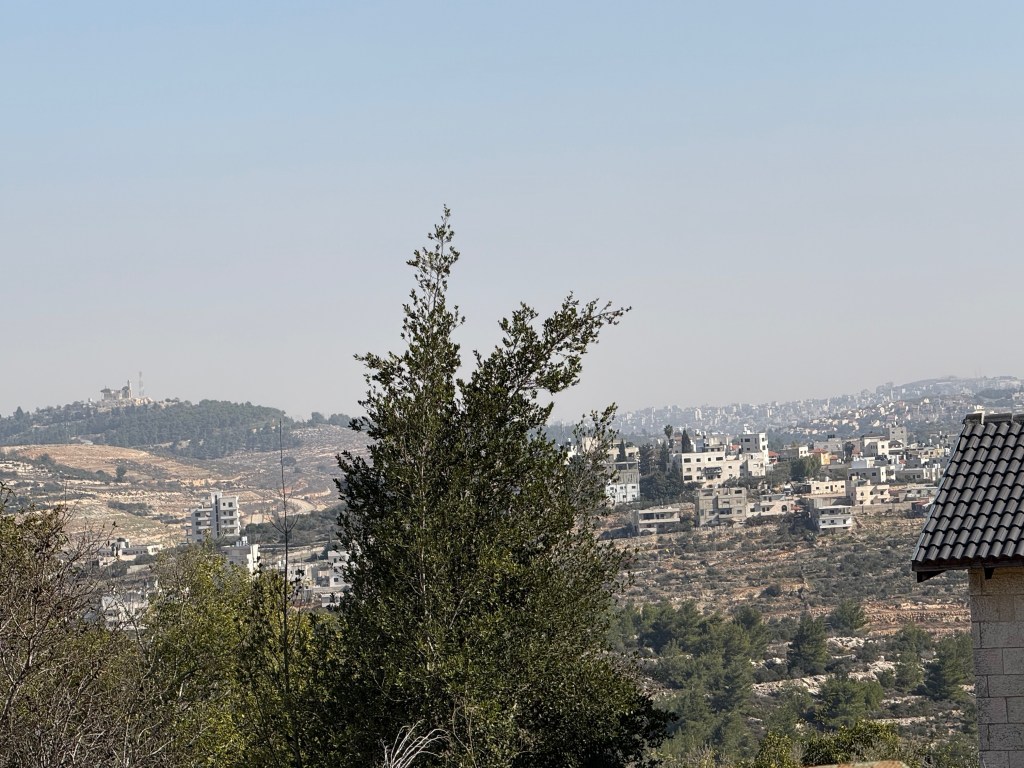
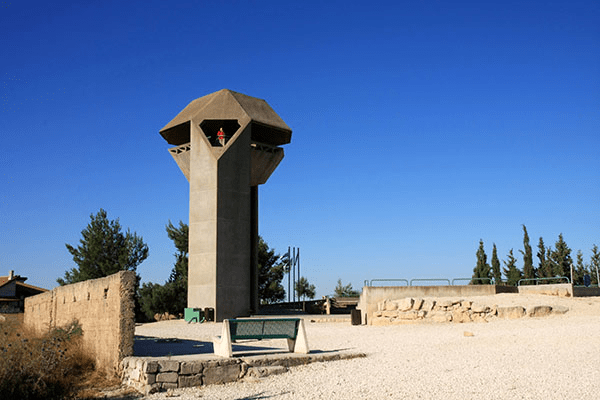
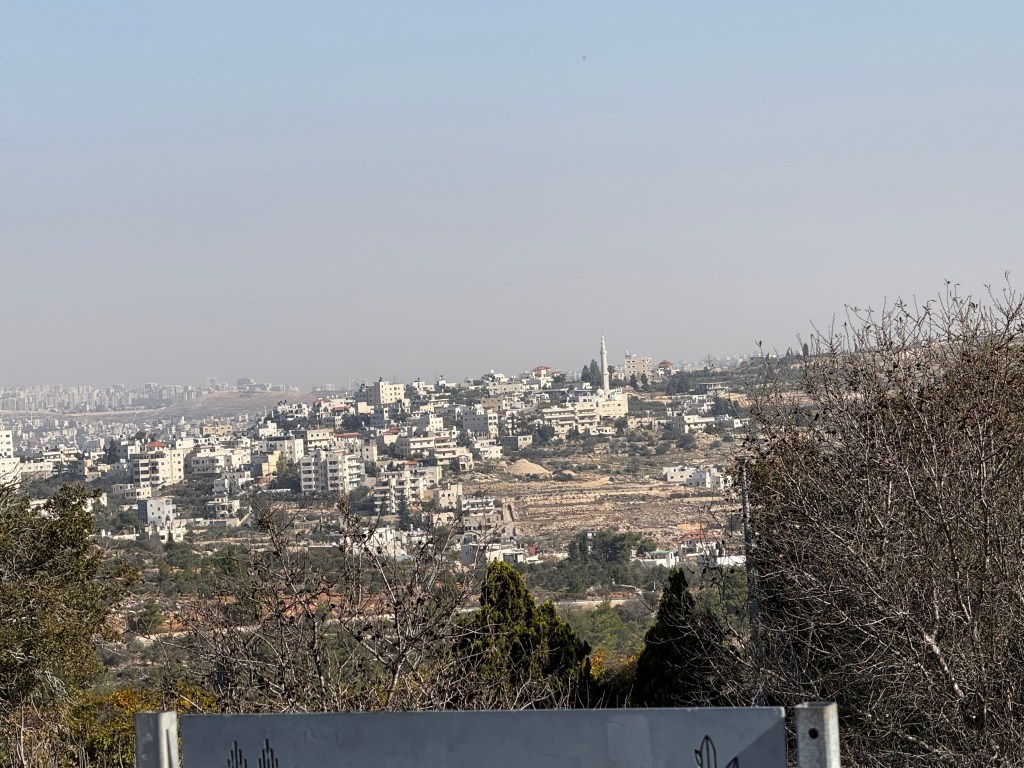
We hopped on the bus, stopped for some coffee, and continued on to Har Adar, an incredible overlook in the Jerusalem mountains. It was the sight of key battles in the War of Independence (1948) and the Six Day Way (1967), with tanks left there to memorialize those battles. Israel and her geography can be challenging for those who have never been to visit and seen how small the country is, how much the topography matters for security. Har Adar is a great location to understand the challenges and talk about where we have been, where we are, and where we hope to one day be.

The villages in the background of these photos are looking into Judea/Samaria/West Bank (names are political so I use them all). Deep in the background is Ramallah. Up front are Arab villages. Off to the right is Jerusalem. You get a feel for how close everything is. Before the second intifada (Sept 2000 – Feb 2005) it was common to walk easily between the villages in Judea/Samaria/West Bank and towns like Har Adar. Due to the violence of the second intifada, Israel needed to install the security fence to stop terrorists from coming through and becoming suicide bombers, murdering innocent civilians. The cost of this was that innocent civilians in those villages now had to go through checkpoints, needed approval to enter Israel proper, and had their lives made more difficult. After October 7th, it became more difficult. Just last summer we were able to climb up the tower at the scenic lookout to get a high view of the area. Today the lookout is padlocked and we couldn’t enter. Security cameras were installed since July 2024 to monitor the area. Our reality makes me sad.

Har Adar was once an affluent community. People have left because they don’t feel safe living that close to the border. Sitting by the tanks, eating our lunch, looking over the outlook, all I saw was a lost past and a lost future. Will we ever be able to return to the days where the security fence and checkpoints aren’t needed? Where we can live together in a shared society? I hope. I dream. I’m not sure that I believe. It makes me sad.

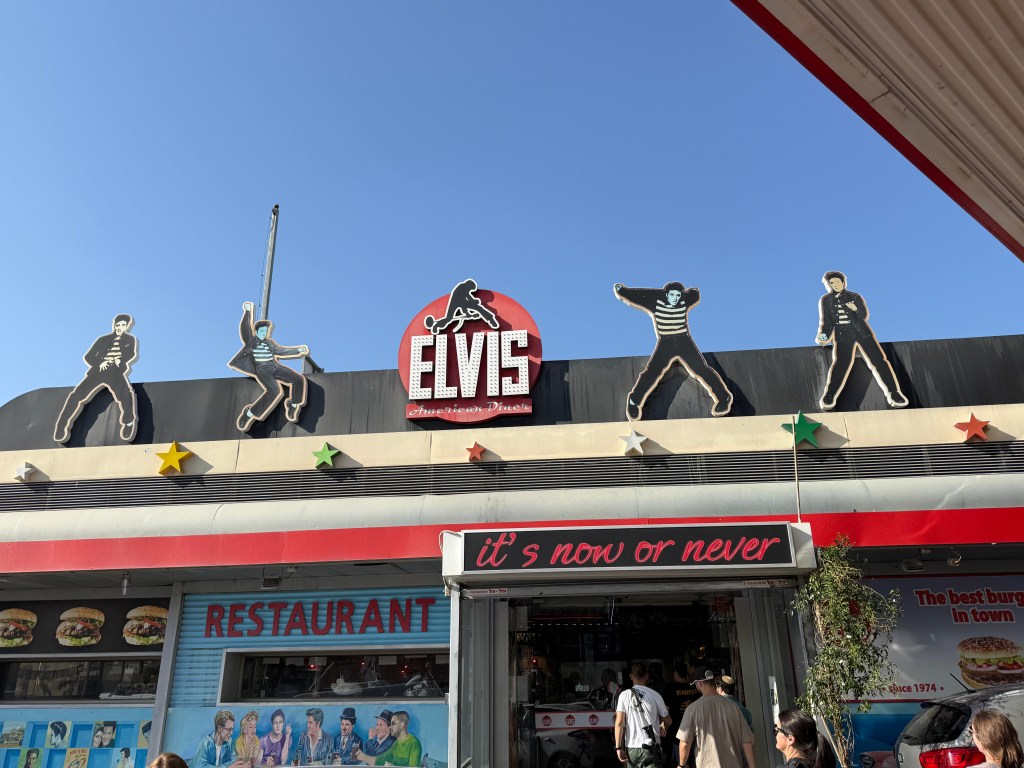
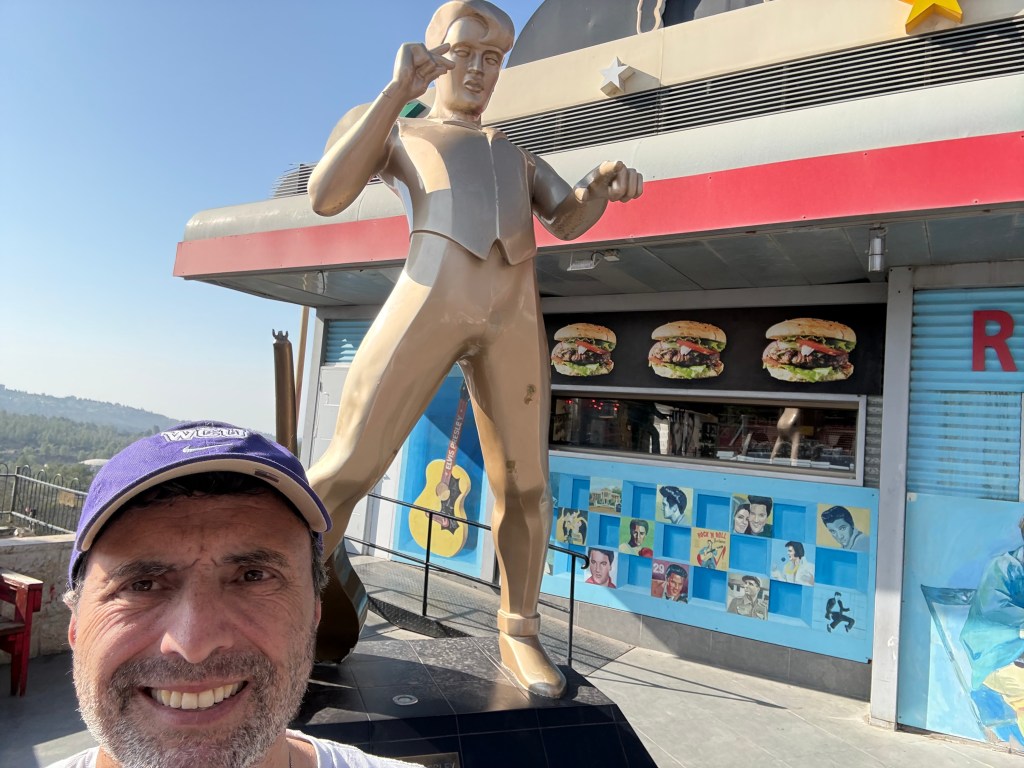
From Har Adar, we made a quick stop at the Elvis Presley Diner to use the bathrooms (the bathrooms at the Har Adar lookout were locked – another security change) and it was fun to experience it. Lots of kitchy things to buy but we couldn’t stop because we were off to the old city of Jerusalem.

In the Old City, we were going to explore the tunnels under the Kotel, under Temple Mount. I’ve been through them many, many times and it never gets old. The education about what Temple Mount is, the history of this area from Abraham and Isaac, to Kings David and Solomon, the Macabees of the Hanukkah story, and King Herod, ties together so much of Jewish history. When you go into the tunnels, that history comes alive. You see the actual walls built by King Herod. In their natural status from 2,000 years ago. You see the actual destruction of the second Temple by the Romans. You get to walk on the actual street from second temple times, the same street our ancestors walked on more than 2,000 years ago. Our feet were on the same street that people walked on during second temple times. It may be the same street that Judah Macabee walked on. As we stood on that street, overcome with the connection we were all feeling, we joined together to sing Am Yisrael Chai – the people of Israel live. We do live. We will continue to live. We will not just survive but thrive. If you told the Jewish people who were being taken into slavery and exile in the year 70 CE that in 2025 their ancestors would be standing on that street, singing Am Yisrael Chai, in the country of Israel, they wouldn’t have believed it.

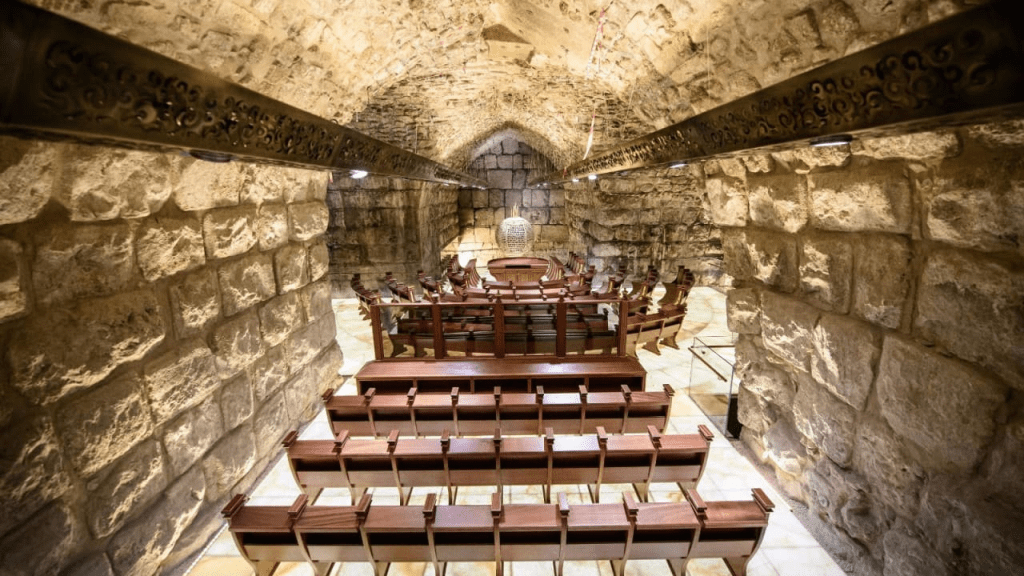
As you enter the tunnels, there is a beautiful modern synagogue built in 2017. Pictures don’t do it justice.

There is a Jewish tradition that at age 70, you begin counting again so when you turn 83, you can have a second Bar/Bat Mitzvah. I’ve decided that when I’m 83, I want to have my second Bar Mitzvah here, in this synagogue, in the tunnels beneath the Kotel, beneath the Temple Mount. I’ve got a while to go yet it is something that gives me hope, that gives me joy. To think that I may be there in 25 years, with my family, my wife, siblings, children, grandchildren, and maybe even great-grandchildren chanting from the Torah and leading services for my 2nd Bar Mitzvah makes me smile. It gives me hope. When that happens, you are all invited!

Israel is a powerful place. As I woke up this morning in Jerusalem and will be spending Shabbat at the Kotel, the Western Wall of the Temple, I can’t help but be filled with gratitude. Despite the challenges in the world today, despite the rise of antisemitism, of hatred, and of division, here I am. In Israel. In Jerusalem. I’m reminded of Psalm 137, verse 5 (and I’m not a Torah scholar but this one is a goodie).

I’ll never forget Jerusalem. I’ll never forget Israel. And I get to be here right now, today. Am Yisrael Chai.

Being Jewish and Inspired

Those who know me, know that I am not the most religiously observant person. While I am very Jewish and have a strong Jewish identity, when it comes to religious observant, I’m on the low end. When my friend asked me to come to services this Shabbat as he was sponsoring the kiddush in memory of his son, I said yes without hesitation. Not because I love services but because friends show up. Instead of my relaxing Saturday morning on the couch, watching College Gameday, rooting for the student to make the field goal and take Pat McAfee’s money, I found myself in synagogue.

I care much more about what goes on inside a synagogue that what the inside looks like in a synagogue. I have been to many that are beautiful inside but I don’t find warm, welcoming, or the service interesting or meaningful. I understand why many people want to invest in making the environment beautiful but I’d much rather see the money go to ensure great clergy, staff, culture. It’s a personal preference.

I note this because I have found that those that are more modest aesthetically tend to be more welcoming and I tend to enjoy what happens in them. As soon as I walked into this synagogue, I felt at home. It was warm, welcoming, and it was clear to me that the investment was being made in what happens inside the rooms rather than the rooms themselves. A number of people welcomed me immediately and the Rabbi, in the middle of the service, walked up to me to welcome me and give me a hug. In a crowded room, they made sure to find me a seat. People came up to say hello and welcome me.

I often find that in Jewish spaces, this type of welcoming doesn’t happen. We want people to come to our events, to be a part of our organizations, and yet we don’t make sure they feel included or special when they do. It was the first time I was at this synagogue and they made me feel right at home. As sombody who doesn’t love services, I found myself enjoying it because of how I was made to feel while there. I enjoyed the loud singing and comraderie that was happening as part of the service. Amazingly, I found myself thinking I would like to go back.

I found myself wondering why we don’t do this more often. We see our synagogues and Jewish organizations struggling with membership and attendance. We also see so many people who want to have a Jewish connection and yet they can’t find one that resonates with them. The old ways, the “Jewish tax”, the mandatory synagogue membership, etc. are no longer applicable. People want to spend their time in a meaningful way and many of them aren’t finding it in Jewish spaces. How do we change this?

There was recently a study about the shortage of people enrolling in Rabbinic School. In the study, they found an incredible diversity of those who enrolled. 58% identify as women, 30% as men, and 12% as nonbinary with an estimated 51% identify as LGBTQ. It’s amazing to see how the field has changed in the past decade or so. There was a big outrage by some about the high percentage being LGTBQ and women Rabbinic students, as if that was a problem. Perhaps to some it is. The bigger concern to me is about the overall number of people enrolling in Rabbinic school and the Rabbis that are graduating. I am a firm believer that the Rabbi is the key to the success of a synagogue. When the Rabbi is inspiring, the synagogue tends to flourish. People want to learn from somebody who inspires them. People want to spend time around those who inspire them. Rather than focus on the sexuality or gender of those in Rabbinic school, perhaps we should be asking ourselves why we aren’t recruiting the best, inspirational people to be our clergy?

At the synagogue I attended this Shabbat, the Rabbi was engaging. He was teaching us torah in between each aliyah. He was funny. He was engaging. I learned something new and applicable to my life each time he taught during the service. It made me want to learn more with him. It made me want to go back. He was inspiring. Our leaders, particularly our clergy, need to be inspiring. What are we doing to ensure we have inspiring clergy? Where are we failing? How will we address it?

One of my favorite clergy members is Cantor Azi Schwartz from Park Avenue Synagogue. He does amazing work putting classic Jewish prayers and songs to contemporary music. His version of Hallelujah set to Bruce Springsteen’s Born to Run at Rosh Hashanah this year is outstanding. I’ve listened to it more than a dozen times.

His version of Adon Olam set to the music of the Broadway show Hamilton has over 1.2 million views on Youtube. I don’t get tired of listening to it and signing along. He inspires and I look forward to seeing and hearing what he will do next. When the streaming services from Park Ave Synagogue come on, I watch because I know it’s going to be special and meaningful.

When the Broadway show Wicked (one of my personal favorites) came out as a movie last year, Cantor Azi and Cantor Mira Davis were ready with a new version of Adon Olam set to the music from Wicked. It’s fun to listen to, to sing along with. There is very little Jewish music that I want to sing along with yet Cantor Azi has multiple versions of Jewish prayer that he has inspired me to listen to for fun and to sing along with.

As I was writing this and looking at the things Cantor Azi has done, I even found new ones. Adon Olam set to Born in the USA. I quickly began to sing along, tapping my feet, clapping my hands, and thoroughly enjoying myself. I found a version of Mi Chamocha set to Taylor Swift. That’s inspiration. Oseh Shalom to the tune of Shallow.

Not everybody has to be Cantor Azi. There are many ways to inspire. There are many ways to be welcoming and engaging. It takes effort. The payoff is worth it, both for the Jewish people as a whole and for each of us individually.

I’ve been lucky to work with and learn with many inspiring Rabbis. My childhood Rabbi, Jeffrey Wohlberg (always my image of a Rabbi) set a great example for me. Rabbis David Kaiman, Andy Koren, Yoni Kaiser-Blueth, Aaron Alexander, Dave Baum, Jonathan Siger, Yonah Schiller, Gail Swedrow, Chaim Albert, Jill Borodin, Randy Brown, Gabi Gittleson, Herb Tobin, Dovid Yachnes, Ari Federgrun, Ben Hassan, Danny Weiner, Josh Broide, Mark Kram, Efrem Goldberg, Irving “Yitz” Greenberg, Ed Rosenthal, Joseph Telushkin, Daniel Wolnerman, Darren Kleinberg, Mayer Abramowitz (z’l), Steve Engel, Neil Zuckerman, Jeremy Barras, Jonah Zinn, and Amram Hoffer are just a microcosm of the Rabbis who have impacted me. While the number of Cantors who have impacted me are smaller, I can’t leave out Cantors Lisa Segal, Rachelle Nelson, Mitch Martin (my Bar Mitzvah Cantor who I still keep in touch with today) who are incredibly inspiring. Perhaps I am spoiled by these amazing Rabbis and Cantors so I have set the bar too high. I don’t think so. Their excellence has showed me what is possible.

As a people, we need to invest whatever it takes to ensure we have excellent clergy. We need to do invest in ensuring we are a welcoming community. We need to invite those who show up into our community. When I was in Hebron a few years ago, our guide pointed to the parking lot and said to us, “This is where Abraham, recently self-circumsized, greeted the strangers and washed their feet.” (the the three angels). I think that if Abraham, at that point in time, would get up to welcome the stranger, who am I not to do the same?

As I finish writing and prepare to return to Israel in 2 days, I want to leave you with Cantor Azi and his Taylor Swift cover. As he sings, “We are never going back to Egypt again” think about what you are willing to do to ensure you are never enslaved again – mentally, physically, or spiritually. Think about what youwill do to find a way to make being Jewish interesting and fun. Ask yourself what it would take for you to want to be involved? To get your family involved? To make sure Judaism has an important part in your life, no matter how religious you may or may not be. No matter how much you may like or not particularly like religious services. No matter how you define being Jewish. Because at the end of the day, we are all Jewish so lets figure it out together.