As I have said many times, I am not a religious person. I don’t go to synagogue often. In fact, a monthly Sunday morning service is all I do right now. And I only go because of the way it is done. It is done in a meaningful and intentional way. It is done not only for the ‘how’ of praying but more importantly for me, the ‘why’. I began learning Torah with a Rabbi a few years ago because I valued the discussion and questions that came out of the process. Studying Torah became about how I choose to live my life today rather than learning some stories verbatim and being able to repeat them back.
I often think that the challenge people have with religion and services, both in the Jewish and non-Jewish communities, is that we are taught only the HOW. We are never taught the WHY. One of my favorite parts of being Jewish has been that I have begun to ask the WHY question and don’t really care that much about the HOW. The WHY is what matters.
It’s interesting that for a guy who isn’t religious, doesn’t really like going to synagogue, doesn’t keep kosher, has his own definition of keeping Shabbat (I don’t do work but I drive, cook, drive a car, turn on the TV, etc. I just don’t do professional work (most of the time)) that I find wisdom in the Torah. As a few friends and teachers have told me, “The Torah is the instruction manual for life.” I think it’s because of the teachers that I have found and the way they teach, how they explain the WHY of things rather than the literal story, that I find meaning and inspiration to be a better person.
I was excited that on this trip, the young adults and I were going to have the opportunity to learn some of the WHY from my longtime colleague and friend, Aryeh Ben-David. From my experiences with him over the past 15 or so years, I knew that he would get to the WHY and boy did he. He did in a brilliant and simple way, using only the first verse of the Torah.
Genesis verse 1 talks about the creation of the earth. Most of know the story of the six days of creation and the 7th day God rested. None of this was what Aryeh discussed. Instead, we focused on THE major life question. WHO AM I?
Three words. None more than 3 letters. Yet it is perhaps the most asked and the most challenging question for all of us. We start the Torah with the big question. Judaism doesn’t mess around. Let’s get right to it.
As we discussed the question first in chevruta (pairs of two) and then as a big group, we were able to bring it together with Aryeh’s guidance to two things. First, we are made in God’s image so that we are all perfectly as God intended. This also means we have to strive to be more Godlike in life. Secondly, we are both dust and soul. The two don’t get along. They fight constantly over us. Are we focused on the here and now and pleasures of the body? Or are we going to be focused on delayed gratification, making things have meaning, going deeper into what we are doing and why we are doing it? Every choice we make is between the immediate pleasure or the delayed gratification. The shallow or the deep. One thing became very clear. While there are people only for the dust (immediate pleasure), they are few and far between and typically easy to identify because they look like a caricature. There are very few who are all about the soul (delayed gratification) and they are also easy to identify. They are monks. They deny the physical entirely, never marrying, living in isolation, depriving themselves of everything but the basics. The challenge is the balance between the two.
There is a place for the dust. We want nice things and there is nothing wrong with having nice things. Good food. Good wine. A nice house. A nice car. Good clothes. An enjoyable sex life. Money in the bank. The ability to travel. The question is always, “at what cost?” Where is the balance? At what point are we only serving ourselves and not serving the larger community or God (and if you don’t believe in God, replace the word with nature or civilization or whatever you want). Do we want to be like the wealthy attorney who owns the huge fields in Israel that we picked apples at and who donates all the food to those who are in need, or do we want to be the person who owns large parcels of land and lets them sit empty because they merely want to make a profit on the resale of the property? Do we want to keep all our money, time, and talent for our benefit or do we want to give our money, time and talent to help others and improve the world. These are the questions we need to ask.
In these crazy times that we currently live, this first verse of the Torah is more important than ever. Do we want to fight hate or make money off it? Do we want to hide and stay quiet, hoping it will pass us by or do we want to do the right thing and stand up against it? Do we want to spend the time to get educated and understand the nuance or believe the soundbites and move on? What are our morals? What are our ethics? What do we stand for? The old saying, “If you don’t stand for something you will fall for anything” has never been truer.
We can even take this into the United State political arena. Do you want to be part of the country that hates the other part of the country? Do you want to live in hating the other political party and their candidates? Would you rather work to solve our society problems? These are choices we get to make every day. Do we want to be spending more of our time on the dust, the physical plane or the soul, the spiritual plane. Note that none of this has to do with religion or even being Jewish although the thought and questions come from the Torah.
Each day we get to ask ourselves these questions. Each day, when we wake up, we have the opportunity to make new choices. In a different session, as we discussed a few of the prayers, there were two that jumped out at me. The first, Modeh Ani, is what we are supposed to say every morning. It is a simple thank you to God for letting us wake up. It also ties into the dust and soul issue. Our soul leaves us at night and returns in the morning. Sleep is for the physical, the dust. While I don’t usually say the Modeh Ani when I wake up, I do thank God every morning when I wake up. It’s the first think that I do (maybe the second after using the bathroom). I thank God for giving me the day ahead and everything that comes with it. It takes me a minute or two and it’s really very simple. “Thank you, God, for the day ahead and everything that comes with it. I am excited to be alive today and grateful that you gave me the gift of life today.” That’s the entire prayer. Each morning when I say it, it inspires me to take action in the day, no matter what the day entails. Sometimes I say it out loud, sometimes in my head. I say it every day.
The second prayer that jumped out at me was the first prayer of the morning service. It is a strange one. We thank God for giving “the rooster understanding to differentiate between day and night.” What a weird thing to say as the very first prayer of the service. We all sat there thinking about why we would say that. What makes that so important to have it be the first prayer of the morning service. Our teacher talked to us about how the most precious thing we have in life is time. On a trip with a group of young adults, all under 26, that’s an interesting concept to discuss. Time is endless for them. They are in the beginning of living as adults. We talked about how Judaism ensures we mark time to remember how important it is. A bris or baby naming. Bar/Bat Mitzvah. Wedding/chuppah. Yahrzeit (anniversary of somebody’s death). We constantly mark the passage of time to not forget how important it is. We say this prayer so that we notice not just the passage of time but also that we pay attention to all the little things that happen every single day that we take for granted. The sun rising. Food to eat. Clothes to wear. Shelter. Loved ones in our life. The rooster knowing the difference between day and night is to symbolize nature and all the things we take for granted. We start each day with gratitude by saying Modeh Ani or our own thank you to God for the day ahead. Then we thank God again for all the things we take for granted.
What a way to start every day. As most of you know, I’m not very religious so saying the Hebrew prayers isn’t something that I do regularly. Every day, I do thank God for the gift of the day and now I have the opportunity to thank God for all the things I take for granted. Maybe that will help me notice them during the day and not take them for granted.
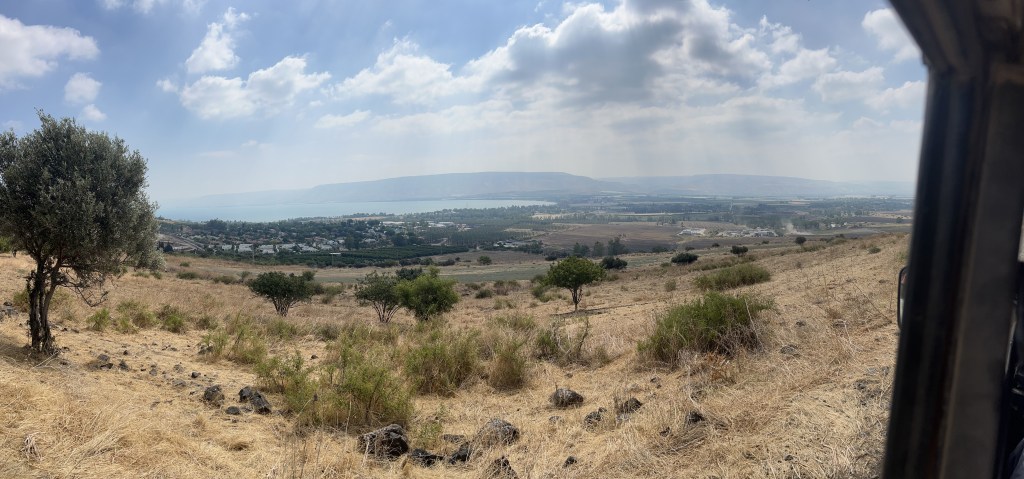
On my trip to Israel last month, we learned about what a miracle it is to wake up in Jerusalem. To breathe the air in Jerusalem. To walk the streets. This morning, I woke up in the Southern Galilee to beautiful views. God as an artist. We rode jeeps around the area, looking at the fields growing fruit and vegetables. At the mountains and the sky. At the Kinneret (Sea of Galilee). When we are in a different place and see the beauty around us, it is very easy to notice it. What about in our own daily life? What about in our own homes, looking at our own backyards?
As I spend two weeks of July in a country at war after spending 10 days here in May and planning another 10 days in August, I am so grateful for many things. Grateful for the existence of the State of Israel. Grateful to the IDF who protect this country. Grateful that I have the ability to come to Israel as often as I have in my life. Grateful for the pioneers who made the desert bloom. Grateful to the leaders like David Ben Gurion, Moshe Dayan, Golda Meir, Shimon Peres, Menachem Begin, Yitzhak Rabin, Ariel Sharon, and many more who created this country. I have the opportunity to live in the dust, enjoy being able to come here and enjoy the food, the people, the beach, and everything it has to offer. More importantly, I have the opportunity to live in the soul as well, fighting on Israel’s behalf to educated and inform people about what it is really like and what is really happening. I have the opportunity to let my soul open up while here and make sure it stays open when I return home.
In Pirkei Avot 1:6, there is a famous line that I have chosen to live by. To paraphrase it, we are charged to find ourselves a teacher, make them our friend, and judge others with grace and giving them the benefit of the doubt. While all three are important, I sometimes struggle with the third and it is the first two that I am living by. I have found myself not just a teacher but a few teachers. They have become my friends. They provide me guidance to be a better person. They explain things and I ask lots of questions. They make it relatable to my life today, in 2024. One of my teachers, who I have been learning with and from for more than 20 years, told me a few weeks ago that I was now a yogi. That was high praise from him and I’m not sure that I really believe that, but I have come a long way. They all continue to inspire me. I learn from all of them.
So, who are you? Where do you stand in the balance of dust and soul? If you don’t know, that is totally ok. Most people do not know. Find yourself a teacher. Make them your friend. Learn. It is not about being more religious. It is about learning life lessons and how to apply them. It is about finding meaning for you in what you choose to do. It is a deeply personal journey and a powerful one. I encourage you to begin the journey. From my experience, it is one you will really enjoy.

 keithdblog