Part 5: Walking in their shoes – November 5, 2019

After going through Checkpoint 300 from Bethlehem to East Jerusalem, we split into different tracks. I chose the track that was focused on Palestinian Culture and art. I don’t know why I chose it, but that’s what I had selected. Boy am I glad that I did.

Our guide for the day was Mahmoud. He and his family own a bookstore in East Jerusalem and he is very active in the art community there. He is also a passionate Palestinian Nationalist/Patriot which to him means he believes in the Palestinian culture and identity and he wants them to continue and for them to have equal rights. As somebody who lives in East Jerusalem, he is not a citizen but has permanent residency status. This gives him freedom of movement but not the right to vote in Israeli elections.

Mahmoud talked to us about some of the challenges in the art community. They are not eligible to receive funding from the PA because they are in East Jerusalem. And they won’t ask for, and don’t believe they would get funding from, the Jerusalem municipality. They choose not to ask because they feel they are treated as 2nd (or 3rd) class citizens and don’t want to legitimize a government that looks at them that way or that treats them that way.

We began by visiting El Mamant, which means workshop in Arabic. It’s called this because the building used to be the home to a tile factory where people would come to get their tile designed. The building was built in 1900 and they began in 1998 creating art exhibits, hosting concerts, talks, and social activities. It was a beautiful building and the programs they run reminded me of many programs we hold at our JCC. As we talked about the role of art, music, and sports in Palestinian culture, it quickly became political.

Mahmoud spoke to us about how the Palestinian football championship could not be played because the two teams were from the West Bank and from Gaza. Neither was being permitted by Israel to travel to play the other. He talked about how they couldn’t bring artists to East Jerusalem from the West Bank or Gaza to participate in exhibits. And he talked about the problems of getting academic professors from the West Bank into Israel to present at conferences. All these things, which are not inherently political, had become political.

Safety and security are essential and come first but it’s hard to understand how these type of blanket travel bans make sense. It was troubling to again hear about the problems with freedom of movement and how significant that is in everyday life.

Building on this, Mahmoud explained to us the rank of privilege the Arab community from his point of view:
1. Israeli Arabs. They have citizenship, likely because their family was already in Israel in 1948.
2. Jerusalem Palestinians. They have residency rights but not citizenship. They can’t vote except in municipal elections. They have access to social services and pay taxes to Israel. Their family has likely been in Jerusalem since 1967.
3. West Bank Palestinians. They have no residency and need permission to cross checkpoints into Israel. In areas A & B they have access to social services provided by the PA. These are provided by Israel in area C. They pay taxes to the PA.
4. Palestinians in Gaza. They are stuck and can’t leave Gaza. Hamas is responsible for any social services.
5. Palestinians in the Diaspora. They can’t return.

It was an interesting summary and viewpoint. This would be reiterated by others throughout the day.

Next Mahmoud took us to the Palestinian Heritage Museum. I had a lot of problems at the museum. Our host talked about the museum and history with very different facts. His narrative did not include the Partition plan on 1947. He said that the war of 1948 was Israel attacking defenseless villages and that Egypt and Jordan were not involved at all. He laughed, saying ‘think about it’ telling us if the Egyptian army was involved they would have rolled through the streets and destroyed the Israeli army. He diminished the concept that people would voluntarily leave their homes and villages, saying ‘Think about it. Who would leave to live in tents?’

I thought about it. In 1979 I lived in Harrisburg, PA, about 10 miles from 3 Mile Island. I remember the day of the accident and the scary news coming out. Nobody knew how bad the accident was and if there would be a nuclear meltdown. My family packed bags, left everything else we owned in the house, and evacuated to relatives in Connecticut. We had no idea if we’d be able to return (if there was a meltdown) and if not, when we’d be able to return. I found myself asking how different is this than 1948 in Palestinian villages. There were Jewish terrorists who slaughtered people in Palestinian villages. It’s embarrassing and nothing to be proud of, but it happened. Is it unreasonable to think if it happened in one village that fear could be used to make people think it would be happening to them so they’d leave? Or that if their leaders told them they needed to leave and in 2 weeks they’d come back and have more that they’d have left ‘for 2 weeks’?


I didn’t want to argue but once again, I was losing hope. How could somebody with such a different set of historical facts be a partner for peace? How could somebody who talks like that be somebody to trust in building a new status quo? I was troubled and happy when we left. Nobody wants the status quo to continue however how can you take even the first step in this situation?

We went to Mahmoud’s bookstore for lunch and our next speaker. As we sat to each lunch, we got to meet a Jerusalem Armenian who is the lead singer of what has become a very, very popular East Jerusalem band. Their first hit song exploded and they are regarded as one of the top bands in the area. The four other bandmates happen to live in Bethlehem which creates a problem. He can go to them (he falls into category 2 above) but they can’t come to him (they are category 3). As such, they had to move the band headquarters to Bethlehem. Most of their live concerts are in the West Bank because of travel issues. Because his bandmates are Palestinian Christians, they typically get to travel to Jerusalem for Easter and Christmas, so that’s when they do concerts in East Jerusalem. When they fly to do concerts in Europe, he flies out of Ben Gurion airport while the bandmates have to fly out of Jordan. He struggles with the inequality he and his band mates face, all because of where they live. As I said above, this is an ongoing theme with the Palestinians I have met. I struggle with this – I know there are security reasons for much of what is happening but I also wonder is this the best we can do. I’m troubled and don’t have answers but only a lot more questions.

Before I end this post, when we went into the bookstore, I asked for the Wi-Fi password. I was not surprised when they told me it was jerusalemisours.

Part 4: In search of common ground – November 5, 2019

Day 2 of Encounter began early as we met at 7 am for breakfast and to continue debriefing. I couldn’t imagine the connection with this group 2 days ago and how much I need their support through this experience. It’s an unexpected benefit.

As we talked this morning a few themes emerged for me. First, the unintended consequences of the Oslo accords. I heard repeatedly how much better it was for the Palestinians before Oslo and how that was a seminal moment for them that changed their status and their lives. I never would have thought that much significance would have been a result of what I considered a failed attempt. It reminded me of recent conversations I have had with some of our local Muslim community leaders about 9/11 and what it means to them and their community.

Secondly, the overwhelming desire for a 1-state solution. The desire to have one country and to feel a part of this country. To have freedom of movement. To not feel like a 2nd or 3rd or 4th class citizen. It made me wonder if the 2-state solution really is dead.

Our day began by going through checkpoint 300. This is the main checkpoint to get from Bethlehem into Jerusalem. While we could have driven through, having the experience of walking through was important, even though as a group of Americans going through at 9 am would make it not a true experience. As we walked in and got it line, we left everything other than passports on the bus. This is because historically things have been ‘lost’. It was a privilege we had that Palestinians don’t. After passing through security uneventfully we got in line. It was slow – like when I don’t have TSA Pre at the airport. It became easy to imagine a packed hall and what the delays can be like. As we got near the front, a security officer seeing us as a group of Americans waved us over and waved us through. Some Palestinian women came over with us and were summarily dismissed and sent back to the longer line. We didn’t even need to show my passport. Talk about privilege. It was very disappointing to get that special treatment.

I think I was struck by two things at the checkpoint. The first is the difficulty in navigating it for Palestinians and how it would be awful to have to do this every day to go to work. The second was looking at the families and the children in lines. The children were smiling and happy. They again reminded me of the children in our JCC school. They waved and engaged. The universal beauty of children was clear and gave me hope that perhaps we can find common ground, perhaps we can find a solution to the conflict and perhaps these children can live a different life.

This isn’t a comment on the necessity or non-necessity of checkpoints. This is merely my observation and thoughts a few hours later.

Part 3: Profound disappointment – November 4, 2019

The final stop on the bus today was the Aida Refugee Camp. I had heard many things about Refugee Camps but have never been to one. I’m not sure what specifically I expected. I hoped I would feel empathy for the people living there.

First, the refugee camp is like a city. I couldn’t tell where Bethlehem ended and where the refugee camp ended. The housing was in better condition than the village in Gush Etzion. They had working roofs that didn’t leak. It looked like a city, not overrun like I expected.

The Aida ‘Refugee Camp’


The entrance/exit for the Aida ‘Refugee Camp’

As we began the program with the head of the local community center, I hoped to hear the challenges they faced and the hopes and dreams that they had. He teaches the youth in the refugee camp and I really hoped to get a positive and hopeful message.

My hopes were dashed. I had heard that refugee camps were breeding grounds for hate and I hoped that this would be proven wrong. Unfortunately, that isn’t what happened.

He told us how he teaches the children there is only one state – Palestine. He told us that the wall/fence wasn’t what stopped terrorists, it was the PA and Israeli government agreeing it would stop. And since this agreement, there were only 2 bombs on buses and one was by someone from Aida. The way he said it seemed like he was proud. He talked about how under international law they were allowed to fight back and while he didn’t believe in suicide attacks or bombs killing women and children, soldiers were ok and he certainly didn’t say that public places were off limits.

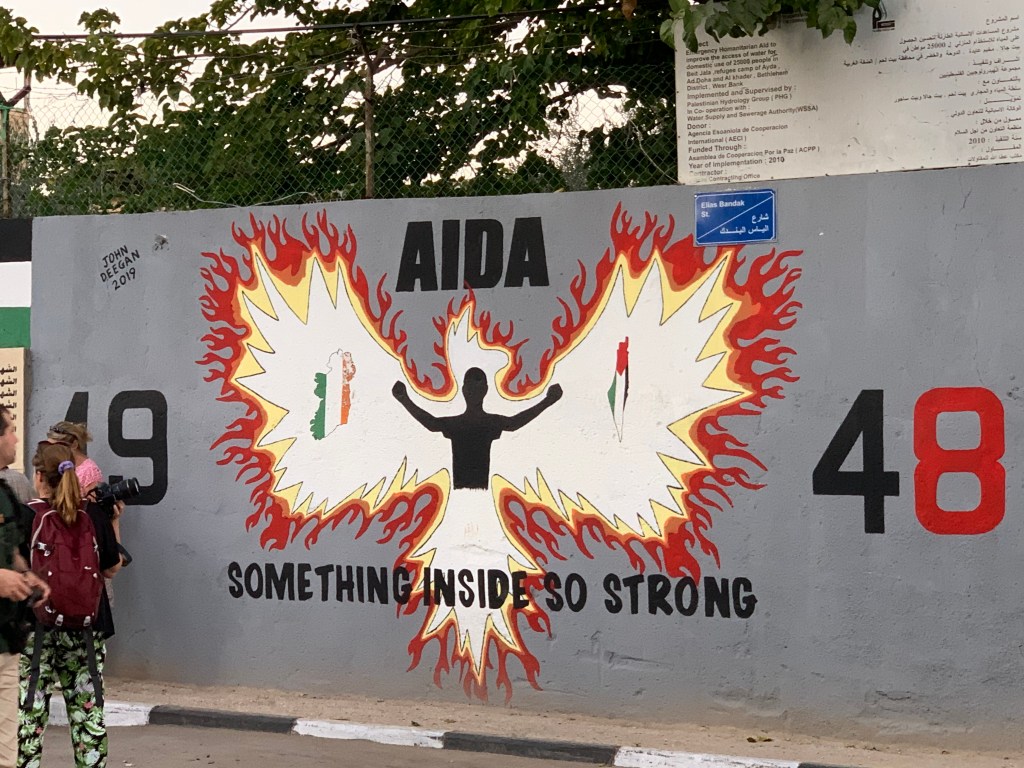
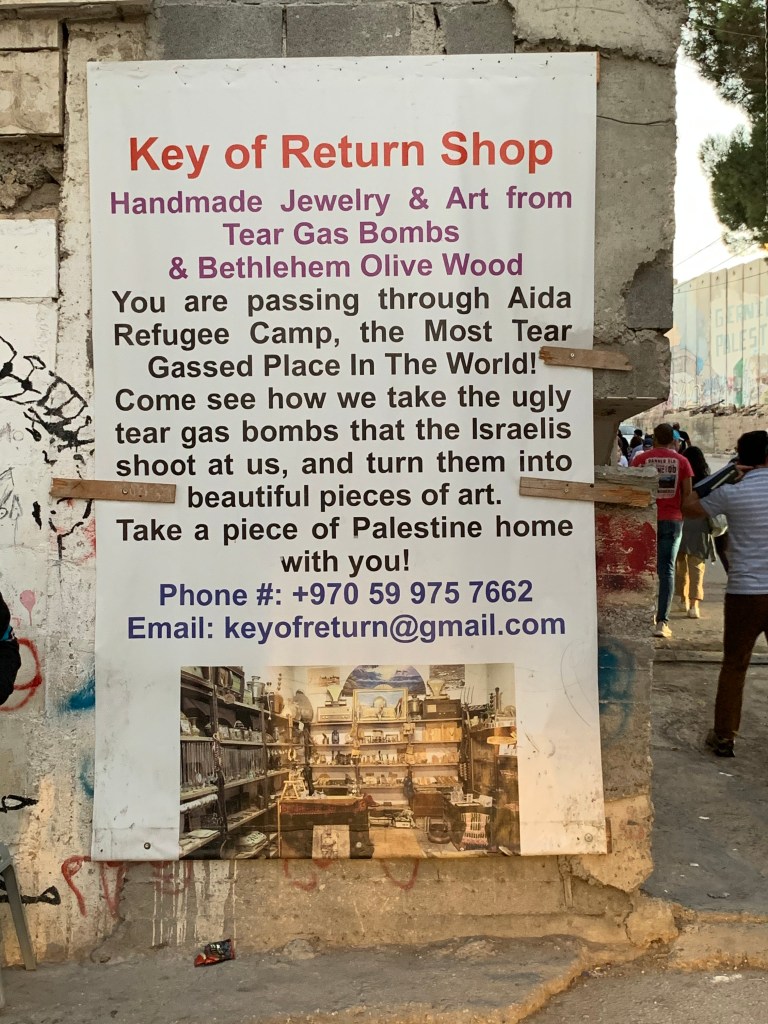
I had questions for him but couldn’t open my mouth to speak because of what I was afraid I would say. As we walked out of the community center into the streets of the camp, I was shaking my head in disbelief. I saw the images below and felt hopeless. In the village I felt sadness and empathy. Here it was pure hopelessness and despair. He told us how Israeli soldiers test new rifles on Palestinian children in the camps. It was surreal. I could barely talk as the bus brought us back to the hotel.


A big part of Encounter is the dialogue you have with other participants. While I had concerns about this part of the trip going into it (really my biggest concerns, far more than safety and security), I was really looking forward to my small group to help me process. I wrote my first post after checking into my room and then went downstairs to my small group.

Almost everybody on this trip I met today. My small group was no different. As we talked and began to share our anger, sadness, disappointment, frustration, hope and hopelessness, it was cathartic. We talked about a group of children we saw in the refugee camp. They were adorable children – smiling, laughing and waving at us. I wondered if at 5 or 8 years old their minds have already been poisoned against peace and if we have lost another generation. I wondered what they will be like in 5 or 10 years and if they will have hope for a better future or be filled with anger, resentment and hate. It felt good to share my experience with the group and as we wrapped up and prepared to head for dinner, I finally was in a place that I could think clearly and deeply about my experience.

Part 2: So many questions …Nov 4, 2019

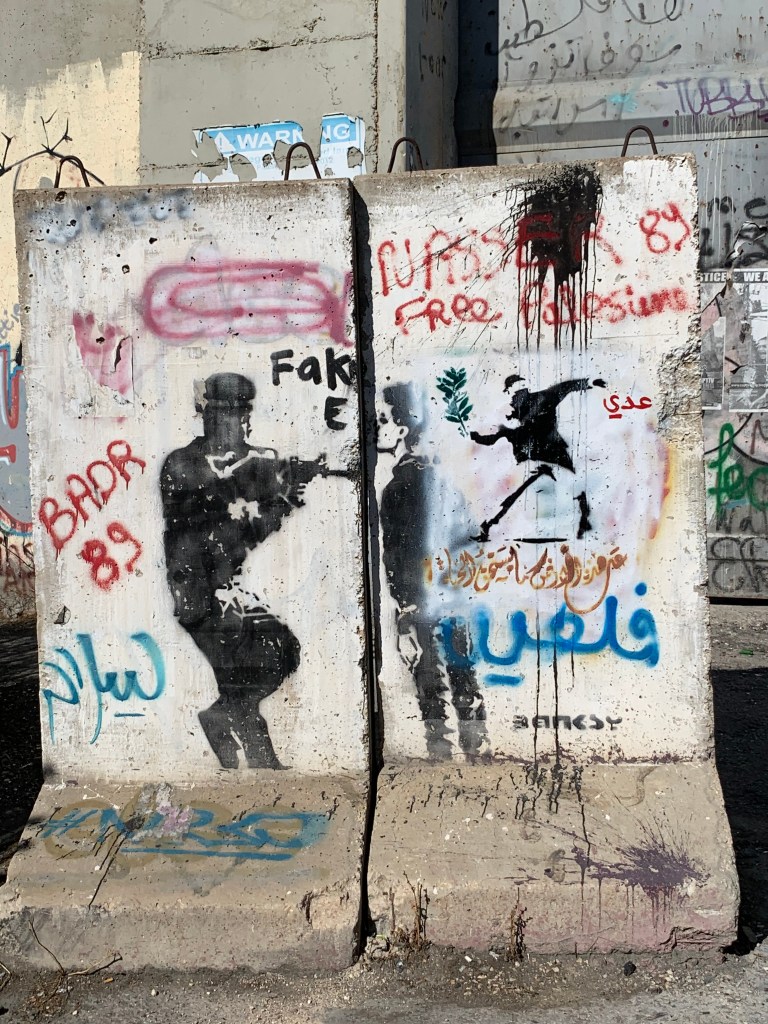
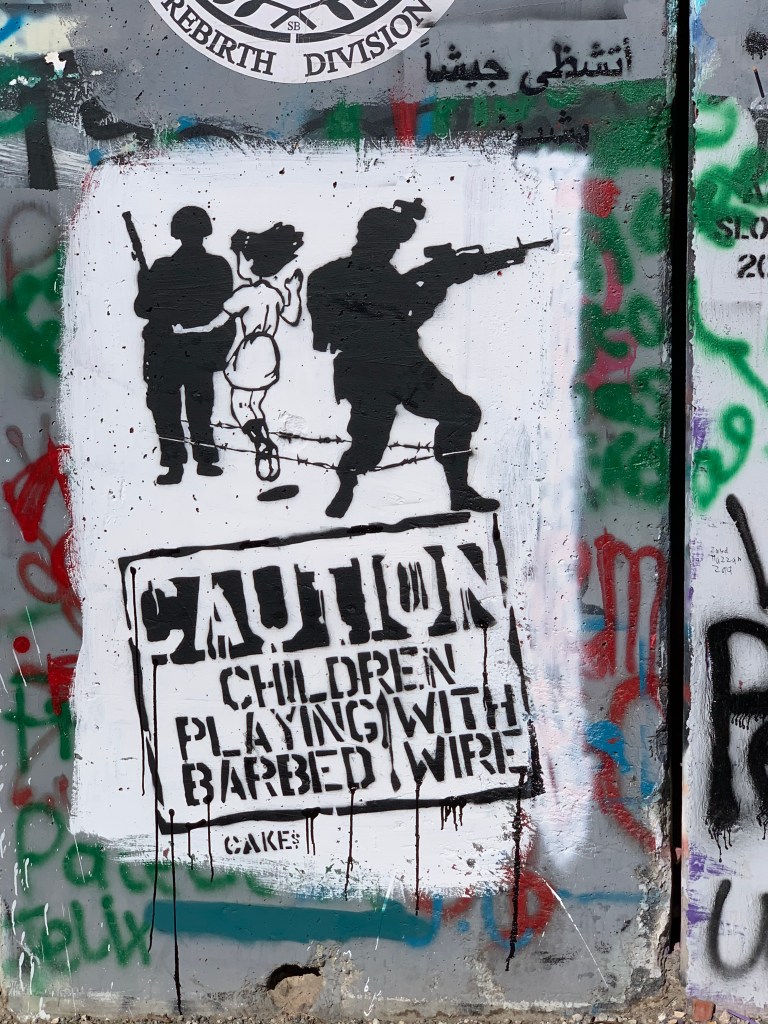
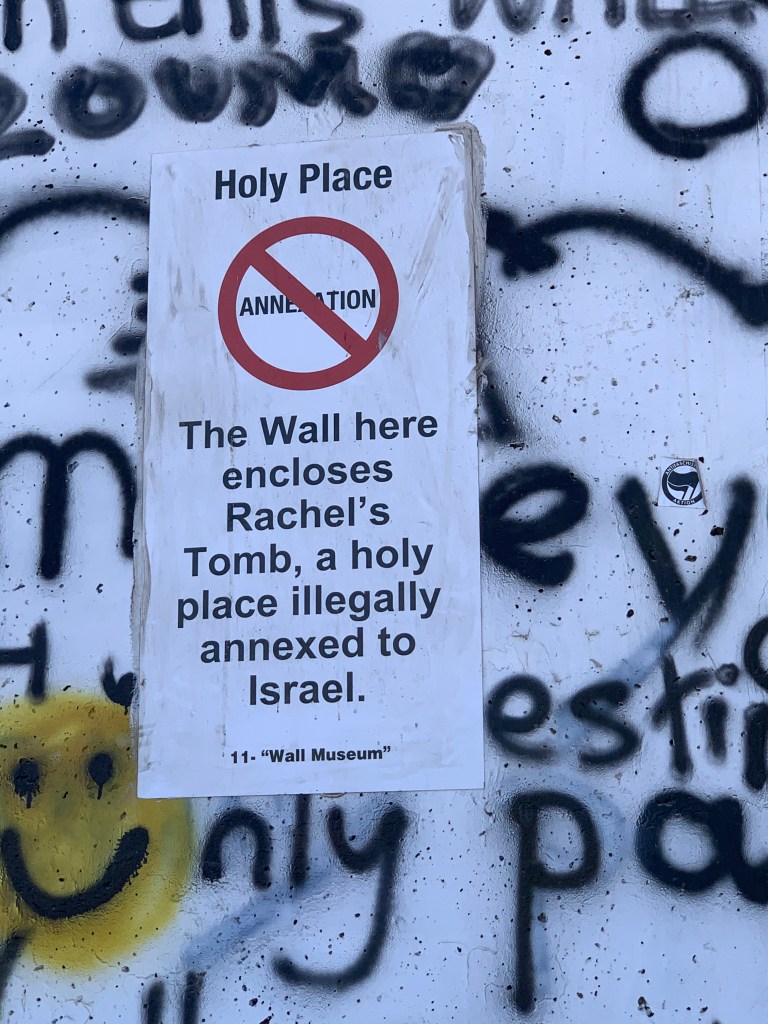
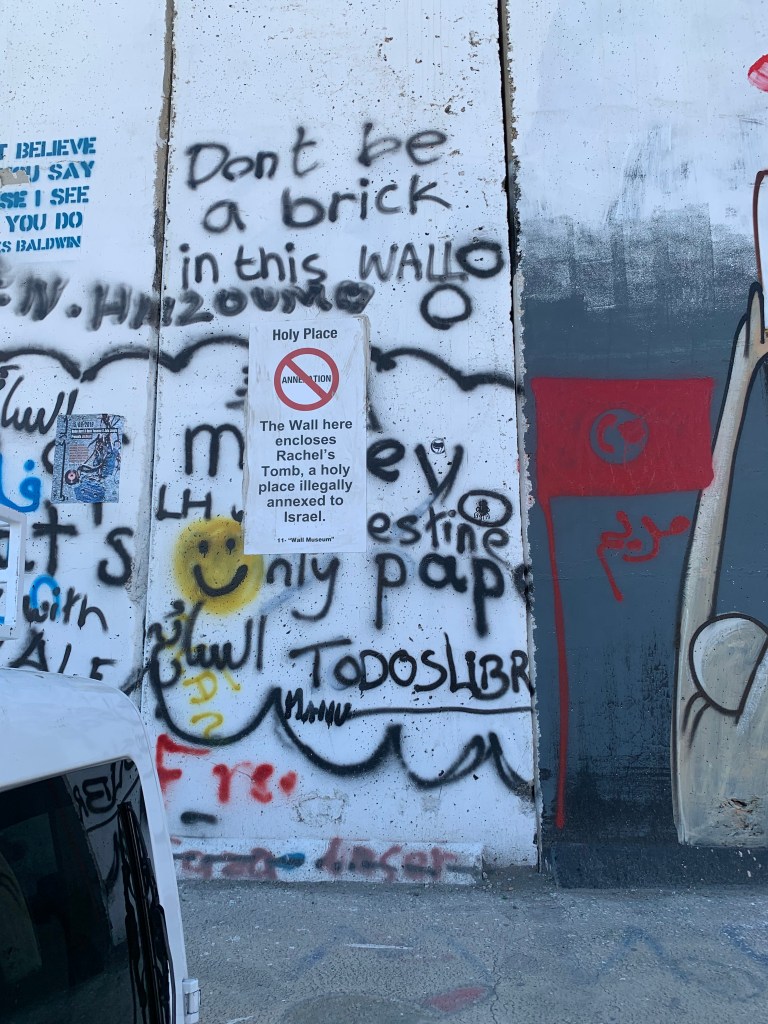
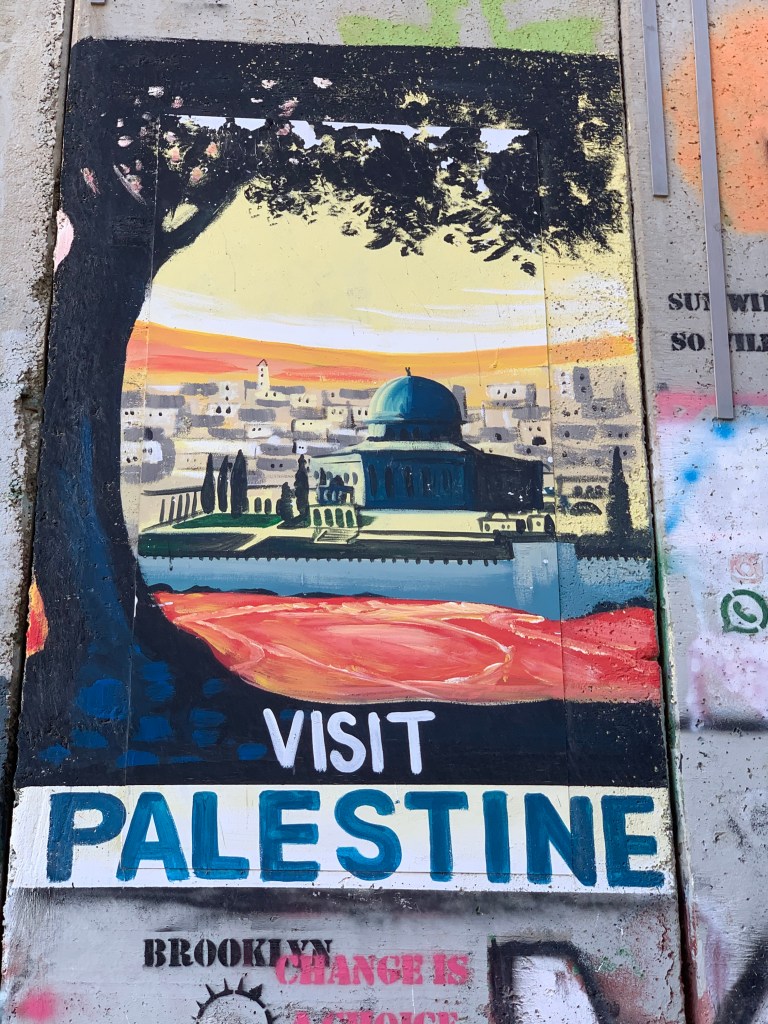
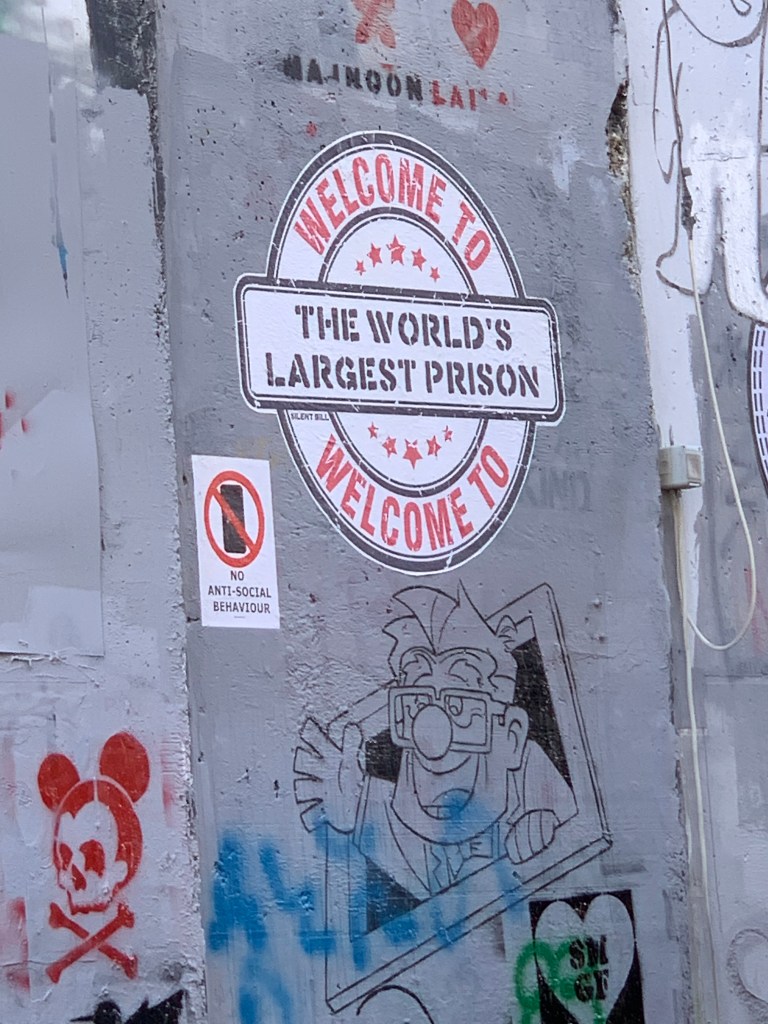
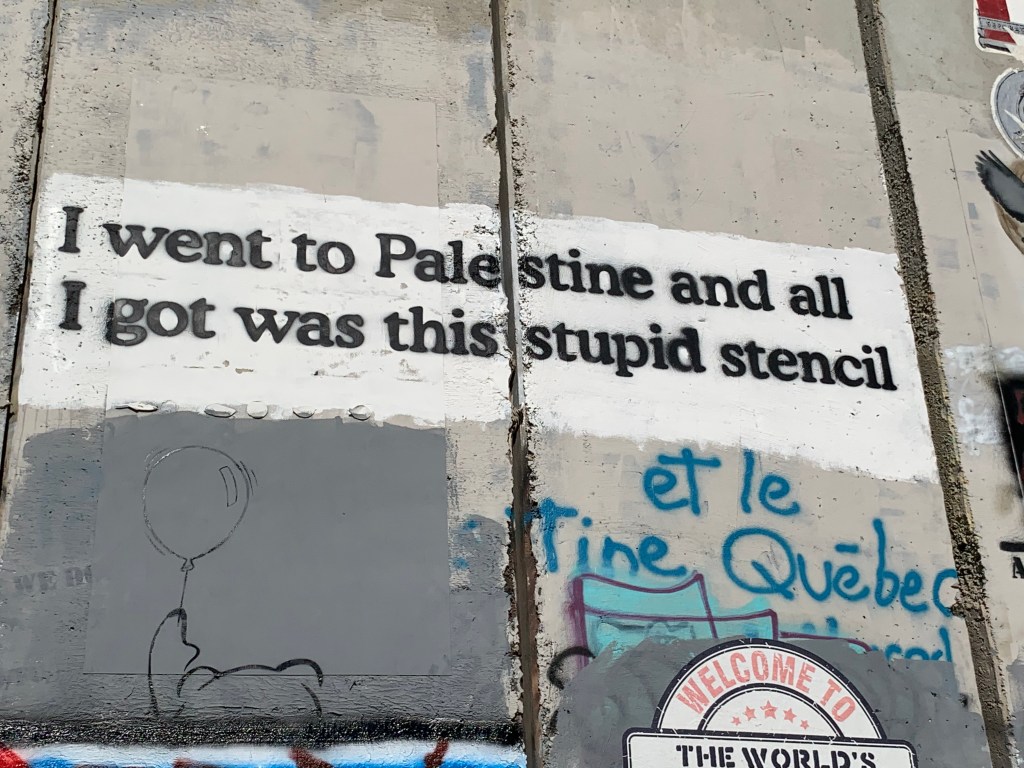
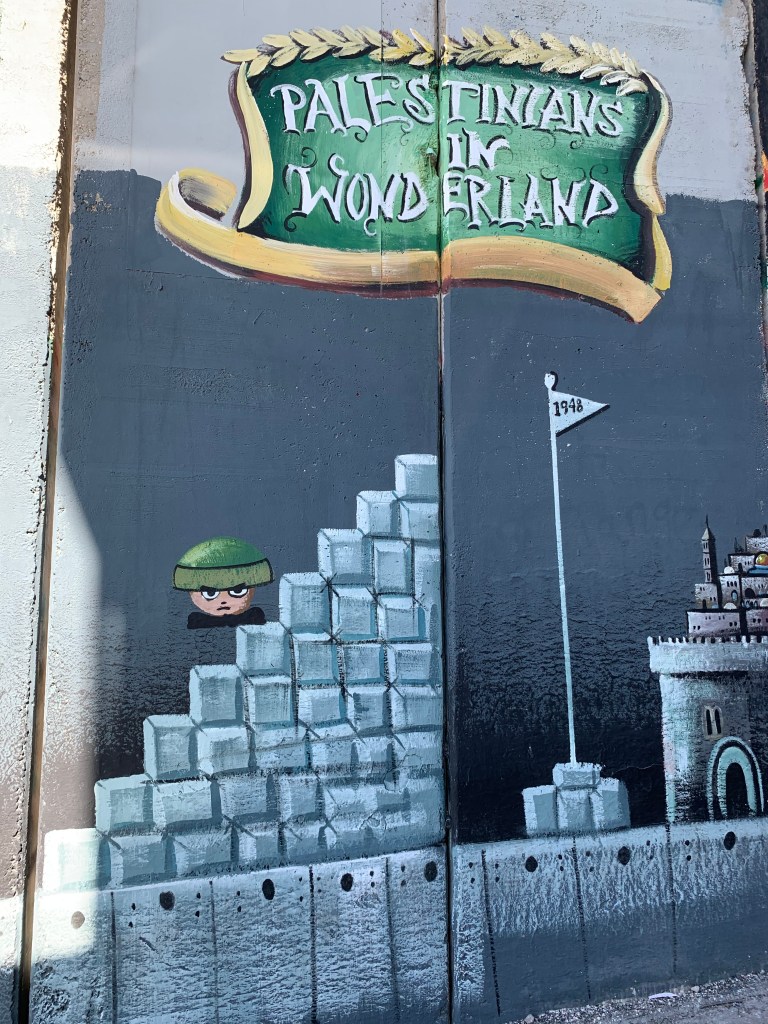
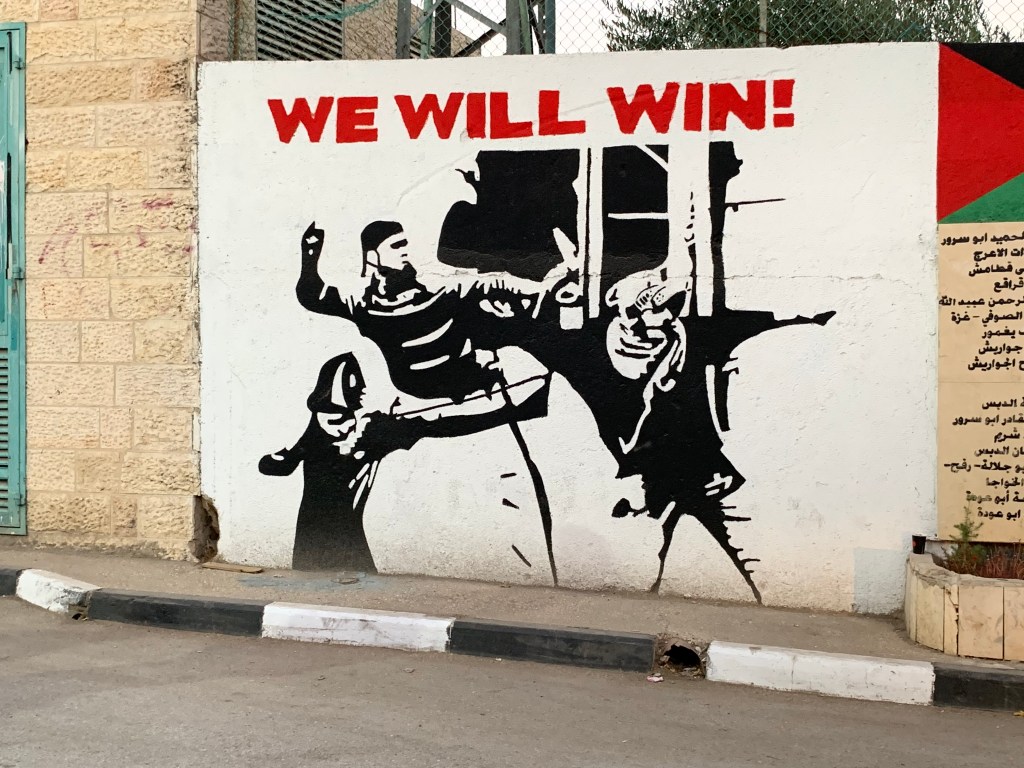
Having 4 hours to process the day has really helped. What a day it has been. After our session on the different zones, we began walking around Bethlehem, specifically looking at the international graffiti that has been painted on the Security Fence/Wall, Separation Fence/Wall (whatever you want to call it – everybody has a different name for it). I am posting some pictures I took – BEWARE THAT THEY MAY UPSET YOU!

After walking through this graffiti on the wall/fence, we got on our bus to go to a Palestinian village in the Gush Etzion area. There are a number of Jewish neighborhoods/settlements (I call them neighborhoods because of the size and scope of them, others call them settlements) and it has been widely accepted that if/when there is peace, this will become part of Israel with a land swap. The village we went to was in area C. This means that no construction can occur without permission from the Israeli government. This permission is rarely ever given. So, what does this mean in practicality. It means that they can’t fix their roofs when they leak. It means they can’t build new homes or expand their homes when needed. They can’t repair or replace their broken playground equipment. If they do, they get a ‘stop work’ order and ultimately a demolition order. It’s sort of like building in the US without a building permit. Only the permits are rarely issued. It’s a challenge and a problem.

As I watched the children playing, I had a smile on my face. They were just like the children at my JCC. Young, smiling, fun, cute. Only their playground equipment wasn’t safe and I wouldn’t let any of our children go near it. Yet it was all they had.

As we spoke with the head of the village council, he told us he and their village just want to live with dignity. They don’t care if they end up in a Palestinian State or as part of Israel. He looked at the new construction that happened on two sides of him in the Jewish neighborhoods with sadness as he knew his village wasn’t allowed to do that.

Seeing this village today was challenging and difficult. My heart broke for the people there who have severe limitations put on them due to the conflict. These are mainly people who work agriculturally and who aren’t interested in anything beyond their small village. When asked about ideas to solve the conflict, to bring peace, to allow his village to grown, their village council head said, “I’m just a simple man”

Many of you may understand why Israel has to put limitations on building in Area C or agree with this policy. I can only tell you that after visiting this village and listening to this village leader, I was left with a lot of questions and no answers.

Day 1 of my Israel Encounter – November 4, 2019

Many of you know that I am in Israel right now. I came to participate in a program called Encounter. Encounter takes Jewish leaders into the Palestinian Territories (the West Bank) for an immersive, intensive, 4-day program. My intention was to post about the day however we are not even finished with the first day and there is too much to post about just once a day. So, if you want to follow what I am experiencing, it will have to be in multiple blog posts. I can’t adequately describe this experience without taking time and space.

After our morning overview today, we left to meet with a leader of the civil society here (I am intentionally leaving names out). We got to experience our first checkpoint and it was closed – resulting in a 15-20-minute delay to our day. He spent the entire day with us giving us lots of insight and at times, some hope. As he described the difference between areas A, B, and C, I learned a great deal.

Area A is the major city centers where the Palestinian Authority (PA – their government) is in charge of both Security and Social Services. This is about 18% of the West Bank.

Area B is approximately 22% of the West Bank and the PA controls the Social Services while the Israeli government controls security.

Area C, the largest area covering 60% of the West Bank is under the control of the Israeli government. Of the estimated 2.5 million Palestinians who live in the West Bank, only 150,000 live in Area C.

Area A is doing well economically and many people are able to work in Israel. Due to the increased security, Israel has been able to lower the age and requirements to enter Israel. As we discussed some of the challenges, I felt some hope that there could be peace.

I’m going to take each part separately as there is a lot to unpack. Later, I will talk about the next two stops and how my hope was dampened and then questioned greatly.