We gathered together for the final time as a group to begin the processing of the entire experience. I learned so much from the others on the trip as well as those we heard from and what I saw throughout the West Bank. One of the things I said in that final gathering was how I knew I needed more time to process and unpack the entire experience. There is much that I have been thinking about that I haven’t written. As I figure stuff out, I’ll write about it.
Four days ago, I met these 35 or so people for the first time (well I did know two of them before and had met one a few years ago). We were strangers in a strange land. After 4 days I feel like I have new friends. We joked how the trip started weeks ago.
Intensive immersive experience is a commonly used term. I’ve used it many times. This was by far the most intensive immersive experience I have ever had. My head is still spinning with all I have seen and experienced. The beliefs I held at the start of the trip, the beliefs that were challenged, the contradictions not only from speaker to speaker but also within the session of a speaker.
As I sit at Ben Gurion airport waiting for my 5:20 am flight (it sounded bad when I booked it and it’s even worse now in actuality), the only thing I am certain of is that this is a very complicated situation and there are no easy answers. Israel has an existential security threat they must address. The Palestinians are suffering and struggling. I’m not into blame and don’t want to go there. I do believe the current situation is untenable and something must change but what, how, who starts, how long it takes, I have no idea.
In the end, just as the Encounter staff told us at the beginning, it’s not my job to solve the conflict. That’s for the Israelis and the Palestinians. I’m not even a citizen so I don’t vote there and have no say in the government. I do believe it’s my job to facilitate conversations. To help people in both my local community as well as in my sphere of influence gain a better understanding of the complexities and challenges that exist. So, as we discussed what our ‘intentionality’ was after the trip, I said mine was to bring this to my community and sphere of influence to do just that.
Now I’m really looking forward to plane taking off so I can go to sleep. The flight home will give me time to rest and maybe begin the processing. Or I may just watch a movie to numb my mind.
Our final speaker of the day and of the trip came with some pre-advertising. One of our facilitators had met him before and heard him before and raved about him. They had become friends.
Osama began his talk by asking for a moment of silence for all the souls lost as a result of the violence.
After our moment of silence, he began by stating that there are two different narratives and both are true. In addition, neither side wants to accept the other’s. It was an interesting beginning as he was the first speaker we had who began by acknowledging Israel’s right to exist and historic ties to the land. He didn’t criticize Israel.
He told some of his family history. They left in 1967 for Jordan and couldn’t get back. His grandfather was passionate about Jerusalem and found a way to Jericho and then Jerusalem. The rest of the family stayed in Jordan.
His earliest memories were being taught ‘fear the black hat Jews’. In 1989 at age 12 he was harassed by soldiers for the first time and when he asked his mom she told him “We don’t call them solders. We call them “Yehud”. Yehud was meant as a racial slur. His hatred was stoked by his family and in 1990 when Saddam Hussain was bombing Tel Aviv, he and his friends would go to the roof of their building to celebrate. He thought that Tel Aviv was an army base, filled with soldiers, not where families lived. As he grew up, everything bad that happened was blamed on the “Yehud”.
His fear of the “Yehud” turned to hate when he was arrested for hanging a Palestinian Flag on a post and he was given a 6-month jail sentence. He ended up serving 9 months. HIs time in jail was where he learned all bad things about the Jews. He said jail is where they “learn the lies to breed hate of Jews.” At one point he was put in solitary confinement. Sitting in the dark, he had reached his lowest point of despair when he began hearing somebody singing a song. He couldn’t make out the words and didn’t know the tune but hearing that singing pulled him out of his darkest place.
Soon after he was released from jail, his best friend was killed by the army. Osama decided to join the Palestinian Police to fight and hurt the ‘Yehud’. He was given orders to protect the Alysha settlement where another of his friends was killed in the skirmish and he left. He left the Palestinian Police because he wanted to ‘do something big to get revenge.’
Doing something big meant he got very involved with the 2nd intifada. In his own words, during those 6 years he lost everything. He lost his “heart and soul and was filled with hate.” One day he needed a ride back to Jericho and asked a friend if he would take him. His friend said yes but he had to stop in Beit Jolla to talk to friends about peace and eat and then he could go home. When he walked into the room with his friend, he saw people with Yarmulkes on. He was confused and said to his friend, “they look like Jews.” His friend told him they are all Jews and they want to talk about peace. Osama couldn’t believe his friend and walked out of the room. While outside the room he began talking to one of the Jews who explained that they wanted peace and weren’t ok with Jews or Palestinians being killed. It was the first time that Osama thought there could be a good Jewish person. He thought perhaps there could be more than just the one. He gave her a hug and walked back into the meeting of Combatants for Peace with his friend, Ahmed, who we had met the day before!
Osama continued going to Combatants for Peace meetings and began to make some Jewish friends. In his own words, he ‘got to see the beauty of Judaism and that the army isn’t Judaism.’
He doesn’t reject his Palestinian narrative but understands there are other narratives and that all can be true. His work with Combatants for Peace, where former fighters from Palestine and Israel, has taught him that both people have a right to the land. He chooses not to look at States but at people. He does believe that the occupation needs to end.
He was asked the same question as his friend Ahmed about naming streets for terrorists. He was passionate that there should not be any streets, plazas or building named for terrorists. He pointed out that Israel has a few of these which I didn’t know. I’ll have to do further research on this to verify what he said and learn more, however there were others in the room who knew exactly what he was talking about.
When asked if there were Israeli citizens, he said yes. He went a step further and said that even soldiers shouldn’t be a target and that nobody deserves to die. He said he understands the soldier’s fear of Palestinians and that “I don’t think blood is justified. Killing people is not the answer.’
When asked about BDS, he said that BDS is done by the elite and wealthy who can have what they want. It’s not for him on the ground dealing with his life challenges. It doesn’t help him in what he wants to achieve. He said that boycotting products is an acceptable form of nonviolence but boycotting people is not ok. When I asked him about boycotting academics, artists and musicians, his reply was that ‘they are people’.
Osama finished his talk by telling us about the first Shabbat dinner he attended with his Jewish friends. They poured the Kiddush wine and gathered around the table where they sang Shalom Aleichem. He began to cry openly. This was the song that he heard in jail that touched him at his darkest time. He was proud to tell us that he now knows it by heart.
As we wrapped up with announcements, one of the staff told him he could go while they prayed Mincha (the afternoon service). He laughed and asked, “What? I can’t stay for Mincha?” He took a yarmulke out of his pocket, put it on and stayed for the service.
I was profoundly moved by Osama. He wasn’t afraid to admit that he was raised with hate and that he acted on that hate. He also wasn’t afraid to admit he was vulnerable and found a way to let go of that hate and find love. He joked with us that if he took a DNA test, he’d probably find out he was part Jewish. He keeps a yarmulke in his pocket in case he is asked to a Shabbat dinner or to join his Jewish friends for a meal.
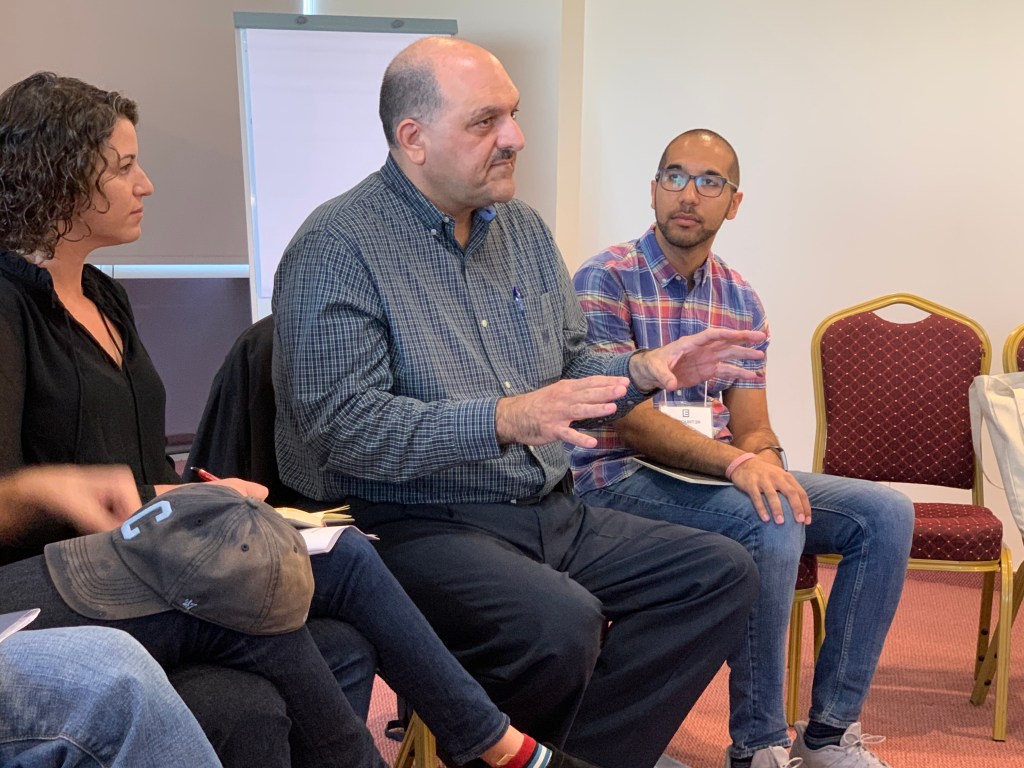
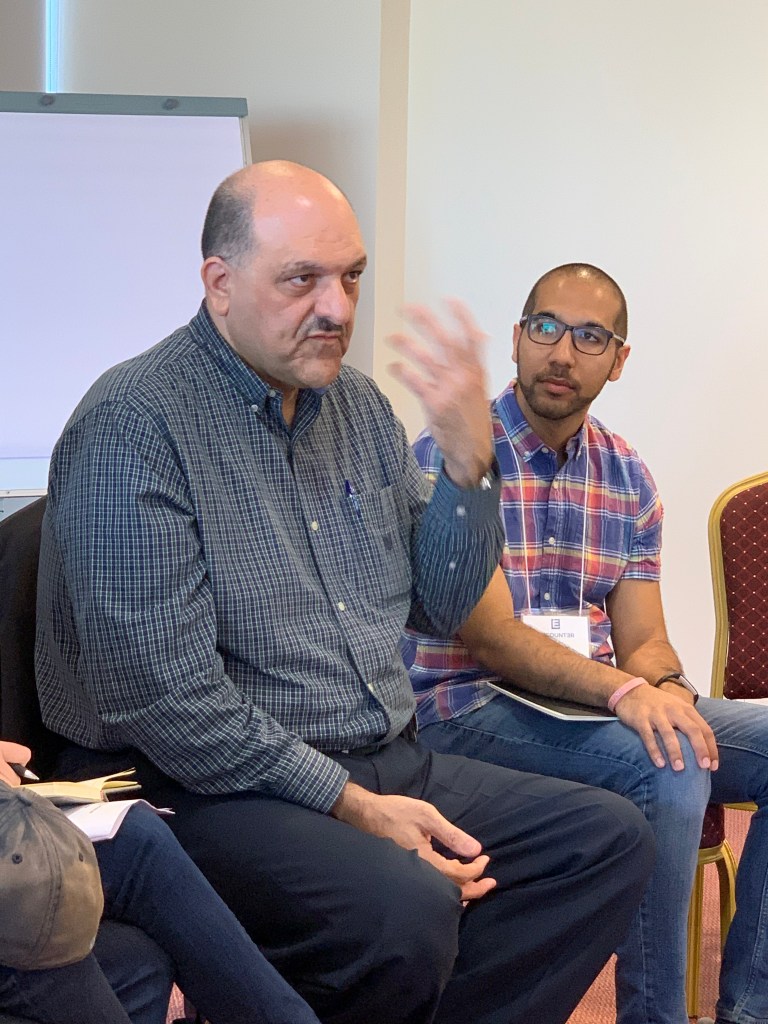
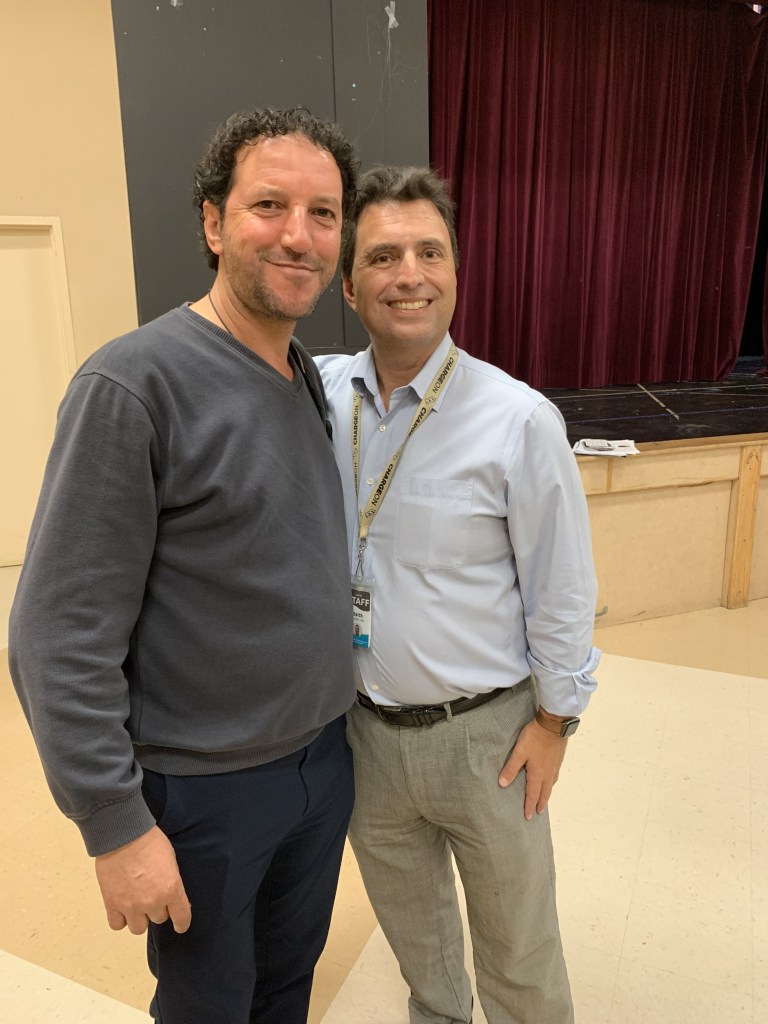
Osama left me with hope. If somebody raised in uneducated hatred and had that validated around him for 2 decades can learn he was wrong and find a way beyond hate and into respect and dare I say love, then perhaps anybody can. Here is a picture of me with Osama – we exchanged contact information and I look forward to building a friendship with him.
Our second speaker was an advisor to the Negotiation Affairs Department. I was immediately concerned when in her opening remarks she dropped the following line, “We will be driving on the new apartheid road”. No explanation. Just dropping a word bomb on us and moving on.
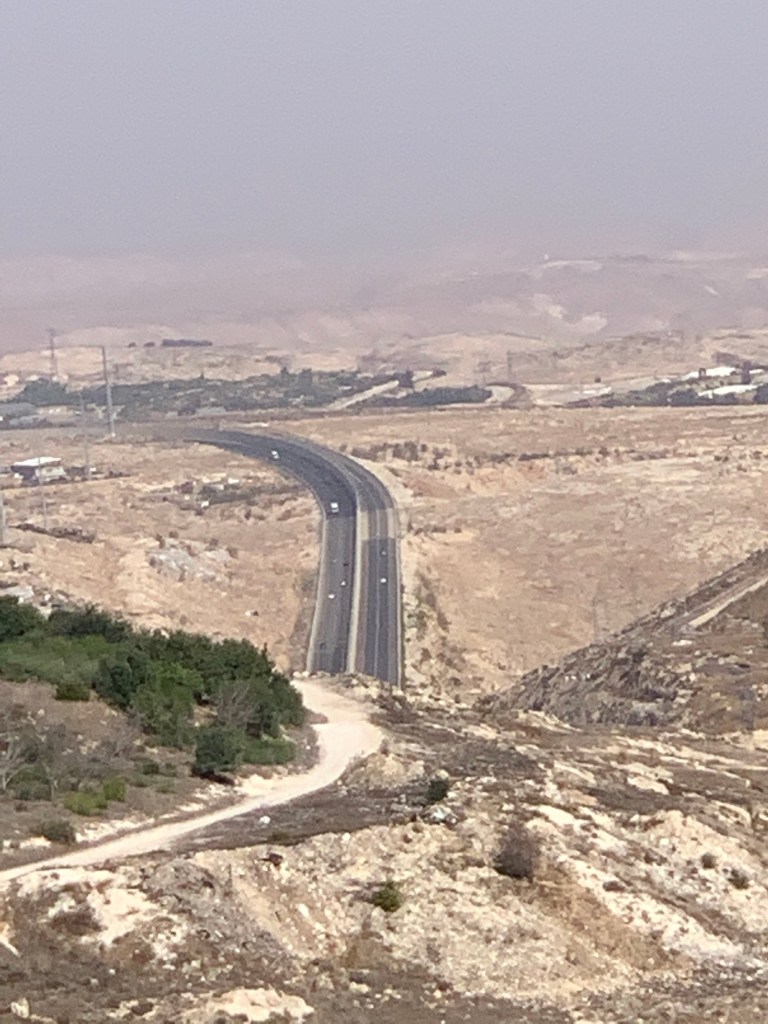
So as she talked, I began to research the ‘Apartheid Road’. Route 4370 was built to connect Geva Binyamin to Route 1 (the Jerusalem-Tel Aviv highway). It was designed to serve Pisgat Ze’ev and French Hill and will also serve Arabs and those in the Shoafat Refugee camp.
So, what makes it ‘the apartheid road?’ It is because there are two roads, separated by a wall. One road is for Israeli cars and takes you into Jerusalem. The road for Palestinian cars takes you around Jerusalem since they can’t enter without a permit and can only use certain checkpoints. While visually it is terrible, there is a logic behind it. This is another one of those things that doesn’t feel quite right but I need more time to process it.
She talked about how the settlements are being built and creating transportation problems for Palestinians. The settlers are getting new roads and easier access while the Palestinian villages and towns are not. She also made the claim that the new roads, checkpoints and tunnels are being built with a strategic intention to hide Palestinian cities. There was a documentary made about this that highlights how Israelis know how where and how to get to the settlements in the area but no the Palestinian towns that are right next to the settlements. I didn’t agree with her on this point as it felt too much like a conspiracy theory.
Citing a very common theme throughout the trip, she talked about building permits in Area C. She said that since 1993, only 1% of home building permits by Palestinians have been approved. As a result, they build without permits and then face demolition when found out.
She also told us that her status is Jordanian Resident of East Jerusalem. She is not a citizen, which again is a common theme. As such, if she works/lives abroad for 5-7 years, she loses her status.
One of the more powerful things she said was that she believes settlers are complicit in a war crime. As a result, she refuses to talk to any settler. Other Jews/Israelis she holds accountable but will talk to them. That’s why she would address us as a group.
One of the participants asked her if the new Palestinian state she imagines would be ‘Jew free’. She looked like a deer in headlights at this question, understanding the power of saying it would be Jew free (Juden Frei as the Germans called it). She danced around the question without giving an answer before moving on. She wouldn’t say that Jews would be welcome to live in the new state of Palestine.
Listening to her had me struggling to see a future where Palestinian leadership and intellectually elite would respect Israel’s existence. While she wants to be a citizen of Palestine and live in East Jerusalem in the State of Palestine, she also wants to retire in Jaffa. This didn’t wash with me.
She was the scariest of all the speakers so far for me. She is smart, well spoken, and media savvy. Words have power and she uses hers very carefully with targeted effect. It was the ‘Annexation Wall’ and the “Apartheid Road’. It was also scary to listen to those in our group who appeared to buy into her propaganda.
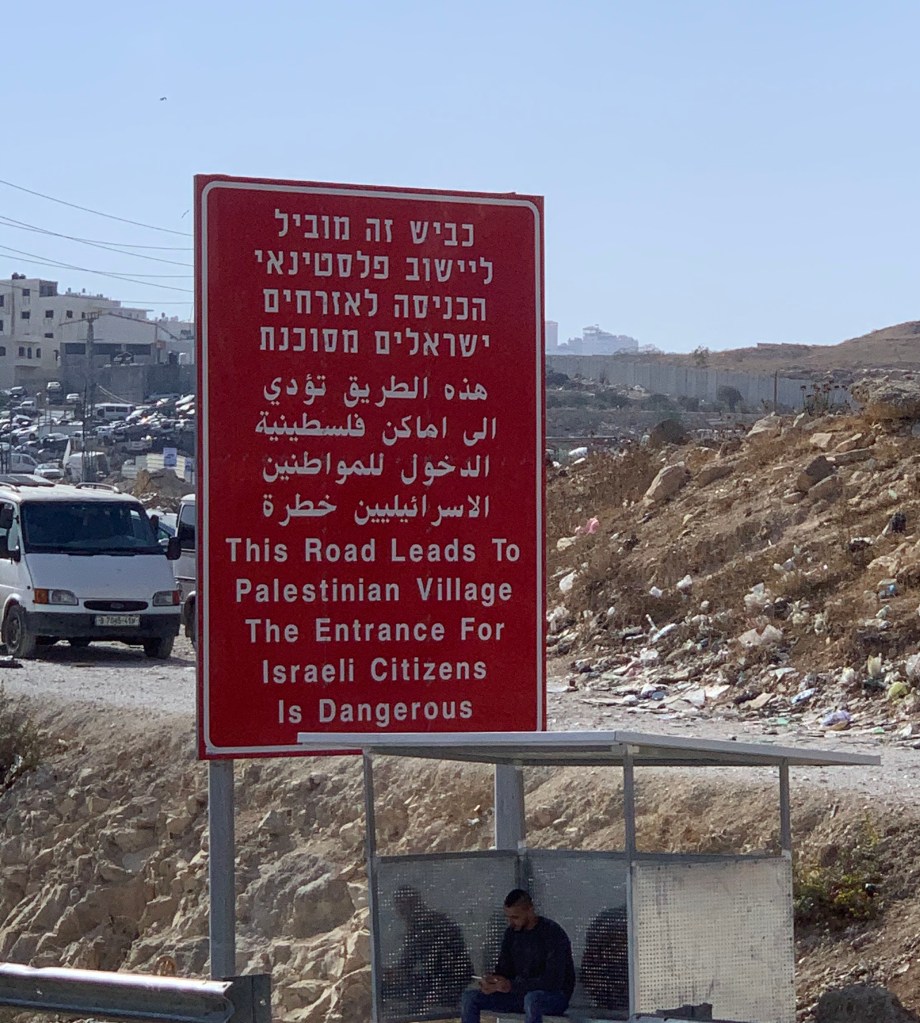
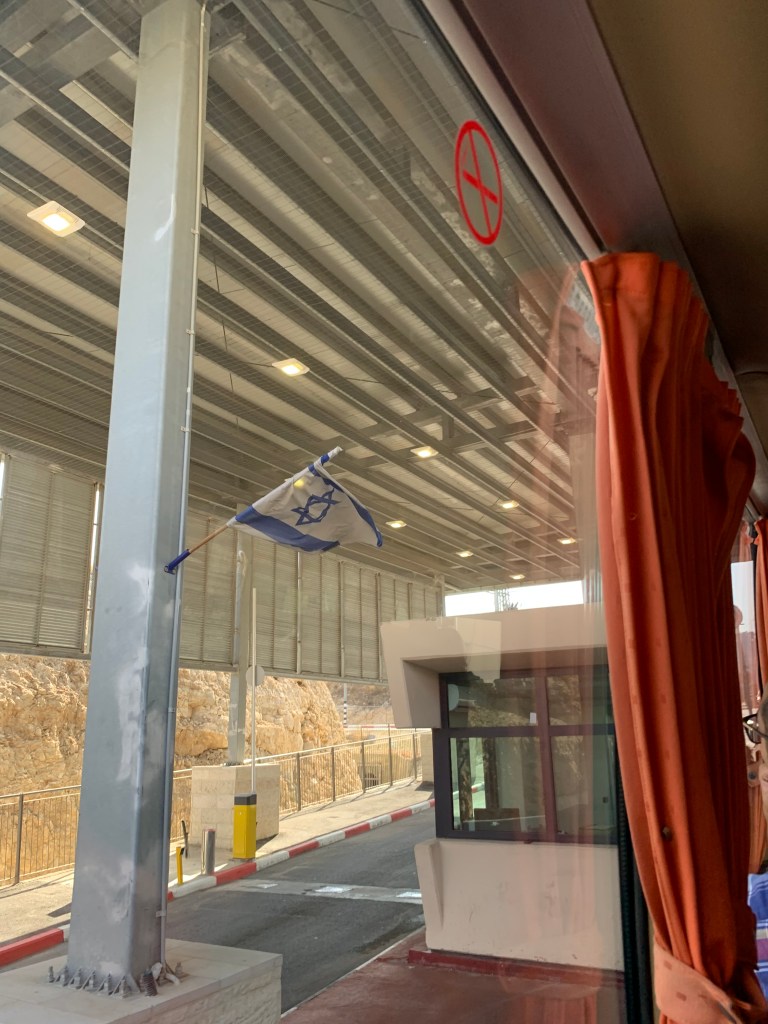
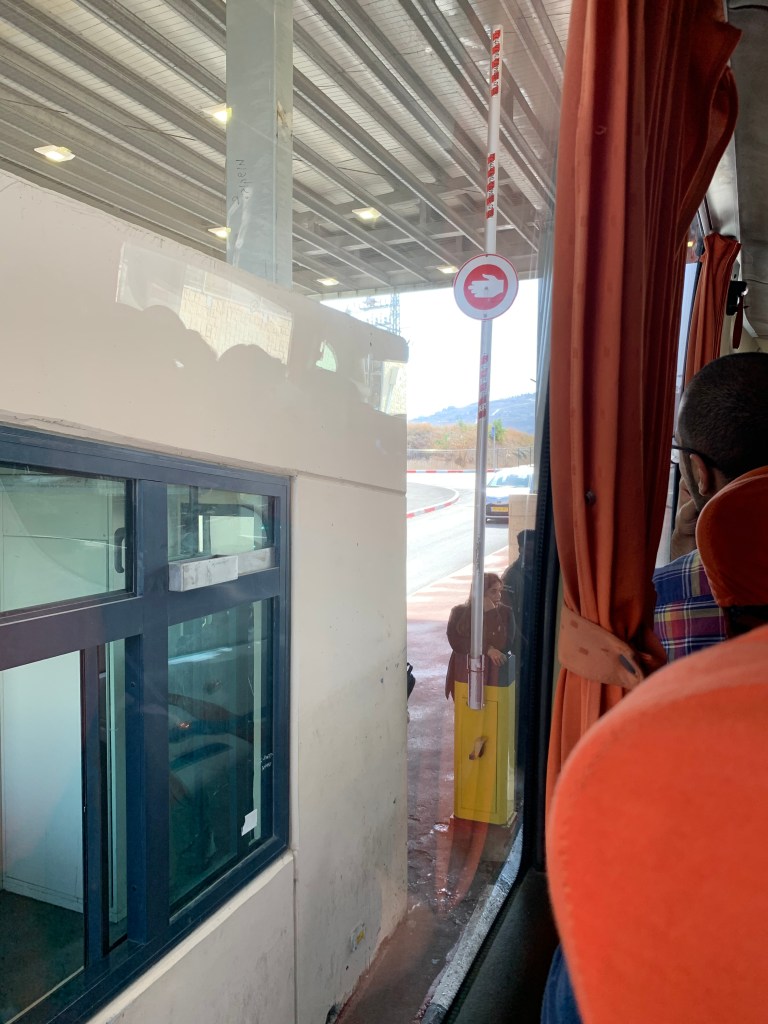
The pictures below are of ‘The Apartheid Road’ (2 lanes each way, not a 4-lane divided highway) and a sign on one road we passed that takes you into a Palestinian area that has been determined to not be safe for Israelis/Jews.
It’s hard to believe that this is the last day of this experience. It’s been a very challenging and rewarding one that will take much unpacking and processing.
Today’s first presenter was Sam Bahour. Born in Youngstown, Ohio to a Palestinian father and a Lebanese mother, Sam grew up with a close connection to his father’s Palestinian neighborhood and felt a stronger connection there than in Youngstown. In 1995 we emigrated to the Palestinian Territories and received a tourist visa, meaning every 3 months he had to leave and return. This continued for 15 years until he was given residency.
The Oslo agreement as a keynote moment for him. After reading it multiple times, he thought it was a disaster. The agreement had two parts. The first was about values and was pretty standard. The second was 4 dozen or so annexes. The reason the annexes were needed was that in the agreement, it addressed many sectors but not one of them was fully transferred to the Palestinian Authority. All were partial transfers. Since his wife wanted to move to Palestine, she urged him to re-read the agreement to make sure. He did and found a line in Annex 36 that resonated. It stated that there would be “separate and independent telecommunication networks.” This gave Sam what he needed to feel comfortable moving to Palestine. He got involved with the creation of the largest telecom company in the region which currently is worth over 1 billion dollars. In his word, they are still not separate and independent however.
Sam got an MBA at Tel Aviv University which meant that he got to meet Israeli’s who were not active soldiers and in uniform. He told us this gave him a unique Palestinian view of Israelis as to most of them, Israeli means Soldier.
Sam has found and still believes that business transcends the conflict. During the first intifada he was working on a big mall project. They needed to get a Point of Sale (POS) system so he did his research. The best system was made by a company in Herzaliya. He had to go to his Arab partners and tell them they could send him to America where he would spend more money for a lesser system or they could send him 45 minutes away to Herzaliya to get the best system at a lower price. After much discussion, the board decided to get the Israeli system.
Sam talked about his concerns. First, he sees a loss of hope. Now a consultant, he sees companies he works with looking to move outside of the West Bank because of what’s going on. He said business moved out of Gaza years ago because there is no hope and he sees that process starting in the West Bank.
He also said that he believes the current Israeli plan is the push the educated out. He used his own daughters as examples. One is an MIT graduate who got some experience and is heading back for her MBA. The other is currently enrolled at Harvard and looking to follow her sister’s plan. With this type of education, there will be no jobs for them in the West Bank, which will only leave the uneducated with no hope there. This wasn’t the first time I heard about this conspiracy theory and while it makes sense for their narrative, I question it. Something doesn’t sound right and it sounds like with economic progress, this is a new phenomenon for a larger number of families.
Based on what he said so far, Sam highlighted three trends he saw. 1. They turn violent. He believes that this is what the Netanyahu government wants because it’s what they mastered. 2. Leave. He expects that somebody in Tel Aviv is looking at his file and asking “Why is he still here? What do we have to do to get him to leave?” He said that the strangulation of the economy accomplishes this. 3. Take your ID and get a permit to go through the checkpoint. Leave your hope at 3:30 am to get to work at 8 am. Work 10 hours and head home. Kiss your sleeping children and repeat the next day. Work as a day laborer.
He wants to create a 4th option by building a vibrant economy in Palestine. It is his believe that this is essential for the Palestinian people and the future in the region and Israel is not allowing it.
He was asked what the ‘end of the occupation’ means to him. He said the following: 1. Israel needs to acknowledge there is an occupation. it’s not ‘occupied territory’ or ‘disputed territory’. According to Sam, occupation is defined as temporary and 52 years later it’s not temporary. 2. Palestine should be established with 3 borders set and 1 to be negotiated. This is what Israel currently is and he wants them treated the same way.
According to Sam there is a call for new elections happening. Due to the ‘occupation’, Israel will have to approve the elections and the concern is that the Israeli government will not allow them. This will change the narrative and make their lack of elections due to Israel.
The most concerning thing that Sam said was what he closed with. He said that it won’t remain nonviolent forever. In addition, he said that either Israel is occupying them or there is one state with 2 different rules for its citizens. So, if Israel isn’t an occupier then Israel is an Apartheid state. He said there is already a call to drop Statehood and declare Israel Apartheid. There are those who think this is the best way to force a 1 state solution which will end up not being a Jewish state.
Sam was fascinating to listen to and raised great caution for me. He is an extremely successful businessman and has traveled the world. He has a worldwide audience already and will be a power to be reckoned with. He already speaks on college campuses and should they choose to renounce statehood and attempt to get Israel classified as an Apartheid state to force a 1 state solution, the Jewish state is at risk.
The time with Sam and what he said is something I need to reflect much more on. Unlike many of the other speakers during the first three days, his was filled with nuance and key use of language. There are a lot of things that are rubbing me wrong but I can’t put my fingers on them just yet. You can find him online – he has a blog and has written some powerful pieces including a sarcastic open letter to Jared Kushner and a serious letter to Mahmoud Abbas (Abu Mazen) with 8 points in it. It’s important to read what he says to understand his brilliance and the potential risk.
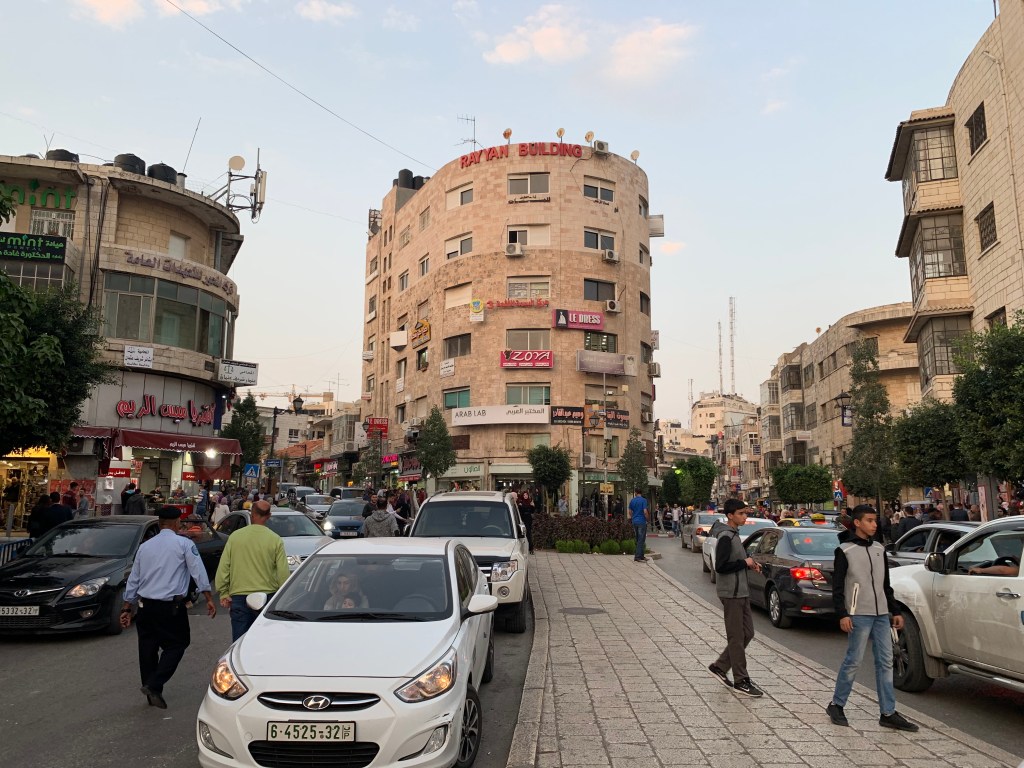
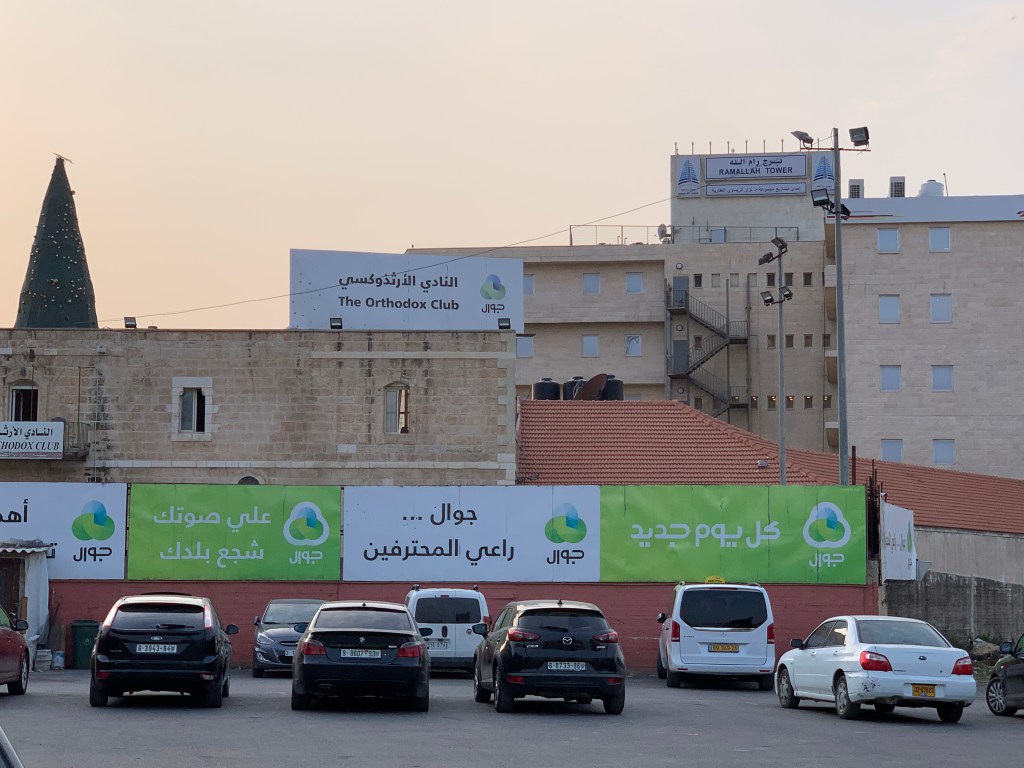
After checking in to our hotel in Ramallah (which is really, really nice – a 5-star place which I didn’t expect here), we met for a walk about the city.
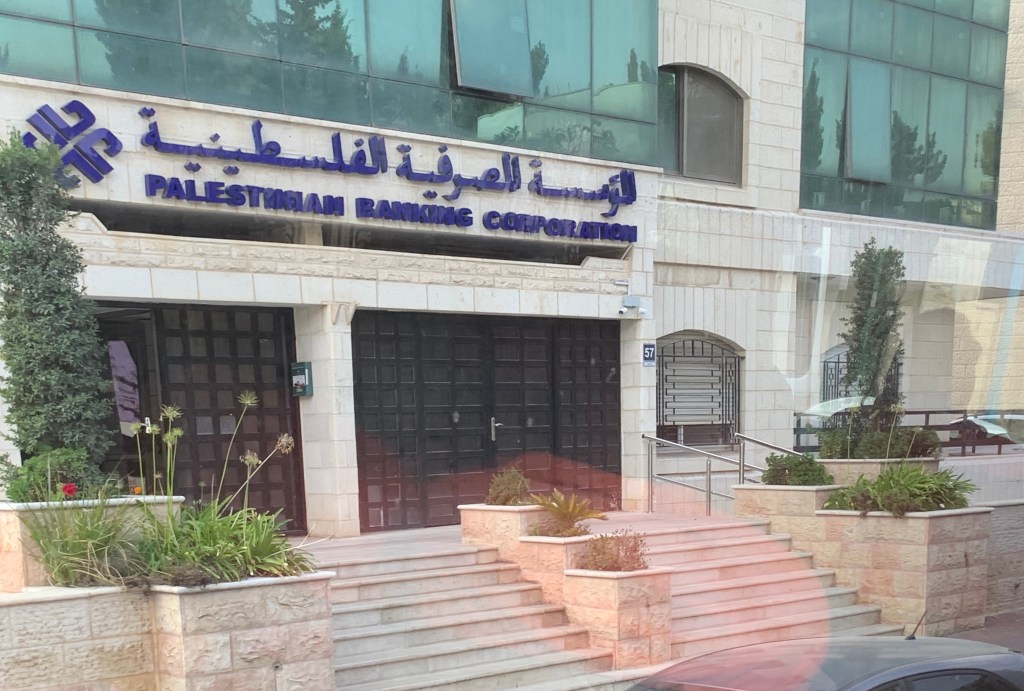
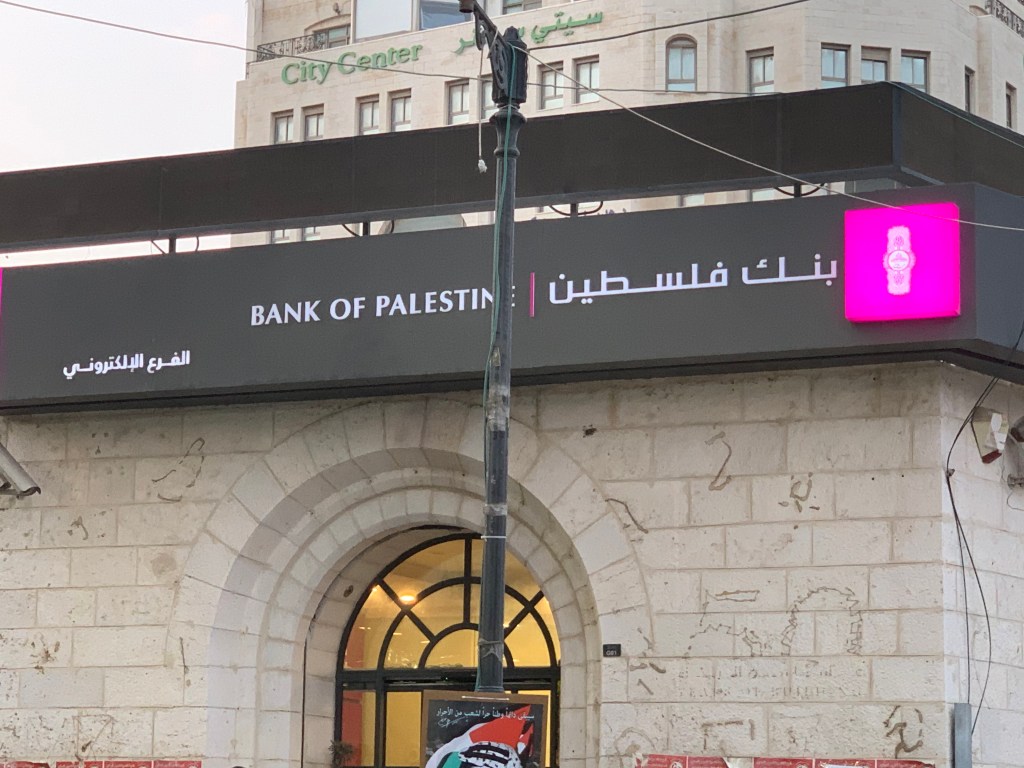
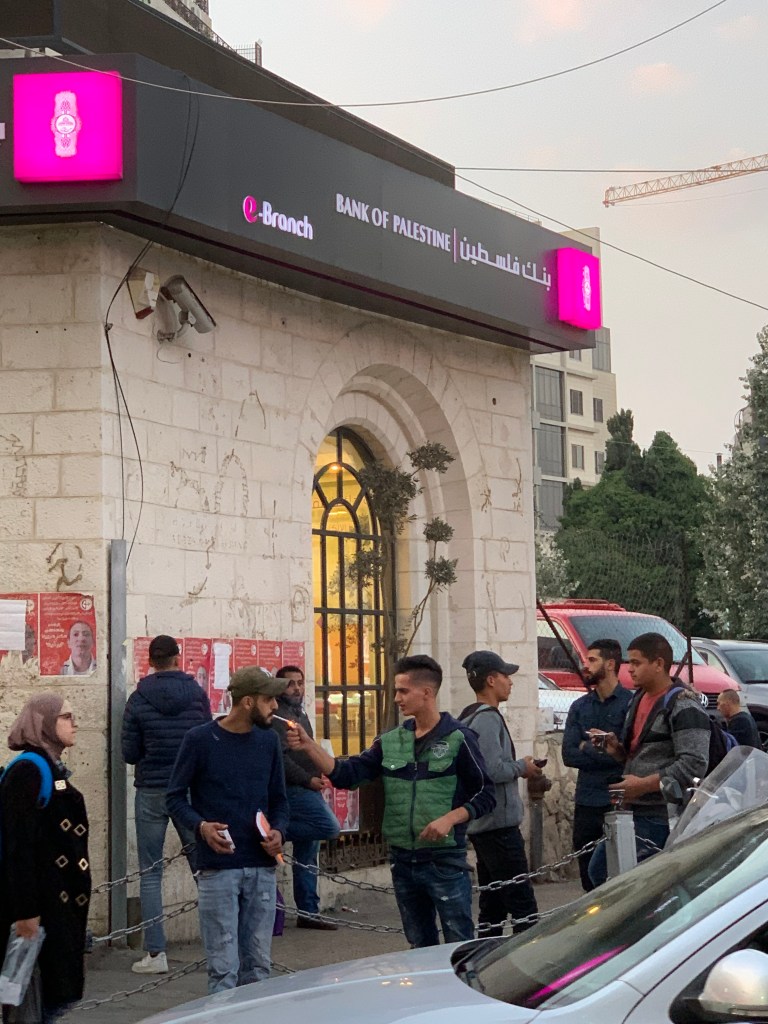
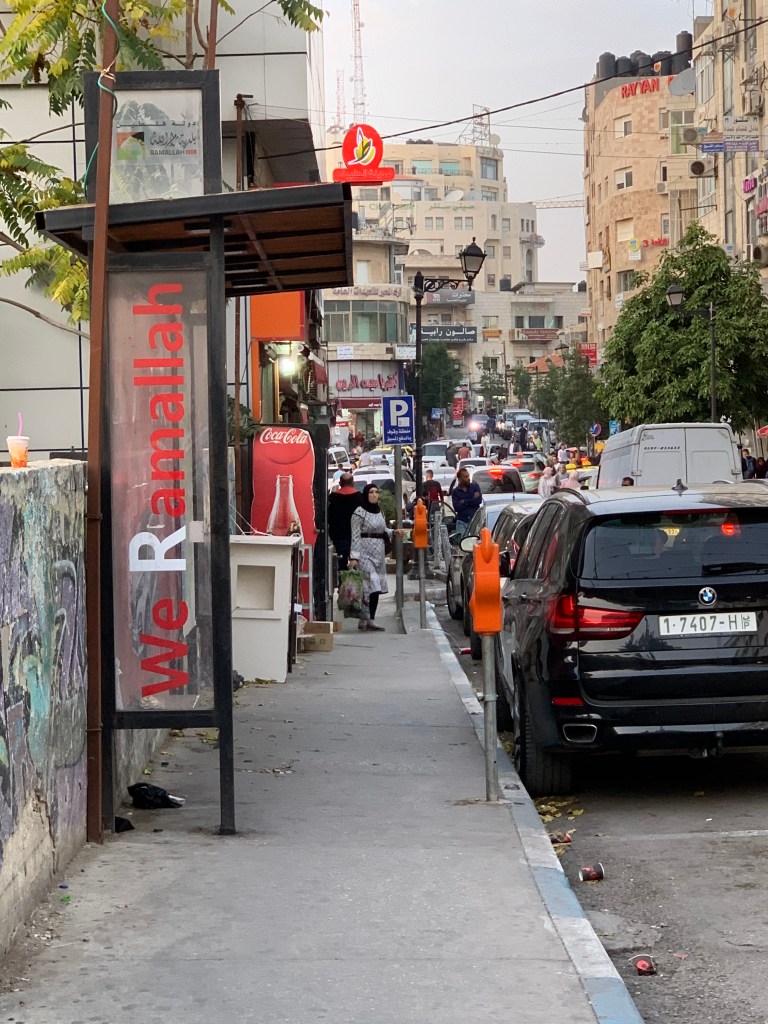
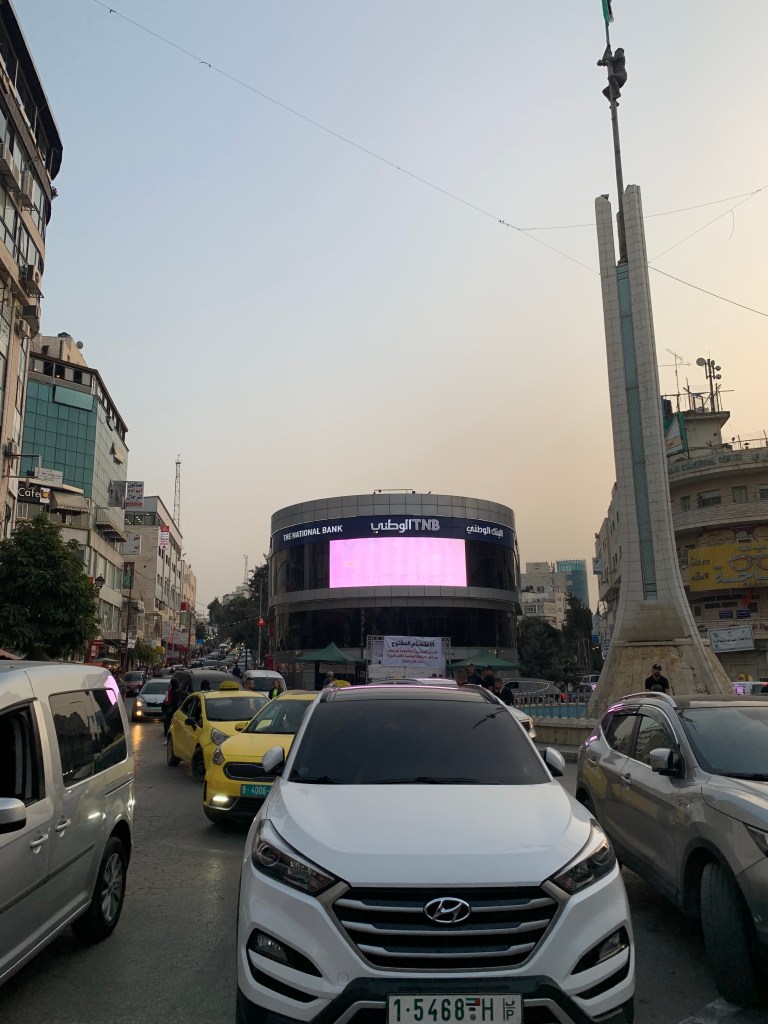
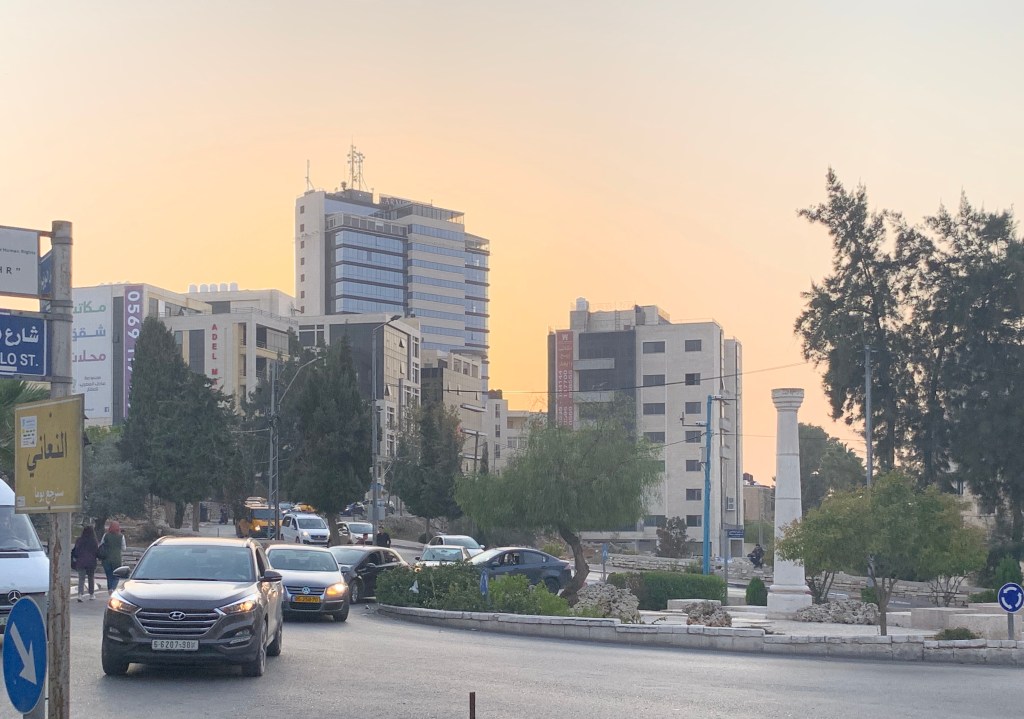
Ramallah and the banks
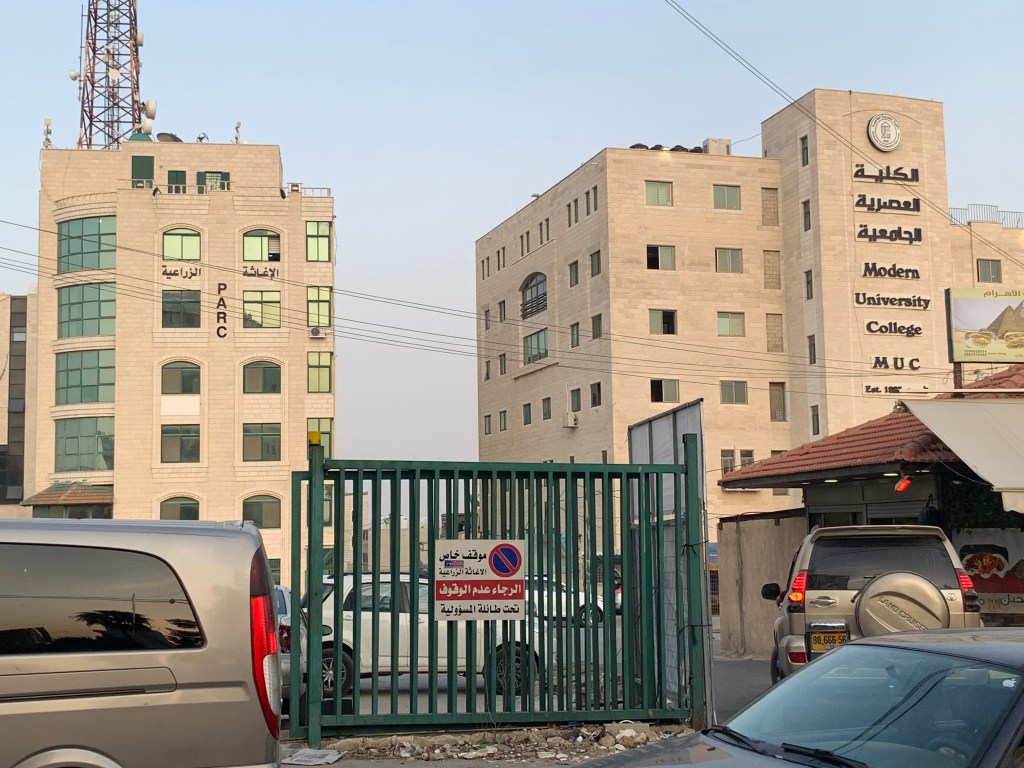
The first thing I noticed was the traffic. There were a lot of cabs and traffic was brutal. There was a lot of new construction going on and it seemed like there was quite a growing economy. The closer we got to the center of town the worse the traffic got and the more people we encountered.
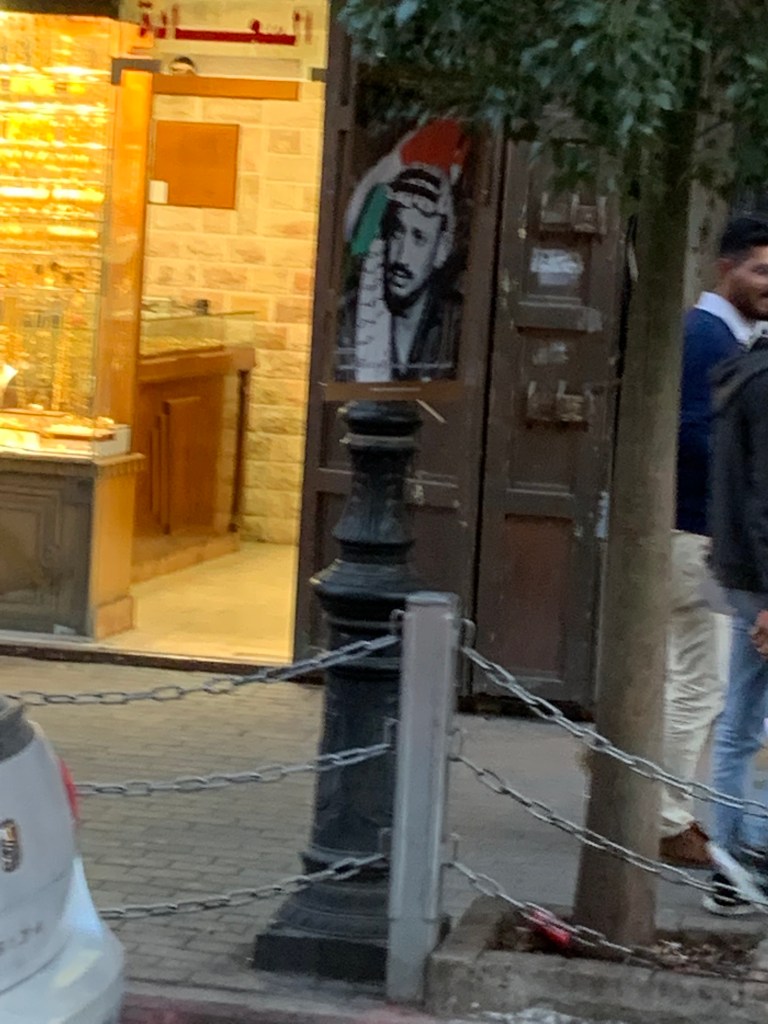
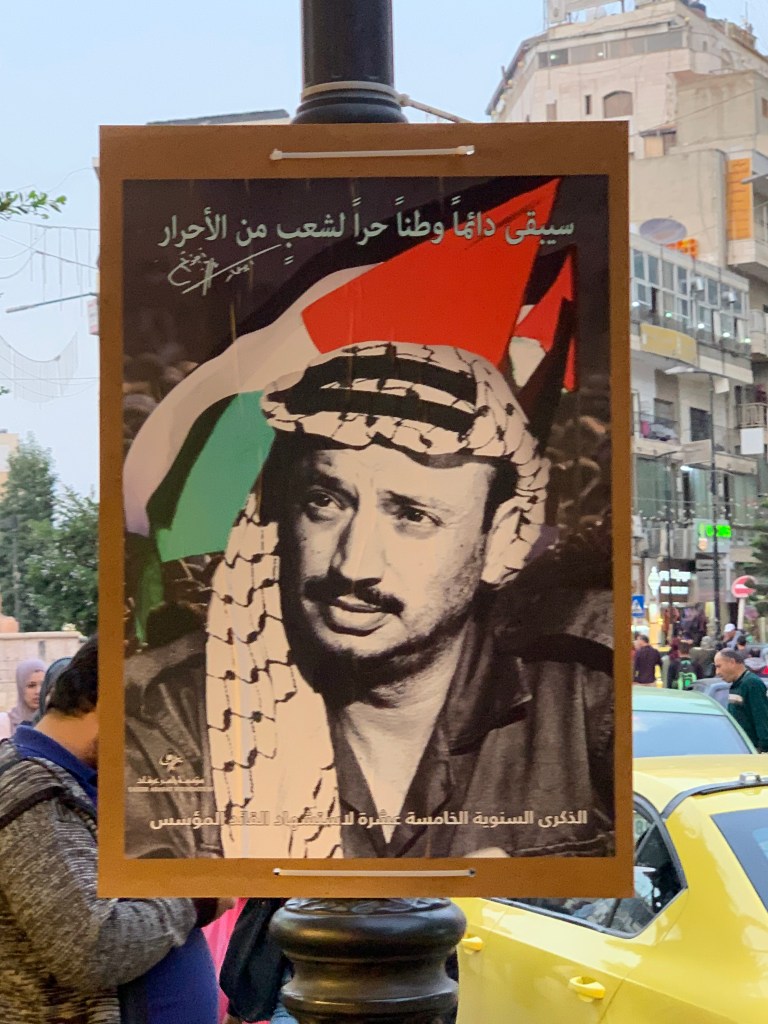
I had anticipated Ramallah to be more run down. Poorer. I’m not sure why other than my own biases, but it’s not what I saw or experienced. I did get the feeling over overcrowding as the streets and sidewalks were packed. There were shop after shop open with varying things for sale. Jewelry, appliances, food, etc. We saw doctors’ offices and law offices. Other than the language being Arabic and posters of Yasser Arafat everywhere, this could have been any city.
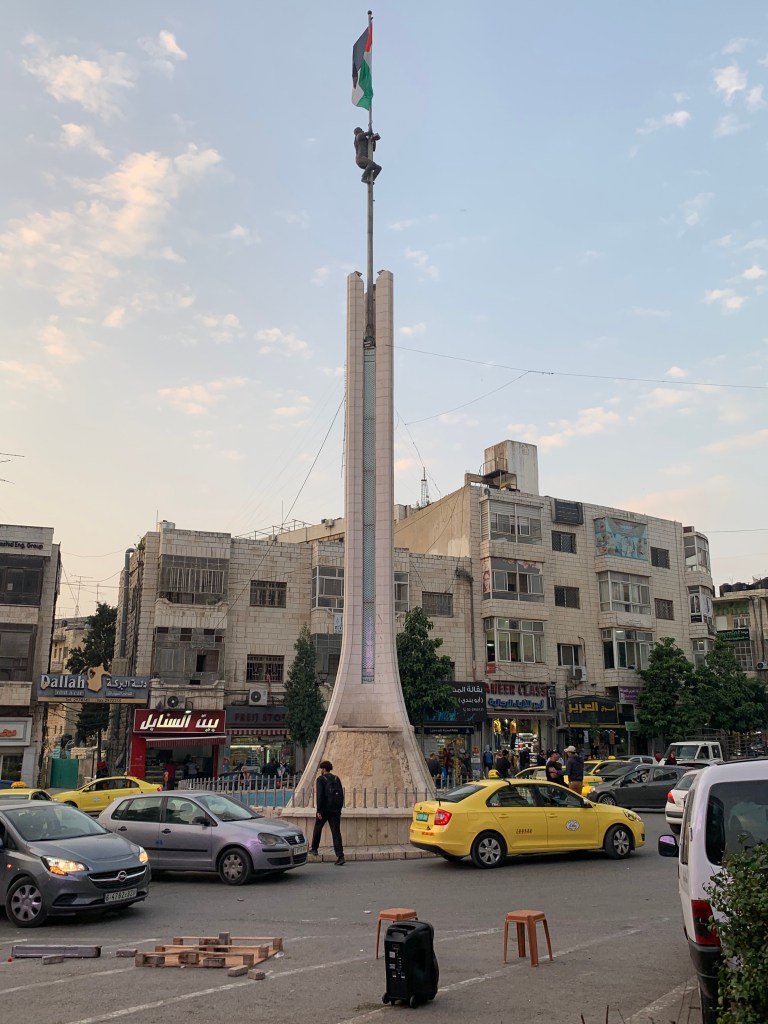
It was interesting to learn that Ramallah (pronounced by our guide as Rahm-Allah) was founded by a family that fled Jordan because they killed somebody and needed a safe place to go live. It was interesting to see the town square which used to have a clocktower that was replaced with the Palestinian climbing an electrical pole to hang a Palestinian flag. We were told this is because they tried to do this inside Israel and would get arrested so it’s a symbol of freedom.
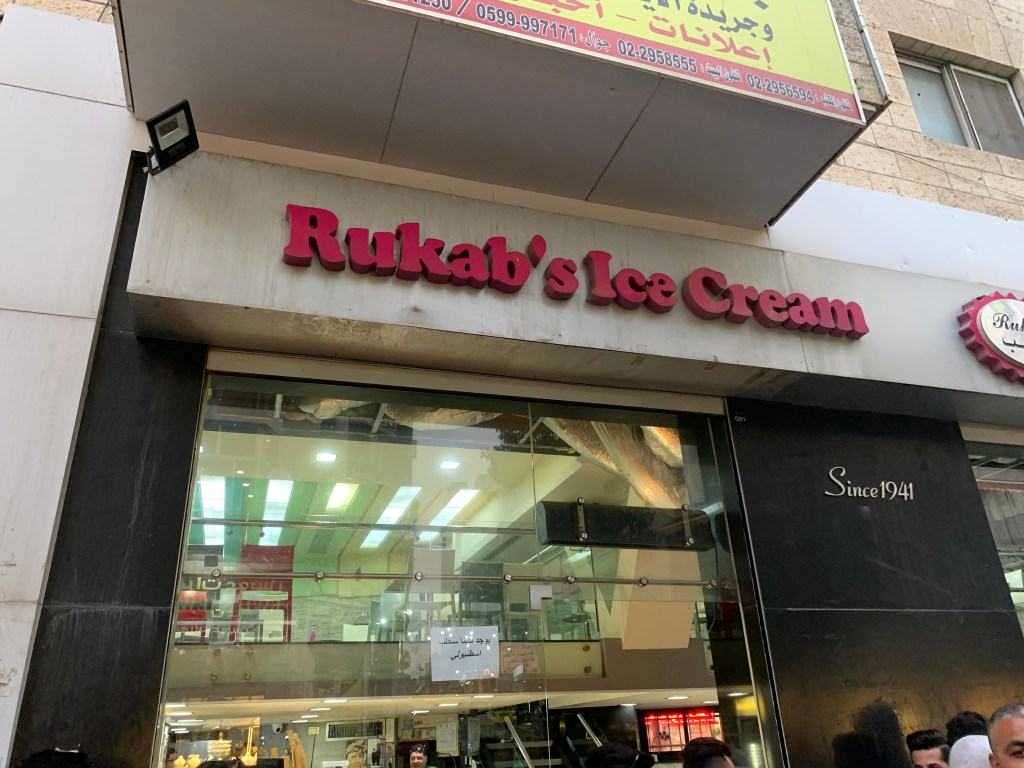
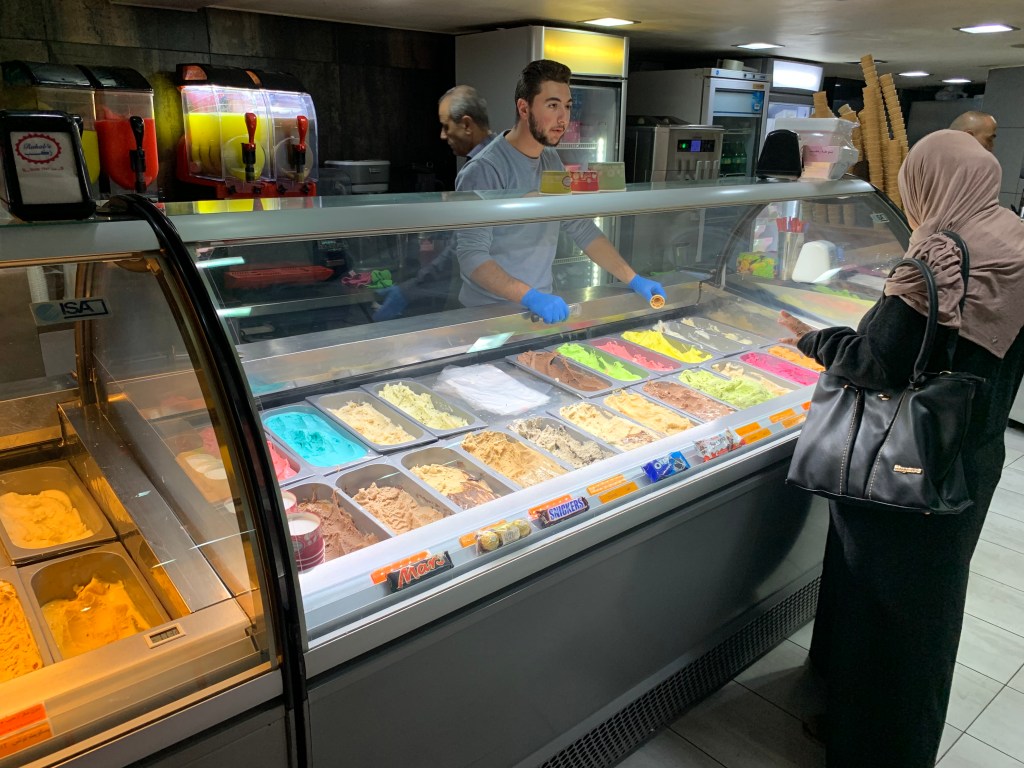
We stopped at Rukab’s ice cream. I had been told this was a place that I HAD to go. They had a ton of choices and it was truly amazing. A three-scoop cone was 10 shekels! Those who didn’t want ice cream went across the street to get freshly baked zaatar bread. We walked back to hotel for our wrap up sessions and to get ready to go to dinner at a restaurant in Ramallah.
After the sessions, we walked to the restaurant. It was a beautiful place. The food was plentiful and good. They had huge TV sets showing ‘football’ (soccer to most of us) and we ate, talked, and finally had a chance to relax a bit. I had a great interaction with one of the waiters who asked me if I was American. We talked a bit and he was so excited to meet somebody from America. It gave me some hope that if we can engage the Palestinian youth and give them hope for a better future, perhaps we have a real chance.
After dinner we moved to a private room at the restaurant to listen to some traditional Palestinian music, which was very enjoyable. We go to celebrate a participant’s birthday before walking back to the hotel.
After three exhausting and very meaningful days, I am excited that tomorrow breakfast doesn’t start until 7:45 am. Somehow that seems really late!
Tomorrow is the last day of the trip and I am sad to see it end. I will have time after the close of the program before my flight to hopefully meet some friends in Jerusalem and talk about the experience. I look forward to being back in Central Florida this weekend.
So after sitting outside and eating a great lunch with far too much food being served, (the first restaurant I have been to in the West Bank/Judea and Samaria) we were introduced to Eid and Feraz, two former prisoners in Israeli jails. We knew nothing about either of them and neither spoke much/any English, so Ahmed translated for us.
Eid spent 6 years in prison during the first intifada. He was given a life sentence but as a part of the Oslo agreement he was released early. When we asked why he was arrested and got a life sentence, he told us that it was because he was very involved in the first intifada. As we dug deeper because this didn’t make sense, we learned that the reason he got a life sentence and was in prison was because he murdered an Israeli spy. Again, there was no remorse about the murder. He was angry that Israel had leveled his home as part of his conviction and his family had consequences because of his actions. He was angry that they are prohibited from rebuilding on that land. The freedom fighter troupe returned as justification. He gave us some insight into what prison was like in the late 80’s and early 90’s but there was no insight, no remorse, and no change. From what I heard from my Palestinian hosts at dinner the last two nights, I was expecting to learn that he had a high-level position with the PA.
Then it was Feraz’s turn to share his story with us. Feraz was recently released from prison after serving 14 years and 2 months (he was very specific). He told us that he was a part of the Al Aqsa Brigade and was arrested for being a ‘freedom fighter’. The reason he got such a long sentence was because of how involved he was with the Al Aqsa Brigade and because Israel classified him as a member of a terrorist military organization. He considered himself a soldier, not a criminal. Further conversation allowed us to understand that he was part of the group that was firing on Israeli soldiers when there were skirmishes in Jericho and that’s why he was arrested.
Eid, Feraz, and Ahmed all consider themselves political prisoners. There was no responsibility for their actions. No remorse. Neither Eid nor Ferez had any change in attitude or belief about what they had done or about Israel or Jews. While I’m glad that I had the interaction with them to gain a better understanding of the complex groups of Palestinians and their varying beliefs, I hope that I never see Eid or Feraz again. Once again, this is the Jewish fear. This is the reason we don’t have peace. And these won’t be the peacemakers but they could be the peacebreakers.
So, after lunch, a member of Hamas, a murderer, and a member of the Al Aqsa Brigade walk into a room of Jews…….. It sounds like a joke but it certainly wasn’t funny.
So, the day started with hope and Ali. Then I had the challenge and conundrum of Ahmed. As we pulled into Ramallah to visit the Palestinian Prisoners Club, I wasn’t sure what to expect.
Walking in I felt like I was back in the 1970’s. The smell of smoke permeated everything. Think of the rooms in The Spy or cafe’s in old movies. It was hard to breathe. We moved into their conference room which wasn’t very smoky as Kadur, the director of the club, began to talk to us.
He apologized because he had to leave right away to do a radio interview. There were two “Jordanian Palestinians” who had been arrested with ‘Administrative Detention’ and were about to be released. Administrative Detention is when you can be arrested and no reason given. I guess it has been a big news story. So he left us to do his radio interview. As I looked around the room, there were pictures of Yasser Arafat on the wall. There were mosquitoes flying around the room. It didn’t give off a good vibe or set good expectations.
When he returned, Kadur broke down the number of Palestinian’s in Israeli prison, telling us that there were 5,000 currently incarcerated and ‘only’ 570 were serving life sentences. He continued to go on about the injustice but it simply wasn’t resonating. And then it got worse. He began to talk about the money given to the families of those who are in prison for killing Jews and for those who are suicide bombers. He was angry that anybody would tell the PA how to spend their budget. And how it was wrong to cut this funding because ‘just like in the US, when the father is in prison they need money to live.’
Ah – welfare we thought. Regular social services. That may make sense. So we asked if they got this money from the same pool that all the poor access. And he told us no. There is a special funding pool for each category. And every category gets a different amount. ‘Martyrs and Prisoners’ he said, need a special category. As I looked around the room I saw people with a look of disbelief.
He then continued framing everything as a result of the occupation. The reason they have crime is the occupation. The reason for every bad thing is the occupation. I realized that I was sitting in a room with the stereotypical Palestinian who hates Jews, wants all the land, believes in ‘from the river to the sea’, wants to see Jews killed and is not a partner for peace. He even openly said, “As an enemy of Israel, I like when Israel does things that I can use.”
His final comment was a failed attempt to make himself look better. “Israel will continue to be our neighbor for at least ……… 100 years.’ The pause was palpable. It seemed like he was searching for a number that seemed to be a long time and that he could actually get out of his mouth. He then said, “those that kill Israelis are freedom fighters. I respect them. I live with them.”
As we left the center, I began talking with a few participants about what we just experienced. The hope from Ali was gone at this point. All that remained was the ‘Jewish fear’ that Ali spoke about and a lot of anger. How can you even begin with somebody like this?
When the program started, I was thinking that 4 days seemed awful short. As I began day 3, I realized that 4 days is about all I can handle due to the intensity. There is so much to take in, to listen, to learn, and to process, that I am glad we have just 4 intensive days.
Once again, we split into 3 tracks. I chose the Prison one. I’m not sure why but I did. Our first speaker was a man named Ali Abu-Awwad. Ali was involved with the startup of the Roots program. He left them a year or so ago and started a new organization called Taghyeer Movement.
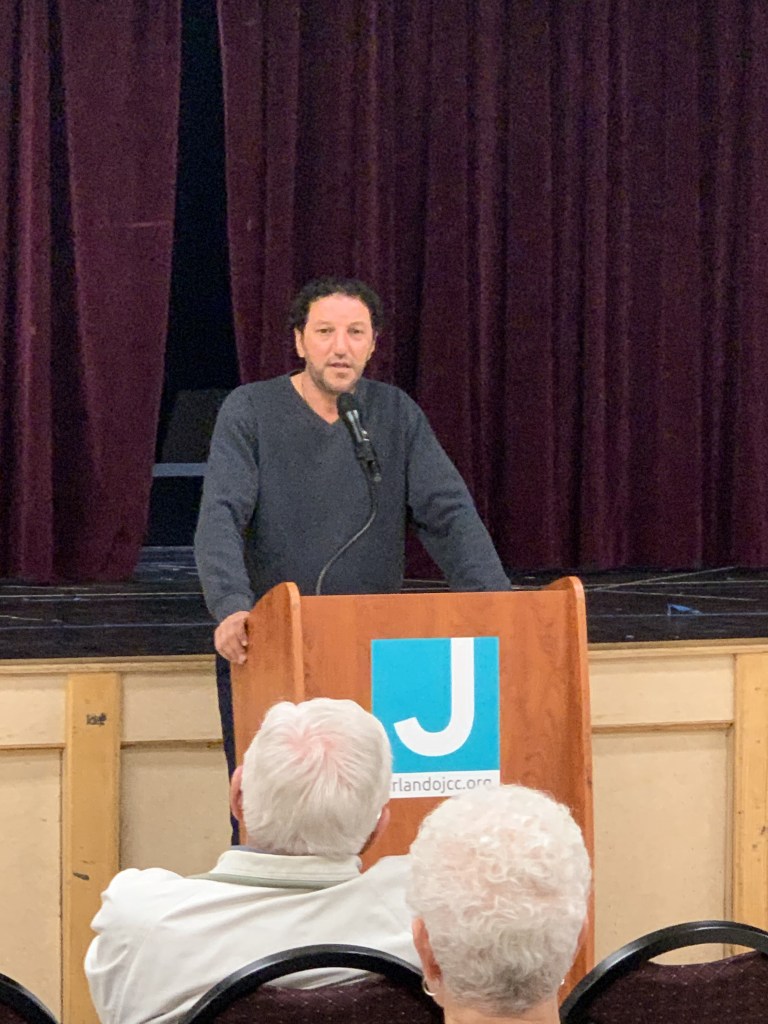
Ali speaking a few months later at The Roth Family JCC
Ali’s mom got very involved with the PLO and she was a leader in the movement as he grew up. This made him special in the eyes of many and he quickly became an activist. He was first arrested at age 15 for throwing stones at soldiers. At age 18, he was arrested a second time for throwing stones only this time the IDF wanted him to give them information on his mother. They threatened him with 10 years in prison if he didn’t. Ali didn’t believe he could get 10 years in prison for throwing rocks and he chose not to say anything about his mom. At his trial, he was given a 10-year prison sentence.
It was in prison that he learned to speak Hebrew and got most of his education. The first intifada was mostly political and not violent so the political prisoners were educated people. They had created a system of government and education in the camp to make sure they were getting educated. In 1994, after the Oslo accords, he was released early from prison. He began working as a Palestinian security officer to help enforce the law. It was a struggle as he told us that he was humiliated by Israeli soldiers and he watched them humiliate his mom. The culminating moment for him was when a soldier shot and killed his brother.
Things changed for him when the family received a letter from an Orthodox Jew whose son had been killed by Hamas. The man had started a grief forum for families and heard about his brother’s murder. He wanted to send condolences and told them he ‘stood for their rights’. The man also asked permission to come to house to personally share condolences. This act changed Ali’s life. He had Israeli’s come to his house before but never any who asked about coming. When they met this man, they could feel his compassion and Ali realized that vengeance was using anger to try to get justice. And the only justice for his brother’s death was to have his brother back. Since that was impossible, he had to find a new way.
Ali shared his belief on why the peace talks failed. It was so clear. He told us:
1. The leaders signed the agreement but it was never implemented on the ground. 2. Signing an agreement doesn’t make peace. Those involved need to be included in the process. Refugees and Settlers were not included and in order for peace to work, we need reconciliation on the ground. If they are not included, there will be no reconciliation 3. Engagement of outsiders in the peace process. He specifically called out Iran who wanted to keep the conflict going and the Arab World who didn’t want to see a modern Arab democratic state. 4. The leadership who signed the agreement wasn’t really looking to have Peace. If they did, Ali said that Rabin’s assassination wouldn’t have stopped it. It was people, not systems. Rabin was dead and Arafat was weak. 5. Palestinians could not make the transition from resistance to being citizens. They struggled with a new identity of building a state instead of battling Israel in revolution. 6. Corruption by leadership. Oslo created the PA and that has become a way to help individuals (lining their pockets) rather than the state (building a country).
Ali had a few very significant statements that I want to share.
“The biggest obstacle to Palestinian freedom is Jewish Fear and Palestinian Anger.” He said the Palestinians must understand this and address it moving forward.
“Our freedom will not be built by Jewish lives. It will not be built on Jewish graves. It will be built through Jewish hearts.”
“It’s not about guilt or blame but about responsibility. The best tool I have is my humanity, not my rightness or support of my cause, but my humanity.”
Ali’s new organization is based on creating a Palestinian identity based on non-violence. He is working to address the identity issue of being citizens rather than being part of a resistance. He is building a movement and already has 13 chapters and it’s growing fast.
He finished with a few very important points. the first was 3 truths about Palestinians and Jews 1. We both have no other place to go 2. We both have a historical connection to the land 3. Nobody else wants either of us
He closed with talking about the need for recognition by the Palestinians to the Jewish claim to the land and by the Jews to the Palestinian claim to the land.
So if you actually read all of this, wow! And I hope you are as filled with hope as I was. I have heard the complaints about no partner for peace. I have heard the complaints that the Palestinians won’t govern, can’t govern, and won’t take responsibility. Ali is an example that proves both those things wrong. Perhaps it’s time for us to find the other Ali’s and work together to create a better world and peace.
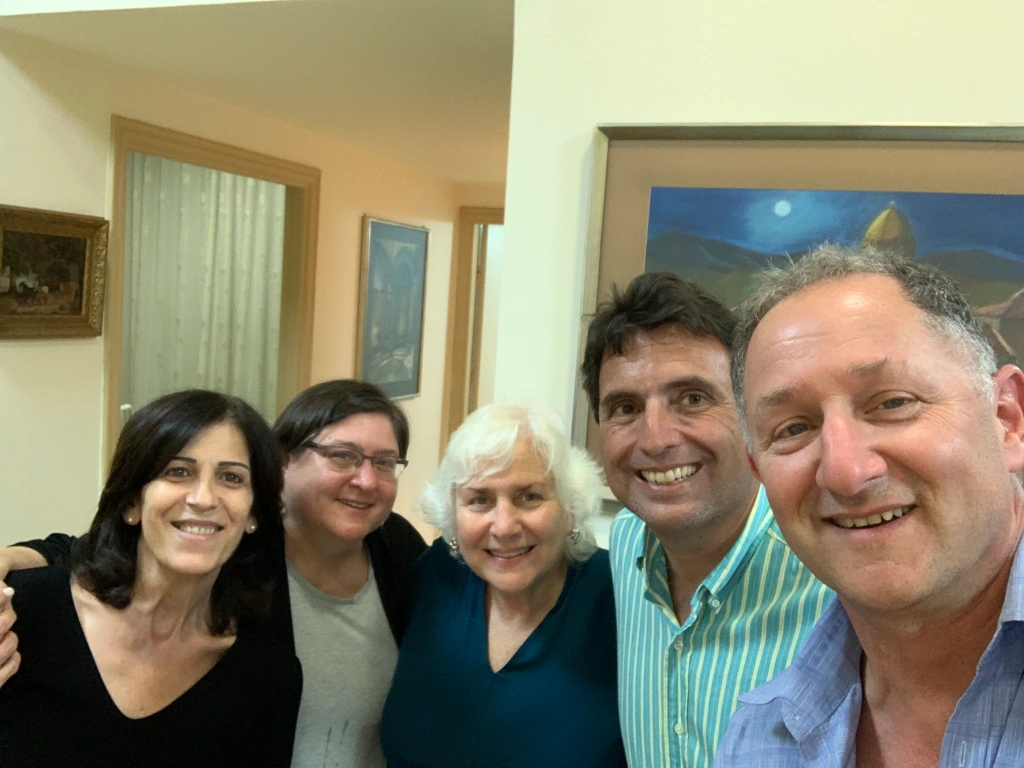
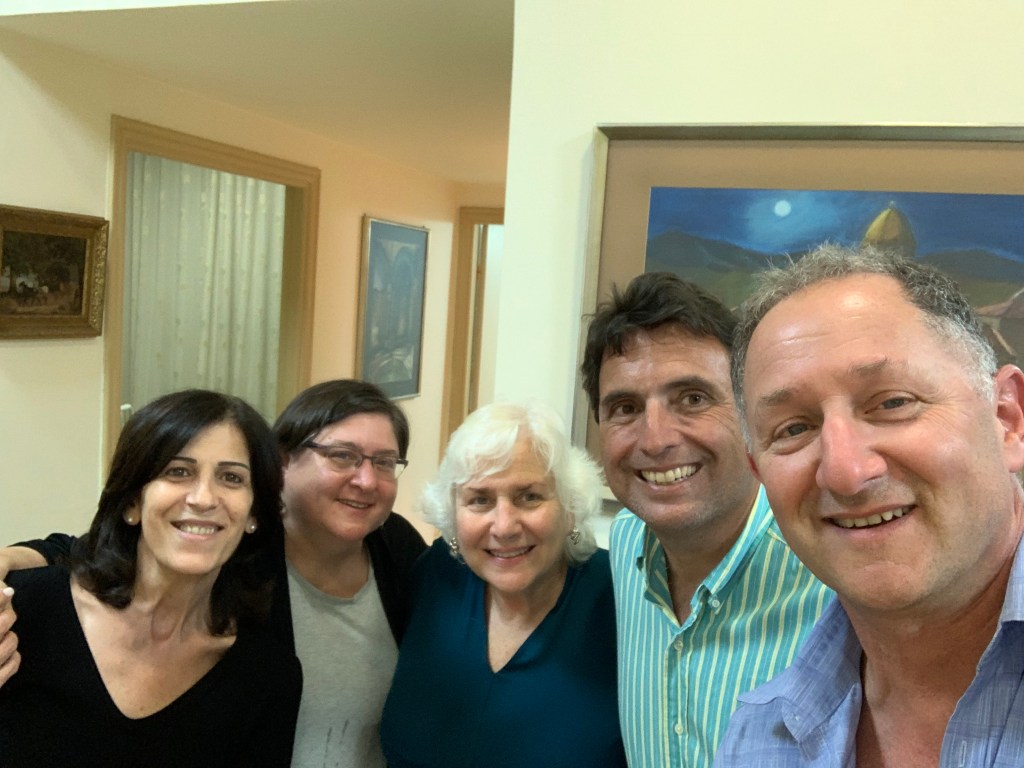
My favorite part of the trip so far was dinner last night with Susan at her home in Bethlehem. Five of us ate, talked and became friends. I was very much looking forward to getting to have dinner tonight with another Palestinian family.
Susan is in the black dress on the left
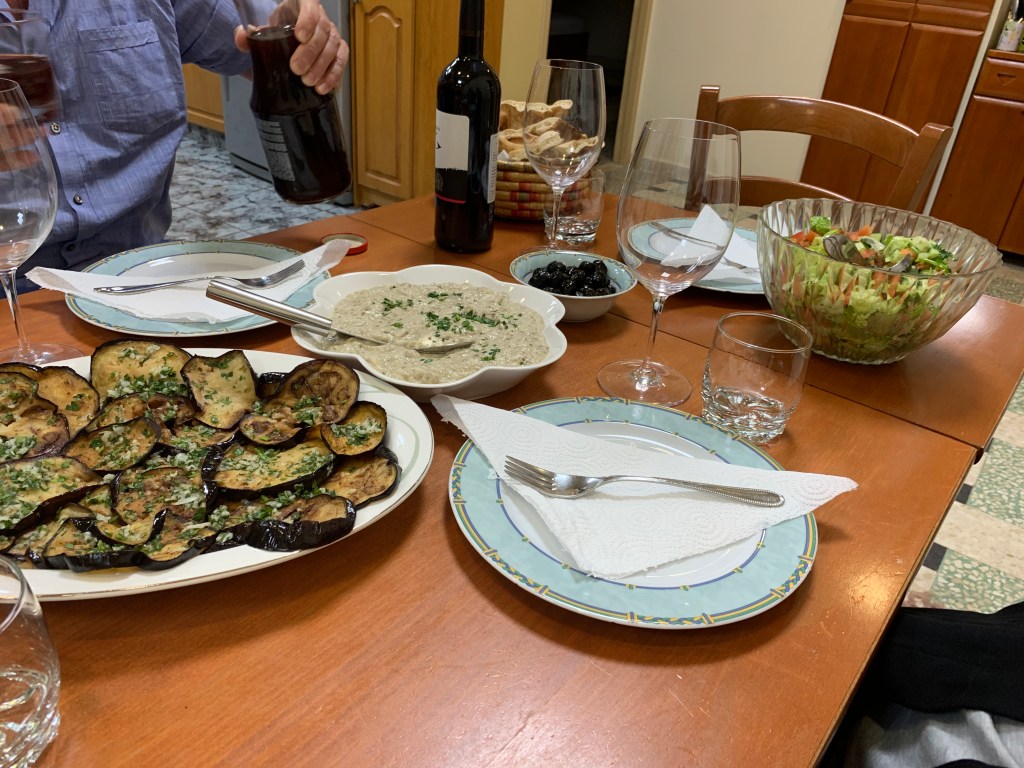
Dinner at Susan’s
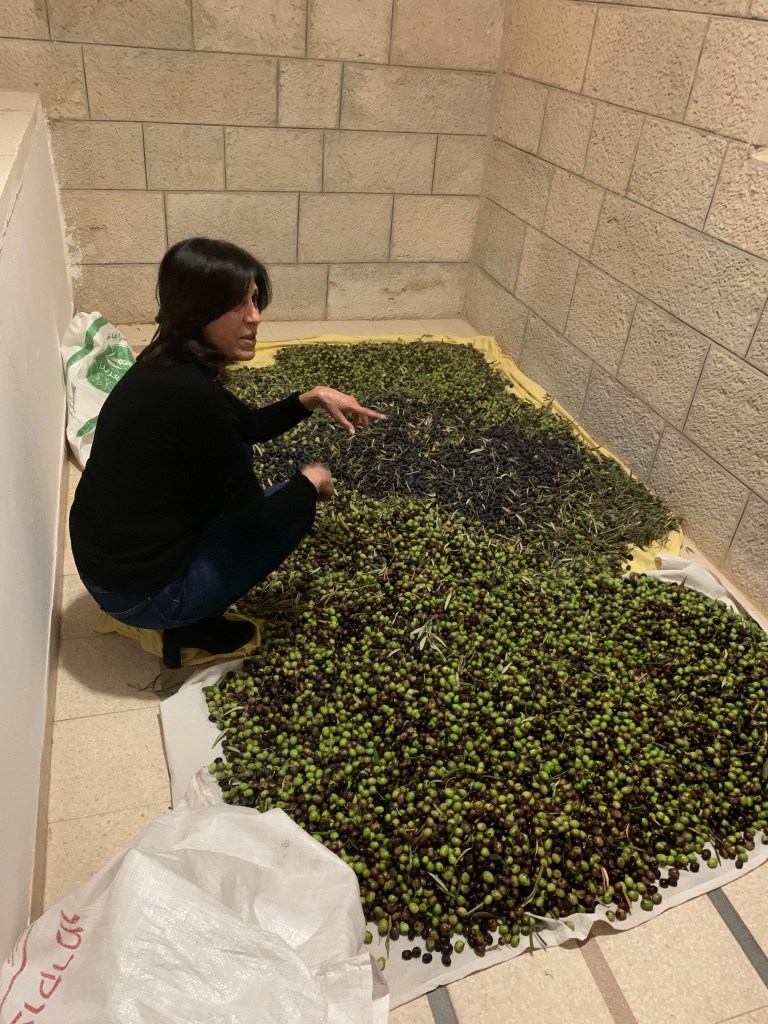
Susan has Olive trees – this was the harvest
Dinner at Susan’s
Unlike last night, Hiba and Muhammad are Palestinian Muslims. Muhammad picked up the four of us and took us to his home. He and Hiba live in a very nice east Jerusalem neighborhood in a beautiful home. As we drove there, Muhammad pointed out the difference in the roads for the Israelis and the Palestinians. The Israeli’s get wider roads that are better maintained. When we stopped at one specific light, he told us about an Al Jazeera feature on that light. It was a heavily congested intersection. Two of the lanes went to and from an Israeli neighborhood. The other two went to and from an East Jerusalem Palestinian neighborhood. The timing on the light was set to be much longer on the Israeli roads and Al Jazeera actually recorded it for their feature.
Both Hiba and Muhammad have good jobs (I won’t specify them on purpose). Both are highly educated with graduate degrees. As we discussed the challenges of living in East Jerusalem, Muhammad shared with us a recent UN study about building permits in Jerusalem from 2006-2018. During that time there were 16,000 permits issued in East Jerusalem. In West Jerusalem there were 160,000. It’s easy to see why they question the fairness of the government.
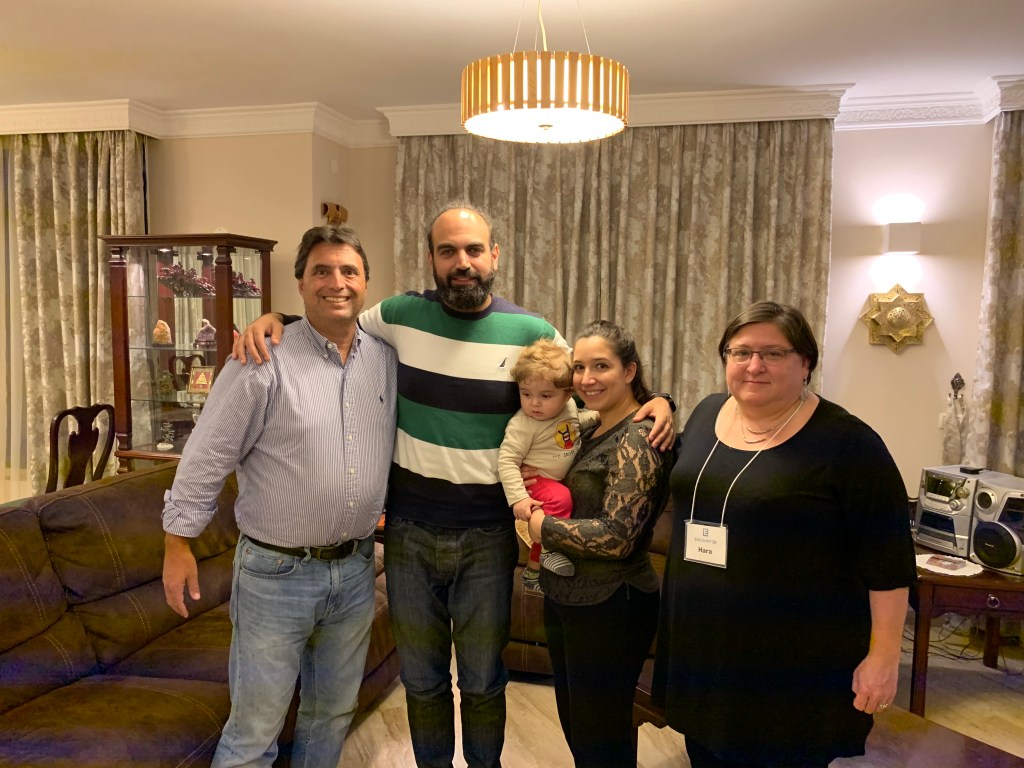
We got to their home and Hiba welcomed us in. Their adorable 11-month-old son went right to Muhammad and the joy of an 11-month-old child filled their home. Hiba told us to sit as dinner was ready. She served us a beautiful and delicious dinner (I didn’t take pictures tonight, sorry.) And just like a Jewish mother, she not only served us but wanted us to eat more!
During dinner we began to talk about the conflict and the issues. Both Hiba and Muhammad have deep and strong educational backgrounds and it was a rich and meaningful one. I asked why they wouldn’t want to grow their own political party and was sad to hear them say that Fatah would just squash them. As people living in East Jerusalem they don’t want to live in the territories nor do they want to live in a Palestinian state unless it includes East Jerusalem.
We talked about applying for Israeli citizenship and the costs of doing so. What they have to give up and could they live with giving all that up. The pros and cons. I got a good lesson in the difficulties they face in making that choice. With rumors that sometime in the near future the Palestinians in East Jerusalem will be forced to choose between Israeli citizenship or moving to the West Bank, they are afraid of waiting but aren’t sure they want to do it either. I don’t envy their situation.
Hiba’s work is supposed to take her to Gaza but she hasn’t been yet due to visa problems. Muhammad goes monthly and we asked what it’s really like. He talked of the lack of sewers and the smell as a result. How it truly felt like a jail and how it’s been 13 years since they were able to leave. The overcrowding and how awful it is. Most importantly, he talked about the lack of hope and the inability of parents to provide hope for their children. I’m not sure how we can every solve the Gaza challenge and both he and Hiba were concerned it may just go on and on and on as a result.
We talked about the PA and how getting a position requires a decade or more in prison. The cronyism and corruption. The hopelessness of change or elections until Abbas (Abu Mazen as we called him) dies and maybe not even then. They shared with us that in order to work for the PA you may not have finished high school. They are looking for followers, not leaders. The uneducated who won’t ask questions rather than the educated who will.
We moved from the dinner table to the couch to continue our conversation and asked questions I never imagined. How can they reconcile that in 1947 there was going to be a Palestinian and Jewish state. In 1948 there was a Jewish state with different borders but instead of the Palestinian state in the remaining land, Egypt and Jordan grabbed it? We asked about the perception that the Palestinians aren’t ready to govern themselves and build a nation and got a lecture on how they have done that in other Muslim countries that they were forced to move to. We talked about hopes and dreams and I wish we could have stayed and talked longer. My final question was if they wanted 1 state or 2 states. Once again, they preferred one state. They want to be able to go anywhere in the country without limits. Because of their status and jobs, they currently can and in a 2-state solution they wouldn’t have the same ability.
As we backed out of the driveway, Muhammad asked me about Bibi and if I thought he would go to jail. He was impressed that Israel actually arrests leaders who break the law and will send them to prison. It gave me hope that if we act ethically and morally, keeping safety and security in mind, we can find a pathway to peace. As we got out of the car at the hotel, I told him that I hoped we would see each other again. He told me how to get his contact information and I gave him mine. I feel like I made two new friends today and look forward to staying in touch with them. I have many friends in Israel – often times too many to visit when I come. Now I have a new set of friends in East Jerusalem to see next time. I look forward to watching their son grow up and hope he has a bright future.
While I was part of a small group that spent the day with Mahmoud, the rest of the group hadn’t heard from him or spoken to him yet. He was our last speaker before we would go to dinner at the home of a Palestinian couple.
Mahmoud’s father was a teacher in the Refugee camp. As a result, Mahmoud and all his siblings went to school in the camp. As he talked about the camp and the significance of these refugees living here for 71 years now, I found myself questioning why it still exists. What purpose does this camp serve? It’s not a short-term housing option until they are able to return home. It breeds hatred and violence. Is it just a way to create rhetoric and leverage? I have to believe that with only 5,000 people living in the camp we could find a way to help them find a permanent home and begin a new life. After 71 years, there is no excuse to be living in ‘temporary’ housing.
Mahmoud started the bookstore with a goal of creating a place for conversations. Authors, discussions, and cultural events are held at the bookstore. He believes that it is through culture, music and sports that the new leadership for the Palestinian people will develop and he is doing his part to make that happen. East Jerusalem is his home – when he has to go to West Jerusalem for business, he feels uncomfortable. His Palestinian identity is primary there. When he needs to get away and ‘escape’, he goes to Tel Aviv, where he is just seen as a person. He feels no judgment. I find it very interesting that a 30-minute train ride or a 45-minute drive is all it takes to find a place within Israel that does what he and others like him want – treat them with dignity and fairness. It shows me that this is possible and there is hope.
He spoke about his and others issues with the Israeli government. He wanted to be very clear that this was about Israel the country and the government and Palestinians, not Jews and Arabs. He acknowledged that the conflict has blurred the line from being anti-Israeli government to anti-Jewish to anti-Semitism. He believes the only way to address this is through building relationships with people and working to make the government change their policies.
There were two final points he discussed that concerned me for different reasons. The first is his belief (and I have heard it from many other Palestinians) that the creation of Israel is what caused the Palestinian problem and so it’s Israel’s job to fix it. There is no comprehension of shared responsibility for both the cause and the solution. I fear that without shared responsibility, we will not find a solution. The second point related to his belief that a 1-state solution is the answer. Jews, Palestinians, Christians, and others all living together on the land in a shared state. The problem is that he doesn’t understand the importance to Israelis and Jews that this be a shared JEWISH state. Without that understanding, without realizing that a JEWISH state is a red line that can’t be crossed, I also fear we will not have peace.
It made me wonder what our red lines are. Safety and security. A Jewish State. What else? What are the things that we can risk but only if we build trust? Where do we start?
I’m not an Israeli and I don’t vote in Israel’s elections. As a community leader I believe it is my responsibility to ask these hard questions of myself and of the community. Together we can understand what our red lines are. What are the things we will defend and what are the things we need to be prepared to give up if/when we have trust?
One thing has become clear to me. The status quo is not sustainable. Change is coming. It’s just a matter of when and how.






 keithdblog