Keith has been a nonprofit leader for 25 years before moving into the consulting world in 2023. He focuses on three major areas:
(1) Fundraising - All aspects from creating development plans, solicitations, annual, capital, endowment and special campaigns, as well as feasibility studies.
(2) Organizational development - This includes reviewing and creating the business structure, coaching and mentoring employees, board and staff training, job description review and creation, and creating organizational structure and charts.
(3) Family philanthropy.- Focusing on the goals of the family/individual to determine where to give and how to measure impact and ROI. This also includes the best vehicles to use for philanthropy and compliance for these vehicles.
Keith is a proud Zionist, having visited Israel 25 times. He has spent time meeting with leaders of Palestinian Civil Society as well as Israeli-Arabs, and lots of time with Jewish Israelis.
He is a huge sports fan. Favorite teams are the NY Yankees, Penn State Nittany Lions, Philadelphia 76ers and whatever team his oldest son is coaching.
The opinions in this blog are entirely Keith’s.
To contact him, you can email keithdvorchik@gmail.com
Once again, I am back in Israel. This is my 20th trip and I am excited not just to be in Israel but also on the Momentum Men’s trip with 10 amazing men from Orlando and my two other City Leaders. After our long flight from Miami to Tel Aviv, we jumped in cabs to spend the morning in Tel Aviv. We relaxed while looking at the Mediterranean Sea and then began walking the beach and exploring the city. We walked for nearly 2 hours, along the beach, over to the Carmel Market, and then wandered through neighborhoods until we returned to our meeting point and headed back to the airport to meet our Momentum group.
We headed north to Tiberius and the Kinneret (Sea of Galilee). The Kinneret is beautiful and after checking into the hotel, I sat on the patio looking out at the water, the mountains, and the skyline. As the sun began to set and the colors filled my eyes, I was filled with a sense of peace and joy.
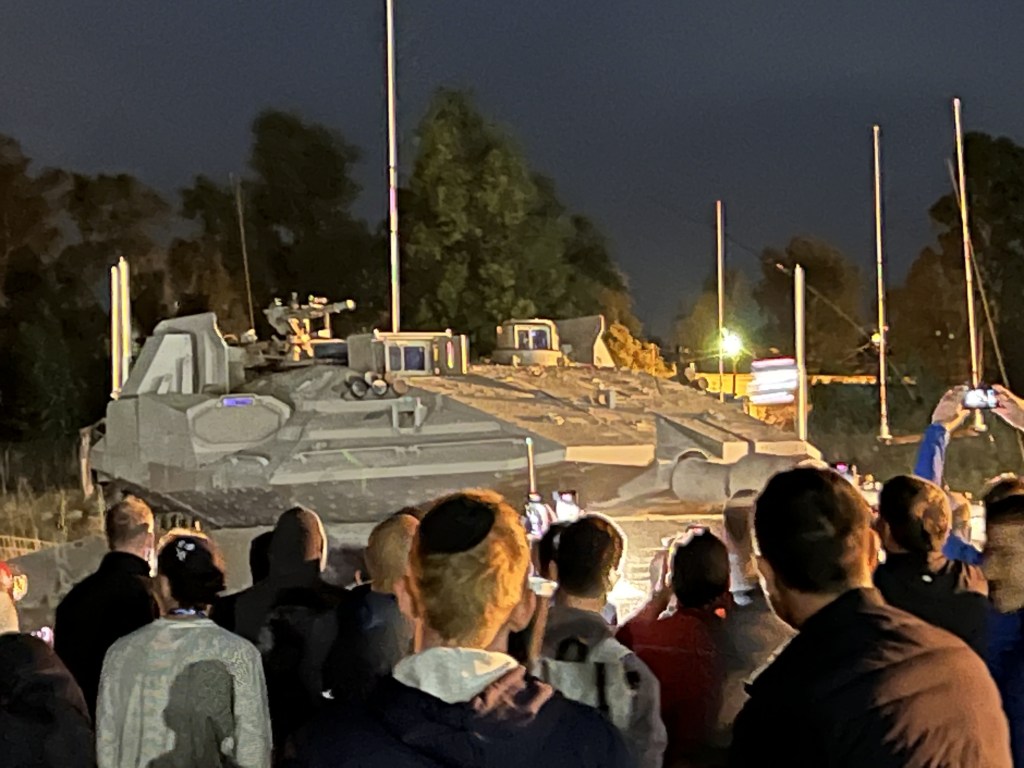
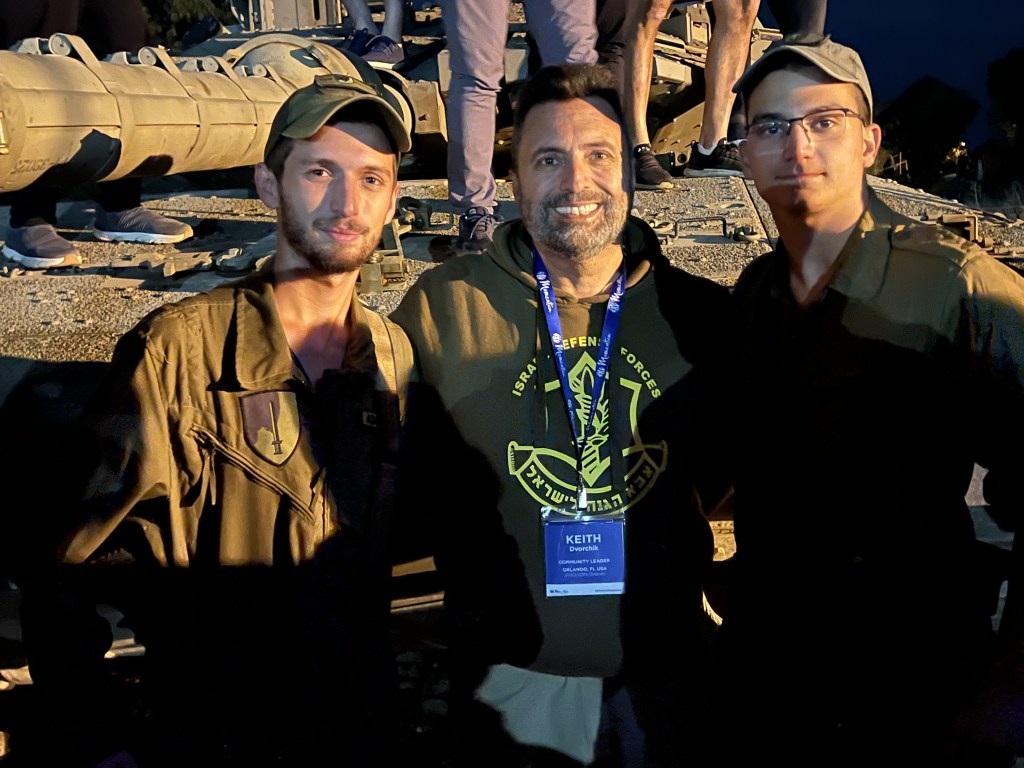
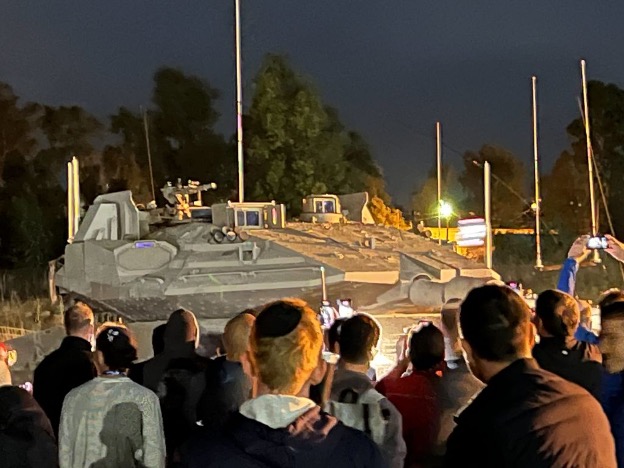
We left the hotel and went to hear our Trip Leader, Ari Shabat, set the tone for the trip. Ari is a friend and a truly inspirational person. Over the past year, I have learned a great deal from him, and am excited to have him leading the trip again this year. He inspired us to begin this journey together, and we then all headed up to the Golan Heights to a military base. If you’ve never been to the Golan Heights, the strategic value is huge. We got there after dark and spent time with a commander in the reserves of the tank unit. He taught us about the tanks from the 1973 Yom Kippur War and the tanks of today. We got to climb and explore both tanks and even got an exhibition of the new tanks and how they work. It was truly incredible. It was also freezing as the sun was down and we were high in the mountains. Some of the soldiers from the tank unit showed us what they do and we had the chance to say Thank You to them.
With two active soldiers in the tank unit
After learning about the tank unit, we headed back to Tiberius to Decks restaurant (one of my favorites) right on the Kinneret. They brought us way too much food and we ate, talked, laughed, and had fun. It’s about to start the rainy season in Israel and during dinner, it began to rain. We sat outside, got a little wet, and continued to have fun.
After two days with almost no sleep (the travel day to get here and then today as our first day), I’m excited to get some rest and begin fresh tomorrow. We head to Tzfat, one of my favorite cities, in the morning and finish the day in Jerusalem. I can’t wait to be filled with the mysticism of Tzfat and the specialness of Jerusalem.
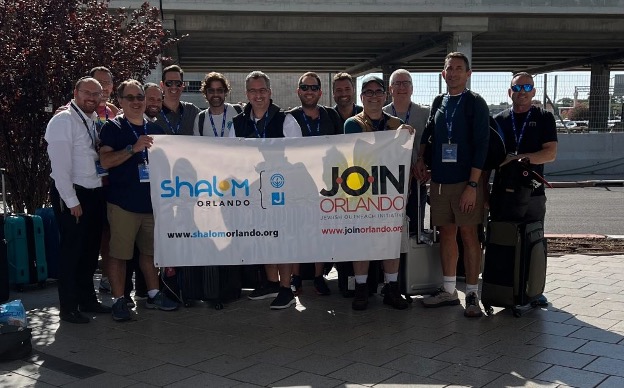
Once again, I am back in Israel. This is my 20th trip and I am excited not just to be in Israel but also on the Momentum Men’s trip with 10 amazing men from Orlando and my two other City Leaders. After our long flight from Miami to Tel Aviv, we jumped in cabs to spend the morning in Tel Aviv. We relaxed while looking at the Mediterranean Sea and then began walking the beach and exploring the city. We walked for nearly 2 hours, along the beach, over to the Carmel Market, and then wandering through neighborhoods until we returned to our meeting point and headed back to the airport to meet our Momentum group.
The Men’s Momentum Trip cohort.
We headed north to Tiberius and the Kinneret (Sea of Galilee). The Kinneret is beautiful and after checking into the hotel, I sat on the patio looking out at the water, the mountains, and the skyline.
As the sun began to set and the colors filled my eyes, I was filled with a sense of peace and joy.
We left the hotel and went to hear our Trip Leader, Ari Shabat, set the tone for the trip. Ari is a friend and a truly inspirational person. Over the past year, I have learned a great deal from him and am excited to have him leading the trip again this year. He inspired us to begin this journey together, and we then all headed up to the Golan Heights to a military base. If you’ve never been to the Golan Heights, the strategic value is huge. We got there after dark and spent time with a commander in the reserves of the tank unit. He taught us about the tanks from the 1973 Yom Kippur War and the tanks of today. We got to climb and explore both tanks and even got an exhibition of the new tanks and how they work. It was truly incredible. It was also freezing as the sun was down and we were high in the mountains. Some of the soldiers from the tank unit showed us what they do and we had the chance to say Thank You to them.
In the Golan Heights.
After learning about the tank unit, we headed back to Tiberius to Decks restaurant (one of my favorites) right on the Kinneret. They brought us way too much food and we ate, talked, laughed and had fun. It’s about to start rainy season in Israel and during dinner it began to rain. We sat outside, got a little wet, and continued to have fun.
After two days with almost no sleep (the travel day to get here and then today as our first day), I’m excited to get some rest and begin fresh tomorrow. We head to Tzfat, one of my favorite cities, in the morning and finish the day in Jerusalem. I can’t wait to be filled with the mysticism of Tzfat and the specialness of Jerusalem.
Today is Yom Hazikaron, Israel’s Memorial Day. It’s very different here than in the United States. It’s not a 3-day weekend. There aren’t big sales or barbecues. It’s a solemn day. People wear white shirts to honor and remember those who lost their lives in battle or due to terrorist attacks.
We started the day in Jaffa at the home of an amazing women, Rachel, who helped us understand and unpack Israel and Israeli society through children’s literature. It was truly fascinating, and a number of the stories were incredibly moving. In Israel, losing loved ones due to war or terrorism is something that impacts almost every family. It may be a relative, a neighbor, a friend, or a friend’s child. As such, children’s books address it. On Yom HaZikaron, it was a powerful and painful reminder of the cost of having the State of Israel.
We left her house at 10:45 to walk toward a busy street. This is because at 11 a.m. on Yom HaZikaron, there is a 2-minute siren across the country to remember those who have lost their lives. Traffic stops (mostly), people get out of their cars, stop walking, and just listen and remember. It’s powerful to see this in person and truly makes you think about the cost of freedom and of a Jewish state.
One thing that is very unique about Israel is how Memorial Day (Yom HaZikaron) is followed immediately by Independence Day (Yom Ha’atzmaut). There is no break or no transition. It’s a bipolar holiday—from the depths of sadness and mourning to the heights of celebration. We spent some time in Neve Tzedek, one of the first neighborhoods of Tel Aviv, preparing ourselves, as a group, for the transition. After our preparation, we had the ability to go on our own and celebrate Yom Ha’atzmaut.
A couple of us chose to go to Jaffa and explore. We walked the streets, most stores still closed from Yom HaZikaron, and enjoyed the uniqueness of Jaffa. Jaffa is the port city where Jonah goes into the water and is swallowed by the whale (really, it says ‘Big Fish’). After walking around for a while, we headed to meet a number of people from our group for dinner at Itzik HaGadol (Big Itzik), a steakhouse right on the Jaffa/Tel Aviv border that came highly recommended. Seven of us had a big table in the back where we prepared for a feast. They start with 30 different salads. It was incredible. One was better than the next. The falafel and fried eggplant were amazing. The chopped liver was incredible. All sorts of eggplant, spicy dishes, veggies, and more. We laughed as we looked at all the food on the table, just from the salads! Of course, we ordered meat, and it was delicious. We sat and ate and talked and laughed for 3 hours. The waiter never rushed us, and we finally asked for the check so we could head out towards Rabin Square for Yom Ha’atzmaut.
A delicious final dinner in Israel.
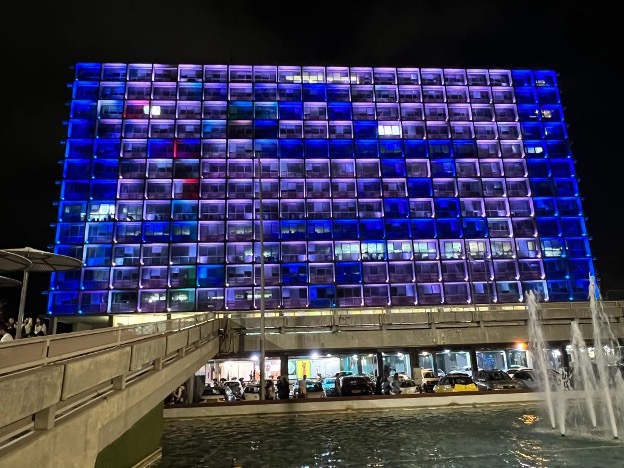
Off we went, walking 45 minutes to Rabin Square. We walked through Shuk HaCarmel where there were people celebrating and stalls open. We walked through groups of people celebrating and you could feel the energy. By the time we got to Rabin Square, the festivities there were over. The building was lit up and beautiful, however it was quite different than the last time I was here for Yom Ha’atzmaut, when Rabin Square was still partying when we left at 1 a.m. The impact of COVID and gathering was clear. On our walk to the hotel, it was amazing hearing the music pounding and seeing all the house parties celebrating Independence Day. I felt like I could have just walked into any of them and would have been welcomed and had a good time.
Tel Aviv lit up for Yom Ha’atzmaut.
We walked a few miles tonight from Jaffa to the old port in north Tel Aviv, going through Neve Tzedek, Shuk HaCarmel, and Rabin Square. Many people think Israel is dangerous and not safe. Nothing could be further from the truth. It felt safer than after an Orlando Magic game downtown.
Israel is an amazing country that must be experienced, felt, tasted, and seen. It’s incredibly vibrant and very diverse. It’s full of contradictions. And it’s incredibly beautiful.
Tomorrow is my last day here on this trip. As I go to sleep tonight, it’s the last night I’ll sleep in Israel on this trip. It’s sad for me. Being here inspires me and fills my spiritual cup. The good news is that I know I’ll be back and this is a temporary goodbye, or as Israelis say, “L’hitraot,” until we meet again.
Beit Issie Shapiro is a place I have heard about for nearly 20 years. It’s one of the preeminent advocates and programs for people with special needs in the world. They consult with the United Nations as well as many communities and organizations. Today I had the chance to visit for the first time.
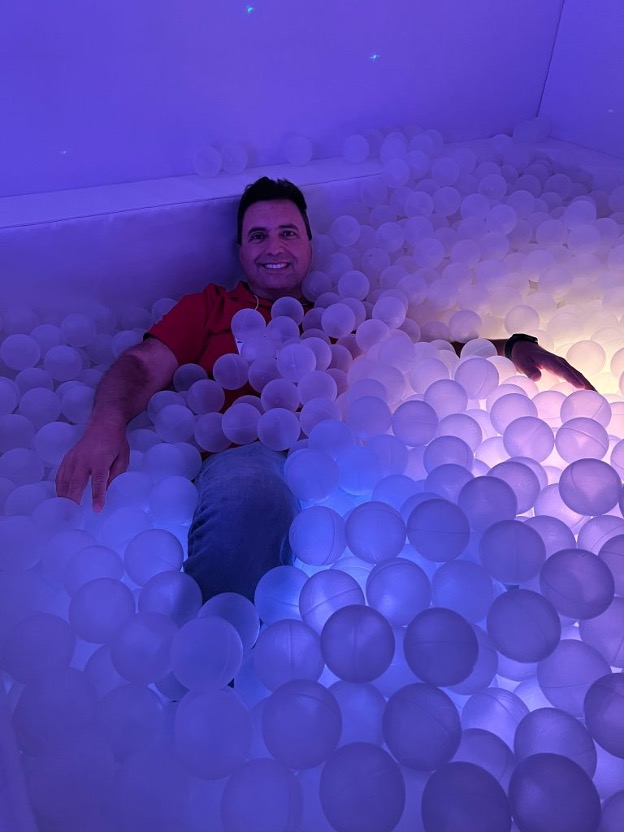
As I expected, it was impressive. We had an opportunity to learn from their staff about the founding of the program, the advocacy work they do, and their willingness to consult and help others who want to change the world. We got to experience their sensory spaces which were amazing. As we prepare to build our own sensory space, I asked for their assistance, and they quickly said yes! They offered to help any way they can so that we have the right design and set-up of our space. I had the chance to climb into their ball pit and didn’t want to get out—it was such a great space, so peaceful and relaxing with the lighting, sounds, and intentionality that created it. I can’t wait until we can offer that to people, as well.
Keith enjoying the ball pit at Beit Issie Shapiro.
Before leaving, we visited Friendship Park, a special playground for everybody including people with disabilities. Part of what they created is not just physical access but social access, so that people with disabilities aren’t ignored by those who do not have disabilities and further isolate them. It was inspiring to see Israel once again leading the world in social change and making the lives of people better. This is the part of Israel that usually is ignored in the media and not shared enough.
We left Raanana and headed to a Kibbutz to learn about their early childhood center and to explore their ‘Junk Playground’. Looking out at the age-appropriate playgrounds they created with their ‘junk’ reminded me of how I played as a child. We would find things and play with them. Old appliances, broken toys, whatever it was, we used our imagination and created things. These children have the opportunity to use their imagination and that inspired me. It’s so important to encourage imagination, and I’m proud that’s what we do in our Richard S. Adler Early Childhood Center. We ate a picnic lunch at the kibbutz and enjoyed the beautiful day and the beautiful location.
Our final ‘official’ stop for the day was the Peres Center for Peace and Innovation. I have known about the Peres Center for years, but never actually visited. My friend Rafael Kravec (z”l) was a childhood friend of Shimon Peres and a major supporter of the center, so I really have no excuse for not visiting before. The Peres Center is an amazing place. His Nobel Peace Prize is displayed there and the bottom floor highlights current innovations that Israeli companies are working on developing. Not all will work, however it showed exactly why Israel is the ‘Start up Nation.’ The ideas behind these projects were amazing and some of them will change the world. One in particular allows you to put stickers on things in your refrigerator and then you get notified if they are going bad or running out. Imagine never wondering if your milk is bad or if you need milk!
We headed back to the hotel in North Tel Aviv from Jaffa in 5 p.m. traffic. This means it took 45 minutes to get there—it felt just like being on I-4, except I was a passenger on a bus and didn’t have to drive in it. Our bus driver Mohammad was amazing, and I need to mention him because he truly has been a miracle worker driving our bus. The things I’ve seen him do with a huge charter bus are amazing.
Last year, we were lucky to have two amazing Shinshinim (young Israelis doing a gap year before their military service to bring Israel to our community). Maya and Ariel are amazing and unfortunately, we needed to take this year off for many reasons. Our new Shinshinim, Gil and Avia, are two amazing young women and we had a chance to meet them in person tonight! Gil lives in the Negev and Avia lives in the Galilee. They are going to bring so much to our community, and I’m really excited for them to arrive in August. We are still looking for home hospitality for them and those that hosted Maya and Ariel will tell you it was an incredible experience.
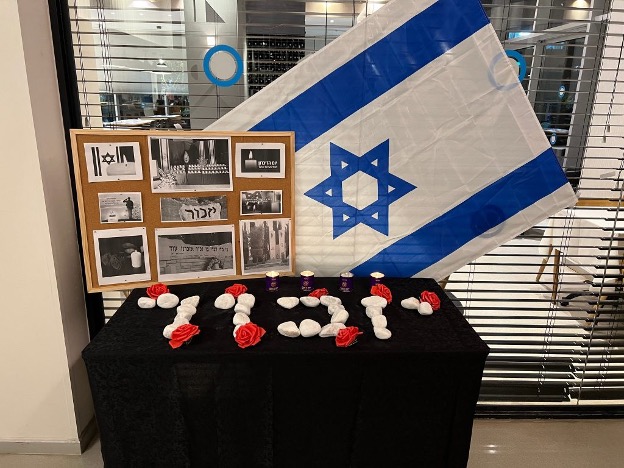
Tonight began Yom HaZikaron, Israel’s memorial day. Unlike Memorial Day in the US, which is a 3-day weekend filled with barbecues and sales, here in Israel it is a somber remembrance of those lost in war or as victims of terrorism. We prepared for its beginning as a group with some powerful written words that were deeply moving. At 8 p.m., a siren goes off across the entire country for a minute, with people stopping what they are doing to remember. Tomorrow at 11 a.m., another siren will go off for 2 minutes, reminding us again of the cost of freedom.
A memorial for Yom Hazikaron.
We went to the beach tonight to listen to the siren while looking out over the Mediterranean Sea. As the siren began to sound it was incredibly powerful. I was overtaken with emotion, thinking of all those who sacrificed so I could stand on the beach in Tel Aviv tonight. So that I could explore the Old City of Jerusalem, pray at the Kotel, wander the streets of Jerusalem. So that I could enjoy the beauty of the Golan, the Negev, and the Judean desert. So that I could climb Masada and float in the Dead Sea. I realized just how big a debt of gratitude I owe to these people and their families. As I listened to the siren and stared out into the beautiful night looking out over the water, it was incredibly moving.
In many ways, I think Israel is best represented by Yom HaZikaron and Yom Ha’atzmaut (Israeli Independence Day, which begins tomorrow night). Tonight and tomorrow are deeply emotional, filled with sorrow and gratitude. It is a time for reflection and the country mourns. And then tomorrow night at sunset, the mood changes instantly. It is celebration and parties. It is the 4th of July, Israel-style. It might be the most fun day of the year. These 48 hours covers every emotion a human being can feel. And this is totally Israel—chaotic, far from perfect, incredibly wonderful, beautiful, challenging, spiritual and secular. It’s why I love Israel so much.
Haifa is a beautiful city with the Mediterranean Sea on the west and the Carmel Mountains on the east. It’s a city that thrives on coexistence and in many ways is a model to be replicated. Today started with a view of the Bahai Gardens from the top of the mountain. I always love when I can walk into them and have had the opportunity to walk through them. Unfortunately, today they were closed so we had to look through the gates. Still magnificent.
We visited a school that educates both Arab and Jewish children together. This is not incredibly common in Israel. This school has 9 branches and we got to visit the one in Haifa. While there, they told us there are only 2 other ones in the country. As we think about building community and getting to know others, this highlights how important it is to reach beyond the Jewish community to get to know your neighbors who may be different from you. It made me think of my friend Atif and the relationship we have built. I am Jewish, he is Muslim, and we have great respect for each other and have developed a wonderful friendship. We need more of this in the world and it starts with us in our local community.
The group in Haifa.
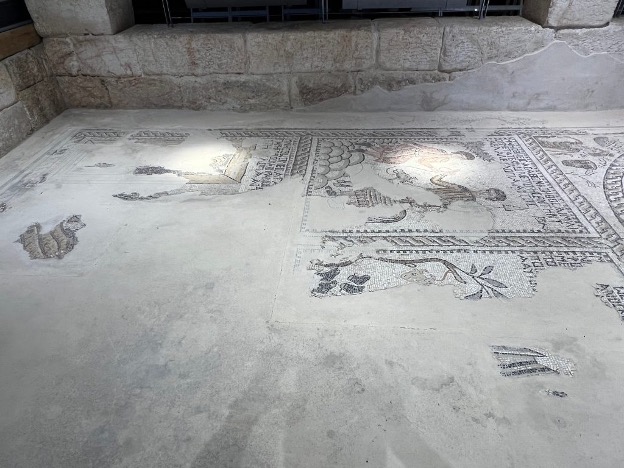
We left Haifa and drove to Tzippori in the lower Galilee. I love the Galilee. It is incredibly beautiful with the mountains and the valleys and the flourishing foliage. A number of people on the trip commented how it looked like either Napa or Tuscany. Tzippori was home to the Sanhedrin, the Jewish legal ruling body, after the destruction of the Second Temple following its time in Yavneh, until the 5th century. While there, we had the opportunity to do some challenging work on debate of Jewish concepts and learn skills to bring back to Orlando to help challenge the way we think and push forward with better decision-making. We also had the opportunity to see a synagogue that is over 1,800 years old. The floor had an incredible mosaic that remains beautiful to this day. Sitting there, looking at the beautiful mosaic on the floor, it was easy to imagine the Jewish community praying there 1,800 years ago. Today I stood there. The power of the Jewish people is that linking of generations—me today with the Jews in the year 200. It was pretty amazing.
The ancient mosaic.
Lunch was at a winery in a village that houses people with special needs. It was amazing to hear about the village, the work that the people with special needs do, the life that has been built for them in the village, and eat some delicious food. For those that wanted to participate, there was a wine tasting of three different types of wine that comes from their vineyard. It was a pretty wonderful afternoon as we had a chance to see an example of how Israel provides for people with special needs. I found myself thinking of our own RAISE program and the way it changes lives. I felt proud to know that there is a connection between Israel and Orlando through our work with job skills and training for those with special needs.
Off we went to Tel Aviv, the final city in our journey. I spent time before this cohort began in Tel Aviv and it was great to be back. We checked in, dropped our bags in the room, and headed to Shuk HaCarmel before it closed. We had a great time walking through the shuk, laughing, talking, and being tourists for a brief time. After buying too much stuff, we decided to walk back to the hotel. It was a nice 45-minute walk through many different neighborhoods on a truly magnificent evening. We left at dusk and walked in the dark.
Israel is often portrayed as dangerous, however when you are here, you realize just how safe you really are. We walked, talked, and enjoyed the differing neighborhoods. We turned onto the road next to the beach and enjoyed the stunning evening along the Mediterranean. After dropping off the things we bought in our rooms, we headed 2 blocks north to the old Port of Tel Aviv for dinner. Eating at a seafood restaurant, we continued the conversations, enjoyed amazing food (and they gave us WAY too much once again), and relaxed. Once again, we were struck by the way dinner went. The timing is much slower, there is no rush to give you the check or to get you to open your table. Dinner ends up being so much more than eating, as you have time to really talk and spend time with the people you are eating with. It’s a little thing that I will miss greatly when I return home.
We in America have it wrong. Going out to dinner isn’t about filling our bellies, it’s about using the time that we eat to build relationships, get to know people, learn, and experience friendship.
Tomorrow night starts Yom HaZikaron, Israel Memorial Day. Unlike our Memorial Day in American, this is not a long weekend with barbecues and vacations. I have spent Yom HaZikaron here once before and it was incredibly moving. I am looking forward to another powerful experience tomorrow.
Shabbat. Often misunderstood in America, and defined by what you can’t do. During every Israel trip I have every been on (all 19 of them), Shabbat has focused on what I CAN do: REST!! The week is so meaningful and full and busy and nonstop that by the time Shabbat arrives, the gift of rest is welcomed and embraced. I fell asleep not long after dinner last night and slept without an alarm, waking up when my body told me to. I showered and headed off to my friends Margot and Tamar’s house to have brunch with them and spend time with them and their 3 children.
The walk to their home is only about a 15-20 minute walk from my hotel and as I walked, I was completely aware of how quiet Jerusalem is on Shabbat morning. Very few cars were on the road. There was no hustle and bustle of an active city. I saw many people walking to synagogue and wished them ‘Shabbat Shalom.’ It was a beautiful day and a beautiful walk. I arrived and Margot and her oldest daughter Haleli were the only ones home, as Tamar and their sons Michael and Lavi had gone to the Arab village of Abu Gosh to get more things for brunch. Abu Gosh makes some of the best hummus in the world, so I was excited for them to come back. Haleli is 7 and she did her reading assignment with me (she has to read out loud and then the person listening has to sign her sheet). Her reading was amazing, and I followed along since I can read Hebrew but don’t understand most of it. I got to be the first person to sign her sheet this week!
When Tamar, Michael, and Lavi returned, they had wonderful goodies. Margot had made shakshuka, so we ate wonderful food. Lavi couldn’t wait to get his hands on the fresh falafel balls and ate two right away. The day was filled with relaxation, fun, family, friends, and connection. We played with a magnetic building kit and laughed and had fun. Lavi took a nap and Haleli and Michael put on their costumes and paraded around as Queen Elsa and Spiderman before changing to a different Elsa costume and Batman. It was so wonderful and fun and meaningful. We watched Gnomeo and Juliet (since my kids are 19 and 22, this is not the type of movie we watch any longer) and they sat on the couch with me, eating popcorn, laughing, and having fun.
Keith with Margot and Tamar’s family.
One of my favorite things about Israel is the people and the friends I have here. This trip alone has given me the chance to spend time with Daniel, Adam, Hallel, Irit and Avi, Margot and Tamar and the kids, plus time with new friends like Rachel and Fleur, and there are more I hope to get to see. Israel truly is family. The Rabbi at the Kotel knew Rabbi Lipskier and that’s not the first time the Rabbi I met at the Kotel has known somebody where I live. Walk around and talk with Israelis and you will get more Shabbat dinner invitations than you can imagine!
As strange as it may sound, today is my favorite day of the trip because it allowed me to be Keith, visiting friends in Israel, playing with their children, catching up on life, eating great food, and just being a human being. I think that is the essence of Shabbat—step back, relax, look at the world around you and appreciate the amazing beauty that exists not just in the world, but in our lives. It’s so easy to take it for granted. I look forward to getting to spend more time with Margot, Tamar, Haleli, Michael, and Lavi. I can’t wait to see the amazing things happening for Margot and Tamar, watch their children grow up, and see how they will change the world. They are my family and I love them, and getting to be with family in Israel is amazing.
There is more activity as Shabbat ends. Havdalah. The Old City for the Sound and Light show (which is truly amazing), and a delicious dinner with friends. But nothing will beat Shabbat spent with my friends and their children.
Today was a basic day. We had two places to visit and that is it. But what an amazing two places.
Our first place to visit was Masada, King Herod’s amazing mountain resort in the Judean desert. We took the long drive from Jerusalem to Masada in the morning through the beautiful Judean desert. Having just spent a few days in the Negev, it was amazing to see how different the Judean Desert looks than the Negev Desert. It is certainly true that deserts are not all the same.
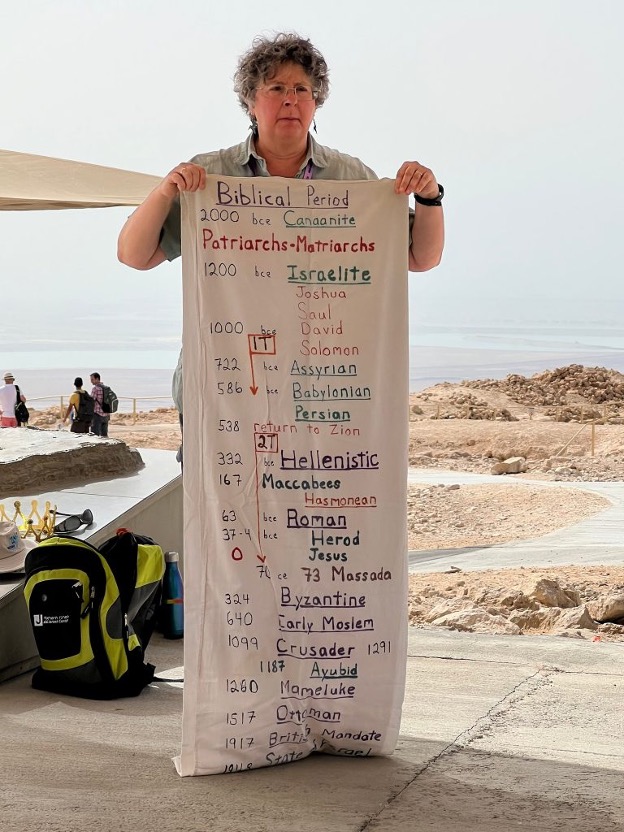
Due to timing challenges, we took the cable car to the top. I always enjoy walking up either the Roman path or walking up and/or down the snake path, but that wasn’t to be for this trip. At the top we began to explore Masada, its history, the history of the Jewish people and the land, and how it all intertwines. The role of King Herod, his close friendship with Marc Antony, his paranoia, and his amazing ability to build. The combination of all that has left landmarks from what was the Second Temple to Masada to Caesarea, among many other things in the land. I have been to Masada many, many times and the story is a captivating one. I enjoyed the movie and mini-series they did about it. If you aren’t familiar with the story, I encourage you to learn about it.
When I am on top of Masada, recently I find myself thinking more about the archeologists uncovering the history. What it must have been like to find proof of the Jewish history on the mountain in the years 68-72 CE. The history of King Herod, who ruled before the common era began and died just as it did. How exciting it must have been for them to find the various items that not only are incredibly meaningful historically but incredibly meaningful Jewishly. You can see the fresco in my pictures that is over 2000 years old—what must it have been like to discover that? One of the amazing things about Israel is that not only does history come alive, so does biblical history. I remember years ago being in Caesarea just after they had found the first proof that a man named Pontius Pilate existed. I remember when they discovered the burial site of King Herod. I have been on an archeological dig here and the excitement we had just found a broken pottery shard will stay with me forever. Israel is a land of history and of hope, of story, and of fact. And when I’m on the top of Masada, I always say a quick thank you to King Herod for having the foresight to install WiFi. (While there is WiFi on Masada, obviously it wasn’t King Herod who installed it.)
A timeline of Masada.
We left Masada and headed to the Dead Sea. There are many spots that have beaches and access to the Dead Sea and the one we went to was a place I hadn’t been before. There were shops and food available, and we ate at The Lowest Bar on Earth. This is because the Dead Sea is the lowest point on earth (1,412 feet below sea level). After eating, changing into bathing suits and putting on water shoes (it’s a rocky beach, so you want water shoes to get there and when you go in the water), we walked in. The floor of this area of the Dead Sea was filled with Dead Sea mud. If you have never had the opportunity to put it on your skin, you are missing something special (you can buy it in the US). We dug the mud out and smeared it all over our bodies. The minerals are incredibly strong, and it leaves your skin incredibly smooth.
As we walked a little further, we began to encounter mud pits where you would sink. I think I ended up sinking in the most mudholes of our group! It was like quicksand in the old Saturday morning cartoons. One minute I was standing, and the next my leg had sunk to mid-thigh. We laughed each time and I managed to pull myself out without too much trouble. We floated as you only do in the Dead Sea—just sit back and you are like a raft in the pool. It’s an amazing feeling that never ceases to amaze and doing it with people who have never experienced it makes it even more fun. We finished our time at the Dead Sea and headed back to Jerusalem for Shabbat.
Floating in the Dead Sea.
We chose to do our Kabbalat Shabbat service overlooking the city at the Haas Promenade. It was a beautiful area with a great view of Jerusalem. As we began to welcome Shabbat, the smell of a Muslim family preparing grilled meat to end their Ramadan daily fast wafted over us. It was a fitting way to end the week and welcome Shabbat. In Jerusalem, with a mixture of cultures, with a truly historic view. We walked back to the hotel (I love all the walking we get to do in Israel) and joined together in the hotel dining room for Shabbat.
It has been a thoroughly meaningful and inspirational week. I’ve learned so much to apply to my life and my work. I’ve been able to spend meaningful time in conversation with my colleagues at The Roth Family JCC as well as other JCCs around the country. And Shabbat will let me rest and recharge to prepare for the next week here.
I’m incredibly grateful that I am privileged to be here now and that I have been able to come here so many times. It is something I don’t ever take for granted and appreciate greatly. And it’s why I encourage everybody to find a way to come to Israel and to explore. It’s not just the country or the religions that dominate the country here, it’s the personal exploration and inner development that happens while you are here. It leaves an imprint on your soul.
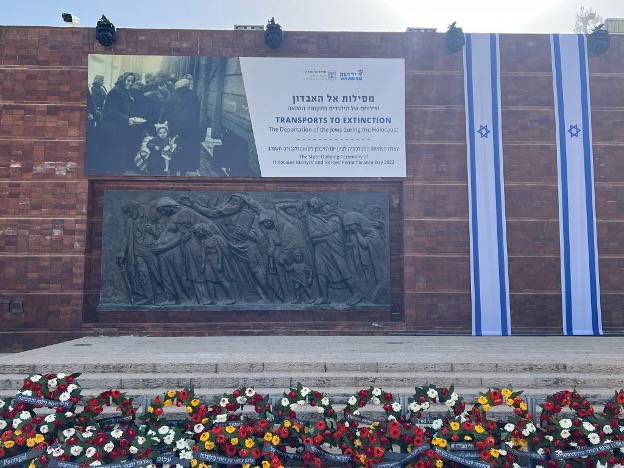
Today was Yom HaShoah, Holocaust Remembrance Day. I have never been in Israel for Yom HaShoah and as you know, last night was incredibly impactful and meaningful as I had the chance to hear from Ruth, who was a part of the Kindertransport in 1939. Today was mainly spent in two locations, each very powerful and meaningful places.
We began the day by going to the old city of Jerusalem. I love the old city. Wandering the streets of the Jewish quarter, the Armenian quarter, the Christian quarter, and even parts of the Muslim quarter. There is a feeling in the air, the smells and sounds are different, and it’s easy to close my eyes and feel like I am 2,000 years ago when I’m in the old city.
Today began a little differently. We entered through the Dung gate (this was the gate used to remove trash, hence the name) and went to the egalitarian part of the Kotel. I have spent time at the men’s side of the Kotel and on the plaza may times, however I have spent very little, if any time, in the egalitarian part. I have always believed it was very important to have this sacred space, but it was never a place I really wanted to go. I love my experiences on the men’s side.
I was struck by a number of things as we began the day here. First, was how different this space was compared to the men’s and women’s sides of the Kotel. It felt less than, and I wasn’t as connected. There was another group there praying and they were singing the melodies I’d hear at synagogue rather than the ones I hear at the men’s side. It felt much more modern and I found myself distressed that the egalitarian side didn’t have the same experience as the men’s or women’s side. Why should it be any less than? Perhaps it really isn’t, and it’s just my own expectations and desires. The image of the paratroopers in 1967 is a powerful one for me and has always defined the Kotel. This section is definitely not in that image. It made me think about the inequality at the Kotel and wonder why we do that to ourselves. Shouldn’t everybody have equal access to this powerfully spiritual space? It left me with more questions than answers.
A view of the Kotel from the top of the Aish HaTorah building.
We left the egalitarian section and headed to the main plaza. As one of two men on this trip, I walked away from the group and headed toward the men’s section. It was almost 10 a.m. and that is when the siren sounds in Israel on Yom HaShoah. I chose to wait on the plaza for the siren before entering the men’s area. When the siren began, I felt wrapped by the sound. It enveloped my entire body and as I stood there, facing the Kotel, all I could think about was the 6 million Jews who perished in the Holocaust and never had a chance to experience the Kotel. Six million Jews who didn’t get to have this direct connection with Israel and whose lives were cut short for no reason other than hatred. I found myself wondering why we continue to say ‘Never Again’ yet watch as it does happen again to others, like what is happening in Ukraine right now. I found myself wondering if I was going to be one of those who stood by and did nothing, or would be one who acted and did what they could to make a difference. When the siren ended, a group of teens next to me began singing Hatikvah, the Israeli national anthem, and I joined in fervently. It felt right to be singing Hatikvah on Yom HaShoah, at the Kotel, right after the siren remembering those murdered by the Nazis.
When I went into the men’s section, I stopped to put on tefillin before approaching the Kotel. Amazingly, there was a perfect spot for me at the Kotel and I took it. I took the two prayers I had written and brought with me out of my pocket, said them one after the other, and placed them both into the Kotel. I closed my eyes, put my forehead against the Kotel, and began to pray. For the first time, I lost myself in prayer at the Kotel. It was a powerful and meaningful experience, shaped by many, many prior trips to the Kotel, as well as it being Yom HaShoah. More than 12 hours later, I still feel the energy running through me from this time at the Kotel.
I rejoined the group and we explored the Old City before breaking for lunch. I have a favorite jewelry store in the Cardo that I have been shopping at for years. Named for its owner, Mira, I always go by and talk to Mira, usually buying a gift or two (or more). I hadn’t seen Mira since 2019 and was excited to see her, reconnect, and talk. I was shocked to find out that she had died a few months after the last time I saw her. I was surprised how much it hurt to know she was gone since I only saw her for 20-30 minutes once a year, at most. I went into the store and talked to her son, who now runs it. We talked about his mother and how special she was. He told me stories of his young children and what they remember about their savta. It was heartwarming to make a connection with him about Mira. I think every time I see that sign, I will miss her a little more.
Unlike most trips I have taken to the Old City, this one concluded by visiting the Christian quarter and the Church of the Holy Sepulcher. I have been there before, however our tour guide provided a great overview. It’s a powerful place to visit, as I get to watch others have the same type of experience that I have at the Kotel. From the place Christians believe Jesus was crucified to where his body was prepared for burial to the burial cave, it is both beautiful and powerful. There are five different denominations that call the Church of the Holy Sepulcher home, and to see them all there was interesting.
We left the Old City and went to Yad Vashem, Israel’s Holocaust Museum. Because it was Yom HaShoah, the museum part of the complex was packed with people and so we didn’t go into the museum. Instead, we focused on other areas of the campus. We walked around and through the Pathway of the Righteous unto the Nations and saw the tree planted for Oskar Schindler and his wife.
I saw a tree planted for a couple from Ukraine and wondered who would be the Righteous unto the Nations to help people in Ukraine now?
We went to the Children’s Memorial, which is always very emotional for me. Before walking in, we stopped at the memorial for Janus Korczek. For those who don’t know who he was, Janus Korczek was a very famous children’s author. He was Poland’s equivalent to Mark Twain, and his books were similar to Tom Sawyer and Huck Finn. He was the principal of an orphanage in Warsaw and in 1942, the Germans came to liquidate the ghetto and took all the orphans to the train station to go to Treblinka. As he approached the trains with the children, one of the SS Guards recognized him and told him he shouldn’t get on the train and was going to save him. Korczek told him that ‘where my children go, I go.’ He boarded the train with the children from the orphanage and they all were murdered at Treblinka. I was struck by the power of responsibility and obligation. Of selfless service to the children so they didn’t have to go alone in terror. What a great man to learn from, 80 years after his death.
We entered the children’s memorial and as usual, I gulped entering. It’s dark with candles and mirrors, making it seem like all the stars in the sky. As you begin to walk through, the names of the 1.5 million children murdered in the Holocaust are read. My prior experiences have usually involved the thought of my own children’s names being the ones that were being read and what that would be like. It was terrifying and immensely sad. My children are now 19 and 22. Their names wouldn’t be read; they would be in the main museum. I realized that my future grandchildren would be the names that were read. Or the little girl that I made pita with yesterday in Yerucham. It was a powerful realization about life. And then I heard the names of children from Ukraine. It was like a slap in the face. It happened in the Shoah and it’s happening again now. It was incredibly sobering and made me angry.
Outside at Yad Vashem.
As we exited the children’s memorial, we went to a park-like area to sit and debrief. As we discussed what we felt and experienced, I found myself looking out beyond Yad Vashem onto the modern city of Jerusalem and feeling hope. Despite losing 6 million of us during the Shoah, despite odds far against us in wars with our neighbors, we have persevered and overcome.We have not only survived, but we have also thrived. Israel is our growing, living testament to that.
We left Yad Vashem and returned to the hotel. Melissa, Fara, and our friend Lauren joined me as we walked back to the Old City to enjoy the view of the Kotel plaza from the roof of Aish HaTorah. I have a friend who works there that showed us a bit of Aish and then took us to the roof. I have been there before, however the view is so magnificent that it still takes my breath away. We stood on the roof absorbing the power of the view and talking. The time passed quickly and suddenly it was time to leave for dinner.
Nigh view from the top of the Aish HaTorah building.
We wrapped up the day with Dinner at First Station (the old train station). It’s a hot, hip, and fun area with some great restaurants. I made reservations at the steakhouse, having eaten there before, and knowing how great the food is. We ate, laughed, talked, and wrapped up the day. It truly was a fitting end to Yom HaShoah; laughter is life, and while Yom HaShoah remembers those whose lives were stolen from them, it also allows us to have hope and look to the future.
During our time this morning at Robinson’s Arch, the egalitarian section of the Kotel, a poem by Rabbi Lawrence Hoffman was read. One line stood out to me:
Pilgrims allow places to pass through them.
That’s how I feel about Israel. Israel, particularly Jerusalem, passes through me, leaving permanent imprints on my soul, like the river does to the rock.
Waking up in the desert is always something special. After breakfast, I took a short walk to Aroma to get my iced coffee, and the weather was amazing. I didn’t want to get on the bus and go anywhere—just enjoy the weather and the beauty of the desert. But I did get on the bus, and off we went.
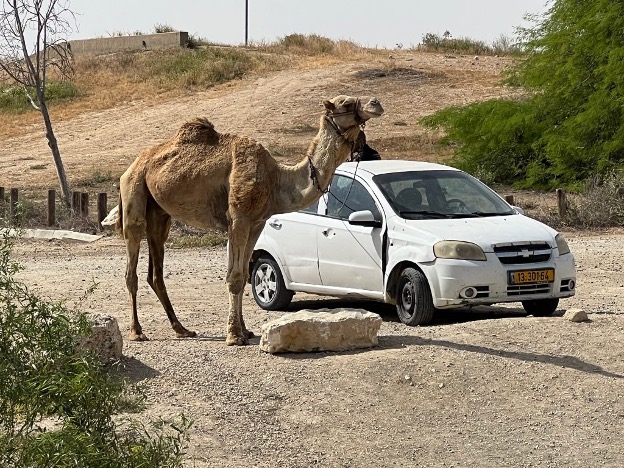
We spent the morning in Yerucham, the partnership city of the Greater Miami Jewish Federation. I’ve heard about Yerucham for years but have never visited. It was a very cute town that looked and felt like most small towns. We began by visiting a park with a beautiful lake. As we looked out over the lake and learned about Yerucham, all of a sudden, a car drove up with a camel tied to the door, running alongside! We were all shocked at what we saw. The driver parked, got out, untied his camel from the car and took him to the water to drink and some bushes to eat. It was one of the most bizarre things I have seen—a camel tied to a car, running alongside it.
The camel and its car.
We left the lake and headed to one of the many early childhood centers in Yerucham. Interestingly enough, while they have many centers that run independently, they are all under the supervision of the same person. Since this is Israel and we are currently counting the Omer, they had the 2- and 3-year-old children outside grinding wheat. They also had them making their own pita bread, kneading the dough. The little girl sitting next to where I was standing wasn’t doing anything with her dough, so I started to show her how to do it and we did it together. We had so much fun and this little girl stole my heart. As we left the school, she blew me kisses and my heart melted the way only a little child can make it melt.
We visited a facility that takes care of the needs of children. In Israel, they have something called tipot chalav, or “drop of milk.” This is a medical center that provides all the healthcare needs for children. Vaccinations, wellness checkups, etc. They place these facilities in neighborhoods to make access easy for families with young children to ensure the children are healthy. It was truly amazing to learn about and see in practice. The sensory rooms were amazing and there was much to learn.
The community center was our final stop before lunch. It was a combination of a public library and community center. It was fascinating to see how they are both different from our JCCs and how similar they are. How we share many of the same challenges and are coming up with similar solutions. It inspired me to have colleagues in Israel addressing the same things, which means that maybe the challenges we face aren’t so unique!
For lunch, we went to an interesting restaurant. It is a place in somebody’s home that is part of a program that retired women started to cook for tourists, keep themselves busy, generate revenue, and share their stories. What started as one has now grown to five or six in Yerucham. The food was delicious, and afterward we heard from two women about the program and their personal story. It was truly inspiring.
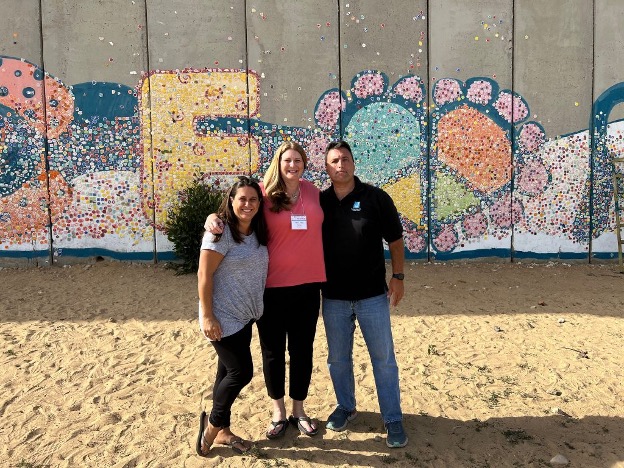
While it felt like we’d already had a full day, we weren’t close to being done. We left Yerucham and traveled to Nativ HaSarah, a small village right on the border of the Gaza Strip. We met with a woman who lives there and has endured the challenges of all the rocket attacks. As an artist, she decided to do something creative and created an organization called Path to Peace. Using her art, she is decorating the walls protecting the town. We heard her story and then got to select a small piece of pottery that spoke to us, write a message on the back, and take it with us to the border to place it on the wall, filling words like Peace, Shalom, etc. This artwork faces Gaza so the people living there can see it. It was incredible to be right at the border with Gaza and to imagine what it is like to have 5 seconds to get to safety when the alarm goes off. It was depressing to see the children’s school bus stops are bomb shelters. We can all hope and pray for peace throughout the world, however standing at the Gaza border, I felt no hope. On the other side of the fence, Gaza looked so bleak to me.
Keith, Fara Gold, and Melissa Youngblood at the Path to Peace wall facing Gaza.
We left the border and headed north toward Jerusalem, but we had one more stop before returning to our hotel. As the dusk began, so did Yom Hashoah (Holocaust Remembrance Day). I have never been in Israel for Yom HaShoah. Our stop was to meet Ruth and hear her story as one of the Kindertransport children, who in 1939 left their parents and families in Germany and traveled to London to escape the Nazis and the death camps. She was 13 when she left her family to board the train that would eventually take her to London. At 97-years-old, Ruth often needed her daughter to repeat the question, however her memory of 1939 was crystal clear.
Hearing her tell the stories of how things changed for her and her family was horrifying and inspiring. It was heartbreaking, and yet knowing she survived and has two children, six grandchildren, and a number of great-grandchildren gave me hope for the future. Ruth was lucky in many ways—she went to London to a boarding school for refugees and was treated well. Her parents were able to get out of Germany and they were reunited, although she didn’t live with them for a 3-year period. She told us the story of her husband, who also escaped but lost his entire family to the Nazis. Her daughter told us how her father (z”l) would never speak about his childhood and wouldn’t share any information about his parents, siblings, aunts, or uncles. He refused to speak German and wouldn’t buy anything German. Her aunt (Ruth’s younger sister) still lives in England and refuses to discuss the Kindertransport or anything about Germany. This was a very special way to mark Yom Hashoah; even our visit to Yad Vashem tomorrow, also on Yom Hashoah, may not have the same impact as Ruth.
We left and headed to Jerusalem. I always love seeing the lights of Jerusalem when you enter the city at night. After checking into the hotel, I sat on my balcony looking out at the beauty of the city and took a few pictures to share. It truly is the City of Gold, and I’m excited to spend a good part of tomorrow exploring the Old City, which never gets old for me. A few of the people on the trip are here for their first visit to Israel, and being with them as they experience Jerusalem for the first time is also exciting.
At the Seder each year, we finish by saying, “Next year in Jerusalem.” This year, I was able to say, “Next week in Jerusalem” (even though it was really more than a week) and I’m so happy to be here.
Today was all about the Negev Desert. We began in Mitzpe Ramon at the crater. It was incredible to see Israel’s Grand Canyon in person set against the beauty of the Negev Desert. It was miles long and miles wide and truly massive. It was incredible to sit looking out at the crater and the Negev in silence and just feel the power of the desert. It is said the desert talks to you if you are quiet, and I definitely felt that today. This was a spirituality that exists that words don’t codify.
We left the crater and headed to Sde Boker, the kibbutz in the Negev where David Ben Gurion, Israel’s first prime minister, is buried. He believed the future of Israel was in the Negev, and in his late 60s retired as Prime Minister to join the kibbutz and live in the desert. We visited both his grave and the grave of his wife Paula, who are prominently buried in a beautiful site. We then walked around Sde Boker and headed to the part of the kibbutz dedicated to his memory which also includes the house that he and Paula lived in.
We learned a lot about the history of the kibbutz and about Ben Gurion—who he was, how he led, and what a truly amazing visionary and man that he was. We had a chance to do some leadership and teamwork exercises together that were very interesting and I learned a lot about myself and others to bring back. I’m excited to continue processing what teamwork really means and how competition can either enhance or destroy teamwork.
We had a chance to explore Ben Gurion’s home in Sde Boker. It is preserved incredibly and the home was very modest, although a little bigger than I expected based on how it’s called a ‘hut’ and how the level of modesty was played up. He and Paula had separate bedrooms and it was interesting to see the difference between them. They had a small kitchen, which most homes on the kibbutz did not have, as there was a communal dining room. We were told that Paula insisted upon it because she didn’t trust the food in the communal dining room! The biggest two rooms were the living room and Ben Gurion’s office.
Ben Gurion’s home.
The overall visit made me want to read more about the life of David Ben Gurion. I knew a lot, however he was much more complex and deep than I knew and I think there is a lot I can learn by learning more about him, the decisions he made, the challenges he faced, and how he lived his life. I also didn’t realize just how short he was—I thought he was around 5’6, however he was really only about 5’1.
Our next stop was at the Ramat Negev Desert Agroresearch and Business Center. Scientists from all over the world come there to study how to best develop solar energy and to harness the desert. They have a huge solar tower and are generating huge amounts of energy. They are finding new ways to grow fruit and vegetables in the desert, and we had a chance to taste some amazing strawberries they grow there. They are finding ways to maximize crop development so the desert can provide both significant food and revenue.
Our final stop was back at the crater. We saw it that morning with the sun rising and we had a chance to see it in the evening, as well. The view was different at each time of day and it was quite meaningful both times.
Mitzpe Ramon.
The Negev is truly beautiful and impressive. Making the desert bloom is a reality, and seeing what they are doing with energy and agriculture is astounding. I have spent time in the Negev on previous trips, including sleeping out in the desert for two nights on my first trip—which was quite an experience—however today was the first time I felt the desert truly spoke to me. I could spend days in Mitzpe Ramon at the crater just being and experiencing the power and beauty of the Negev. It was meditative and peaceful.








 keithdblog