October 7, 2023 was a terrible day. I sat in my living room, captivated and horrified by what I was seeing on television. Hamas terrorists had attacked Israel and murdered innocent civilians. Women, children, infants, teens, seniors, Jewish and non-Jewish, it didn’t matter. They were bloodthirsty and out to murder. The reports came in about the rapes and the kidnappings. The taking of hostages. I remember 1978 and 1979 and the Iranian hostage crisis. I remembered how I felt as an American when they were taken and held as hostages for 444 days. I was angry at our government. I was angry at President Carter. I stayed up as an 11 and 12 year old boy to watch the new TV show, Nightline, that updated us every day on the hostage crisis. I hoped every night to hear something positive but didn’t.
On October 7th, my friend Maor Elbaz-Starinsky, who is also the Consul General for Israel to Florida (and other states) called me, begging me to turn off the TV as it wasn’t healthy to keep watching this horror. I told him I couldn’t. October 8th, Florida Senator Rick Scott called me to check on me and make sure I was doing ok. I wasn’t and told him so. He asked what he could do to help and I didn’t have an answer for him at that time, only thanks for calling. He posts on social media about the hostages every single day. Every day. Without fail.
Since October 7th, the hostages have been on my mind daily. I can’t imagine what they are going through. A friend of mine had two cousins that were hostages. The daughter was released the day before she turned 13 and we made sure to get her birthday and Hanukkah presents. It mattered. The videos of her getting them are priceless. The other was released two days after her daughter.
I have been to Hostage Square in Tel Aviv. I have been to the Hostage Center in Tel Aviv and heard two fathers speak about their sons who were, and are, hostages. I have heard Rachel Goldberg Polin speak in Washington DC at the rally on the National Mall in October 2023. I have twice visited both the Nova site and K’far Aza where hostages were taken. I say the Acheinu prayer for the hostages every day. They are never out of my mind. So when I read this piece by Jon Polin, it hit home. We all need to remember the hostages every day. Read his thoughts and I hope you take action.
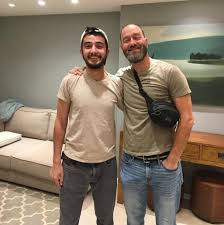
Below is the op-ed written by Jon Polin, Hersh Goldberg Polin’s father, published last week in Makor Rishon.
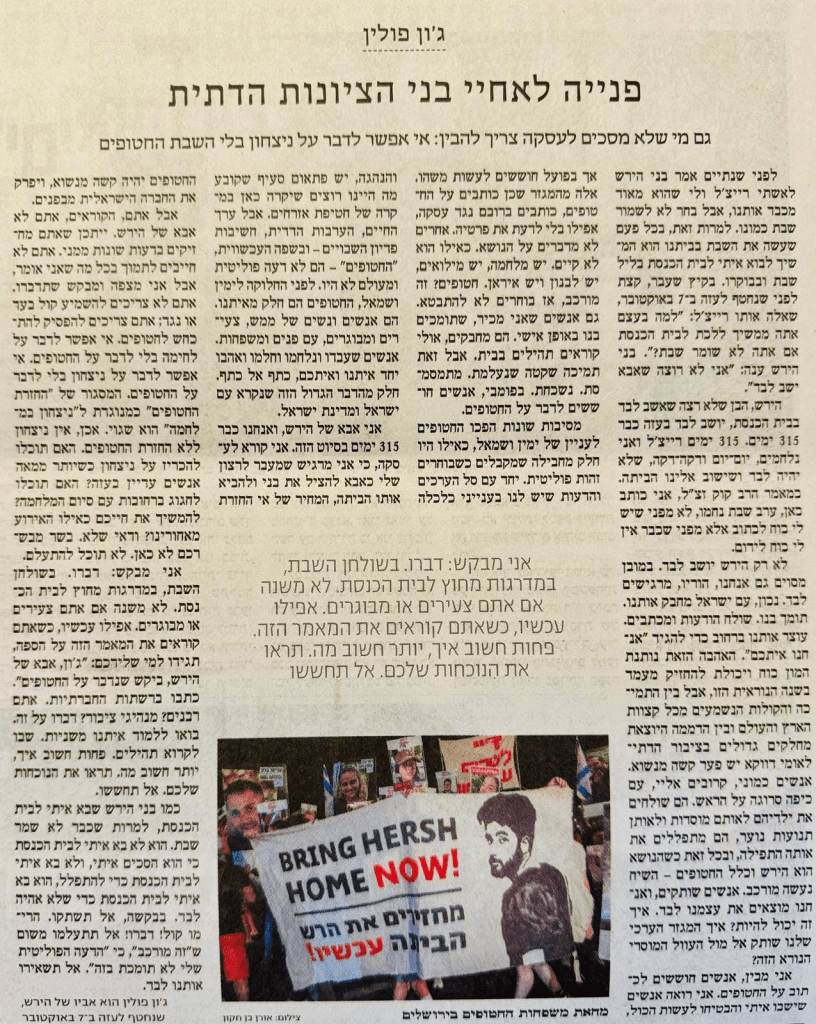
An Appeal to My Religious Zionist Brothers by Jonathan Polin
Two years ago, my son Hersh told my wife Rachel and me that he respects us very much, but he was not going to be observing Shabbat as we do. Despite this, every time he was home, he continued to come with me to synagogue, both on Shabbat evening and morning.
Last summer, shortly before he was kidnapped on October 7, Rachel asked Hersh, “Why do you keep going to synagogue if Shabbat is not speaking to you at this time?” and he answered, “I don’t want Dad to sit alone.”
It has been 308 days, and now Hersh, the son who didn’t want me to sit alone in synagogue, sits alone, held captive, in Gaza. It has been 308 days that Rachel and I fight, day after day, minute after minute, so that Hersh will no longer be alone, and he will come home to us. As Rabbi Kook said, I am writing here, on the eve of Shabbat Hazon [the Shabbat before Tisha B’Av], not because I have the strength to write, but because I no longer have the strength to stand.
It is not only Hersh who is alone. In a way, we, his parents, also feel alone. True, the people of Israel embrace us, love us and support us. They send messages and letters. They stop us in the street to say “We are with you.” This love gives us enormous strength and the ability to endure this terrible year. But the gap between the support and the voices heard from all over the country and the world, in contrast to the silence coming specifically from large parts of the national religious public, is challenging.
These are people like me, who are close to me, with a knitted kippa on their head. They send their children to the same institutions and the same youth movements; they recite the same prayers, and yet, when the subject is Hersh and the other hostages, the conversation is complicated. People are silent, and we find ourselves alone. How can that be? How is it that our value-based sector is silent in the face of this terrible moral injustice?
I understand that people are hesitant to write about the hostages. I have met with people who sat with me, promising to do everything, but in action, they hesitate to do anything. And those from the religious sector who write about the hostages—mostly write only against a deal, without even knowing its details. I see that people don’t talk about the issue of these innocent human souls being held hostage, as if it doesn’t exist. There is war, there are reserves, there is Lebanon and there is Iran. The hostages? “It’s complicated,” and they choose not to speak. Even people I know, who support us personally. They hug us. Maybe they read tehillim [psalms] at home. We are grateful to them for their quiet prayers. But this is a silent support that disappears. Dissolves. In public, people are afraid to talk about the hostages.
For varying reasons, the hostages have become a matter of right and left. As if they are part of the package you get when you choose a political identity. Together with the basket of values and opinions we have regarding the economy and leadership, there is suddenly a line determining what we would want to happen here if our citizens are taken hostage.
But the value of life, arvut hadadit [mutual responsibility], ransom of captives, or in the lexicon of today – the “chatufim (kidnapped)” are not a political issue and they never were. They are not about the division into right and left; the hostages are part of us. They are real people, men and women, young and old, with faces and families, people who worked and fought and dreamed and loved together with us and you, shoulder to shoulder. Part of this great thing called the nation and state of Israel.
I am Hersh’s father. We are already 308 days into this nightmare. I am calling for a deal, because I, personally, feel that beyond my desire as a father to save my son and bring him home, the price of NOT returning them will be an unbearable blow to our national identity and will tear Israeli society apart from the inside.
But you, the readers, are not Hersh’s father. You may have different opinions than me. You clearly don’t have to support everything I say, but I expect, and ask, that you speak up. You don’t need to take a public stance for or against, you do not need to yell. But you need to stop denying the existence of the hostages. It is impossible to talk about the war without talking about the hostages. You can’t talk about victory without talking about the hostages.
This framing, as if the “return of the hostages” is somehow in opposition to “victory in the war”, is wrong. There really is no victory without the return of the hostages. Imagine it for yourself: can you declare victory when more than a hundred people are still in Gaza? Will you be able to celebrate in the streets when the war is over? Continue your life as if things are behind us? Certainly not. “The flesh of your flesh” is not here. You will not be able to ignore it. What will you say after your 120 years in this world, when you face your maker and are asked, “Where were you when your brother’s blood cried out to you from the ground?” Where were all of us?
I beseech you: speak. At the Shabbat table or on the steps outside the synagogue. It doesn’t matter if you are young or old. Even now, as you read this article on the sofa, say to the person next to you, ‘Jon, Hersh’s father, asked us to talk about the hostages.’ Write on social networks. Talk. Are you rabbis? Public leaders? Talk about it. Come and learn mishnayot with us. Sit and read tehillim.
It matters less how, it matters more what. Show your presence. Don’t be afraid.
Like my son, Hersh, who came with me to the synagogue even though he no longer observed Shabbat. He did not come with me to the synagogue because he agreed with me, and he did not come with me to the synagogue to pray; he came with me to the synagogue so that I would not be alone. Please don’t be silent. Let your voice be heard! Speak up!
You cannot ignore it because “it is complex”, or because “my political camp does not support it.”
I ask you now, do not leave us alone.
———————————————–
There are many ways to remember the hostages. Here are two easy ones.
At your Shabbat table, when you say Kiddush, or even anytime you drink wine, use the wine from the Wines of Hope Collection that is done in partnership with the families of hostages. You are inviting the hostages and their families into your home whether they know it or not.

When I was in Israel in July, I met with the parents of a Itamar, IDF medic who was murdered leaving Gaza. His father, Asaf, said that when he says kiddush each week, it is no longer for his family. It is now for the hostages and will be until they are released. You can do that too.

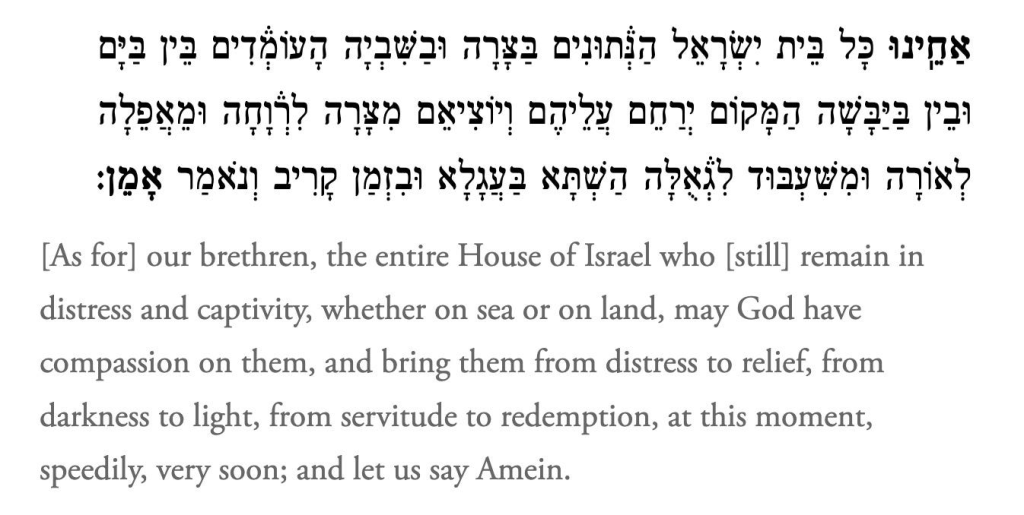
The other thing you can do is say the Acheinu prayer. It’s very simple and you can say it in English or Hebrew. It’s a reminder of the hostages. It does what Jon asked and helps us with our humanity.
The one thing we cannot do is forget the hostages. They are family. They are mishpacha. They were stolen away and must be returned. I think of the Bibas kids often. Kfir has now spent most of his life as a hostage. How, as a society, we tolerate that is unaccepatable. It was unacceptable to an 11 and 12 year old me in 1978-80 and it remains unacceptable to me as a 55-56 year old man today. I held President Carter in contempt back then and President Biden in contempt today. If whoever wins the election in November doesn’t take action, I will hold them in contempt as well. These are people. Human beings. They did nothing wrong and we have done very little right to get them home. We must Bring Them Home Now.

Discover more from keithdblog
Subscribe to get the latest posts sent to your email.
 keithdblog
Beautiful article by Mr Polin. Thanks for sharing.
LikeLike
It was so powerful – we need to hear different voices and the media doesn’t promote them. His message really hit home.
LikeLike